International Research Journal of Engineering and Technology (IRJET) e-ISSN: 2395 -0056
Volume: 04 Issue: 05 | May -2017 www.irjet.net p-ISSN: 2395-0072
© 2017, IRJET | Impact Factor value: 5.181 | ISO 9001:2008 Certified Journal | Page 864
Distribution and Load Sharing of Transformer Automatically by Using
Microcontroller
Laknapuram Sai Vani
Assistant Professor, Dept. Of EEE,LIMAT,Andhra Pradesh,India
---------------------------------------------------------------------***---------------------------------------------------------------------
Abstract - The transformer is a static device, which converts
power from one level to another level. The main aim is to
protect the transformer under overload condition by load
sharing. Due to overload on transformer, the efficiency drops
and windings get overheated and may get burnt. Thus by
sharing load on transformer, the transformer is protected.
This will be done by connecting another transformer in
parallel through a micro-controller. The micro controller
compares the load on the first transformer with a reference
value. When the load exceeds the reference value, the second
transformer will share the extra load. Therefore, the two
transformer work efficiently and damage is prevented. Main
modules used here are sensing unit, control unit and micro-
control. A GSM modem is also used to inform the control
station about switching. The advantages of the project are
transformer protection, uninterrupted power supply, and
short circuit protection.
Key Words: Transformer, Sensing unit, control unit,
Micro controller, GSM Module
1. INTRODUCTION
Transformer is the vital component in the electric power
transmission and distribution system. The problems of
overloading, voltage variation and heating effects are very
common. It takes a lot of time for its repair and also involves
lot of expenditure. This work is all about protecting the
transformer under overload condition. Due to overload the
efficiency drops and the secondary winding gets overheated
or it may be burnt. So, by reducing the extra load, the
transformer can be protected. This can be donebyoperating
another transformer in parallel with main transformer
through microcontroller and change over relay. The
microcontroller compares the load on the first transformer
with a reference value. When the load exceeds the reference
value, the slave transformer will automaticallybeconnected
in parallel with first transformer and share the extra load.
Therefore, a number of transformers work efficiently under
overload condition and the damage can be prevented.
In this work, the slave transformers share the load ofmaster
transformer in the case of over load and over temperature
conditions. A sensor circuit containing microcontroller,
current transformer etc. is designed to log the data from
master transformer and if it is found to be in overload
condition, immediately the slave transformer will be
connected in the parallel to the master transformer and the
load is shared. The microcontroller monitors the load
current and temperature of transformer and displays the
values on LCD .Whenever loads are added to the secondary
side of the transformer, the current at the secondary side
rise. As the load current exceeds the rated current rating of
the transformer, the temperature of the secondary winding
rises, therefore the microcontroller will send a trip signal to
the relay, thereby turning on the slavetransformers.Initially
when we switched ON the load that load will be shared by
the first transformer. Once load has been increased on first
transformer above its rated capacity then the stand by
transformer (second) will share the load automatically.
Here three modules are used to control the loadcurrent.The
first module is the sensing unit, which is used to sense the
current of the load; the second module is control unit in
which relay plays the main role, and its function is to change
the position with respect to the control signal and last
module is microcontroller. It will read the digital signal and
perform calculations and finally gives control signal to the
relay. For monitoring the load current continuously,current
transformer is used and the output of current transformeris
fed to micro-controller through A-D converter. Similarly for
monitoring transformer body temperature operational
amplifiers are used with suitable temperature transducer.
The concept of automatic load sharing of transformer or
overload protection of transformerisdone byvariousmeans
like by using microprocessors, by usingGSMtechnology,and
by using relays. Among them, a relay is usedandcomparator
IC‟s for automatic load sharing between three transformers.
The number of transformers to be operated in parallel can
also be increased according to demand of a particular area.
While operating the number of transformers in parallel we
have to follow some conditions like same voltageratio,same
X/R ratio, same KVA ratings, and same polarity etc. i.e.
identical transformers are operating in parallel.
International Research Journal of Engineering and Technology (IRJET) e-ISSN: 2395 -0056
Volume: 04 Issue: 05 | May -2017 www.irjet.net p-ISSN: 2395-0072
© 2017, IRJET | Impact Factor value: 5.181 | ISO 9001:2008 Certified Journal | Page 865
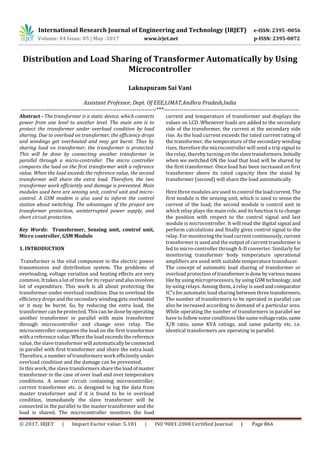
1.1 Block Diagram
Fig: Simplified Block diagram
In this paper three identical transformers are using which
are connected in parallel through change over relay.
Transformer-TF1 is a main transformer, which is called
master transformer and transformer-TF2 is an auxiliary
transformers which is called as slave transformers. Each
transformer has its own load handling capacity. In case of a
normal operation the master transformer shares the load
but as the load is beyond the rated capacity of main
transformer the slave transformer is connected in parallel
automatically and shares the load.
Load switching network is provided to ON/OFF the load
on the transformers which isconnectedtoloadbank.Shuntis
used to distribute the current to all the sections of the circuit.
Comparator is having two inputs one is from shunt and the
second is from the reference voltage.
Reference voltage is set by the user. Comparator
(microcontroller)comparesthereferencevoltageandsystem
voltage continuously and the output signal is given to the
relay driver circuit. Relay driver circuit consists of NPN
transistor to drive the relay. Relay driver gives the signal to
the change over relay in case of overload conditions. Change
over relay closes its contact when load on the master
transformer is more than it’s rated capacity and the
transformer-T2 i.e. slave transformer is automatically
connected in parallel with the main transformer and if the
load is increased to such a amount that can’t be handled with
the two transformers then the third transformer T3 is
automatically connected in parallel with T1 & T2 and shares
the load. Due to which the transformer-T1 is not overloaded
and the problem like overheating, burning of winding of
transformer and un-interruption of supply is gets eliminated
by this arrangement. The visual indicator contains the LED‟s
which shows the ON/OFF status of the all transformers.
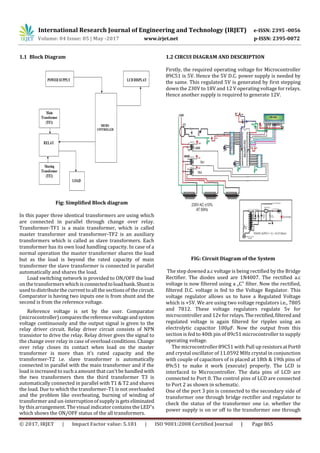
1.2 CIRCUI DIAGRAM AND DESCRIPTION
Firstly, the required operating voltage for Microcontroller
89C51 is 5V. Hence the 5V D.C. power supply is needed by
the same. This regulated 5V is generated by first stepping
down the 230V to 18V and 12 V operating voltage for relays.
Hence another supply is required to generate 12V.
FIG: Circuit Diagram of the System
The step downed a.c voltage is being rectified by the Bridge
Rectifier. The diodes used are 1N4007. The rectified a.c
voltage is now filtered using a „C‟ filter. Now the rectified,
filtered D.C. voltage is fed to the Voltage Regulator. This
voltage regulator allows us to have a Regulated Voltage
which is +5V. We are using two voltage regulators i.e., 7805
and 7812. These voltage regulators regulate 5v for
microcontroller and 12v for relays.Therectified,filtered and
regulated voltage is again filtered for ripples using an
electrolytic capacitor 100μF. Now the output from this
section is fed to 40th pin of 89c51 microcontroller to supply
operating voltage.
The microcontroller 89C51 with Pull up resistorsatPort0
and crystal oscillator of 11.0592 MHz crystal in conjunction
with couple of capacitors of is placed at 18th & 19th pins of
89c51 to make it work (execute) properly. The LCD is
interfaced to Microcontroller. The data pins of LCD are
connected to Port 0. The control pins of LCD are connected
to Port 2 as shown in schematic.
One of the port 3 pin is connected to the secondary side of
transformer one through bridge rectifier and regulator to
check the status of the transformer one i.e. whether the
power supply is on or off to the transformer one through
International Research Journal of Engineering and Technology (IRJET) e-ISSN: 2395 -0056
Volume: 04 Issue: 05 | May -2017 www.irjet.net p-ISSN: 2395-0072
© 2017, IRJET | Impact Factor value: 5.181 | ISO 9001:2008 Certified Journal | Page 866
relay. Relay is used to on & off the transformer occurred it is
connected to P2.0 microcontroller. The data pins of ADC are
connected to the port 1 of microcontroller. Whatever the
data in ADC from C.T (current transformer) will be
converted from analog to digital and fed it to the
microcontroller. Reference value is setinthepresetwhichis
continuously compared with feedback signal in the
controller. Three relays are connected to controller through
relay driver. The phase of transformers T1, T2 & T3 are
connected to the relay contactor while the neutral is given
separately from the single phase supply.
100W bulbs are used as loads which is connected to the
secondary side of main transformer T1. Another n-p-n
transistor of controller is used for providing the feedback
signal and to make the system automatic.
Initially, when we switched ON the supply then main
transformer T1 is ON and shares the load up to it‟s rated
capacity. Now, we graduallyvarytheloadonthetransformer
T1 by turning on the bulbs. This variation of the loadisgiven
to the microcontroller continuously by feedback circuit. As
the load is increased to such an extent that can‟t be handled
by transformer T1 then this value is compared with the
reference or set value by the controller IC and signal isfed to
the relay driver IC ULN2803 for closing of relay contacts. In
normal condition the relay contacts are open that‟s why the
transformer T2 & T3 are in OFF condition or in other ways
they are not part of sharing the load. As the relay-2 closes its
contacts the auxiliarytransformerT2isconnectedinparallel
with transformer T1 and shares it‟s load automatically.
When the load is increased and increased to such an extent
that can‟t be handled by two transformers, then again
comparator IC gives the signal to the relay driver IC for
closing the contacts of relay-3. As the relay-3 closes its
contacts the transformer T3 is connected automatically in
parallel with transformer T1& T2 and shares the increased
load on the system. In this way the automatic load sharing
between number of transformers is done and the protection
of transformers against overload is achieved.
2. SPECIFICATON OF COMPONENTS USED
S.No. Component Used Rating
01. Transformer 230/12 V
02. Capacitor 2200uf, 1000uf,
220uf
03. 7805 Regulator IC & CT -
04. Relay Driver IC- ULN2003 Up to 30volt
05. Relay (SPDT) 30V DC, 1Amp
06. Resistors 56KΩ, 1.6KΩ, 18K Ω
07. Diode (P-N junction) IN4004
08. Bulbs 100W
09. ADC 0508 G
10. 16 x 2 Character LCD 5V
11. AT89S52 microcontroller 5V
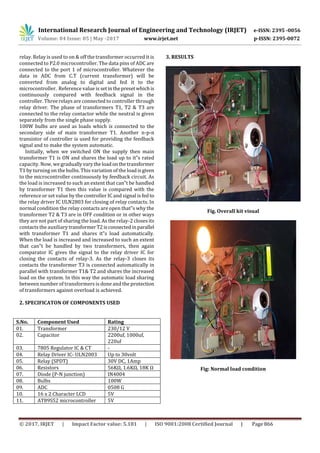
3. RESULTS
Fig. Overall kit visual
Fig: Normal load condition
International Research Journal of Engineering and Technology (IRJET) e-ISSN: 2395 -0056
Volume: 04 Issue: 05 | May -2017 www.irjet.net p-ISSN: 2395-0072
© 2017, IRJET | Impact Factor value: 5.181 | ISO 9001:2008 Certified Journal | Page 867
Fig: Heavy load condition
4. OBSERVATION AND CONCLUSION
In this paper, observed that if load on one transformer is
increases then the relay will sense the change in current &
microcontroller operates & slave transformers comes
automatically in operation to share the load.
The work on “Automatic load sharing of transformers” is
successfully designed, tested and a demo unit is fabricated
for operating three transformers in parallel tosharetheload
automatically with the help of change over relay and relay
driver circuit and also to protect the transformers from
overloading and thus providing an uninterrupted power
supply to the customers.
ADVANTAGES:
1) The load is shared by transformers is automatically.
2) No manual errors are taking place.
3) It prevents the main transformer from damage due to the
problems like overload and overheats.
4) Un-interrupted power supply to the consumers is
supplied.
5. FUTURE SCOPE
The paper describes about how to use power supply
intelligently under peak loads. It automaticallyconnectsand
disconnects the transformer thus protecting transformer
from overload. Sensing unit, i.e. Current transformer plays
an important role by sensing the current through the load
and sending feedback signal to the microcontroller.PIC
Microcontroller is so programmed that as soon as the load
exceeds a particular current limit it will soon generate a
control signal that would be amplified by the driver unitand
finally control signal is fed to the relay. The switching
process occurs in theRelaywhichautomaticallyconnectsthe
transformer in parallel in accordance to the load sensed by
the CT. The future scope of our project is particularly in
Substation. In substations particularlyduringthepeak hours
there is a need for the operation of additional transformer to
supply the additional load requirement. Our project
automatically connects the transformer under critical loads.
Thus there is no need to operate both transformers under
normal loads, particularlyduringoffpeak hours.Thus power
is shared intelligently with the transformers in parallel.
REFERENCES
[1] Hassan Abniki, H.Afsharirad, A.Mohseni, F. Khoshkhati,
Has-san Monsef, PouryaSahmsi „Effective On-line
Parameters for Transformer Monitoring and Protection‟,on
Northern American Power Symposium (NAPS), pp 1-5,
September 2010.
[2] Tong Xiaoyang, Wu Guanging, Zhang Guangehun, Tan
Yong-dong „A Transformer OnlineMonitoringandDiagnosis
Em-bedded System Based on TCP/IP and Pub/Sub New
Technology‟, on Properties and Applications of Dielectric
Materials, vol 1, pp 467-470, June2003.
[3] SuxiangQian, Hongsheng Hu, „Design of Temperature
Moni-toring System for Oil-Immersed Power Transformers
based on MCU‟, on International Conference on Electronic
Measurements and Instrumentation (ICEMI), May 2009.
[4] S.M Bashi, N. Mariun and A.rafa (2007). „Power
Transformer protection using microcontroller based relay‟,
Journal of applied science, 7(12), pp.1602-1607.
[5] V.Thiyagarajan & T.G. Palanivel, (J2010) „An efficient
monitoring of substations using microcontroller based
monitoring system‟ International Journal of Research and
Reviews in Applied Sciences, 4 (1), pp.63-68.

Distribution and Load Sharing of Transformer Automatically by using Microcontroller

  • 1.
    International Research Journalof Engineering and Technology (IRJET) e-ISSN: 2395 -0056 Volume: 04 Issue: 05 | May -2017 www.irjet.net p-ISSN: 2395-0072 © 2017, IRJET | Impact Factor value: 5.181 | ISO 9001:2008 Certified Journal | Page 864 Distribution and Load Sharing of Transformer Automatically by Using Microcontroller Laknapuram Sai Vani Assistant Professor, Dept. Of EEE,LIMAT,Andhra Pradesh,India ---------------------------------------------------------------------***--------------------------------------------------------------------- Abstract - The transformer is a static device, which converts power from one level to another level. The main aim is to protect the transformer under overload condition by load sharing. Due to overload on transformer, the efficiency drops and windings get overheated and may get burnt. Thus by sharing load on transformer, the transformer is protected. This will be done by connecting another transformer in parallel through a micro-controller. The micro controller compares the load on the first transformer with a reference value. When the load exceeds the reference value, the second transformer will share the extra load. Therefore, the two transformer work efficiently and damage is prevented. Main modules used here are sensing unit, control unit and micro- control. A GSM modem is also used to inform the control station about switching. The advantages of the project are transformer protection, uninterrupted power supply, and short circuit protection. Key Words: Transformer, Sensing unit, control unit, Micro controller, GSM Module 1. INTRODUCTION Transformer is the vital component in the electric power transmission and distribution system. The problems of overloading, voltage variation and heating effects are very common. It takes a lot of time for its repair and also involves lot of expenditure. This work is all about protecting the transformer under overload condition. Due to overload the efficiency drops and the secondary winding gets overheated or it may be burnt. So, by reducing the extra load, the transformer can be protected. This can be donebyoperating another transformer in parallel with main transformer through microcontroller and change over relay. The microcontroller compares the load on the first transformer with a reference value. When the load exceeds the reference value, the slave transformer will automaticallybeconnected in parallel with first transformer and share the extra load. Therefore, a number of transformers work efficiently under overload condition and the damage can be prevented. In this work, the slave transformers share the load ofmaster transformer in the case of over load and over temperature conditions. A sensor circuit containing microcontroller, current transformer etc. is designed to log the data from master transformer and if it is found to be in overload condition, immediately the slave transformer will be connected in the parallel to the master transformer and the load is shared. The microcontroller monitors the load current and temperature of transformer and displays the values on LCD .Whenever loads are added to the secondary side of the transformer, the current at the secondary side rise. As the load current exceeds the rated current rating of the transformer, the temperature of the secondary winding rises, therefore the microcontroller will send a trip signal to the relay, thereby turning on the slavetransformers.Initially when we switched ON the load that load will be shared by the first transformer. Once load has been increased on first transformer above its rated capacity then the stand by transformer (second) will share the load automatically. Here three modules are used to control the loadcurrent.The first module is the sensing unit, which is used to sense the current of the load; the second module is control unit in which relay plays the main role, and its function is to change the position with respect to the control signal and last module is microcontroller. It will read the digital signal and perform calculations and finally gives control signal to the relay. For monitoring the load current continuously,current transformer is used and the output of current transformeris fed to micro-controller through A-D converter. Similarly for monitoring transformer body temperature operational amplifiers are used with suitable temperature transducer. The concept of automatic load sharing of transformer or overload protection of transformerisdone byvariousmeans like by using microprocessors, by usingGSMtechnology,and by using relays. Among them, a relay is usedandcomparator IC‟s for automatic load sharing between three transformers. The number of transformers to be operated in parallel can also be increased according to demand of a particular area. While operating the number of transformers in parallel we have to follow some conditions like same voltageratio,same X/R ratio, same KVA ratings, and same polarity etc. i.e. identical transformers are operating in parallel.
  • 2.
    International Research Journalof Engineering and Technology (IRJET) e-ISSN: 2395 -0056 Volume: 04 Issue: 05 | May -2017 www.irjet.net p-ISSN: 2395-0072 © 2017, IRJET | Impact Factor value: 5.181 | ISO 9001:2008 Certified Journal | Page 865 1.1 Block Diagram Fig: Simplified Block diagram In this paper three identical transformers are using which are connected in parallel through change over relay. Transformer-TF1 is a main transformer, which is called master transformer and transformer-TF2 is an auxiliary transformers which is called as slave transformers. Each transformer has its own load handling capacity. In case of a normal operation the master transformer shares the load but as the load is beyond the rated capacity of main transformer the slave transformer is connected in parallel automatically and shares the load. Load switching network is provided to ON/OFF the load on the transformers which isconnectedtoloadbank.Shuntis used to distribute the current to all the sections of the circuit. Comparator is having two inputs one is from shunt and the second is from the reference voltage. Reference voltage is set by the user. Comparator (microcontroller)comparesthereferencevoltageandsystem voltage continuously and the output signal is given to the relay driver circuit. Relay driver circuit consists of NPN transistor to drive the relay. Relay driver gives the signal to the change over relay in case of overload conditions. Change over relay closes its contact when load on the master transformer is more than it’s rated capacity and the transformer-T2 i.e. slave transformer is automatically connected in parallel with the main transformer and if the load is increased to such a amount that can’t be handled with the two transformers then the third transformer T3 is automatically connected in parallel with T1 & T2 and shares the load. Due to which the transformer-T1 is not overloaded and the problem like overheating, burning of winding of transformer and un-interruption of supply is gets eliminated by this arrangement. The visual indicator contains the LED‟s which shows the ON/OFF status of the all transformers. 1.2 CIRCUI DIAGRAM AND DESCRIPTION Firstly, the required operating voltage for Microcontroller 89C51 is 5V. Hence the 5V D.C. power supply is needed by the same. This regulated 5V is generated by first stepping down the 230V to 18V and 12 V operating voltage for relays. Hence another supply is required to generate 12V. FIG: Circuit Diagram of the System The step downed a.c voltage is being rectified by the Bridge Rectifier. The diodes used are 1N4007. The rectified a.c voltage is now filtered using a „C‟ filter. Now the rectified, filtered D.C. voltage is fed to the Voltage Regulator. This voltage regulator allows us to have a Regulated Voltage which is +5V. We are using two voltage regulators i.e., 7805 and 7812. These voltage regulators regulate 5v for microcontroller and 12v for relays.Therectified,filtered and regulated voltage is again filtered for ripples using an electrolytic capacitor 100μF. Now the output from this section is fed to 40th pin of 89c51 microcontroller to supply operating voltage. The microcontroller 89C51 with Pull up resistorsatPort0 and crystal oscillator of 11.0592 MHz crystal in conjunction with couple of capacitors of is placed at 18th & 19th pins of 89c51 to make it work (execute) properly. The LCD is interfaced to Microcontroller. The data pins of LCD are connected to Port 0. The control pins of LCD are connected to Port 2 as shown in schematic. One of the port 3 pin is connected to the secondary side of transformer one through bridge rectifier and regulator to check the status of the transformer one i.e. whether the power supply is on or off to the transformer one through
  • 3.
    International Research Journalof Engineering and Technology (IRJET) e-ISSN: 2395 -0056 Volume: 04 Issue: 05 | May -2017 www.irjet.net p-ISSN: 2395-0072 © 2017, IRJET | Impact Factor value: 5.181 | ISO 9001:2008 Certified Journal | Page 866 relay. Relay is used to on & off the transformer occurred it is connected to P2.0 microcontroller. The data pins of ADC are connected to the port 1 of microcontroller. Whatever the data in ADC from C.T (current transformer) will be converted from analog to digital and fed it to the microcontroller. Reference value is setinthepresetwhichis continuously compared with feedback signal in the controller. Three relays are connected to controller through relay driver. The phase of transformers T1, T2 & T3 are connected to the relay contactor while the neutral is given separately from the single phase supply. 100W bulbs are used as loads which is connected to the secondary side of main transformer T1. Another n-p-n transistor of controller is used for providing the feedback signal and to make the system automatic. Initially, when we switched ON the supply then main transformer T1 is ON and shares the load up to it‟s rated capacity. Now, we graduallyvarytheloadonthetransformer T1 by turning on the bulbs. This variation of the loadisgiven to the microcontroller continuously by feedback circuit. As the load is increased to such an extent that can‟t be handled by transformer T1 then this value is compared with the reference or set value by the controller IC and signal isfed to the relay driver IC ULN2803 for closing of relay contacts. In normal condition the relay contacts are open that‟s why the transformer T2 & T3 are in OFF condition or in other ways they are not part of sharing the load. As the relay-2 closes its contacts the auxiliarytransformerT2isconnectedinparallel with transformer T1 and shares it‟s load automatically. When the load is increased and increased to such an extent that can‟t be handled by two transformers, then again comparator IC gives the signal to the relay driver IC for closing the contacts of relay-3. As the relay-3 closes its contacts the transformer T3 is connected automatically in parallel with transformer T1& T2 and shares the increased load on the system. In this way the automatic load sharing between number of transformers is done and the protection of transformers against overload is achieved. 2. SPECIFICATON OF COMPONENTS USED S.No. Component Used Rating 01. Transformer 230/12 V 02. Capacitor 2200uf, 1000uf, 220uf 03. 7805 Regulator IC & CT - 04. Relay Driver IC- ULN2003 Up to 30volt 05. Relay (SPDT) 30V DC, 1Amp 06. Resistors 56KΩ, 1.6KΩ, 18K Ω 07. Diode (P-N junction) IN4004 08. Bulbs 100W 09. ADC 0508 G 10. 16 x 2 Character LCD 5V 11. AT89S52 microcontroller 5V 3. RESULTS Fig. Overall kit visual Fig: Normal load condition
  • 4.
    International Research Journalof Engineering and Technology (IRJET) e-ISSN: 2395 -0056 Volume: 04 Issue: 05 | May -2017 www.irjet.net p-ISSN: 2395-0072 © 2017, IRJET | Impact Factor value: 5.181 | ISO 9001:2008 Certified Journal | Page 867 Fig: Heavy load condition 4. OBSERVATION AND CONCLUSION In this paper, observed that if load on one transformer is increases then the relay will sense the change in current & microcontroller operates & slave transformers comes automatically in operation to share the load. The work on “Automatic load sharing of transformers” is successfully designed, tested and a demo unit is fabricated for operating three transformers in parallel tosharetheload automatically with the help of change over relay and relay driver circuit and also to protect the transformers from overloading and thus providing an uninterrupted power supply to the customers. ADVANTAGES: 1) The load is shared by transformers is automatically. 2) No manual errors are taking place. 3) It prevents the main transformer from damage due to the problems like overload and overheats. 4) Un-interrupted power supply to the consumers is supplied. 5. FUTURE SCOPE The paper describes about how to use power supply intelligently under peak loads. It automaticallyconnectsand disconnects the transformer thus protecting transformer from overload. Sensing unit, i.e. Current transformer plays an important role by sensing the current through the load and sending feedback signal to the microcontroller.PIC Microcontroller is so programmed that as soon as the load exceeds a particular current limit it will soon generate a control signal that would be amplified by the driver unitand finally control signal is fed to the relay. The switching process occurs in theRelaywhichautomaticallyconnectsthe transformer in parallel in accordance to the load sensed by the CT. The future scope of our project is particularly in Substation. In substations particularlyduringthepeak hours there is a need for the operation of additional transformer to supply the additional load requirement. Our project automatically connects the transformer under critical loads. Thus there is no need to operate both transformers under normal loads, particularlyduringoffpeak hours.Thus power is shared intelligently with the transformers in parallel. REFERENCES [1] Hassan Abniki, H.Afsharirad, A.Mohseni, F. Khoshkhati, Has-san Monsef, PouryaSahmsi „Effective On-line Parameters for Transformer Monitoring and Protection‟,on Northern American Power Symposium (NAPS), pp 1-5, September 2010. [2] Tong Xiaoyang, Wu Guanging, Zhang Guangehun, Tan Yong-dong „A Transformer OnlineMonitoringandDiagnosis Em-bedded System Based on TCP/IP and Pub/Sub New Technology‟, on Properties and Applications of Dielectric Materials, vol 1, pp 467-470, June2003. [3] SuxiangQian, Hongsheng Hu, „Design of Temperature Moni-toring System for Oil-Immersed Power Transformers based on MCU‟, on International Conference on Electronic Measurements and Instrumentation (ICEMI), May 2009. [4] S.M Bashi, N. Mariun and A.rafa (2007). „Power Transformer protection using microcontroller based relay‟, Journal of applied science, 7(12), pp.1602-1607. [5] V.Thiyagarajan & T.G. Palanivel, (J2010) „An efficient monitoring of substations using microcontroller based monitoring system‟ International Journal of Research and Reviews in Applied Sciences, 4 (1), pp.63-68.