CLEANING AND 
SANITIZING
Cleaning 
• is the process of removing food and other 
types of soil from a surface, such as a dish, 
glass, or cutting board. 
• is done with a cleaning agent that removes 
food, soil, or other substances.
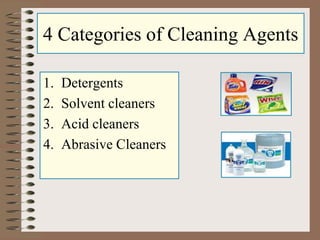
4 Categories of Cleaning Agents 
1. Detergents 
2. Solvent cleaners 
3. Acid cleaners 
4. Abrasive Cleaners
Detergents 
• Use detergents to routinely wash 
tableware, surfaces, and equipment. 
• Detergents can penetrate soil quickly and 
soften it. 
• Examples include dishwashing detergent 
and automatic dishwasher detergents.
Solvent cleaners 
• Use periodically on surfaces where grease 
has burned on. 
• Solvent cleaners are often called 
degreasers.
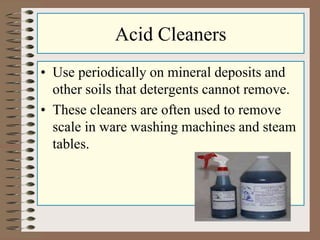
Acid Cleaners 
• Use periodically on mineral deposits and 
other soils that detergents cannot remove. 
• These cleaners are often used to remove 
scale in ware washing machines and steam 
tables.
Abrasive Cleaners 
• Use these cleaners to remove heavy 
accumulations of soil that are difficult to 
remove with detergents. Some abrasive 
cleaners also disinfect. Clean food-contact 
surfaces that are used to prepare potentially 
hazardous foods as needed throughout the 
day but no less than every four hours. If 
they are not properly cleaned, food that 
comes into contact with these surfaces 
could become contaminated.
Sanitizing 
• Is done using heat, radiation, or chemicals. Heat 
and chemicals are commonly used as a method 
for sanitizing in a restaurant; radiation rarely is. 
The item to be sanitized must first be washed 
properly before it can be properly sanitized. 
Some chemical sanitizers, such as chlorine and 
iodine, react with food and soil and so will be 
less effective on a surface that has not been 
properly cleaned.
Sanitizing Methods 
• Heat 
• Chemicals
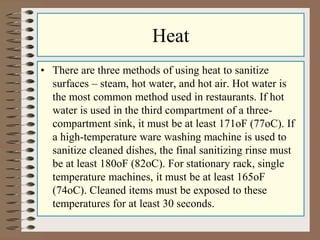
Heat 
• There are three methods of using heat to sanitize 
surfaces – steam, hot water, and hot air. Hot water is 
the most common method used in restaurants. If hot 
water is used in the third compartment of a three-compartment 
sink, it must be at least 171oF (77oC). If 
a high-temperature ware washing machine is used to 
sanitize cleaned dishes, the final sanitizing rinse must 
be at least 180oF (82oC). For stationary rack, single 
temperature machines, it must be at least 165oF 
(74oC). Cleaned items must be exposed to these 
temperatures for at least 30 seconds.
Chemicals 
• Chemicals that are approved sanitizers are 
chlorine, iodine, and quaternary 
ammonium. Different factors influence the 
effectiveness of chemical sanitizers. 
• The three factors that must be considered 
are:
Concentration 
• The presence of too little sanitizer will 
result in an inadequate reduction of 
harmful microorganisms. Too much can be 
toxic.
Temperature 
• Generally chemical sanitizers work best in 
water that is between 55oF(13oC) and 
120oF (49oC).
Contact time 
• In order for the sanitizer to kill harmful 
microorganisms, the cleaned item must 
be in contact with the sanitizer (either 
heat or approved chemical) for the 
recommended length of time.
Sanitizer Testing 
• Every restaurant must have the appropriate 
testing kit to measure chemical sanitizer 
concentrations. To accurately test the strength of 
a sanitizing solution, one must first determine 
which chemical is being used --- chlorine, iodine, 
or quaternary ammonium. Test kits are not 
interchangeable so check with your chemical 
supplier to be certain that you are using the 
correct kit. The appropriate test kit must then be 
used throughout the day to measure chemical 
sanitizer concentrations.
Advantages and Disadvantages of 
Different Chemical Sanitizers
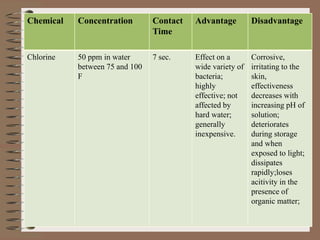
Chemical Concentration Contact 
Time 
Advantage Disadvantage 
Chlorine 50 ppm in water 
between 75 and 100 
F 
7 sec. Effect on a 
wide variety of 
bacteria; 
highly 
effective; not 
affected by 
hard water; 
generally 
inexpensive. 
Corrosive, 
irritating to the 
skin, 
effectiveness 
decreases with 
increasing pH of 
solution; 
deteriorates 
during storage 
and when 
exposed to light; 
dissipates 
rapidly;loses 
acitivity in the 
presence of 
organic matter;
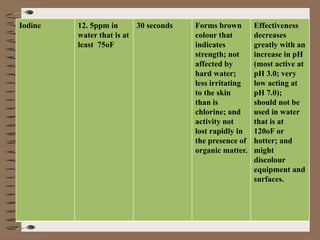
Iodine 12. 5ppm in 
water that is at 
least 75oF 
30 seconds Forms brown 
colour that 
indicates 
strength; not 
affected by 
hard water; 
less irritating 
to the skin 
than is 
chlorine; and 
activity not 
lost rapidly in 
the presence of 
organic matter. 
Effectiveness 
decreases 
greatly with an 
increase in pH 
(most active at 
pH 3.0; very 
low acting at 
pH 7.0); 
should not be 
used in water 
that is at 
120oF or 
hotter; and 
might 
discolour 
equipment and 
surfaces.
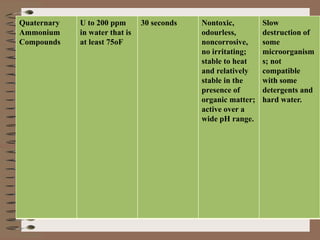
Quaternary 
Ammonium 
Compounds 
U to 200 ppm 
in water that is 
at least 75oF 
30 seconds Nontoxic, 
odourless, 
noncorrosive, 
no irritating; 
stable to heat 
and relatively 
stable in the 
presence of 
organic matter; 
active over a 
wide pH range. 
Slow 
destruction of 
some 
microorganism 
s; not 
compatible 
with some 
detergents and 
hard water.
Cleaning and sanitizing 
utensils 
• There are three steps needed to effectively 
clean and sanitize utensils: 
Washing 
Sanitizing 
Drying
Utensils such as cutting boards, 
bowls and knives need to be 
thoroughly washed in warm soapy 
water. After washing, the utensils 
should look clean and there should 
be no food or anything else visible 
on them. Effective cleaning will 
remove most of the dangerous 
bacteria present. Sanitising will then 
kill any that might remain.
A dishwasher is very effective at sanitizing if it has a 
hot wash and drying cycle. If you do not have a 
dishwasher, you will need to sanitise in a sink using a 
chemical sanitiser or very hot water. If using a 
chemical sanitizer such as a sodium hypochlorite– or 
quaternary ammonium–based solution, ensure that it 
can be safely used for sanitizing eating, drinking and 
cooking utensils. Follow the instructions on the 
container carefully, as different sanitizers work in 
different ways. If you are using very hot water, take 
extra care to avoid being scalded. All utensils must 
then be thoroughly dried before they are re-used. Air-drying 
is best but tea towels can be used if they are 
clean.
If you are washing up at an event 
being held outdoors, make sure you 
have access to plenty of hot water. If 
hot water is not available, disposable 
eating and drinking utensils should 
be used and enough cooking utensils 
provided to last the duration of the 
event so that washing up is not 
necessary.
Cleaning kitchen premises 
• Cleaning your kitchen regularly is important 
not only to keep it looking its best, but also to 
remove all of the germs and bacteria that 
accumulate regularly in the kitchen area. 
There are several surfaces around the kitchen, 
and by making a homemade versatile cleaning 
solution, you can easily clean most of the 
surfaces with one basic mixture of household 
ingredients that are probably already in your 
kitchen cupboards.
Things You'll Need 
• Broom 
• Cleaning rags 
• Bucket
Instructions 
1. Collect loose dust by sweeping the kitchen 
floor daily with a broom or static sweeper 
and wiping down counter tops, tables and 
other surfaces with a cleaning rag. To 
remove sticky build up, wipe with a damp 
cleaning rag and wipe a damp mop over 
your kitchen floor.
2. Mix 1 gallon warm water in a bucket 
with 1/2 cup white vinegar and 1 tsp. dish 
soap. Dip your mop into the bucket, wring 
the mop out and wipe across your kitchen 
floors. The diluted vinegar solution makes it 
safe for any kitchen floor surface while still 
strong enough to clean and disinfect. The 
dish soap assists in cutting through any 
food residue that may be on the kitchen 
floor. Let your floor air dry after cleaning.
3. Make an all-purpose cleaner in a spray 
bottle. Combine 3 cups warm water with 
½ cup white vinegar and 1 tsp. dish soap. 
4. Spray this solution onto kitchen 
surfaces and wipe off with a damp 
cleaning rag. This works well on any 
type of kitchen surface including 
cabinetry, sinks, tables, counters and any 
other area that requires cleaning.
5. Fill a few bowls with about 
1/2 cup each of baking soda. 
Place these around your kitchen 
to absorb odor and keep the 
kitchen smelling fresh. Open 
windows to let fresh air 
circulate, which is especially 
useful when cooking strong-smelling 
foods.
Cleaning and sanitizing

Cleaning and sanitizing

  • 1.
  • 2.
    Cleaning • isthe process of removing food and other types of soil from a surface, such as a dish, glass, or cutting board. • is done with a cleaning agent that removes food, soil, or other substances.
  • 3.
    4 Categories ofCleaning Agents 1. Detergents 2. Solvent cleaners 3. Acid cleaners 4. Abrasive Cleaners
  • 4.
    Detergents • Usedetergents to routinely wash tableware, surfaces, and equipment. • Detergents can penetrate soil quickly and soften it. • Examples include dishwashing detergent and automatic dishwasher detergents.
  • 5.
    Solvent cleaners •Use periodically on surfaces where grease has burned on. • Solvent cleaners are often called degreasers.
  • 6.
    Acid Cleaners •Use periodically on mineral deposits and other soils that detergents cannot remove. • These cleaners are often used to remove scale in ware washing machines and steam tables.
  • 7.
    Abrasive Cleaners •Use these cleaners to remove heavy accumulations of soil that are difficult to remove with detergents. Some abrasive cleaners also disinfect. Clean food-contact surfaces that are used to prepare potentially hazardous foods as needed throughout the day but no less than every four hours. If they are not properly cleaned, food that comes into contact with these surfaces could become contaminated.
  • 8.
    Sanitizing • Isdone using heat, radiation, or chemicals. Heat and chemicals are commonly used as a method for sanitizing in a restaurant; radiation rarely is. The item to be sanitized must first be washed properly before it can be properly sanitized. Some chemical sanitizers, such as chlorine and iodine, react with food and soil and so will be less effective on a surface that has not been properly cleaned.
  • 9.
    Sanitizing Methods •Heat • Chemicals
  • 10.
    Heat • Thereare three methods of using heat to sanitize surfaces – steam, hot water, and hot air. Hot water is the most common method used in restaurants. If hot water is used in the third compartment of a three-compartment sink, it must be at least 171oF (77oC). If a high-temperature ware washing machine is used to sanitize cleaned dishes, the final sanitizing rinse must be at least 180oF (82oC). For stationary rack, single temperature machines, it must be at least 165oF (74oC). Cleaned items must be exposed to these temperatures for at least 30 seconds.
  • 11.
    Chemicals • Chemicalsthat are approved sanitizers are chlorine, iodine, and quaternary ammonium. Different factors influence the effectiveness of chemical sanitizers. • The three factors that must be considered are:
  • 12.
    Concentration • Thepresence of too little sanitizer will result in an inadequate reduction of harmful microorganisms. Too much can be toxic.
  • 13.
    Temperature • Generallychemical sanitizers work best in water that is between 55oF(13oC) and 120oF (49oC).
  • 14.
    Contact time •In order for the sanitizer to kill harmful microorganisms, the cleaned item must be in contact with the sanitizer (either heat or approved chemical) for the recommended length of time.
  • 15.
    Sanitizer Testing •Every restaurant must have the appropriate testing kit to measure chemical sanitizer concentrations. To accurately test the strength of a sanitizing solution, one must first determine which chemical is being used --- chlorine, iodine, or quaternary ammonium. Test kits are not interchangeable so check with your chemical supplier to be certain that you are using the correct kit. The appropriate test kit must then be used throughout the day to measure chemical sanitizer concentrations.
  • 16.
    Advantages and Disadvantagesof Different Chemical Sanitizers
  • 17.
    Chemical Concentration Contact Time Advantage Disadvantage Chlorine 50 ppm in water between 75 and 100 F 7 sec. Effect on a wide variety of bacteria; highly effective; not affected by hard water; generally inexpensive. Corrosive, irritating to the skin, effectiveness decreases with increasing pH of solution; deteriorates during storage and when exposed to light; dissipates rapidly;loses acitivity in the presence of organic matter;
  • 18.
    Iodine 12. 5ppmin water that is at least 75oF 30 seconds Forms brown colour that indicates strength; not affected by hard water; less irritating to the skin than is chlorine; and activity not lost rapidly in the presence of organic matter. Effectiveness decreases greatly with an increase in pH (most active at pH 3.0; very low acting at pH 7.0); should not be used in water that is at 120oF or hotter; and might discolour equipment and surfaces.
  • 19.
    Quaternary Ammonium Compounds U to 200 ppm in water that is at least 75oF 30 seconds Nontoxic, odourless, noncorrosive, no irritating; stable to heat and relatively stable in the presence of organic matter; active over a wide pH range. Slow destruction of some microorganism s; not compatible with some detergents and hard water.
  • 20.
    Cleaning and sanitizing utensils • There are three steps needed to effectively clean and sanitize utensils: Washing Sanitizing Drying
  • 21.
    Utensils such ascutting boards, bowls and knives need to be thoroughly washed in warm soapy water. After washing, the utensils should look clean and there should be no food or anything else visible on them. Effective cleaning will remove most of the dangerous bacteria present. Sanitising will then kill any that might remain.
  • 22.
    A dishwasher isvery effective at sanitizing if it has a hot wash and drying cycle. If you do not have a dishwasher, you will need to sanitise in a sink using a chemical sanitiser or very hot water. If using a chemical sanitizer such as a sodium hypochlorite– or quaternary ammonium–based solution, ensure that it can be safely used for sanitizing eating, drinking and cooking utensils. Follow the instructions on the container carefully, as different sanitizers work in different ways. If you are using very hot water, take extra care to avoid being scalded. All utensils must then be thoroughly dried before they are re-used. Air-drying is best but tea towels can be used if they are clean.
  • 23.
    If you arewashing up at an event being held outdoors, make sure you have access to plenty of hot water. If hot water is not available, disposable eating and drinking utensils should be used and enough cooking utensils provided to last the duration of the event so that washing up is not necessary.
  • 24.
    Cleaning kitchen premises • Cleaning your kitchen regularly is important not only to keep it looking its best, but also to remove all of the germs and bacteria that accumulate regularly in the kitchen area. There are several surfaces around the kitchen, and by making a homemade versatile cleaning solution, you can easily clean most of the surfaces with one basic mixture of household ingredients that are probably already in your kitchen cupboards.
  • 25.
    Things You'll Need • Broom • Cleaning rags • Bucket
  • 26.
    Instructions 1. Collectloose dust by sweeping the kitchen floor daily with a broom or static sweeper and wiping down counter tops, tables and other surfaces with a cleaning rag. To remove sticky build up, wipe with a damp cleaning rag and wipe a damp mop over your kitchen floor.
  • 27.
    2. Mix 1gallon warm water in a bucket with 1/2 cup white vinegar and 1 tsp. dish soap. Dip your mop into the bucket, wring the mop out and wipe across your kitchen floors. The diluted vinegar solution makes it safe for any kitchen floor surface while still strong enough to clean and disinfect. The dish soap assists in cutting through any food residue that may be on the kitchen floor. Let your floor air dry after cleaning.
  • 28.
    3. Make anall-purpose cleaner in a spray bottle. Combine 3 cups warm water with ½ cup white vinegar and 1 tsp. dish soap. 4. Spray this solution onto kitchen surfaces and wipe off with a damp cleaning rag. This works well on any type of kitchen surface including cabinetry, sinks, tables, counters and any other area that requires cleaning.
  • 29.
    5. Fill afew bowls with about 1/2 cup each of baking soda. Place these around your kitchen to absorb odor and keep the kitchen smelling fresh. Open windows to let fresh air circulate, which is especially useful when cooking strong-smelling foods.