Leadership and Organization
Behavior
Course Code: MGT-537
Class: MBA IV & BBA VIII
By: Dr. Hina Shahab
Assistant Professor
NUML, Management Sciences Dept.
1-1
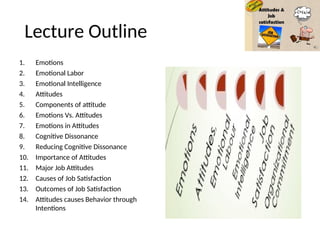
Lecture Outline
1. Emotions
2. Emotional Labor
3. Emotional Intelligence
4. Attitudes
5. Components of attitude
6. Emotions Vs. Attitudes
7. Emotions in Attitudes
8. Cognitive Dissonance
9. Reducing Cognitive Dissonance
10. Importance of Attitudes
11. Major Job Attitudes
12. Causes of Job Satisfaction
13. Outcomes of Job Satisfaction
14. Attitudes causes Behavior through
Intentions
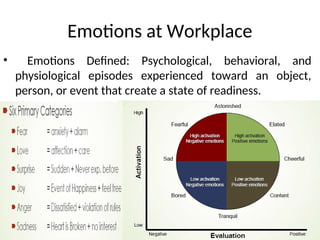
Emotions at Workplace
1-3
• Emotions Defined: Psychological, behavioral, and
physiological episodes experienced toward an object,
person, or event that create a state of readiness.
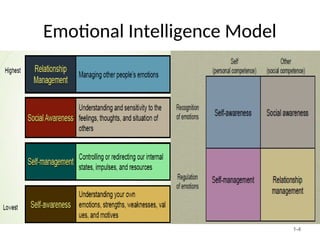
Emotional Intelligence Model
1-4
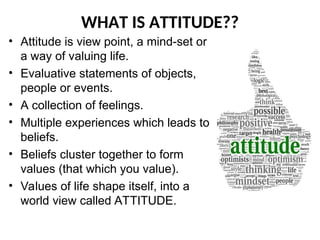
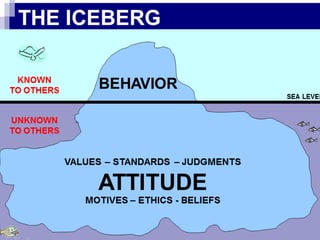
• Attitude is view point, a mind-set or
a way of valuing life.
• Evaluative statements of objects,
people or events.
• A collection of feelings.
• Multiple experiences which leads to
beliefs.
• Beliefs cluster together to form
values (that which you value).
• Values of life shape itself, into a
world view called ATTITUDE.
WHAT IS ATTITUDE??
WHAT IS ATTITUDE??
6
• Attitudes are evaluative statements—either favorable
or unfavorable—about objects, people, or events. They
reflect how we feel about something. When I say “I like
my job,” I am expressing my attitude about work.
Components of attitudes
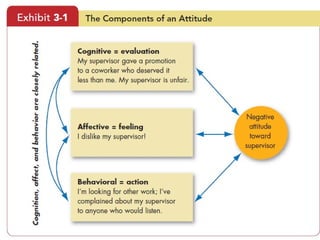
• cognitive component of an attitude— a description of or
belief in the way things are.
– “My pay is low”
• cognitive component sets the stage for the more critical
part of an attitude—its affective component . Affect is the
emotional or feeling segment of an attitude and is
reflected in the statement
– “I am angry over how little I’m paid.”
• Finally, affect can lead to behavioral outcomes. The
behavioral component of an attitude describes an
intention to behave in a certain way toward someone or
something—to continue the example,
– “I’m going to look for another job that pays better.”
© 2009 Prentice-Hall Inc.
All rights reserved.
3-8
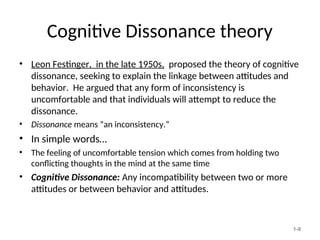
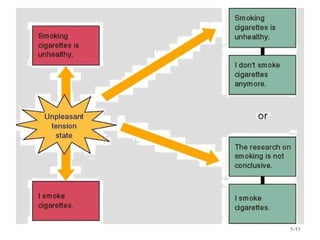
Cognitive Dissonance theory
1-9
• Leon Festinger, in the late 1950s, proposed the theory of cognitive
dissonance, seeking to explain the linkage between attitudes and
behavior. He argued that any form of inconsistency is
uncomfortable and that individuals will attempt to reduce the
dissonance.
• Dissonance means “an inconsistency.”
• In simple words…
• The feeling of uncomfortable tension which comes from holding two
conflicting thoughts in the mind at the same time
• Cognitive Dissonance: Any incompatibility between two or more
attitudes or between behavior and attitudes.
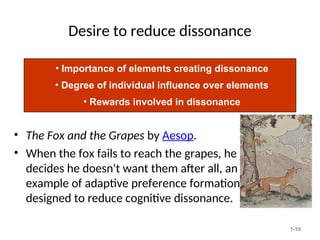
Desire to reduce dissonance
• The Fox and the Grapes by Aesop.
• When the fox fails to reach the grapes, he
decides he doesn't want them after all, an
example of adaptive preference formation
designed to reduce cognitive dissonance.
1-10
• Importance of elements creating dissonance
• Degree of individual influence over elements
• Rewards involved in dissonance
1-11
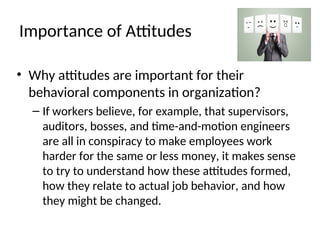
Importance of Attitudes
• Why attitudes are important for their
behavioral components in organization?
– If workers believe, for example, that supervisors,
auditors, bosses, and time-and-motion engineers
are all in conspiracy to make employees work
harder for the same or less money, it makes sense
to try to understand how these attitudes formed,
how they relate to actual job behavior, and how
they might be changed.
© 2009 Prentice-Hall Inc.
All rights reserved.
3-13
© 2009 Prentice-Hall Inc.
All rights reserved.
3-14
© 2009 Prentice-Hall Inc.
All rights reserved.
3-15
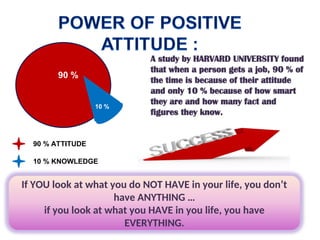
90 % ATTITUDE
10 % KNOWLEDGE
90 %
10 %
10 %
A study by HARVARD UNIVERSITY found
that when a person gets a job, 90 % of
the time is because of their attitude
and only 10 % because of how smart
they are and how many fact and
figures they know.
If YOU look at what you do NOT HAVE in your life, you don’t
have ANYTHING …
if you look at what you HAVE in you life, you have
EVERYTHING.
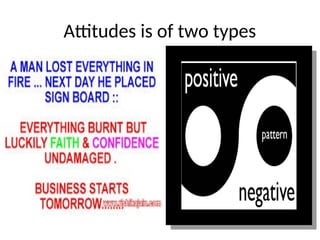
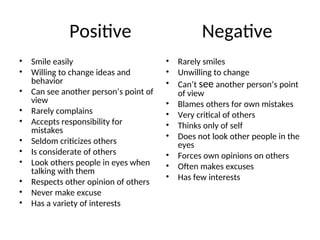
Attitudes is of two types
• Smile easily
• Willing to change ideas and
behavior
• Can see another person’s point of
view
• Rarely complains
• Accepts responsibility for
mistakes
• Seldom criticizes others
• Is considerate of others
• Look others people in eyes when
talking with them
• Respects other opinion of others
• Never make excuse
• Has a variety of interests
• Rarely smiles
• Unwilling to change
• Can’t see another person’s point
of view
• Blames others for own mistakes
• Very critical of others
• Thinks only of self
• Does not look other people in the
eyes
• Forces own opinions on others
• Often makes excuses
• Has few interests
Positive Negative
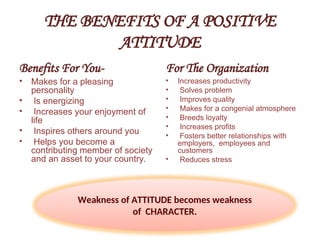
THE BENEFITS OF A POSITIVE
ATTITUDE
Benefits For You-
• Makes for a pleasing
personality
• Is energizing
• Increases your enjoyment of
life
• Inspires others around you
• Helps you become a
contributing member of society
and an asset to your country.
For The Organization
• Increases productivity
• Solves problem
• Improves quality
• Makes for a congenial atmosphere
• Breeds loyalty
• Increases profits
• Fosters better relationships with
employers, employees and
customers
• Reduces stress
3-19
Weakness of ATTITUDE becomes weakness
of CHARACTER.
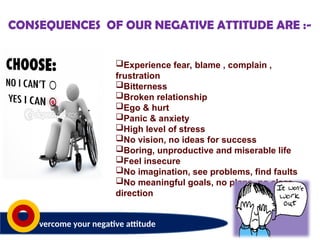
CONSEQUENCES OF OUR NEGATIVE ATTITUDE ARE :-
Experience fear, blame , complain ,
frustration
Bitterness
Broken relationship
Ego & hurt
Panic & anxiety
High level of stress
No vision, no ideas for success
Boring, unproductive and miserable life
Feel insecure
No imagination, see problems, find faults
No meaningful goals, no plans, no clear
direction
vercome your negative attitude

03 (1).02 (1).pptx---------------------------------

  • 1.
    Leadership and Organization Behavior CourseCode: MGT-537 Class: MBA IV & BBA VIII By: Dr. Hina Shahab Assistant Professor NUML, Management Sciences Dept. 1-1
  • 2.
    Lecture Outline 1. Emotions 2.Emotional Labor 3. Emotional Intelligence 4. Attitudes 5. Components of attitude 6. Emotions Vs. Attitudes 7. Emotions in Attitudes 8. Cognitive Dissonance 9. Reducing Cognitive Dissonance 10. Importance of Attitudes 11. Major Job Attitudes 12. Causes of Job Satisfaction 13. Outcomes of Job Satisfaction 14. Attitudes causes Behavior through Intentions
  • 3.
    Emotions at Workplace 1-3 •Emotions Defined: Psychological, behavioral, and physiological episodes experienced toward an object, person, or event that create a state of readiness.
  • 4.
  • 5.
    • Attitude isview point, a mind-set or a way of valuing life. • Evaluative statements of objects, people or events. • A collection of feelings. • Multiple experiences which leads to beliefs. • Beliefs cluster together to form values (that which you value). • Values of life shape itself, into a world view called ATTITUDE. WHAT IS ATTITUDE??
  • 6.
    WHAT IS ATTITUDE?? 6 •Attitudes are evaluative statements—either favorable or unfavorable—about objects, people, or events. They reflect how we feel about something. When I say “I like my job,” I am expressing my attitude about work.
  • 7.
    Components of attitudes •cognitive component of an attitude— a description of or belief in the way things are. – “My pay is low” • cognitive component sets the stage for the more critical part of an attitude—its affective component . Affect is the emotional or feeling segment of an attitude and is reflected in the statement – “I am angry over how little I’m paid.” • Finally, affect can lead to behavioral outcomes. The behavioral component of an attitude describes an intention to behave in a certain way toward someone or something—to continue the example, – “I’m going to look for another job that pays better.”
  • 8.
    © 2009 Prentice-HallInc. All rights reserved. 3-8
  • 9.
    Cognitive Dissonance theory 1-9 •Leon Festinger, in the late 1950s, proposed the theory of cognitive dissonance, seeking to explain the linkage between attitudes and behavior. He argued that any form of inconsistency is uncomfortable and that individuals will attempt to reduce the dissonance. • Dissonance means “an inconsistency.” • In simple words… • The feeling of uncomfortable tension which comes from holding two conflicting thoughts in the mind at the same time • Cognitive Dissonance: Any incompatibility between two or more attitudes or between behavior and attitudes.
  • 10.
    Desire to reducedissonance • The Fox and the Grapes by Aesop. • When the fox fails to reach the grapes, he decides he doesn't want them after all, an example of adaptive preference formation designed to reduce cognitive dissonance. 1-10 • Importance of elements creating dissonance • Degree of individual influence over elements • Rewards involved in dissonance
  • 11.
  • 12.
    Importance of Attitudes •Why attitudes are important for their behavioral components in organization? – If workers believe, for example, that supervisors, auditors, bosses, and time-and-motion engineers are all in conspiracy to make employees work harder for the same or less money, it makes sense to try to understand how these attitudes formed, how they relate to actual job behavior, and how they might be changed.
  • 13.
    © 2009 Prentice-HallInc. All rights reserved. 3-13
  • 14.
    © 2009 Prentice-HallInc. All rights reserved. 3-14
  • 15.
    © 2009 Prentice-HallInc. All rights reserved. 3-15
  • 16.
    90 % ATTITUDE 10% KNOWLEDGE 90 % 10 % 10 % A study by HARVARD UNIVERSITY found that when a person gets a job, 90 % of the time is because of their attitude and only 10 % because of how smart they are and how many fact and figures they know. If YOU look at what you do NOT HAVE in your life, you don’t have ANYTHING … if you look at what you HAVE in you life, you have EVERYTHING.
  • 17.
    Attitudes is oftwo types
  • 18.
    • Smile easily •Willing to change ideas and behavior • Can see another person’s point of view • Rarely complains • Accepts responsibility for mistakes • Seldom criticizes others • Is considerate of others • Look others people in eyes when talking with them • Respects other opinion of others • Never make excuse • Has a variety of interests • Rarely smiles • Unwilling to change • Can’t see another person’s point of view • Blames others for own mistakes • Very critical of others • Thinks only of self • Does not look other people in the eyes • Forces own opinions on others • Often makes excuses • Has few interests Positive Negative
  • 19.
    THE BENEFITS OFA POSITIVE ATTITUDE Benefits For You- • Makes for a pleasing personality • Is energizing • Increases your enjoyment of life • Inspires others around you • Helps you become a contributing member of society and an asset to your country. For The Organization • Increases productivity • Solves problem • Improves quality • Makes for a congenial atmosphere • Breeds loyalty • Increases profits • Fosters better relationships with employers, employees and customers • Reduces stress 3-19 Weakness of ATTITUDE becomes weakness of CHARACTER.
  • 20.
    CONSEQUENCES OF OURNEGATIVE ATTITUDE ARE :- Experience fear, blame , complain , frustration Bitterness Broken relationship Ego & hurt Panic & anxiety High level of stress No vision, no ideas for success Boring, unproductive and miserable life Feel insecure No imagination, see problems, find faults No meaningful goals, no plans, no clear direction vercome your negative attitude