AttitudeAttitude
What is attitude?What is attitude?
• A predisposition to evaluate an object or
product positively or negatively.
• Is lasting because it tends to endure over
time.
• Is general because it applies to more than
a momentary event.
• Has three components - beliefs, affect,
and behavioural intentions.
Importance of attitudeImportance of attitude
Attitude is important because:
• Cognitive function.
• The affective function.
• The connative function.
Characteristics of attitudeCharacteristics of attitude
• Favorability.
• Attitude accessibility.
• Attitude confidence.
• Attitude persistence.
• Attitude resistance.
• Ambivalence.
Forming and sources ofForming and sources of
influencing attitudeinfluencing attitude
• Approach 1- attitudes based
on cognitions.
• Approach 2- attitudes based
on emotions.
Influencing attitudesInfluencing attitudes
• Two ways to influence-
1. Cognitively.
2. Affectively.
Attitude play powerful roles, once
formed.
Forming attitude through cognitionForming attitude through cognition
1. Cognitive response model.
2. TORA model.
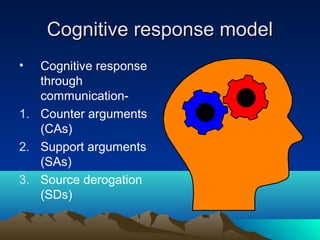
Cognitive response modelCognitive response model
• Cognitive response
through
communication-
1. Counter arguments
(CAs)
2. Support arguments
(SAs)
3. Source derogation
(SDs)
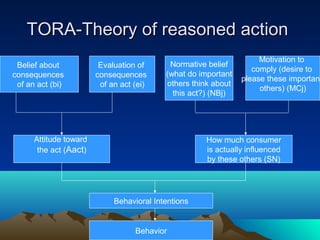
TORA-Theory of reasoned actionTORA-Theory of reasoned action
Belief about
consequences
of an act (bi)
Evaluation of
consequences
of an act (ei)
Normative belief
(what do important
others think about
this act?) (NBj)
Motivation to
comply (desire to
please these important
others) (MCj)
Attitude toward
the act (Aact)
How much consumer
is actually influenced
by these others (SN)
Behavioral Intentions
Behavior
Calculating TORA BehavioralCalculating TORA Behavioral
IntentionsIntentions
BI A SN
A b e
SN NB MC
act
act i i
i
j j
j
= +
=
=
∑
∑
Structural Models of AttitudesStructural Models of Attitudes
• Tricomponent Attitude Model
• Multiattribute Attitude Model
• The Trying-to-Consume Model
• Attitude-Toward-the-Ad Model
The Tricomponent ModelThe Tricomponent Model
Components-
• Cognitive
• Affective
• Conative
• A consumer’s
emotions or
feelings about a
particular product
or brand
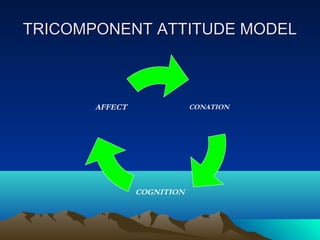
TRICOMPONENT ATTITUDE MODELTRICOMPONENT ATTITUDE MODEL
CONATION
COGNITION
AFFECT
COGNITIVE COMPONENTCOGNITIVE COMPONENT
• The knowledge and perceptions that are
acquired by a combination of direct
experience with the attitude object and
related information from various sources
Affective ComponentAffective Component
• A consumer’s emotions or
feelings about a particular
product or brand
Conative ComponentConative Component
• The likelihood or tendency that an
individual will undertake a specific action
or behave in a particular way with regard
to the attitude object
Thank youThank you

Attitude

  • 1.
  • 2.
    What is attitude?Whatis attitude? • A predisposition to evaluate an object or product positively or negatively. • Is lasting because it tends to endure over time. • Is general because it applies to more than a momentary event. • Has three components - beliefs, affect, and behavioural intentions.
  • 3.
    Importance of attitudeImportanceof attitude Attitude is important because: • Cognitive function. • The affective function. • The connative function.
  • 4.
    Characteristics of attitudeCharacteristicsof attitude • Favorability. • Attitude accessibility. • Attitude confidence. • Attitude persistence. • Attitude resistance. • Ambivalence.
  • 5.
    Forming and sourcesofForming and sources of influencing attitudeinfluencing attitude • Approach 1- attitudes based on cognitions. • Approach 2- attitudes based on emotions.
  • 6.
    Influencing attitudesInfluencing attitudes •Two ways to influence- 1. Cognitively. 2. Affectively. Attitude play powerful roles, once formed.
  • 7.
    Forming attitude throughcognitionForming attitude through cognition 1. Cognitive response model. 2. TORA model.
  • 8.
    Cognitive response modelCognitiveresponse model • Cognitive response through communication- 1. Counter arguments (CAs) 2. Support arguments (SAs) 3. Source derogation (SDs)
  • 9.
    TORA-Theory of reasonedactionTORA-Theory of reasoned action Belief about consequences of an act (bi) Evaluation of consequences of an act (ei) Normative belief (what do important others think about this act?) (NBj) Motivation to comply (desire to please these important others) (MCj) Attitude toward the act (Aact) How much consumer is actually influenced by these others (SN) Behavioral Intentions Behavior
  • 10.
    Calculating TORA BehavioralCalculatingTORA Behavioral IntentionsIntentions BI A SN A b e SN NB MC act act i i i j j j = + = = ∑ ∑
  • 11.
    Structural Models ofAttitudesStructural Models of Attitudes • Tricomponent Attitude Model • Multiattribute Attitude Model • The Trying-to-Consume Model • Attitude-Toward-the-Ad Model
  • 12.
    The Tricomponent ModelTheTricomponent Model Components- • Cognitive • Affective • Conative • A consumer’s emotions or feelings about a particular product or brand
  • 13.
    TRICOMPONENT ATTITUDE MODELTRICOMPONENTATTITUDE MODEL CONATION COGNITION AFFECT
  • 14.
    COGNITIVE COMPONENTCOGNITIVE COMPONENT •The knowledge and perceptions that are acquired by a combination of direct experience with the attitude object and related information from various sources
  • 15.
    Affective ComponentAffective Component •A consumer’s emotions or feelings about a particular product or brand
  • 16.
    Conative ComponentConative Component •The likelihood or tendency that an individual will undertake a specific action or behave in a particular way with regard to the attitude object
  • 17.