SUMITTED BY

MUKESH KUMAR
NAWAZ AHAMED
       SANDIP
     SANTOSH
       SACHIN
        AMAR
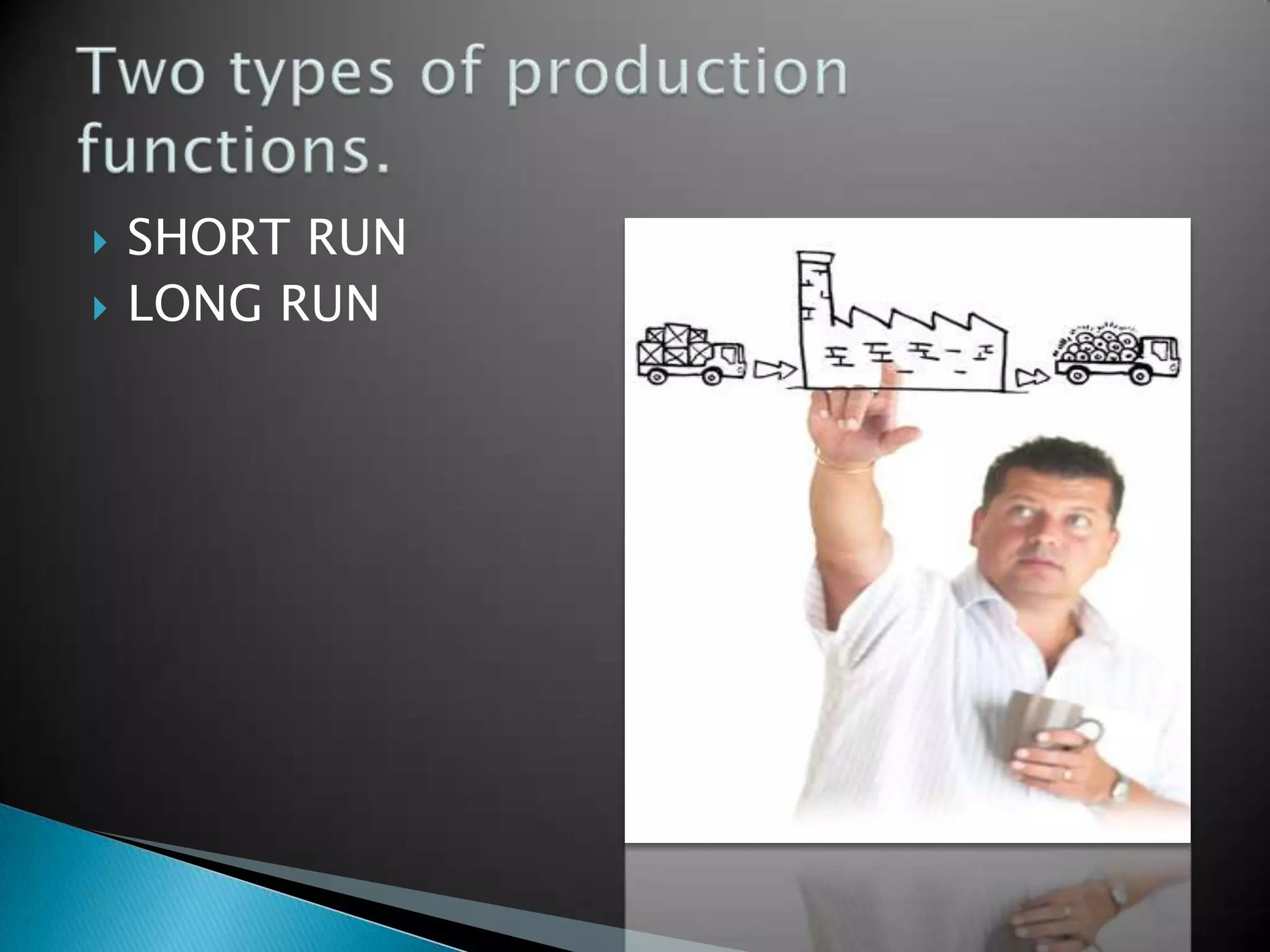
Production Function-Explains the
relationship between factor input
and output in physical terms. Or the
term PRODUCTION means
transformation of physical “inputs”
into physical “outputs”.
    A production function can be represented in
    the form of a mathematical model of
    equation as Q = f ( a,b,c,…… etc.) where Q
    stands for quantity of output per unit of time
    and a, b, c, etc are the various factor inputs
    like land, capital, labour etc, which are used
    in the production of output.
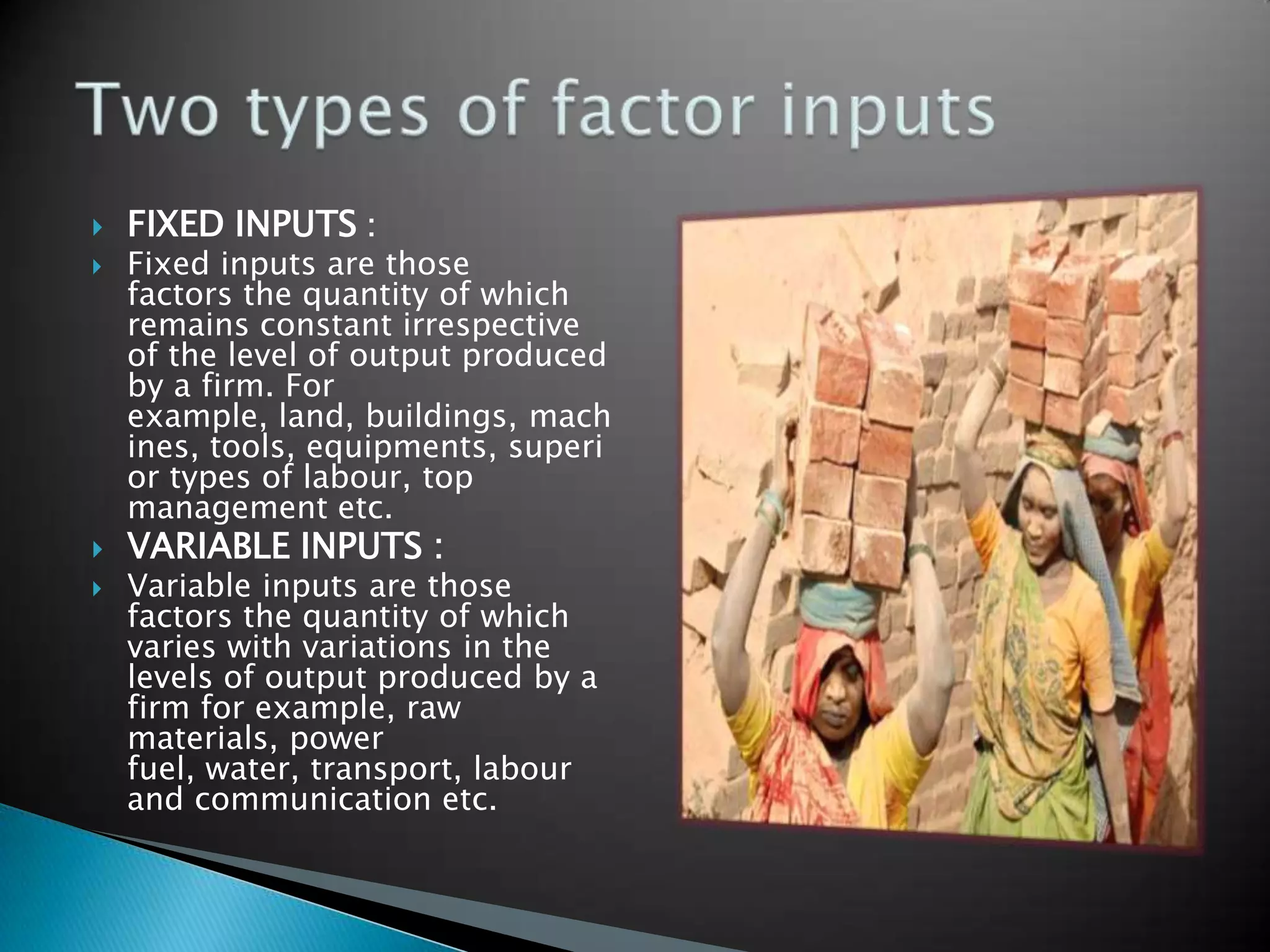
   FIXED INPUTS :
   Fixed inputs are those
    factors the quantity of which
    remains constant irrespective
    of the level of output produced
    by a firm. For
    example, land, buildings, mach
    ines, tools, equipments, superi
    or types of labour, top
    management etc.
   VARIABLE INPUTS :
   Variable inputs are those
    factors the quantity of which
    varies with variations in the
    levels of output produced by a
    firm for example, raw
    materials, power
    fuel, water, transport, labour
    and communication etc.
   SHORT RUN
   LONG RUN
In this case, the producer will keep
all fixed factors as constant and
changes only a few variable factor
inputs. For example, Law of Variable
Proportions.
In this case, the producer will vary
the quantities of all factor inputs
both fixed as well as variable in the
same proportion. For example, the
laws of returns to scale.
In the short-run the level of production
can be changed by
changing the factor proportions.
This law examines the production
function with on factor variable, keeping
the other factors quantities fixed.
The law explains the short-run
production function. When the
quantity of one input is
varied, keeping other inputs
constant, the proportion between
factors changes. When the proportio
n of variable factors
increases, the total output does not
always increase in the
same proportion, but in varying pro
portion.
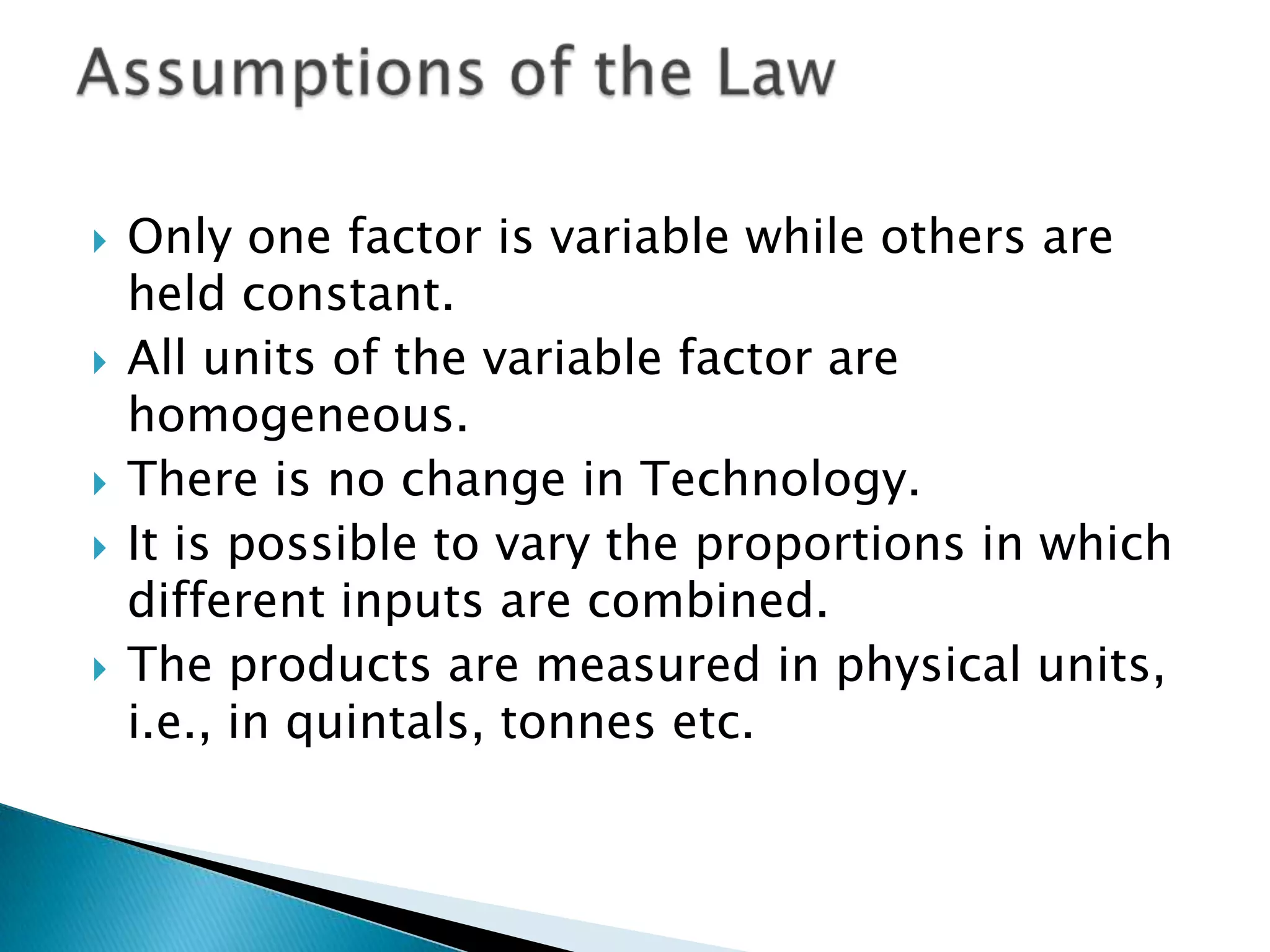
   Only one factor is variable while others are
    held constant.
   All units of the variable factor are
    homogeneous.
   There is no change in Technology.
   It is possible to vary the proportions in which
    different inputs are combined.
   The products are measured in physical units,
    i.e., in quintals, tonnes etc.
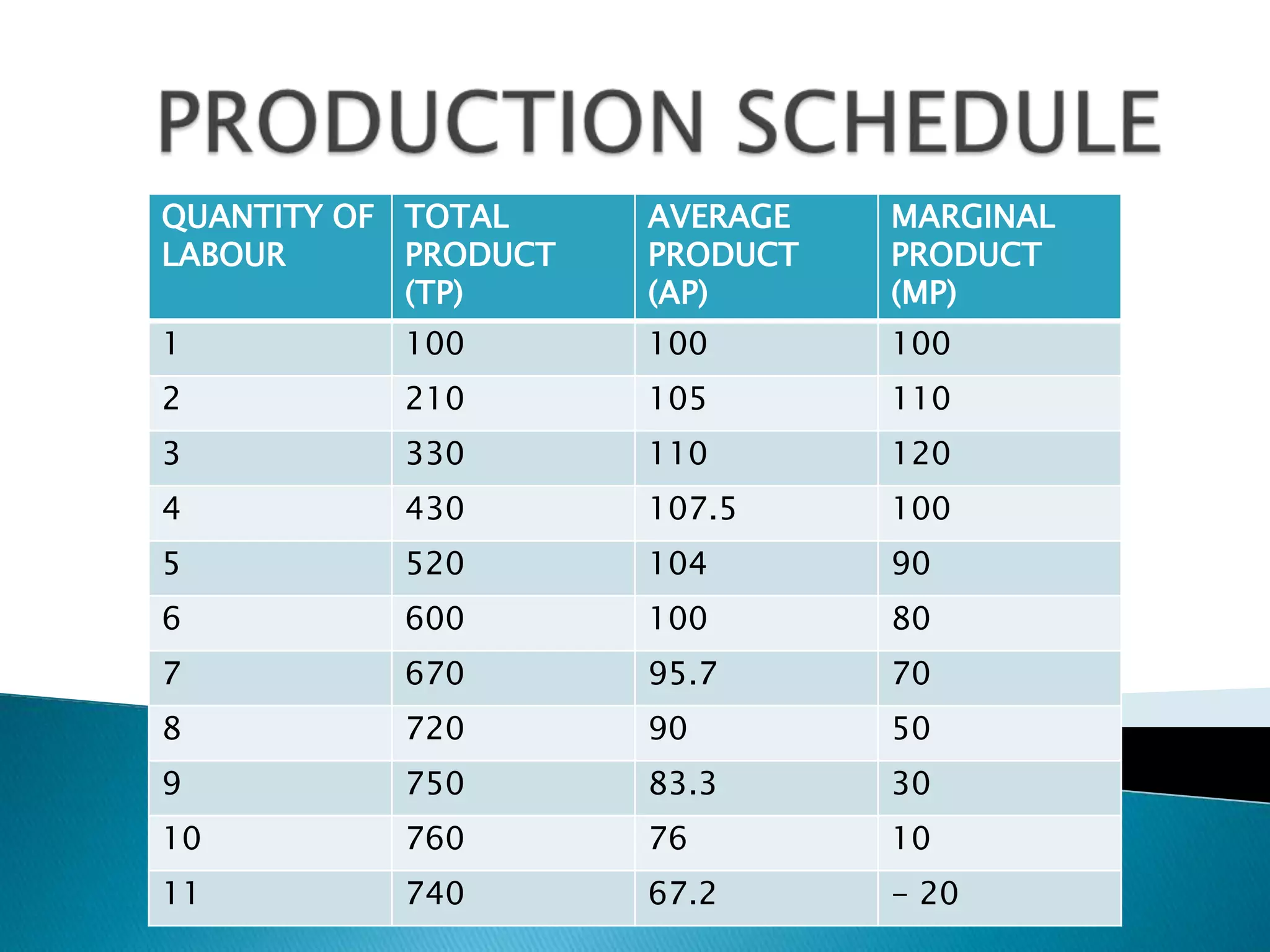
QUANTITY OF TOTAL     AVERAGE   MARGINAL
LABOUR      PRODUCT   PRODUCT   PRODUCT
            (TP)      (AP)      (MP)
1          100        100       100
2          210        105       110
3          330        110       120
4          430        107.5     100
5          520        104       90
6          600        100       80
7          670        95.7      70
8          720        90        50
9          750        83.3      30
10         760        76        10
11         740        67.2      - 20
   It refers to the total volume of goods
    produced during a specified period of time.
   Total product (TP)can be raised only by
    increasing the quantity of variable factors
    employed in production.
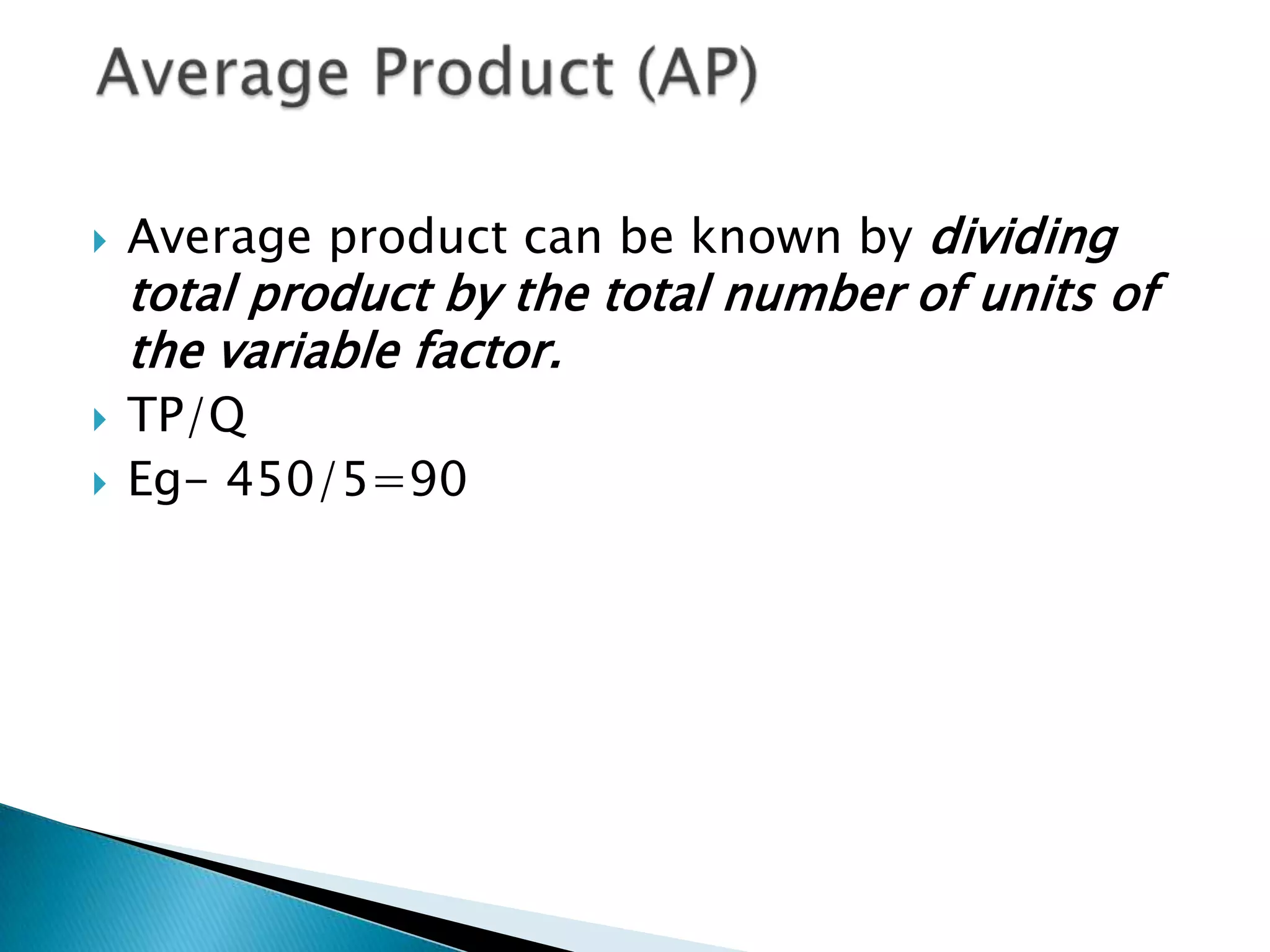
   Average product can be known by dividing
    total product by the total number of units of
    the variable factor.
   TP/Q
   Eg- 450/5=90
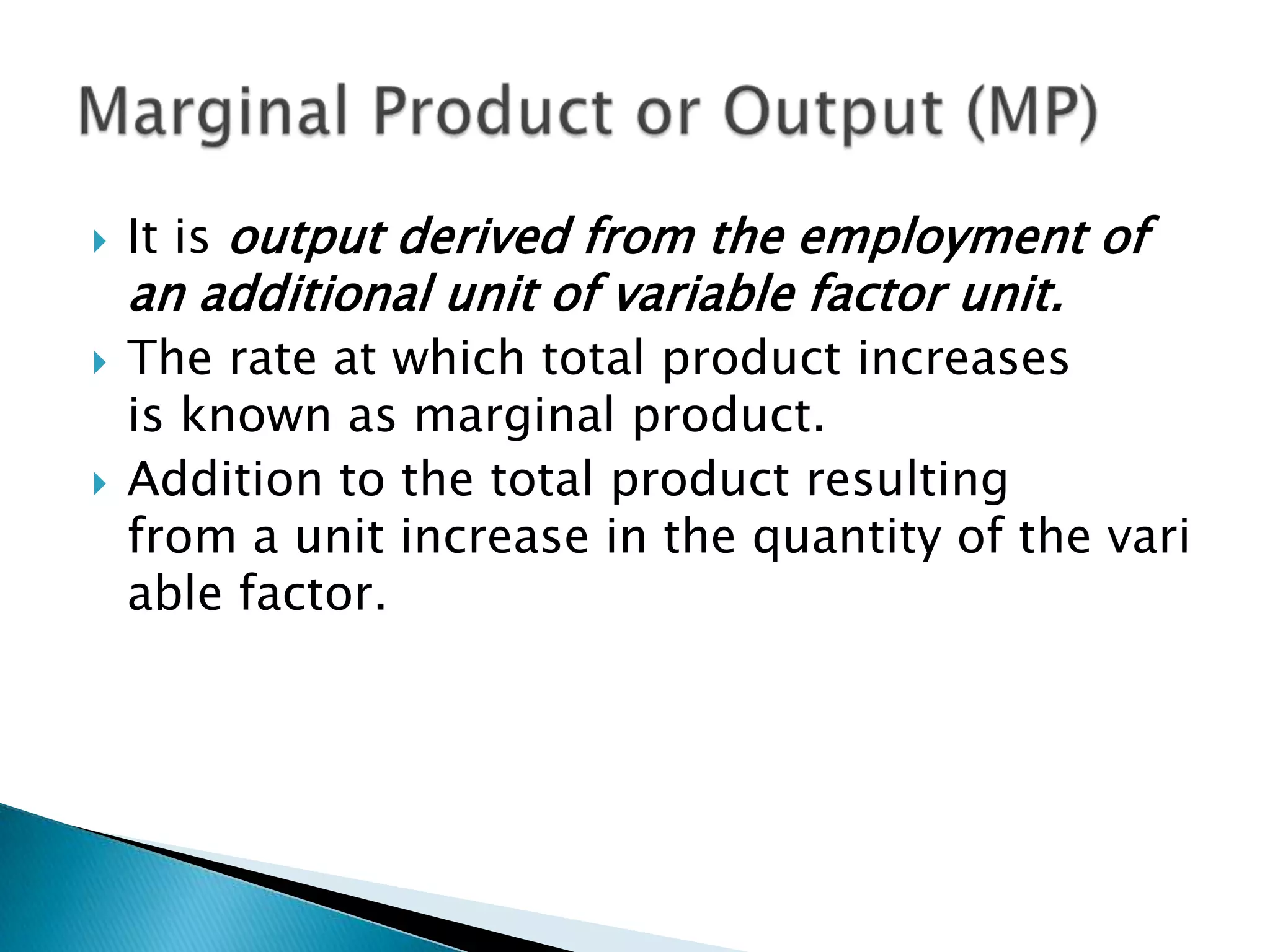
   It is output derived from the employment of
    an additional unit of variable factor unit.
   The rate at which total product increases
    is known as marginal product.
   Addition to the total product resulting
    from a unit increase in the quantity of the vari
    able factor.
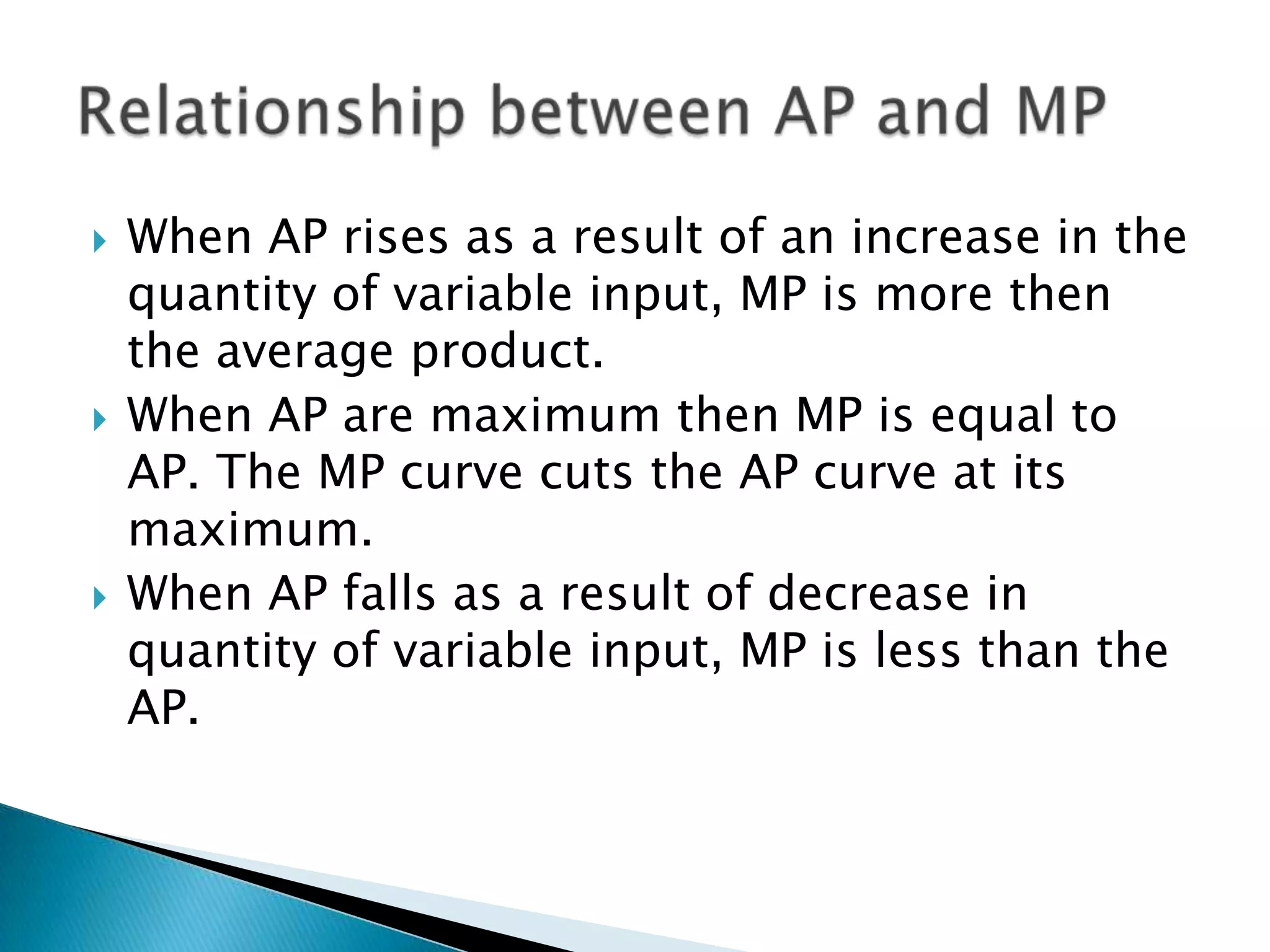
   When AP rises as a result of an increase in the
    quantity of variable input, MP is more then
    the average product.
   When AP are maximum then MP is equal to
    AP. The MP curve cuts the AP curve at its
    maximum.
   When AP falls as a result of decrease in
    quantity of variable input, MP is less than the
    AP.
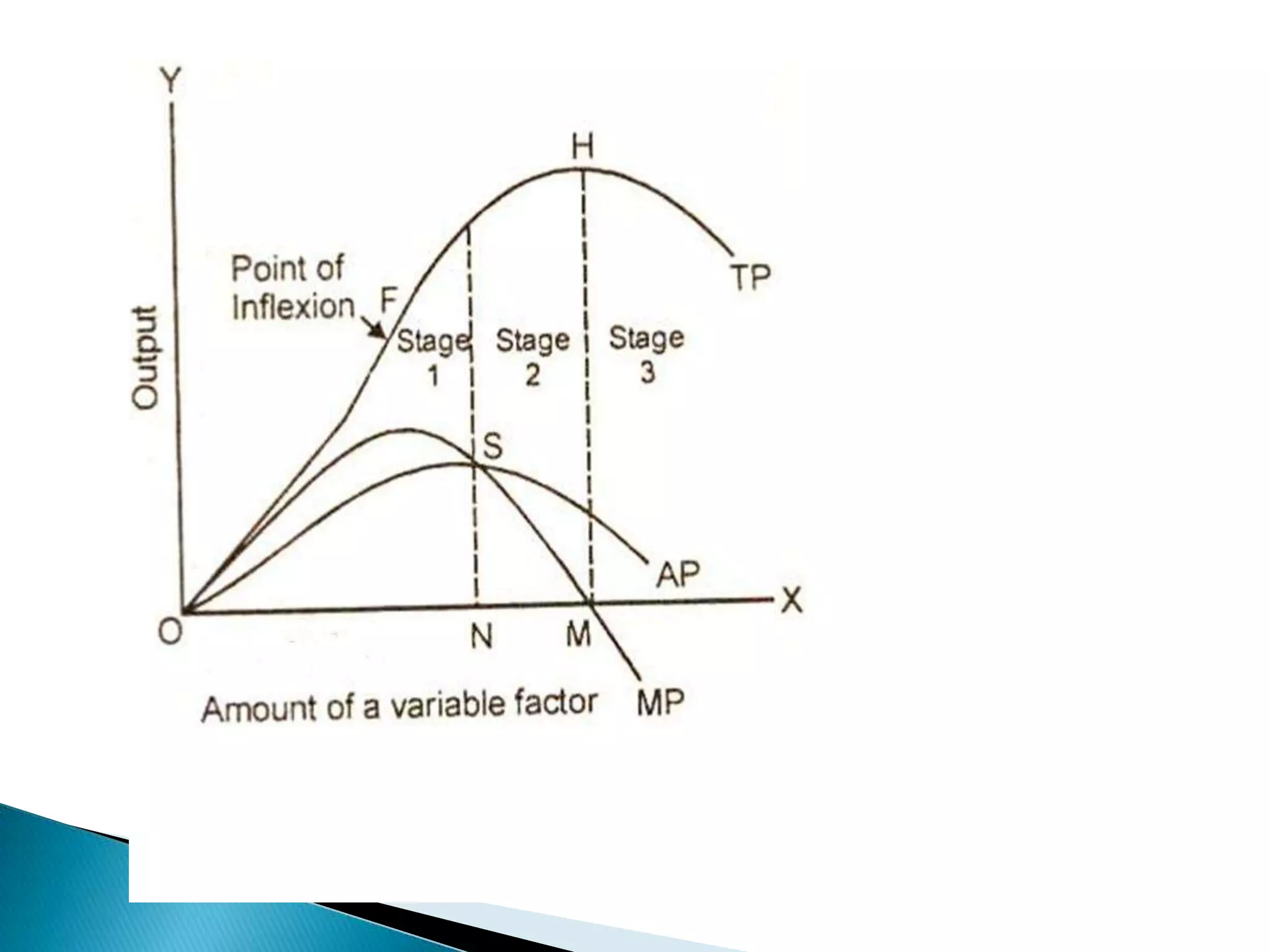
   Stage 1- THE LAW ON INCREASING RETURNS.
   Stage 2- THE LAW OF DIMINSHING RETURNS.
   Stage 3- THE STATE OF NAGATIVE RETURNS
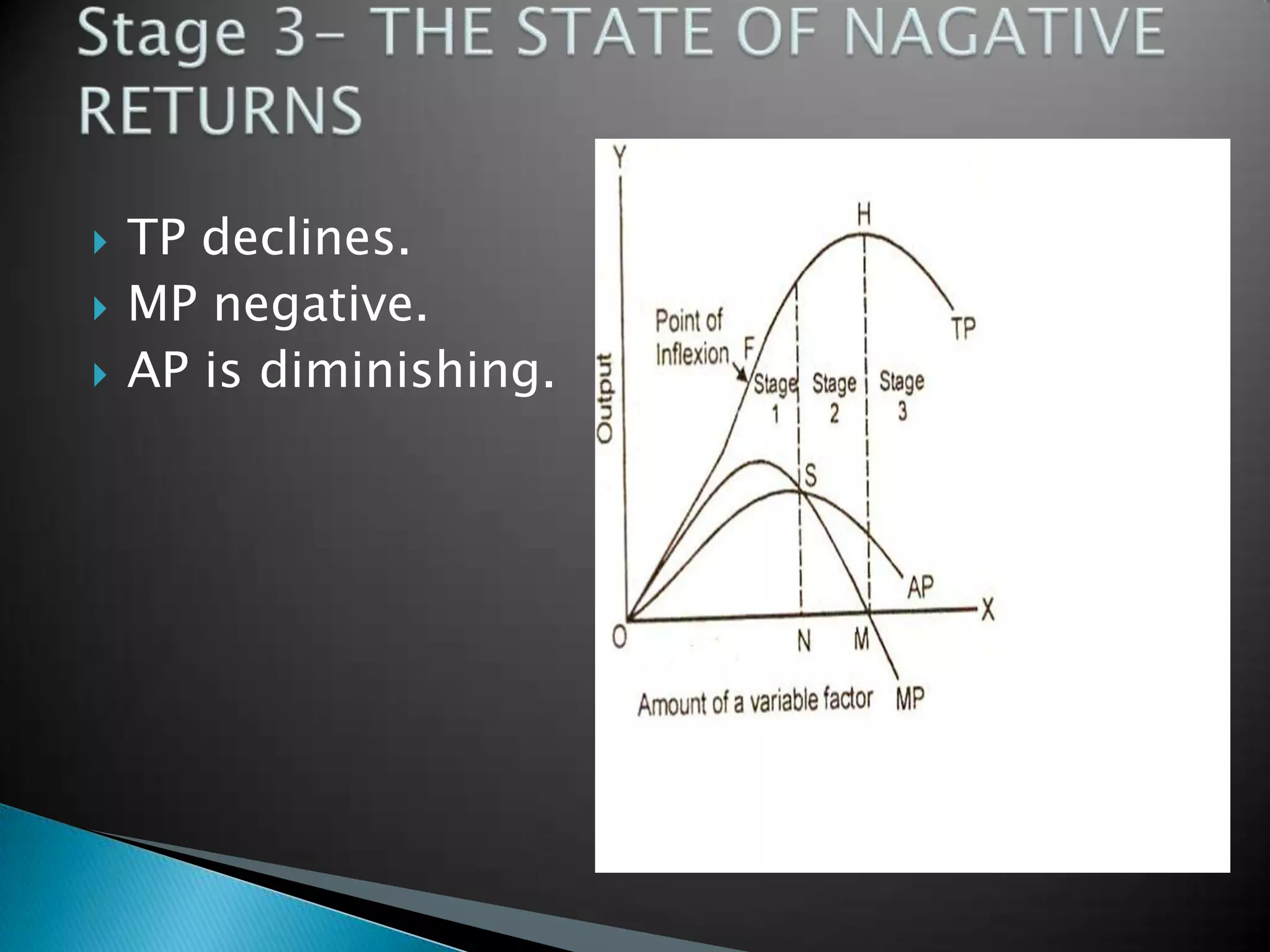
   TP increases at an increasing rate up to a
    point F.
   MP also rises and is maximum at point F.
   AP goes on rising.
   After point F , TP rises but at diminishing
    rate.
   MP falls but is positive.
   Stage 1 ends where AP reaches its highest
    point.
   TP continues to increase at a diminishing
    rate, until it reaches it maximum point H.
   Both MP and AP continuously fall during this
    stage.
   Stage ends when TP reaches its maximum
    point H.
   TP declines.
   MP negative.
   AP is diminishing.
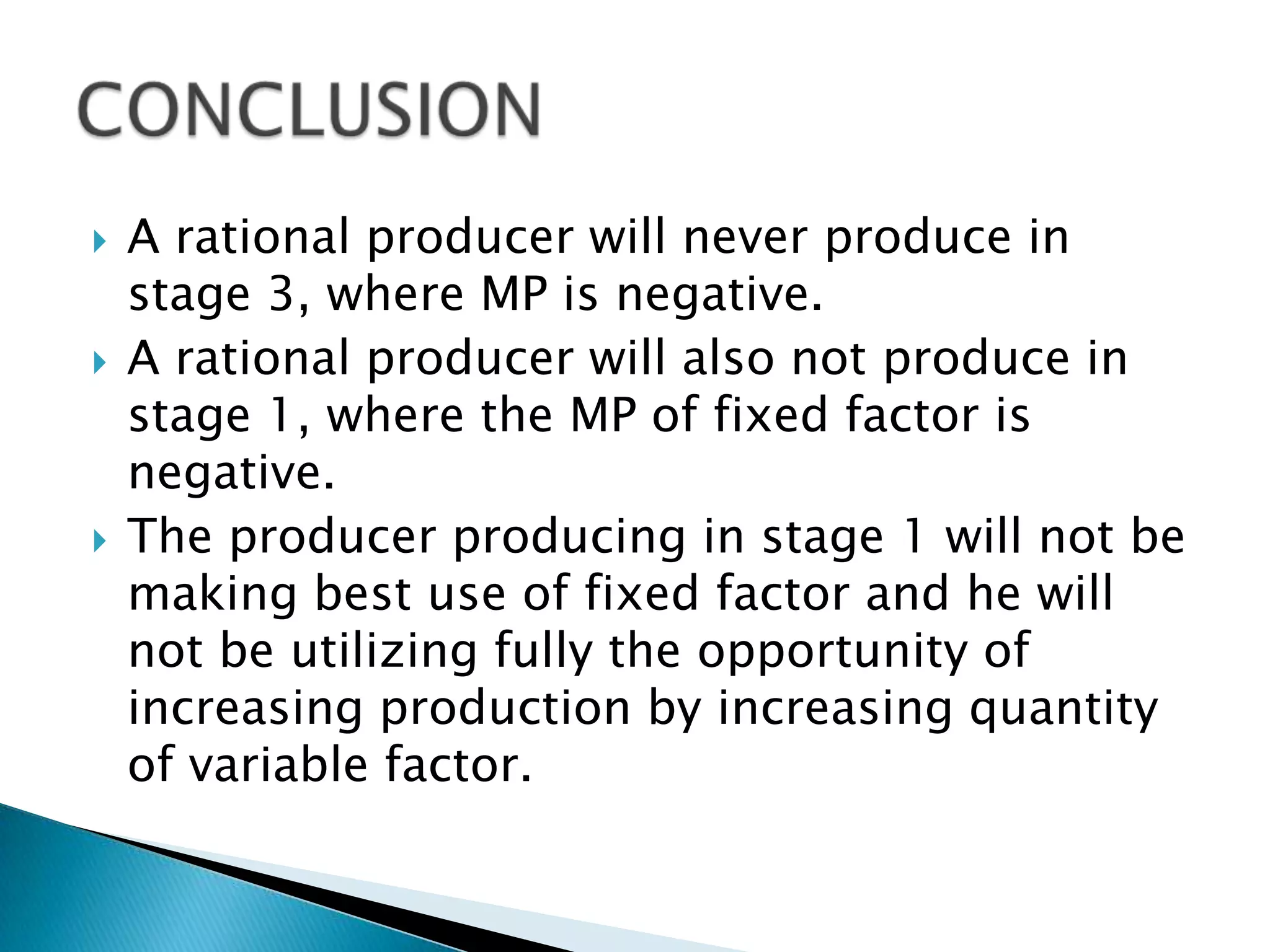
   A rational producer will never produce in
    stage 3, where MP is negative.
   A rational producer will also not produce in
    stage 1, where the MP of fixed factor is
    negative.
   The producer producing in stage 1 will not be
    making best use of fixed factor and he will
    not be utilizing fully the opportunity of
    increasing production by increasing quantity
    of variable factor.
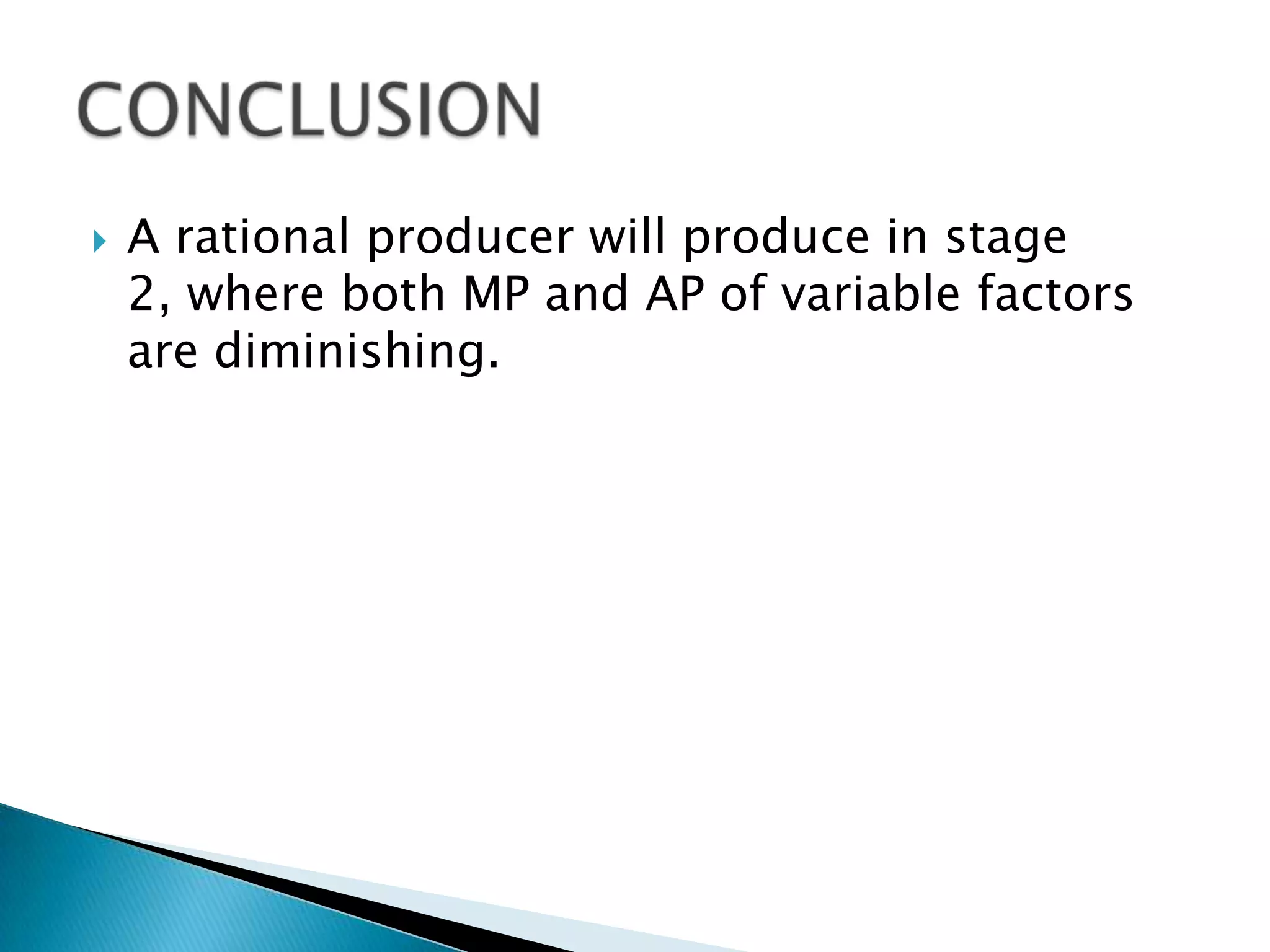
   A rational producer will produce in stage
    2, where both MP and AP of variable factors
    are diminishing.
   Mallikarjuna‟s shop is
    very popular and
    stocks all kinds of
    goods- from rice and
    wheat to processed
    food, imported
    chocolates and cheese.
    There is a small
    section which has a
    photocopying machine
    and a STD booth. MR.
    Mallikarjuna runs the
    shop with the help of
    his children.
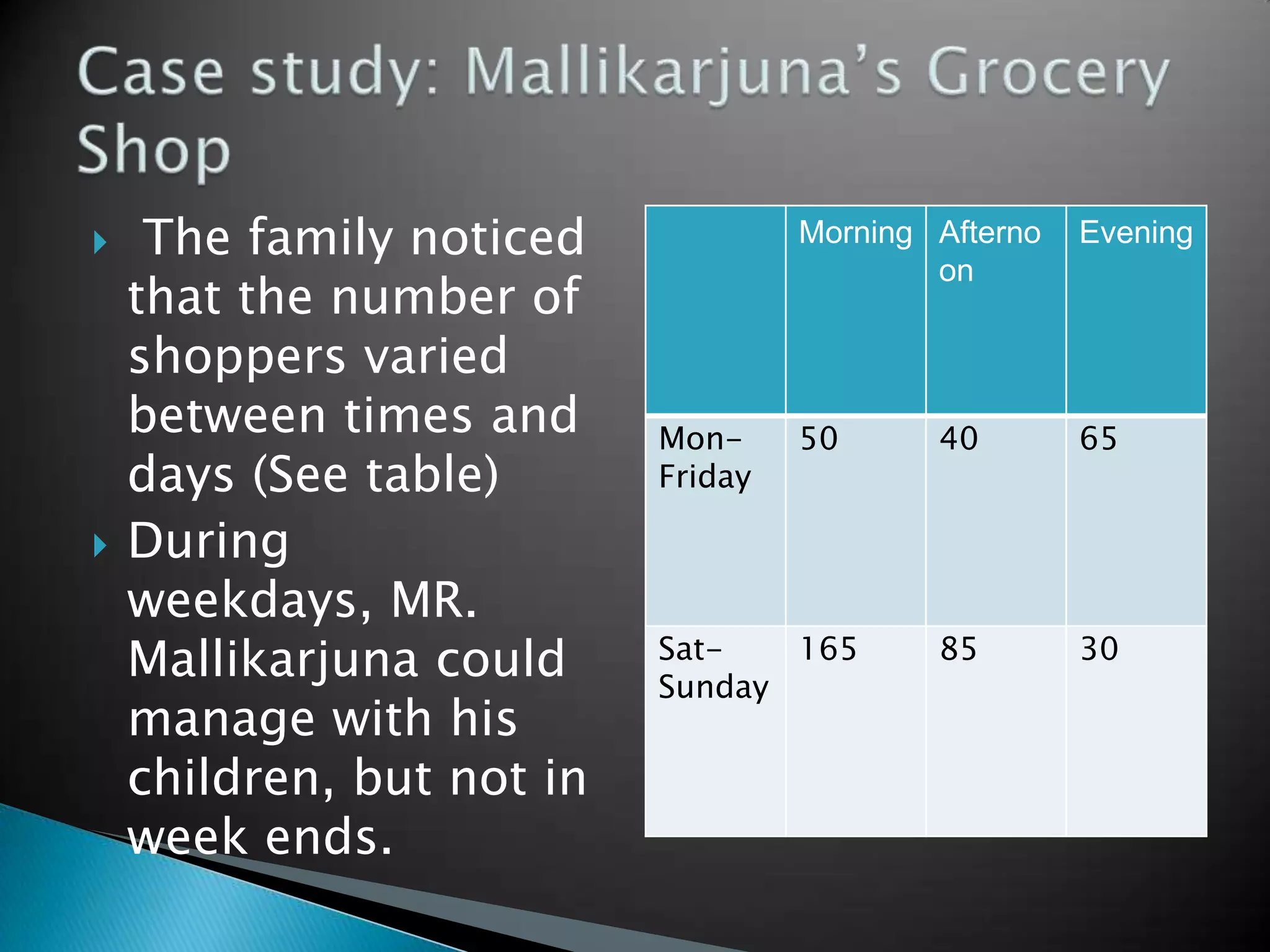
    The family noticed             Morning Afterno   Evening
                                            on
    that the number of
    shoppers varied
    between times and      Mon-     50      40        65
    days (See table)       Friday

   During
    weekdays, MR.
    Mallikarjuna could     Sat-
                           Sunday
                                  165       85        30

    manage with his
    children, but not in
    week ends.
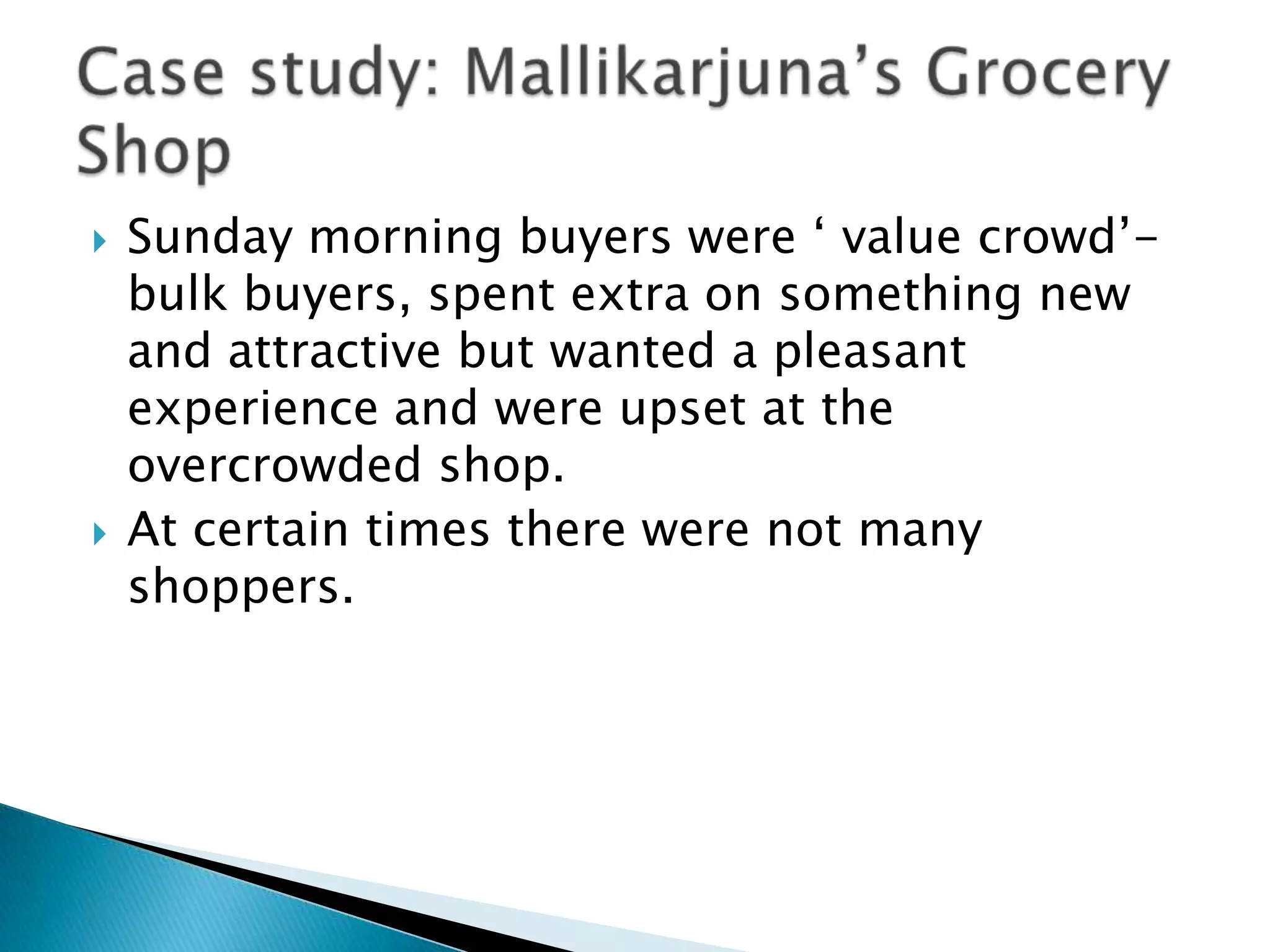
   Sunday morning buyers were „ value crowd‟-
    bulk buyers, spent extra on something new
    and attractive but wanted a pleasant
    experience and were upset at the
    overcrowded shop.
   At certain times there were not many
    shoppers.
He employed 3 assistants during week
 ends, but that did not solve the problem as
 the shop had a small floor area and only one
 billing machine
1.Can you explain Mallikarjuna‟s problem in
 terms of law of variable proportions?
2.Suggest in detail how he can improve the
 functioning of the shop.
Law of variable proportion

Law of variable proportion

  • 2.
    SUMITTED BY MUKESH KUMAR NAWAZAHAMED SANDIP SANTOSH SACHIN AMAR
  • 3.
    Production Function-Explains the relationshipbetween factor input and output in physical terms. Or the term PRODUCTION means transformation of physical “inputs” into physical “outputs”.
  • 4.
    A production function can be represented in the form of a mathematical model of equation as Q = f ( a,b,c,…… etc.) where Q stands for quantity of output per unit of time and a, b, c, etc are the various factor inputs like land, capital, labour etc, which are used in the production of output.
  • 5.
    FIXED INPUTS :  Fixed inputs are those factors the quantity of which remains constant irrespective of the level of output produced by a firm. For example, land, buildings, mach ines, tools, equipments, superi or types of labour, top management etc.  VARIABLE INPUTS :  Variable inputs are those factors the quantity of which varies with variations in the levels of output produced by a firm for example, raw materials, power fuel, water, transport, labour and communication etc.
  • 6.
    SHORT RUN  LONG RUN
  • 7.
    In this case,the producer will keep all fixed factors as constant and changes only a few variable factor inputs. For example, Law of Variable Proportions.
  • 8.
    In this case,the producer will vary the quantities of all factor inputs both fixed as well as variable in the same proportion. For example, the laws of returns to scale.
  • 9.
    In the short-runthe level of production can be changed by changing the factor proportions. This law examines the production function with on factor variable, keeping the other factors quantities fixed.
  • 10.
    The law explainsthe short-run production function. When the quantity of one input is varied, keeping other inputs constant, the proportion between factors changes. When the proportio n of variable factors increases, the total output does not always increase in the same proportion, but in varying pro portion.
  • 11.
    Only one factor is variable while others are held constant.  All units of the variable factor are homogeneous.  There is no change in Technology.  It is possible to vary the proportions in which different inputs are combined.  The products are measured in physical units, i.e., in quintals, tonnes etc.
  • 12.
    QUANTITY OF TOTAL AVERAGE MARGINAL LABOUR PRODUCT PRODUCT PRODUCT (TP) (AP) (MP) 1 100 100 100 2 210 105 110 3 330 110 120 4 430 107.5 100 5 520 104 90 6 600 100 80 7 670 95.7 70 8 720 90 50 9 750 83.3 30 10 760 76 10 11 740 67.2 - 20
  • 13.
    It refers to the total volume of goods produced during a specified period of time.  Total product (TP)can be raised only by increasing the quantity of variable factors employed in production.
  • 14.
    Average product can be known by dividing total product by the total number of units of the variable factor.  TP/Q  Eg- 450/5=90
  • 15.
    It is output derived from the employment of an additional unit of variable factor unit.  The rate at which total product increases is known as marginal product.  Addition to the total product resulting from a unit increase in the quantity of the vari able factor.
  • 16.
    When AP rises as a result of an increase in the quantity of variable input, MP is more then the average product.  When AP are maximum then MP is equal to AP. The MP curve cuts the AP curve at its maximum.  When AP falls as a result of decrease in quantity of variable input, MP is less than the AP.
  • 18.
    Stage 1- THE LAW ON INCREASING RETURNS.  Stage 2- THE LAW OF DIMINSHING RETURNS.  Stage 3- THE STATE OF NAGATIVE RETURNS
  • 19.
    TP increases at an increasing rate up to a point F.  MP also rises and is maximum at point F.  AP goes on rising.  After point F , TP rises but at diminishing rate.  MP falls but is positive.  Stage 1 ends where AP reaches its highest point.
  • 20.
    TP continues to increase at a diminishing rate, until it reaches it maximum point H.  Both MP and AP continuously fall during this stage.  Stage ends when TP reaches its maximum point H.
  • 21.
    TP declines.  MP negative.  AP is diminishing.
  • 22.
    A rational producer will never produce in stage 3, where MP is negative.  A rational producer will also not produce in stage 1, where the MP of fixed factor is negative.  The producer producing in stage 1 will not be making best use of fixed factor and he will not be utilizing fully the opportunity of increasing production by increasing quantity of variable factor.
  • 23.
    A rational producer will produce in stage 2, where both MP and AP of variable factors are diminishing.
  • 25.
    Mallikarjuna‟s shop is very popular and stocks all kinds of goods- from rice and wheat to processed food, imported chocolates and cheese. There is a small section which has a photocopying machine and a STD booth. MR. Mallikarjuna runs the shop with the help of his children.
  • 26.
    The family noticed Morning Afterno Evening on that the number of shoppers varied between times and Mon- 50 40 65 days (See table) Friday  During weekdays, MR. Mallikarjuna could Sat- Sunday 165 85 30 manage with his children, but not in week ends.
  • 27.
    Sunday morning buyers were „ value crowd‟- bulk buyers, spent extra on something new and attractive but wanted a pleasant experience and were upset at the overcrowded shop.  At certain times there were not many shoppers.
  • 28.
    He employed 3assistants during week ends, but that did not solve the problem as the shop had a small floor area and only one billing machine 1.Can you explain Mallikarjuna‟s problem in terms of law of variable proportions? 2.Suggest in detail how he can improve the functioning of the shop.