Consumer Attitude
Formation and
Change
Attitude
A learned
predisposition to
behave in a
consistently favorable
or unfavorable manner
with respect to a given
object.
We have attitudes toward many
things – to people, products,
advertisements, ideas, and more.
2
What Are Attitudes?
• The attitude “object”
• Attitudes are a learned predisposition-
either through direct experience or from others
• Attitudes may not be consistent over
time
• Attitudes occur within a situation
3
Structural Models of Attitudes
• Tricomponent Attitude Model
• Multiattribute Attitude Model
• The Trying-to-Consume Model
• Attitude-Toward-the-Ad Model
4
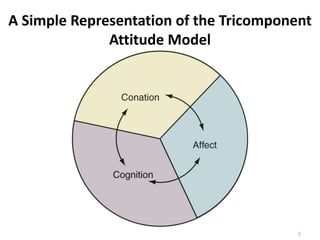
Cognition
A Simple Representation of the Tricomponent
Attitude Model
5
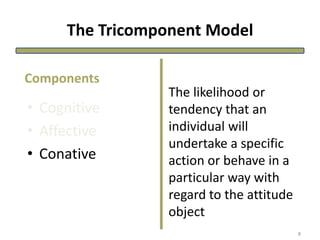
The Tricomponent Model
• Cognitive
• Affective
• Conative
The knowledge and
perceptions that are
acquired by a
combination of direct
experience with the
attitude object and
related information
from various sources
Components
6
The Tricomponent Model
• Cognitive
• Affective
• Conative
A consumer’s
emotions or feelings
about a particular
product or brand
Components
7
The Tricomponent Model
• Cognitive
• Affective
• Conative
The likelihood or
tendency that an
individual will
undertake a specific
action or behave in a
particular way with
regard to the attitude
object
Components
8
Multiattribute
Attitude
Models
Attitude models that
examine the
composition of
consumer attitudes
in terms of selected
product attributes or
beliefs.
9
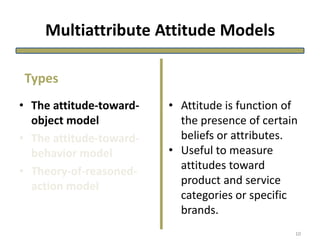
Multiattribute Attitude Models
• The attitude-toward-
object model
• The attitude-toward-
behavior model
• Theory-of-reasoned-
action model
• Attitude is function of
the presence of certain
beliefs or attributes.
• Useful to measure
attitudes toward
product and service
categories or specific
brands.
Types
10
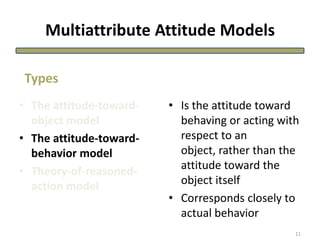
Multiattribute Attitude Models
• The attitude-toward-
object model
• The attitude-toward-
behavior model
• Theory-of-reasoned-
action model
• Is the attitude toward
behaving or acting with
respect to an
object, rather than the
attitude toward the
object itself
• Corresponds closely to
actual behavior
Types
11
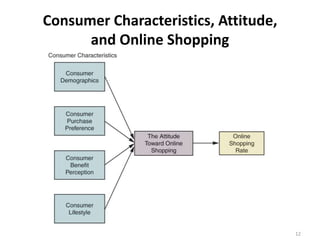
Consumer Characteristics, Attitude,
and Online Shopping
12
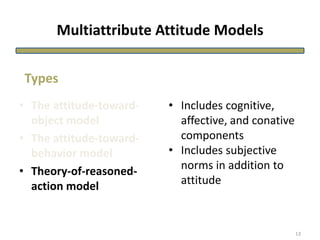
Multiattribute Attitude Models
• The attitude-toward-
object model
• The attitude-toward-
behavior model
• Theory-of-reasoned-
action model
• Includes cognitive,
affective, and conative
components
• Includes subjective
norms in addition to
attitude
Types
13
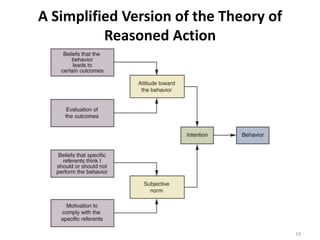
A Simplified Version of the Theory of
Reasoned Action
14
Theory of
Trying to
Consume
An attitude theory
designed to account
for the many cases
where the action or
outcome is not certain
but instead reflects
the consumer’s
attempt to consume
(or purchase).
15
Attitude-
Toward-the-
Ad Model
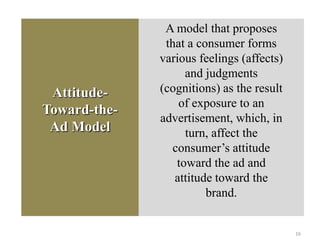
A model that proposes
that a consumer forms
various feelings (affects)
and judgments
(cognitions) as the result
of exposure to an
advertisement, which, in
turn, affect the
consumer’s attitude
toward the ad and
attitude toward the
brand.
16
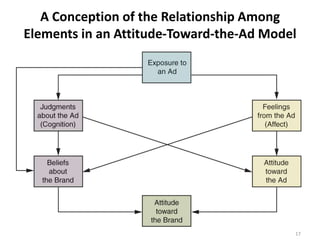
A Conception of the Relationship Among
Elements in an Attitude-Toward-the-Ad Model
17
Issues in Attitude Formation
• How attitudes are learned
– Conditioning and experience
– Knowledge and beliefs
18
Issues in Attitude Formation
• Sources of influence on attitude formation
– Personal experience
– Influence of family
– Direct marketing and mass media
• Personality factors
19
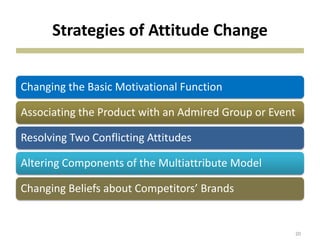
Strategies of Attitude Change
Changing the Basic Motivational Function
Associating the Product with an Admired Group or Event
Resolving Two Conflicting Attitudes
Altering Components of the Multiattribute Model
Changing Beliefs about Competitors’ Brands
20
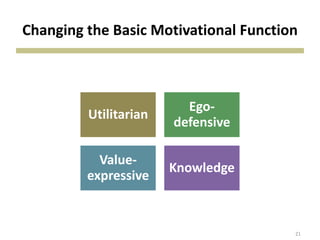
Changing the Basic Motivational Function
Utilitarian
Ego-
defensive
Value-
expressive
Knowledge
21
Attitude Change
• Altering Components of the Multiattribute
Model
– Changing relative evaluation of attributes
– Changing brand beliefs
– Adding an attribute
– Changing the overall brand rating
• Changing Beliefs about Competitors’
Brands
22
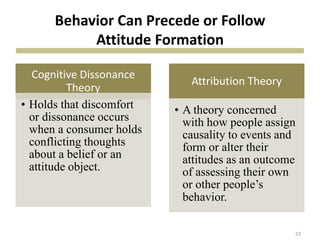
Behavior Can Precede or Follow
Attitude Formation
Cognitive Dissonance
Theory
• Holds that discomfort
or dissonance occurs
when a consumer holds
conflicting thoughts
about a belief or an
attitude object.
Attribution Theory
• A theory concerned
with how people assign
causality to events and
form or alter their
attitudes as an outcome
of assessing their own
or other people’s
behavior.
23
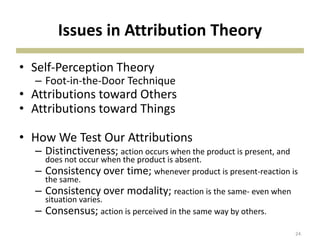
Issues in Attribution Theory
• Self-Perception Theory
– Foot-in-the-Door Technique
• Attributions toward Others
• Attributions toward Things
• How We Test Our Attributions
– Distinctiveness; action occurs when the product is present, and
does not occur when the product is absent.
– Consistency over time; whenever product is present-reaction is
the same.
– Consistency over modality; reaction is the same- even when
situation varies.
– Consensus; action is perceived in the same way by others.
24
THANK YOU!
25

Attitude and change - Consumer Behavior

  • 1.
  • 2.
    Attitude A learned predisposition to behavein a consistently favorable or unfavorable manner with respect to a given object. We have attitudes toward many things – to people, products, advertisements, ideas, and more. 2
  • 3.
    What Are Attitudes? •The attitude “object” • Attitudes are a learned predisposition- either through direct experience or from others • Attitudes may not be consistent over time • Attitudes occur within a situation 3
  • 4.
    Structural Models ofAttitudes • Tricomponent Attitude Model • Multiattribute Attitude Model • The Trying-to-Consume Model • Attitude-Toward-the-Ad Model 4
  • 5.
    Cognition A Simple Representationof the Tricomponent Attitude Model 5
  • 6.
    The Tricomponent Model •Cognitive • Affective • Conative The knowledge and perceptions that are acquired by a combination of direct experience with the attitude object and related information from various sources Components 6
  • 7.
    The Tricomponent Model •Cognitive • Affective • Conative A consumer’s emotions or feelings about a particular product or brand Components 7
  • 8.
    The Tricomponent Model •Cognitive • Affective • Conative The likelihood or tendency that an individual will undertake a specific action or behave in a particular way with regard to the attitude object Components 8
  • 9.
    Multiattribute Attitude Models Attitude models that examinethe composition of consumer attitudes in terms of selected product attributes or beliefs. 9
  • 10.
    Multiattribute Attitude Models •The attitude-toward- object model • The attitude-toward- behavior model • Theory-of-reasoned- action model • Attitude is function of the presence of certain beliefs or attributes. • Useful to measure attitudes toward product and service categories or specific brands. Types 10
  • 11.
    Multiattribute Attitude Models •The attitude-toward- object model • The attitude-toward- behavior model • Theory-of-reasoned- action model • Is the attitude toward behaving or acting with respect to an object, rather than the attitude toward the object itself • Corresponds closely to actual behavior Types 11
  • 12.
  • 13.
    Multiattribute Attitude Models •The attitude-toward- object model • The attitude-toward- behavior model • Theory-of-reasoned- action model • Includes cognitive, affective, and conative components • Includes subjective norms in addition to attitude Types 13
  • 14.
    A Simplified Versionof the Theory of Reasoned Action 14
  • 15.
    Theory of Trying to Consume Anattitude theory designed to account for the many cases where the action or outcome is not certain but instead reflects the consumer’s attempt to consume (or purchase). 15
  • 16.
    Attitude- Toward-the- Ad Model A modelthat proposes that a consumer forms various feelings (affects) and judgments (cognitions) as the result of exposure to an advertisement, which, in turn, affect the consumer’s attitude toward the ad and attitude toward the brand. 16
  • 17.
    A Conception ofthe Relationship Among Elements in an Attitude-Toward-the-Ad Model 17
  • 18.
    Issues in AttitudeFormation • How attitudes are learned – Conditioning and experience – Knowledge and beliefs 18
  • 19.
    Issues in AttitudeFormation • Sources of influence on attitude formation – Personal experience – Influence of family – Direct marketing and mass media • Personality factors 19
  • 20.
    Strategies of AttitudeChange Changing the Basic Motivational Function Associating the Product with an Admired Group or Event Resolving Two Conflicting Attitudes Altering Components of the Multiattribute Model Changing Beliefs about Competitors’ Brands 20
  • 21.
    Changing the BasicMotivational Function Utilitarian Ego- defensive Value- expressive Knowledge 21
  • 22.
    Attitude Change • AlteringComponents of the Multiattribute Model – Changing relative evaluation of attributes – Changing brand beliefs – Adding an attribute – Changing the overall brand rating • Changing Beliefs about Competitors’ Brands 22
  • 23.
    Behavior Can Precedeor Follow Attitude Formation Cognitive Dissonance Theory • Holds that discomfort or dissonance occurs when a consumer holds conflicting thoughts about a belief or an attitude object. Attribution Theory • A theory concerned with how people assign causality to events and form or alter their attitudes as an outcome of assessing their own or other people’s behavior. 23
  • 24.
    Issues in AttributionTheory • Self-Perception Theory – Foot-in-the-Door Technique • Attributions toward Others • Attributions toward Things • How We Test Our Attributions – Distinctiveness; action occurs when the product is present, and does not occur when the product is absent. – Consistency over time; whenever product is present-reaction is the same. – Consistency over modality; reaction is the same- even when situation varies. – Consensus; action is perceived in the same way by others. 24
  • 25.

Editor's Notes

  • #10 These are models that breakdown overall attitude into the attributes or beliefs which form an overall opinion.
  • #11 According to the attitude-toward-object model, consumers will like a brand or product that has an adequate level of attributes that the consumer thinks are positive. For example, if you are buying a home, there is a list of attributes that the home must have – 2 bedrooms, 2 bathrooms, air conditioning, and a back yard. With this model, an attitude is positive for the house that has the most of these attributes.
  • #12 Instead of asking people what product they like and have positive attitudes toward, the attitude-toward-behavior model is based on how positive someone's attitude is toward acting a certain way, for instance purchasing a certain brand. The question is now how likely are you to purchase brand X rather than how highly do you rate brand X.
  • #13 This is a model that looks at people’s attitudes toward purchasing online. On the lefthand side are the consumer characteristics that tend to impact a person’s attitude toward purchasing online. Their attitude was broken down further by how they view nine benefits of online shopping, including effectiveness, convenience, information, safety, service, delivery speed, web design, selection, and familiarity with company name. In addition, the attitude leads to how a consumer will rate an online shopping experience.
  • #14 Like other models, the theory of reasoned action has the three components, cognitive (think), affective (feel), and conative (do). In this model, we also need to understand subjective norms or how a consumer is influenced by others.
  • #15 This is a figure of the theory of reasoned action. The subjective norms that are distinctive to this model are the two lower blocks on the right. A consumer has beliefs about what others think they should do and also have differing levels of how likely they will follow those beliefs, also known as their motivation to comply with the referents. This subjective norm is now combined with the consumer’s personal attitude toward a behavior to form an intention to perform a behavior. This intention may or may not lead to the actual behavior.Certain groups are very influenced by the motivation to comply with people in their group. This web link brings you to cosmogirl.com. This site for younger female teens is loaded with information to supply motivation – see if you can identify three on the homepage alone.
  • #16 The theory of trying to consume addresses the fact that many people may want to purchase but in many cases they cannot. This may occur for personal reasons, such as not having enough money, or environmental reasons, such as not being able to go to a particular store.
  • #17 The attitude-toward-the-ad model helps us understand how advertising impacts attitudes.
  • #18 Here we see that everything begins with exposure to the ad. After this exposure, the consumer has feelings (affect) and thoughts (cognition) regarding the ad. This forms an attitude which works with beliefs about the brand to help form an attitude toward the brand.
  • #19 Attitudes are formed through learning. Recalling the concepts of classical and operant conditioning from earlier chapters, we recall that two stimuli can be paired or linked together to form a learned response. In addition, consumers can learn attitudes from rewards or outcomes from behavior.If attitudes are learned, then it is through experiences that this learning occurs. This can be from personal experience or from experiences with friends or exposure to marketing influences. Another topic studied in an earlier chapter comes into play with attitude formation. This is the consumer’s need for cognition. People will form attitudes based on the information that best suits them, information for the high need for cognition consumer, and images and spokespeople for the low need for cognition.
  • #21 Here are five strategies for attitude change. If you think about it, attitude change and formation are not all that different. They are both learned, they are both influenced by personal experience, and personality affects both of them.
  • #22 Changing the basic motivational function means to change the basic need that a consumer is trying to fulfill. Utilitarian function is how the product is useful to us. A marketer might want to create a more positive attitude toward a brand by showing all it can do. An ego-defensive function would show how the product would make them feel more secure and confident. A value-expressive function would more positively reflect the consumer’s values, lifestyle, and outlook. Finally, the knowledge function would satisfy the consumer’s “need to know” and help them understand more about the world around them.It is important for marketers to realize that they might have to combine functions because different customers are motivated to purchase their products for different reasons. Someone might buy a product because it tastes good and fills them up (utilitarian), while another thinks it is low fat and will make them healthy and therefore look better (ego-defensive).
  • #23 Perhaps the consumer thinks inexpensive is fine for a product, but a marketer might be able to point out that it is often worth paying a bit more for better quality. A marketer can also change the way consumers believe a brand rates on a certain attribute. Maybe a consumer thinks a brand is very expensive when in fact it is less expensive then several other brands. There may be an attribute that does not even exist. Who thought chewiness was an attribute that could even exist for a vitamin until Gummy Vites came along?Finally, we can step away from looking individually at the attribute and attempt to change the consumer’s overall assessment of the brand. We can do any of these attitude change strategies by changing beliefs of our own product or our competitor's product.