Personality
Development
• General:
Aims to help an individual maximize available
resources to reach a persons full potential through a
well-rounded personality
LEARNING OBJECTIVES
• Specific:
At the end of this program, the participants will learn how to:
– Value the concept of self-mastery
– Be self-confident about their physical appearance
– Package themselves through the application on aspects of personality.
LEARNING OBJECTIVES
OUTLINE OF PRESENTATION
I. INTRODUCTION
II. BASIC CONCEPTS
III. DETERMINANTS OF PERSONALITY
IV. ASPECTS OF PERSONALITY
V. AREAS THAT PROJECTS PERSONALITY
PERSONALITY…!!!
SUPERSTAR
DEFINITION
Personality
- The pattern of enduring characteristics that produce
consistency and individuality in a given person
- the set of emotional qualities, ways of behaving, etc., that
makes a person different from other people
- It is also personality that leads us to act consistently in
different situations and over extended periods of time.
Freud’s Psychoanalytic Theory
Sigmund Freud, an Australian physician,
developed Psychoanalytic theory in early
1900’s.
- Conscious experience is a small part of our
psychological makeup and experience.
- He argued that much of our behavior is
motivated by the unconscious
UNCONSCIOUS
- A part of personality that contains the
memories, knowledge, beliefs, feelings, urges,
drives and instincts of which the individual is
not aware.
HOW MUCH DO YOU SEE OF AN ICEBERG?
A SMALL TRUTH
TO MAKE LIFE
100%
The Iceberg phenomena is also applicable on human beings …
SUPEREGO
EGO
CONSCIOUS
Id
UNCONSCIOUS
STRUCTURE OF PERSONALITY
ID EGO SUPEREGO
The raw, unorganized,
inborn part of
personality
It is the basic core of our
being
Begins to develop soon
after birth
Develops from direct
teaching from parents,
teachers, and other
significant individuals
Operates on
PLEASURE
PRINCIPLE to gain
pleasure, avoid pain
Operates on REALITY
PRINCIPLES – does
realistic and logical
thinking
Operates on MORAL
PRINCIPLES
Driven by sexual and
aggressive urge
The balance between ID
and the outside world
Able to differentiate
between good and bad,
right and wrong
Responsible for our
basic instinct that we
need for survival
DEFENSE MECHANISM
Anxiety- an intense, negative emotional
experience.
- Are unconscious strategies that people use
to reduce anxiety by concealing the source
from themselves and others.
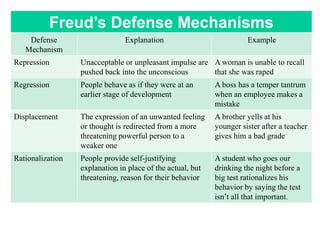
Freud’s Defense Mechanisms
Defense
Mechanism
Explanation Example
Repression Unacceptable or unpleasant impulse are
pushed back into the unconscious
A woman is unable to recall
that she was raped
Regression People behave as if they were at an
earlier stage of development
A boss has a temper tantrum
when an employee makes a
mistake
Displacement The expression of an unwanted feeling
or thought is redirected from a more
threatening powerful person to a
weaker one
A brother yells at his
younger sister after a teacher
gives him a bad grade
Rationalization People provide self-justifying
explanation in place of the actual, but
threatening, reason for their behavior
A student who goes our
drinking the night before a
big test rationalizes his
behavior by saying the test
isn’t all that important.
Freud’s Defense Mechanisms
Defense Mechanism Explanation Example
Denial People refuse to accept or
acknowledge an anxiety-
producing piece of
information
A student refuses to believe
that he has flunked a course
Projection People attribute unwanted
impulses and feelings to
someone else
A man who is angry at his
father acts lovingly to his
father but complains that his
father is angry with him
Sublimation People divert unwanted
impulses into socially
approved thoughts feelings,
or behaviors
A person with strong
feelings of aggression
becomes a soldier
Reaction formation Unconscious impulses are
expressed as their opposite
in consciousness
A mother who
unconsciously resents her
child acts in an overly
loving way toward the child
DISPLACEMENT
DENIAL
WORKSHOP 1
E:SeminarPresentationPersonality1WORK
SHOP_PERSONALITY.ppt
DETERMINANTS OF
PERSONALITY
HEREDITY
ENVIRONMENT
ENVIRONMENT
Among the factors that exert pressures on our personality
formation are the culture in which we are raised, our early
conditioning, the norms among our family, friends and social
groups etc.
The situation influences the effects of heredity and
environment on personality
Nature versus Nurture
Debate continues… which is it?
• Nature Argument – heredity, genetic structure (Innate
Behaviour)
• Nurture Argument – result of learning and experience
resulting from outside factors such as parents, media,
peers and religion (learned behaviour)
Aspects of Personality
A. Personal
Appearance
B. Intelligence
C. Emotional
D. Social
E. Character & Moral
F. Spiritual
A. PERSONAL APPEARANCE
• YOUR personal appearance says much about you.
• If a man is tall, of good physical proportions, and
well-muscled, his personality is likely to be
affected favorably.
• A person who is very small, very tall, too fat or
too thin is a deviate. Being a deviate lessens the
feeling of confidence and personal worth.
Building a pleasing personality
pleasing personality helps in getting friendly
cooperation from others.
Don't compare
yourself with
any one in this
world.
If you
compare, you
are insulting
yourself.
the fact is that no one can
judge personal and intellectual
qualities by physical
appearance.
BE YOURSELF
B. INTELLIGENCE
Intelligence has been defined in many different
ways such as in terms of one's capacity for logic,
abstract thought, understanding, self-awareness,
communication, learning, emotional knowledge,
memory, planning, creativity and problem
solving.
• Intelligence is certainly an asset.
• It enables easy adjustment even under
difficult circumstances and thus helps in
building up personality.
• Intelligent people are able to adjust
themselves to changing environments
with great ease, efficiency and speed and
hence they are said to have good
personality.
E:SEMINARPRESENTATION
PERSONALITY2WORKSHOP_
NUMBER.PPTX
WORKSHOP #2
C. EMOTIONAL
Emotional intelligence
The term emotional intelligence was officially coined in 1990
by Salovey and Mayer
Emotional Intelligence/Quotient is “the capacity for
recognizing our own feelings and those of others, for
motivating ourselves, and for managing emotions well in
ourselves and in our relationships. Emotional intelligence
describes abilities distinct from, but complementary to,
academic intelligence.”
- Daniel Goleman (1998)
So what’s EI and why is it
important?
• Some research shows that
IQ can help you to be
successful to the extent of
20 percent only in life.
The rest of 80 percent
success depends on your
EQ.
20%
IQ
80%
EQ
VIDEO CLIP
IF WE COULD SEE INSIDE EACH OTHER
HEARTS IN 4 MINUTES…
E:SeminarPresentationPersonalityVIDEO
CLIP1IF WE COULD SEE INSIDE
OTHERS' HEARTS.mp4
D. TEMPERAMENT
• Man may be rational
animal, but at times
he is extremely
emotional also.
• Intense and violent
feeling is emotional
long drawn out
emotion is a mood.
Mood when it becomes permanent influences our
TEMPERAMENT.
One Should Have an Open Mind
Rather Than an Empty Mind
• An open mind is flexible; it evaluates and may accept or
reject ideas and concepts based on merit.
• An empty mind is a dumping ground for good and bad. It
accepts without evaluation.
E. CHARACTER AND MORAL
TRAIT
 Character is the sum of all tendencies, which the
individual possesses.
 It is the organization of instincts and habits under the
sentiment of self-regard.
 Character and the personality of the individual are very
closely related.
MORAL CHARACTER
 CONSIST OF ALL
THOSE QUALITIES
THAT ENABLE US TO
BE OUR ETHICAL
BEST IN
RELATIONSHIPS AND
ROLES AS CITIZENS.
VALUES/TRAITS
• HUMILITY
• INTEGRITY
• JUSTICE
• CARING
• RESPECT
• HONESTY
Life laughs
at you when
you are
unhappy...
Life smiles at you
when you are happy…
Life salutes you when
you make others
happy...
THE ABILITY TO SMILE
Video Clip
Positive Attitude
E:SeminarPresentationPersonalityVIDEO
CLIP2POSITIVE ATTITUDE.mp4
F. SPIRITUAL
Matthew 6:33-34
“Keep on, then, seeking first the Kingdom
and his righteousness, and all these other
things will be added to you. So never be
anxious about the next day, for the next
day will have its own anxieties. Each day
has enough of its own troubles.”
IV. AREAS THAT PROJECTS
PERSONALITY
• Having Clear Goals
• Don't Complain And Criticize
• Adaptable T Change
• Overcoming The Guilt And Worry
• Learning From Failure
• Hope For the Best
HAVING CLEAR GOALS
DON’T COMPLAIN & CRITICIZE
WHAT YOU CANNOT CHANGE
A girl who was tortured, raped, and
kept in a closet for 5 years by her
mother and step father
Hungry, tired children; Mindanao
conflict’s biggest victims
POVERTY IN AFRICA
E:SeminarPresentationPersonal
ityAmanda Todd Suicide -
Original Full Video.mp4
Easy is to judge the mistakes of others.
Difficult is to recognize our own
mistakes.
It is easier to protect your feet
with slippers than to cover the
earth with carpet.
No one can go back and
change a bad beginning;
But anyone can start now
and create a successful
ending.
ADAPTABLE TO CHANGE
OVERCOMING THE GUILT &
WORRY
Mistakes are painful when they happen.
But year's later collection of
mistakes is called experience,
which leads to success.
LEARNING FROM FAILURE
Be bold when you loose
and be calm when you
win.
Heated gold becomes
ornament. Beaten copper
becomes wires. Depleted
stone becomes statue. So the
more pain you get in life you
become more valuable.
I’M POSSIBLE
If a problem can be
solved, no need to
worry about it.
BUT ALL PROBLEMS
CAN BE SOLVED COZ
IMPOSSIBLE IS
NOTHING…
HOPE FOR THE BEST
If you miss an
opportunity
don't fill the
eyes with
tears.
It will hide
another better
opportunity in
front of you
VIDEO CLIP
Never Give
UpE:SeminarPresentationPerson
alityVIDEO CLIP3NEVER
GIVE UP.mp4
WORKSHOP 3
Personality devlopment

Personality devlopment

  • 1.
  • 2.
    • General: Aims tohelp an individual maximize available resources to reach a persons full potential through a well-rounded personality LEARNING OBJECTIVES
  • 3.
    • Specific: At theend of this program, the participants will learn how to: – Value the concept of self-mastery – Be self-confident about their physical appearance – Package themselves through the application on aspects of personality. LEARNING OBJECTIVES
  • 4.
    OUTLINE OF PRESENTATION I.INTRODUCTION II. BASIC CONCEPTS III. DETERMINANTS OF PERSONALITY IV. ASPECTS OF PERSONALITY V. AREAS THAT PROJECTS PERSONALITY
  • 5.
  • 6.
  • 7.
    DEFINITION Personality - The patternof enduring characteristics that produce consistency and individuality in a given person - the set of emotional qualities, ways of behaving, etc., that makes a person different from other people - It is also personality that leads us to act consistently in different situations and over extended periods of time.
  • 8.
    Freud’s Psychoanalytic Theory SigmundFreud, an Australian physician, developed Psychoanalytic theory in early 1900’s. - Conscious experience is a small part of our psychological makeup and experience. - He argued that much of our behavior is motivated by the unconscious
  • 9.
    UNCONSCIOUS - A partof personality that contains the memories, knowledge, beliefs, feelings, urges, drives and instincts of which the individual is not aware.
  • 10.
    HOW MUCH DOYOU SEE OF AN ICEBERG?
  • 11.
    A SMALL TRUTH TOMAKE LIFE 100%
  • 12.
    The Iceberg phenomenais also applicable on human beings …
  • 13.
  • 14.
    STRUCTURE OF PERSONALITY IDEGO SUPEREGO The raw, unorganized, inborn part of personality It is the basic core of our being Begins to develop soon after birth Develops from direct teaching from parents, teachers, and other significant individuals Operates on PLEASURE PRINCIPLE to gain pleasure, avoid pain Operates on REALITY PRINCIPLES – does realistic and logical thinking Operates on MORAL PRINCIPLES Driven by sexual and aggressive urge The balance between ID and the outside world Able to differentiate between good and bad, right and wrong Responsible for our basic instinct that we need for survival
  • 15.
    DEFENSE MECHANISM Anxiety- anintense, negative emotional experience. - Are unconscious strategies that people use to reduce anxiety by concealing the source from themselves and others.
  • 16.
    Freud’s Defense Mechanisms Defense Mechanism ExplanationExample Repression Unacceptable or unpleasant impulse are pushed back into the unconscious A woman is unable to recall that she was raped Regression People behave as if they were at an earlier stage of development A boss has a temper tantrum when an employee makes a mistake Displacement The expression of an unwanted feeling or thought is redirected from a more threatening powerful person to a weaker one A brother yells at his younger sister after a teacher gives him a bad grade Rationalization People provide self-justifying explanation in place of the actual, but threatening, reason for their behavior A student who goes our drinking the night before a big test rationalizes his behavior by saying the test isn’t all that important.
  • 17.
    Freud’s Defense Mechanisms DefenseMechanism Explanation Example Denial People refuse to accept or acknowledge an anxiety- producing piece of information A student refuses to believe that he has flunked a course Projection People attribute unwanted impulses and feelings to someone else A man who is angry at his father acts lovingly to his father but complains that his father is angry with him Sublimation People divert unwanted impulses into socially approved thoughts feelings, or behaviors A person with strong feelings of aggression becomes a soldier Reaction formation Unconscious impulses are expressed as their opposite in consciousness A mother who unconsciously resents her child acts in an overly loving way toward the child
  • 19.
  • 21.
  • 26.
  • 27.
  • 29.
    ENVIRONMENT Among the factorsthat exert pressures on our personality formation are the culture in which we are raised, our early conditioning, the norms among our family, friends and social groups etc.
  • 30.
    The situation influencesthe effects of heredity and environment on personality
  • 31.
    Nature versus Nurture Debatecontinues… which is it? • Nature Argument – heredity, genetic structure (Innate Behaviour) • Nurture Argument – result of learning and experience resulting from outside factors such as parents, media, peers and religion (learned behaviour)
  • 32.
    Aspects of Personality A.Personal Appearance B. Intelligence C. Emotional D. Social E. Character & Moral F. Spiritual
  • 33.
    A. PERSONAL APPEARANCE •YOUR personal appearance says much about you. • If a man is tall, of good physical proportions, and well-muscled, his personality is likely to be affected favorably. • A person who is very small, very tall, too fat or too thin is a deviate. Being a deviate lessens the feeling of confidence and personal worth.
  • 34.
    Building a pleasingpersonality pleasing personality helps in getting friendly cooperation from others.
  • 38.
    Don't compare yourself with anyone in this world. If you compare, you are insulting yourself.
  • 39.
    the fact isthat no one can judge personal and intellectual qualities by physical appearance.
  • 40.
  • 41.
    B. INTELLIGENCE Intelligence hasbeen defined in many different ways such as in terms of one's capacity for logic, abstract thought, understanding, self-awareness, communication, learning, emotional knowledge, memory, planning, creativity and problem solving.
  • 42.
    • Intelligence iscertainly an asset. • It enables easy adjustment even under difficult circumstances and thus helps in building up personality. • Intelligent people are able to adjust themselves to changing environments with great ease, efficiency and speed and hence they are said to have good personality.
  • 43.
  • 44.
  • 45.
    Emotional intelligence The termemotional intelligence was officially coined in 1990 by Salovey and Mayer Emotional Intelligence/Quotient is “the capacity for recognizing our own feelings and those of others, for motivating ourselves, and for managing emotions well in ourselves and in our relationships. Emotional intelligence describes abilities distinct from, but complementary to, academic intelligence.” - Daniel Goleman (1998)
  • 46.
    So what’s EIand why is it important? • Some research shows that IQ can help you to be successful to the extent of 20 percent only in life. The rest of 80 percent success depends on your EQ. 20% IQ 80% EQ
  • 47.
    VIDEO CLIP IF WECOULD SEE INSIDE EACH OTHER HEARTS IN 4 MINUTES… E:SeminarPresentationPersonalityVIDEO CLIP1IF WE COULD SEE INSIDE OTHERS' HEARTS.mp4
  • 48.
    D. TEMPERAMENT • Manmay be rational animal, but at times he is extremely emotional also. • Intense and violent feeling is emotional long drawn out emotion is a mood. Mood when it becomes permanent influences our TEMPERAMENT.
  • 49.
    One Should Havean Open Mind Rather Than an Empty Mind • An open mind is flexible; it evaluates and may accept or reject ideas and concepts based on merit. • An empty mind is a dumping ground for good and bad. It accepts without evaluation.
  • 50.
    E. CHARACTER ANDMORAL TRAIT  Character is the sum of all tendencies, which the individual possesses.  It is the organization of instincts and habits under the sentiment of self-regard.  Character and the personality of the individual are very closely related.
  • 51.
    MORAL CHARACTER  CONSISTOF ALL THOSE QUALITIES THAT ENABLE US TO BE OUR ETHICAL BEST IN RELATIONSHIPS AND ROLES AS CITIZENS. VALUES/TRAITS • HUMILITY • INTEGRITY • JUSTICE • CARING • RESPECT • HONESTY
  • 52.
    Life laughs at youwhen you are unhappy... Life smiles at you when you are happy… Life salutes you when you make others happy...
  • 53.
  • 54.
  • 56.
  • 57.
    Matthew 6:33-34 “Keep on,then, seeking first the Kingdom and his righteousness, and all these other things will be added to you. So never be anxious about the next day, for the next day will have its own anxieties. Each day has enough of its own troubles.”
  • 58.
    IV. AREAS THATPROJECTS PERSONALITY • Having Clear Goals • Don't Complain And Criticize • Adaptable T Change • Overcoming The Guilt And Worry • Learning From Failure • Hope For the Best
  • 59.
  • 61.
    DON’T COMPLAIN &CRITICIZE WHAT YOU CANNOT CHANGE
  • 62.
    A girl whowas tortured, raped, and kept in a closet for 5 years by her mother and step father
  • 63.
    Hungry, tired children;Mindanao conflict’s biggest victims
  • 64.
  • 65.
  • 66.
    Easy is tojudge the mistakes of others. Difficult is to recognize our own mistakes. It is easier to protect your feet with slippers than to cover the earth with carpet.
  • 67.
    No one cango back and change a bad beginning; But anyone can start now and create a successful ending.
  • 68.
  • 69.
  • 70.
    Mistakes are painfulwhen they happen. But year's later collection of mistakes is called experience, which leads to success.
  • 71.
  • 73.
    Be bold whenyou loose and be calm when you win. Heated gold becomes ornament. Beaten copper becomes wires. Depleted stone becomes statue. So the more pain you get in life you become more valuable.
  • 74.
  • 75.
    If a problemcan be solved, no need to worry about it. BUT ALL PROBLEMS CAN BE SOLVED COZ IMPOSSIBLE IS NOTHING…
  • 76.
  • 77.
    If you missan opportunity don't fill the eyes with tears. It will hide another better opportunity in front of you
  • 78.
  • 79.