Training program conducted for
Hi Tech Arai
By
Dr.V.Veera Balaji Kumar
Attitude –
Changing for the best
WHAT IS MEANT BY
ATTITUDE
 WHAT HAVE YOU GOT TO SAY?
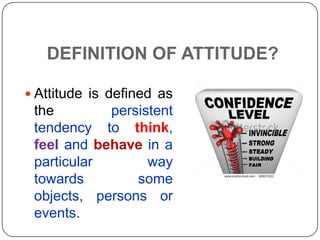
DEFINITION OF ATTITUDE?
 Attitude is defined as
the persistent
tendency to think,
feel and behave in a
particular way
towards some
objects, persons or
events.
WHAT IS AN ATTITUDE?
 Attitude is a state of mind
 Your attitude is your mind-set
 It is the way you look at things mentally
 Attitudes are evaluative statements
 They indicate one’s feelings either favourably or
unfavourably to persons objects and or events
ATTITUDES ARE EVALUATIVE
STATEMENTS
 Attitude reflect how one feels about something
 It can be Positive or Negative
Eg. When someone says “I like teaching” he is
expressing his attitude about his work.
When someone says “I hate when someone
advises/teaches ” he is expressing his attitude
towards receiving advice.
ATTITUDE IS YOUR MENTAL FOCUS
ON THE OUTSIDE WORLD
 Like using a camera you can focus or set your
mind on what appeals to you
 You can see situations as either opportunities or
failures
 Examples
 A hot summer day may be beautiful or ugly
 A departmental meeting is either interesting or
boring
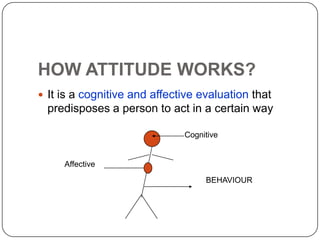
HOW ATTITUDE WORKS?
 It is a cognitive and affective evaluation that
predisposes a person to act in a certain way
Cognitive
Affective
BEHAVIOUR
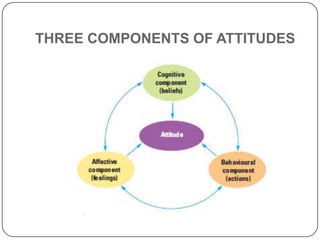
THREE COMPONENTS OF
ATTITUDES?
 Cognitions (Thoughts)
 Affections (Feelings)
 Behaviour ( Actions and reactions)
THREE COMPONENTS OF ATTITUDES
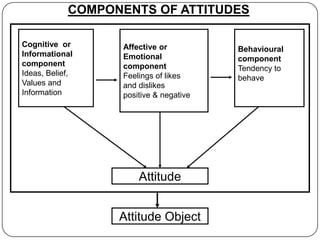
Cognitive or
Informational
component
Ideas, Belief,
Values and
Information
Affective or
Emotional
component
Feelings of likes
and dislikes
positive & negative
Behavioural
component
Tendency to
behave
Attitude
Attitude Object
COMPONENTS OF ATTITUDES
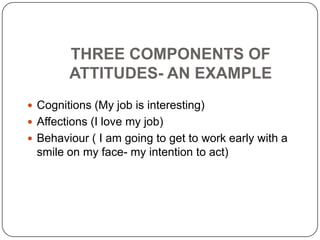
THREE COMPONENTS OF
ATTITUDES- AN EXAMPLE
 Cognitions (My job is interesting)
 Affections (I love my job)
 Behaviour ( I am going to get to work early with a
smile on my face- my intention to act)
FACTORS THAT DETERMINE OUR ATTITUDE
 Environment
 Experience
 Education
ENVIRONMENT CONSISTS OF THE FOLLOWING
 Home : Positive or Negative influences.
 School: Peer Pressures.
 Work : Supportive or over critical Supervisor.
 Media: Television, Newspapers, Magazines,
Radio, movies.
 Cultural back ground.
 Traditions and Beliefs.
 Social Environment.
 Political Environment.
14
What are the salient features about
attitudes?
 Attitudes are related to feelings and beliefs about
people
 Attitude is a response to persons objects or events
 Attitudes affect behaviour positively or negatively
 Attitudes undergo changes
 Attitudes affect perception, and in turn, behaviour
Attitudes and behaviour
 Many factors influence whether attitude and
behaviour will be consistent. Some of the most
significant factors include:
 How strong the attitude is
 How easily it comes to mind
 The situation we are in
 Our personal belief that we can actually perform the
behaviour associated with the attitude
Strength of attitude
 A strong attitude is well known, easily accessible,
personally relevant and has a strong emotional
component
 The stronger the attitude the more likely it will be
consistent, resistant to change and influence
behaviour
 Kraus (1995) found that the stronger the attitude
that more likely it would predict behaviour
HOW ATTITUDES ARE FORMED - DIRECT
LEARNING AND SOCIAL LEARNING
 Attitudes are not inherited
 They are acquired or learned by people from
the environment in which they interact
 The formation of attitudes is broadly classified
in to two sources namely
1. Direct experience
2. Social Learning
PROCESS OF LEARNING ATTITUDES FROM
OBSERVATION- DIRECT LEARNING
 One’s direct experience with an object or person
serves as a powerful source for his or her attitude
formation
 In other words attitudes are formed on the basis
of one’s past experience in concerned object or
person
PROCESS OF LEARNING ATTITUDES FROM
OBSERVATION- SOCIAL LEARNING
 The process of deriving attitudes from family peer
groups religious organizations and culture is
called social learning
 In social learning a person acquires attitudes from
his or her environment in an indirect manner
 They acquire it mainly by observing their models
PROCESS OF LEARNING ATTITUDES FROM
OBSERVATION- SOCIAL EARNING
 Attention - focus on something
 Retention - what observed must be retained
 Reproduction - Behaviour must be practiced
again and again
 Motivation - learner must be motivated to learn
from it
ROLE OF CULTURE IN ATTITUDE
FORMATION
 Culture plays a definitive role in the formation
of attitudes
 Eg- Indians earn for future requirements
 Americans for that matter earn to enjoy
the present
THREE TYPES OF JOB RELATED
ATTITUDES
 Job satisfaction - Individual’s pleasurable or
positive emotional state toward his job
 Job Involvement - the degree to which people
immerse themselves in their jobs - It is
identifying with one’s job
 Organizational commitment - it is about
employees loyalty towards their organizations -
It is identifying with one’s organization
JOB SATISFACTION IS RELATED WITH
FIVE SPECIFC JOB DIMENSIONS
 PAY
 WORK ITSELF
 PROMOTIONAL OPPORTUNITIES
 SUPERVISION
 CO-WORKERS
JOB INVOLVEMENT
 It is the degree to which employees immerse
themselves in their jobs, invest time and
energy in them and consider work as central
part of their overall lives
 Such employees tend to be high performers
and seldom tardy and get absent
ORGANIZATIONAL COMMITMENT
 It is an attitude about employee’s
commitment to the organization
 It is the process by which an employee
identify with the organization and and want to
maintain membership with the organization
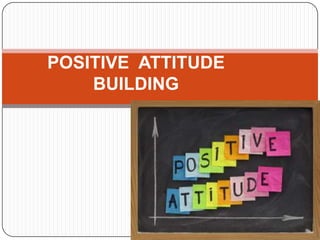
POSITIVE ATTITUDE
BUILDING
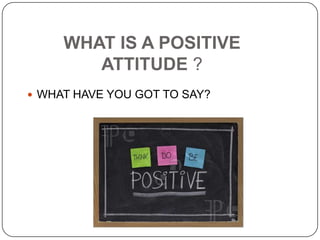
WHAT IS A POSITIVE
ATTITUDE ?
 WHAT HAVE YOU GOT TO SAY?
WHAT IS A POSITIVE
ATTITUDE?
 Attitude is the way you communicate your mood
to others
 The way you perceive the world and your position
in it directly affects your dealings with others
 a positive self image will reinforce and improve
both professional and personal relationships
ARE YOU AWARE OF THIS?
 When you are optimistic and anticipate
successful encounters you transmit a positive
attitude and people usually respond favourably
 When you are pessimistic and expect the worst
your attitude is often negative and people tend to
avoid you
 Quite simply you take the picture of life you want
to take
EMPHASIZING THE POSITIVE AND
DIFFUSING THE NEGATIVE
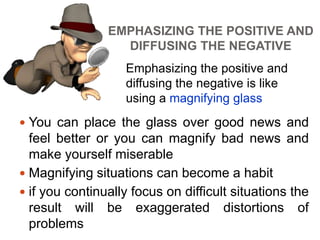
 You can place the glass over good news and
feel better or you can magnify bad news and
make yourself miserable
 Magnifying situations can become a habit
 if you continually focus on difficult situations the
result will be exaggerated distortions of
problems
Emphasizing the positive and
diffusing the negative is like
using a magnifying glass
A BETTER APPROACH
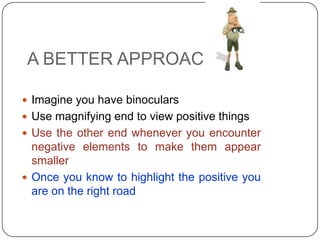
 Imagine you have binoculars
 Use magnifying end to view positive things
 Use the other end whenever you encounter
negative elements to make them appear
smaller
 Once you know to highlight the positive you
are on the right road
WHAT CAN WE LEARN FROM
THIS?
 Think more about the positive things and try to
make use of the positives to drive your life
 This means that you have learnt to alter your
imagery to highlight the positive
 This means that you are on the right road
REMEMBER! ATTITUDE IS NEVER
STATIC!
IT IS AN ONGOING DYNAMIC
PERCEPTUAL PROCESS
Unless you are on constant guard
negatives can slip in to your mind
which make your mind time spend on
difficulties rather than on
opportunities
If negative factors stay around for a
long time they will be reflected in
your disposition.
The positive may be still there but
may be overshadowed by the
negative.
Challenge!
 Push the negative factors to the outer perimeter
of your thinking
 Those who will learn the trick will reflect it and
others will notice it
 Of course! No one can be positive all the time
 Excessive optimism is not realistic
 Positive attitude is not an act. It must be genuine
HOW TO MEASURE ATTITUDES
 Self- Report
 Indirect tests
 Direct observation Techniques
 Psychological Reaction Techniques
HOW TO CHANGE ATTITUDE?
 Filling in information Gap
 use of fear
 Resolving Discrepancies
 Impact of peers
 The co-opting approach
Thank you

Attitude – changing for the best vbk

  • 1.
    Training program conductedfor Hi Tech Arai By Dr.V.Veera Balaji Kumar Attitude – Changing for the best
  • 2.
    WHAT IS MEANTBY ATTITUDE  WHAT HAVE YOU GOT TO SAY?
  • 3.
    DEFINITION OF ATTITUDE? Attitude is defined as the persistent tendency to think, feel and behave in a particular way towards some objects, persons or events.
  • 4.
    WHAT IS ANATTITUDE?  Attitude is a state of mind  Your attitude is your mind-set  It is the way you look at things mentally  Attitudes are evaluative statements  They indicate one’s feelings either favourably or unfavourably to persons objects and or events
  • 5.
    ATTITUDES ARE EVALUATIVE STATEMENTS Attitude reflect how one feels about something  It can be Positive or Negative Eg. When someone says “I like teaching” he is expressing his attitude about his work. When someone says “I hate when someone advises/teaches ” he is expressing his attitude towards receiving advice.
  • 6.
    ATTITUDE IS YOURMENTAL FOCUS ON THE OUTSIDE WORLD  Like using a camera you can focus or set your mind on what appeals to you  You can see situations as either opportunities or failures  Examples  A hot summer day may be beautiful or ugly  A departmental meeting is either interesting or boring
  • 7.
    HOW ATTITUDE WORKS? It is a cognitive and affective evaluation that predisposes a person to act in a certain way Cognitive Affective BEHAVIOUR
  • 8.
    THREE COMPONENTS OF ATTITUDES? Cognitions (Thoughts)  Affections (Feelings)  Behaviour ( Actions and reactions)
  • 9.
  • 10.
    Cognitive or Informational component Ideas, Belief, Valuesand Information Affective or Emotional component Feelings of likes and dislikes positive & negative Behavioural component Tendency to behave Attitude Attitude Object COMPONENTS OF ATTITUDES
  • 11.
    THREE COMPONENTS OF ATTITUDES-AN EXAMPLE  Cognitions (My job is interesting)  Affections (I love my job)  Behaviour ( I am going to get to work early with a smile on my face- my intention to act)
  • 12.
    FACTORS THAT DETERMINEOUR ATTITUDE  Environment  Experience  Education
  • 13.
    ENVIRONMENT CONSISTS OFTHE FOLLOWING  Home : Positive or Negative influences.  School: Peer Pressures.  Work : Supportive or over critical Supervisor.  Media: Television, Newspapers, Magazines, Radio, movies.  Cultural back ground.  Traditions and Beliefs.  Social Environment.  Political Environment.
  • 14.
  • 15.
    What are thesalient features about attitudes?  Attitudes are related to feelings and beliefs about people  Attitude is a response to persons objects or events  Attitudes affect behaviour positively or negatively  Attitudes undergo changes  Attitudes affect perception, and in turn, behaviour
  • 16.
    Attitudes and behaviour Many factors influence whether attitude and behaviour will be consistent. Some of the most significant factors include:  How strong the attitude is  How easily it comes to mind  The situation we are in  Our personal belief that we can actually perform the behaviour associated with the attitude
  • 17.
    Strength of attitude A strong attitude is well known, easily accessible, personally relevant and has a strong emotional component  The stronger the attitude the more likely it will be consistent, resistant to change and influence behaviour  Kraus (1995) found that the stronger the attitude that more likely it would predict behaviour
  • 18.
    HOW ATTITUDES AREFORMED - DIRECT LEARNING AND SOCIAL LEARNING  Attitudes are not inherited  They are acquired or learned by people from the environment in which they interact  The formation of attitudes is broadly classified in to two sources namely 1. Direct experience 2. Social Learning
  • 19.
    PROCESS OF LEARNINGATTITUDES FROM OBSERVATION- DIRECT LEARNING  One’s direct experience with an object or person serves as a powerful source for his or her attitude formation  In other words attitudes are formed on the basis of one’s past experience in concerned object or person
  • 20.
    PROCESS OF LEARNINGATTITUDES FROM OBSERVATION- SOCIAL LEARNING  The process of deriving attitudes from family peer groups religious organizations and culture is called social learning  In social learning a person acquires attitudes from his or her environment in an indirect manner  They acquire it mainly by observing their models
  • 21.
    PROCESS OF LEARNINGATTITUDES FROM OBSERVATION- SOCIAL EARNING  Attention - focus on something  Retention - what observed must be retained  Reproduction - Behaviour must be practiced again and again  Motivation - learner must be motivated to learn from it
  • 22.
    ROLE OF CULTUREIN ATTITUDE FORMATION  Culture plays a definitive role in the formation of attitudes  Eg- Indians earn for future requirements  Americans for that matter earn to enjoy the present
  • 23.
    THREE TYPES OFJOB RELATED ATTITUDES  Job satisfaction - Individual’s pleasurable or positive emotional state toward his job  Job Involvement - the degree to which people immerse themselves in their jobs - It is identifying with one’s job  Organizational commitment - it is about employees loyalty towards their organizations - It is identifying with one’s organization
  • 24.
    JOB SATISFACTION ISRELATED WITH FIVE SPECIFC JOB DIMENSIONS  PAY  WORK ITSELF  PROMOTIONAL OPPORTUNITIES  SUPERVISION  CO-WORKERS
  • 25.
    JOB INVOLVEMENT  Itis the degree to which employees immerse themselves in their jobs, invest time and energy in them and consider work as central part of their overall lives  Such employees tend to be high performers and seldom tardy and get absent
  • 26.
    ORGANIZATIONAL COMMITMENT  Itis an attitude about employee’s commitment to the organization  It is the process by which an employee identify with the organization and and want to maintain membership with the organization
  • 27.
  • 28.
    WHAT IS APOSITIVE ATTITUDE ?  WHAT HAVE YOU GOT TO SAY?
  • 29.
    WHAT IS APOSITIVE ATTITUDE?  Attitude is the way you communicate your mood to others  The way you perceive the world and your position in it directly affects your dealings with others  a positive self image will reinforce and improve both professional and personal relationships
  • 30.
    ARE YOU AWAREOF THIS?  When you are optimistic and anticipate successful encounters you transmit a positive attitude and people usually respond favourably  When you are pessimistic and expect the worst your attitude is often negative and people tend to avoid you  Quite simply you take the picture of life you want to take
  • 31.
    EMPHASIZING THE POSITIVEAND DIFFUSING THE NEGATIVE  You can place the glass over good news and feel better or you can magnify bad news and make yourself miserable  Magnifying situations can become a habit  if you continually focus on difficult situations the result will be exaggerated distortions of problems Emphasizing the positive and diffusing the negative is like using a magnifying glass
  • 32.
    A BETTER APPROACH Imagine you have binoculars  Use magnifying end to view positive things  Use the other end whenever you encounter negative elements to make them appear smaller  Once you know to highlight the positive you are on the right road
  • 33.
    WHAT CAN WELEARN FROM THIS?  Think more about the positive things and try to make use of the positives to drive your life  This means that you have learnt to alter your imagery to highlight the positive  This means that you are on the right road
  • 34.
    REMEMBER! ATTITUDE ISNEVER STATIC! IT IS AN ONGOING DYNAMIC PERCEPTUAL PROCESS
  • 35.
    Unless you areon constant guard negatives can slip in to your mind which make your mind time spend on difficulties rather than on opportunities
  • 36.
    If negative factorsstay around for a long time they will be reflected in your disposition. The positive may be still there but may be overshadowed by the negative.
  • 37.
    Challenge!  Push thenegative factors to the outer perimeter of your thinking  Those who will learn the trick will reflect it and others will notice it  Of course! No one can be positive all the time  Excessive optimism is not realistic  Positive attitude is not an act. It must be genuine
  • 38.
    HOW TO MEASUREATTITUDES  Self- Report  Indirect tests  Direct observation Techniques  Psychological Reaction Techniques
  • 39.
    HOW TO CHANGEATTITUDE?  Filling in information Gap  use of fear  Resolving Discrepancies  Impact of peers  The co-opting approach
  • 40.