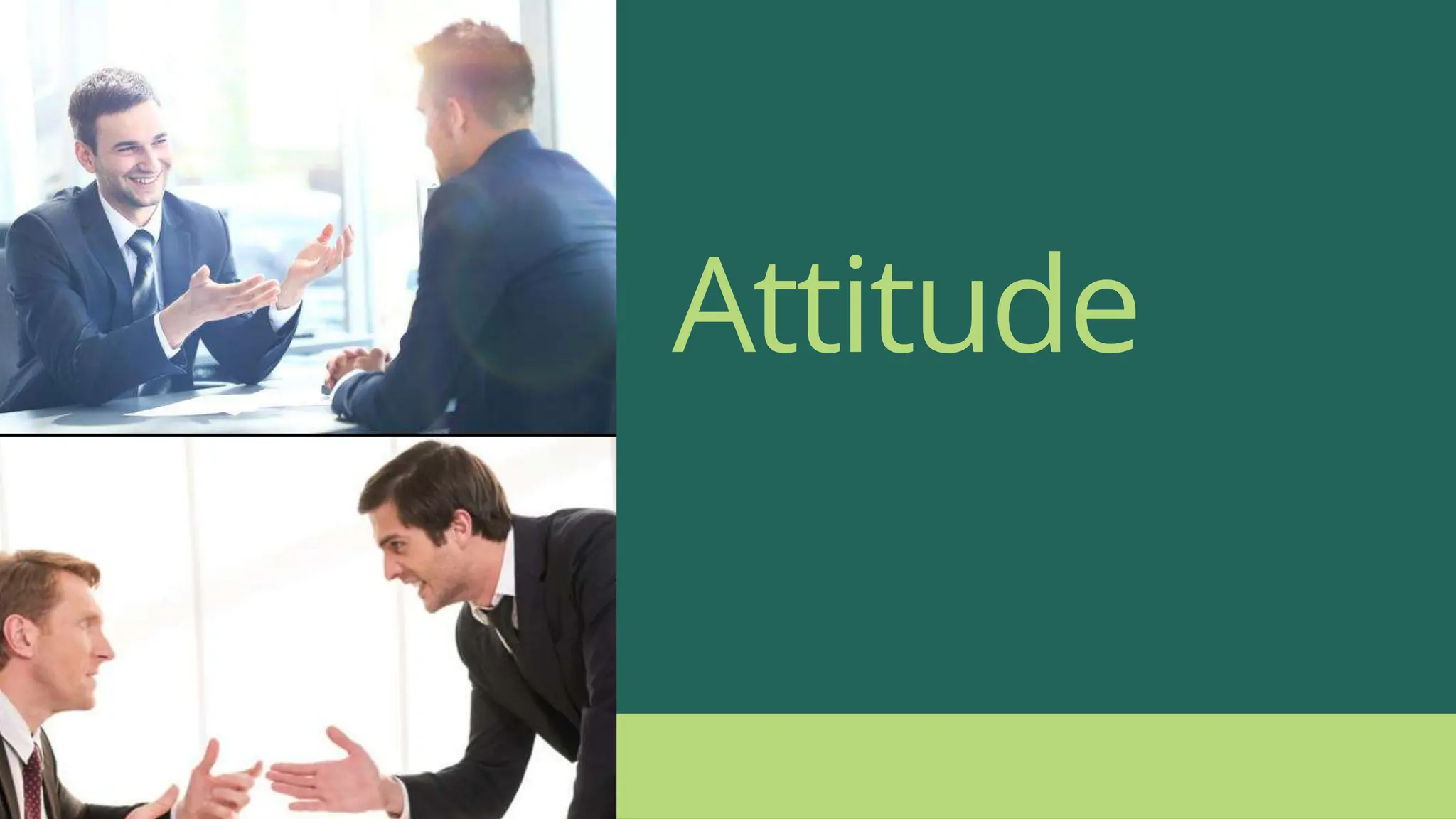
Attitude
Introduction
Attitude and Behavior
Factors in attitude formation
Different attitude at workplace
Ways of changing attitude
Content
Intoduction
⚬MEANING
Attitude is a predisposition to react to a
situation, person.
This response can be either positive or
negative.
⚬DEFINITION
According to Gibson, Ivancevich and
Donnelly," attitude is a mental sate of
readiness, organized through experience,
exerting a specific influence upon a person's
response to people, objects, and situations
with which it is related."
Introduction
Nature of Attitude
⚬An attitude is a state of mind.
⚬Attitudes are persistent in nature.
⚬It is directed towards an object.
⚬Attitudes are an internal feeling, they may
be expressed to others or kept to oneself.
⚬It is learned from a person's past
experience, observation and other's
attitude.
ATTITUDE
Components Of Attitude
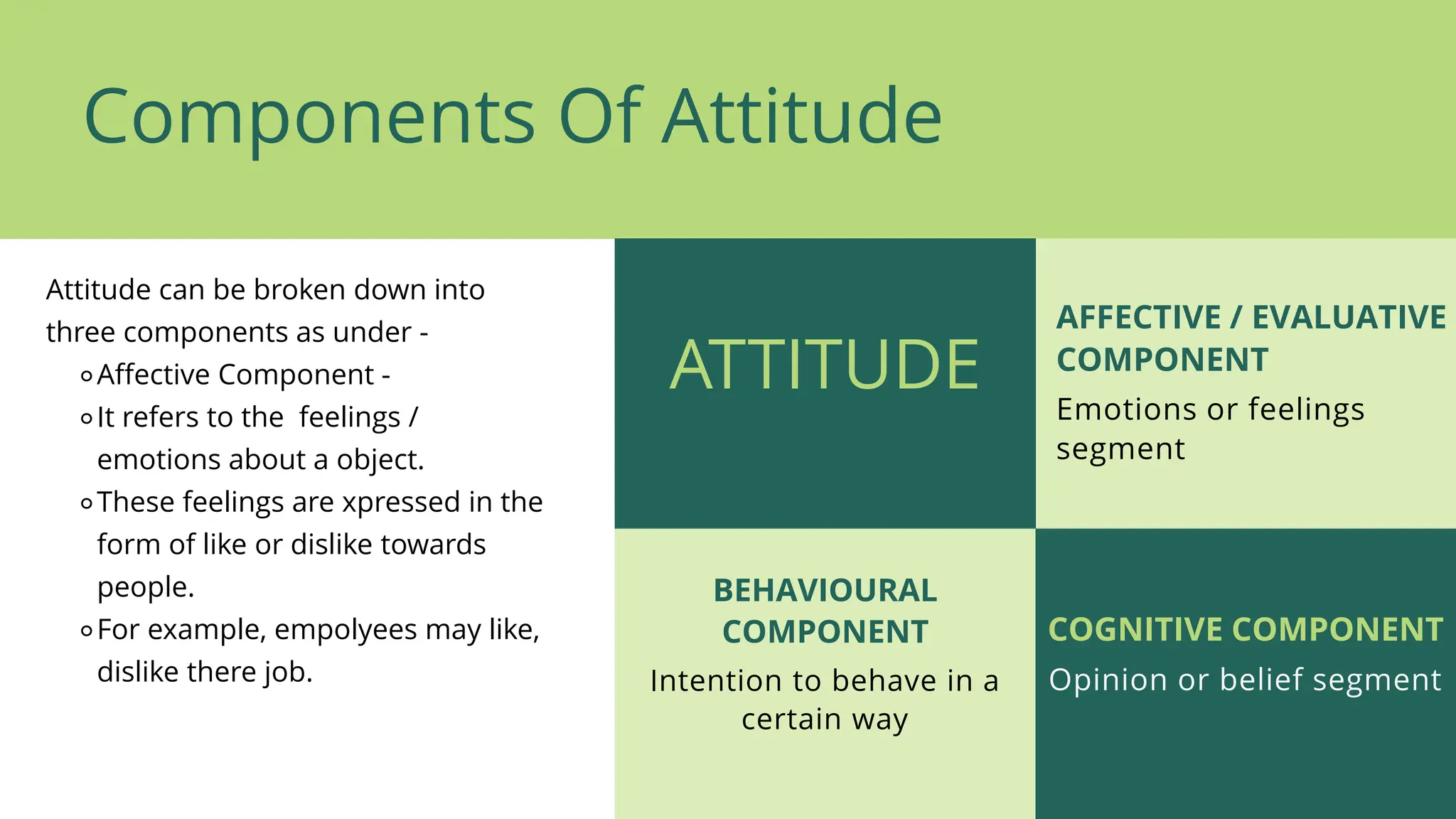
Attitude can be broken down into
three components as under -
⚬Affective Component -
⚬It refers to the feelings /
emotions about a object.
⚬These feelings are xpressed in the
form of like or dislike towards
people.
⚬For example, empolyees may like,
dislike there job.
AFFECTIVE / EVALUATIVE
COMPONENT
Emotions or feelings
segment
COGNITIVE COMPONENT
Opinion or belief segment
BEHAVIOURAL
COMPONENT
Intention to behave in a
certain way
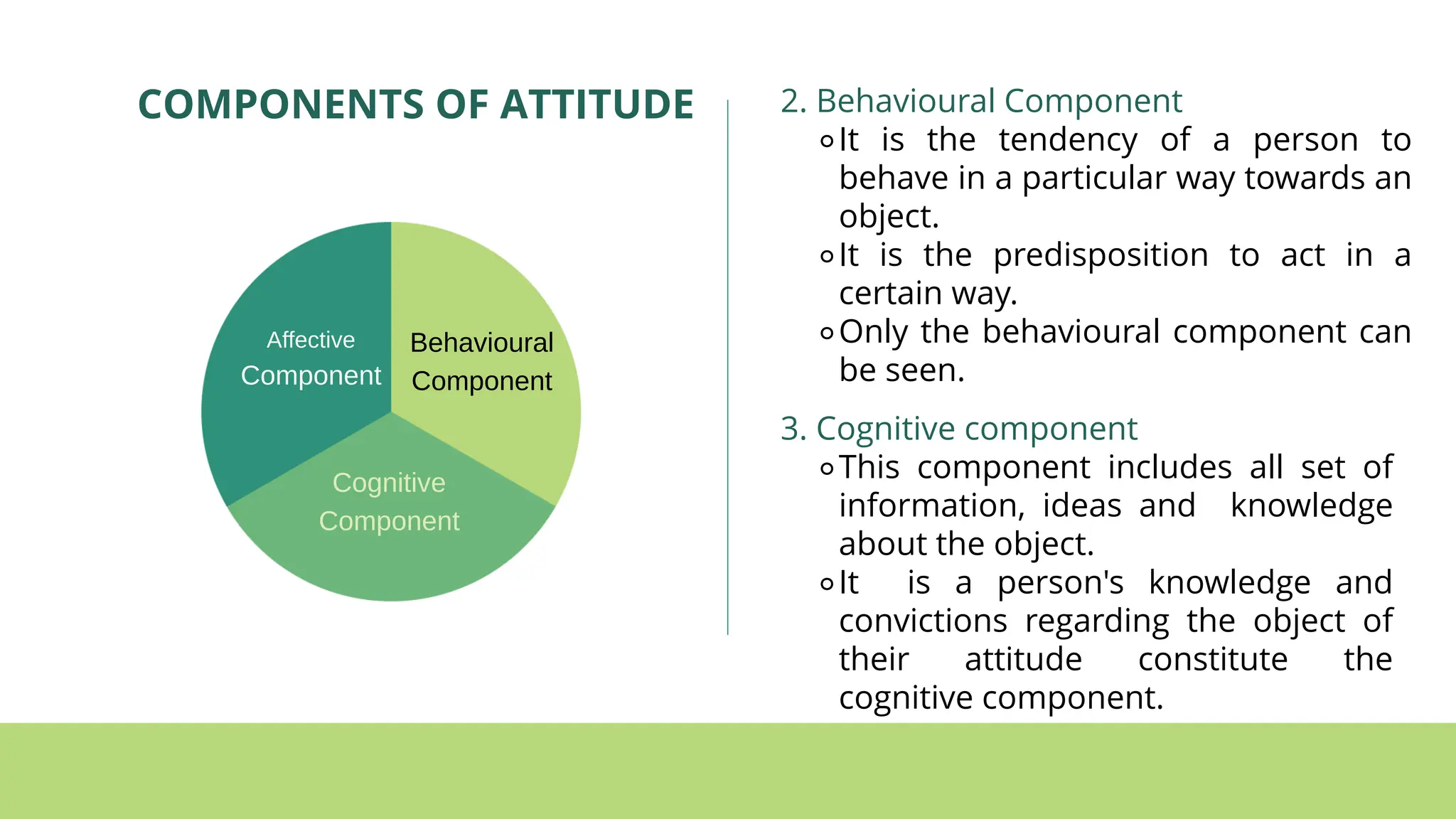
COMPONENTS OF ATTITUDE 2. Behavioural Component
⚬It is the tendency of a person to
behave in a particular way towards an
object.
⚬It is the predisposition to act in a
certain way.
⚬Only the behavioural component can
be seen.
3. Cognitive component
⚬This component includes all set of
information, ideas and knowledge
about the object.
⚬It is a person's knowledge and
convictions regarding the object of
their attitude constitute the
cognitive component.
Behavioural
Component
Affective
Component
Cognitive
Component
ATTITUDE AND BEHAVIOR
WHAT IS THE DIFFERENCE BETWEEN ATTITUDE AND BEHAVIOR
• In social psychology, attitudes and behaviors are viewed
as connected to each other. It is important to
remember, though, that attitudes and behavior are not
the same things.
• Attitudes are predisposed feelings toward people,
places, or things. They are different from beliefs, but
beliefs can influence our attitudes.
• Behaviors are actions in response to stimuli. This
includes observable actions, unobservable mental
processes, and non-conscious processes.
• Central route processing is when someone encounters an argument and thoughtfully
considers the logic and strength of the argument's key points. When this happens,
someone might be persuaded to adopt a new attitude or change an old attitude based on
the overall merit of the argument.
EFFECT OF ATTITUDE ON
BEHAVIOR
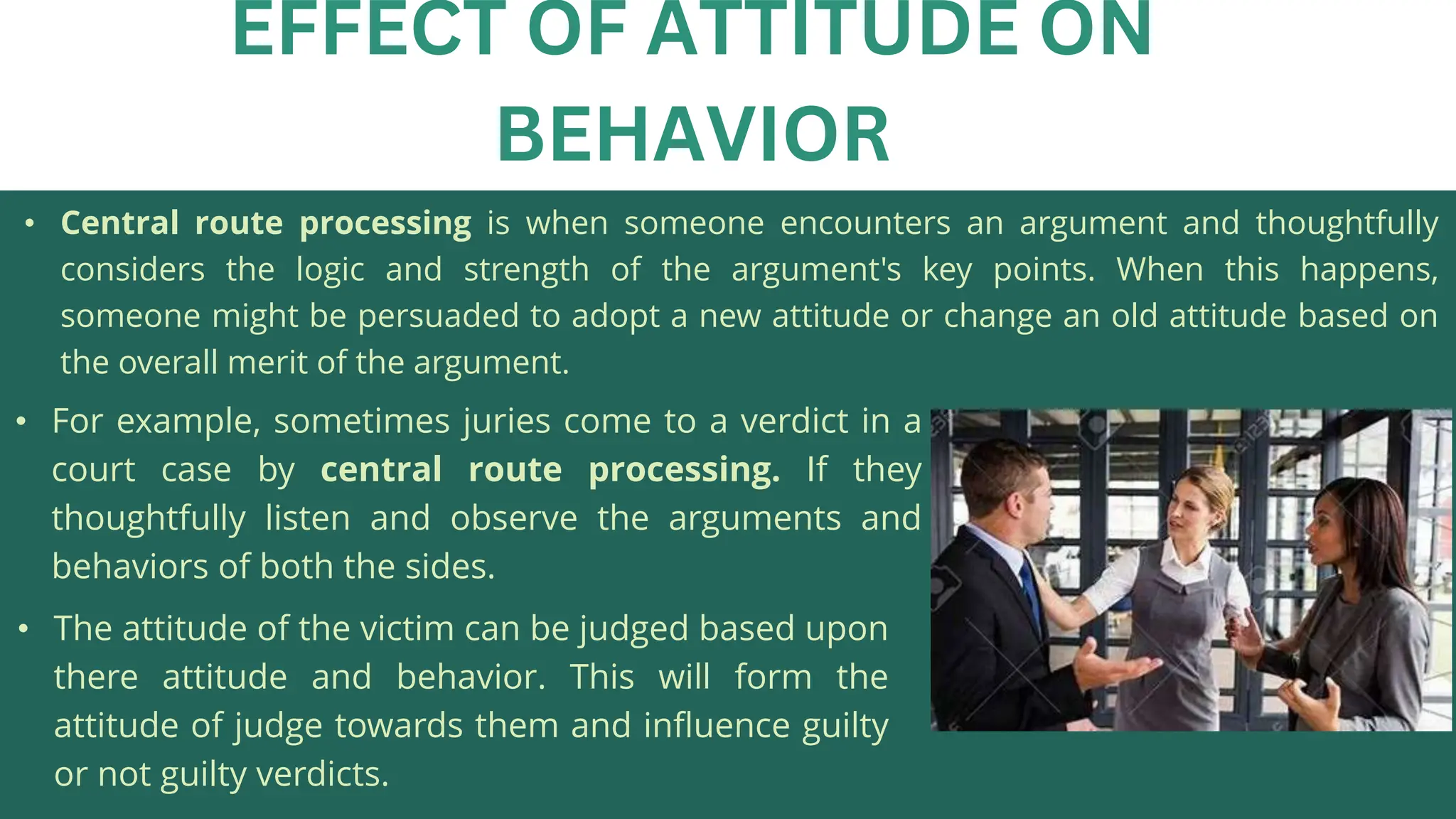
• For example, sometimes juries come to a verdict in a
court case by central route processing. If they
thoughtfully listen and observe the arguments and
behaviors of both the sides.
• The attitude of the victim can be judged based upon
there attitude and behavior. This will form the
attitude of judge towards them and influence guilty
or not guilty verdicts.
• Peripheral route processing is when someone is
persuaded by factors that are not a part of an
argument's key points, such as an emotional appeal
or the person presenting the argument.
• For instance, TV commercials show well-known
people and places to make their products seem more
attractive. We get attracted to try the product because
of the people and places in the commercial and not
because of the product.
EFFECT OF ATTITUDE ON BEHAVIOR
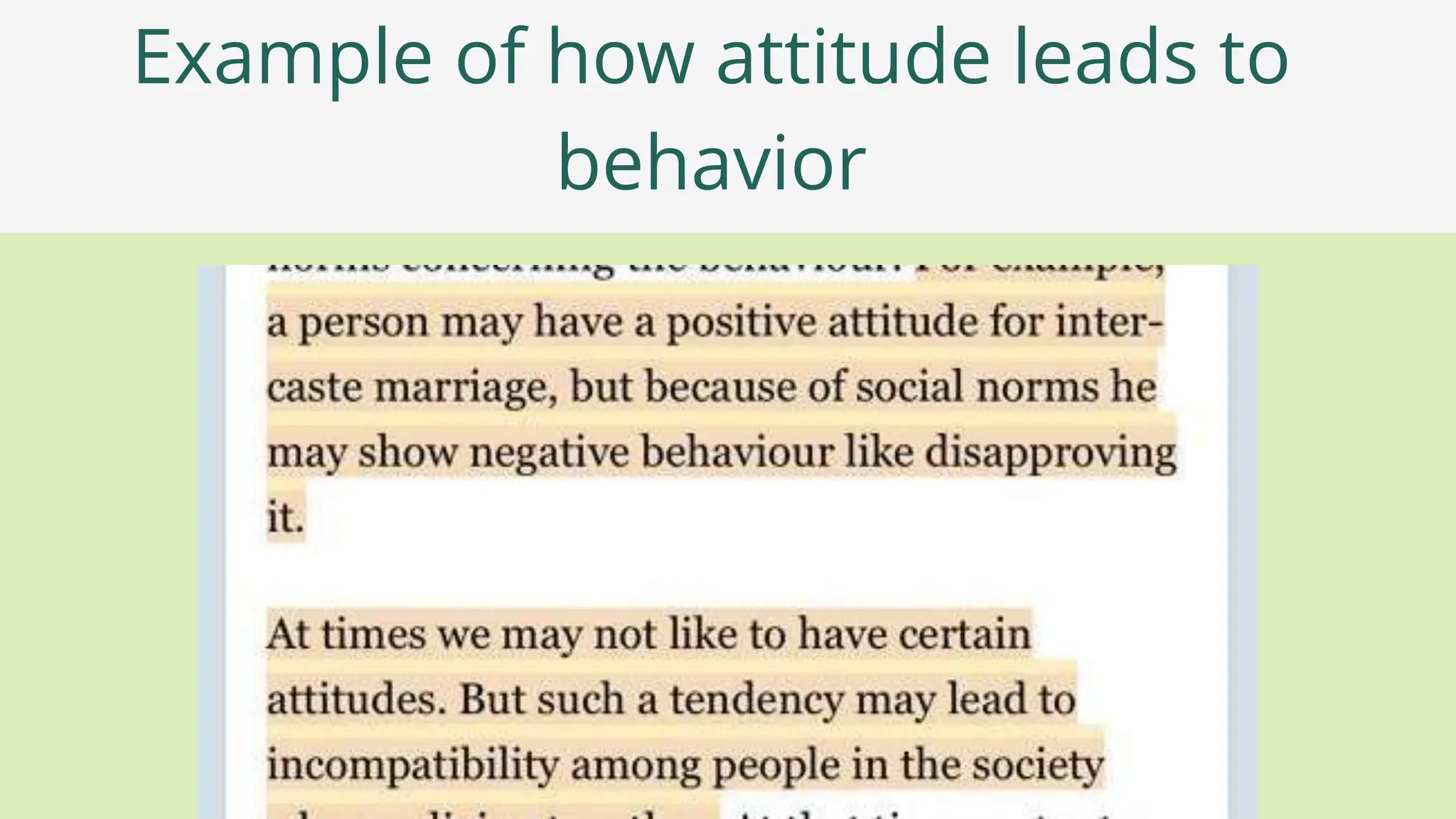
Example of how attitude leads to
behavior
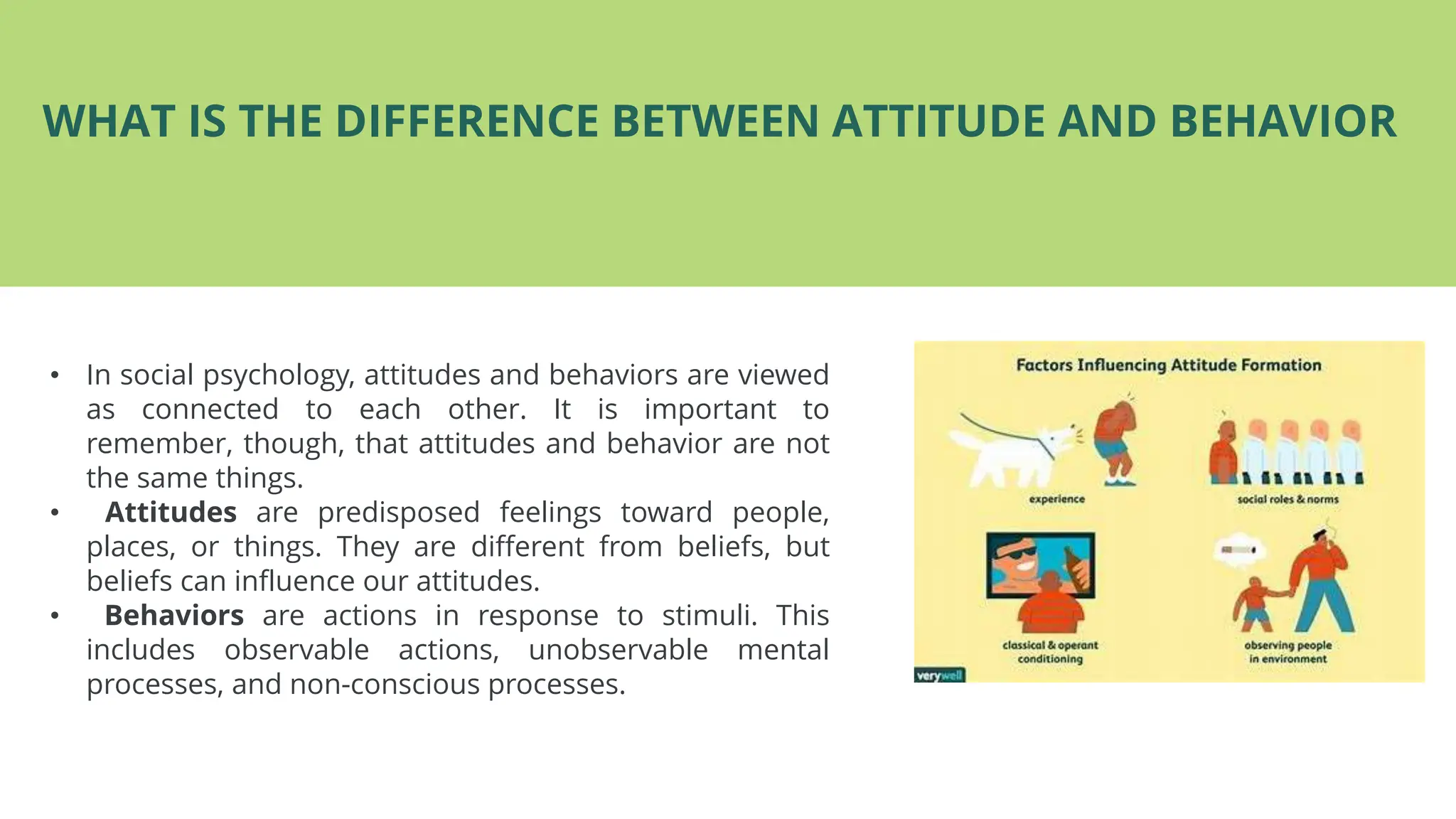
FACTORS IN ATTITUDE FORMATION
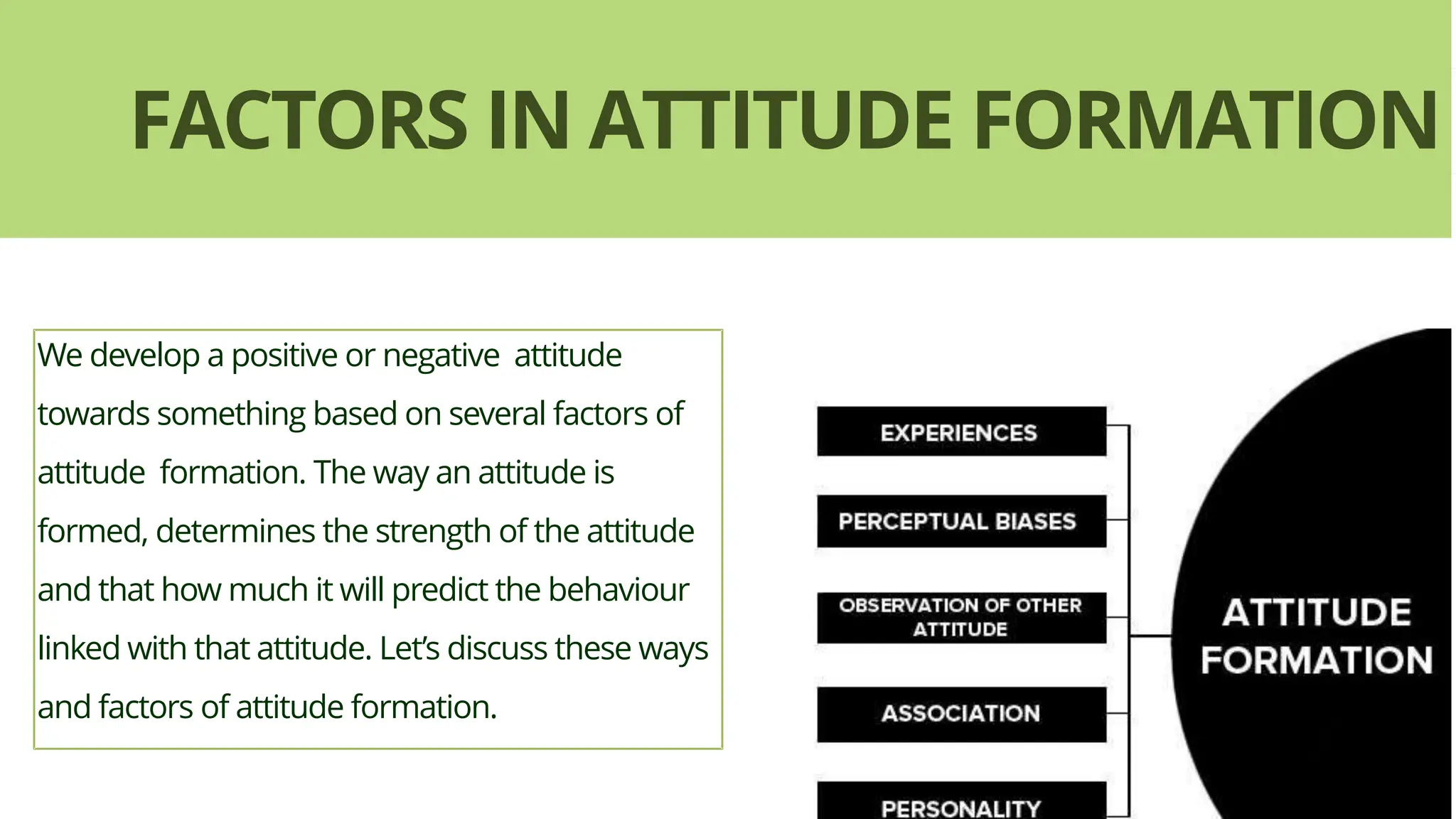
We develop a positive or negative attitude
towards something based on several factors of
attitude formation. The way an attitude is
formed, determines the strength of the attitude
and that how much it will predict the behaviour
linked with that attitude. Let’s discuss these ways
and factors of attitude formation.
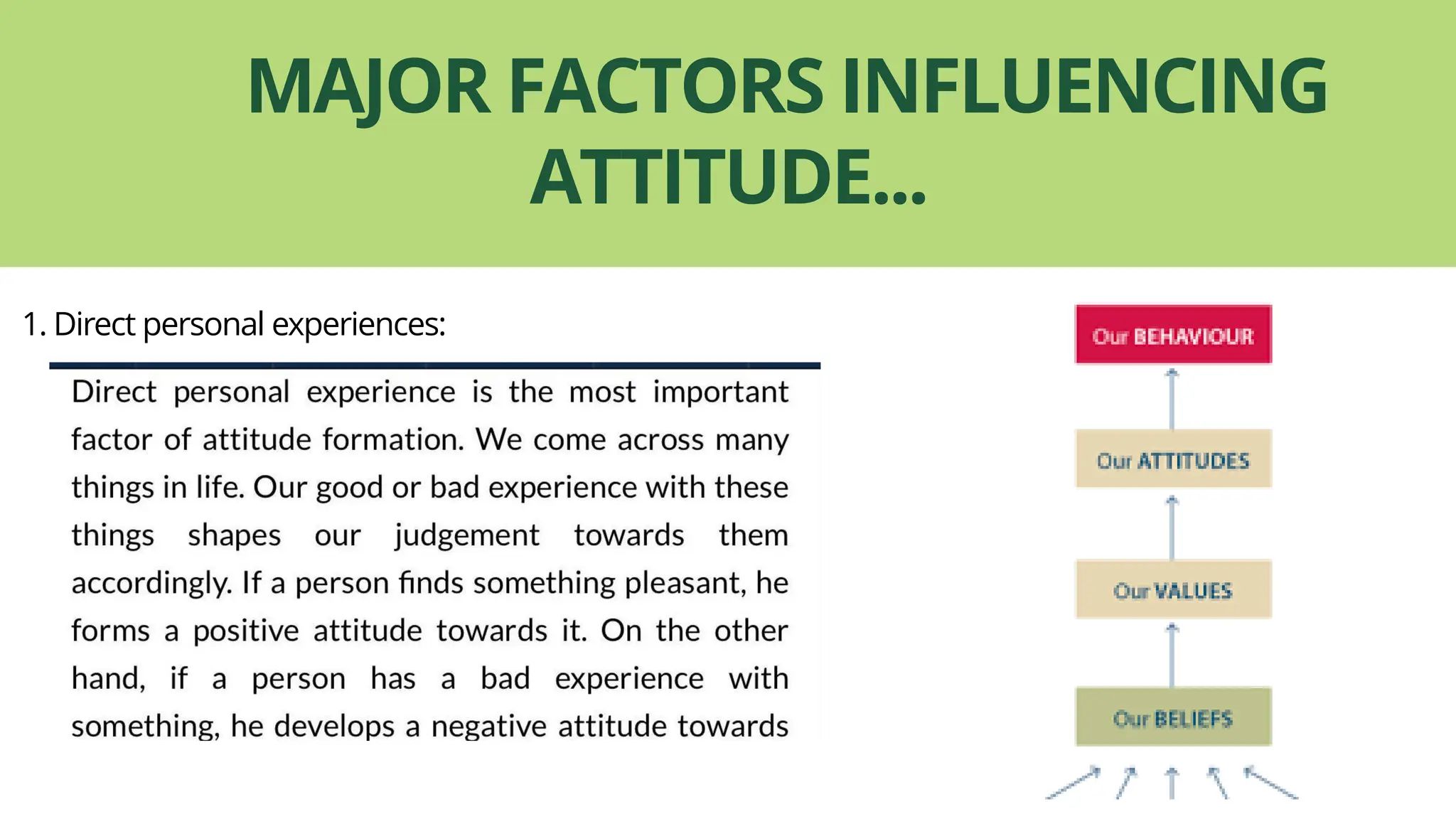
MAJOR FACTORS INFLUENCING
ATTITUDE...
1. Direct personal experiences:
CONTINUE...
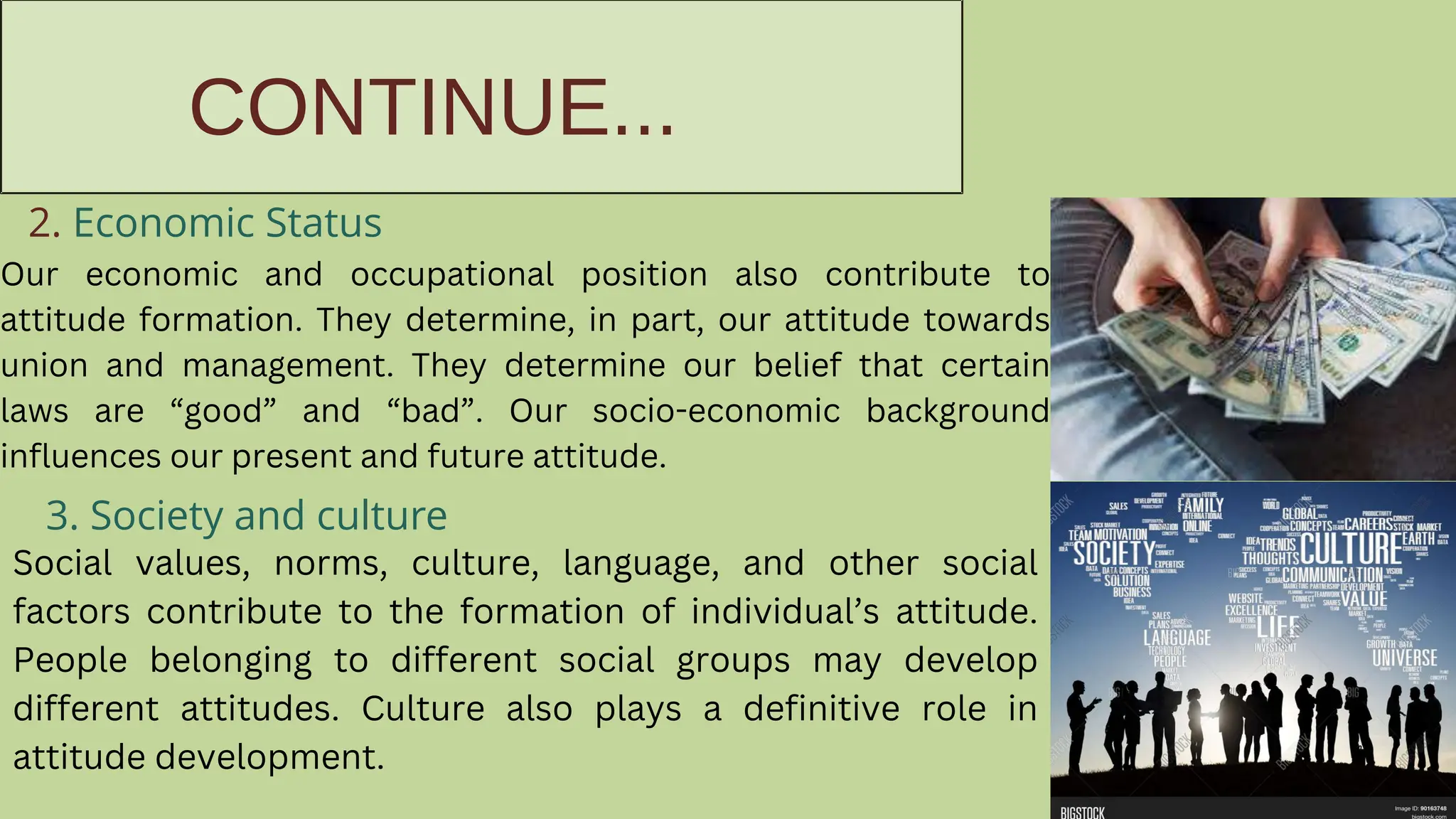
2. Economic Status
Our economic and occupational position also contribute to
attitude formation. They determine, in part, our attitude towards
union and management. They determine our belief that certain
laws are “good” and “bad”. Our socio-economic background
influences our present and future attitude.
3. Society and culture
Social values, norms, culture, language, and other social
factors contribute to the formation of individual’s attitude.
People belonging to different social groups may develop
different attitudes. Culture also plays a definitive role in
attitude development.
CONTINUE...
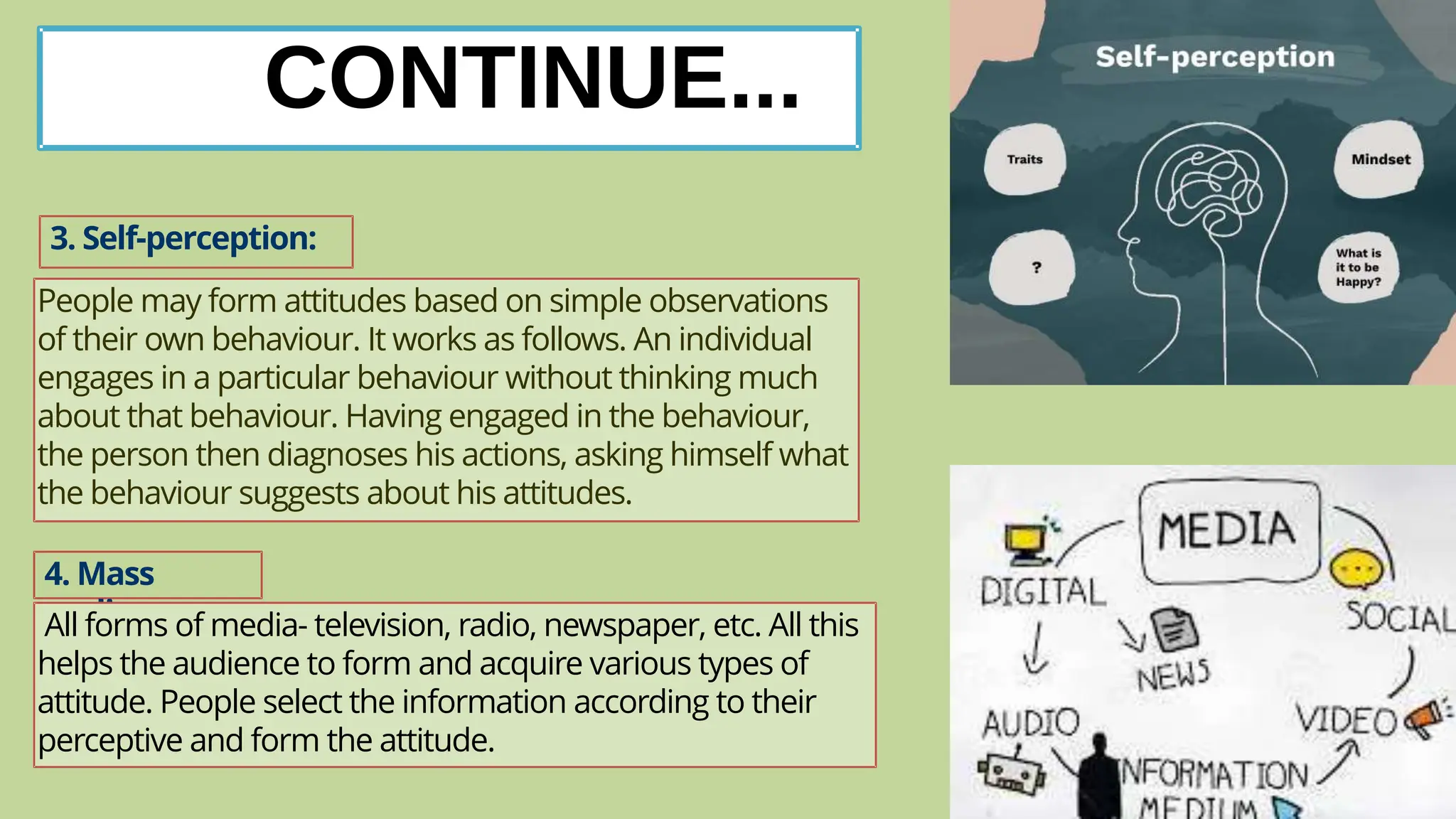
3. Self-perception:
People may form attitudes based on simple observations
of their own behaviour. It works as follows. An individual
engages in a particular behaviour without thinking much
about that behaviour. Having engaged in the behaviour,
the person then diagnoses his actions, asking himself what
the behaviour suggests about his attitudes.
4. Mass
media:
All forms of media- television, radio, newspaper, etc. All this
helps the audience to form and acquire various types of
attitude. People select the information according to their
perceptive and form the attitude.
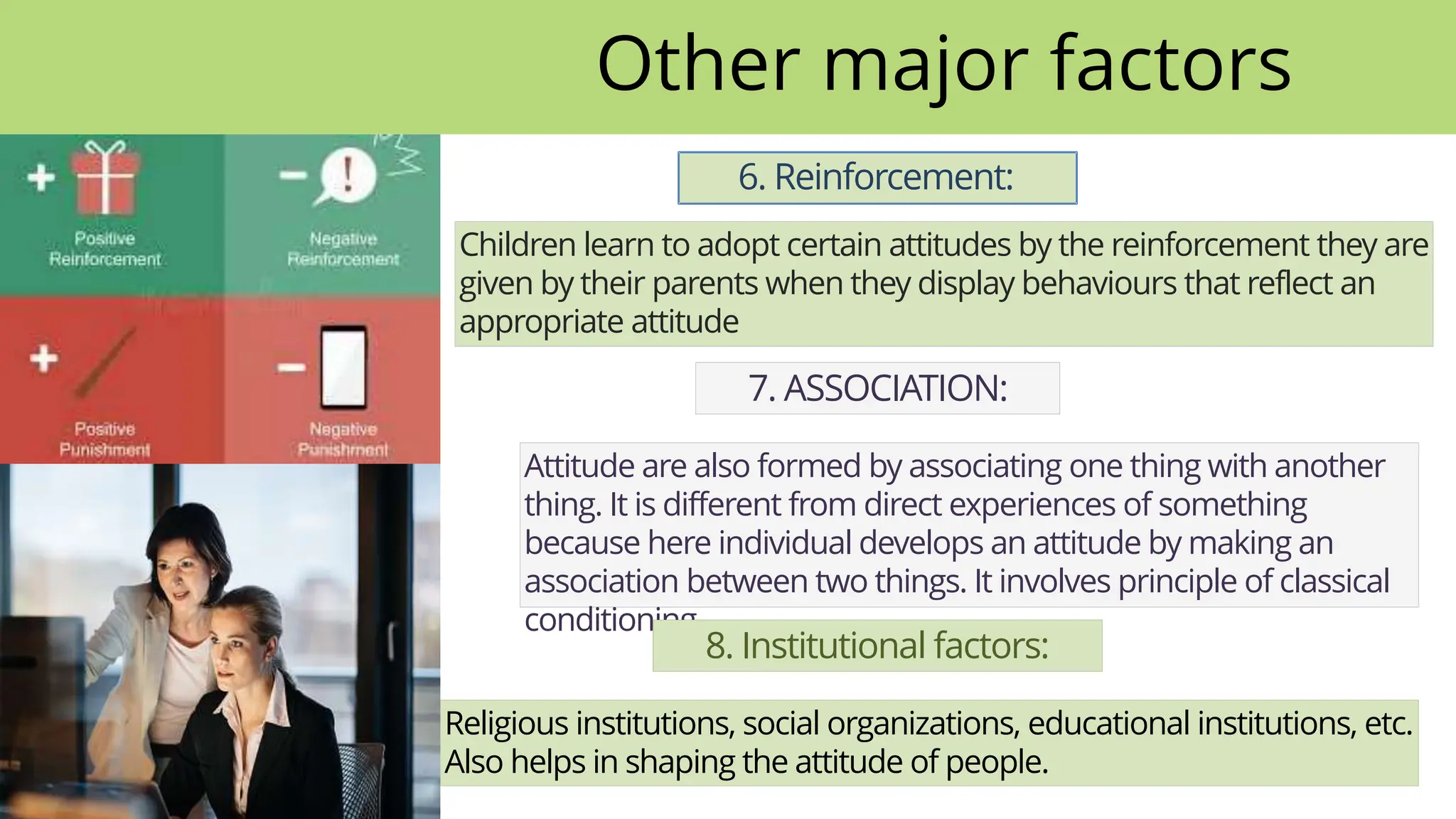
6. Reinforcement:
Children learn to adopt certain attitudes by the reinforcement they are
given by their parents when they display behaviours that reflect an
appropriate attitude
7. ASSOCIATION:
Attitude are also formed by associating one thing with another
thing. It is different from direct experiences of something
because here individual develops an attitude by making an
association between two things. It involves principle of classical
conditioning.
8. Institutional factors:
Religious institutions, social organizations, educational institutions, etc.
Also helps in shaping the attitude of people.
Other major factors
Organizational commitment is the emotional attachment
people have toward the company they work for.
A highly committed employee is one who accepts and believes
in the company’s values, is willing to put out effort to meet the
company’s goals, and has a strong desire to remain with the
company.
People who are committed to their company often refer to
their company as “we” as opposed to “they” as in “in this
company, we have great benefits.”
The way we refer to the company indicates the type of
attachment and identification we have with the company.
Attitude at workplace
• Organizational
Commitment
Attitude at workplace
2. Job Satisfaction it refers to the general attitude of employees towards their
jobs. Job satisfaction probably is the most widely studied
variable in OB.
when the attitude of an employee towards his or her job is
positive , there exists job satisfaction.
Dissatisfaction exists when the attitude is negative. Job
satisfaction is important for management as it has impact on
turnover, productivity, absenteeism and other job related
aspects.
O
Attitude at workplace
3. Job Involvement
It refers to an intrinsic task reflecting a sense
of self-control in relation to one's work role
Job involvement refers to how closely an
individual is linked with his or her job, how
active he or she engages in it, and
understanding how essential his or her
performance is to one’s self-worth.
4. Psychological Empowerment
The higher the job involvement, the higher the
productivity in the organization. Here,
employees feel the job they have really a
value that enhances their self-worth.
Psychological empowerment theory holds
that empowered employees have a more
positive orientation toward his or her work.
This reflects an orientation where
employees want to have, and actually have,
confidence in shaping their work role
Attitude at workplace
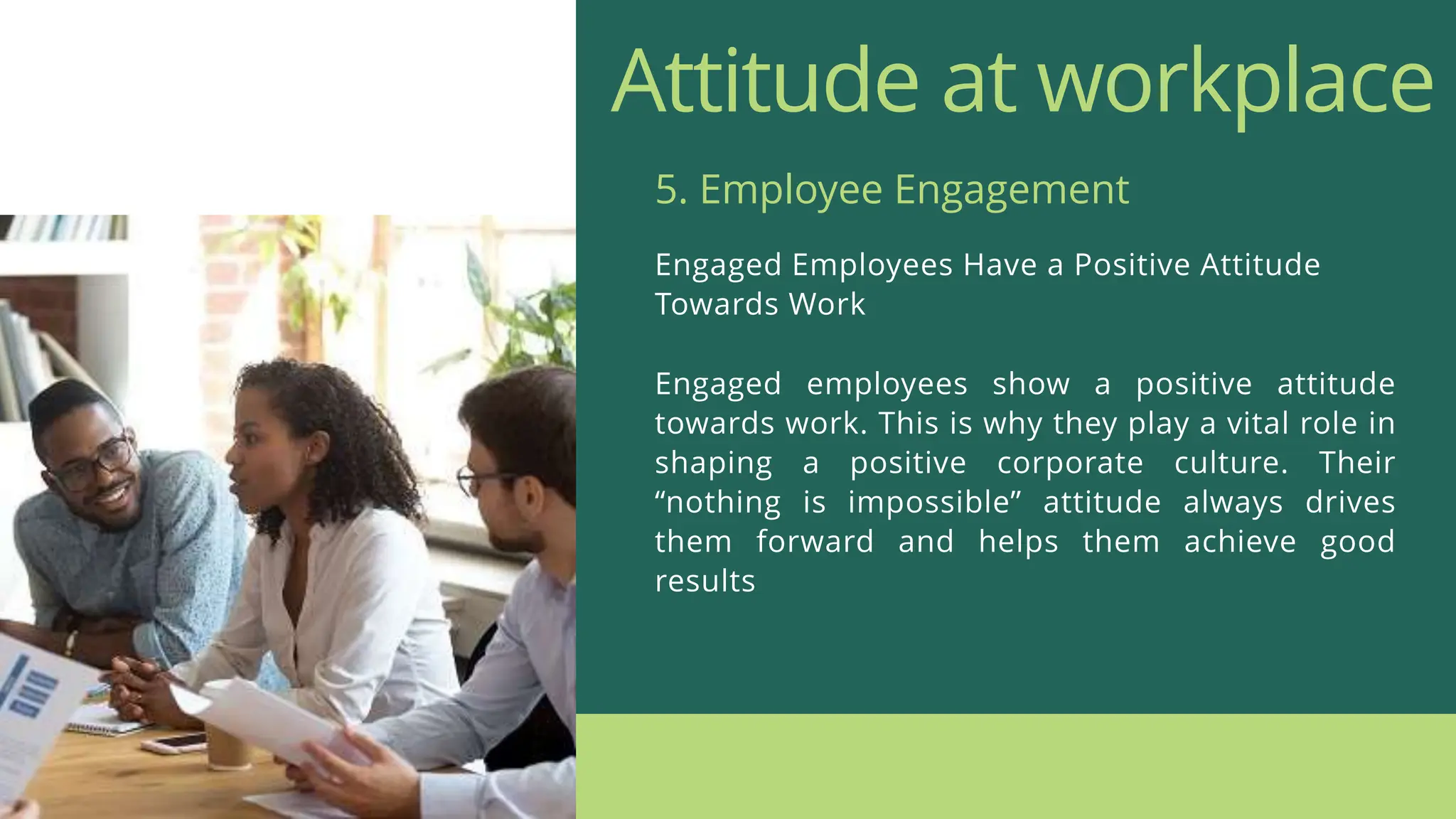
Engaged Employees Have a Positive Attitude
Towards Work
5. Employee Engagement
Engaged employees show a positive attitude
towards work. This is why they play a vital role in
shaping a positive corporate culture. Their
“nothing is impossible” attitude always drives
them forward and helps them achieve good
results
⚬Changing one's attitude
⚬1. Thinking for one self - the individual should develop his or her
own attitude based on other's input.
2. Be aware of one's attitude - people who arepositive have higher
level of job satisfaction. the individual needs to maintain positive
attitude consciously.
3. Keep an open mind - The individual should listen to other
person's input and use it to develop positive attitude.
Ways of changing attitude
⚬Changing one's attitude
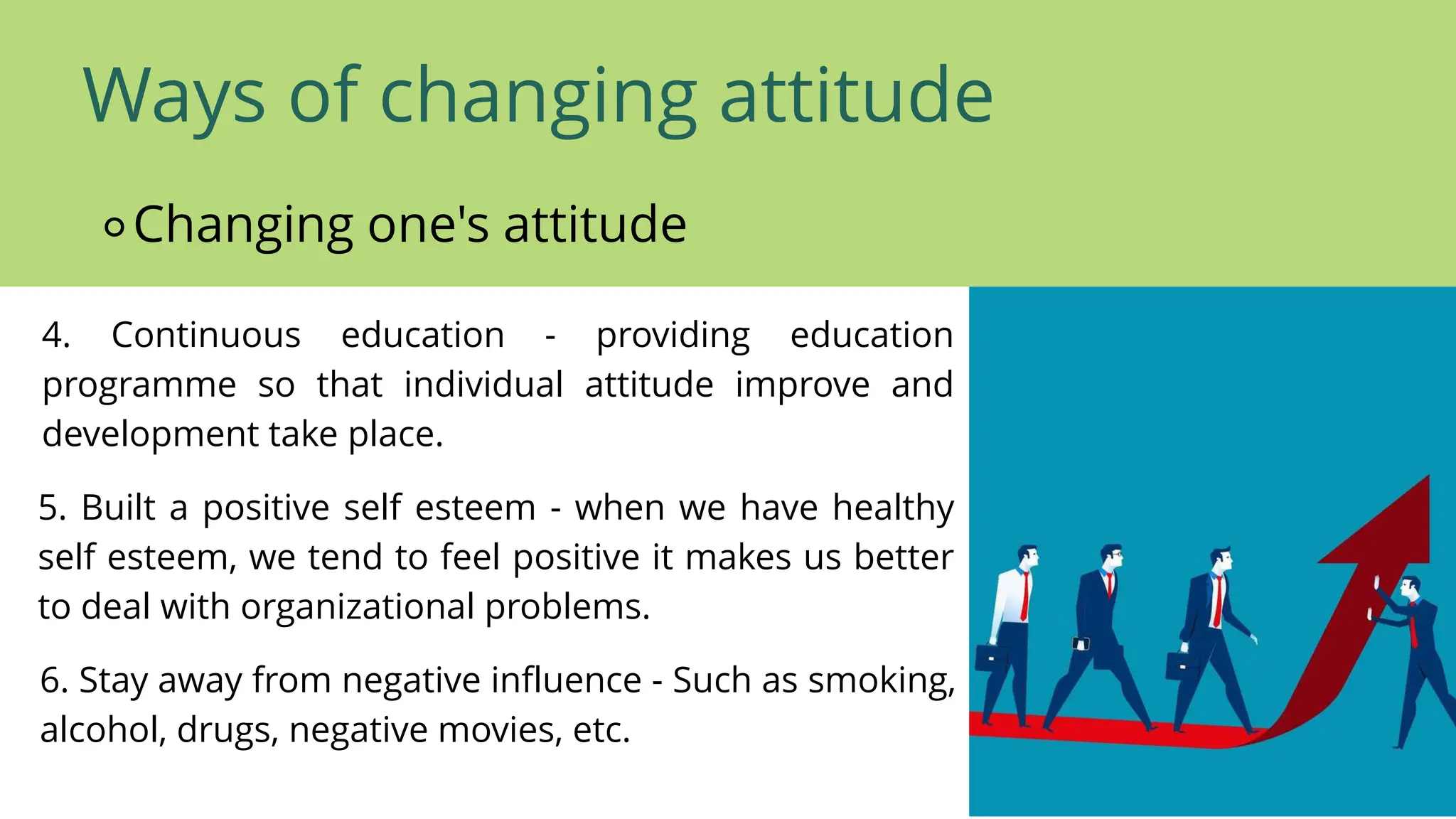
4. Continuous education - providing education
programme so that individual attitude improve and
development take place.
5. Built a positive self esteem - when we have healthy
self esteem, we tend to feel positive it makes us better
to deal with organizational problems.
6. Stay away from negative influence - Such as smoking,
alcohol, drugs, negative movies, etc.
Ways of changing
one's attitude
⚬Changing attitude of
employee
1. Giving feedback -
employees to be told about
their negative, if any, the
manager need to offer
alternative attitude.
2. Positive condition - employees tend to
develop positive attitude towards the work they
do well. Manager should make sure that the
working condition are pleasant and also taht
the employees have all the resources and
training to do a good job.
3. Positive role model - if the manager has a positive attitude,
employee may also have similar attitude.
Ways of changing attitude
⚬Changing attitude of employees
4. Use of fear - fear can use attitude , however the change
depends on the degree of fear.
5. Providing new information - when employees are aware of
new information and changes happening in the organization,
they perform positively.
6. Motivation - it means to stimulating an individual to act in
certain manner. motivating employees in right way creates a
positive attitude.

Attitude and Behavior for organizational behavior

  • 1.
  • 2.
    Introduction Attitude and Behavior Factorsin attitude formation Different attitude at workplace Ways of changing attitude Content
  • 3.
    Intoduction ⚬MEANING Attitude is apredisposition to react to a situation, person. This response can be either positive or negative. ⚬DEFINITION According to Gibson, Ivancevich and Donnelly," attitude is a mental sate of readiness, organized through experience, exerting a specific influence upon a person's response to people, objects, and situations with which it is related."
  • 4.
    Introduction Nature of Attitude ⚬Anattitude is a state of mind. ⚬Attitudes are persistent in nature. ⚬It is directed towards an object. ⚬Attitudes are an internal feeling, they may be expressed to others or kept to oneself. ⚬It is learned from a person's past experience, observation and other's attitude.
  • 5.
    ATTITUDE Components Of Attitude Attitudecan be broken down into three components as under - ⚬Affective Component - ⚬It refers to the feelings / emotions about a object. ⚬These feelings are xpressed in the form of like or dislike towards people. ⚬For example, empolyees may like, dislike there job. AFFECTIVE / EVALUATIVE COMPONENT Emotions or feelings segment COGNITIVE COMPONENT Opinion or belief segment BEHAVIOURAL COMPONENT Intention to behave in a certain way
  • 6.
    COMPONENTS OF ATTITUDE2. Behavioural Component ⚬It is the tendency of a person to behave in a particular way towards an object. ⚬It is the predisposition to act in a certain way. ⚬Only the behavioural component can be seen. 3. Cognitive component ⚬This component includes all set of information, ideas and knowledge about the object. ⚬It is a person's knowledge and convictions regarding the object of their attitude constitute the cognitive component. Behavioural Component Affective Component Cognitive Component
  • 7.
  • 8.
    WHAT IS THEDIFFERENCE BETWEEN ATTITUDE AND BEHAVIOR • In social psychology, attitudes and behaviors are viewed as connected to each other. It is important to remember, though, that attitudes and behavior are not the same things. • Attitudes are predisposed feelings toward people, places, or things. They are different from beliefs, but beliefs can influence our attitudes. • Behaviors are actions in response to stimuli. This includes observable actions, unobservable mental processes, and non-conscious processes.
  • 9.
    • Central routeprocessing is when someone encounters an argument and thoughtfully considers the logic and strength of the argument's key points. When this happens, someone might be persuaded to adopt a new attitude or change an old attitude based on the overall merit of the argument. EFFECT OF ATTITUDE ON BEHAVIOR • For example, sometimes juries come to a verdict in a court case by central route processing. If they thoughtfully listen and observe the arguments and behaviors of both the sides. • The attitude of the victim can be judged based upon there attitude and behavior. This will form the attitude of judge towards them and influence guilty or not guilty verdicts.
  • 10.
    • Peripheral routeprocessing is when someone is persuaded by factors that are not a part of an argument's key points, such as an emotional appeal or the person presenting the argument. • For instance, TV commercials show well-known people and places to make their products seem more attractive. We get attracted to try the product because of the people and places in the commercial and not because of the product. EFFECT OF ATTITUDE ON BEHAVIOR
  • 11.
    Example of howattitude leads to behavior
  • 12.
    FACTORS IN ATTITUDEFORMATION We develop a positive or negative attitude towards something based on several factors of attitude formation. The way an attitude is formed, determines the strength of the attitude and that how much it will predict the behaviour linked with that attitude. Let’s discuss these ways and factors of attitude formation.
  • 13.
    MAJOR FACTORS INFLUENCING ATTITUDE... 1.Direct personal experiences:
  • 14.
    CONTINUE... 2. Economic Status Oureconomic and occupational position also contribute to attitude formation. They determine, in part, our attitude towards union and management. They determine our belief that certain laws are “good” and “bad”. Our socio-economic background influences our present and future attitude. 3. Society and culture Social values, norms, culture, language, and other social factors contribute to the formation of individual’s attitude. People belonging to different social groups may develop different attitudes. Culture also plays a definitive role in attitude development.
  • 15.
    CONTINUE... 3. Self-perception: People mayform attitudes based on simple observations of their own behaviour. It works as follows. An individual engages in a particular behaviour without thinking much about that behaviour. Having engaged in the behaviour, the person then diagnoses his actions, asking himself what the behaviour suggests about his attitudes. 4. Mass media: All forms of media- television, radio, newspaper, etc. All this helps the audience to form and acquire various types of attitude. People select the information according to their perceptive and form the attitude.
  • 16.
    6. Reinforcement: Children learnto adopt certain attitudes by the reinforcement they are given by their parents when they display behaviours that reflect an appropriate attitude 7. ASSOCIATION: Attitude are also formed by associating one thing with another thing. It is different from direct experiences of something because here individual develops an attitude by making an association between two things. It involves principle of classical conditioning. 8. Institutional factors: Religious institutions, social organizations, educational institutions, etc. Also helps in shaping the attitude of people. Other major factors
  • 17.
    Organizational commitment isthe emotional attachment people have toward the company they work for. A highly committed employee is one who accepts and believes in the company’s values, is willing to put out effort to meet the company’s goals, and has a strong desire to remain with the company. People who are committed to their company often refer to their company as “we” as opposed to “they” as in “in this company, we have great benefits.” The way we refer to the company indicates the type of attachment and identification we have with the company. Attitude at workplace • Organizational Commitment
  • 18.
    Attitude at workplace 2.Job Satisfaction it refers to the general attitude of employees towards their jobs. Job satisfaction probably is the most widely studied variable in OB. when the attitude of an employee towards his or her job is positive , there exists job satisfaction. Dissatisfaction exists when the attitude is negative. Job satisfaction is important for management as it has impact on turnover, productivity, absenteeism and other job related aspects. O
  • 19.
    Attitude at workplace 3.Job Involvement It refers to an intrinsic task reflecting a sense of self-control in relation to one's work role Job involvement refers to how closely an individual is linked with his or her job, how active he or she engages in it, and understanding how essential his or her performance is to one’s self-worth. 4. Psychological Empowerment The higher the job involvement, the higher the productivity in the organization. Here, employees feel the job they have really a value that enhances their self-worth. Psychological empowerment theory holds that empowered employees have a more positive orientation toward his or her work. This reflects an orientation where employees want to have, and actually have, confidence in shaping their work role
  • 20.
    Attitude at workplace EngagedEmployees Have a Positive Attitude Towards Work 5. Employee Engagement Engaged employees show a positive attitude towards work. This is why they play a vital role in shaping a positive corporate culture. Their “nothing is impossible” attitude always drives them forward and helps them achieve good results
  • 21.
    ⚬Changing one's attitude ⚬1.Thinking for one self - the individual should develop his or her own attitude based on other's input. 2. Be aware of one's attitude - people who arepositive have higher level of job satisfaction. the individual needs to maintain positive attitude consciously. 3. Keep an open mind - The individual should listen to other person's input and use it to develop positive attitude. Ways of changing attitude
  • 22.
    Ways of changingattitude ⚬Changing one's attitude 4. Continuous education - providing education programme so that individual attitude improve and development take place. 5. Built a positive self esteem - when we have healthy self esteem, we tend to feel positive it makes us better to deal with organizational problems. 6. Stay away from negative influence - Such as smoking, alcohol, drugs, negative movies, etc.
  • 23.
    Ways of changing one'sattitude ⚬Changing attitude of employee 1. Giving feedback - employees to be told about their negative, if any, the manager need to offer alternative attitude. 2. Positive condition - employees tend to develop positive attitude towards the work they do well. Manager should make sure that the working condition are pleasant and also taht the employees have all the resources and training to do a good job.
  • 24.
    3. Positive rolemodel - if the manager has a positive attitude, employee may also have similar attitude. Ways of changing attitude ⚬Changing attitude of employees 4. Use of fear - fear can use attitude , however the change depends on the degree of fear. 5. Providing new information - when employees are aware of new information and changes happening in the organization, they perform positively. 6. Motivation - it means to stimulating an individual to act in certain manner. motivating employees in right way creates a positive attitude.