PROBLEM SOLVING AND
SCIENTIFIC METHODS
PRESENTED BY
SREETHA AKHIL
MSC NURSING 1ST YEAR
JMCON
DEFINITION
The problem solving is a process of overcoming
difficulties that appear to interfere with the
attainment of goal.
(SKINNER)
The problem solving is a systematic approach
to the solution or alleviation of problems
characterised by sequential execution of the
following observation through action process.
APPROACHES
• INDUCTIVE APPROACH
It is the process of developing generalization from
specific observations
• DEDUCTIVE APPROACH
It is the process of developing specific predictions from
general principles
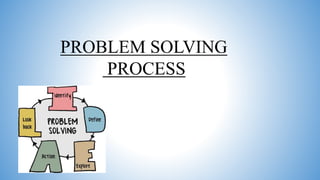
PROBLEM
SOLVING
PROCESS
PROBLEM
DEFINITION
PROBLEM
ANALYSIS
GENERATIN
G PROBLEM
SOLUTIONS
ANALYSING
THE
SOLUTION
SELECTING
BEST
SOLUTION
AND
IMPLEMENT
ATION
EVALUATIO
N AND
REVISION
1 ) PROBLEM DEFINITION:
The normal process for solving a problem
initially involves defining the problem that is to
be solved. In this first stage there is a need to
write down what exactly the problem entails,
which helps to identify the real problem that is
under study and needs an immediate solution.
This is considered as most essential step of the
problem-solving process
2)PROBLEM ANALYSIS:
• Analyse how the problem affects the researcher and his or her
Current situation and the other people involved in the
situation.
• The analysis helps in understanding the source of the
problem and how it affects the current developments and the
researcher’s environment.
• It is often good to reconfirm, if the initial problem definition
is still valid.
3) GENERATING POSSIBLE SOLUTIONS:
•Focus must be on identifying and
generating all possible solutions for a
problem. Each potential idea for solution
of a problem must be considered without
discarding it through value judgement
4) ANALYSING THE SOLUTIONS
Various factors about each of the potential
solutions are investigated, wherein all the
positive and negative aspects of each solution
are analysed.
5) SELECTING THE BEST SOLUTION AND
IMPLEMENTATION
•Best solution is selected based on the careful
judgement, which is supposed to solve the
problem swiftly and smoothly.
•The final step of the problem-solving
process is to practically solve the problem by
implementing the selected solution
6) EVALUATION AND REVISION
Evaluation is made to judge the effectiveness
of the solution in resolving the problem. This
stage also helps to redefine the problem and
revise the problem-solving process In case the
initial solution fails to manage the problem
effectively.
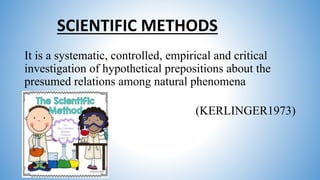
It is a systematic, controlled, empirical and critical
investigation of hypothetical prepositions about the
presumed relations among natural phenomena
(KERLINGER1973)
SCIENTIFIC METHODS
Scientific methods are defined as controlled,
systematic investigation that are rooted in
objective reality and that aim to develop general
knowledge about natural phenomena.
Polit and Hungler describes the characteristics of scientific
approach are
• They are orderly and systematically
• Scientist attempts to control external factors that are not
under direct investigation
• Their findings are based on the empirical evidences
• Findings of scientific methods can be generalised , which
means that they can be used in situations other than the one
under study
• They are based on assumptions or hypotheses
• They are basically conducted to develop or test hypothesis
OBJECTIVES
Description
To observe in order to know, is the aim of all nursing
research. The nurse who observes, “Verifies and
documents his/her observations work at a crucial level
of research.
Exploration
•Exploratory research is an extension of descriptive
research and is more directly oriented towards the
discovery of relationship.
Explanation
•To predict nurse begins with an explanation – what
should be found on observation and tests these
predictions in nursing research. Descriptive and
exploratory research provides new information
whereas theoretical or explanatory research offers us
understanding.
Prediction and control
•The researcher may predict that correlations will
be found between specified factors. It is possible
to use the scientific approach to make reliable
predictions and to develop control mechanisms
in the absence of total understanding.
LIMITATIONS OF SCIENTIFIC METHODS
•Moral or ethical problem
•Human complexity
•Measurement problems
•External variable control problems
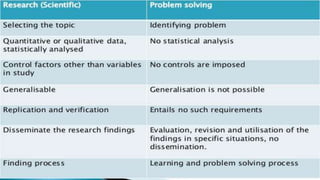
DIFFERENCE BETWEEN
SCIENTIFIC
METHOD AND
PROBLEM SOLVING
METHORD
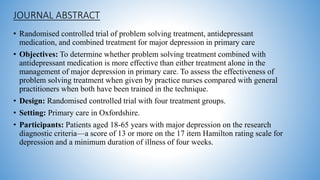
JOURNAL ABSTRACT
• Randomised controlled trial of problem solving treatment, antidepressant
medication, and combined treatment for major depression in primary care
• Objectives: To determine whether problem solving treatment combined with
antidepressant medication is more effective than either treatment alone in the
management of major depression in primary care. To assess the effectiveness of
problem solving treatment when given by practice nurses compared with general
practitioners when both have been trained in the technique.
• Design: Randomised controlled trial with four treatment groups.
• Setting: Primary care in Oxfordshire.
• Participants: Patients aged 18-65 years with major depression on the research
diagnostic criteria—a score of 13 or more on the 17 item Hamilton rating scale for
depression and a minimum duration of illness of four weeks.
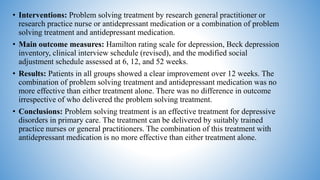
• Interventions: Problem solving treatment by research general practitioner or
research practice nurse or antidepressant medication or a combination of problem
solving treatment and antidepressant medication.
• Main outcome measures: Hamilton rating scale for depression, Beck depression
inventory, clinical interview schedule (revised), and the modified social
adjustment schedule assessed at 6, 12, and 52 weeks.
• Results: Patients in all groups showed a clear improvement over 12 weeks. The
combination of problem solving treatment and antidepressant medication was no
more effective than either treatment alone. There was no difference in outcome
irrespective of who delivered the problem solving treatment.
• Conclusions: Problem solving treatment is an effective treatment for depressive
disorders in primary care. The treatment can be delivered by suitably trained
practice nurses or general practitioners. The combination of this treatment with
antidepressant medication is no more effective than either treatment alone.
BIBLIOGRAPHY
• Sharma S K. nursing research and statistics. Second edition. Chenni; Elsevier
publications .2014
• Kaur S, Singh A. simplified nursing research and statistics. Delhi; CBS
publications. 2016.
• Kothari CR. Research methodology, methords and techniques. Delhi; New age
international publications. 2010
• Basavanthappa BT. Nursing research and statistics. Third edition. New Delhi’’; jay
pee brothers publications.2014
• Houser J. nursing research . New Delhi; Jonea and Bartlet publishers . 2011
• Raj EB. Nursing research and bio statistics. Third edition. Bangalor; EMMESS
publications. 2017
THANK
YOU

Problem solving method and scientific method

  • 1.
    PROBLEM SOLVING AND SCIENTIFICMETHODS PRESENTED BY SREETHA AKHIL MSC NURSING 1ST YEAR JMCON
  • 2.
    DEFINITION The problem solvingis a process of overcoming difficulties that appear to interfere with the attainment of goal. (SKINNER)
  • 3.
    The problem solvingis a systematic approach to the solution or alleviation of problems characterised by sequential execution of the following observation through action process.
  • 4.
    APPROACHES • INDUCTIVE APPROACH Itis the process of developing generalization from specific observations • DEDUCTIVE APPROACH It is the process of developing specific predictions from general principles
  • 6.
  • 7.
    1 ) PROBLEMDEFINITION: The normal process for solving a problem initially involves defining the problem that is to be solved. In this first stage there is a need to write down what exactly the problem entails, which helps to identify the real problem that is under study and needs an immediate solution. This is considered as most essential step of the problem-solving process
  • 8.
    2)PROBLEM ANALYSIS: • Analysehow the problem affects the researcher and his or her Current situation and the other people involved in the situation. • The analysis helps in understanding the source of the problem and how it affects the current developments and the researcher’s environment. • It is often good to reconfirm, if the initial problem definition is still valid.
  • 9.
    3) GENERATING POSSIBLESOLUTIONS: •Focus must be on identifying and generating all possible solutions for a problem. Each potential idea for solution of a problem must be considered without discarding it through value judgement
  • 10.
    4) ANALYSING THESOLUTIONS Various factors about each of the potential solutions are investigated, wherein all the positive and negative aspects of each solution are analysed.
  • 11.
    5) SELECTING THEBEST SOLUTION AND IMPLEMENTATION •Best solution is selected based on the careful judgement, which is supposed to solve the problem swiftly and smoothly. •The final step of the problem-solving process is to practically solve the problem by implementing the selected solution
  • 12.
    6) EVALUATION ANDREVISION Evaluation is made to judge the effectiveness of the solution in resolving the problem. This stage also helps to redefine the problem and revise the problem-solving process In case the initial solution fails to manage the problem effectively.
  • 13.
    It is asystematic, controlled, empirical and critical investigation of hypothetical prepositions about the presumed relations among natural phenomena (KERLINGER1973) SCIENTIFIC METHODS
  • 14.
    Scientific methods aredefined as controlled, systematic investigation that are rooted in objective reality and that aim to develop general knowledge about natural phenomena.
  • 15.
    Polit and Hunglerdescribes the characteristics of scientific approach are • They are orderly and systematically • Scientist attempts to control external factors that are not under direct investigation • Their findings are based on the empirical evidences • Findings of scientific methods can be generalised , which means that they can be used in situations other than the one under study • They are based on assumptions or hypotheses • They are basically conducted to develop or test hypothesis
  • 16.
    OBJECTIVES Description To observe inorder to know, is the aim of all nursing research. The nurse who observes, “Verifies and documents his/her observations work at a crucial level of research.
  • 17.
    Exploration •Exploratory research isan extension of descriptive research and is more directly oriented towards the discovery of relationship. Explanation •To predict nurse begins with an explanation – what should be found on observation and tests these predictions in nursing research. Descriptive and exploratory research provides new information whereas theoretical or explanatory research offers us understanding.
  • 18.
    Prediction and control •Theresearcher may predict that correlations will be found between specified factors. It is possible to use the scientific approach to make reliable predictions and to develop control mechanisms in the absence of total understanding.
  • 19.
    LIMITATIONS OF SCIENTIFICMETHODS •Moral or ethical problem •Human complexity •Measurement problems •External variable control problems
  • 20.
  • 22.
    JOURNAL ABSTRACT • Randomisedcontrolled trial of problem solving treatment, antidepressant medication, and combined treatment for major depression in primary care • Objectives: To determine whether problem solving treatment combined with antidepressant medication is more effective than either treatment alone in the management of major depression in primary care. To assess the effectiveness of problem solving treatment when given by practice nurses compared with general practitioners when both have been trained in the technique. • Design: Randomised controlled trial with four treatment groups. • Setting: Primary care in Oxfordshire. • Participants: Patients aged 18-65 years with major depression on the research diagnostic criteria—a score of 13 or more on the 17 item Hamilton rating scale for depression and a minimum duration of illness of four weeks.
  • 23.
    • Interventions: Problemsolving treatment by research general practitioner or research practice nurse or antidepressant medication or a combination of problem solving treatment and antidepressant medication. • Main outcome measures: Hamilton rating scale for depression, Beck depression inventory, clinical interview schedule (revised), and the modified social adjustment schedule assessed at 6, 12, and 52 weeks. • Results: Patients in all groups showed a clear improvement over 12 weeks. The combination of problem solving treatment and antidepressant medication was no more effective than either treatment alone. There was no difference in outcome irrespective of who delivered the problem solving treatment. • Conclusions: Problem solving treatment is an effective treatment for depressive disorders in primary care. The treatment can be delivered by suitably trained practice nurses or general practitioners. The combination of this treatment with antidepressant medication is no more effective than either treatment alone.
  • 24.
    BIBLIOGRAPHY • Sharma SK. nursing research and statistics. Second edition. Chenni; Elsevier publications .2014 • Kaur S, Singh A. simplified nursing research and statistics. Delhi; CBS publications. 2016. • Kothari CR. Research methodology, methords and techniques. Delhi; New age international publications. 2010 • Basavanthappa BT. Nursing research and statistics. Third edition. New Delhi’’; jay pee brothers publications.2014 • Houser J. nursing research . New Delhi; Jonea and Bartlet publishers . 2011 • Raj EB. Nursing research and bio statistics. Third edition. Bangalor; EMMESS publications. 2017
  • 25.