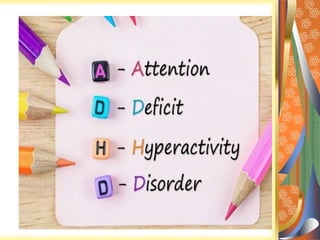
PRESENTED BY:
K. SIVASAKTHI,
M.SC NURSING IST YEAR,
CON- PIMS.
INTRODUCTION:
It is a neurobehavioral developmental
disorder and is primarily characterized
by” the co-existence of attention
problems, hyperactivity with each
behavior occurring infrequently alone.”
While symptoms may appear to be
innocent and merely annoying
nuisances to observers.
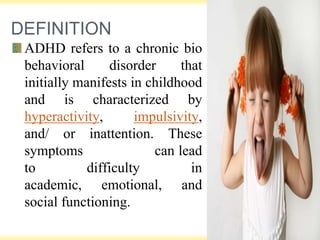
DEFINITION
ADHD refers to a chronic bio
behavioral disorder that
initially manifests in childhood
and is characterized by
hyperactivity, impulsivity,
and/ or inattention. These
symptoms can lead
to difficulty in
academic, emotional, and
social functioning.
DEFINITION
ADHD is a persistent pattern of in
attention and or hyperactivity-impulsivity
that is more frequent and severe than is
typically observed in individuals at a
compatible level of development (APA,
2000).
EPIDEMIOLOGY:
It is four to nine times more common
in boys than in girls.
Prevalence of ADHD is 3 to 7 percent
of school-age children.
It is most commonly present in school
children
CAUSES
The cause of ADHD has not
been fully defined.
A genetic predisposition has
been demonstrated in (identical)
twin and sibling studies.
Biochemical theory: An elevation in the
catecholamine dopamine and epinephrine
have been implicated in the over activity
attributed to ADHD.
Prenatal factors:
Maternal smoking
Hyperkinetic
impulsive behavior in
offspring
Intrauterine exposure
to toxic substances-
alcohol
fetal alcohol syndrome
Postnatal factors:
cerebral palsy
epilepsy
CNS abnormalities
Perinatal
prematurity
signs of foetal distress
precipitated prolonged labour
perinatal asphyxia
low Apgar scores
Environmentalfactors
Diet factor
Psychosocial influences:
stress
maternal mental disorder
parental criminality
low socio-economic status
family history of alcoholism
parental history of hyperactivity
developmental learning disorder
CLASSIFICATION
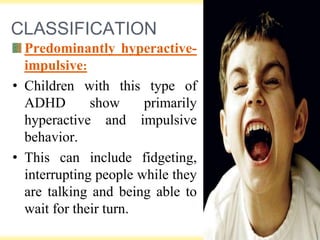
Predominantly hyperactive-
impulsive:
• Children with this type of
ADHD show primarily
hyperactive and impulsive
behavior.
• This can include fidgeting,
interrupting people while they
are talking and being able to
wait for their turn.
Predominantly inattentive
• Children with this type of
ADHD have extreme difficulty
in focusing finishing tasks and
following instructions.
• This type of is most common
among girls with ADHD.
Combined hyperactive-
impulsive and inattentive
• Children with this combined
type of ADHD display both
inattentive and hyperactive
symptoms.
• These includes an inability
to pay attention, a tendency
toward impulsiveness and
above normal levels of
activity and energy.
CLINICAL FEATURES
Inattention:
Fails to give close attention to
details or makes careless
mistakes in schoolwork, work, or
other activities.
Difficulty sustaining attention in
tasks or play activities.
The child often does not seem to
listen when spoken to directly.
Does not follow instructions and fails to
finish schoolwork, chores, or duties in the
workplace
Difficulty in organizing tasks and
activities.
Avoids, dislikes, or is reluctant to engage
in tasks that require sustained mental
effort
Easily distracted by extraneous stimuli.
Forgetful in daily activities
Hyperactivity:
The child often fidgets with his/her hands
or feet or squirms in his/her seat.
The child often runs about or climbs
excessively in situations in which it is
inappropriate.
The child often has difficulty playing or
engaging in leisure activities quiet
The child often talks excessively.
Impulsivity:
The child often blurts out answers before
questions have been completed.
The child often has difficulty awaiting
his/her turn
The child often interrupts or intrudes
in conversations
ASSOCIATED CONDITIONS
Conduct disorder,
Borderline personality disorder,
Primary disorder of vigilance, which is
characterized by poor attention and
concentration, as well as difficulties
staying awake.
Mood disorders.
Bipolar disorder.
Anxiety disorder,
Obsessive-compulsive disorder
DIAGNOSTIC CRITERIA
DSM-IV criteria for diagnosis
of ADHD requires that some
hyperactive, impulsive, or inattention
symptoms that cause present difficulties
were present before 7 years of age and
are present in two or more settings (at
school [or work] or at home).
There must be clear evidence of
significant impairment in social,
academic, or occupational functioning.
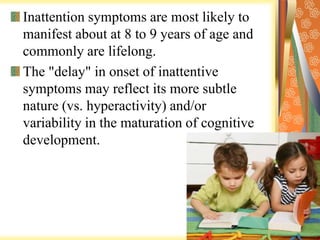
Inattention symptoms are most likely to
manifest about at 8 to 9 years of age and
commonly are lifelong.
The "delay" in onset of inattentive
symptoms may reflect its more subtle
nature (vs. hyperactivity) and/or
variability in the maturation of cognitive
development.
MANAGEMENT
Family education and
counseling
Medications
Proper classroom placement,
Environmental manipulation,
Behavioral therapy or
psychotherapy for the child
Medication:
Several different types of medications
may be used to treat ADHD.
Stimulants are the best known
treatment. They have been used for
the treatment of ADHD. Eg., Strattera
Non-stimulants were approved for
treating ADHD. Eg., ritaline, methylin,
focalin.
Antidepressants are sometimes a
treatment option.
Behavioral therapy
Receive instruction in effective
parenting skills such as
-delivering positive reinforcement
-rewarding small increments of desired
behaviors,
-providing age-appropriate consequence
- use of organizational charts for
completing self care activities
-increasing manually writing out
assignments are emphasized
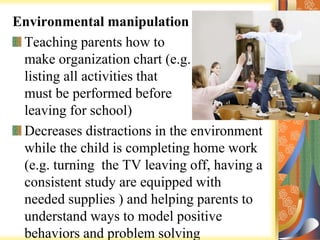
Environmental manipulation
Teaching parents how to
make organization chart (e.g.
listing all activities that
must be performed before
leaving for school)
Decreases distractions in the environment
while the child is completing home work
(e.g. turning the TV leaving off, having a
consistent study are equipped with
needed supplies ) and helping parents to
understand ways to model positive
behaviors and problem solving
Appropriate classroom placement;
home work and classroom assignments
may need to be reduced,
- more time may need to be allotted for tests
to allow the child to complete the task
-verbal instruction should be accompanied by
visual reference such as written
instructions on the block board
academic subjects are taught in the
morning when the child is experiencing
in the effects of the morning dose of
medication.
-provide regular and frequent breaks
- Computers are helpful for children who
have difficulty with writing and fine
motor skills.
-special training for learning
difficulty
NURSES ROLE:
Ensure that client has safe
environment.
Remove objects from immediate
area on which client could injure
self as a result of random,
hyperactive movement.
Provide adequate supervision and
assistance.
Limit child’s participation if
adequate supervision is not
possible.
Identify deliberate behavior that put
the child at risk.
NURSING DIAGNOSIS
Impaired social interaction related to
inability to trust, neurological alterations
Impaired verbal communication related to
withdrawal into the self, inadequate
sensory stimulation, neurological
alterations.
Disturbed personal identity related to
inadequate sensory stimulation,
neurological alterations
Low self esteem related to dysfunctional
family system and negative feed back
Risk for injury related to impulsive and
accident prone behavior and inability to
perceive self harm.
SUMMARY
CONCLUSION
Proper diagnosis by a trained professional
is imperative, especially to rule out other
conditions or problems. Treatment is most
effective when it’s multimodal and involves
the family. Effective treatment does not
always have to include medication.
Although there is no cure for ADHD, a
multimodal approach can greatly improve
the symptoms and outcomes for a child
with ADHD and lead to an increase in self-
esteem and self- efficacy
Thank you

ADHD.pptx

  • 1.
    PRESENTED BY: K. SIVASAKTHI, M.SCNURSING IST YEAR, CON- PIMS.
  • 3.
    INTRODUCTION: It is aneurobehavioral developmental disorder and is primarily characterized by” the co-existence of attention problems, hyperactivity with each behavior occurring infrequently alone.” While symptoms may appear to be innocent and merely annoying nuisances to observers.
  • 4.
    DEFINITION ADHD refers toa chronic bio behavioral disorder that initially manifests in childhood and is characterized by hyperactivity, impulsivity, and/ or inattention. These symptoms can lead to difficulty in academic, emotional, and social functioning.
  • 5.
    DEFINITION ADHD is apersistent pattern of in attention and or hyperactivity-impulsivity that is more frequent and severe than is typically observed in individuals at a compatible level of development (APA, 2000).
  • 6.
    EPIDEMIOLOGY: It is fourto nine times more common in boys than in girls. Prevalence of ADHD is 3 to 7 percent of school-age children. It is most commonly present in school children
  • 7.
    CAUSES The cause ofADHD has not been fully defined. A genetic predisposition has been demonstrated in (identical) twin and sibling studies. Biochemical theory: An elevation in the catecholamine dopamine and epinephrine have been implicated in the over activity attributed to ADHD.
  • 8.
    Prenatal factors: Maternal smoking Hyperkinetic impulsivebehavior in offspring Intrauterine exposure to toxic substances- alcohol fetal alcohol syndrome
  • 9.
  • 10.
    Perinatal prematurity signs of foetaldistress precipitated prolonged labour perinatal asphyxia low Apgar scores Environmentalfactors Diet factor
  • 11.
    Psychosocial influences: stress maternal mentaldisorder parental criminality low socio-economic status family history of alcoholism parental history of hyperactivity developmental learning disorder
  • 12.
    CLASSIFICATION Predominantly hyperactive- impulsive: • Childrenwith this type of ADHD show primarily hyperactive and impulsive behavior. • This can include fidgeting, interrupting people while they are talking and being able to wait for their turn.
  • 13.
    Predominantly inattentive • Childrenwith this type of ADHD have extreme difficulty in focusing finishing tasks and following instructions. • This type of is most common among girls with ADHD.
  • 14.
    Combined hyperactive- impulsive andinattentive • Children with this combined type of ADHD display both inattentive and hyperactive symptoms. • These includes an inability to pay attention, a tendency toward impulsiveness and above normal levels of activity and energy.
  • 15.
    CLINICAL FEATURES Inattention: Fails togive close attention to details or makes careless mistakes in schoolwork, work, or other activities. Difficulty sustaining attention in tasks or play activities. The child often does not seem to listen when spoken to directly.
  • 16.
    Does not followinstructions and fails to finish schoolwork, chores, or duties in the workplace Difficulty in organizing tasks and activities. Avoids, dislikes, or is reluctant to engage in tasks that require sustained mental effort Easily distracted by extraneous stimuli. Forgetful in daily activities
  • 17.
    Hyperactivity: The child oftenfidgets with his/her hands or feet or squirms in his/her seat. The child often runs about or climbs excessively in situations in which it is inappropriate. The child often has difficulty playing or engaging in leisure activities quiet The child often talks excessively.
  • 18.
    Impulsivity: The child oftenblurts out answers before questions have been completed. The child often has difficulty awaiting his/her turn The child often interrupts or intrudes in conversations
  • 19.
    ASSOCIATED CONDITIONS Conduct disorder, Borderlinepersonality disorder, Primary disorder of vigilance, which is characterized by poor attention and concentration, as well as difficulties staying awake. Mood disorders. Bipolar disorder. Anxiety disorder, Obsessive-compulsive disorder
  • 20.
    DIAGNOSTIC CRITERIA DSM-IV criteriafor diagnosis of ADHD requires that some hyperactive, impulsive, or inattention symptoms that cause present difficulties were present before 7 years of age and are present in two or more settings (at school [or work] or at home). There must be clear evidence of significant impairment in social, academic, or occupational functioning.
  • 21.
    Inattention symptoms aremost likely to manifest about at 8 to 9 years of age and commonly are lifelong. The "delay" in onset of inattentive symptoms may reflect its more subtle nature (vs. hyperactivity) and/or variability in the maturation of cognitive development.
  • 22.
    MANAGEMENT Family education and counseling Medications Properclassroom placement, Environmental manipulation, Behavioral therapy or psychotherapy for the child
  • 23.
    Medication: Several different typesof medications may be used to treat ADHD. Stimulants are the best known treatment. They have been used for the treatment of ADHD. Eg., Strattera Non-stimulants were approved for treating ADHD. Eg., ritaline, methylin, focalin. Antidepressants are sometimes a treatment option.
  • 24.
    Behavioral therapy Receive instructionin effective parenting skills such as -delivering positive reinforcement -rewarding small increments of desired behaviors, -providing age-appropriate consequence - use of organizational charts for completing self care activities -increasing manually writing out assignments are emphasized
  • 25.
    Environmental manipulation Teaching parentshow to make organization chart (e.g. listing all activities that must be performed before leaving for school) Decreases distractions in the environment while the child is completing home work (e.g. turning the TV leaving off, having a consistent study are equipped with needed supplies ) and helping parents to understand ways to model positive behaviors and problem solving
  • 26.
    Appropriate classroom placement; homework and classroom assignments may need to be reduced, - more time may need to be allotted for tests to allow the child to complete the task -verbal instruction should be accompanied by visual reference such as written instructions on the block board
  • 27.
    academic subjects aretaught in the morning when the child is experiencing in the effects of the morning dose of medication. -provide regular and frequent breaks - Computers are helpful for children who have difficulty with writing and fine motor skills. -special training for learning difficulty
  • 28.
    NURSES ROLE: Ensure thatclient has safe environment. Remove objects from immediate area on which client could injure self as a result of random, hyperactive movement. Provide adequate supervision and assistance. Limit child’s participation if adequate supervision is not possible. Identify deliberate behavior that put the child at risk.
  • 29.
    NURSING DIAGNOSIS Impaired socialinteraction related to inability to trust, neurological alterations Impaired verbal communication related to withdrawal into the self, inadequate sensory stimulation, neurological alterations. Disturbed personal identity related to inadequate sensory stimulation, neurological alterations
  • 30.
    Low self esteemrelated to dysfunctional family system and negative feed back Risk for injury related to impulsive and accident prone behavior and inability to perceive self harm.
  • 31.
  • 32.
    CONCLUSION Proper diagnosis bya trained professional is imperative, especially to rule out other conditions or problems. Treatment is most effective when it’s multimodal and involves the family. Effective treatment does not always have to include medication. Although there is no cure for ADHD, a multimodal approach can greatly improve the symptoms and outcomes for a child with ADHD and lead to an increase in self- esteem and self- efficacy
  • 33.