ATTENTION
DEFICITDIFICIENCY
DISORDER
(ADHD)
Miss. Kalyani Rajendra Saudagar
 It also called hyperkinetic disorder.
 A neurological disorder.
 ADHD is marked by developmentally inappropriate inattention,
impulsiveness, & in some cases, hyperactivity.
 Unless identified & treated properly, ADHD may progress to
conduct disorder, academic & job failure, depression, relationship
problems, & substance abuse.
 Most children with ADHD experience signs & symptoms by age 4.
a few aren’t diagnosed until they enter school.
CONCEPT
EPIDEMIOLOGY
 A prevalence of 1.7% was found among primary school children.
 ADHD is four time more common in boys than in girls.
ETIOLOGY
1. Biological Influences
 Biological Factors:
 There is greater concordance in monozygotic than is dizgotic twins.
 Siblings of hyperactive children have about twice the risk of having
the disorder as does the general population.
 Biological parents of children with the disorder have a higher
incidence of ADHD than do adoptive parents.
2 Biochemical theory
 A deficit of dopamine & norepinephrine has been attributed in the
over activity seen in ADHD. This deficit of neurotransmitters is believed
to lower the threshold for stimuli input.
3 Pre, peri & postnatal factors:
 Prenatal toxic exposure, prenatal mechanical insult to the fetal
nervous system.
 Prematurity, fetal distress, precipitated or prolonged labor, Perinatal
asphyxia & low Apgarscores.
 Postnatal infections, CNS abnormalities rresulting from trauma, etc.
4. Environmental influences
 Environmental lead
 Food additives, coloring preservatives & sugar level also been
suggested as possible causes of hyperactive behavior but there is no
definite evidence.
5 Psychosocial Factors:
 Prolonged emotional deprivation
 Stress psychic events.
 Disruption of family equilibrium.
Risk factors for ADHD:
 Drug exposure in utero
 Birth complications
 Low birth weight
 Lead poisoning
SIGN&
SYMPTOMS
Signs & symptoms of ADHD fall into three categories:
 Inattention
 Impulsiveness
 Hyperactivity
 Commonly, these behaviors intensify when the child is bored, in an
unstructured situation, or required to concentrate or focus on a task
for an extended period.
Inattention
Children with ADHD have a short attention span, don’t seem to listen,
& have a hard time keeping their minds on any one things.
They get bored easily, tiring of tasks after just a few minutes.
Children with ADHD may give effortless attention to the things they
enjoy, they have difficulty focusing deliberate, conscious attention on
organizing & completing a task or learning something new. In attention
causes them to lose things, be forgetful, & make careless mistakes.
Children with ADHD don’t follow through on instruction, fails to finish
tasks, & have trouble organizing tasks. Easily distracted, they’re
reluctant to engage in tasks that call for sustained mental effort
Impulsiveness
Children with ADHD have trouble curbing their immediate reactions.
They act before they think. They interrupt others – for instance, blurting
out inappropriate remarks or answering a question before the person
has finished asking it.
Waiting their turn & waiting for things they want are also challenging
for these children. When upset, they may grab another child’s toy or
strike out
Hyperactivity
Children with ADHD are always in motion & can’t seem to sit still. They
try to do several things at once.
In school, they fidget or squirm in their seat, room around the room, or
talk excessively. They have trouble engaging in quiet activities & may
find it impossible to sit trough a class. Some tap their pencils incessantly,
wiggle their feet, or touch everything.
DIAGNOSIS
Complete medical evaluation, with emphasis on a neurologic
examination, hearing & vision.
A psychiatric evaluation to assess intellectual ability, academic
achievement, & potential learning disorder problem
Detailed prenatal history & early developmental history
Direct observation, teacher’s school report (often the most reliable),
parent’s report
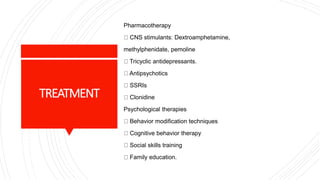
TREATMENT
Pharmacotherapy
CNS stimulants: Dextroamphetamine,
methylphenidate, pemoline
Tricyclic antidepressants.
Antipsychotics
SSRIs
Clonidine
Psychological therapies
Behavior modification techniques
Cognitive behavior therapy
Social skills training
Family education.
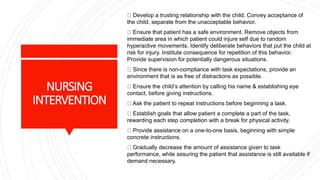
NURSING
INTERVENTION
Develop a trusting relationship with the child. Convey acceptance of
the child, separate from the unacceptable behavior.
Ensure that patient has a safe environment. Remove objects from
immediate area in which patient could injure self due to random
hyperactive movements. Identify deliberate behaviors that put the child at
risk for injury. Institute consequence for repetition of this behavior.
Provide supervision for potentially dangerous situations.
Since there is non-compliance with task expectations, provide an
environment that is as free of distractions as possible.
Ensure the child’s attention by calling his name & establishing eye
contact, before giving instructions.
Ask the patient to repeat instructions before beginning a task.
Establish goals that allow patient a complete a part of the task,
rewarding each step completion with a break for physical activity.
Provide assistance on a one-to-one basis, beginning with simple
concrete instructions.
Gradually decrease the amount of assistance given to task
performance, while assuring the patient that assistance is still available if
demand necessary.
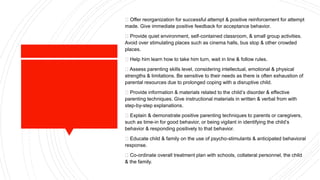
Offer reorganization for successful attempt & positive reinforcement for attempt
made. Give immediate positive feedback for acceptance behavior.
Provide quiet environment, self-contained classroom, & small group activities.
Avoid over stimulating places such as cinema halls, bus stop & other crowded
places.
Help him learn how to take him turn, wait in line & follow rules.
Assess parenting skills level, considering intellectual, emotional & physical
strengths & limitations. Be sensitive to their needs as there is often exhaustion of
parental resources due to prolonged coping with a disruptive child.
Provide information & materials related to the child’s disorder & effective
parenting techniques. Give instructional materials in written & verbal from with
step-by-step explanations.
Explain & demonstrate positive parenting techniques to parents or caregivers,
such as time-in for good behavior, or being vigilant in identifying the child’s
behavior & responding positively to that behavior.
Educate child & family on the use of psycho-stimulants & anticipated behavioral
response.
Co-ordinate overall treatment plan with schools, collateral personnel, the child
& the family.
THANK YOU

Attention deficit deficiency disorder

  • 1.
  • 2.
     It alsocalled hyperkinetic disorder.  A neurological disorder.  ADHD is marked by developmentally inappropriate inattention, impulsiveness, & in some cases, hyperactivity.  Unless identified & treated properly, ADHD may progress to conduct disorder, academic & job failure, depression, relationship problems, & substance abuse.  Most children with ADHD experience signs & symptoms by age 4. a few aren’t diagnosed until they enter school. CONCEPT
  • 3.
    EPIDEMIOLOGY  A prevalenceof 1.7% was found among primary school children.  ADHD is four time more common in boys than in girls.
  • 4.
    ETIOLOGY 1. Biological Influences Biological Factors:  There is greater concordance in monozygotic than is dizgotic twins.  Siblings of hyperactive children have about twice the risk of having the disorder as does the general population.  Biological parents of children with the disorder have a higher incidence of ADHD than do adoptive parents. 2 Biochemical theory  A deficit of dopamine & norepinephrine has been attributed in the over activity seen in ADHD. This deficit of neurotransmitters is believed to lower the threshold for stimuli input. 3 Pre, peri & postnatal factors:  Prenatal toxic exposure, prenatal mechanical insult to the fetal nervous system.  Prematurity, fetal distress, precipitated or prolonged labor, Perinatal asphyxia & low Apgarscores.  Postnatal infections, CNS abnormalities rresulting from trauma, etc.
  • 5.
    4. Environmental influences Environmental lead  Food additives, coloring preservatives & sugar level also been suggested as possible causes of hyperactive behavior but there is no definite evidence. 5 Psychosocial Factors:  Prolonged emotional deprivation  Stress psychic events.  Disruption of family equilibrium. Risk factors for ADHD:  Drug exposure in utero  Birth complications  Low birth weight  Lead poisoning
  • 6.
    SIGN& SYMPTOMS Signs & symptomsof ADHD fall into three categories:  Inattention  Impulsiveness  Hyperactivity  Commonly, these behaviors intensify when the child is bored, in an unstructured situation, or required to concentrate or focus on a task for an extended period. Inattention Children with ADHD have a short attention span, don’t seem to listen, & have a hard time keeping their minds on any one things. They get bored easily, tiring of tasks after just a few minutes. Children with ADHD may give effortless attention to the things they enjoy, they have difficulty focusing deliberate, conscious attention on organizing & completing a task or learning something new. In attention causes them to lose things, be forgetful, & make careless mistakes. Children with ADHD don’t follow through on instruction, fails to finish tasks, & have trouble organizing tasks. Easily distracted, they’re reluctant to engage in tasks that call for sustained mental effort
  • 7.
    Impulsiveness Children with ADHDhave trouble curbing their immediate reactions. They act before they think. They interrupt others – for instance, blurting out inappropriate remarks or answering a question before the person has finished asking it. Waiting their turn & waiting for things they want are also challenging for these children. When upset, they may grab another child’s toy or strike out Hyperactivity Children with ADHD are always in motion & can’t seem to sit still. They try to do several things at once. In school, they fidget or squirm in their seat, room around the room, or talk excessively. They have trouble engaging in quiet activities & may find it impossible to sit trough a class. Some tap their pencils incessantly, wiggle their feet, or touch everything.
  • 8.
    DIAGNOSIS Complete medical evaluation,with emphasis on a neurologic examination, hearing & vision. A psychiatric evaluation to assess intellectual ability, academic achievement, & potential learning disorder problem Detailed prenatal history & early developmental history Direct observation, teacher’s school report (often the most reliable), parent’s report
  • 9.
    TREATMENT Pharmacotherapy CNS stimulants: Dextroamphetamine, methylphenidate,pemoline Tricyclic antidepressants. Antipsychotics SSRIs Clonidine Psychological therapies Behavior modification techniques Cognitive behavior therapy Social skills training Family education.
  • 10.
    NURSING INTERVENTION Develop a trustingrelationship with the child. Convey acceptance of the child, separate from the unacceptable behavior. Ensure that patient has a safe environment. Remove objects from immediate area in which patient could injure self due to random hyperactive movements. Identify deliberate behaviors that put the child at risk for injury. Institute consequence for repetition of this behavior. Provide supervision for potentially dangerous situations. Since there is non-compliance with task expectations, provide an environment that is as free of distractions as possible. Ensure the child’s attention by calling his name & establishing eye contact, before giving instructions. Ask the patient to repeat instructions before beginning a task. Establish goals that allow patient a complete a part of the task, rewarding each step completion with a break for physical activity. Provide assistance on a one-to-one basis, beginning with simple concrete instructions. Gradually decrease the amount of assistance given to task performance, while assuring the patient that assistance is still available if demand necessary.
  • 11.
    Offer reorganization forsuccessful attempt & positive reinforcement for attempt made. Give immediate positive feedback for acceptance behavior. Provide quiet environment, self-contained classroom, & small group activities. Avoid over stimulating places such as cinema halls, bus stop & other crowded places. Help him learn how to take him turn, wait in line & follow rules. Assess parenting skills level, considering intellectual, emotional & physical strengths & limitations. Be sensitive to their needs as there is often exhaustion of parental resources due to prolonged coping with a disruptive child. Provide information & materials related to the child’s disorder & effective parenting techniques. Give instructional materials in written & verbal from with step-by-step explanations. Explain & demonstrate positive parenting techniques to parents or caregivers, such as time-in for good behavior, or being vigilant in identifying the child’s behavior & responding positively to that behavior. Educate child & family on the use of psycho-stimulants & anticipated behavioral response. Co-ordinate overall treatment plan with schools, collateral personnel, the child & the family.
  • 12.