ATTENTION DEFICIT
HYPERACTIVE DISORDER
By: MS. Aradhana
Masih
M.Sc.Nursing
INTRODUCTION
• THE term ADHD refers to “ATTENTION DEFICIT
HYPERACTIVITY DISORDER” this is a syndrome, first describe
by Hein Rich Hoff in 1854.
• Since then it has been known by variety of names like Minimal Brain
Dysfunction (MBO), Hyperkinetic Syndrome, Strauss Syndrome,
Minimal Brain Damage, Organic Drivenness and ADHD.
DEFINITIONS
• The American Psychiatric Association (APA) defines ADHD as a
behavioral condition that affects a person's ability to focus. It's
characterized by a pattern of inattention, hyperactivity, and
impulsivity.
• According to the Diagnostic and Statistical Manual of Mental
Disorders (DSM-5), Attention-Deficit Hyperactivity Disorder
(ADHD) is a neurodevelopmental disorder that involves inattention,
hyperactivity, and impulsivity.
PREVALANCE/INCIDENCE
• It affected 3-5% of children globally.
• More common in males than in females.
• 30-50% of those who diagnosed in childhood and have continue the
symptoms into adulthood.
• 5% of school age children are diagnosed with ADHD.
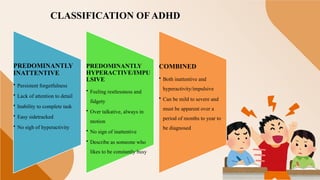
CLASSIFICATION OF ADHD
PREDOMINANTLY
INATTENTIVE
• Persistent forgetfulness
• Lack of attention to detail
• Inability to complete task
• Easy sidetracked
• No sigh of hyperactivity
PREDOMINANTLY
HYPERACTIVE/IMPU
LSIVE
• Feeling restlessness and
fidgety
• Over talkative, always in
motion
• No sign of inattentive
• Describe as someone who
likes to be constantly busy
COMBINED
• Both inattentive and
hyperactivity/impulsive
• Can be mild to severe and
must be apparent over a
period of months to year to
be diagnosed
ETIOLOGY
• Genetic theory - Twins shows that ADHD often runs in families.
• Role of neurotransmitter – Dopamine and norepinephrine appear
depleted, serotonin is also reduced.
• Brain injuries – Traumatic brain injuries may lead to ADHD.
• Maternal factors – Cigarette smoking and alcohol use during
pregnancies.
• Environmental factors – Exposure of higher level of lead have high
risk of developing ADHD.
• Psychosocial factors – Family dysfunctions inadequacies in
educational systems, violence and emotional abuse.
• Other factors pesticides exposures, orphans, neglected or abused.
CLINICAL MANIFESTATIONS
INATTENTIVE
• Easily distracted
and miss details.
• Difficult in
maintaining focus
• Become bored with
a task easily
• Do not listen
carefully.
• Easily confused.
• Struggle to follow
instructions
HYPERACTIVE/IMPULSIVE
• Talk nonstop.
• Be constantly in
motion.
• Trouble in setting
still during dinner,
school, or story time
• Difficulty in doing
quiet tasks.
• Play with anything
and everything
COMBINED
• Very impatient
• Strong irresistible
emotion.
• Act without regard
for consequences.
• Difficilties in
waiting for things
DIAGNOSTIC CRITERIA
• History collection
• Physical examination
• Psychiatric assessments
• Radiological examinations
• Laboratory test
TREATMENT MODALITIES
• MEDICATIONS
Stimulents – Such as methyl phenidate and amphetamines ,are the
common types of medications.
Other medications – Non stimulants, antidepressant, antihypertensive,
mood stabilizers and neuroleptic drugs.
• PSYCHOSOCIAL THERAPIES
Psychoeducational input – Focus on managing inattentive and
hyperactive impulsive behavior.
CONT…
Cognitive behavior therapy – Aims to help a child change his behavior
such as-
a. Create a routine
b. Get organized
c. Avoid distractions
d. Limit choices
e. Use goals and rewards
f. Be clear and consistent
Interpersonal psychotherapy – Help child to develop new skills,
attitude and teach how to relate this with family, peers and teachers.
Family therapy – To find better way to handle disruptive behaviour.
Supportive group – Help parents and families to meet regularly to
exchange information about recommended specialist, strategies and to
work with experts.
CONT…
• Routine and Structure - Having a predictable schedule can be crucial
for managing ADHD. This can include setting reminders, using
planners, and breaking tasks into smaller steps. The more structure you
can build, the better.
• Environmental Adjustments - Limiting distractions is important.
Creating a quiet, organized workspace and using noise-canceling
headphones or white noise can help with focus.
• Diet and Exercise - A balanced diet and regular exercise can improve
mood and cognitive function. Omega-3 fatty acids, found in fish or
supplements, are often suggested as beneficial for brain health.
CONT…
• Mindfulness and Relaxation - Mindfulness meditation or relaxation
techniques like deep breathing can help reduce impulsivity and
improve concentration over time.
• Support Systems - Having a support system—whether through
therapy, ADHD support groups, or just understanding friends and
family—can be incredibly helpful. They can offer encouragement and
accountability.
• Technology Tools - There are plenty of apps designed to help with time
management, staying organized, and breaking tasks into manageable
pieces (e.g., Trello, Todoist, or time-tracking apps).
NURSING MANAGEMENT
Nursing management of ADHD focuses on supporting the individual in
managing symptoms, promoting optimal functioning, and ensuring that
interventions are tailored to the patient's needs. Nurses play an important
role in both direct care and education. Here's a breakdown of the nursing
approach to ADHD management:
1. Assessment and Diagnosis
• Comprehensive assessment: Nurses may assist in the initial assessment
by observing the child or adult, gathering information from family
members or teachers, and reviewing the patient’s medical history.
• Screening tools: Use ADHD-specific rating scales (like the Conners’
Rating Scales) to assess symptoms. Nurses help in gathering feedback
from different environments (home, school, etc.) to get a well-rounded
understanding.
• Development of a care plan: Based on assessment data, a tailored care
plan can be created that addresses specific challenges and strengths
CONDUCT DISORDER
2. Medication Management
• Education on medications: Nurses educate patients and families about the different
types of medications (stimulants like methylphenidate and non-stimulants like
atomoxetine). They explain potential side effects, dosing schedules, and what to do if
a dose is missed.
• Monitoring for side effects: Nurses should monitor for common side effects such as
insomnia, appetite changes, or anxiety, and educate families on when to contact a
healthcare provider.
• Medication adherence: Encouraging consistency with taking medication is
important. Nurses can offer strategies for managing medication schedules, especially
for children.
3. Promoting Behavioral Interventions
• Encouraging structure: Nurses can help caregivers implement daily routines,
provide organizational tools, and suggest behavior modification strategies (like
positive reinforcement) to support behavior management.
• Collaboration with therapists: Nurses may collaborate with other healthcare
professionals, like psychologists or occupational therapists, to integrate behavioral
techniques and therapies that complement medical treatment.
CONT…
4. Collaboration with Schools
• School coordination: Nurses may work with teachers and school counselors to create
an Individualized Education Plan (IEP) or a 504 plan, providing accommodations like
extra time on tests, seating arrangements, or assistance with organization.
5. Encouraging a Healthy Lifestyle
• Physical activity: Nurses should encourage regular physical activity, which can help
with impulse control and focus. Exercise is beneficial in managing ADHD symptoms.
• Balanced nutrition: Educating on the importance of a healthy diet, rich in omega-3
fatty acids, proteins, and complex carbohydrates, can be a part of the nursing
management plan.
6. Family and Caregiver Support
• Caregiver support: Nurses can provide resources or support groups for caregivers to
help them understand the challenges of managing ADHD and offer practical advice for
dealing with behavioral issues.
• Stress management for parents: Parenting a child with ADHD can be stressful.
Nurses can offer techniques to help parents manage stress and avoid burnout.
ATTENTION DEFICIT HYPERACTIVE DISORDER.pptx

ATTENTION DEFICIT HYPERACTIVE DISORDER.pptx

  • 1.
    ATTENTION DEFICIT HYPERACTIVE DISORDER By:MS. Aradhana Masih M.Sc.Nursing
  • 2.
    INTRODUCTION • THE termADHD refers to “ATTENTION DEFICIT HYPERACTIVITY DISORDER” this is a syndrome, first describe by Hein Rich Hoff in 1854. • Since then it has been known by variety of names like Minimal Brain Dysfunction (MBO), Hyperkinetic Syndrome, Strauss Syndrome, Minimal Brain Damage, Organic Drivenness and ADHD.
  • 3.
    DEFINITIONS • The AmericanPsychiatric Association (APA) defines ADHD as a behavioral condition that affects a person's ability to focus. It's characterized by a pattern of inattention, hyperactivity, and impulsivity. • According to the Diagnostic and Statistical Manual of Mental Disorders (DSM-5), Attention-Deficit Hyperactivity Disorder (ADHD) is a neurodevelopmental disorder that involves inattention, hyperactivity, and impulsivity.
  • 4.
    PREVALANCE/INCIDENCE • It affected3-5% of children globally. • More common in males than in females. • 30-50% of those who diagnosed in childhood and have continue the symptoms into adulthood. • 5% of school age children are diagnosed with ADHD.
  • 5.
    CLASSIFICATION OF ADHD PREDOMINANTLY INATTENTIVE •Persistent forgetfulness • Lack of attention to detail • Inability to complete task • Easy sidetracked • No sigh of hyperactivity PREDOMINANTLY HYPERACTIVE/IMPU LSIVE • Feeling restlessness and fidgety • Over talkative, always in motion • No sign of inattentive • Describe as someone who likes to be constantly busy COMBINED • Both inattentive and hyperactivity/impulsive • Can be mild to severe and must be apparent over a period of months to year to be diagnosed
  • 6.
    ETIOLOGY • Genetic theory- Twins shows that ADHD often runs in families. • Role of neurotransmitter – Dopamine and norepinephrine appear depleted, serotonin is also reduced. • Brain injuries – Traumatic brain injuries may lead to ADHD. • Maternal factors – Cigarette smoking and alcohol use during pregnancies. • Environmental factors – Exposure of higher level of lead have high risk of developing ADHD. • Psychosocial factors – Family dysfunctions inadequacies in educational systems, violence and emotional abuse. • Other factors pesticides exposures, orphans, neglected or abused.
  • 7.
    CLINICAL MANIFESTATIONS INATTENTIVE • Easilydistracted and miss details. • Difficult in maintaining focus • Become bored with a task easily • Do not listen carefully. • Easily confused. • Struggle to follow instructions HYPERACTIVE/IMPULSIVE • Talk nonstop. • Be constantly in motion. • Trouble in setting still during dinner, school, or story time • Difficulty in doing quiet tasks. • Play with anything and everything COMBINED • Very impatient • Strong irresistible emotion. • Act without regard for consequences. • Difficilties in waiting for things
  • 8.
    DIAGNOSTIC CRITERIA • Historycollection • Physical examination • Psychiatric assessments • Radiological examinations • Laboratory test
  • 9.
    TREATMENT MODALITIES • MEDICATIONS Stimulents– Such as methyl phenidate and amphetamines ,are the common types of medications. Other medications – Non stimulants, antidepressant, antihypertensive, mood stabilizers and neuroleptic drugs. • PSYCHOSOCIAL THERAPIES Psychoeducational input – Focus on managing inattentive and hyperactive impulsive behavior.
  • 10.
    CONT… Cognitive behavior therapy– Aims to help a child change his behavior such as- a. Create a routine b. Get organized c. Avoid distractions d. Limit choices e. Use goals and rewards f. Be clear and consistent Interpersonal psychotherapy – Help child to develop new skills, attitude and teach how to relate this with family, peers and teachers. Family therapy – To find better way to handle disruptive behaviour. Supportive group – Help parents and families to meet regularly to exchange information about recommended specialist, strategies and to work with experts.
  • 11.
    CONT… • Routine andStructure - Having a predictable schedule can be crucial for managing ADHD. This can include setting reminders, using planners, and breaking tasks into smaller steps. The more structure you can build, the better. • Environmental Adjustments - Limiting distractions is important. Creating a quiet, organized workspace and using noise-canceling headphones or white noise can help with focus. • Diet and Exercise - A balanced diet and regular exercise can improve mood and cognitive function. Omega-3 fatty acids, found in fish or supplements, are often suggested as beneficial for brain health.
  • 12.
    CONT… • Mindfulness andRelaxation - Mindfulness meditation or relaxation techniques like deep breathing can help reduce impulsivity and improve concentration over time. • Support Systems - Having a support system—whether through therapy, ADHD support groups, or just understanding friends and family—can be incredibly helpful. They can offer encouragement and accountability. • Technology Tools - There are plenty of apps designed to help with time management, staying organized, and breaking tasks into manageable pieces (e.g., Trello, Todoist, or time-tracking apps).
  • 13.
    NURSING MANAGEMENT Nursing managementof ADHD focuses on supporting the individual in managing symptoms, promoting optimal functioning, and ensuring that interventions are tailored to the patient's needs. Nurses play an important role in both direct care and education. Here's a breakdown of the nursing approach to ADHD management: 1. Assessment and Diagnosis • Comprehensive assessment: Nurses may assist in the initial assessment by observing the child or adult, gathering information from family members or teachers, and reviewing the patient’s medical history. • Screening tools: Use ADHD-specific rating scales (like the Conners’ Rating Scales) to assess symptoms. Nurses help in gathering feedback from different environments (home, school, etc.) to get a well-rounded understanding. • Development of a care plan: Based on assessment data, a tailored care plan can be created that addresses specific challenges and strengths
  • 14.
    CONDUCT DISORDER 2. MedicationManagement • Education on medications: Nurses educate patients and families about the different types of medications (stimulants like methylphenidate and non-stimulants like atomoxetine). They explain potential side effects, dosing schedules, and what to do if a dose is missed. • Monitoring for side effects: Nurses should monitor for common side effects such as insomnia, appetite changes, or anxiety, and educate families on when to contact a healthcare provider. • Medication adherence: Encouraging consistency with taking medication is important. Nurses can offer strategies for managing medication schedules, especially for children. 3. Promoting Behavioral Interventions • Encouraging structure: Nurses can help caregivers implement daily routines, provide organizational tools, and suggest behavior modification strategies (like positive reinforcement) to support behavior management. • Collaboration with therapists: Nurses may collaborate with other healthcare professionals, like psychologists or occupational therapists, to integrate behavioral techniques and therapies that complement medical treatment.
  • 15.
    CONT… 4. Collaboration withSchools • School coordination: Nurses may work with teachers and school counselors to create an Individualized Education Plan (IEP) or a 504 plan, providing accommodations like extra time on tests, seating arrangements, or assistance with organization. 5. Encouraging a Healthy Lifestyle • Physical activity: Nurses should encourage regular physical activity, which can help with impulse control and focus. Exercise is beneficial in managing ADHD symptoms. • Balanced nutrition: Educating on the importance of a healthy diet, rich in omega-3 fatty acids, proteins, and complex carbohydrates, can be a part of the nursing management plan. 6. Family and Caregiver Support • Caregiver support: Nurses can provide resources or support groups for caregivers to help them understand the challenges of managing ADHD and offer practical advice for dealing with behavioral issues. • Stress management for parents: Parenting a child with ADHD can be stressful. Nurses can offer techniques to help parents manage stress and avoid burnout.