MANIA
   Presenter –
Neha Shrivastava
Definition
An abnormally elevated mood state
characterized by such symptoms as
• Inappropriate elation,
• Increased irritability
• Severe insomnia,
• Grandiose notions,
• Increased speed or volume of speech
• Disconnected & racing thoughts
• Increased sexual activity level
• Poor judgment and appropriate social
  behavior
HYPOMANIA
• Lesser degree of mania
• Mild elevation of mood
• Increased sense of
  psychological well being and
  happiness , not keeping with
  ongoing events.
PREDISPOSING FACTORS
• Biological theories

• Psychosocial theories

• The transactional model
BIOLOGICAL THEORIES
• Genetics
• Biochemical influences
 Biogenic amines
 electrolytes
• Physiological influences
 Brain lesions
 Medication side effects
PSYCHOSOCIAL
           THEORIES
• Importance declined
• Mania is viewed as disease of brain
  with biological etiologies
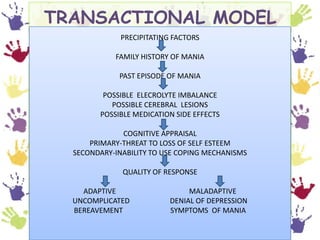
TRANSACTIONAL MODEL
              PRECIPITATING FACTORS

            FAMILY HISTORY OF MANIA

             PAST EPISODE OF MANIA

         POSSIBLE ELECROLYTE IMBALANCE
           POSSIBLE CEREBRAL LESIONS
        POSSIBLE MEDICATION SIDE EFFECTS

              COGNITIVE APPRAISAL
      PRIMARY-THREAT TO LOSS OF SELF ESTEEM
  SECONDARY-INABILITY TO USE COPING MECHANISMS

              QUALITY OF RESPONSE

    ADAPTIVE                    MALADAPTIVE
  UNCOMPLICATED            DENIAL OF DEPRESSION
  BEREAVEMENT              SYMPTOMS OF MANIA
CLINICAL FEATURES
The underlined characteristics are:-
• Elevated mood
• An increase in quantity & speed of
  physical & mental activity
AFFECTIVE SYMPTOMS
• Elevated mood: it has 4 stages depending on
  severity of manic episodes
• EUPHORIA (stage-I) : increased sense of
  psychological well being & happiness not in keeping
  with ongoing events
• ELATION (stage-II) : moderate elevation of
  mood with increased psychomotor activity
• EXALTATION (stage-III) : intense elation of
  mood with Delusions of Grandeur.
• ECSTASY (stage-IV) : severe elevation of mood ,
  intense sense of rapture or blissfullness seen in
  delirious or stuporous mania
AFFECTIVE SYMPTOMS
•   Elevated mood
•   Expensiveness
•   Humorousness
•   Inflated self esteem
•   Intolerance of criticism
•   Lack of shame or guilt
•   Sometimes irritable mood is predominant
•   May shift from Euphoria to Depression
    or Anger
BEHAVIORAL SYMPTOMS
•   Aggressiveness
•   Grandiose acts
•   Hyperactivity
•   Increased motor activity
•   Irresponsibility
•   Irritability
•   Argumentativeness
BEHAVIORAL SYMPTOMS
                 contd…

• Poor personal grooming
• Provocativeness
• Increased social activity
• Dressed up in gaudy or
  flamboyant clothes
• Sexual hyperactivity
COGNITIVE SYMPTOMS
•   Ambitiousness
•   Denial of realistic danger
•   Easily distracted
•   Flight of ideas
•   Uses playful language
•   Speaks loudly
•   Delusions of grandeur
•   Delusion of persecution
•   Lack of judgment
•   Distractibility
PHYSIOLOGICAL
         SYMPTOMS
• Dehydration
• Inadequate nutrition (due to
  over-activity)
• Little need of sleep
• Weight loss
CLASSIFICATION
• By ICD-10
• F-30 = manic episode
DIAGNOSIS
• ICD-10
• Psychological tests as Young mania
  Rating Scale
• MSE
MENTAL STATUS
         EXAMINATION
• GENERAL APPEARANCE &
  BEHAVIOR:-
• Psychomotor agitation ; sitting
  still is difficult
• may wear clothes that reflect
  elevated mood---brightly colored
  clothes, flamboyant, attention-
  getting, Pressured speech
• Interrupts and cannot listen to
  others
Mood & affect
• Euphoric, grandiosity, and false
  sense of well-being.
• Mood is quite labile.
Thought process and content
• flight of ideas
• Cannot connect concepts and jump
  from one subject to another

• Circumstantiality and Tangentiality

• Do not consider risks or personal
  experience, abilities or resources.

• Some experience psychotic features–
  grandiose delusions
Sensorium and intellectual
          processes
• Oriented to person and place but
  rarely to time
• Intellectual function is difficult to
  assess during the manic phase
• Claims to have many abilities that they
  do not possess
• Impaired ability to concentrate or pay
  attention
• If psychotic—may experience
  hallucination
Judgment and insight
• Easily angered and irritated

• Impulsive and rarely think before
  acting or speaking

• Insight is limited---believes they
  are ―fine‖ and have no problems

• Blames any difficulties on others
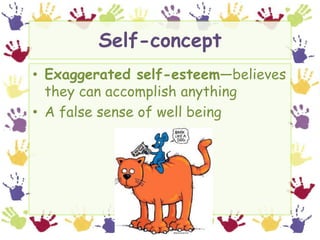
Self-concept
• Exaggerated self-esteem—believes
  they can accomplish anything
• A false sense of well being
Roles and Relationships
• Rarely can fulfill role &
  responsibilities.

• Have trouble at work or school---
  too distracted and hyperactive to
  pay attention to children or ADLs.

• Begins many tasks or projects but
  completes few.
Physiologic and self-care
        considerations
• Can go days w/o sleep or food and not
  even realize they are hungry or tired
• Unwilling to stop or unable to rest or
  sleep
• Ignores personal hygiene
• destroy valued items
• May physically injure themselves
• Tend to ignore or be unaware of
  health needs
TREATMENT
• Pharmacotherapy

• Electro-convulsive therapy

• Psychological treatment
PSYCHOPHARMACOLOGY
• MOOD STABILIZERS
• Antimanic - Lithium
• Anticonvulsant - clonazepam,
                  valproic acid
• Calcium channel blocker - verapamil
• ANTIPSYCHOTICS
• Olanzapine, Risperidone, Quetiapine
  Chlorpromazine, Haloperidol
• SEDTIVES/HYPNOTICS
• benzodiazepines
NURSING MANAGEMENT
• ASSESSMENT :-
• Severity of disorder.
• Knowing the causes.
• Resources available.
• Judging the effect of
  patient’s behavior on other people.
• MSE
Nursing Diagnosis
• Risk for injury related to extreme
  hyperactivity
• Risk for violence r/t manic
  excitement
• Imbalanced nutrition less than body
  requirement related to refusal
• Impaired social interaction r/t
  egocentric behaviour
Mania

Mania

  • 1.
    MANIA Presenter – Neha Shrivastava
  • 2.
    Definition An abnormally elevatedmood state characterized by such symptoms as • Inappropriate elation, • Increased irritability • Severe insomnia, • Grandiose notions, • Increased speed or volume of speech • Disconnected & racing thoughts • Increased sexual activity level • Poor judgment and appropriate social behavior
  • 3.
    HYPOMANIA • Lesser degreeof mania • Mild elevation of mood • Increased sense of psychological well being and happiness , not keeping with ongoing events.
  • 4.
    PREDISPOSING FACTORS • Biologicaltheories • Psychosocial theories • The transactional model
  • 5.
    BIOLOGICAL THEORIES • Genetics •Biochemical influences  Biogenic amines  electrolytes • Physiological influences  Brain lesions  Medication side effects
  • 6.
    PSYCHOSOCIAL THEORIES • Importance declined • Mania is viewed as disease of brain with biological etiologies
  • 7.
    TRANSACTIONAL MODEL PRECIPITATING FACTORS FAMILY HISTORY OF MANIA PAST EPISODE OF MANIA POSSIBLE ELECROLYTE IMBALANCE POSSIBLE CEREBRAL LESIONS POSSIBLE MEDICATION SIDE EFFECTS COGNITIVE APPRAISAL PRIMARY-THREAT TO LOSS OF SELF ESTEEM SECONDARY-INABILITY TO USE COPING MECHANISMS QUALITY OF RESPONSE ADAPTIVE MALADAPTIVE UNCOMPLICATED DENIAL OF DEPRESSION BEREAVEMENT SYMPTOMS OF MANIA
  • 8.
    CLINICAL FEATURES The underlinedcharacteristics are:- • Elevated mood • An increase in quantity & speed of physical & mental activity
  • 9.
    AFFECTIVE SYMPTOMS • Elevatedmood: it has 4 stages depending on severity of manic episodes • EUPHORIA (stage-I) : increased sense of psychological well being & happiness not in keeping with ongoing events • ELATION (stage-II) : moderate elevation of mood with increased psychomotor activity • EXALTATION (stage-III) : intense elation of mood with Delusions of Grandeur. • ECSTASY (stage-IV) : severe elevation of mood , intense sense of rapture or blissfullness seen in delirious or stuporous mania
  • 10.
    AFFECTIVE SYMPTOMS • Elevated mood • Expensiveness • Humorousness • Inflated self esteem • Intolerance of criticism • Lack of shame or guilt • Sometimes irritable mood is predominant • May shift from Euphoria to Depression or Anger
  • 11.
    BEHAVIORAL SYMPTOMS • Aggressiveness • Grandiose acts • Hyperactivity • Increased motor activity • Irresponsibility • Irritability • Argumentativeness
  • 12.
    BEHAVIORAL SYMPTOMS contd… • Poor personal grooming • Provocativeness • Increased social activity • Dressed up in gaudy or flamboyant clothes • Sexual hyperactivity
  • 13.
    COGNITIVE SYMPTOMS • Ambitiousness • Denial of realistic danger • Easily distracted • Flight of ideas • Uses playful language • Speaks loudly • Delusions of grandeur • Delusion of persecution • Lack of judgment • Distractibility
  • 14.
    PHYSIOLOGICAL SYMPTOMS • Dehydration • Inadequate nutrition (due to over-activity) • Little need of sleep • Weight loss
  • 15.
  • 16.
    DIAGNOSIS • ICD-10 • Psychologicaltests as Young mania Rating Scale • MSE
  • 17.
    MENTAL STATUS EXAMINATION • GENERAL APPEARANCE & BEHAVIOR:- • Psychomotor agitation ; sitting still is difficult • may wear clothes that reflect elevated mood---brightly colored clothes, flamboyant, attention- getting, Pressured speech • Interrupts and cannot listen to others
  • 18.
    Mood & affect •Euphoric, grandiosity, and false sense of well-being. • Mood is quite labile.
  • 19.
    Thought process andcontent • flight of ideas • Cannot connect concepts and jump from one subject to another • Circumstantiality and Tangentiality • Do not consider risks or personal experience, abilities or resources. • Some experience psychotic features– grandiose delusions
  • 20.
    Sensorium and intellectual processes • Oriented to person and place but rarely to time • Intellectual function is difficult to assess during the manic phase • Claims to have many abilities that they do not possess • Impaired ability to concentrate or pay attention • If psychotic—may experience hallucination
  • 21.
    Judgment and insight •Easily angered and irritated • Impulsive and rarely think before acting or speaking • Insight is limited---believes they are ―fine‖ and have no problems • Blames any difficulties on others
  • 22.
    Self-concept • Exaggerated self-esteem—believes they can accomplish anything • A false sense of well being
  • 23.
    Roles and Relationships •Rarely can fulfill role & responsibilities. • Have trouble at work or school--- too distracted and hyperactive to pay attention to children or ADLs. • Begins many tasks or projects but completes few.
  • 24.
    Physiologic and self-care considerations • Can go days w/o sleep or food and not even realize they are hungry or tired • Unwilling to stop or unable to rest or sleep • Ignores personal hygiene • destroy valued items • May physically injure themselves • Tend to ignore or be unaware of health needs
  • 25.
    TREATMENT • Pharmacotherapy • Electro-convulsivetherapy • Psychological treatment
  • 26.
    PSYCHOPHARMACOLOGY • MOOD STABILIZERS •Antimanic - Lithium • Anticonvulsant - clonazepam, valproic acid • Calcium channel blocker - verapamil • ANTIPSYCHOTICS • Olanzapine, Risperidone, Quetiapine Chlorpromazine, Haloperidol • SEDTIVES/HYPNOTICS • benzodiazepines
  • 27.
    NURSING MANAGEMENT • ASSESSMENT:- • Severity of disorder. • Knowing the causes. • Resources available. • Judging the effect of patient’s behavior on other people. • MSE
  • 28.
    Nursing Diagnosis • Riskfor injury related to extreme hyperactivity • Risk for violence r/t manic excitement • Imbalanced nutrition less than body requirement related to refusal • Impaired social interaction r/t egocentric behaviour