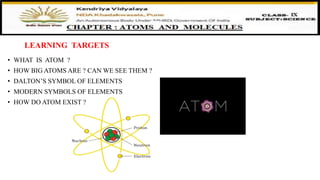
LEARNING TARGETS
• WHAT IS ATOM ?
• HOW BIG ATOMS ARE ? CAN WE SEE THEM ?
• DALTON’S SYMBOL OF ELEMENTS
• MODERN SYMBOLS OF ELEMENTS
• HOW DO ATOM EXIST ?
WHAT IS ATOM ?
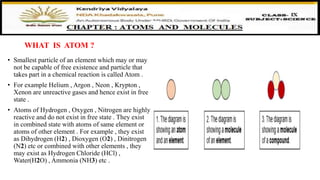
• Smallest particle of an element which may or may
not be capable of free existence and particle that
takes part in a chemical reaction is called Atom .
• For example Helium , Argon , Neon , Krypton ,
Xenon are unreactive gases and hence exist in free
state .
• Atoms of Hydrogen , Oxygen , Nitrogen are highly
reactive and do not exist in free state . They exist
in combined state with atoms of same element or
atoms of other element . For example , they exist
as Dihydrogen (H2) , Dioxygen (O2) , Dinitrogen
(N2) etc or combined with other elements , they
may exist as Hydrogen Chloride (HCl) ,
Water(H2O) , Ammonia (NH3) etc .
HOW BIG ATOMS ARE ? CAN WE SEE THEM ?
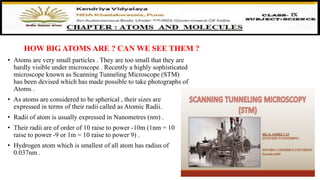
• Atoms are very small particles . They are too small that they are
hardly visible under microscope . Recently a highly sophisticated
microscope known as Scanning Tunneling Microscope (STM)
has been devised which has made possible to take photographs of
Atoms .
• As atoms are considered to be spherical , their sizes are
expressed in terms of their radii called as Atomic Radii.
• Radii of atom is usually expressed in Nanometres (nm) .
• Their radii are of order of 10 raise to power -10m (1nm = 10
raise to power -9 or 1m = 10 raise to power 9) .
• Hydrogen atom which is smallest of all atom has radius of
0.037nm .
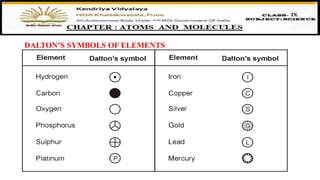
DALTON’S SYMBOLS OF ELEMENTS
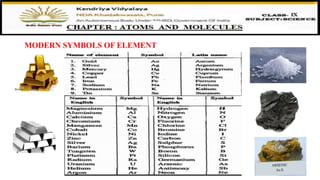
MODERN SYMBOLS OF ELEMENTS
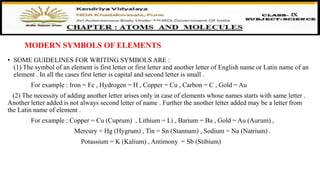
• SOME GUIDELINES FOR WRITING SYMBOLS ARE :
(1) The symbol of an element is first letter or first letter and another letter of English name or Latin name of an
element . In all the cases first letter is capital and second letter is small .
For example : Iron = Fe , Hydrogen = H , Copper = Cu , Carbon = C , Gold = Au
(2) The necessity of adding another letter arises only in case of elements whose names starts with same letter .
Another letter added is not always second letter of name . Further the another letter added may be a letter from
the Latin name of element .
For example : Copper = Cu (Cuprum) , Lithium = Li , Barium = Ba , Gold = Au (Aurum) ,
Mercury = Hg (Hygrum) , Tin = Sn (Stannum) , Sodium = Na (Natrium) .
Potassium = K (Kalium) , Antimony = Sb (Stibium)
MODERN SYMBOLS OF ELEMENT
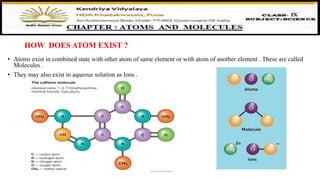
HOW DOES ATOM EXIST ?
• Atoms exist in combined state with other atom of same element or with atom of another element . These are called
Molecules .
• They may also exist in aqueous solution as Ions .
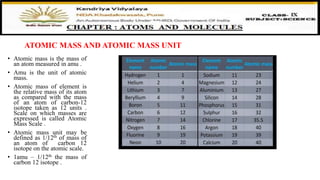
ATOMIC MASS AND ATOMIC MASS UNIT
• Atomic mass is the mass of
an atom measured in amu .
• Amu is the unit of atomic
mass.
• Atomic mass of element is
the relative mass of its atom
as compared with the mass
of an atom of carbon-12
isotope taken as 12 units .
Scale on which masses are
expressed is called Atomic
Mass Scale .
• Atomic mass unit may be
defined as 1/12th of mass of
an atom of carbon 12
isotope on the atomic scale.
• 1amu – 1/12th the mass of
carbon 12 isotope .
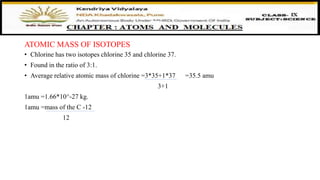
• Chlorine has two isotopes chlorine 35 and chlorine 37.
• Found in the ratio of 3:1.
• Average relative atomic mass of chlorine =3*35+1*37 =35.5 amu
3+1
1amu =1.66*10^-27 kg.
1amu =mass of the C -12
12
ATOMIC MASS OF ISOTOPES
SUMMARY
• WHAT IS ATOM ?
• HOW BIG ATOMS ARE ? CAN WE SEE THEM ?
• DALTON’S SYMBOL OF ELEMENTS
• MODERN SYMBOLS OF ELEMENTS
• HOW DO ATOM EXIST ?

Class 9 ppt 2 atoms n molecules

  • 1.
    LEARNING TARGETS • WHATIS ATOM ? • HOW BIG ATOMS ARE ? CAN WE SEE THEM ? • DALTON’S SYMBOL OF ELEMENTS • MODERN SYMBOLS OF ELEMENTS • HOW DO ATOM EXIST ?
  • 2.
    WHAT IS ATOM? • Smallest particle of an element which may or may not be capable of free existence and particle that takes part in a chemical reaction is called Atom . • For example Helium , Argon , Neon , Krypton , Xenon are unreactive gases and hence exist in free state . • Atoms of Hydrogen , Oxygen , Nitrogen are highly reactive and do not exist in free state . They exist in combined state with atoms of same element or atoms of other element . For example , they exist as Dihydrogen (H2) , Dioxygen (O2) , Dinitrogen (N2) etc or combined with other elements , they may exist as Hydrogen Chloride (HCl) , Water(H2O) , Ammonia (NH3) etc .
  • 3.
    HOW BIG ATOMSARE ? CAN WE SEE THEM ? • Atoms are very small particles . They are too small that they are hardly visible under microscope . Recently a highly sophisticated microscope known as Scanning Tunneling Microscope (STM) has been devised which has made possible to take photographs of Atoms . • As atoms are considered to be spherical , their sizes are expressed in terms of their radii called as Atomic Radii. • Radii of atom is usually expressed in Nanometres (nm) . • Their radii are of order of 10 raise to power -10m (1nm = 10 raise to power -9 or 1m = 10 raise to power 9) . • Hydrogen atom which is smallest of all atom has radius of 0.037nm .
  • 4.
  • 5.
    MODERN SYMBOLS OFELEMENTS • SOME GUIDELINES FOR WRITING SYMBOLS ARE : (1) The symbol of an element is first letter or first letter and another letter of English name or Latin name of an element . In all the cases first letter is capital and second letter is small . For example : Iron = Fe , Hydrogen = H , Copper = Cu , Carbon = C , Gold = Au (2) The necessity of adding another letter arises only in case of elements whose names starts with same letter . Another letter added is not always second letter of name . Further the another letter added may be a letter from the Latin name of element . For example : Copper = Cu (Cuprum) , Lithium = Li , Barium = Ba , Gold = Au (Aurum) , Mercury = Hg (Hygrum) , Tin = Sn (Stannum) , Sodium = Na (Natrium) . Potassium = K (Kalium) , Antimony = Sb (Stibium)
  • 6.
  • 7.
    HOW DOES ATOMEXIST ? • Atoms exist in combined state with other atom of same element or with atom of another element . These are called Molecules . • They may also exist in aqueous solution as Ions .
  • 8.
    ATOMIC MASS ANDATOMIC MASS UNIT • Atomic mass is the mass of an atom measured in amu . • Amu is the unit of atomic mass. • Atomic mass of element is the relative mass of its atom as compared with the mass of an atom of carbon-12 isotope taken as 12 units . Scale on which masses are expressed is called Atomic Mass Scale . • Atomic mass unit may be defined as 1/12th of mass of an atom of carbon 12 isotope on the atomic scale. • 1amu – 1/12th the mass of carbon 12 isotope .
  • 9.
    • Chlorine hastwo isotopes chlorine 35 and chlorine 37. • Found in the ratio of 3:1. • Average relative atomic mass of chlorine =3*35+1*37 =35.5 amu 3+1 1amu =1.66*10^-27 kg. 1amu =mass of the C -12 12 ATOMIC MASS OF ISOTOPES
  • 10.
    SUMMARY • WHAT ISATOM ? • HOW BIG ATOMS ARE ? CAN WE SEE THEM ? • DALTON’S SYMBOL OF ELEMENTS • MODERN SYMBOLS OF ELEMENTS • HOW DO ATOM EXIST ?