




-PRESENTED BY
A.Akila
1st yr M.TECH
Nano Science and Technology
Anna University –BIT Campus
Trichy
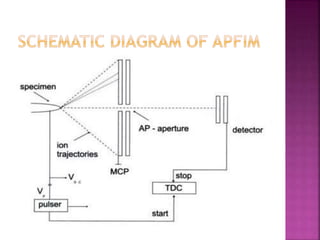
 Atom probe field ion microscopy is a combination
of field ion microscopy and time of flight mass
spectrometer.
 FIM is a projection type microscope of atomic
resolution.
 Time of flight : atom go through a small apecture
in the centre of screen makes it possible to
determine the mass to charge ratio.
 The atom probe microscope operates by removing
and analyzing individual atoms.
 The precursor to the atom probe microscope was
the field ion microscope (FIM)
 During FIM analysis, gas atoms adsorbed to the
surface of a sharply pointed specimen are ionized
by means of a strong electric field.
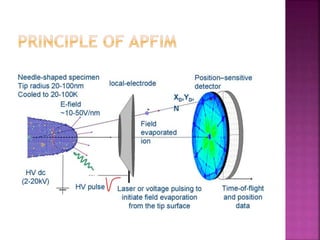
 They are then accelerated toward a phosphor
screen or other position-sensitive detector placed at
some distance from the specimen.
• Extremely high spatial resolution
• Equal detection efficiency for light elements
• The atom probe’s unique atom-by-atom analysis
provides a map of the elemental and isotopic
identity and position of individual atoms in
volumes of material of up to 100 nm in diameter
and 100 nm in depth.
 The atom probe analyzes three-dimensional
volumes of material, whereas the AFM analyzes
surface features only.
 The atom probe provides both imaging and
chemical analysis, whereas AFM provides imaging
only.
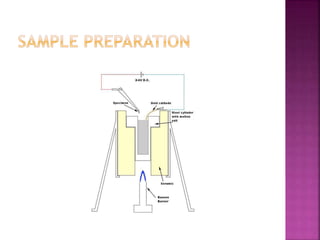
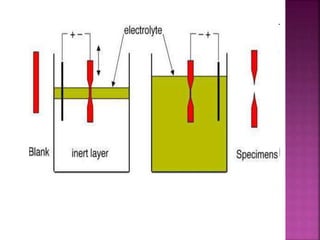
 Basic technique of preparing sample is electro
polishing technique.
 Advanced techniques - focused ion beam technique.
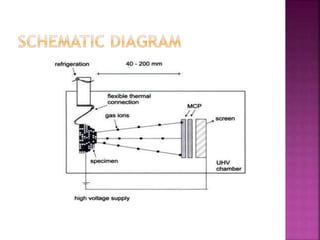
 Image is produced by applying high voltage to specimen
with respect to channel plate screen in presence of
imaging gas .
 The field strength required at the sample surface
reaches approximately 50v/nm.
 In order to achieve this order of magnitude needle
shaped specimens are prepared with average radius of
curvature R=10-100nm.
 The whole setup is kept in ultra high vacuum at a
pressure of 10ˆ-7 pa.
 During the operation tip is kept at temperature of 10-
150k
 Imaging system comprises of micro channel plate and
phosphor screen.
 The applied field at which field image results is called Best
Image Field (BIF) and the corresponding voltage is called
Best Image Voltage(BIV).
 Advantages of field evaporation
> Removal of oxides and impurities on the surface of
sample.
> smoothens the irregular surface of the sample until
the hemispherical surface is obtained.
 Chemical identification of the sample is achieved by
measuring the time of flight when used in combination
with the FIM.
 Difference between the BIF and evaporation field strength
is created by superimposing a short pulse Vp with respect
to width and amplitude of to that of the permanent
BIV.
 Vp must be high enough to remove the specimen atoms by
field evaporation.
 Pulse fraction is the ratio of pulse to permanent voltage.
 By the correction of selection of Vp and setting of the
analysis temperature the preferential evaporation of any
constituent with respect to the others is avoided and a
reliable analysis can be achieved.
 Synchron pulse in TDC (Time to digital converter) is used
to reset and start the clock
 When the field evaporation ion reaches the drift velocity ,
surface atoms are evaporated
 After the time of flight T , the ion hits the detector and the
pulse is used to stop the clock.
 Conversion of energy for drifting ion is given by
 From the above relation mass to charge ratio can be
measured for the field evaporation ion
 So the whole analysis is performed by adjusting the pulse
frequency
 The projection of probe hole onto the surface of the tip
defines the diameter of the sample and the length of the
sample is given by the hkl plane
 The resolution depends on the shape of applied pulse and
kind of TOF.
 The information obtained from the data is that only the
composition of the sample and it could not specify the
different distribution of the constituents.
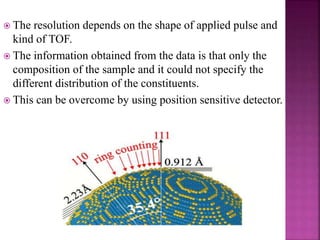
 This can be overcome by using position sensitive detector.
Atom probe field ion microscopy seminar

Atom probe field ion microscopy seminar

  • 1.
    -PRESENTED BY A.Akila 1st yrM.TECH Nano Science and Technology Anna University –BIT Campus Trichy
  • 2.
     Atom probefield ion microscopy is a combination of field ion microscopy and time of flight mass spectrometer.  FIM is a projection type microscope of atomic resolution.  Time of flight : atom go through a small apecture in the centre of screen makes it possible to determine the mass to charge ratio.  The atom probe microscope operates by removing and analyzing individual atoms.
  • 4.
     The precursorto the atom probe microscope was the field ion microscope (FIM)  During FIM analysis, gas atoms adsorbed to the surface of a sharply pointed specimen are ionized by means of a strong electric field.  They are then accelerated toward a phosphor screen or other position-sensitive detector placed at some distance from the specimen.
  • 5.
    • Extremely highspatial resolution • Equal detection efficiency for light elements • The atom probe’s unique atom-by-atom analysis provides a map of the elemental and isotopic identity and position of individual atoms in volumes of material of up to 100 nm in diameter and 100 nm in depth.
  • 6.
     The atomprobe analyzes three-dimensional volumes of material, whereas the AFM analyzes surface features only.  The atom probe provides both imaging and chemical analysis, whereas AFM provides imaging only.
  • 9.
     Basic techniqueof preparing sample is electro polishing technique.  Advanced techniques - focused ion beam technique.
  • 12.
     Image isproduced by applying high voltage to specimen with respect to channel plate screen in presence of imaging gas .  The field strength required at the sample surface reaches approximately 50v/nm.  In order to achieve this order of magnitude needle shaped specimens are prepared with average radius of curvature R=10-100nm.  The whole setup is kept in ultra high vacuum at a pressure of 10ˆ-7 pa.  During the operation tip is kept at temperature of 10- 150k  Imaging system comprises of micro channel plate and phosphor screen.
  • 13.
     The appliedfield at which field image results is called Best Image Field (BIF) and the corresponding voltage is called Best Image Voltage(BIV).  Advantages of field evaporation > Removal of oxides and impurities on the surface of sample. > smoothens the irregular surface of the sample until the hemispherical surface is obtained.
  • 16.
     Chemical identificationof the sample is achieved by measuring the time of flight when used in combination with the FIM.  Difference between the BIF and evaporation field strength is created by superimposing a short pulse Vp with respect to width and amplitude of to that of the permanent BIV.  Vp must be high enough to remove the specimen atoms by field evaporation.  Pulse fraction is the ratio of pulse to permanent voltage.  By the correction of selection of Vp and setting of the analysis temperature the preferential evaporation of any constituent with respect to the others is avoided and a reliable analysis can be achieved.
  • 17.
     Synchron pulsein TDC (Time to digital converter) is used to reset and start the clock  When the field evaporation ion reaches the drift velocity , surface atoms are evaporated  After the time of flight T , the ion hits the detector and the pulse is used to stop the clock.  Conversion of energy for drifting ion is given by  From the above relation mass to charge ratio can be measured for the field evaporation ion  So the whole analysis is performed by adjusting the pulse frequency  The projection of probe hole onto the surface of the tip defines the diameter of the sample and the length of the sample is given by the hkl plane
  • 18.
     The resolutiondepends on the shape of applied pulse and kind of TOF.  The information obtained from the data is that only the composition of the sample and it could not specify the different distribution of the constituents.  This can be overcome by using position sensitive detector.