Super Plasticity
Dr.R.Narayanasamy,
Professor,
Department of Production Engineering,
National Institute of Technology, Tiruchirappalli – 620 015.
Tamil Nadu, India
Super Plasticity
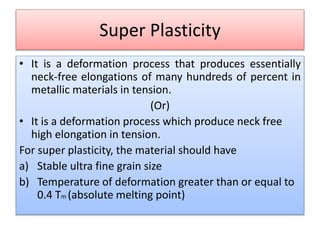
• It is a deformation process that produces essentially
neck-free elongations of many hundreds of percent in
metallic materials in tension.
(Or)
• It is a deformation process which produce neck free
high elongation in tension.
For super plasticity, the material should have
a) Stable ultra fine grain size
b) Temperature of deformation greater than or equal to
0.4 Tm (absolute melting point)
Constitutive Relationship
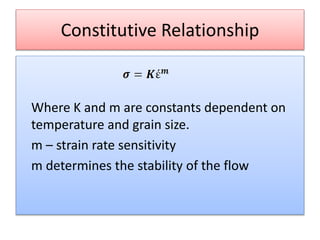
Where K and m are constants dependent on
temperature and grain size.
m – strain rate sensitivity
m determines the stability of the flow
Tensile test
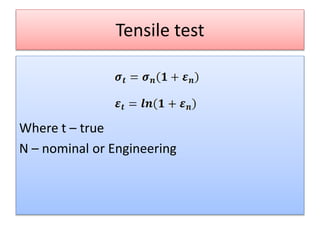
Where t – true
N – nominal or Engineering
Constitutive Relationship
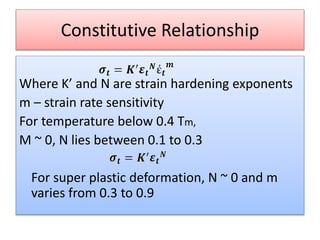
Where K’ and N are strain hardening exponents
m – strain rate sensitivity
For temperature below 0.4 Tm,
M ~ 0, N lies between 0.1 to 0.3
For super plastic deformation, N ~ 0 and m
varies from 0.3 to 0.9
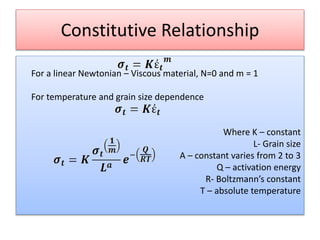
Constitutive Relationship
For a linear Newtonian – Viscous material, N=0 and m = 1
For temperature and grain size dependence
Where K – constant
L- Grain size
A – constant varies from 2 to 3
Q – activation energy
R- Boltzmann’s constant
T – absolute temperature
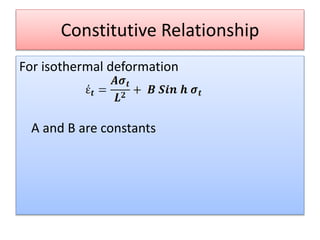
Constitutive Relationship
For isothermal deformation
A and B are constants
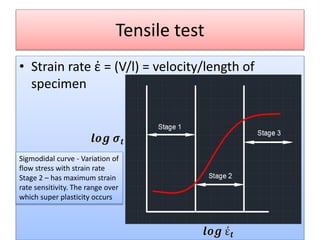
Tensile test
• Strain rate ἐ = (V/l) = velocity/length of
specimen
Sigmodidal curve - Variation of
flow stress with strain rate
Stage 2 – has maximum strain
rate sensitivity. The range over
which super plasticity occurs
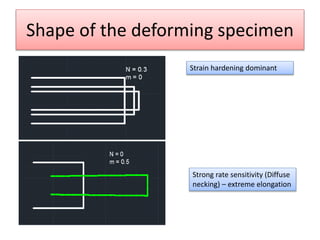
Shape of the deforming specimen
Strain hardening dominant
Strong rate sensitivity (Diffuse
necking) – extreme elongation
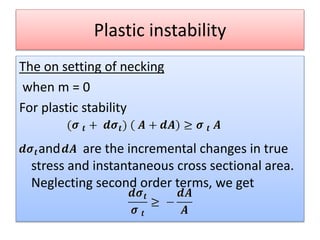
Plastic instability
The on setting of necking
when m = 0
For plastic stability
and are the incremental changes in true
stress and instantaneous cross sectional area.
Neglecting second order terms, we get
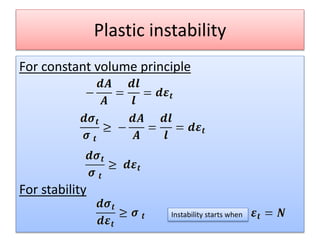
Plastic instability
For constant volume principle
For stability
Instability starts when
Plastic instability
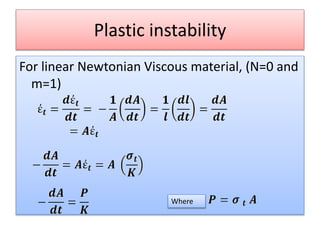
For linear Newtonian Viscous material, (N=0 and
m=1)
Where
Plastic instability
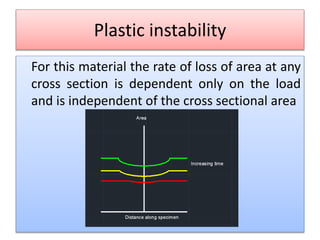
For this material the rate of loss of area at any
cross section is dependent only on the load
and is independent of the cross sectional area
Plastic instability
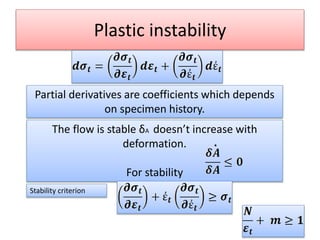
Partial derivatives are coefficients which depends
on specimen history.
The flow is stable δA doesn’t increase with
deformation.
For stability
.
Stability criterion
Plastic instability
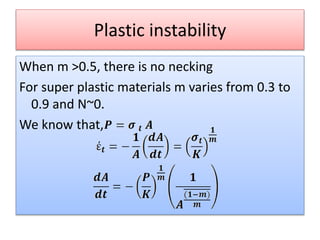
When m >0.5, there is no necking
For super plastic materials m varies from 0.3 to
0.9 and N~0.
We know that,
Plastic instability
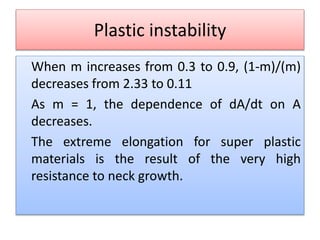
When m increases from 0.3 to 0.9, (1-m)/(m)
decreases from 2.33 to 0.11
As m = 1, the dependence of dA/dt on A
decreases.
The extreme elongation for super plastic
materials is the result of the very high
resistance to neck growth.
Plastic instability
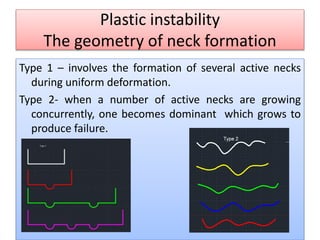
The geometry of neck formation
Type 1 – involves the formation of several active necks
during uniform deformation.
Type 2- when a number of active necks are growing
concurrently, one becomes dominant which grows to
produce failure.
Plastic instability
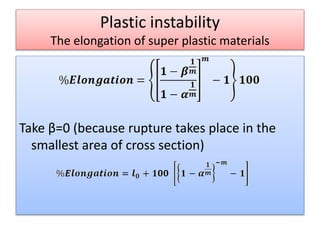
The elongation of super plastic materials
Take β=0 (because rupture takes place in the
smallest area of cross section)
Plastic instability
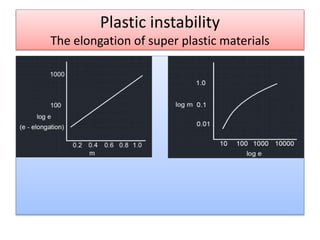
The elongation of super plastic materials
Plastic instability
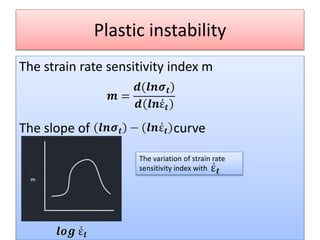
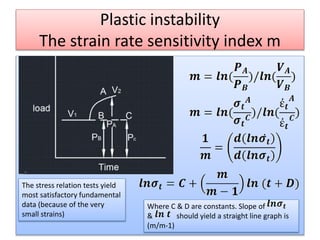
The strain rate sensitivity index m
The slope of curve
The variation of strain rate
sensitivity index with
Plastic instability
The strain rate sensitivity index m
The stress relation tests yield
most satisfactory fundamental
data (because of the very
small strains)
Where C & D are constants. Slope of
& should yield a straight line graph is
(m/m-1)
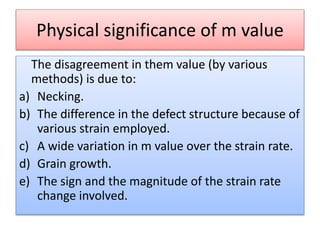
Physical significance of m value
The disagreement in them value (by various
methods) is due to:
a) Necking.
b) The difference in the defect structure because of
various strain employed.
c) A wide variation in m value over the strain rate.
d) Grain growth.
e) The sign and the magnitude of the strain rate
change involved.
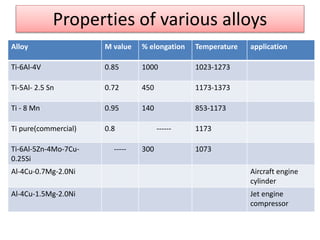
Properties of various alloys
Alloy M value % elongation Temperature application
Ti-6Al-4V 0.85 1000 1023-1273
Ti-5Al- 2.5 Sn 0.72 450 1173-1373
Ti - 8 Mn 0.95 140 853-1173
Ti pure(commercial) 0.8 ------ 1173
Ti-6Al-5Zn-4Mo-7Cu-
0.25Si
----- 300 1073
Al-4Cu-0.7Mg-2.0Ni Aircraft engine
cylinder
Al-4Cu-1.5Mg-2.0Ni Jet engine
compressor
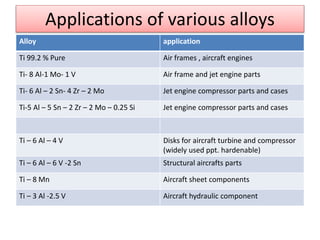
Applications of various alloys
Alloy application
Ti 99.2 % Pure Air frames , aircraft engines
Ti- 8 Al-1 Mo- 1 V Air frame and jet engine parts
Ti- 6 Al – 2 Sn- 4 Zr – 2 Mo Jet engine compressor parts and cases
Ti-5 Al – 5 Sn – 2 Zr – 2 Mo – 0.25 Si Jet engine compressor parts and cases
Ti – 6 Al – 4 V Disks for aircraft turbine and compressor
(widely used ppt. hardenable)
Ti – 6 Al – 6 V -2 Sn Structural aircrafts parts
Ti – 8 Mn Aircraft sheet components
Ti – 3 Al -2.5 V Aircraft hydraulic component
Mechanical properties
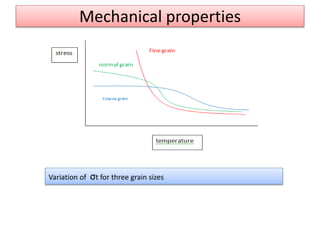
Variation of σt for three grain sizes
Mechanical properties
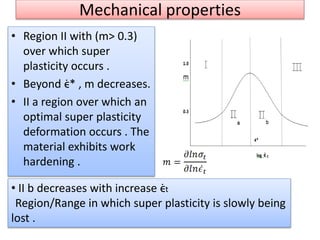
• Region II with (m> 0.3)
over which super
plasticity occurs .
• Beyond ϵ̇* , m decreases.
• II a region over which an
optimal super plasticity
deformation occurs . The
material exhibits work
hardening .
• II b decreases with increase ϵ̇t
Region/Range in which super plasticity is slowly being
lost .
Necessary condition for super plastic
forming
1. Duplex and multiphase structure (which have
stable grain size and resistance to grain
growth)
2. The type of phase or phase and their
distribution .
3. The grain boundary condition .
4. Temperature , strain rate and grain size .
Above condition influence the degree of super
plasticity .
Necessary condition for super plastic forming
5. Lower the eutectic (or equivalent)
temperature , better the super plasticity
properties .
6. Ternary eutectics are more super plastic than
binaries .
7. Strain rate should match the velocity of
diffusion processes . This improves the super
plasticity .
Necessary condition for super plastic
forming
8. Coarse grained structure and dissolved
second phase – eliminates strain rate
sensitivity (m) and high elongation .
9. non-deformable second phase particle found
in dispersion hardening alloys- eliminates the
effect of fine grain size and lead to cavitation .
10. Undissolved carbides (martensite in Fe-C
system ) prevent superplasticity .
Production of ultrafine grain size
1. Cold/hot work the commercial pure metal
and produce fine grain sizes stabilize the
grain sizes by dispersion of impure
particles which pin the grain boundaries
predominantly .
Production of ultrafine grain size
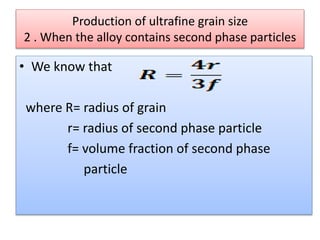
2 . When the alloy contains second phase particles
• We know that
where R= radius of grain
r= radius of second phase particle
f= volume fraction of second phase
particle
Production of ultrafine grain size
2 . When the alloy contains second phase particles
• The above relation shows that the minimum
grain size that can be obtained depends on
a) A smaller “r”
b) More “f ”(high f)
when second phase particle are present , the
grain boundary area is eliminated (where the
boundary intersects the particle) . This leads
to a decrease in the grain boundary energy .
2 . When the alloy contains second
phase particles
When the decrease in grain boundary energy
is more , the system results in grain growth .
(this is structural super plasticity)
Zr addition in Al alloys is helpful .
Production of ultrafine grain size
3. (a). cast alloys of eutectic/eutectoid or poly
phase
(b). Work them by about 60-70% to get an
intimate mixture of phases .
(c). Stable ultra fine grains of less than 10 µm.
can be obtained when particles are relatively
coarse and well separated .
This is extensively employed
ex. Zn-Al , Al-Cu
Production of ultrafine grain size
For Ni base super alloys
• Power metallurgy route because of several
advantages .
• Segregation and bonding makes unsuitable in
conventional method .
a) Compact alloy powder (after mixing)
b) Hot extrude
grain refinement is obtained
spinodal decomposition
Production of ultrafine grain size
Variable of deformation
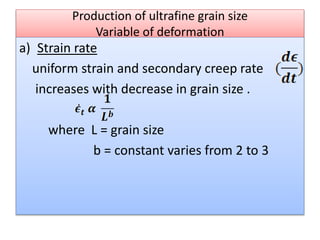
a) Strain rate
uniform strain and secondary creep rate
increases with decrease in grain size .
where L = grain size
b = constant varies from 2 to 3
Production of ultrafine grain size
Variable of deformation
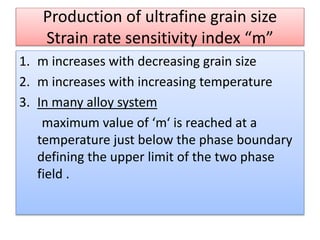
• Increase in strain rate beyond ϵ̇t , is equivalent
to increases in the grain size which has a
deleterious effect on super plasticity .
• The strain rate increases exponentially with
temperature .
Production of ultrafine grain size
Variable of deformation
Strain
i. Finer grain material exhibits greater recovery
σI = stress at zero strain for a given strain
rate
α =slowly varies with strain rate
ii. Super plastic deformation is essentially strain
independent when structural changes are
absent .
Production of ultrafine grain size
Strain rate sensitivity index “m”
1. m increases with decreasing grain size
2. m increases with increasing temperature
3. In many alloy system
maximum value of ‘m‘ is reached at a
temperature just below the phase boundary
defining the upper limit of the two phase
field .
Production of ultrafine grain size
Strain rate sensitivity index “m”
4. The temperature dependence of ‘m’ is more
in region II compared with region I or III .
5. ‘m’ is independent of strain rate and
dependent of temperature
ex. Zn-Al eutectoid alloy.
Reference book
• K. A. Padmanabhan, Davis , Super plasticity .
Thank you

Dr.R.Narayanasamy - Super Plasticity

  • 1.
    Super Plasticity Dr.R.Narayanasamy, Professor, Department ofProduction Engineering, National Institute of Technology, Tiruchirappalli – 620 015. Tamil Nadu, India
  • 2.
    Super Plasticity • Itis a deformation process that produces essentially neck-free elongations of many hundreds of percent in metallic materials in tension. (Or) • It is a deformation process which produce neck free high elongation in tension. For super plasticity, the material should have a) Stable ultra fine grain size b) Temperature of deformation greater than or equal to 0.4 Tm (absolute melting point)
  • 3.
    Constitutive Relationship Where Kand m are constants dependent on temperature and grain size. m – strain rate sensitivity m determines the stability of the flow
  • 4.
    Tensile test Where t– true N – nominal or Engineering
  • 5.
    Constitutive Relationship Where K’and N are strain hardening exponents m – strain rate sensitivity For temperature below 0.4 Tm, M ~ 0, N lies between 0.1 to 0.3 For super plastic deformation, N ~ 0 and m varies from 0.3 to 0.9
  • 6.
    Constitutive Relationship For alinear Newtonian – Viscous material, N=0 and m = 1 For temperature and grain size dependence Where K – constant L- Grain size A – constant varies from 2 to 3 Q – activation energy R- Boltzmann’s constant T – absolute temperature
  • 7.
    Constitutive Relationship For isothermaldeformation A and B are constants
  • 8.
    Tensile test • Strainrate ἐ = (V/l) = velocity/length of specimen Sigmodidal curve - Variation of flow stress with strain rate Stage 2 – has maximum strain rate sensitivity. The range over which super plasticity occurs
  • 9.
    Shape of thedeforming specimen Strain hardening dominant Strong rate sensitivity (Diffuse necking) – extreme elongation
  • 10.
    Plastic instability The onsetting of necking when m = 0 For plastic stability and are the incremental changes in true stress and instantaneous cross sectional area. Neglecting second order terms, we get
  • 11.
    Plastic instability For constantvolume principle For stability Instability starts when
  • 12.
    Plastic instability For linearNewtonian Viscous material, (N=0 and m=1) Where
  • 13.
    Plastic instability For thismaterial the rate of loss of area at any cross section is dependent only on the load and is independent of the cross sectional area
  • 14.
    Plastic instability Partial derivativesare coefficients which depends on specimen history. The flow is stable δA doesn’t increase with deformation. For stability . Stability criterion
  • 15.
    Plastic instability When m>0.5, there is no necking For super plastic materials m varies from 0.3 to 0.9 and N~0. We know that,
  • 16.
    Plastic instability When mincreases from 0.3 to 0.9, (1-m)/(m) decreases from 2.33 to 0.11 As m = 1, the dependence of dA/dt on A decreases. The extreme elongation for super plastic materials is the result of the very high resistance to neck growth.
  • 17.
    Plastic instability The geometryof neck formation Type 1 – involves the formation of several active necks during uniform deformation. Type 2- when a number of active necks are growing concurrently, one becomes dominant which grows to produce failure.
  • 18.
    Plastic instability The elongationof super plastic materials Take β=0 (because rupture takes place in the smallest area of cross section)
  • 19.
    Plastic instability The elongationof super plastic materials
  • 20.
    Plastic instability The strainrate sensitivity index m The slope of curve The variation of strain rate sensitivity index with
  • 21.
    Plastic instability The strainrate sensitivity index m The stress relation tests yield most satisfactory fundamental data (because of the very small strains) Where C & D are constants. Slope of & should yield a straight line graph is (m/m-1)
  • 22.
    Physical significance ofm value The disagreement in them value (by various methods) is due to: a) Necking. b) The difference in the defect structure because of various strain employed. c) A wide variation in m value over the strain rate. d) Grain growth. e) The sign and the magnitude of the strain rate change involved.
  • 23.
    Properties of variousalloys Alloy M value % elongation Temperature application Ti-6Al-4V 0.85 1000 1023-1273 Ti-5Al- 2.5 Sn 0.72 450 1173-1373 Ti - 8 Mn 0.95 140 853-1173 Ti pure(commercial) 0.8 ------ 1173 Ti-6Al-5Zn-4Mo-7Cu- 0.25Si ----- 300 1073 Al-4Cu-0.7Mg-2.0Ni Aircraft engine cylinder Al-4Cu-1.5Mg-2.0Ni Jet engine compressor
  • 24.
    Applications of variousalloys Alloy application Ti 99.2 % Pure Air frames , aircraft engines Ti- 8 Al-1 Mo- 1 V Air frame and jet engine parts Ti- 6 Al – 2 Sn- 4 Zr – 2 Mo Jet engine compressor parts and cases Ti-5 Al – 5 Sn – 2 Zr – 2 Mo – 0.25 Si Jet engine compressor parts and cases Ti – 6 Al – 4 V Disks for aircraft turbine and compressor (widely used ppt. hardenable) Ti – 6 Al – 6 V -2 Sn Structural aircrafts parts Ti – 8 Mn Aircraft sheet components Ti – 3 Al -2.5 V Aircraft hydraulic component
  • 25.
    Mechanical properties Variation ofσt for three grain sizes
  • 26.
    Mechanical properties • RegionII with (m> 0.3) over which super plasticity occurs . • Beyond ϵ̇* , m decreases. • II a region over which an optimal super plasticity deformation occurs . The material exhibits work hardening . • II b decreases with increase ϵ̇t Region/Range in which super plasticity is slowly being lost .
  • 27.
    Necessary condition forsuper plastic forming 1. Duplex and multiphase structure (which have stable grain size and resistance to grain growth) 2. The type of phase or phase and their distribution . 3. The grain boundary condition . 4. Temperature , strain rate and grain size . Above condition influence the degree of super plasticity .
  • 28.
    Necessary condition forsuper plastic forming 5. Lower the eutectic (or equivalent) temperature , better the super plasticity properties . 6. Ternary eutectics are more super plastic than binaries . 7. Strain rate should match the velocity of diffusion processes . This improves the super plasticity .
  • 29.
    Necessary condition forsuper plastic forming 8. Coarse grained structure and dissolved second phase – eliminates strain rate sensitivity (m) and high elongation . 9. non-deformable second phase particle found in dispersion hardening alloys- eliminates the effect of fine grain size and lead to cavitation . 10. Undissolved carbides (martensite in Fe-C system ) prevent superplasticity .
  • 30.
    Production of ultrafinegrain size 1. Cold/hot work the commercial pure metal and produce fine grain sizes stabilize the grain sizes by dispersion of impure particles which pin the grain boundaries predominantly .
  • 31.
    Production of ultrafinegrain size 2 . When the alloy contains second phase particles • We know that where R= radius of grain r= radius of second phase particle f= volume fraction of second phase particle
  • 32.
    Production of ultrafinegrain size 2 . When the alloy contains second phase particles • The above relation shows that the minimum grain size that can be obtained depends on a) A smaller “r” b) More “f ”(high f) when second phase particle are present , the grain boundary area is eliminated (where the boundary intersects the particle) . This leads to a decrease in the grain boundary energy .
  • 33.
    2 . Whenthe alloy contains second phase particles When the decrease in grain boundary energy is more , the system results in grain growth . (this is structural super plasticity) Zr addition in Al alloys is helpful .
  • 34.
    Production of ultrafinegrain size 3. (a). cast alloys of eutectic/eutectoid or poly phase (b). Work them by about 60-70% to get an intimate mixture of phases . (c). Stable ultra fine grains of less than 10 µm. can be obtained when particles are relatively coarse and well separated . This is extensively employed ex. Zn-Al , Al-Cu
  • 35.
    Production of ultrafinegrain size For Ni base super alloys • Power metallurgy route because of several advantages . • Segregation and bonding makes unsuitable in conventional method . a) Compact alloy powder (after mixing) b) Hot extrude grain refinement is obtained spinodal decomposition
  • 36.
    Production of ultrafinegrain size Variable of deformation a) Strain rate uniform strain and secondary creep rate increases with decrease in grain size . where L = grain size b = constant varies from 2 to 3
  • 37.
    Production of ultrafinegrain size Variable of deformation • Increase in strain rate beyond ϵ̇t , is equivalent to increases in the grain size which has a deleterious effect on super plasticity . • The strain rate increases exponentially with temperature .
  • 38.
    Production of ultrafinegrain size Variable of deformation Strain i. Finer grain material exhibits greater recovery σI = stress at zero strain for a given strain rate α =slowly varies with strain rate ii. Super plastic deformation is essentially strain independent when structural changes are absent .
  • 39.
    Production of ultrafinegrain size Strain rate sensitivity index “m” 1. m increases with decreasing grain size 2. m increases with increasing temperature 3. In many alloy system maximum value of ‘m‘ is reached at a temperature just below the phase boundary defining the upper limit of the two phase field .
  • 40.
    Production of ultrafinegrain size Strain rate sensitivity index “m” 4. The temperature dependence of ‘m’ is more in region II compared with region I or III . 5. ‘m’ is independent of strain rate and dependent of temperature ex. Zn-Al eutectoid alloy.
  • 41.
    Reference book • K.A. Padmanabhan, Davis , Super plasticity .
  • 42.