

Presenter: Imtiaz Ali
Registration No. : 400360
 Introduction to EBSD
 Brief History
 Principal system components
 How the Pattern is Formed?
 EBSP - Electron Backscatter Diffraction
Patterns
 Operating conditions
 Uses of EBSD
 Summary
EBSD is a technique that allows:
 Crystallographic Orientations
 Misorientations
 Texture trends
 Grain size and boundary types
 Phases
 1928 Kikuchi lines observed inTEM
 1954 Alam: patterns obtained inTEM
 1973Venebles: patterns recorded on film in SEM
 1980 Patterns imaged with low lightTV cameras
 1990 Automatic pattern solving using Hough transform
 Present day
 Local orientation and misorientations measurements
 Crystal Orientation Mapping (COM)
 Special grain boundaries imaged
 Special textures revealed
 Grain sizing
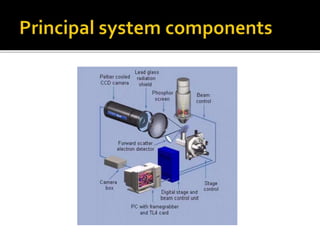
 Sample tilted at 70° from the horizontal.
 A phosphor screen.
 A sensitive CCD video camera
 A vacuum interface for mounting the phosphor and
camera in an SEM port.
 Electronic hardware that controls the SEM, including
the beam position, stage, focus, and magnification.
 A computer to control EBSD experiments, analyze the
EBSD pattern and process and display the results.
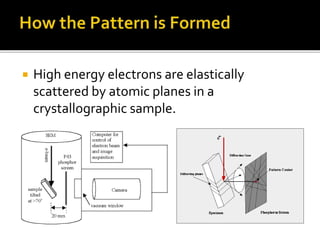
 High energy electrons are elastically
scattered by atomic planes in a
crystallographic sample.
 Accelerating Voltage : 15-30 kV
 Beam current : 1-15 nA
 Collection angle : 70°
 Working distance : 10-25 mm
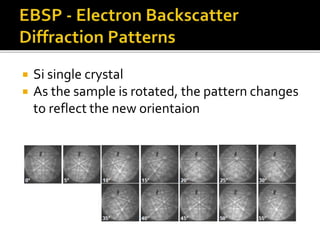
 Si single crystal
 As the sample is rotated, the pattern changes
to reflect the new orientaion
 Quantitative
 micro structural data
 Phase identification
 Strain analysis
 Maps
 EBSD has become a well established micro structural
analytical technique.
 EBSD mapping can be used to explore the processing
microstructure – properties relationships.
 EBSD can be used on most crystalline materials
 Grain size, sample tilt, and sample preparation are the
primary limitations of the technique.
Electron backscatter diffraction (ebsd)

Electron backscatter diffraction (ebsd)

  • 1.
  • 2.
     Introduction toEBSD  Brief History  Principal system components  How the Pattern is Formed?  EBSP - Electron Backscatter Diffraction Patterns  Operating conditions  Uses of EBSD  Summary
  • 3.
    EBSD is atechnique that allows:  Crystallographic Orientations  Misorientations  Texture trends  Grain size and boundary types  Phases
  • 4.
     1928 Kikuchilines observed inTEM  1954 Alam: patterns obtained inTEM  1973Venebles: patterns recorded on film in SEM  1980 Patterns imaged with low lightTV cameras  1990 Automatic pattern solving using Hough transform  Present day  Local orientation and misorientations measurements  Crystal Orientation Mapping (COM)  Special grain boundaries imaged  Special textures revealed  Grain sizing
  • 5.
     Sample tiltedat 70° from the horizontal.  A phosphor screen.  A sensitive CCD video camera  A vacuum interface for mounting the phosphor and camera in an SEM port.  Electronic hardware that controls the SEM, including the beam position, stage, focus, and magnification.  A computer to control EBSD experiments, analyze the EBSD pattern and process and display the results.
  • 7.
     High energyelectrons are elastically scattered by atomic planes in a crystallographic sample.
  • 8.
     Accelerating Voltage: 15-30 kV  Beam current : 1-15 nA  Collection angle : 70°  Working distance : 10-25 mm
  • 9.
     Si singlecrystal  As the sample is rotated, the pattern changes to reflect the new orientaion
  • 10.
     Quantitative  microstructural data  Phase identification  Strain analysis  Maps
  • 11.
     EBSD hasbecome a well established micro structural analytical technique.  EBSD mapping can be used to explore the processing microstructure – properties relationships.  EBSD can be used on most crystalline materials  Grain size, sample tilt, and sample preparation are the primary limitations of the technique.