Physical Metallurgy
II Year B.Tech.I Sem
Ms. Sindhu B
Assistant Professor C
Dpmt of Metallurgical Engineering
JNTUHCEH
MODULE –I
Metallurgical microscope
 Introduction
 Principle
 Construction
 Types of objectives and eyepieces
 Defects in lenses
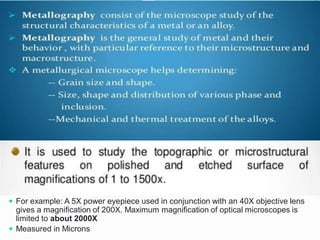
 For example: A 5X power eyepiece used in conjunction with an 40X objective lens
gives a magnification of 200X. Maximum magnification of optical microscopes is
limited to about 2000X
 Measured in Microns
APPLICATIONS
 Size, shape and distribution of various phases,
 Grain size determination and its distribution,
 Prediction of probable mechanicalproperties,
 Presence of secondary phase and its distribution
 Non-metallic inclusions,
 Segregation of elements,
 Heterogeneous conditions,
 Abnormal structure,
 Directionality in metal working process, and
 Effect of Heat Treatment
Metallography is widely used in research centers for:
Routine testing during production,
Failure analysis, and
Research and development of new alloys and processes.
List of Modern Microscopes
1) Watson Royal Microscope.
2) Van Lanes Hock Microscope.
3) Glass led Microscope.
4) Baker series Microscope.
5) Leitr Microscope.
Principle of Metallurgical Microscope
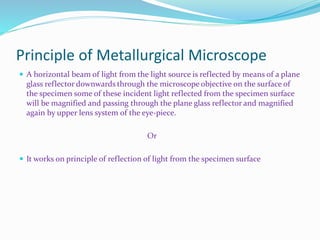
 A horizontal beam of light from the light source is reflected by means of a plane
glass reflector downwards through the microscope objective on the surface of
the specimen some of these incident light reflected from the specimen surface
will be magnified and passing through the plane glass reflector and magnified
again by upper lens system of the eye-piece.
Or
 It works on principle of reflection of light from the specimen surface
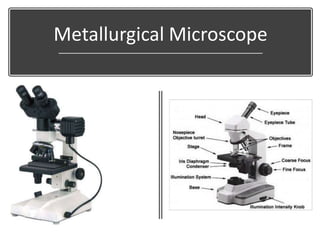
Metallurgical Microscope
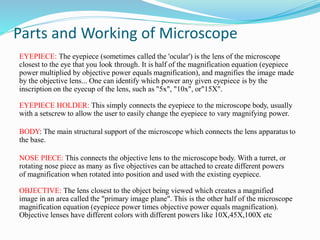
Parts and Working of Microscope
EYEPIECE: The eyepiece (sometimes called the 'ocular') is the lens of the microscope
closest to the eye that you look through. It is half of the magnification equation (eyepiece
power multiplied by objective power equals magnification), and magnifies the image made
by the objective lens... One can identify which power any given eyepiece is by the
inscription on the eyecup of the lens, such as "5x", "10x", or"15X".
EYEPIECE HOLDER: This simply connects the eyepiece to the microscope body, usually
with a setscrew to allow the user to easily change the eyepiece to vary magnifying power.
BODY: The main structural support of the microscope which connects the lens apparatus to
the base.
NOSE PIECE: This connects the objective lens to the microscope body. With a turret, or
rotating nose piece as many as five objectives can be attached to create different powers
of magnification when rotated into position and used with the existing eyepiece.
OBJECTIVE: The lens closest to the object being viewed which creates a magnified
image in an area called the "primary image plane". This is the other half of the microscope
magnification equation (eyepiece power times objective power equals magnification).
Objective lenses have different colors with different powers like 10X,45X,100X etc
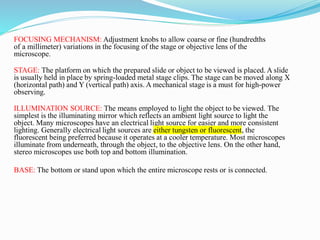
FOCUSING MECHANISM: Adjustment knobs to allow coarse or fine (hundredths
of a millimeter) variations in the focusing of the stage or objective lens of the
microscope.
STAGE: The platform on which the prepared slide or object to be viewed is placed. A slide
is usually held in place by spring-loaded metal stage clips. The stage can be moved along X
(horizontal path) and Y (vertical path) axis. A mechanical stage is a must for high-power
observing.
ILLUMINATION SOURCE: The means employed to light the object to be viewed. The
simplest is the illuminating mirror which reflects an ambient light source to light the
object. Many microscopes have an electrical light source for easier and more consistent
lighting. Generally electrical light sources are either tungsten or fluorescent, the
fluorescent being preferred because it operates at a cooler temperature. Most microscopes
illuminate from underneath, through the object, to the objective lens. On the other hand,
stereo microscopes use both top and bottom illumination.
BASE: The bottom or stand upon which the entire microscope rests or is connected.
 The light originates from the illumination box,
then travels to a piece of glass coated with a
reflecting element.
 The light coming from that angle (450C) is
reflected down into the objective and focused
on the sample. Light is then reflected back
from the sample up into the objective, and
then travels at a different angle on the
reflecting element, which allows it to pass
through the glass instead of reflect off of it.
 It then reaches the eyepieces and is visible to
the human eye.
WORKING MECHANISM
(2000 X)
Magnification
Total magnification of microscope may be calculated as
M= L*E/ F
L- The distance from back of objective to eyepiece.
E- Magnification of Eye piece.
F- The focal length of objective.
Specimen Preparation
Sectioning / Sampling:
 If the material is soft, such as nonferrous metals or alloy & non heat treated
steels, the section is obtained by manual hack sawing /power saw.
 If the material is hard, the section may be obtained by use of an abrasive cut
off wheels. This wheel is thin disk of suitable cutting abrasive rotating at high
speed. The specimen should be kept cool during the cutting operation.
Grinding
 Surface layers damaged by cutting must be removed by grinding.
 Mounted specimens are ground with rotating discs of abrasive paper flushed
with a suitable coolant to remove debris and heat, for example wet silicon
carbide paper. The coarseness of the paper is indicated by a number: the
number of grains of silicon carbide per square inch. So, for example, 180 grit
paper is coarser than 1200. The grinding procedure involves several stages, using a
finer paper (higher number) for each successive stage. Each grinding stage removes
the scratches from the previous coarser paper.
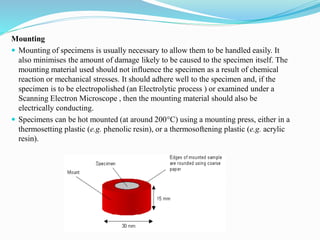
Mounting
 Mounting of specimens is usually necessary to allow them to be handled easily. It
also minimises the amount of damage likely to be caused to the specimen itself. The
mounting material used should not influence the specimen as a result of chemical
reaction or mechanical stresses. It should adhere well to the specimen and, if the
specimen is to be electropolished (an Electrolytic process ) or examined under a
Scanning Electron Microscope , then the mounting material should also be
electrically conducting.
 Specimens can be hot mounted (at around 200°C) using a mounting press, either in a
thermosetting plastic (e.g. phenolic resin), or a thermosoftening plastic (e.g. acrylic
resin).
INTERMEDIATE POLISHING
 After the previous processes the specimen is polishing on a series of emery
paper containing successively finer abrasive (Si-C). The first paper is usually no.
1 than 1/ 0,2/0, 3/0, & finally 4/0. The intermediate polishing operation using
emery paper is usually done dry.
FINE POLISHING
 The time consumed & the success of fine polishing depends largely on the case
that we exercised during the previous polishing processes.
 The final approximation to the flat, scratch free surface is obtained by the use of
a wet rotating wheel covered with a special cloth(Velvet) that is charged by
carefully sized abrasive particles.
 A wide range of abrasive used are aluminium-oxides (Al2O3) or diamond paste
depend on type of metals and alloys.
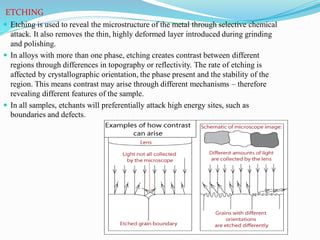
ETCHING
 Etching is used to reveal the microstructure of the metal through selective chemical
attack. It also removes the thin, highly deformed layer introduced during grinding
and polishing.
 In alloys with more than one phase, etching creates contrast between different
regions through differences in topography or reflectivity. The rate of etching is
affected by crystallographic orientation, the phase present and the stability of the
region. This means contrast may arise through different mechanisms – therefore
revealing different features of the sample.
 In all samples, etchants will preferentially attack high energy sites, such as
boundaries and defects.
 The specimen is etched using a reagent. For example, for etching stainless steel or
copper and its alloys, a saturated aqueous solution of ferric chloride, containing a few
drops of hydrochloric acid is used. This is applied using a cotton bud wiped over the
surface a few times (Care should be taken not to over-etch - this is difficult to
determine, however, the photos below may be of some help). The specimen should
then immediately be washed in alcohol and dried.
 Following the etching process there may be numerous small pits present on the
surface. These are etch pits caused by localised chemical attack and, in most cases,
they do not represent features of the microstructure. They may occur preferentially in
regions of high local disorder, for example where there is a high concentration of
dislocations.
 If the specimen is over etched, i.e. etched for too long, these pits tend to grow, and
obscure the main features to be observed. If this occurs it may be better to grind
away the poorly etched surface and re-polish and etch, although it is important to
remember what features you are trying to observe – repeatedly grinding a very thin
sample may leave nothing to see.
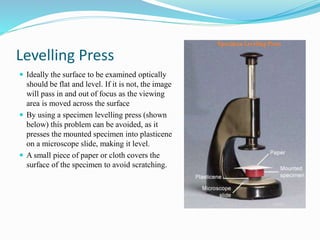
Levelling Press
 Ideally the surface to be examined optically
should be flat and level. If it is not, the image
will pass in and out of focus as the viewing
area is moved across the surface
 By using a specimen levelling press (shown
below) this problem can be avoided, as it
presses the mounted specimen into plasticene
on a microscope slide, making it level.
 A small piece of paper or cloth covers the
surface of the specimen to avoid scratching.
PROCEDURE:
Step 1: Place the microscope on the table with the arm facing your body.
Step 2: Make sure that the low-power objective (smallest objective lens) is in position over the
stage (facing the stage)
Step 3: Rotate the diaphragm to get your optimum light
Step 4: Place your slide on the stage, adjusting it so that the specimen is directly under the
lens – the specimen should be in view when you are looking through the eyepiece
Step 5: Focus on the specimen by slowly moving the coarse-adjustment knob so that the slide
is being moved away from the lens.
Step 6: Rotate the revolving nosepiece so that the medium-power objective is in position.
Focus with the fine-adjustment knob.
Step 7: Rotate the revolving nosepiece so that the high-power objective is in position. Focus
with the fine-adjustment knob.
Step 8: When you are finished with the microscope, return to the low-power objective lens, and
remove the slide from the stage
Finally note the magnifying power of each objective lens and each eye piece to indicate the
total magnification.
• Types of objectives and eyepieces
• Defects in lenses
Eyepiece and Objective Lens
 The Eyepiece Lens is a cylinder
containing two or more lenses; its function
is to bring the image into focus for the eye.
The eyepiece is inserted into the top end
of the body tube.
 The objective lenses are the optical
elements closest to the specimen. The
objective lens gathers light from the
specimen, which is focused to produce the
real image that is seen on the ocular lens.
The numerical aperture is measurement of ability of an optical fiber to capture the
light
EYEPIECE
• Metallurgical microscopes can come in one of many types of
eyepiece styles. These include monocular, binocular,
trinocular, or dual head.
• A monocular eyepiece has one objective and one body tube
for monocular vision.
• Binocular microscopes are fitted with double eyepieces for
vision with both eyes.
• It is named, as it is near to the eye. It is made up of various Powers
such as 5X, 10X, 15X Etc
Types of Eye pieces
• There are two major types of eyepieces
that are grouped according to lens and
diaphragm arrangement:
1. The negative eyepieces with an internal
diaphragm and
2. positive eyepieces that have a diaphragm
below the lenses of the eyepiece.
• Negative eyepieces have two lenses: the upper lens, which is
closest to the observer's eye, is called the eye-lens and the
lower lens (beneath the diaphragm) is often termed the field
lens. In their simplest form, both lenses are plano-convex,
with convex sides "facing" the specimen
• The simplest negative eyepiece design, often termed
the Huygenian eye-piece (illustrated in Figure), is found on most
teaching and laboratory microscopes fitted with achromatic objectives.
• Although the Huygenian eye and field lenses are not well corrected,
their aberrations tend to cancel each other out.
• More highly corrected negative eyepieces have two or three lens
elements cemented and combined together to make the eye lens.
• If an unknown eyepiece carries only the magnification inscribed on the
housing, it is most likely to be a Huygenian eyepiece, best suited for use
with achromatic objectives of 5x-40x magnification.
• The other main kind of eyepiece is the positive
eyepiece with a diaphragm below its lenses,
commonly known as the Ramsden eyepiece, as
illustrated in Figure
• This eyepiece has an eye lens and field lens that
are also plano-convex, but the field lens is
mounted with the curved surface facing towards
the eye lens.
• The front focal plane of this eyepiece lies just
below the field lens, at the level of the eyepiece
diaphragm, making this eyepiece readily
adaptable for mounting reticles.
• To provide better correction, the two lenses of the
Ramsden eyepiece may be cemented together.
It may be positive or negative lens can be used at all magnifications
Using an incorrect eyepiece with an apochromatic objective designed for a finite (160
or 170 mm) tube length application results in dramatically increased contrast with red
fringes on the outer diameters and blue fringes on the inner diameters of the specimen
details.
Defects in lenses
ABERRATIONS
• The calculations of resolution and depth of field are based on the
assumptions that all components of the microscope are perfect, and that
light rays from any point on an object focus on a correspondingly unique
point in the image.
• Unfortunately, this is almost impossible due to image distortions by the lens
called lens aberrations.
Some aberrations affect the whole field/ on-axis of the image
• Chromatic
• Spherical aberrations
while others affect only off-axis points of the image
• Astigmatism
• Curvature of field
• Chromatic aberration is caused by the variation in the refractive index of the
lens in the range of light wavelengths .
• The refractive index of lens glass is greater for shorter wavelengths (for
example, blue) than for longer wavelengths (for example, red).
• Thus, the degree of light deflection by a lens depends on the wavelength of
light.
• Because a range of wavelengths is present in ordinary light (white light),
light cannot be focused at a single point. This phenomenon is illustrated in
Figure 1.7.
• Spherical aberration is caused by the spherical curvature of a lens. Light
rays from a point on the object on the optical axis enter a lens at different
angles and cannot be focused at a single point, as shown in Figure 1.8.
• The portion of the lens farthest from the optical axis brings the rays to a
focus nearer the lens than does the central portion of the lens.
• Astigmatism results when the rays passing through vertical
diameters of the lens are not focused on the same image
plane as rays passing through horizontal diameters, as shown
in Figure 1.9.
• In this case, the image of a point becomes an elliptical streak
at either side of the best focal plane.
• Astigmatism can be severe in a lens with asymmetric
curvature.
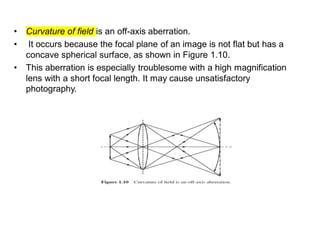
• Curvature of field is an off-axis aberration.
• It occurs because the focal plane of an image is not flat but has a
concave spherical surface, as shown in Figure 1.10.
• This aberration is especially troublesome with a high magnification
lens with a short focal length. It may cause unsatisfactory
photography.
In general, objective lenses are responsible for:
• Primary image formation
• Determine the quality of the image produced
• The total magnification
• The overall resolution
Objective Lens
Objective Lens and Types
• The objective lens is the most important optical component of a light microscope.
• The magnification of the objective lens determines the total magnification of the
microscope because eyepieces commonly have a fixed magnification of 10×.
• The objective lens generates the primary image of the specimen
• The numerical aperture (NA) of the objective lens varies from 0.16 to 1.40, depending
on the type of lens.
• A lens with a high magnification has a higher NA.
• The highest NA for a dry lens (where the medium between the lens and specimen is
air) is about 0.95. Further increase in NA can be achieved by using a lens immersed
in an oil medium.(Improve resolution)
• The oil immersion lens is often used for examining microstructure greater than
1000×magnification.
Classification of the objective lens is based on its aberration correction capabilities,
mainly chromatic aberration.
The following lenses are shown from low to high capability.
 Achromat;
 Semi-achromat (also called ‘fluorite’); and
 Apochromat.
• The achromatic lens corrects chromatic aberration for two
wavelengths (red and blue). It requires green illumination to achieve
satisfactory results for visual observation and black and white
photography.
• The semi-achromatic lens improves correction of chromatic
aberration.
• Its NA is larger than that of an achromatic lens with the same
magnification and produces a brighter image and higher resolution
of detail.
• The apochromatic lens provides the highest degree of aberration
correction. It almost completely eliminates chromatic aberration. It
also provides correction of spherical aberration for two colors.
• Its NA is even larger than that of a semi-achromatic lens.
Improvement in quality requires a substantial increase in complexity
of the lens structure, and costs. For example, an apochromatic lens
may contain 12 or more optical elements.
Classification based on Microscopy Method
The differences in microscopy methods can largely be
attributed to the different types of objective lenses used.
Objective lenses classified according to microscopy methods
include:
• Reflected dark field objectives - Have a special
construction that consists of a 360 degree hollow
chamber that surrounds the centrally located lens
element.
Most darkfield reflected light microscope
objectives are infinity-corrected and are
available in a broad spectrum of
magnifications ranging from 5x to 200x.
These objectives are also manufactured in
various qualities of chromatic and spherical
correction
• Differential interference
contrast (DIC) microscopy, also
known as Nomarski interference
contrast (NIC) or Nomarski
microscopy, is an optical
microscopy technique used to
enhance the contrast in
unstained, transparent samples.
Differential interference contrast (DIC objectives)
• Fluorescence objectives - designed with
quartz and special glass with high
transmission from ultraviolet to the
infrared regions.
• Phase contrast objectives -
• It slows the wavelength and Internal
structures of the cell and organisms are
sharply defined (clear image with different
phases)
• These types of objectives are divided into
several categories depending on
construction and neutral density of
internal phase ring.
• These include;
• Dark low objectives (DL)
• Dark low low objectives (DLL)
• Apodized dark low objectives (ADL)
• Dark medium objectives (DM)
• Bright medium objectives (BM).
Metallurgical microscopy.pdf

Metallurgical microscopy.pdf

  • 1.
    Physical Metallurgy II YearB.Tech.I Sem Ms. Sindhu B Assistant Professor C Dpmt of Metallurgical Engineering JNTUHCEH MODULE –I
  • 2.
    Metallurgical microscope  Introduction Principle  Construction  Types of objectives and eyepieces  Defects in lenses
  • 4.
     For example:A 5X power eyepiece used in conjunction with an 40X objective lens gives a magnification of 200X. Maximum magnification of optical microscopes is limited to about 2000X  Measured in Microns
  • 5.
    APPLICATIONS  Size, shapeand distribution of various phases,  Grain size determination and its distribution,  Prediction of probable mechanicalproperties,  Presence of secondary phase and its distribution  Non-metallic inclusions,  Segregation of elements,  Heterogeneous conditions,  Abnormal structure,  Directionality in metal working process, and  Effect of Heat Treatment Metallography is widely used in research centers for: Routine testing during production, Failure analysis, and Research and development of new alloys and processes.
  • 6.
    List of ModernMicroscopes 1) Watson Royal Microscope. 2) Van Lanes Hock Microscope. 3) Glass led Microscope. 4) Baker series Microscope. 5) Leitr Microscope.
  • 7.
    Principle of MetallurgicalMicroscope  A horizontal beam of light from the light source is reflected by means of a plane glass reflector downwards through the microscope objective on the surface of the specimen some of these incident light reflected from the specimen surface will be magnified and passing through the plane glass reflector and magnified again by upper lens system of the eye-piece. Or  It works on principle of reflection of light from the specimen surface
  • 9.
  • 10.
    Parts and Workingof Microscope EYEPIECE: The eyepiece (sometimes called the 'ocular') is the lens of the microscope closest to the eye that you look through. It is half of the magnification equation (eyepiece power multiplied by objective power equals magnification), and magnifies the image made by the objective lens... One can identify which power any given eyepiece is by the inscription on the eyecup of the lens, such as "5x", "10x", or"15X". EYEPIECE HOLDER: This simply connects the eyepiece to the microscope body, usually with a setscrew to allow the user to easily change the eyepiece to vary magnifying power. BODY: The main structural support of the microscope which connects the lens apparatus to the base. NOSE PIECE: This connects the objective lens to the microscope body. With a turret, or rotating nose piece as many as five objectives can be attached to create different powers of magnification when rotated into position and used with the existing eyepiece. OBJECTIVE: The lens closest to the object being viewed which creates a magnified image in an area called the "primary image plane". This is the other half of the microscope magnification equation (eyepiece power times objective power equals magnification). Objective lenses have different colors with different powers like 10X,45X,100X etc
  • 11.
    FOCUSING MECHANISM: Adjustmentknobs to allow coarse or fine (hundredths of a millimeter) variations in the focusing of the stage or objective lens of the microscope. STAGE: The platform on which the prepared slide or object to be viewed is placed. A slide is usually held in place by spring-loaded metal stage clips. The stage can be moved along X (horizontal path) and Y (vertical path) axis. A mechanical stage is a must for high-power observing. ILLUMINATION SOURCE: The means employed to light the object to be viewed. The simplest is the illuminating mirror which reflects an ambient light source to light the object. Many microscopes have an electrical light source for easier and more consistent lighting. Generally electrical light sources are either tungsten or fluorescent, the fluorescent being preferred because it operates at a cooler temperature. Most microscopes illuminate from underneath, through the object, to the objective lens. On the other hand, stereo microscopes use both top and bottom illumination. BASE: The bottom or stand upon which the entire microscope rests or is connected.
  • 12.
     The lightoriginates from the illumination box, then travels to a piece of glass coated with a reflecting element.  The light coming from that angle (450C) is reflected down into the objective and focused on the sample. Light is then reflected back from the sample up into the objective, and then travels at a different angle on the reflecting element, which allows it to pass through the glass instead of reflect off of it.  It then reaches the eyepieces and is visible to the human eye. WORKING MECHANISM (2000 X)
  • 13.
    Magnification Total magnification ofmicroscope may be calculated as M= L*E/ F L- The distance from back of objective to eyepiece. E- Magnification of Eye piece. F- The focal length of objective.
  • 14.
    Specimen Preparation Sectioning /Sampling:  If the material is soft, such as nonferrous metals or alloy & non heat treated steels, the section is obtained by manual hack sawing /power saw.  If the material is hard, the section may be obtained by use of an abrasive cut off wheels. This wheel is thin disk of suitable cutting abrasive rotating at high speed. The specimen should be kept cool during the cutting operation. Grinding  Surface layers damaged by cutting must be removed by grinding.  Mounted specimens are ground with rotating discs of abrasive paper flushed with a suitable coolant to remove debris and heat, for example wet silicon carbide paper. The coarseness of the paper is indicated by a number: the number of grains of silicon carbide per square inch. So, for example, 180 grit paper is coarser than 1200. The grinding procedure involves several stages, using a finer paper (higher number) for each successive stage. Each grinding stage removes the scratches from the previous coarser paper.
  • 15.
    Mounting  Mounting ofspecimens is usually necessary to allow them to be handled easily. It also minimises the amount of damage likely to be caused to the specimen itself. The mounting material used should not influence the specimen as a result of chemical reaction or mechanical stresses. It should adhere well to the specimen and, if the specimen is to be electropolished (an Electrolytic process ) or examined under a Scanning Electron Microscope , then the mounting material should also be electrically conducting.  Specimens can be hot mounted (at around 200°C) using a mounting press, either in a thermosetting plastic (e.g. phenolic resin), or a thermosoftening plastic (e.g. acrylic resin).
  • 16.
    INTERMEDIATE POLISHING  Afterthe previous processes the specimen is polishing on a series of emery paper containing successively finer abrasive (Si-C). The first paper is usually no. 1 than 1/ 0,2/0, 3/0, & finally 4/0. The intermediate polishing operation using emery paper is usually done dry. FINE POLISHING  The time consumed & the success of fine polishing depends largely on the case that we exercised during the previous polishing processes.  The final approximation to the flat, scratch free surface is obtained by the use of a wet rotating wheel covered with a special cloth(Velvet) that is charged by carefully sized abrasive particles.  A wide range of abrasive used are aluminium-oxides (Al2O3) or diamond paste depend on type of metals and alloys.
  • 17.
    ETCHING  Etching isused to reveal the microstructure of the metal through selective chemical attack. It also removes the thin, highly deformed layer introduced during grinding and polishing.  In alloys with more than one phase, etching creates contrast between different regions through differences in topography or reflectivity. The rate of etching is affected by crystallographic orientation, the phase present and the stability of the region. This means contrast may arise through different mechanisms – therefore revealing different features of the sample.  In all samples, etchants will preferentially attack high energy sites, such as boundaries and defects.
  • 18.
     The specimenis etched using a reagent. For example, for etching stainless steel or copper and its alloys, a saturated aqueous solution of ferric chloride, containing a few drops of hydrochloric acid is used. This is applied using a cotton bud wiped over the surface a few times (Care should be taken not to over-etch - this is difficult to determine, however, the photos below may be of some help). The specimen should then immediately be washed in alcohol and dried.  Following the etching process there may be numerous small pits present on the surface. These are etch pits caused by localised chemical attack and, in most cases, they do not represent features of the microstructure. They may occur preferentially in regions of high local disorder, for example where there is a high concentration of dislocations.  If the specimen is over etched, i.e. etched for too long, these pits tend to grow, and obscure the main features to be observed. If this occurs it may be better to grind away the poorly etched surface and re-polish and etch, although it is important to remember what features you are trying to observe – repeatedly grinding a very thin sample may leave nothing to see.
  • 19.
    Levelling Press  Ideallythe surface to be examined optically should be flat and level. If it is not, the image will pass in and out of focus as the viewing area is moved across the surface  By using a specimen levelling press (shown below) this problem can be avoided, as it presses the mounted specimen into plasticene on a microscope slide, making it level.  A small piece of paper or cloth covers the surface of the specimen to avoid scratching.
  • 20.
    PROCEDURE: Step 1: Placethe microscope on the table with the arm facing your body. Step 2: Make sure that the low-power objective (smallest objective lens) is in position over the stage (facing the stage) Step 3: Rotate the diaphragm to get your optimum light Step 4: Place your slide on the stage, adjusting it so that the specimen is directly under the lens – the specimen should be in view when you are looking through the eyepiece Step 5: Focus on the specimen by slowly moving the coarse-adjustment knob so that the slide is being moved away from the lens. Step 6: Rotate the revolving nosepiece so that the medium-power objective is in position. Focus with the fine-adjustment knob. Step 7: Rotate the revolving nosepiece so that the high-power objective is in position. Focus with the fine-adjustment knob. Step 8: When you are finished with the microscope, return to the low-power objective lens, and remove the slide from the stage Finally note the magnifying power of each objective lens and each eye piece to indicate the total magnification.
  • 21.
    • Types ofobjectives and eyepieces • Defects in lenses
  • 22.
    Eyepiece and ObjectiveLens  The Eyepiece Lens is a cylinder containing two or more lenses; its function is to bring the image into focus for the eye. The eyepiece is inserted into the top end of the body tube.  The objective lenses are the optical elements closest to the specimen. The objective lens gathers light from the specimen, which is focused to produce the real image that is seen on the ocular lens.
  • 23.
    The numerical apertureis measurement of ability of an optical fiber to capture the light
  • 24.
    EYEPIECE • Metallurgical microscopescan come in one of many types of eyepiece styles. These include monocular, binocular, trinocular, or dual head. • A monocular eyepiece has one objective and one body tube for monocular vision. • Binocular microscopes are fitted with double eyepieces for vision with both eyes. • It is named, as it is near to the eye. It is made up of various Powers such as 5X, 10X, 15X Etc
  • 25.
    Types of Eyepieces • There are two major types of eyepieces that are grouped according to lens and diaphragm arrangement: 1. The negative eyepieces with an internal diaphragm and 2. positive eyepieces that have a diaphragm below the lenses of the eyepiece.
  • 26.
    • Negative eyepieceshave two lenses: the upper lens, which is closest to the observer's eye, is called the eye-lens and the lower lens (beneath the diaphragm) is often termed the field lens. In their simplest form, both lenses are plano-convex, with convex sides "facing" the specimen • The simplest negative eyepiece design, often termed the Huygenian eye-piece (illustrated in Figure), is found on most teaching and laboratory microscopes fitted with achromatic objectives. • Although the Huygenian eye and field lenses are not well corrected, their aberrations tend to cancel each other out. • More highly corrected negative eyepieces have two or three lens elements cemented and combined together to make the eye lens. • If an unknown eyepiece carries only the magnification inscribed on the housing, it is most likely to be a Huygenian eyepiece, best suited for use with achromatic objectives of 5x-40x magnification.
  • 27.
    • The othermain kind of eyepiece is the positive eyepiece with a diaphragm below its lenses, commonly known as the Ramsden eyepiece, as illustrated in Figure • This eyepiece has an eye lens and field lens that are also plano-convex, but the field lens is mounted with the curved surface facing towards the eye lens. • The front focal plane of this eyepiece lies just below the field lens, at the level of the eyepiece diaphragm, making this eyepiece readily adaptable for mounting reticles. • To provide better correction, the two lenses of the Ramsden eyepiece may be cemented together.
  • 28.
    It may bepositive or negative lens can be used at all magnifications Using an incorrect eyepiece with an apochromatic objective designed for a finite (160 or 170 mm) tube length application results in dramatically increased contrast with red fringes on the outer diameters and blue fringes on the inner diameters of the specimen details.
  • 29.
    Defects in lenses ABERRATIONS •The calculations of resolution and depth of field are based on the assumptions that all components of the microscope are perfect, and that light rays from any point on an object focus on a correspondingly unique point in the image. • Unfortunately, this is almost impossible due to image distortions by the lens called lens aberrations. Some aberrations affect the whole field/ on-axis of the image • Chromatic • Spherical aberrations while others affect only off-axis points of the image • Astigmatism • Curvature of field
  • 30.
    • Chromatic aberrationis caused by the variation in the refractive index of the lens in the range of light wavelengths . • The refractive index of lens glass is greater for shorter wavelengths (for example, blue) than for longer wavelengths (for example, red). • Thus, the degree of light deflection by a lens depends on the wavelength of light. • Because a range of wavelengths is present in ordinary light (white light), light cannot be focused at a single point. This phenomenon is illustrated in Figure 1.7.
  • 31.
    • Spherical aberrationis caused by the spherical curvature of a lens. Light rays from a point on the object on the optical axis enter a lens at different angles and cannot be focused at a single point, as shown in Figure 1.8. • The portion of the lens farthest from the optical axis brings the rays to a focus nearer the lens than does the central portion of the lens.
  • 32.
    • Astigmatism resultswhen the rays passing through vertical diameters of the lens are not focused on the same image plane as rays passing through horizontal diameters, as shown in Figure 1.9. • In this case, the image of a point becomes an elliptical streak at either side of the best focal plane. • Astigmatism can be severe in a lens with asymmetric curvature.
  • 33.
    • Curvature offield is an off-axis aberration. • It occurs because the focal plane of an image is not flat but has a concave spherical surface, as shown in Figure 1.10. • This aberration is especially troublesome with a high magnification lens with a short focal length. It may cause unsatisfactory photography.
  • 34.
    In general, objectivelenses are responsible for: • Primary image formation • Determine the quality of the image produced • The total magnification • The overall resolution Objective Lens
  • 35.
    Objective Lens andTypes • The objective lens is the most important optical component of a light microscope. • The magnification of the objective lens determines the total magnification of the microscope because eyepieces commonly have a fixed magnification of 10×. • The objective lens generates the primary image of the specimen • The numerical aperture (NA) of the objective lens varies from 0.16 to 1.40, depending on the type of lens. • A lens with a high magnification has a higher NA. • The highest NA for a dry lens (where the medium between the lens and specimen is air) is about 0.95. Further increase in NA can be achieved by using a lens immersed in an oil medium.(Improve resolution) • The oil immersion lens is often used for examining microstructure greater than 1000×magnification. Classification of the objective lens is based on its aberration correction capabilities, mainly chromatic aberration. The following lenses are shown from low to high capability.  Achromat;  Semi-achromat (also called ‘fluorite’); and  Apochromat.
  • 36.
    • The achromaticlens corrects chromatic aberration for two wavelengths (red and blue). It requires green illumination to achieve satisfactory results for visual observation and black and white photography. • The semi-achromatic lens improves correction of chromatic aberration. • Its NA is larger than that of an achromatic lens with the same magnification and produces a brighter image and higher resolution of detail. • The apochromatic lens provides the highest degree of aberration correction. It almost completely eliminates chromatic aberration. It also provides correction of spherical aberration for two colors. • Its NA is even larger than that of a semi-achromatic lens. Improvement in quality requires a substantial increase in complexity of the lens structure, and costs. For example, an apochromatic lens may contain 12 or more optical elements.
  • 37.
    Classification based onMicroscopy Method The differences in microscopy methods can largely be attributed to the different types of objective lenses used. Objective lenses classified according to microscopy methods include: • Reflected dark field objectives - Have a special construction that consists of a 360 degree hollow chamber that surrounds the centrally located lens element. Most darkfield reflected light microscope objectives are infinity-corrected and are available in a broad spectrum of magnifications ranging from 5x to 200x. These objectives are also manufactured in various qualities of chromatic and spherical correction
  • 38.
    • Differential interference contrast(DIC) microscopy, also known as Nomarski interference contrast (NIC) or Nomarski microscopy, is an optical microscopy technique used to enhance the contrast in unstained, transparent samples. Differential interference contrast (DIC objectives)
  • 39.
    • Fluorescence objectives- designed with quartz and special glass with high transmission from ultraviolet to the infrared regions. • Phase contrast objectives - • It slows the wavelength and Internal structures of the cell and organisms are sharply defined (clear image with different phases) • These types of objectives are divided into several categories depending on construction and neutral density of internal phase ring. • These include; • Dark low objectives (DL) • Dark low low objectives (DLL) • Apodized dark low objectives (ADL) • Dark medium objectives (DM) • Bright medium objectives (BM).