Manoj Kumar Sahoo
Part-I: ChiralityPart-I: Chirality
(History, chiral technologies e.g. asymmetric synthesis,(History, chiral technologies e.g. asymmetric synthesis,
absolute configuration, enantiomeric excess)absolute configuration, enantiomeric excess)
Part-II: Origin of lifePart-II: Origin of life
(Origin of homochirality, physical and chemical models)(Origin of homochirality, physical and chemical models)
Part.I
CHIRALITY
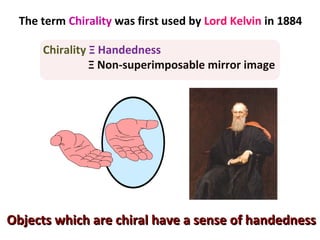
The term Chirality was first used by Lord Kelvin in 1884
Chirality Ξ Handedness
Ξ Non-superimposable mirror image
Objects which are chiral have a sense of handednessObjects which are chiral have a sense of handedness
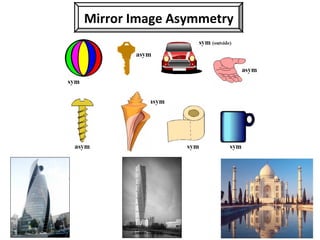
Mirror Image Asymmetry
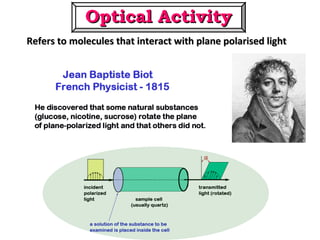
Refers to molecules that interact with plane polarised lightRefers to molecules that interact with plane polarised light
Optical ActivityOptical Activity
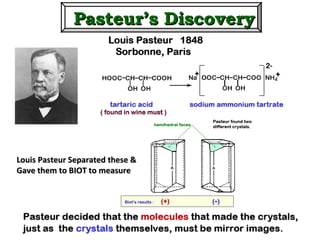
Louis Pasteur Separated these &Louis Pasteur Separated these &
Gave them to BIOT to measureGave them to BIOT to measure
Pasteur’s DiscoveryPasteur’s Discovery
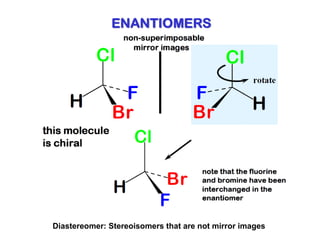
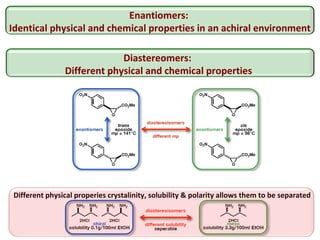
Diastereomer: Stereoisomers that are not mirror images
Enantiomers:
Identical physical and chemical properties in an achiral environment
Diastereomers:
Different physical and chemical properties
Different physical properies crystalinity, solubility & polarity allows them to be separated
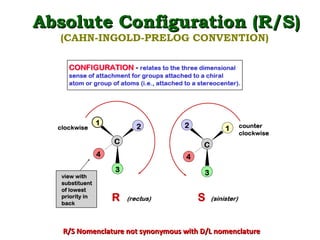
Absolute Configuration (R/S)Absolute Configuration (R/S)
(CAHN-INGOLD-PRELOG CONVENTION)
R/S Nomenclature not synonymous with D/L nomenclatureR/S Nomenclature not synonymous with D/L nomenclature
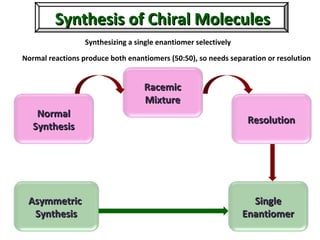
Synthesis of Chiral MoleculesSynthesis of Chiral Molecules
Synthesizing a single enantiomer selectively
Normal reactions produce both enantiomers (50:50), so needs separation or resolution
ResolutionResolution
AsymmetricAsymmetric
SynthesisSynthesis
SingleSingle
EnantiomerEnantiomer
NormalNormal
SynthesisSynthesis
RacemicRacemic
MixtureMixture
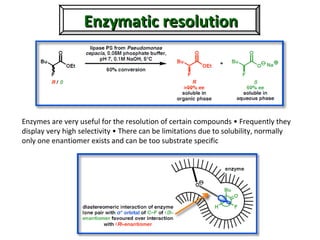
Enzymatic resolutionEnzymatic resolution
Enzymes are very useful for the resolution of certain compounds • Frequently they
display very high selectivity • There can be limitations due to solubility, normally
only one enantiomer exists and can be too substrate specific
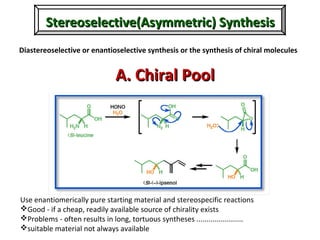
Stereoselective(Asymmetric) SynthesisStereoselective(Asymmetric) Synthesis
Diastereoselective or enantioselective synthesis or the synthesis of chiral molecules
Use enantiomerically pure starting material and stereospecific reactions
Good - if a cheap, readily available source of chirality exists
Problems - often results in long, tortuous syntheses .......................
suitable material not always available
A. Chiral PoolA. Chiral Pool
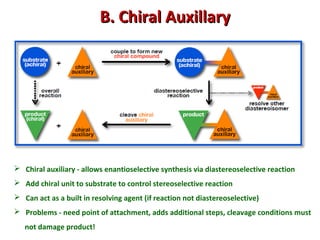
 Chiral auxiliary - allows enantioselective synthesis via diastereoselective reaction
 Add chiral unit to substrate to control stereoselective reaction
 Can act as a built in resolving agent (if reaction not diastereoselective)
 Problems - need point of attachment, adds additional steps, cleavage conditions must
not damage product!
B. Chiral AuxillaryB. Chiral Auxillary
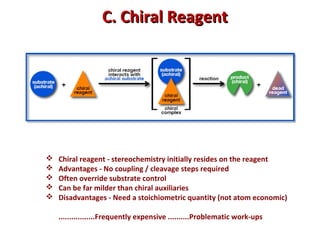
 Chiral reagent - stereochemistry initially resides on the reagent
 Advantages - No coupling / cleavage steps required
 Often override substrate control
 Can be far milder than chiral auxiliaries
 Disadvantages - Need a stoichiometric quantity (not atom economic)
.................Frequently expensive ..........Problematic work-ups
C. Chiral ReagentC. Chiral Reagent
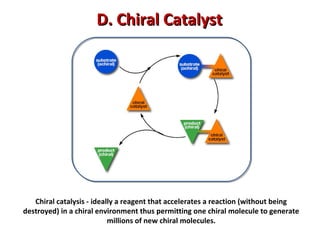
Chiral catalysis - ideally a reagent that accelerates a reaction (without being
destroyed) in a chiral environment thus permitting one chiral molecule to generate
millions of new chiral molecules.
D. Chiral CatalystD. Chiral Catalyst
((Enantiomeric Excess (ee)Enantiomeric Excess (ee)))
Measuring ChiralityMeasuring Chirality
• Optical purity:Optical purity: a way of describing the composition of
a mixture of enantiomers
• Enantiomeric excess:Enantiomeric excess: the difference between the
percentage of two enantiomers in a mixture
optical purity is numerically equal to enantiomeric
excess, but is experimentally determined
x 100
[α]sample
Percent optical purity =
[α]pure enantiomer
x 100
[R] + [S]
[R] - [S]
Enantiomeric excess (ee) = = %R - %S
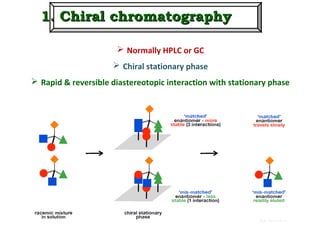
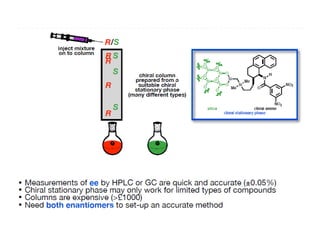
1. Chiral chromatography1. Chiral chromatography
 Normally HPLC or GC
 Chiral stationary phase
 Rapid & reversible diastereotopic interaction with stationary phase
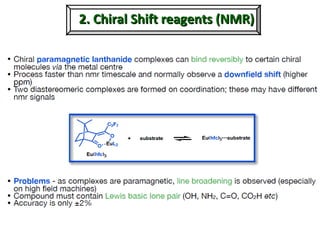
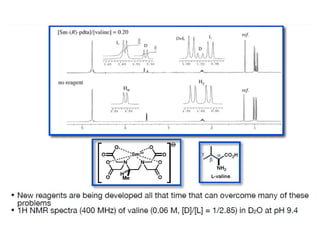
2. Chiral Shift reagents (NMR)2. Chiral Shift reagents (NMR)
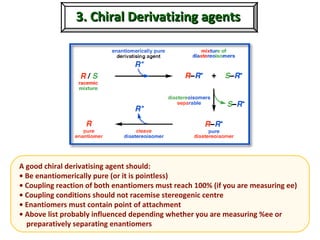
3. Chiral Derivatizing agents3. Chiral Derivatizing agents
A good chiral derivatising agent should:
• Be enantiomerically pure (or it is pointless)
• Coupling reaction of both enantiomers must reach 100% (if you are measuring ee)
• Coupling conditions should not racemise stereogenic centre
• Enantiomers must contain point of attachment
• Above list probably influenced depending whether you are measuring %ee or
preparatively separating enantiomers
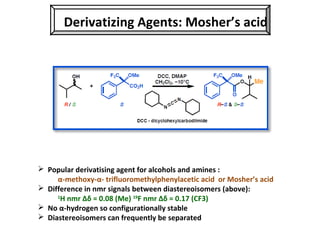
Derivatizing Agents: Mosher’s acid
 Popular derivatising agent for alcohols and amines :
α-methoxy-α- trifluoromethylphenylacetic acid or Mosher’s acid
 Difference in nmr signals between diastereoisomers (above):
1
H nmr Δδ = 0.08 (Me) 19
F nmr Δδ = 0.17 (CF3)
 No α-hydrogen so configurationally stable
 Diastereoisomers can frequently be separated
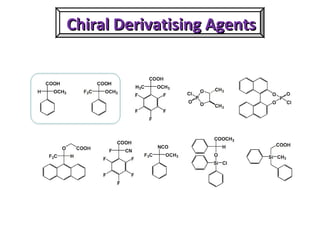
Chiral Derivatising AgentsChiral Derivatising Agents
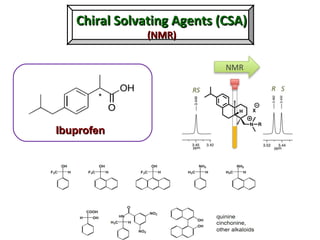
Chiral Solvating Agents (CSA)Chiral Solvating Agents (CSA)
(NMR)(NMR)
IbuprofenIbuprofen
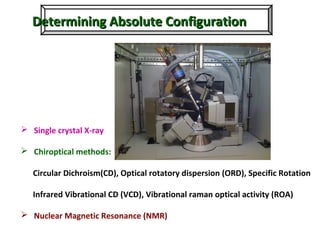
Determining Absolute ConfigurationDetermining Absolute Configuration
 Single crystal X-ray
 Chiroptical methods:
Circular Dichroism(CD), Optical rotatory dispersion (ORD), Specific Rotation
Infrared Vibrational CD (VCD), Vibrational raman optical activity (ROA)
 Nuclear Magnetic Resonance (NMR)
Manoj Kumar Sahoo
Part.II
Origin of life
(The homochirality problem)
"Deducing the mechanism of the origin of life on earth has always
remained a fascinating but unsolved puzzle. Some have even
considered it too difficult for scientific study, because the direct
evidence is long gone, and we can only work by plausible
inference."
-R.H. Crabtree, Science, 1997, 276, 222
"Biogenesis, as a problem of science, is lastly going to be a problem
of synthesis. The origin of life cannot be 'discovered', it has to be
re-invented."
-A. Eschenmoser, Tetrahedron, 2007, 63, 12821-12844.
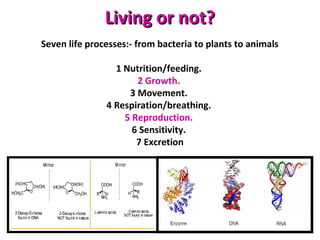
Living or not?Living or not?
Seven life processes:- from bacteria to plants to animals
1 Nutrition/feeding.
2 Growth.
3 Movement.
4 Respiration/breathing.
5 Reproduction.
6 Sensitivity.
7 Excretion
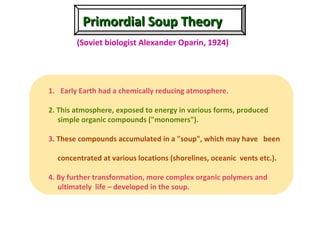
Primordial Soup TheoryPrimordial Soup Theory
(Soviet biologist Alexander Oparin, 1924)
1. Early Earth had a chemically reducing atmosphere.
2. This atmosphere, exposed to energy in various forms, produced
simple organic compounds ("monomers").
3. These compounds accumulated in a "soup", which may have been
concentrated at various locations (shorelines, oceanic vents etc.).
4. By further transformation, more complex organic polymers and
ultimately life – developed in the soup.
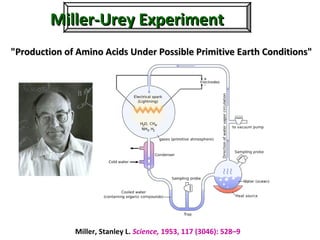
Miller-Urey ExperimentMiller-Urey Experiment
Miller, Stanley L. Science, 1953, 117 (3046): 528–9
"Production of Amino Acids Under Possible Primitive Earth Conditions""Production of Amino Acids Under Possible Primitive Earth Conditions"
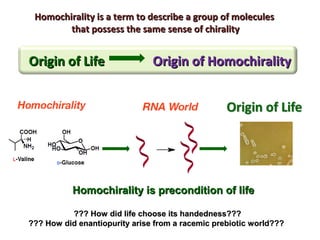
Homochirality is a term to describe a group of moleculesHomochirality is a term to describe a group of molecules
that possess the same sense of chiralitythat possess the same sense of chirality
Origin of LifeOrigin of Life Origin of HomochiralityOrigin of Homochirality
Homochirality is precondition of lifeHomochirality is precondition of life
??? How did life choose its handedness?????? How did life choose its handedness???
??? How did enantiopurity arise from a racemic prebiotic world?????? How did enantiopurity arise from a racemic prebiotic world???
Conclusion from Part-IConclusion from Part-I
Chirality is created in presence of a chiral directing for
(Chiral pool, chiral auxillary, chiral catalyst,
chiral reagent, & circularly polarised light)
Absolute asymmetric synthesis
How the first chiral compound synthesized???
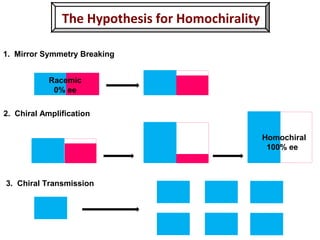
The Hypothesis for Homochirality
3. Chiral Transmission
1. Mirror Symmetry Breaking
Racemic
0% ee
2. Chiral Amplification
Homochiral
100% ee
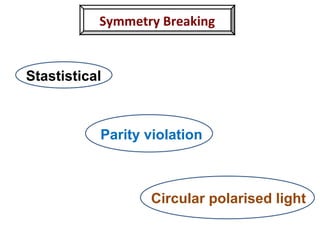
Symmetry Breaking
Stastistical
Parity violation
Circular polarised light
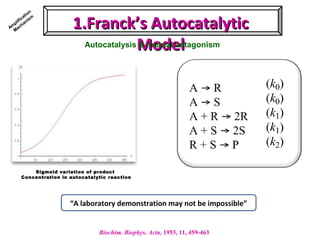
1.Franck’s Autocatalytic1.Franck’s Autocatalytic
ModelModel
Biochim. Biophys. Acta, 1953, 11, 459-463
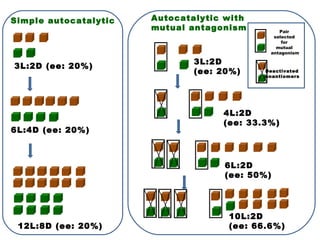
Autocatalysis & mutual antagonism
“A laboratory demonstration may not be impossible”
Am
plification
M
echanism
Sigmoid variation of product
Concentration in autocatalytic reaction
3L:2D (ee: 20%)
6L:4D (ee: 20%)
12L:8D (ee: 20%)
3L:2D
(ee: 20%)
4L:2D
(ee: 33.3%)
6L:2D
(ee: 50%)
10L:2D
(ee: 66.6%)
Simple autocatalytic Autocatalytic with
mutual antagonism Pair
selected
for
mutual
antagonism
Deactivated
enantiomers
Am
plification
M
echanism
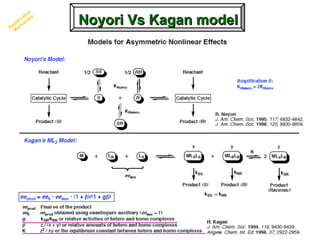
Noyori Vs Kagan modelNoyori Vs Kagan modelAm
plification
M
echanism
Am
plification
M
echanism
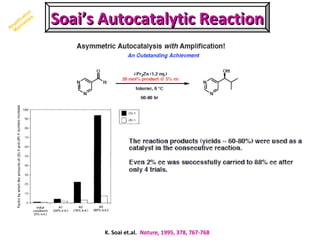
Soai’s Autocatalytic ReactionSoai’s Autocatalytic Reaction
K. Soai et.al. Nature, 1995, 378, 767-768
Am
plification
M
echanism
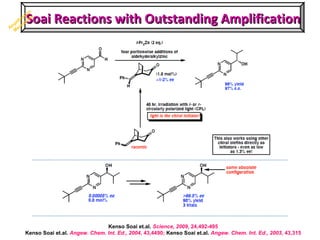
Kenso Soai et.al. Science, 2009, 24,492-495
Kenso Soai et.al. Angew. Chem. Int. Ed., 2004, 43,4490; Kenso Soai et.al. Angew. Chem. Int. Ed., 2003, 43,315
Soai Reactions with Outstanding AmplificationSoai Reactions with Outstanding AmplificationAm
plification
M
echanism
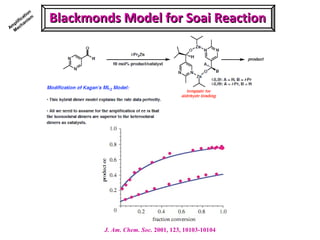
Blackmonds Model for Soai ReactionBlackmonds Model for Soai Reaction
J. Am. Chem. Soc. 2001, 123, 10103-10104
Am
plification
M
echanism
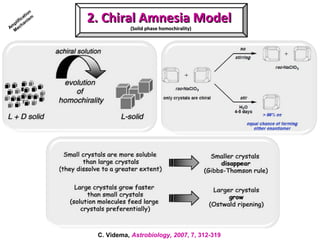
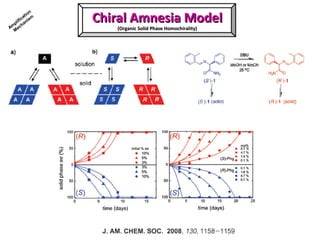
2. Chiral Amnesia Model2. Chiral Amnesia Model
(Solid phase homochirality)(Solid phase homochirality)
C. Videma, Astrobiology, 2007, 7, 312-319
Am
plification
M
echanism
Chiral Amnesia ModelChiral Amnesia Model
(Organic Solid Phase Homochirality)(Organic Solid Phase Homochirality)Am
plification
M
echanism
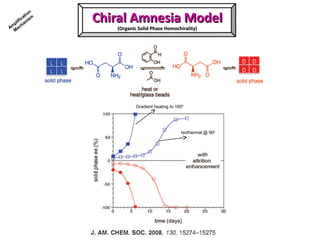
Gradient heating to 1600
Isothermal @ 900
Chiral Amnesia ModelChiral Amnesia Model
(Organic Solid Phase Homochirality)(Organic Solid Phase Homochirality)Am
plification
M
echanism
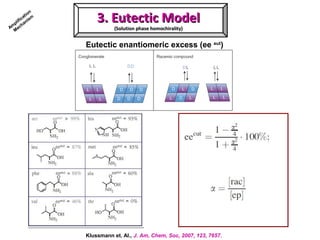
3. Eutectic Model3. Eutectic Model
(Solution phase homochirality)(Solution phase homochirality)
Eutectic enantiomeric excess (ee eut
)
Klussmann et. Al., J. Am, Chem, Soc, 2007, 123, 7657.
Am
plification
M
echanism
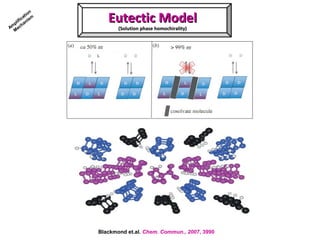
Blackmond et.al. Chem. Commun., 2007, 3990
Eutectic ModelEutectic Model
(Solution phase homochirality)(Solution phase homochirality)Am
plification
M
echanism
ConclusionConclusion
1. Chemical models provide a plausible pathway for the evolution of
homochirality in nature
2. These investigations will be helpful in the new field of “Systems
Chemistry” which will uncover the chemical roots of biological
organization ultimately enable the engineering of novel biological
systems & functions
3. Building systems that can self-recognize & self assemble, process
information, transport material and energy impact future
technology in areas of material science, synthetic biology
and pharmaceuticals
Homochirality

Homochirality

  • 1.
  • 2.
    Part-I: ChiralityPart-I: Chirality (History,chiral technologies e.g. asymmetric synthesis,(History, chiral technologies e.g. asymmetric synthesis, absolute configuration, enantiomeric excess)absolute configuration, enantiomeric excess) Part-II: Origin of lifePart-II: Origin of life (Origin of homochirality, physical and chemical models)(Origin of homochirality, physical and chemical models)
  • 3.
  • 4.
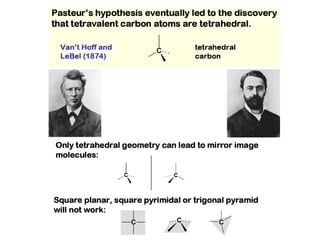
    The term Chiralitywas first used by Lord Kelvin in 1884 Chirality Ξ Handedness Ξ Non-superimposable mirror image Objects which are chiral have a sense of handednessObjects which are chiral have a sense of handedness
  • 5.
  • 6.
    Refers to moleculesthat interact with plane polarised lightRefers to molecules that interact with plane polarised light Optical ActivityOptical Activity
  • 7.
    Louis Pasteur Separatedthese &Louis Pasteur Separated these & Gave them to BIOT to measureGave them to BIOT to measure Pasteur’s DiscoveryPasteur’s Discovery
  • 9.
    Diastereomer: Stereoisomers thatare not mirror images
  • 10.
    Enantiomers: Identical physical andchemical properties in an achiral environment Diastereomers: Different physical and chemical properties Different physical properies crystalinity, solubility & polarity allows them to be separated
  • 11.
    Absolute Configuration (R/S)AbsoluteConfiguration (R/S) (CAHN-INGOLD-PRELOG CONVENTION) R/S Nomenclature not synonymous with D/L nomenclatureR/S Nomenclature not synonymous with D/L nomenclature
  • 12.
    Synthesis of ChiralMoleculesSynthesis of Chiral Molecules Synthesizing a single enantiomer selectively Normal reactions produce both enantiomers (50:50), so needs separation or resolution ResolutionResolution AsymmetricAsymmetric SynthesisSynthesis SingleSingle EnantiomerEnantiomer NormalNormal SynthesisSynthesis RacemicRacemic MixtureMixture
  • 13.
    Enzymatic resolutionEnzymatic resolution Enzymesare very useful for the resolution of certain compounds • Frequently they display very high selectivity • There can be limitations due to solubility, normally only one enantiomer exists and can be too substrate specific
  • 14.
    Stereoselective(Asymmetric) SynthesisStereoselective(Asymmetric) Synthesis Diastereoselectiveor enantioselective synthesis or the synthesis of chiral molecules Use enantiomerically pure starting material and stereospecific reactions Good - if a cheap, readily available source of chirality exists Problems - often results in long, tortuous syntheses ....................... suitable material not always available A. Chiral PoolA. Chiral Pool
  • 15.
     Chiral auxiliary- allows enantioselective synthesis via diastereoselective reaction  Add chiral unit to substrate to control stereoselective reaction  Can act as a built in resolving agent (if reaction not diastereoselective)  Problems - need point of attachment, adds additional steps, cleavage conditions must not damage product! B. Chiral AuxillaryB. Chiral Auxillary
  • 16.
     Chiral reagent- stereochemistry initially resides on the reagent  Advantages - No coupling / cleavage steps required  Often override substrate control  Can be far milder than chiral auxiliaries  Disadvantages - Need a stoichiometric quantity (not atom economic) .................Frequently expensive ..........Problematic work-ups C. Chiral ReagentC. Chiral Reagent
  • 17.
    Chiral catalysis -ideally a reagent that accelerates a reaction (without being destroyed) in a chiral environment thus permitting one chiral molecule to generate millions of new chiral molecules. D. Chiral CatalystD. Chiral Catalyst
  • 18.
    ((Enantiomeric Excess (ee)EnantiomericExcess (ee))) Measuring ChiralityMeasuring Chirality • Optical purity:Optical purity: a way of describing the composition of a mixture of enantiomers • Enantiomeric excess:Enantiomeric excess: the difference between the percentage of two enantiomers in a mixture optical purity is numerically equal to enantiomeric excess, but is experimentally determined x 100 [α]sample Percent optical purity = [α]pure enantiomer x 100 [R] + [S] [R] - [S] Enantiomeric excess (ee) = = %R - %S
  • 19.
    1. Chiral chromatography1.Chiral chromatography  Normally HPLC or GC  Chiral stationary phase  Rapid & reversible diastereotopic interaction with stationary phase
  • 21.
    2. Chiral Shiftreagents (NMR)2. Chiral Shift reagents (NMR)
  • 23.
    3. Chiral Derivatizingagents3. Chiral Derivatizing agents A good chiral derivatising agent should: • Be enantiomerically pure (or it is pointless) • Coupling reaction of both enantiomers must reach 100% (if you are measuring ee) • Coupling conditions should not racemise stereogenic centre • Enantiomers must contain point of attachment • Above list probably influenced depending whether you are measuring %ee or preparatively separating enantiomers
  • 24.
    Derivatizing Agents: Mosher’sacid  Popular derivatising agent for alcohols and amines : α-methoxy-α- trifluoromethylphenylacetic acid or Mosher’s acid  Difference in nmr signals between diastereoisomers (above): 1 H nmr Δδ = 0.08 (Me) 19 F nmr Δδ = 0.17 (CF3)  No α-hydrogen so configurationally stable  Diastereoisomers can frequently be separated
  • 25.
  • 26.
    Chiral Solvating Agents(CSA)Chiral Solvating Agents (CSA) (NMR)(NMR) IbuprofenIbuprofen
  • 27.
    Determining Absolute ConfigurationDeterminingAbsolute Configuration  Single crystal X-ray  Chiroptical methods: Circular Dichroism(CD), Optical rotatory dispersion (ORD), Specific Rotation Infrared Vibrational CD (VCD), Vibrational raman optical activity (ROA)  Nuclear Magnetic Resonance (NMR)
  • 28.
  • 29.
    Part.II Origin of life (Thehomochirality problem)
  • 30.
    "Deducing the mechanismof the origin of life on earth has always remained a fascinating but unsolved puzzle. Some have even considered it too difficult for scientific study, because the direct evidence is long gone, and we can only work by plausible inference." -R.H. Crabtree, Science, 1997, 276, 222 "Biogenesis, as a problem of science, is lastly going to be a problem of synthesis. The origin of life cannot be 'discovered', it has to be re-invented." -A. Eschenmoser, Tetrahedron, 2007, 63, 12821-12844.
  • 31.
    Living or not?Livingor not? Seven life processes:- from bacteria to plants to animals 1 Nutrition/feeding. 2 Growth. 3 Movement. 4 Respiration/breathing. 5 Reproduction. 6 Sensitivity. 7 Excretion
  • 32.
    Primordial Soup TheoryPrimordialSoup Theory (Soviet biologist Alexander Oparin, 1924) 1. Early Earth had a chemically reducing atmosphere. 2. This atmosphere, exposed to energy in various forms, produced simple organic compounds ("monomers"). 3. These compounds accumulated in a "soup", which may have been concentrated at various locations (shorelines, oceanic vents etc.). 4. By further transformation, more complex organic polymers and ultimately life – developed in the soup.
  • 33.
    Miller-Urey ExperimentMiller-Urey Experiment Miller,Stanley L. Science, 1953, 117 (3046): 528–9 "Production of Amino Acids Under Possible Primitive Earth Conditions""Production of Amino Acids Under Possible Primitive Earth Conditions"
  • 34.
    Homochirality is aterm to describe a group of moleculesHomochirality is a term to describe a group of molecules that possess the same sense of chiralitythat possess the same sense of chirality Origin of LifeOrigin of Life Origin of HomochiralityOrigin of Homochirality Homochirality is precondition of lifeHomochirality is precondition of life ??? How did life choose its handedness?????? How did life choose its handedness??? ??? How did enantiopurity arise from a racemic prebiotic world?????? How did enantiopurity arise from a racemic prebiotic world???
  • 35.
    Conclusion from Part-IConclusionfrom Part-I Chirality is created in presence of a chiral directing for (Chiral pool, chiral auxillary, chiral catalyst, chiral reagent, & circularly polarised light) Absolute asymmetric synthesis How the first chiral compound synthesized???
  • 36.
    The Hypothesis forHomochirality 3. Chiral Transmission 1. Mirror Symmetry Breaking Racemic 0% ee 2. Chiral Amplification Homochiral 100% ee
  • 37.
  • 38.
    1.Franck’s Autocatalytic1.Franck’s Autocatalytic ModelModel Biochim.Biophys. Acta, 1953, 11, 459-463 Autocatalysis & mutual antagonism “A laboratory demonstration may not be impossible” Am plification M echanism Sigmoid variation of product Concentration in autocatalytic reaction
  • 39.
    3L:2D (ee: 20%) 6L:4D(ee: 20%) 12L:8D (ee: 20%) 3L:2D (ee: 20%) 4L:2D (ee: 33.3%) 6L:2D (ee: 50%) 10L:2D (ee: 66.6%) Simple autocatalytic Autocatalytic with mutual antagonism Pair selected for mutual antagonism Deactivated enantiomers
  • 40.
  • 41.
    Noyori Vs KaganmodelNoyori Vs Kagan modelAm plification M echanism
  • 42.
  • 43.
    Soai’s Autocatalytic ReactionSoai’sAutocatalytic Reaction K. Soai et.al. Nature, 1995, 378, 767-768 Am plification M echanism
  • 44.
    Kenso Soai et.al.Science, 2009, 24,492-495 Kenso Soai et.al. Angew. Chem. Int. Ed., 2004, 43,4490; Kenso Soai et.al. Angew. Chem. Int. Ed., 2003, 43,315 Soai Reactions with Outstanding AmplificationSoai Reactions with Outstanding AmplificationAm plification M echanism
  • 45.
    Blackmonds Model forSoai ReactionBlackmonds Model for Soai Reaction J. Am. Chem. Soc. 2001, 123, 10103-10104 Am plification M echanism
  • 46.
    2. Chiral AmnesiaModel2. Chiral Amnesia Model (Solid phase homochirality)(Solid phase homochirality) C. Videma, Astrobiology, 2007, 7, 312-319 Am plification M echanism
  • 47.
    Chiral Amnesia ModelChiralAmnesia Model (Organic Solid Phase Homochirality)(Organic Solid Phase Homochirality)Am plification M echanism
  • 48.
    Gradient heating to1600 Isothermal @ 900 Chiral Amnesia ModelChiral Amnesia Model (Organic Solid Phase Homochirality)(Organic Solid Phase Homochirality)Am plification M echanism
  • 49.
    3. Eutectic Model3.Eutectic Model (Solution phase homochirality)(Solution phase homochirality) Eutectic enantiomeric excess (ee eut ) Klussmann et. Al., J. Am, Chem, Soc, 2007, 123, 7657. Am plification M echanism
  • 50.
    Blackmond et.al. Chem.Commun., 2007, 3990 Eutectic ModelEutectic Model (Solution phase homochirality)(Solution phase homochirality)Am plification M echanism
  • 51.
    ConclusionConclusion 1. Chemical modelsprovide a plausible pathway for the evolution of homochirality in nature 2. These investigations will be helpful in the new field of “Systems Chemistry” which will uncover the chemical roots of biological organization ultimately enable the engineering of novel biological systems & functions 3. Building systems that can self-recognize & self assemble, process information, transport material and energy impact future technology in areas of material science, synthetic biology and pharmaceuticals