AMAL T. BABU
1ST MSc. CHEMISTRY
SACRED HEART(AUTONOMOUS) COLLEGE, THEVARA
INTRODUCTION
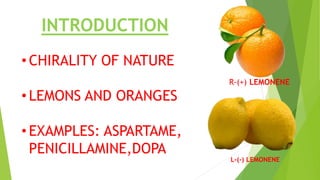
• CHIRALITY OF NATURE
• LEMONS AND ORANGES
• EXAMPLES: ASPARTAME,
PENICILLAMINE,DOPA
R-(+) LEMONENE
L-(-) LEMONENE
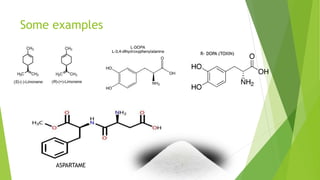
Some examples
R- DOPA (TOXIN)
ASPARTAME
ASYMMETRIC SYNTHESIS
 Asymmetric synthesis or Stereo selective synthesis
chemical reaction (or reaction sequence) in which one or
more new elements of chirality are formed in a substrate
molecule and which produces the stereo isomeric
(enantiomeric or diastereo isomeric) products in unequal
amounts.
 Production of a specific enantiomer from achiral compound
or racemic mixture
 Absolute synthesis, partial asymmetric synthesis
 enantio specific synthesis
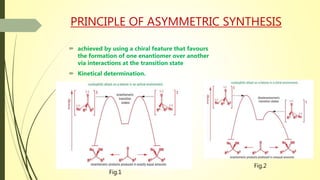
PRINCIPLE OF ASYMMETRIC SYNTHESIS
 achieved by using a chiral feature that favours
the formation of one enantiomer over another
via interactions at the transition state
 Kinetical determination.
Fig.1
Fig.2
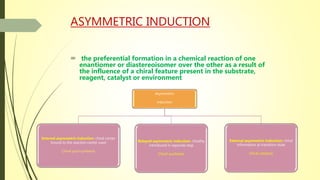
ASYMMETRIC INDUCTION
 the preferential formation in a chemical reaction of one
enantiomer or diastereoisomer over the other as a result of
the influence of a chiral feature present in the substrate,
reagent, catalyst or environment
Asymmetric
induction
Internal asymmetric induction: chiral center
bound to the reaction center used
Chiral pool synthesis
Relayed asymmetric induction: chirality
introduced in separate step
Chiral auxiliaries
External asymmetric induction: chiral
information at transition state
Chiral catalysts
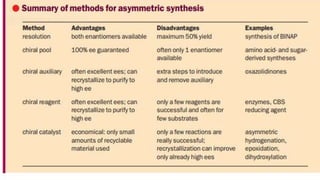
DIFFERENT APPROACHES
• Chiral pool synthesis
• Chiral auxiliaries
• Chiral reagents, Chiral catalysts and chiral ligands
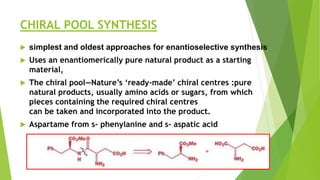
CHIRAL POOL SYNTHESIS
 simplest and oldest approaches for enantioselective synthesis
 Uses an enantiomerically pure natural product as a starting
material,
 The chiral pool—Nature’s ‘ready-made’ chiral centres :pure
natural products, usually amino acids or sugars, from which
pieces containing the required chiral centres
can be taken and incorporated into the product.
 Aspartame from s- phenylanine and s- aspatic acid
CHIRAL AUXILIARIES
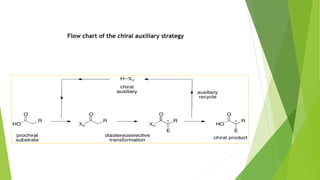
 An enantiomerically pure compound (usually derived from a simple natural
product like an amino acid), called a chiral auxiliary, is attached to the
starting
material.

A diastereoselective reaction is carried out, which, because of the
enantiomeric purity of the chiral auxiliary, gives only one enantiomer of the
product.

The chiral auxiliary is removed by, for example, hydrolysis, leaving the
product of the reaction as a single enantiomer.
 The best chiral auxiliaries can be recycled, so although stoichiometric
quantities are
needed, there is no waste.
Flow chart of the chiral auxiliary strategy
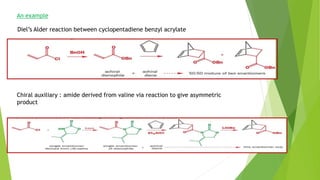
Diel’s Alder reaction between cyclopentadiene benzyl acrylate
Chiral auxiliary : amide derived from valine via reaction to give asymmetric
product
An example
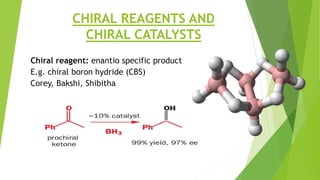
CHIRAL REAGENTS AND
CHIRAL CATALYSTS
Chiral reagent: enantio specific product
E.g. chiral boron hydride (CBS)
Corey, Bakshi, Shibitha
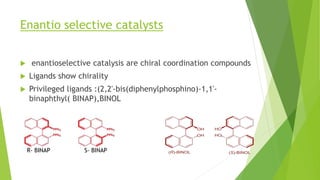
Enantio selective catalysts
 enantioselective catalysis are chiral coordination compounds
 Ligands show chirality
 Privileged ligands :(2,2'-bis(diphenylphosphino)-1,1'-
binaphthyl( BINAP),BINOL
R- BINAP S- BINAP
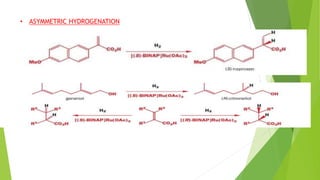
• ASYMMETRIC HYDROGENATION
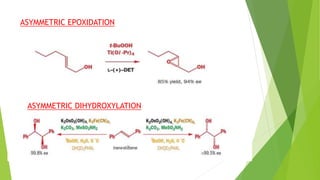
ASYMMETRIC EPOXIDATION
ASYMMETRIC DIHYDROXYLATION
SEPARATION AND ANALYSIS OF ENANTIOMERS
same physicsl properties
 same NMR, IR, Retention factor,
retention time
Varying properties in the presence of
other chiral compounds
X-ray crystallography
conclusion
Drug safety
Pharmaceuticals
Flavours
Mimic nature
Clayden, Jonathan, Nick Greeves and Stuart Warren. Organic Chemistry, 2nd Edition. Oxford.
2012.
Finar, I. L. Organic Chemistry : Stereo Chemistry and Chemistry of Natural Products (vol:2),
5th Edition. Dorling Kindersley Pvt. Ltd. Noida, India. 1975.
Nasipuri, D. Stereochemistry of Organic Compounds: Principles and Applications, 2nd Edition.
New Age International Pvt. Ltd. New Delhi. 1994.
REFERENCES
Asymmetric  synthesis

Asymmetric synthesis

  • 1.
    AMAL T. BABU 1STMSc. CHEMISTRY SACRED HEART(AUTONOMOUS) COLLEGE, THEVARA
  • 2.
    INTRODUCTION • CHIRALITY OFNATURE • LEMONS AND ORANGES • EXAMPLES: ASPARTAME, PENICILLAMINE,DOPA R-(+) LEMONENE L-(-) LEMONENE
  • 3.
    Some examples R- DOPA(TOXIN) ASPARTAME
  • 4.
    ASYMMETRIC SYNTHESIS  Asymmetricsynthesis or Stereo selective synthesis chemical reaction (or reaction sequence) in which one or more new elements of chirality are formed in a substrate molecule and which produces the stereo isomeric (enantiomeric or diastereo isomeric) products in unequal amounts.  Production of a specific enantiomer from achiral compound or racemic mixture  Absolute synthesis, partial asymmetric synthesis  enantio specific synthesis
  • 5.
    PRINCIPLE OF ASYMMETRICSYNTHESIS  achieved by using a chiral feature that favours the formation of one enantiomer over another via interactions at the transition state  Kinetical determination. Fig.1 Fig.2
  • 6.
    ASYMMETRIC INDUCTION  thepreferential formation in a chemical reaction of one enantiomer or diastereoisomer over the other as a result of the influence of a chiral feature present in the substrate, reagent, catalyst or environment Asymmetric induction Internal asymmetric induction: chiral center bound to the reaction center used Chiral pool synthesis Relayed asymmetric induction: chirality introduced in separate step Chiral auxiliaries External asymmetric induction: chiral information at transition state Chiral catalysts
  • 7.
    DIFFERENT APPROACHES • Chiralpool synthesis • Chiral auxiliaries • Chiral reagents, Chiral catalysts and chiral ligands
  • 8.
    CHIRAL POOL SYNTHESIS simplest and oldest approaches for enantioselective synthesis  Uses an enantiomerically pure natural product as a starting material,  The chiral pool—Nature’s ‘ready-made’ chiral centres :pure natural products, usually amino acids or sugars, from which pieces containing the required chiral centres can be taken and incorporated into the product.  Aspartame from s- phenylanine and s- aspatic acid
  • 9.
    CHIRAL AUXILIARIES  Anenantiomerically pure compound (usually derived from a simple natural product like an amino acid), called a chiral auxiliary, is attached to the starting material.  A diastereoselective reaction is carried out, which, because of the enantiomeric purity of the chiral auxiliary, gives only one enantiomer of the product.  The chiral auxiliary is removed by, for example, hydrolysis, leaving the product of the reaction as a single enantiomer.  The best chiral auxiliaries can be recycled, so although stoichiometric quantities are needed, there is no waste.
  • 10.
    Flow chart ofthe chiral auxiliary strategy
  • 11.
    Diel’s Alder reactionbetween cyclopentadiene benzyl acrylate Chiral auxiliary : amide derived from valine via reaction to give asymmetric product An example
  • 12.
    CHIRAL REAGENTS AND CHIRALCATALYSTS Chiral reagent: enantio specific product E.g. chiral boron hydride (CBS) Corey, Bakshi, Shibitha
  • 13.
    Enantio selective catalysts enantioselective catalysis are chiral coordination compounds  Ligands show chirality  Privileged ligands :(2,2'-bis(diphenylphosphino)-1,1'- binaphthyl( BINAP),BINOL R- BINAP S- BINAP
  • 14.
  • 15.
  • 17.
    SEPARATION AND ANALYSISOF ENANTIOMERS same physicsl properties  same NMR, IR, Retention factor, retention time Varying properties in the presence of other chiral compounds X-ray crystallography
  • 18.
  • 19.
    Clayden, Jonathan, NickGreeves and Stuart Warren. Organic Chemistry, 2nd Edition. Oxford. 2012. Finar, I. L. Organic Chemistry : Stereo Chemistry and Chemistry of Natural Products (vol:2), 5th Edition. Dorling Kindersley Pvt. Ltd. Noida, India. 1975. Nasipuri, D. Stereochemistry of Organic Compounds: Principles and Applications, 2nd Edition. New Age International Pvt. Ltd. New Delhi. 1994. REFERENCES