Giancarlo Agnelli, M.D., Harry R. Buller, M.D., Ph.D., Alexander Cohen, M.D., Madelyn Curto, D.V.M., Alexander S.
Gallus, M.D., Margot Johnson, M.D., Urszula Masiukiewicz, M.D., Raphael Pak, Ph.D., John Thompson, Ph.D., Gary
E. Raskob, Ph.D., and Jeffrey I. Weitz, M.D. for the AMPLIFY Investigators
N Engl J Med 2013
ORAL APIXABAN FOR
THE TREATMENT OF
ACUTE VENOUS
THROMBOEMBOLISM
 Background
 Methods
 Results
 Discussion
 Conclusion
Background
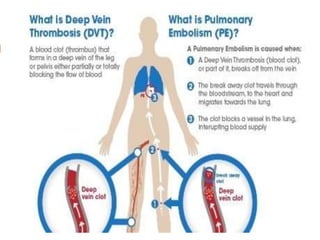
 The broader term venous thromboembolism
(VTE) refers to DVT, PE, or to a combination of
both.
 Venous thromboembolism, with an annual
incidence of 1 to 2 cases per 1000 persons in
the general population, is the third most
common cause of vascular death after
myocardial infarction and stroke.
 Conventional treatment consists of a
parenteral anticoagulant, such as enoxaparin,
for at least 5 days , and warfarin begun during
this time ( 72 hrs) and continued for at least 3
months.
 Although effective, this regimen presents a
challenge because enoxaparin requires daily
subcutaneous injections, and warfarin therapy
requires coagulation monitoring and dose
adjustment.
 It is an oral factor Xa inhibitor :
I. that inhibits platelet activation by selectively and
reversibly blocking the active site of factor Xa
without requiring a cofactor .
II. rapid onset of action
III. predictable pharmacokinetics that allow a fixed-
dose regimen
 With these characteristics, apixaban may simplify
the treatment of venous thromboembolism by
eliminating the need for initial parenteral
anticoagulant therapy and laboratory monitoring.
Apixaban :
Apixaban has been shown to be effective for the
prevention of recurrent venous
thromboembolism in patients who have
completed 6 to 12 months of anticoagulant
therapy for acute venous thromboembolism, with
rates of major bleeding that are similar to those
for placebo.
This concept is supported by recent
studies
The Apixaban for the Initial Management of
Pulmonary Embolism and Deep-Vein
Thrombosis as First-Line Therapy (AMPLIFY)
trial, compared apixaban with conventional
anticoagulant therapy in patients with acute
symptomatic venous thromboembolism.
Methods
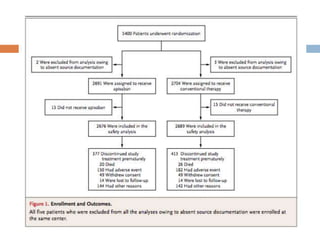
 Randomized, double-blind trial study .
 Compared the efficacy and safety of apixaban
with the efficacy and safety of conventional
therapy (enoxaparin and warfarin) in patients
with deep-vein thrombosis, pulmonary
embolism, or both.
 The trial was sponsored by Bristol-Myers
Squibb and Pfizer.
 An independent data and safety monitoring
committee periodically reviewed the study
outcomes.
Study Design And Oversight :
 Over 18 .
 Had objectively confirmed, symptomatic
proximal deep-vein thrombosis or pulmonary
embolism (with or withoutdeep-vein
thrombosis).
Patients :
 Had active bleeding, a high risk of bleeding, or other
contraindications to treatment with enoxaparin and
warfarin.
 Had cancer and long-term treatment with low-
molecular-weight heparin plan
 Their deep-vein thrombosis or pulmonary
embolism was provoked in the absence of a
persistent risk factor for recurrence.
 If less than 6 months of anticoagulant treatment
was planned; or if they had another indication for
long-term anticoagulation therapy, dual antiplatelet
therapy, treatment with aspirin at a dose of more than
165 mg daily, or treatment with potent inhibitors of
cytochrome .
They Were Excluded If:
 Patients were also excluded if they had received
more than two doses of a once-daily low-
molecular- weight heparin regimen, fondaparinux,
or a vitamin K antagonist; more than three doses
of a twice-daily low-molecular-weight heparin
regimen; or more than 36 hours of continuous
intravenous heparin.
 A hemoglobin level of less than 9 mg per deciliter.
 A platelet count of less than 100,000 per
cubicmillimeter,
 A serum creatinine level of more than 2.5 mg per
deciliter .
RANDOMIZATION AND STUDY
TREATMENT
1. Patients assigned to the apixaban group received 10 mg of
apixaban twice daily for the first 7 days, followed by 5 mg
twice daily for 6 months.
2. Patients assigned to the conventional-therapy group received
enoxaparin at a dose of 1 mg per kilogram of body weight
every 12 hours for at least 5 days and warfarin begun
concomitantly and continued for 6 months.
3. The warfarin dose was adjusted to maintain the international
normalized ratio (INR) between 2.0 and 3.0. Enoxaparin or
placebo was discontinued when a blinded INR of 2.0 or more was
achieved.
( Evaluation of the INR was required at least monthly, or more frequently if clinically
indicated.)
OUTCOME MEASURES
The primary efficacy outcome was the incidence of the adjudicated
composite of recurrent symptomatic venous thromboembolism or
death related to venous thromboembolism. Recurrent venous
thromboembolism included fatal or nonfatal pulmonary embolism and
deep-vein thrombosis. Death was adjudicated as related to venous
thromboembolism, related to cardiovascular disease, caused by
bleeding, or due to other causes.
Pulmonary embolism was considered the cause of death if there
was any objective documentation.
Cont.
 The primary safety outcome was adjudicated
major bleeding.
 The secondary safety outcome was the
composite of major bleeding and clinically
relevant nonmajor bleeding.
 Patients underwent assessment, either in the
clinic or by telephone.
 Patients were instructed to report to the study
center if they had symptoms suggestive of
recurrent venous thromboembolism or
bleeding.
 A prespecified objective testing was required
for patients in whom an outcome event was
suspected.
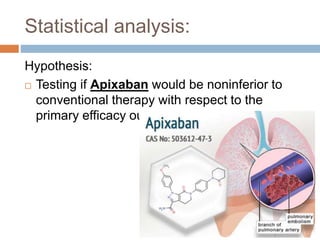
Statistical analysis:
Hypothesis:
 Testing if Apixaban would be noninferior to
conventional therapy with respect to the
primary efficacy outcome.
According to a prespecified
hierarchy of outcomes:
1. Major bleeding (primary safety outcome).
2. Recurrent venous thromboembolism or death
related to venous thromboembolism (primary
efficacy outcome).
3. The composite of major bleeding and
clinically relevant non-major bleeding
(secondary safety outcome).
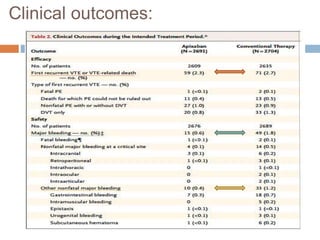
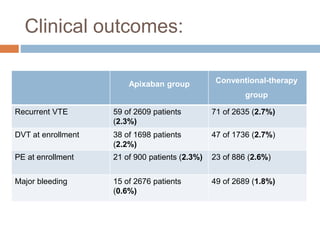
Clinical outcomes:
Clinical outcomes:
Conventional-therapy
group
Apixaban group
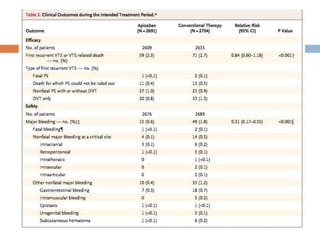
71 of 2635 (2.7%)59 of 2609 patients
(2.3%)
Recurrent VTE
47 of 1736 (2.7%)38 of 1698 patients
(2.2%)
DVT at enrollment
23 of 886 (2.6%)21 of 900 patients (2.3%)PE at enrollment
49 of 2689 (1.8%)15 of 2676 patients
(0.6%)
Major bleeding
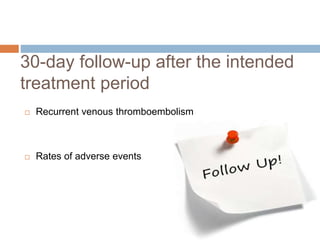
30-day follow-up after the intended
treatment period
 Recurrent venous thromboembolism
 Rates of adverse events
Discussion :
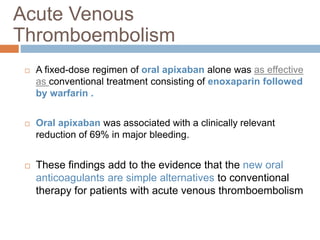
 A fixed-dose regimen of oral apixaban alone was as effective
as conventional treatment consisting of enoxaparin followed
by warfarin .
 Oral apixaban was associated with a clinically relevant
reduction of 69% in major bleeding.
 These findings add to the evidence that the new oral
anticoagulants are simple alternatives to conventional
therapy for patients with acute venous thromboembolism
Acute Venous
Thromboembolism
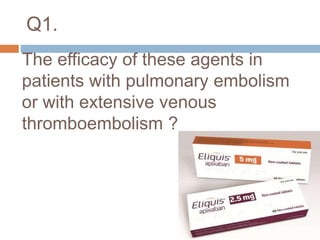
The efficacy of these agents in
patients with pulmonary embolism
or with extensive venous
thromboembolism ?
Q1.
Pulmonary Embolism
 Similar to that in the patients with deep-vein thrombosis,
and the relative effect was maintained in the
approximately 40% of patients who presented with
extensive disease.
Q2.
The efficacy and safety of the new
agents relative to well-controlled
warfarin therapy ?
 The efficacy and the reduction in major bleeding with
apixaban were consistent with the overall findings.
 They were also consistent across a broad range of
subgroups, including those based on clinically important
features such as an :
 Age >75 years.
 Body weight >100 kg.
 Use of parenteral anticoagulant treatment before
randomization.
 Duration of such treatment.
Methodologic strengths of the
study:
 The minimization of bias with the double-blind design
 Identical follow-up of all patients
 Study execution was rigorous, with minimal loss to follow-up
 Few patients withdrawing consent
 Good adherence to study medication, and well-managed
warfarin therapy.
As a result of this study:
 Apixaban for the Extended Treatment of Deep Vein
Thrombosis and Pulmonary Embolism trial, provided a
simple, effective and safe regimen for the initial and
long-term treatment of venous thromboembolism.
Oral apixaban
Oral apixaban

Oral apixaban

  • 1.
    Giancarlo Agnelli, M.D.,Harry R. Buller, M.D., Ph.D., Alexander Cohen, M.D., Madelyn Curto, D.V.M., Alexander S. Gallus, M.D., Margot Johnson, M.D., Urszula Masiukiewicz, M.D., Raphael Pak, Ph.D., John Thompson, Ph.D., Gary E. Raskob, Ph.D., and Jeffrey I. Weitz, M.D. for the AMPLIFY Investigators N Engl J Med 2013 ORAL APIXABAN FOR THE TREATMENT OF ACUTE VENOUS THROMBOEMBOLISM
  • 2.
     Background  Methods Results  Discussion  Conclusion
  • 3.
  • 5.
     The broaderterm venous thromboembolism (VTE) refers to DVT, PE, or to a combination of both.  Venous thromboembolism, with an annual incidence of 1 to 2 cases per 1000 persons in the general population, is the third most common cause of vascular death after myocardial infarction and stroke.
  • 6.
     Conventional treatmentconsists of a parenteral anticoagulant, such as enoxaparin, for at least 5 days , and warfarin begun during this time ( 72 hrs) and continued for at least 3 months.  Although effective, this regimen presents a challenge because enoxaparin requires daily subcutaneous injections, and warfarin therapy requires coagulation monitoring and dose adjustment.
  • 7.
     It isan oral factor Xa inhibitor : I. that inhibits platelet activation by selectively and reversibly blocking the active site of factor Xa without requiring a cofactor . II. rapid onset of action III. predictable pharmacokinetics that allow a fixed- dose regimen  With these characteristics, apixaban may simplify the treatment of venous thromboembolism by eliminating the need for initial parenteral anticoagulant therapy and laboratory monitoring. Apixaban :
  • 8.
    Apixaban has beenshown to be effective for the prevention of recurrent venous thromboembolism in patients who have completed 6 to 12 months of anticoagulant therapy for acute venous thromboembolism, with rates of major bleeding that are similar to those for placebo. This concept is supported by recent studies
  • 9.
    The Apixaban forthe Initial Management of Pulmonary Embolism and Deep-Vein Thrombosis as First-Line Therapy (AMPLIFY) trial, compared apixaban with conventional anticoagulant therapy in patients with acute symptomatic venous thromboembolism.
  • 10.
  • 11.
     Randomized, double-blindtrial study .  Compared the efficacy and safety of apixaban with the efficacy and safety of conventional therapy (enoxaparin and warfarin) in patients with deep-vein thrombosis, pulmonary embolism, or both.  The trial was sponsored by Bristol-Myers Squibb and Pfizer.  An independent data and safety monitoring committee periodically reviewed the study outcomes. Study Design And Oversight :
  • 12.
     Over 18.  Had objectively confirmed, symptomatic proximal deep-vein thrombosis or pulmonary embolism (with or withoutdeep-vein thrombosis). Patients :
  • 13.
     Had activebleeding, a high risk of bleeding, or other contraindications to treatment with enoxaparin and warfarin.  Had cancer and long-term treatment with low- molecular-weight heparin plan  Their deep-vein thrombosis or pulmonary embolism was provoked in the absence of a persistent risk factor for recurrence.  If less than 6 months of anticoagulant treatment was planned; or if they had another indication for long-term anticoagulation therapy, dual antiplatelet therapy, treatment with aspirin at a dose of more than 165 mg daily, or treatment with potent inhibitors of cytochrome . They Were Excluded If:
  • 14.
     Patients werealso excluded if they had received more than two doses of a once-daily low- molecular- weight heparin regimen, fondaparinux, or a vitamin K antagonist; more than three doses of a twice-daily low-molecular-weight heparin regimen; or more than 36 hours of continuous intravenous heparin.  A hemoglobin level of less than 9 mg per deciliter.  A platelet count of less than 100,000 per cubicmillimeter,  A serum creatinine level of more than 2.5 mg per deciliter .
  • 16.
    RANDOMIZATION AND STUDY TREATMENT 1.Patients assigned to the apixaban group received 10 mg of apixaban twice daily for the first 7 days, followed by 5 mg twice daily for 6 months. 2. Patients assigned to the conventional-therapy group received enoxaparin at a dose of 1 mg per kilogram of body weight every 12 hours for at least 5 days and warfarin begun concomitantly and continued for 6 months. 3. The warfarin dose was adjusted to maintain the international normalized ratio (INR) between 2.0 and 3.0. Enoxaparin or placebo was discontinued when a blinded INR of 2.0 or more was achieved. ( Evaluation of the INR was required at least monthly, or more frequently if clinically indicated.)
  • 17.
    OUTCOME MEASURES The primaryefficacy outcome was the incidence of the adjudicated composite of recurrent symptomatic venous thromboembolism or death related to venous thromboembolism. Recurrent venous thromboembolism included fatal or nonfatal pulmonary embolism and deep-vein thrombosis. Death was adjudicated as related to venous thromboembolism, related to cardiovascular disease, caused by bleeding, or due to other causes. Pulmonary embolism was considered the cause of death if there was any objective documentation.
  • 18.
    Cont.  The primarysafety outcome was adjudicated major bleeding.  The secondary safety outcome was the composite of major bleeding and clinically relevant nonmajor bleeding.
  • 19.
     Patients underwentassessment, either in the clinic or by telephone.  Patients were instructed to report to the study center if they had symptoms suggestive of recurrent venous thromboembolism or bleeding.  A prespecified objective testing was required for patients in whom an outcome event was suspected.
  • 20.
    Statistical analysis: Hypothesis:  Testingif Apixaban would be noninferior to conventional therapy with respect to the primary efficacy outcome.
  • 21.
    According to aprespecified hierarchy of outcomes: 1. Major bleeding (primary safety outcome). 2. Recurrent venous thromboembolism or death related to venous thromboembolism (primary efficacy outcome). 3. The composite of major bleeding and clinically relevant non-major bleeding (secondary safety outcome).
  • 25.
  • 26.
    Clinical outcomes: Conventional-therapy group Apixaban group 71of 2635 (2.7%)59 of 2609 patients (2.3%) Recurrent VTE 47 of 1736 (2.7%)38 of 1698 patients (2.2%) DVT at enrollment 23 of 886 (2.6%)21 of 900 patients (2.3%)PE at enrollment 49 of 2689 (1.8%)15 of 2676 patients (0.6%) Major bleeding
  • 27.
    30-day follow-up afterthe intended treatment period  Recurrent venous thromboembolism  Rates of adverse events
  • 28.
  • 29.
     A fixed-doseregimen of oral apixaban alone was as effective as conventional treatment consisting of enoxaparin followed by warfarin .  Oral apixaban was associated with a clinically relevant reduction of 69% in major bleeding.  These findings add to the evidence that the new oral anticoagulants are simple alternatives to conventional therapy for patients with acute venous thromboembolism Acute Venous Thromboembolism
  • 30.
    The efficacy ofthese agents in patients with pulmonary embolism or with extensive venous thromboembolism ? Q1.
  • 31.
    Pulmonary Embolism  Similarto that in the patients with deep-vein thrombosis, and the relative effect was maintained in the approximately 40% of patients who presented with extensive disease.
  • 32.
    Q2. The efficacy andsafety of the new agents relative to well-controlled warfarin therapy ?
  • 33.
     The efficacyand the reduction in major bleeding with apixaban were consistent with the overall findings.  They were also consistent across a broad range of subgroups, including those based on clinically important features such as an :  Age >75 years.  Body weight >100 kg.  Use of parenteral anticoagulant treatment before randomization.  Duration of such treatment.
  • 34.
    Methodologic strengths ofthe study:  The minimization of bias with the double-blind design  Identical follow-up of all patients  Study execution was rigorous, with minimal loss to follow-up  Few patients withdrawing consent  Good adherence to study medication, and well-managed warfarin therapy.
  • 35.
    As a resultof this study:  Apixaban for the Extended Treatment of Deep Vein Thrombosis and Pulmonary Embolism trial, provided a simple, effective and safe regimen for the initial and long-term treatment of venous thromboembolism.

Editor's Notes

  • #7 until a therapeutic oral anticoagulant effect has been achieved , 7 -17 days
  • #9 Extended anticoagulation with apixaban at either a treatment dose (5 mg) or a thromboprophylactic dose (2.5 mg) reduced the risk of recurrent venous thromboembolism without increasing the rate of major bleeding. (Funded by Bristol-Myers Squibb and Pfizer; AMPLIFY-EXT ClinicalTrials.gov number
  • #13 Proximal deep-vein thrombosis was defined as thrombosis involving at least the popliteal vein or a more proximal vein.
  • #23 we would need to enroll 4094 patients for the study to have 90% power to show the noninferiority of apixaban,
  • #31 One clinical question was about
  • #33 A second question was about
  • #35 Included
  • #37 Of course further studies should be done about the efficacy and safety of apixaban in patients with cancer, low body weight