


Business Research Methods
MGT 524
Abu Bashar
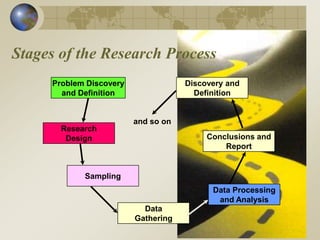
Stages of the Research Process
Problem Discovery
and Definition
Research
Design
Sampling
Data
Gathering
Data Processing
and Analysis
Conclusions and
Report
Discovery and
Definition
and so on
Problem
discovery
Problem definition
(statement of
research objectives)
Secondary
(historical)
data
Experience
survey
Pilot
study
Case
study
Selection of
exploratory research
technique
Selection of
basic research
method
Experiment Survey
Observation
Secondary
Data StudyLaboratory Field Interview Questionnaire
Selection of
Sample Design
Sampling
Probability Nonprobability
Collection of
data
(fieldwork)
Editing and
coding
data
Data
processing
Interpretation
of
findings
Report
Data
Gathering
Data
Processing
and
Analysis
Conclusions
and Report
Research Design
Problem Discovery
and Definition
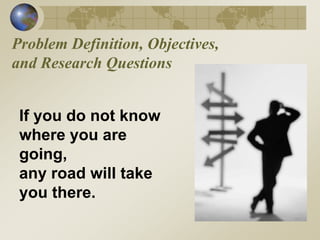
Problem Definition, Objectives,
and Research Questions
If you do not know
where you are
going,
any road will take
you there.
“The formulation of the problem
is often more essential than its
solution”
-Albert Einstein
Two Types of Problems
Management Decision Problem
What decision makers need to do
Sales are on the decline
Customer base is aging and younger consumers
prefer competitor’s brands
Research Problem
Specifies information needed to address
managerial problems & how it can be obtained
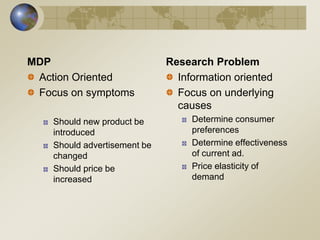
MDP
Action Oriented
Focus on symptoms
Should new product be
introduced
Should advertisement be
changed
Should price be
increased
Research Problem
Information oriented
Focus on underlying
causes
Determine consumer
preferences
Determine effectiveness
of current ad.
Price elasticity of
demand
Research Objectives
Research objectives address information
gaps that must be closed so the manager
solves the marketing management problem
Each research objective must be precise,
detailed, clear, and operational
Example: “Compare the demographic
profiles of AT&T buyers to nonbuyers using
age, sex, education, and annual family
income.”
Research Questions
A research question is the researchers’
paraphrase of the research objective(s) in the
form of a question.
Example:
“Are AT&T’s non-buyers different
demographically from AT&T’s buyers?
Or better yet:
“Are AT&T’s non-buyers younger than
AT&T’s buyers?”
Specific questions are better
Research Hypotheses
A hypothesis is an unproven proposition
or supposition that tentatively explains
certain facts or phenomena; a probable
answer to a research question.
Hypotheses are statements about the
nature of the world. They are guesses.
Example: “AT&T’s non-buyers are
younger than AT&T’s buyers”
Research Hypotheses
Null Hypothesis: Conservative statement
about the status quo. It is what our research
is set out to disprove.
H0: AT&T non-buyers do not differ in age
from AT&T buyers
Alternative Hypothesis: A statement that
states the opposite of the null hypothesis.
HA: AT&T non-buyers are younger than
AT&T buyers
THANK YOU

Problem Definition in research design

  • 1.
  • 2.
    Stages of theResearch Process Problem Discovery and Definition Research Design Sampling Data Gathering Data Processing and Analysis Conclusions and Report Discovery and Definition and so on
  • 3.
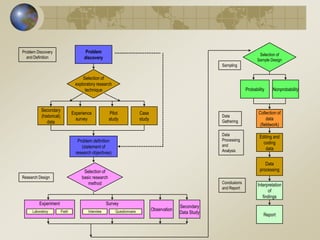
    Problem discovery Problem definition (statement of researchobjectives) Secondary (historical) data Experience survey Pilot study Case study Selection of exploratory research technique Selection of basic research method Experiment Survey Observation Secondary Data StudyLaboratory Field Interview Questionnaire Selection of Sample Design Sampling Probability Nonprobability Collection of data (fieldwork) Editing and coding data Data processing Interpretation of findings Report Data Gathering Data Processing and Analysis Conclusions and Report Research Design Problem Discovery and Definition
  • 4.
    Problem Definition, Objectives, andResearch Questions If you do not know where you are going, any road will take you there.
  • 5.
    “The formulation ofthe problem is often more essential than its solution” -Albert Einstein
  • 6.
    Two Types ofProblems Management Decision Problem What decision makers need to do Sales are on the decline Customer base is aging and younger consumers prefer competitor’s brands Research Problem Specifies information needed to address managerial problems & how it can be obtained
  • 7.
    MDP Action Oriented Focus onsymptoms Should new product be introduced Should advertisement be changed Should price be increased Research Problem Information oriented Focus on underlying causes Determine consumer preferences Determine effectiveness of current ad. Price elasticity of demand
  • 8.
    Research Objectives Research objectivesaddress information gaps that must be closed so the manager solves the marketing management problem Each research objective must be precise, detailed, clear, and operational Example: “Compare the demographic profiles of AT&T buyers to nonbuyers using age, sex, education, and annual family income.”
  • 9.
    Research Questions A researchquestion is the researchers’ paraphrase of the research objective(s) in the form of a question. Example: “Are AT&T’s non-buyers different demographically from AT&T’s buyers? Or better yet: “Are AT&T’s non-buyers younger than AT&T’s buyers?” Specific questions are better
  • 10.
    Research Hypotheses A hypothesisis an unproven proposition or supposition that tentatively explains certain facts or phenomena; a probable answer to a research question. Hypotheses are statements about the nature of the world. They are guesses. Example: “AT&T’s non-buyers are younger than AT&T’s buyers”
  • 11.
    Research Hypotheses Null Hypothesis:Conservative statement about the status quo. It is what our research is set out to disprove. H0: AT&T non-buyers do not differ in age from AT&T buyers Alternative Hypothesis: A statement that states the opposite of the null hypothesis. HA: AT&T non-buyers are younger than AT&T buyers
  • 12.