Dr.A.Ramesh Kumar. Int. Journal of Engineering Research and Application www.ijera.com
ISSN : 2248-9622, Vol. 6, Issue 10, ( Part -2) October 2016, pp.69-75
www.ijera.com 69|P a g e
Solving ONE’S interval linear assignment problem
Dr.A.Ramesh Kumar1
,S. Deepa2
,
1
Head, Department of Mathematics, Srimad Andavan Arts and Science College (Autonomous), T.V.Kovil,
Trichy-5.
2
Assistant professor, Department of mathematics, Srimad Andavan Arts and Science College (Autonomous),
T.V.Kovil,Trichy-5
ABSTRACT
In this paper to introduce a matrix ones interval linear assignment method or MOILA -method for solving wide
range of problem. An example using matrix ones interval linear assignment methods and the existing Hungarian
method have been solved and compared. Also some of the variations and some special cases in assignment
problem and its applications have been discussed ,the proposed method is a systematic procedure, easy to apply
and can be utilized for all types of assignment problem with maximize or minimize objective functions.
Keywords: Assignment Problems, IntervalAnalysis. Hungarian assignment method (HA) method, Linear
Integer Programming, Matrix ones Interval assignment method (MOIAM), optimization
MSC Code: 90B80
I. INTRODUCTION
We define the assignment matrix, then by
using determinant representation we obtain a
reduced matrix which has at least one 1 in each
row and columns. Then by using the new method,
we obtain an optimal solution for interval
assignment problem by assigning ones to each row
and each column, and then try to find a complete
assignment to their ones. In a ground reality the
entries of the cost matrix is not always crisp. In
many application this parameters are uncertain and
this uncertain parameters are represented by
interval. In this contribution we propose matrix
ones interval assignment methods and consider
interval analysis concept for solving matrix ones
interval linear assignment methods .This section
presents a new method to solve the assignment
problem which is different from the preceding
method. We call it ”Matrix one’s- assignment
method” ,because of making assignment in terms
of ones. The new method is based on creating
some ones in the assignment matrix and then try to
find a complete assignment in terms of ones.
II. DEFINITION
Each assignment problem has a table or
matrix associated with it. Generally the row
contains the objects or people we wish to assign
and the column comprise the jobs or task we want
them assigned to. Consider a problem of
assignment of n resources to m activities so as to
minimize the overall cost or time in such a way
that each resource can associate with one and only
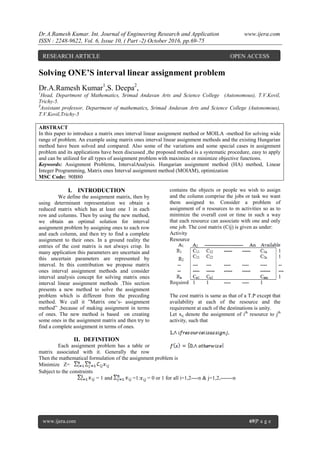
one job. The cost matrix (Cij) is given as under:
Activity
Resource
The cost matrix is same as that of a T.P except that
availability at each of the resource and the
requirement at each of the destinations is unity.
Let xij denote the assignment of ith
resource to jth
activity, such that
Then the mathematical formulation of the assignment problem is
Minimize Z=
Subject to the constraints
= 1 and =1: = 0 or 1 for all i=1,2----n & j=1,2,-------n
RESEARCH ARTICLE OPEN ACCESS
Dr.A.Ramesh Kumar. Int. Journal of Engineering Research and Application www.ijera.com
ISSN : 2248-9622, Vol. 6, Issue 10, ( Part -2) October 2016, pp.69-75
www.ijera.com 70|P a g e
2.1 Definition
The interval form of the parameters may be written as where is the left value [ ] and is the right value [ ]of
the interval respectively. We define the centre is m = and w = is the width of the interval [ ]
Let [ ] and [ ] be two elements then the following arithmetic are well known
(i) [ ] +[ ] = [ + + ]
(ii) [ ] × [ ] =[min{ , } ,max{ , }]
(iii) [ ] ÷ [ ] =[min , } , max , } ] provide if ] ≠
[0, 0],
Notation:
(i) H M - Hungarian method
(ii) MOAP- Matrix ones Assignment problem
(iii) MOILAP - Matrix ones interval Linear
assignment problem
(iv) UBMOAP- Unbalanced Matrix ones
Assignment problem
(v) UBMOILAP -Unbalanced Matrix ones
Interval linear Assignment problem
III. ALGORITHM FOR HUNGARIAN
METHOD:
Step1: Find the opportunity cost table by: (a).
subtracting the smallest number in each row of the
original cost table or matrix from every number in
that row and. (b). Then subtracting the smallest
number in each column of the table obtained in
part (a) from every number in that column.
Step 2: Examine the rows successively until a
row with exactly one unmarked zero is found.
Enclose this zero in a box( ) as an assignment
will be made there and cross (X) all other zeros
appearing in the corresponding column as they will
not be considered for future assignment. Proceed in
this way until all the rows have been examined.
Step 3: After examining all the rows completely,
examine the columns successively until a column
with exactly one unmarked zero is found. Make an
assignment to this single zero by putting square
( ) around it and cross out (X) all other zeros
appearing in the corresponding row as they will not
be used to make any other assignment in that row,
Proceed in this manner until all columns have been
examined.
Step 4: Repeat the operations (Step 1) and (Step
2) successively until one of the following
situations arises: (i). All the zeros in rows /columns
are either marked ( ) or corssed (X ) and there is
exactly one assignment in each row and in each
column. In such a case optimal assignment policy
for the given problem is obtained. (ii). there may
be some row (or column) without assignment, i.e.,
the total number of marked zeros is less than the
order of the matrix. In such a case, proceed to next
Step 4.
Step 5: Draw the minimum number of vertical and
horizontal lines necessary to cover all the zeros in
the reduced cost table obtained from Step 2&3 by
adopting the following procedure:
i. Mark (√) all rows that do not have
assignments.
ii. Mark (√) all columns (not already marked)
which have zeros in the marked rows
iii. Mark (√) all rows (not already marked) that
have assignments in marked columns
iv. Repeat steps 4(ii) and (iii) until no more rows
or columns can be marked.
v. Draw straight lines through each unmarked
row and each marked column. If the number
of lines drawn (or total assignments) is equal
to the number of rows (or columns) then the
current solution is the optimal solution,
Step 6:
Repeat Steps 2 to 4 until an optimal solution is
obtained
3.1 Example :
Consider the following linear assignment problem.
Assign the four jobs to the three machines so as to
minimize the total cost.
I II III IV
1 10 5 10 15
2 3 9 15 3
3 10 7 3 2
4 2 3 2 4
Solution: Subtracting the smallest number in each
row of the original cost table or matrix from every
number in that row, as follows
I II III IV
1 5 0 5 10
2 0 6 12 0
3 8 5 1 0
4 0 1 0 2
Then subtracting the smallest number in each
column of the table obtained from every number in
that column.
Dr.A.Ramesh Kumar. Int. Journal of Engineering Research and Application www.ijera.com
ISSN : 2248-9622, Vol. 6, Issue 10, ( Part -2) October 2016, pp.69-75
www.ijera.com 71|P a g e
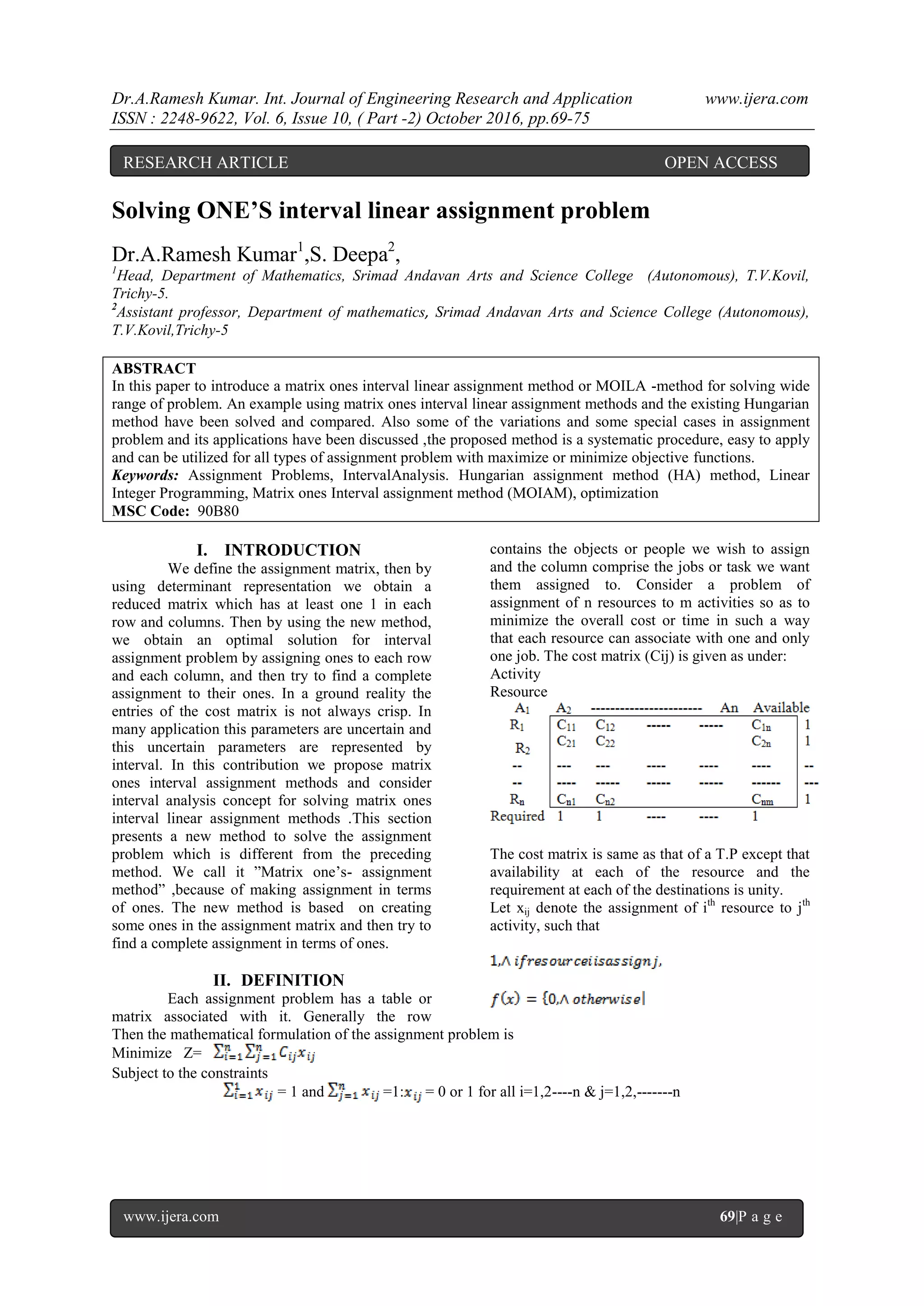
So the complete assignment is possible and we
can assign the Zeros and the Optimum solution is
(1→,II), (2→I), (3→IV), (4→III), and minimum
cost is 12.
IV. ALGORITHM FOR MATRIX ONES
ASSIGNMENT PROBLEM
Step1.
In a minimization (maximization) case,
find the minimum (maximum) elementof each row
in the assignment matrix (say ai) and write it on
the right handside of the matrix.Then divide each
element of ith
row of the matrix by ai. These
operations create at least one ones in each rows. In
term of ones for each row and column do
assignment, otherwise go to step 2.
Step 2.
Find the minimum (maximum) element of
each column in assignment matrix (say bj ), and
write it below jth column. Then divide each
element of jth
column of the matrix by bj .These
operations create at least one ones in each
columns. Make assignment in terms of ones. If no
feasible assignment can be achieved from step (1)
and (2) then go to step 3.
Step 3.
Draw the minimum number of lines to
cover all the ones of the matrix. If the number of
drawn lines less than n, then the complete
assignment is not possible, while if the number of
lines is exactly equal to n, then the complete
assignment is obtained.
Step 4.
If a complete assignment program is not
possible in step 3, then select the smallest
( largest) element (say dij) out of those which do
not lie on any of the lines in the above matrix.
Then divide by dij each element of the uncovered
rows or columns, which dij lies on it. This
operation create some new ones to this row or
column. If still a complete optimal assignment is
not achieved in this new matrix, then use step 4
and 3 iteratively. By repeating the same procedure
the optimal assignment will be obtained.
4.1 Example :
Consider the following linear assignment problem.
Assign the four jobs to the three machines so as to
minimize the total cost.
I II III IV
1 10 5 10 15
2 3 9 15 3
3 10 7 3 2
4 2 3 2 4
Solution:
Find the minimum element of each row in
the assignment matrix and write it on the hand
side of the matrix, then divide each element of ith
row of the matrix ,These operations create ones to
each rows, and the matrix reduces to following
matrix
I II III IV Min
1 2 1 2 3 5
2 1 3 5 1 3
3 5 1 2
4 1 1 2 2
Find the Minimum element of each column in
interval assignment matrix and write it below jth
column. Then divide each element of jth
column of
the matrix
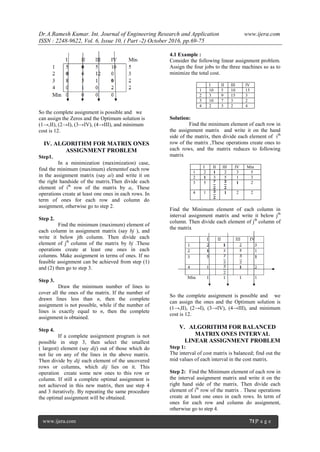
So the complete assignment is possible and we
can assign the ones and the Optimum solution is
(1→,II), (2→I), (3→IV), (4→III), and minimum
cost is 12.
V. ALGORITHM FOR BALANCED
MATRIX ONES INTERVAL
LINEAR ASSIGNMENT PROBLEM
Step 1:
The interval of cost matrix is balanced; find out the
mid values of each interval in the cost matrix.
Step 2: Find the Minimum element of each row in
the interval assignment matrix and write it on the
right hand side of the matrix. Then divide each
element of ith
row of the matrix . These operations
create at least one ones in each rows. In term of
ones for each row and column do assignment,
otherwise go to step 4.
Dr.A.Ramesh Kumar. Int. Journal of Engineering Research and Application www.ijera.com
ISSN : 2248-9622, Vol. 6, Issue 10, ( Part -2) October 2016, pp.69-75
www.ijera.com 72|P a g e
Step 3: Find the Minimum element of each column
in interval assignment matrix and write it below jth
column. Then divide each element of jth
column of
the matrix .These operations create at least one
ones in each columns. Make interval assignment in
terms of ones.
Step 4: Draw lines through appropriate rows and
columns so that all the intervals contain one of the
cost matrix are covered and the minimum number
of such lines is used.
Step5: Test for optimality (i) If the minimum
number of covering lines is equal to the order of
the cost matrix, then optimality is reached. (ii) If
the minimum number of covering lines is less than
the order of the matrix, then go to step 6.
Step 6: Determine the smallest mid value of the
intervals which are not covered by any lines divide
this entry from all un-crossed element and add it
to the crossing having an interval contain one’s.
Then go to step3.
5.1 Example:
Consider the following linear assignment problem.
Assign the five jobs to the five machines so as to
minimize the total cost.
I II III IV
1 10 5 10 15
2 3 9 15 3
3 10 7 3 2
4 2 3 2 4
Solution;
Now change the entry of the cost matrix by some
interval form. Then we get a new cost matrix as
follow. Cost matrix with interval entries
I II III IV
1 [9,11] [4,6] [9,11] [14,16]
2 [2,4] [8,10] [14,16] [2,4]
3 [9,11] [6,8] [2,4] [1,3]
4 [1,3] [2,4] [1,3] [3,5]
Find the minimum element of each row in the
assignment matrix and write it on the hand side of
the matrix, then divide each element of ith
row of
the matrix .
I II III IV Min
1 [ ] [1,1] [ ] [ ] [4,6]
2 [1,1] [ ] [ ] [1,1] [2,4]
3 [ ] [ ] [ ] [1,1] [1,3]
4 [1,1] [ ] [1,1] [ ] [1,3]
Then divide each element of ith
row of the matrix .These operations create ones to each rows, and the matrix
reduces to following matrix
Now find the minimum element of each column in assignment matrix and write it below column. Then divide
each element of jth
column of the matrix
I II III IV
1 [ ] [1,1] [ ] [ ]
2 [1,1] [ ] [ ] [1,1]
3 [ ] [ ] [ ] [1,1]
4 [1,1] [ ] [1,1] [ ]
Min [1,1] [1,1] [1,1] [1,1]
Dr.A.Ramesh Kumar. Int. Journal of Engineering Research and Application www.ijera.com
ISSN : 2248-9622, Vol. 6, Issue 10, ( Part -2) October 2016, pp.69-75
www.ijera.com 73|P a g e
So the complete assignment is possible
and we can assign the ones and the solution is
(1,→II), (2→I), (3→IV), (4→III), and minimum
cost is [8,16]. Now we are applying ones
Assignment method, then we get a minimum
assignment cost is 12
Result:
Balanced optimum solution for three methods is
same solution
Problem HM-Method MOA method MOILAP Optimum
01 12 12 12 12
VI. UNBALANCED ASSIGNMENT
PROBLEM
The method of assignment discussed
above requires that the number of columns and
rows in the assignment matrix be equal. However,
when the given cost matrix is not a square matrix,
the assignment problem is called an unbalanced
problem. In such cases a dummy row(s) or
column(s) are added in the matrix (with zeros as
the cost elements) to make it a square matrix. For
example, when the given cost matrix is of order
4×3, a dummy column would be added with zero
cost element in that column. After making the
given cost matrix a square matrix, Once the
unbalanced assignment problem is converted into
balanced assignment problem then we can follow
usual algorithm to solve the assignment problem.
6.1Example:
Consider the following linear assignment
problem. Assign the four jobs to the three
machines so as to minimize the total cost.
I II III IV
1 10 5 13 15
2 3 9 18 3
3 10 7 3 2
Solution:
The unbalanced assignment problem is converted
into balanced assignment problem
I II III IV
1 10 5 13 15
2 3 9 18 3
3 10 7 3 2
4 0 0 0 0
So the complete assignment is possible and we
can assign the Zeros and the Optimum solution is
(1→,II), (2→I), (3→IV), (4→III), and minimum
cost is 11.
VII. 7UNBALANCED MATRIX ONES
ASSIGNMENT PROBLEM
The method of one’s Assignment problem
discussed above requires that the number of
columns and rows in the assignment matrix be
equal. However, when the given cost matrix is not
a square matrix, the assignment problem is called
an unbalanced problem. In such cases a dummy
row(s) or column(s) are added in the matrix (with
ones as the cost elements) to make it a square
matrix. For example, when the given cost matrix is
of order 4×3, a dummy column would be added
with ones element in that column. After making
the given cost matrix a square matrix, once the
unbalanced ones assignment problem is converted
into balanced ones assignment problem then we
can follow usual algorithm to solve the assignment
problem.
7.1Example:
Consider the following linear assignment
problem. Assign the four jobs to the three
machines so as to minimize the total cost.
I II III IV
1 10 5 13 15
2 3 9 18 3
3 10 7 3 2
Solution:
The unbalanced ones assignment problem is
converted into balanced ones assignment problem
I II III IV
1 10 5 13 15
2 3 9 18 3
3 10 7 3 2
4 1 1 1 1
Dr.A.Ramesh Kumar. Int. Journal of Engineering Research and Application www.ijera.com
ISSN : 2248-9622, Vol. 6, Issue 10, ( Part -2) October 2016, pp.69-75
www.ijera.com 74|P a g e
So the complete assignment is possible
and we can assign the ones and the optimum
solution is (1→,II), (2→I), (3→IV), (4→III), and
minimum cost is 11.
VIII. UNBALANCED MATRIX ONES
INTERVAL LINEAR
ASSIGNMENT PROBLEM
The method of one’s interval Assignment
problem discussed above requires that the number
of columns and rows in the assignment matrix be
equal. However, when the given cost matrix is not
a square matrix, the ones interval assignment
problem is called an unbalanced problem. In such
cases a dummy row(s) or column(s) are added in
the matrix (with interval ones as the cost elements)
to make it a square matrix. For example, when the
given cost matrix is of order 4×3, a dummy column
would be added with interval ones element in that
column. After making the given cost matrix a
square matrix, once the unbalanced ones interval
assignment problem is converted into balanced
ones interval assignment problem then we can
follow usual algorithm to solve the interval
assignment problem.
8.1Example:
Consider the following linear assignment problem.
Assign the four jobs to the three machines so as to
minimize the total cost.
I II III IV
1 10 5 13 15
2 3 9 18 3
3 10 7 3 2
Solution:
Now change the entry of the cost matrix by some
interval form. Then we get a new cost matrix as
follow.& the unbalanced ones assignment problem
is converted into balanced ones assignment
problem
I II III IV
1 [9,11] [4,6] [12,14] [14,16]
2 [2,4] [8,10] [17,19] [2,4]
3 [9,11] [6,8] [2,4] [1,3]
4 [1,1] [1,1] [1,1] [1,1]
The Hungarian condition satisfied, we are applying
the proposed interval Hungarian method and solve
this problem. We get an optimal assignment as
1,2,3,4 machines are assign to II,I,IV,III operators
respectively and the minimum assignment cost is
[8,14] Now we are applying ones Assignment
method, then we get an minimum assignment cost
is 11
IX. CONCLUSION
We conclude that the balanced optimum solution
and unbalanced optimum solution are
(i)Balanced problem for three methods is same solution
Problem HM-Method MOA method MOILAP Optimum
01 12 12 12 12
(ii)Unbalanced problem for three methods is same solution
Problem HM-Method MOA method MOILAP Optimum
02 11 11 11 11
The MOILA-method can be used for all
kinds of assignment problems, whether maximize
or minimize objective. The new method is based
on creating some ones in the assignment matrix
and finds an assignment in terms of the ones. As
considerable number of methods has been so for
presented for assignment problem in which the
Hungarian Method is more convenient method
among them. Also the comparisons between both
the methods have been shown in the paper.
Therefore this paper attempts to propose a method
for solving assignment problem which is different
from thepreceding methods.
REFERENCES
[1]. M.S. Bazarra, John J. Jarvis, Hanif D.
Sherali, Linear programming and newtwork
flows, (2005).
[2]. B.S. Goel, S.K. Mittal, Operations
REsearch, Fifty Ed., (1982) 2405-2416.
[3]. Hamdy A.Taha, Operations Research, an
introduction, 8th Ed. (2007).
[4]. H.J. Zimmermann, Rudrajit Tapador,
Solving the assignment, third Ed. kluwer
Academic, Boston, 1996.
[5]. H. J. Zimmermann, Fuzzy set theory and its
Applications, third Ed., kluwer Academic,
Boston, 1996.
[6]. Shayle R. Searle, Matrix algebra useful for
statistics, John Wiley, (2006).
Dr.A.Ramesh Kumar. Int. Journal of Engineering Research and Application www.ijera.com
ISSN : 2248-9622, Vol. 6, Issue 10, ( Part -2) October 2016, pp.69-75
www.ijera.com 75|P a g e
[7]. Albrecher, H. (2005) “A note on the
asymptotic behavior of bottleneck
problems,” Operations Research Letters, 33,
183–186
[8]. Alvis, D. and Lai, C.W. (1988) “The
probabilistic analysis of a heuristic for the
assignment problem,” SIAM Journal on
Computing, 17, 732–741.
[9]. Buck, M.W., Chan, C. S., and Robbins, D.
P. (2002) “On the Expected Value of the
Minimum Assignment,” Random Structures
& Algorithms, 21 (1), 33–58.
[10]. Burkard, R. E. and Fincke, U. (1982b) “On
random quadratic bottleneck assignment
problems,” Mathematical Programming, 23,
227–232.

Solving ONE’S interval linear assignment problem

  • 1.
    Dr.A.Ramesh Kumar. Int.Journal of Engineering Research and Application www.ijera.com ISSN : 2248-9622, Vol. 6, Issue 10, ( Part -2) October 2016, pp.69-75 www.ijera.com 69|P a g e Solving ONE’S interval linear assignment problem Dr.A.Ramesh Kumar1 ,S. Deepa2 , 1 Head, Department of Mathematics, Srimad Andavan Arts and Science College (Autonomous), T.V.Kovil, Trichy-5. 2 Assistant professor, Department of mathematics, Srimad Andavan Arts and Science College (Autonomous), T.V.Kovil,Trichy-5 ABSTRACT In this paper to introduce a matrix ones interval linear assignment method or MOILA -method for solving wide range of problem. An example using matrix ones interval linear assignment methods and the existing Hungarian method have been solved and compared. Also some of the variations and some special cases in assignment problem and its applications have been discussed ,the proposed method is a systematic procedure, easy to apply and can be utilized for all types of assignment problem with maximize or minimize objective functions. Keywords: Assignment Problems, IntervalAnalysis. Hungarian assignment method (HA) method, Linear Integer Programming, Matrix ones Interval assignment method (MOIAM), optimization MSC Code: 90B80 I. INTRODUCTION We define the assignment matrix, then by using determinant representation we obtain a reduced matrix which has at least one 1 in each row and columns. Then by using the new method, we obtain an optimal solution for interval assignment problem by assigning ones to each row and each column, and then try to find a complete assignment to their ones. In a ground reality the entries of the cost matrix is not always crisp. In many application this parameters are uncertain and this uncertain parameters are represented by interval. In this contribution we propose matrix ones interval assignment methods and consider interval analysis concept for solving matrix ones interval linear assignment methods .This section presents a new method to solve the assignment problem which is different from the preceding method. We call it ”Matrix one’s- assignment method” ,because of making assignment in terms of ones. The new method is based on creating some ones in the assignment matrix and then try to find a complete assignment in terms of ones. II. DEFINITION Each assignment problem has a table or matrix associated with it. Generally the row contains the objects or people we wish to assign and the column comprise the jobs or task we want them assigned to. Consider a problem of assignment of n resources to m activities so as to minimize the overall cost or time in such a way that each resource can associate with one and only one job. The cost matrix (Cij) is given as under: Activity Resource The cost matrix is same as that of a T.P except that availability at each of the resource and the requirement at each of the destinations is unity. Let xij denote the assignment of ith resource to jth activity, such that Then the mathematical formulation of the assignment problem is Minimize Z= Subject to the constraints = 1 and =1: = 0 or 1 for all i=1,2----n & j=1,2,-------n RESEARCH ARTICLE OPEN ACCESS
  • 2.
    Dr.A.Ramesh Kumar. Int.Journal of Engineering Research and Application www.ijera.com ISSN : 2248-9622, Vol. 6, Issue 10, ( Part -2) October 2016, pp.69-75 www.ijera.com 70|P a g e 2.1 Definition The interval form of the parameters may be written as where is the left value [ ] and is the right value [ ]of the interval respectively. We define the centre is m = and w = is the width of the interval [ ] Let [ ] and [ ] be two elements then the following arithmetic are well known (i) [ ] +[ ] = [ + + ] (ii) [ ] × [ ] =[min{ , } ,max{ , }] (iii) [ ] ÷ [ ] =[min , } , max , } ] provide if ] ≠ [0, 0], Notation: (i) H M - Hungarian method (ii) MOAP- Matrix ones Assignment problem (iii) MOILAP - Matrix ones interval Linear assignment problem (iv) UBMOAP- Unbalanced Matrix ones Assignment problem (v) UBMOILAP -Unbalanced Matrix ones Interval linear Assignment problem III. ALGORITHM FOR HUNGARIAN METHOD: Step1: Find the opportunity cost table by: (a). subtracting the smallest number in each row of the original cost table or matrix from every number in that row and. (b). Then subtracting the smallest number in each column of the table obtained in part (a) from every number in that column. Step 2: Examine the rows successively until a row with exactly one unmarked zero is found. Enclose this zero in a box( ) as an assignment will be made there and cross (X) all other zeros appearing in the corresponding column as they will not be considered for future assignment. Proceed in this way until all the rows have been examined. Step 3: After examining all the rows completely, examine the columns successively until a column with exactly one unmarked zero is found. Make an assignment to this single zero by putting square ( ) around it and cross out (X) all other zeros appearing in the corresponding row as they will not be used to make any other assignment in that row, Proceed in this manner until all columns have been examined. Step 4: Repeat the operations (Step 1) and (Step 2) successively until one of the following situations arises: (i). All the zeros in rows /columns are either marked ( ) or corssed (X ) and there is exactly one assignment in each row and in each column. In such a case optimal assignment policy for the given problem is obtained. (ii). there may be some row (or column) without assignment, i.e., the total number of marked zeros is less than the order of the matrix. In such a case, proceed to next Step 4. Step 5: Draw the minimum number of vertical and horizontal lines necessary to cover all the zeros in the reduced cost table obtained from Step 2&3 by adopting the following procedure: i. Mark (√) all rows that do not have assignments. ii. Mark (√) all columns (not already marked) which have zeros in the marked rows iii. Mark (√) all rows (not already marked) that have assignments in marked columns iv. Repeat steps 4(ii) and (iii) until no more rows or columns can be marked. v. Draw straight lines through each unmarked row and each marked column. If the number of lines drawn (or total assignments) is equal to the number of rows (or columns) then the current solution is the optimal solution, Step 6: Repeat Steps 2 to 4 until an optimal solution is obtained 3.1 Example : Consider the following linear assignment problem. Assign the four jobs to the three machines so as to minimize the total cost. I II III IV 1 10 5 10 15 2 3 9 15 3 3 10 7 3 2 4 2 3 2 4 Solution: Subtracting the smallest number in each row of the original cost table or matrix from every number in that row, as follows I II III IV 1 5 0 5 10 2 0 6 12 0 3 8 5 1 0 4 0 1 0 2 Then subtracting the smallest number in each column of the table obtained from every number in that column.
  • 3.
    Dr.A.Ramesh Kumar. Int.Journal of Engineering Research and Application www.ijera.com ISSN : 2248-9622, Vol. 6, Issue 10, ( Part -2) October 2016, pp.69-75 www.ijera.com 71|P a g e So the complete assignment is possible and we can assign the Zeros and the Optimum solution is (1→,II), (2→I), (3→IV), (4→III), and minimum cost is 12. IV. ALGORITHM FOR MATRIX ONES ASSIGNMENT PROBLEM Step1. In a minimization (maximization) case, find the minimum (maximum) elementof each row in the assignment matrix (say ai) and write it on the right handside of the matrix.Then divide each element of ith row of the matrix by ai. These operations create at least one ones in each rows. In term of ones for each row and column do assignment, otherwise go to step 2. Step 2. Find the minimum (maximum) element of each column in assignment matrix (say bj ), and write it below jth column. Then divide each element of jth column of the matrix by bj .These operations create at least one ones in each columns. Make assignment in terms of ones. If no feasible assignment can be achieved from step (1) and (2) then go to step 3. Step 3. Draw the minimum number of lines to cover all the ones of the matrix. If the number of drawn lines less than n, then the complete assignment is not possible, while if the number of lines is exactly equal to n, then the complete assignment is obtained. Step 4. If a complete assignment program is not possible in step 3, then select the smallest ( largest) element (say dij) out of those which do not lie on any of the lines in the above matrix. Then divide by dij each element of the uncovered rows or columns, which dij lies on it. This operation create some new ones to this row or column. If still a complete optimal assignment is not achieved in this new matrix, then use step 4 and 3 iteratively. By repeating the same procedure the optimal assignment will be obtained. 4.1 Example : Consider the following linear assignment problem. Assign the four jobs to the three machines so as to minimize the total cost. I II III IV 1 10 5 10 15 2 3 9 15 3 3 10 7 3 2 4 2 3 2 4 Solution: Find the minimum element of each row in the assignment matrix and write it on the hand side of the matrix, then divide each element of ith row of the matrix ,These operations create ones to each rows, and the matrix reduces to following matrix I II III IV Min 1 2 1 2 3 5 2 1 3 5 1 3 3 5 1 2 4 1 1 2 2 Find the Minimum element of each column in interval assignment matrix and write it below jth column. Then divide each element of jth column of the matrix So the complete assignment is possible and we can assign the ones and the Optimum solution is (1→,II), (2→I), (3→IV), (4→III), and minimum cost is 12. V. ALGORITHM FOR BALANCED MATRIX ONES INTERVAL LINEAR ASSIGNMENT PROBLEM Step 1: The interval of cost matrix is balanced; find out the mid values of each interval in the cost matrix. Step 2: Find the Minimum element of each row in the interval assignment matrix and write it on the right hand side of the matrix. Then divide each element of ith row of the matrix . These operations create at least one ones in each rows. In term of ones for each row and column do assignment, otherwise go to step 4.
  • 4.
    Dr.A.Ramesh Kumar. Int.Journal of Engineering Research and Application www.ijera.com ISSN : 2248-9622, Vol. 6, Issue 10, ( Part -2) October 2016, pp.69-75 www.ijera.com 72|P a g e Step 3: Find the Minimum element of each column in interval assignment matrix and write it below jth column. Then divide each element of jth column of the matrix .These operations create at least one ones in each columns. Make interval assignment in terms of ones. Step 4: Draw lines through appropriate rows and columns so that all the intervals contain one of the cost matrix are covered and the minimum number of such lines is used. Step5: Test for optimality (i) If the minimum number of covering lines is equal to the order of the cost matrix, then optimality is reached. (ii) If the minimum number of covering lines is less than the order of the matrix, then go to step 6. Step 6: Determine the smallest mid value of the intervals which are not covered by any lines divide this entry from all un-crossed element and add it to the crossing having an interval contain one’s. Then go to step3. 5.1 Example: Consider the following linear assignment problem. Assign the five jobs to the five machines so as to minimize the total cost. I II III IV 1 10 5 10 15 2 3 9 15 3 3 10 7 3 2 4 2 3 2 4 Solution; Now change the entry of the cost matrix by some interval form. Then we get a new cost matrix as follow. Cost matrix with interval entries I II III IV 1 [9,11] [4,6] [9,11] [14,16] 2 [2,4] [8,10] [14,16] [2,4] 3 [9,11] [6,8] [2,4] [1,3] 4 [1,3] [2,4] [1,3] [3,5] Find the minimum element of each row in the assignment matrix and write it on the hand side of the matrix, then divide each element of ith row of the matrix . I II III IV Min 1 [ ] [1,1] [ ] [ ] [4,6] 2 [1,1] [ ] [ ] [1,1] [2,4] 3 [ ] [ ] [ ] [1,1] [1,3] 4 [1,1] [ ] [1,1] [ ] [1,3] Then divide each element of ith row of the matrix .These operations create ones to each rows, and the matrix reduces to following matrix Now find the minimum element of each column in assignment matrix and write it below column. Then divide each element of jth column of the matrix I II III IV 1 [ ] [1,1] [ ] [ ] 2 [1,1] [ ] [ ] [1,1] 3 [ ] [ ] [ ] [1,1] 4 [1,1] [ ] [1,1] [ ] Min [1,1] [1,1] [1,1] [1,1]
  • 5.
    Dr.A.Ramesh Kumar. Int.Journal of Engineering Research and Application www.ijera.com ISSN : 2248-9622, Vol. 6, Issue 10, ( Part -2) October 2016, pp.69-75 www.ijera.com 73|P a g e So the complete assignment is possible and we can assign the ones and the solution is (1,→II), (2→I), (3→IV), (4→III), and minimum cost is [8,16]. Now we are applying ones Assignment method, then we get a minimum assignment cost is 12 Result: Balanced optimum solution for three methods is same solution Problem HM-Method MOA method MOILAP Optimum 01 12 12 12 12 VI. UNBALANCED ASSIGNMENT PROBLEM The method of assignment discussed above requires that the number of columns and rows in the assignment matrix be equal. However, when the given cost matrix is not a square matrix, the assignment problem is called an unbalanced problem. In such cases a dummy row(s) or column(s) are added in the matrix (with zeros as the cost elements) to make it a square matrix. For example, when the given cost matrix is of order 4×3, a dummy column would be added with zero cost element in that column. After making the given cost matrix a square matrix, Once the unbalanced assignment problem is converted into balanced assignment problem then we can follow usual algorithm to solve the assignment problem. 6.1Example: Consider the following linear assignment problem. Assign the four jobs to the three machines so as to minimize the total cost. I II III IV 1 10 5 13 15 2 3 9 18 3 3 10 7 3 2 Solution: The unbalanced assignment problem is converted into balanced assignment problem I II III IV 1 10 5 13 15 2 3 9 18 3 3 10 7 3 2 4 0 0 0 0 So the complete assignment is possible and we can assign the Zeros and the Optimum solution is (1→,II), (2→I), (3→IV), (4→III), and minimum cost is 11. VII. 7UNBALANCED MATRIX ONES ASSIGNMENT PROBLEM The method of one’s Assignment problem discussed above requires that the number of columns and rows in the assignment matrix be equal. However, when the given cost matrix is not a square matrix, the assignment problem is called an unbalanced problem. In such cases a dummy row(s) or column(s) are added in the matrix (with ones as the cost elements) to make it a square matrix. For example, when the given cost matrix is of order 4×3, a dummy column would be added with ones element in that column. After making the given cost matrix a square matrix, once the unbalanced ones assignment problem is converted into balanced ones assignment problem then we can follow usual algorithm to solve the assignment problem. 7.1Example: Consider the following linear assignment problem. Assign the four jobs to the three machines so as to minimize the total cost. I II III IV 1 10 5 13 15 2 3 9 18 3 3 10 7 3 2 Solution: The unbalanced ones assignment problem is converted into balanced ones assignment problem I II III IV 1 10 5 13 15 2 3 9 18 3 3 10 7 3 2 4 1 1 1 1
  • 6.
    Dr.A.Ramesh Kumar. Int.Journal of Engineering Research and Application www.ijera.com ISSN : 2248-9622, Vol. 6, Issue 10, ( Part -2) October 2016, pp.69-75 www.ijera.com 74|P a g e So the complete assignment is possible and we can assign the ones and the optimum solution is (1→,II), (2→I), (3→IV), (4→III), and minimum cost is 11. VIII. UNBALANCED MATRIX ONES INTERVAL LINEAR ASSIGNMENT PROBLEM The method of one’s interval Assignment problem discussed above requires that the number of columns and rows in the assignment matrix be equal. However, when the given cost matrix is not a square matrix, the ones interval assignment problem is called an unbalanced problem. In such cases a dummy row(s) or column(s) are added in the matrix (with interval ones as the cost elements) to make it a square matrix. For example, when the given cost matrix is of order 4×3, a dummy column would be added with interval ones element in that column. After making the given cost matrix a square matrix, once the unbalanced ones interval assignment problem is converted into balanced ones interval assignment problem then we can follow usual algorithm to solve the interval assignment problem. 8.1Example: Consider the following linear assignment problem. Assign the four jobs to the three machines so as to minimize the total cost. I II III IV 1 10 5 13 15 2 3 9 18 3 3 10 7 3 2 Solution: Now change the entry of the cost matrix by some interval form. Then we get a new cost matrix as follow.& the unbalanced ones assignment problem is converted into balanced ones assignment problem I II III IV 1 [9,11] [4,6] [12,14] [14,16] 2 [2,4] [8,10] [17,19] [2,4] 3 [9,11] [6,8] [2,4] [1,3] 4 [1,1] [1,1] [1,1] [1,1] The Hungarian condition satisfied, we are applying the proposed interval Hungarian method and solve this problem. We get an optimal assignment as 1,2,3,4 machines are assign to II,I,IV,III operators respectively and the minimum assignment cost is [8,14] Now we are applying ones Assignment method, then we get an minimum assignment cost is 11 IX. CONCLUSION We conclude that the balanced optimum solution and unbalanced optimum solution are (i)Balanced problem for three methods is same solution Problem HM-Method MOA method MOILAP Optimum 01 12 12 12 12 (ii)Unbalanced problem for three methods is same solution Problem HM-Method MOA method MOILAP Optimum 02 11 11 11 11 The MOILA-method can be used for all kinds of assignment problems, whether maximize or minimize objective. The new method is based on creating some ones in the assignment matrix and finds an assignment in terms of the ones. As considerable number of methods has been so for presented for assignment problem in which the Hungarian Method is more convenient method among them. Also the comparisons between both the methods have been shown in the paper. Therefore this paper attempts to propose a method for solving assignment problem which is different from thepreceding methods. REFERENCES [1]. M.S. Bazarra, John J. Jarvis, Hanif D. Sherali, Linear programming and newtwork flows, (2005). [2]. B.S. Goel, S.K. Mittal, Operations REsearch, Fifty Ed., (1982) 2405-2416. [3]. Hamdy A.Taha, Operations Research, an introduction, 8th Ed. (2007). [4]. H.J. Zimmermann, Rudrajit Tapador, Solving the assignment, third Ed. kluwer Academic, Boston, 1996. [5]. H. J. Zimmermann, Fuzzy set theory and its Applications, third Ed., kluwer Academic, Boston, 1996. [6]. Shayle R. Searle, Matrix algebra useful for statistics, John Wiley, (2006).
  • 7.
    Dr.A.Ramesh Kumar. Int.Journal of Engineering Research and Application www.ijera.com ISSN : 2248-9622, Vol. 6, Issue 10, ( Part -2) October 2016, pp.69-75 www.ijera.com 75|P a g e [7]. Albrecher, H. (2005) “A note on the asymptotic behavior of bottleneck problems,” Operations Research Letters, 33, 183–186 [8]. Alvis, D. and Lai, C.W. (1988) “The probabilistic analysis of a heuristic for the assignment problem,” SIAM Journal on Computing, 17, 732–741. [9]. Buck, M.W., Chan, C. S., and Robbins, D. P. (2002) “On the Expected Value of the Minimum Assignment,” Random Structures & Algorithms, 21 (1), 33–58. [10]. Burkard, R. E. and Fincke, U. (1982b) “On random quadratic bottleneck assignment problems,” Mathematical Programming, 23, 227–232.