CHAPTE FOUR
ASSIGNMENT PROBLEMS
Definition and Objective
 The Assignment Problem(AP) refers to the class of
LPPs that involves determining the most efficient
assignment of;
 people to projects,
 salespeople to territories,
 contracts to bidders ,
 jobs to machines, and so on.
 The objective is to assign a number of resources to
an equal number of activities so as to;
 minimize total costs or total time or
 maximize total profit of allocation.
Cont…
 The problem of assignment arises because
available resources such as men, machines, etc have
varying degrees of efficiency for performing
different activities such as job.
 Therefore, cost, profit or time of performing the
different activities is different.
 The AP works under the condition that the number of
origins is equal to the number of destinations.
 m = n
 Hence assignment is made on the basis of 1:1.
Assumptions
1. Number of jobs is equal to the number of machines or
persons.
2. Each man or machine is loaded with one and only one
job.
3. Each man or machine is independently capable of
handling any of the job being presented.
4. Loading criteria must be clearly specified such as;
 “minimizing operating time” or
 “maximizing profit” ,or
 “minimizing production cost” or
 “minimizing throughout (production cycle) time ” etc.
Remark
 The AP is considered as a special TP in which
the supply at each source and the demand at
each destination are always one unit.
 Since the supply and demand are always equal
to one unit in each row and column, there is no
need to write them in the assignment table.
Hungarian Assignment Method(HAM)
 Developed by Hungarian mathematician D.Konig
 It works on the principle of reducing the given cost
matrix (the principle of matrix reduction) to a matrix of
opportunity costs.
 If we can reduce the cost matrix to the extent of
having at least one zero in each row and column, then
it will be possible to make optimal assignments.
Cont…
 Opportunity costs show the relative penalties
associated with assigning resource to an activity as
opposed to making the best or least-cost
assignment.
Steps in Solving Assignment Problems
Step.1. Develop the cost table from the given problem
 If the number of rows does not equal the number of
columns and vice versa, then a dummy row or dummy
column must be added. The assignment costs for
dummy cells are always zero.
Step 2.Find the opportunity cost table
 The transformation of the cost matrix to what is
termed as a total-opportunity cost matrix.
 It involves two operations
Cont…
a. Perform row operation
i.e. Locate the smallest element in each row of the given
cost table and then subtract that from each element
of that row
b. Perform column operation
 In the reduced matrix obtained from 2(a) ,locate the
smallest element in each column and then subtract
that from each element of that column. Notice that
each row and column now have at least one zero
value.
Cont…
Step 3.Test for an optimal assignment
The procedure is:
a. Draw the minimum number of Horizontal and /or
Vertical lines necessary to cover all zeros costs.
 Draw the lines by trial and error but always try to
cover two or more zeros with one line.
b. Count the number of the lines
 If the number of lines equals either the number of
rows or columns in the table, an optimal assignment
can be made.
 If the number of lines is less than the number of rows
or columns, an improvement is possible (we proceed
to step 4).
Cont…
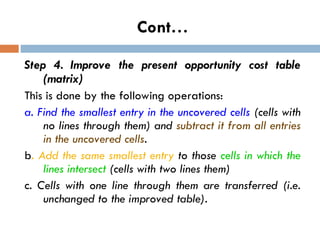
Step 4. Improve the present opportunity cost table
(matrix)
This is done by the following operations:
a. Find the smallest entry in the uncovered cells (cells with
no lines through them) and subtract it from all entries
in the uncovered cells.
b. Add the same smallest entry to those cells in which the
lines intersect (cells with two lines them)
c. Cells with one line through them are transferred (i.e.
unchanged to the improved table).
Cont…
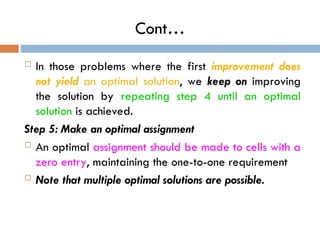
 In those problems where the first improvement does
not yield an optimal solution, we keep on improving
the solution by repeating step 4 until an optimal
solution is achieved.
Step 5: Make an optimal assignment
 An optimal assignment should be made to cells with a
zero entry, maintaining the one-to-one requirement
 Note that multiple optimal solutions are possible.
Cont…
Example:
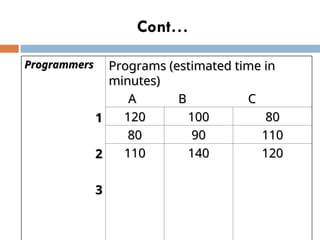
 1. A computer center has three programmers. The
center wants three application programs to be
developed. The head of the computer center, after
studying carefully the programs to be developed,
estimate the computer time in minutes required by the
experts for the application programs as follows:
 Assign the programmers to the programs in such a
way that the total computer time is minimum.
Cont…
Programmers
Programmers
1
1
2
2
3
3
Programs (estimated time in
minutes)
minutes)
A B C
A B C
120
120 100
100 80
80
80
80 90
90 110
110
110
110 140
140 120
120
Cont…
Officials
Officials
Game Sites
Game Sites
Chicago
Chicago Atlanta
Atlanta Durham
Durham Clemson
Clemson
A
A 210
210 90
90 180
180 160
160
B
B 100
100 70
70 130
130 200
200
C
C 175
175 105
105 140
140 170
170
D
D 80
80 65
65 105
105 120
120
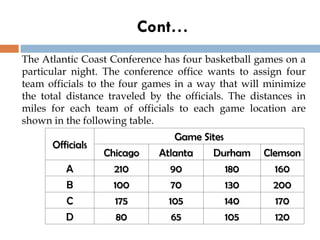
The Atlantic Coast Conference has four basketball games on a
particular night. The conference office wants to assign four
team officials to the four games in a way that will minimize
the total distance traveled by the officials. The distances in
miles for each team of officials to each game location are
shown in the following table.
Special Cases in the Assignment
Problems
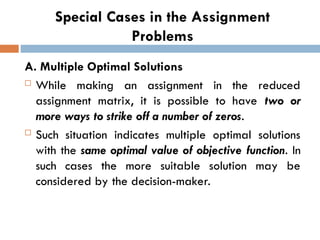
A. Multiple Optimal Solutions
 While making an assignment in the reduced
assignment matrix, it is possible to have two or
more ways to strike off a number of zeros.
 Such situation indicates multiple optimal solutions
with the same optimal value of objective function. In
such cases the more suitable solution may be
considered by the decision-maker.
Cont…
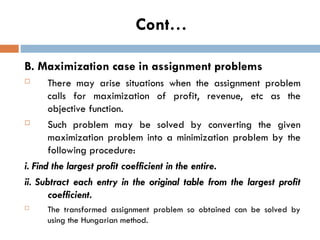
B. Maximization case in assignment problems
 There may arise situations when the assignment problem
calls for maximization of profit, revenue, etc as the
objective function.
 Such problem may be solved by converting the given
maximization problem into a minimization problem by the
following procedure:
i. Find the largest profit coefficient in the entire.
ii. Subtract each entry in the original table from the largest profit
coefficient.
 The transformed assignment problem so obtained can be solved by
using the Hungarian method.
Cont…
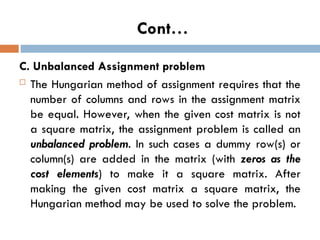
C. Unbalanced Assignment problem
 The Hungarian method of assignment requires that the
number of columns and rows in the assignment matrix
be equal. However, when the given cost matrix is not
a square matrix, the assignment problem is called an
unbalanced problem. In such cases a dummy row(s) or
column(s) are added in the matrix (with zeros as the
cost elements) to make it a square matrix. After
making the given cost matrix a square matrix, the
Hungarian method may be used to solve the problem.
Cont…
D. Restrictions on Assignments
 In certain instances, it may happen that a particular
match or pairing may be either undesirable or
otherwise unacceptable. For example, an employee
may not have the skills necessary to perform a
particular job or a machine may not be equipped to
handle a particular operation. In such cases, the cost
of performing that particular activity by a particular
resource is considered to be very large (written as M
or  ) so as to prohibit the entry of this pair of
employee-job into the final solution.
Cont…
 When such a restriction is present, a letter
(M) is often placed in the table in the position
that would represent a paring. Analysis is
performed as usual except the M is ignored
throughout the analysis. That is, M is not used
in any reductions, nor is any value added to
it or subtracted from it during the course of
the analysis.
Thank You!

Operations Research Assignment Problems.ppt

  • 1.
  • 2.
    Definition and Objective The Assignment Problem(AP) refers to the class of LPPs that involves determining the most efficient assignment of;  people to projects,  salespeople to territories,  contracts to bidders ,  jobs to machines, and so on.  The objective is to assign a number of resources to an equal number of activities so as to;  minimize total costs or total time or  maximize total profit of allocation.
  • 3.
    Cont…  The problemof assignment arises because available resources such as men, machines, etc have varying degrees of efficiency for performing different activities such as job.  Therefore, cost, profit or time of performing the different activities is different.  The AP works under the condition that the number of origins is equal to the number of destinations.  m = n  Hence assignment is made on the basis of 1:1.
  • 4.
    Assumptions 1. Number ofjobs is equal to the number of machines or persons. 2. Each man or machine is loaded with one and only one job. 3. Each man or machine is independently capable of handling any of the job being presented. 4. Loading criteria must be clearly specified such as;  “minimizing operating time” or  “maximizing profit” ,or  “minimizing production cost” or  “minimizing throughout (production cycle) time ” etc.
  • 5.
    Remark  The APis considered as a special TP in which the supply at each source and the demand at each destination are always one unit.  Since the supply and demand are always equal to one unit in each row and column, there is no need to write them in the assignment table.
  • 6.
    Hungarian Assignment Method(HAM) Developed by Hungarian mathematician D.Konig  It works on the principle of reducing the given cost matrix (the principle of matrix reduction) to a matrix of opportunity costs.  If we can reduce the cost matrix to the extent of having at least one zero in each row and column, then it will be possible to make optimal assignments.
  • 7.
    Cont…  Opportunity costsshow the relative penalties associated with assigning resource to an activity as opposed to making the best or least-cost assignment.
  • 8.
    Steps in SolvingAssignment Problems Step.1. Develop the cost table from the given problem  If the number of rows does not equal the number of columns and vice versa, then a dummy row or dummy column must be added. The assignment costs for dummy cells are always zero. Step 2.Find the opportunity cost table  The transformation of the cost matrix to what is termed as a total-opportunity cost matrix.  It involves two operations
  • 9.
    Cont… a. Perform rowoperation i.e. Locate the smallest element in each row of the given cost table and then subtract that from each element of that row b. Perform column operation  In the reduced matrix obtained from 2(a) ,locate the smallest element in each column and then subtract that from each element of that column. Notice that each row and column now have at least one zero value.
  • 10.
    Cont… Step 3.Test foran optimal assignment The procedure is: a. Draw the minimum number of Horizontal and /or Vertical lines necessary to cover all zeros costs.  Draw the lines by trial and error but always try to cover two or more zeros with one line. b. Count the number of the lines  If the number of lines equals either the number of rows or columns in the table, an optimal assignment can be made.  If the number of lines is less than the number of rows or columns, an improvement is possible (we proceed to step 4).
  • 11.
    Cont… Step 4. Improvethe present opportunity cost table (matrix) This is done by the following operations: a. Find the smallest entry in the uncovered cells (cells with no lines through them) and subtract it from all entries in the uncovered cells. b. Add the same smallest entry to those cells in which the lines intersect (cells with two lines them) c. Cells with one line through them are transferred (i.e. unchanged to the improved table).
  • 12.
    Cont…  In thoseproblems where the first improvement does not yield an optimal solution, we keep on improving the solution by repeating step 4 until an optimal solution is achieved. Step 5: Make an optimal assignment  An optimal assignment should be made to cells with a zero entry, maintaining the one-to-one requirement  Note that multiple optimal solutions are possible.
  • 13.
    Cont… Example:  1. Acomputer center has three programmers. The center wants three application programs to be developed. The head of the computer center, after studying carefully the programs to be developed, estimate the computer time in minutes required by the experts for the application programs as follows:  Assign the programmers to the programs in such a way that the total computer time is minimum.
  • 14.
    Cont… Programmers Programmers 1 1 2 2 3 3 Programs (estimated timein Programs (estimated time in minutes) minutes) A B C A B C 120 120 100 100 80 80 80 80 90 90 110 110 110 110 140 140 120 120
  • 15.
    Cont… Officials Officials Game Sites Game Sites Chicago ChicagoAtlanta Atlanta Durham Durham Clemson Clemson A A 210 210 90 90 180 180 160 160 B B 100 100 70 70 130 130 200 200 C C 175 175 105 105 140 140 170 170 D D 80 80 65 65 105 105 120 120 The Atlantic Coast Conference has four basketball games on a particular night. The conference office wants to assign four team officials to the four games in a way that will minimize the total distance traveled by the officials. The distances in miles for each team of officials to each game location are shown in the following table.
  • 16.
    Special Cases inthe Assignment Problems A. Multiple Optimal Solutions  While making an assignment in the reduced assignment matrix, it is possible to have two or more ways to strike off a number of zeros.  Such situation indicates multiple optimal solutions with the same optimal value of objective function. In such cases the more suitable solution may be considered by the decision-maker.
  • 17.
    Cont… B. Maximization casein assignment problems  There may arise situations when the assignment problem calls for maximization of profit, revenue, etc as the objective function.  Such problem may be solved by converting the given maximization problem into a minimization problem by the following procedure: i. Find the largest profit coefficient in the entire. ii. Subtract each entry in the original table from the largest profit coefficient.  The transformed assignment problem so obtained can be solved by using the Hungarian method.
  • 18.
    Cont… C. Unbalanced Assignmentproblem  The Hungarian method of assignment requires that the number of columns and rows in the assignment matrix be equal. However, when the given cost matrix is not a square matrix, the assignment problem is called an unbalanced problem. In such cases a dummy row(s) or column(s) are added in the matrix (with zeros as the cost elements) to make it a square matrix. After making the given cost matrix a square matrix, the Hungarian method may be used to solve the problem.
  • 19.
    Cont… D. Restrictions onAssignments  In certain instances, it may happen that a particular match or pairing may be either undesirable or otherwise unacceptable. For example, an employee may not have the skills necessary to perform a particular job or a machine may not be equipped to handle a particular operation. In such cases, the cost of performing that particular activity by a particular resource is considered to be very large (written as M or  ) so as to prohibit the entry of this pair of employee-job into the final solution.
  • 20.
    Cont…  When sucha restriction is present, a letter (M) is often placed in the table in the position that would represent a paring. Analysis is performed as usual except the M is ignored throughout the analysis. That is, M is not used in any reductions, nor is any value added to it or subtracted from it during the course of the analysis.
  • 21.