MB106
QUANTITATIVE TECHNIQUES
MODULE I
LECTURE 15
Assignment Problems-Hungarian Method
PROF. KRISHNA ROY
Assignment problems
Example:
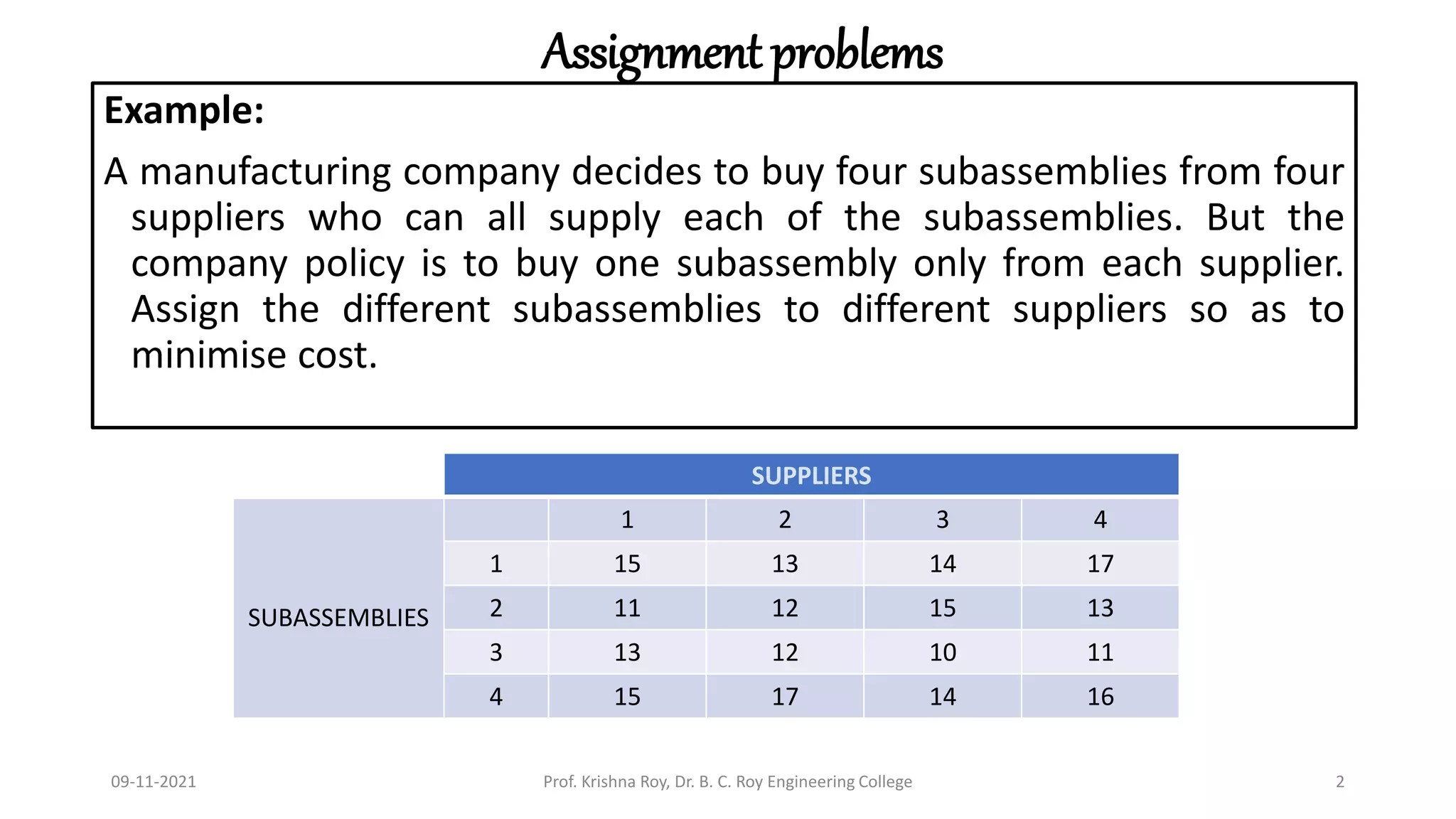
A manufacturing company decides to buy four subassemblies from four
suppliers who can all supply each of the subassemblies. But the
company policy is to buy one subassembly only from each supplier.
Assign the different subassemblies to different suppliers so as to
minimise cost.
09-11-2021 Prof. Krishna Roy, Dr. B. C. Roy Engineering College 2
SUPPLIERS
SUBASSEMBLIES
1 2 3 4
1 15 13 14 17
2 11 12 15 13
3 13 12 10 11
4 15 17 14 16
Assignment problems
Solution:
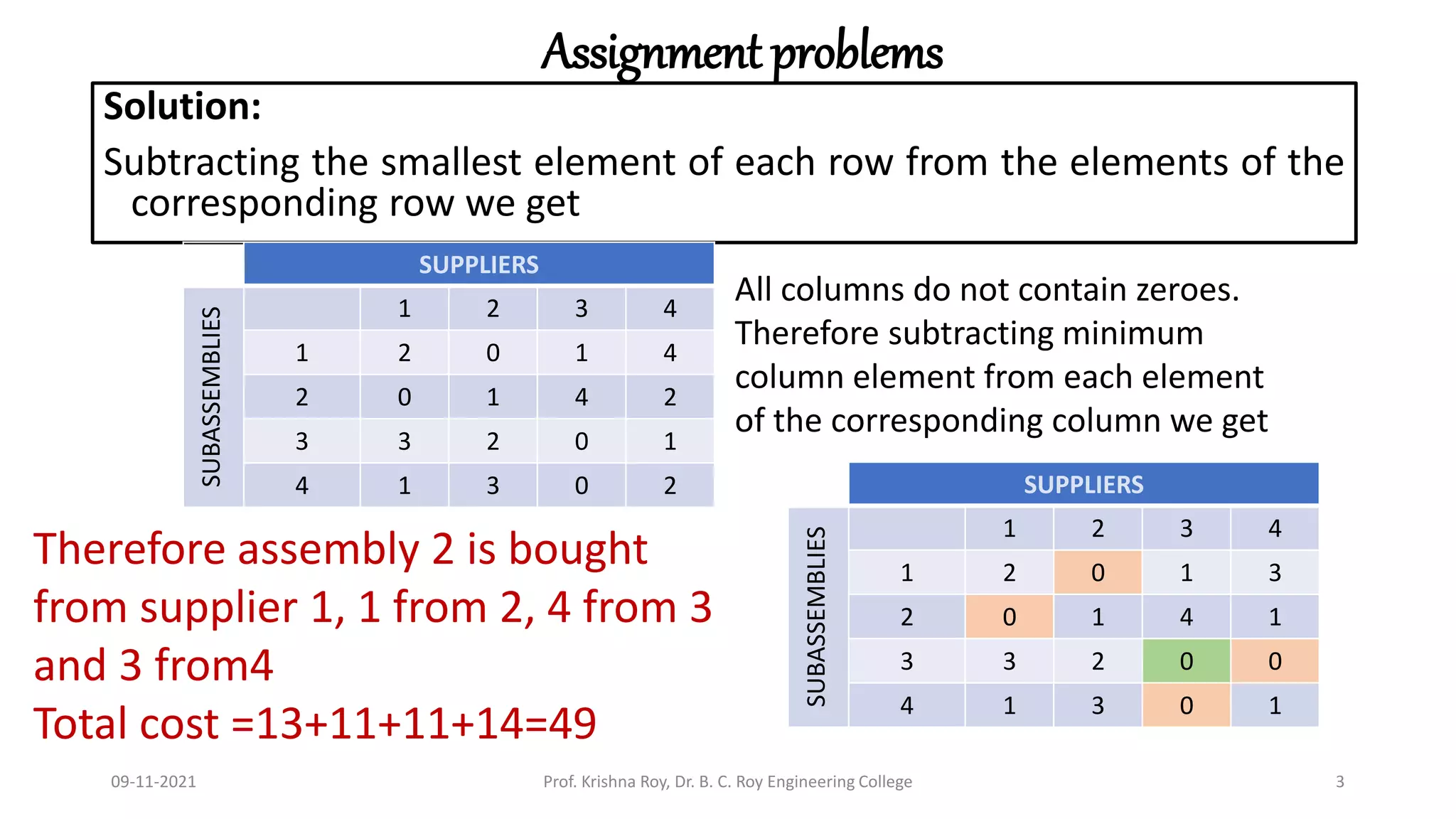
Subtracting the smallest element of each row from the elements of the
corresponding row we get
09-11-2021 Prof. Krishna Roy, Dr. B. C. Roy Engineering College 3
SUPPLIERS
SUBASSEMBLIES
1 2 3 4
1 2 0 1 4
2 0 1 4 2
3 3 2 0 1
4 1 3 0 2
All columns do not contain zeroes.
Therefore subtracting minimum
column element from each element
of the corresponding column we get
SUPPLIERS
SUBASSEMBLIES
1 2 3 4
1 2 0 1 3
2 0 1 4 1
3 3 2 0 0
4 1 3 0 1
Therefore assembly 2 is bought
from supplier 1, 1 from 2, 4 from 3
and 3 from4
Total cost =13+11+11+14=49
Assignment algorithm
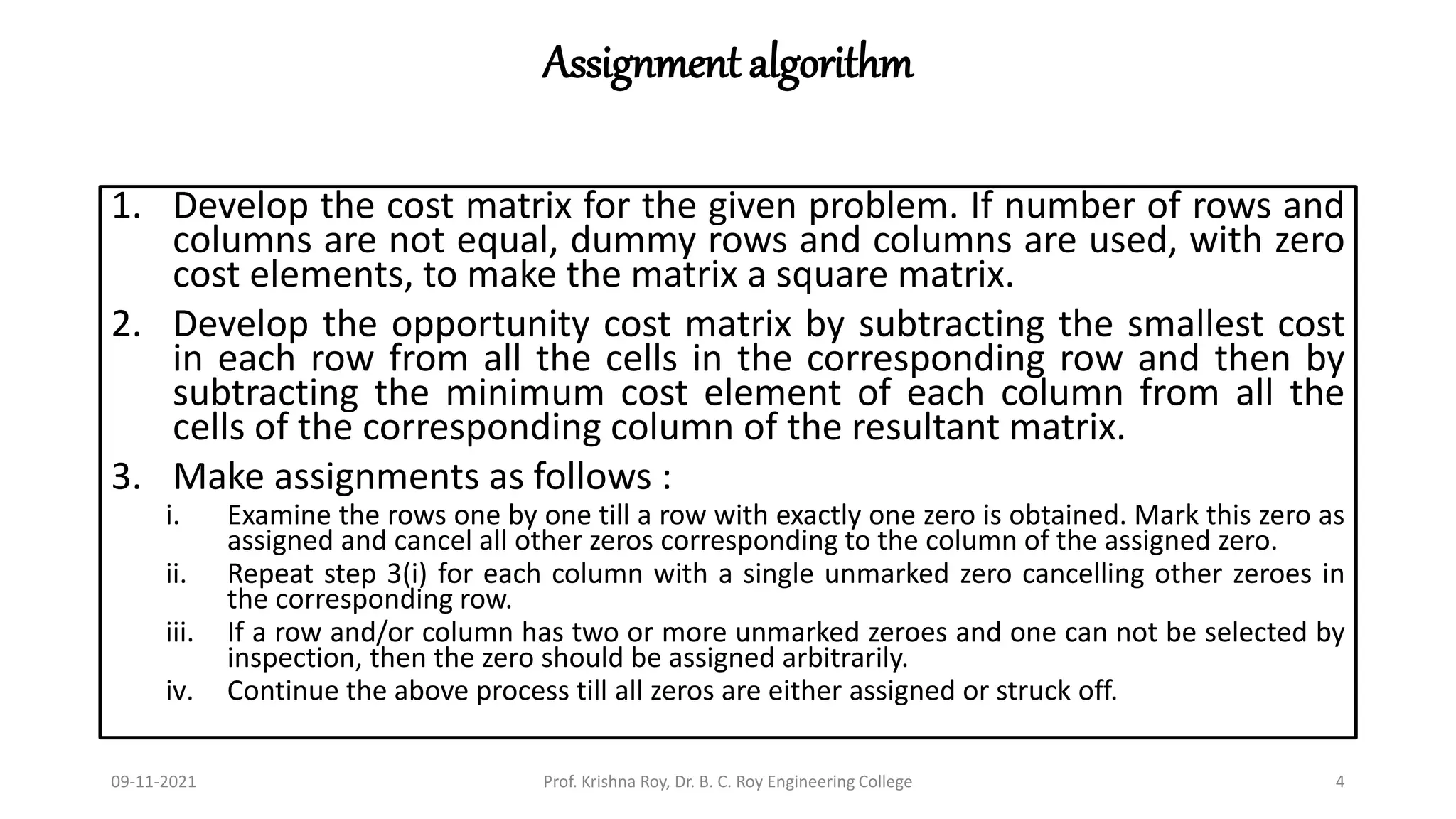
1. Develop the cost matrix for the given problem. If number of rows and
columns are not equal, dummy rows and columns are used, with zero
cost elements, to make the matrix a square matrix.
2. Develop the opportunity cost matrix by subtracting the smallest cost
in each row from all the cells in the corresponding row and then by
subtracting the minimum cost element of each column from all the
cells of the corresponding column of the resultant matrix.
3. Make assignments as follows :
i. Examine the rows one by one till a row with exactly one zero is obtained. Mark this zero as
assigned and cancel all other zeros corresponding to the column of the assigned zero.
ii. Repeat step 3(i) for each column with a single unmarked zero cancelling other zeroes in
the corresponding row.
iii. If a row and/or column has two or more unmarked zeroes and one can not be selected by
inspection, then the zero should be assigned arbitrarily.
iv. Continue the above process till all zeros are either assigned or struck off.
09-11-2021 Prof. Krishna Roy, Dr. B. C. Roy Engineering College 4
Assignment algorithmcontinued
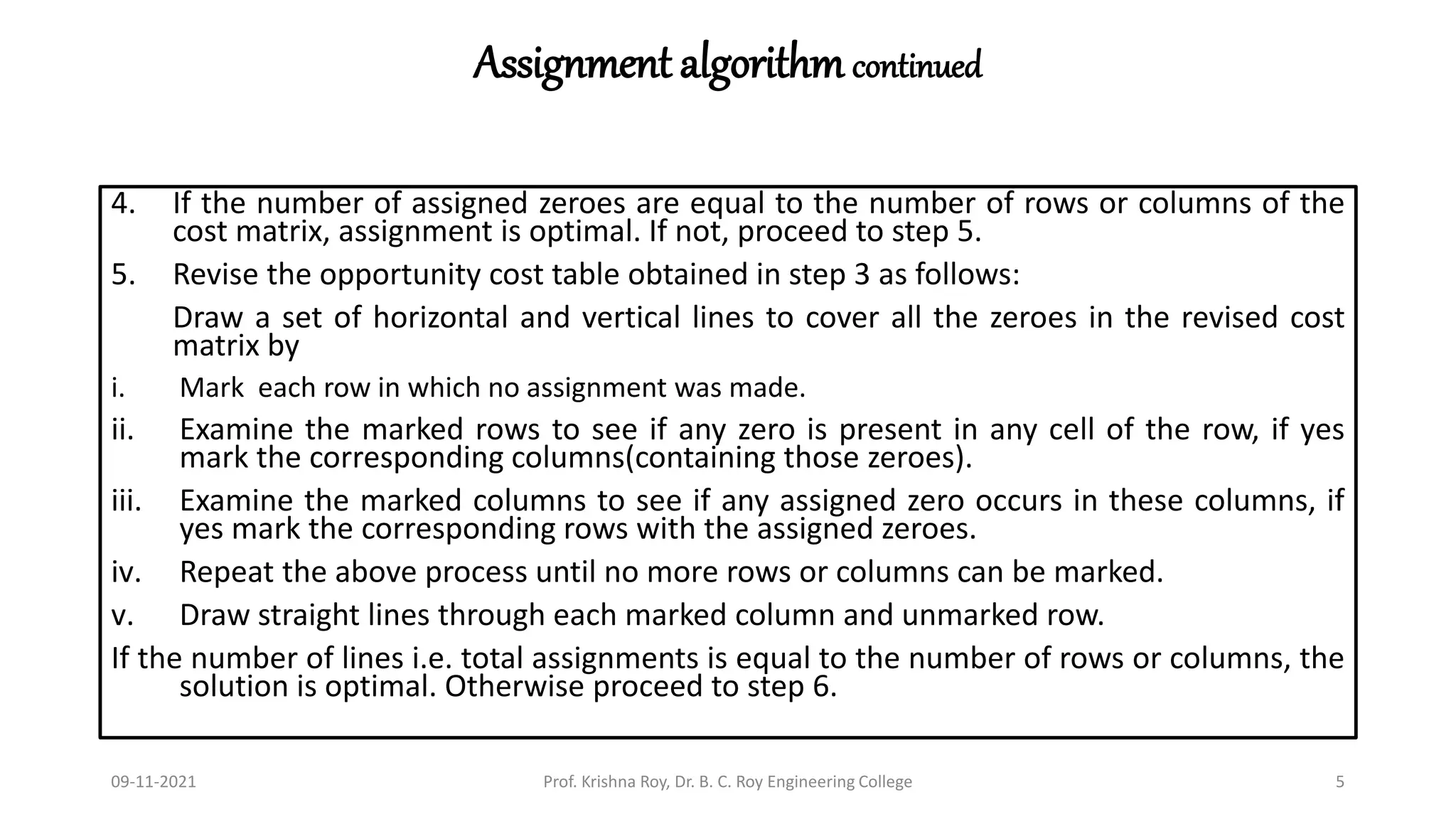
4. If the number of assigned zeroes are equal to the number of rows or columns of the
cost matrix, assignment is optimal. If not, proceed to step 5.
5. Revise the opportunity cost table obtained in step 3 as follows:
Draw a set of horizontal and vertical lines to cover all the zeroes in the revised cost
matrix by
i. Mark each row in which no assignment was made.
ii. Examine the marked rows to see if any zero is present in any cell of the row, if yes
mark the corresponding columns(containing those zeroes).
iii. Examine the marked columns to see if any assigned zero occurs in these columns, if
yes mark the corresponding rows with the assigned zeroes.
iv. Repeat the above process until no more rows or columns can be marked.
v. Draw straight lines through each marked column and unmarked row.
If the number of lines i.e. total assignments is equal to the number of rows or columns, the
solution is optimal. Otherwise proceed to step 6.
09-11-2021 Prof. Krishna Roy, Dr. B. C. Roy Engineering College 5
Assignment algorithmcontinued
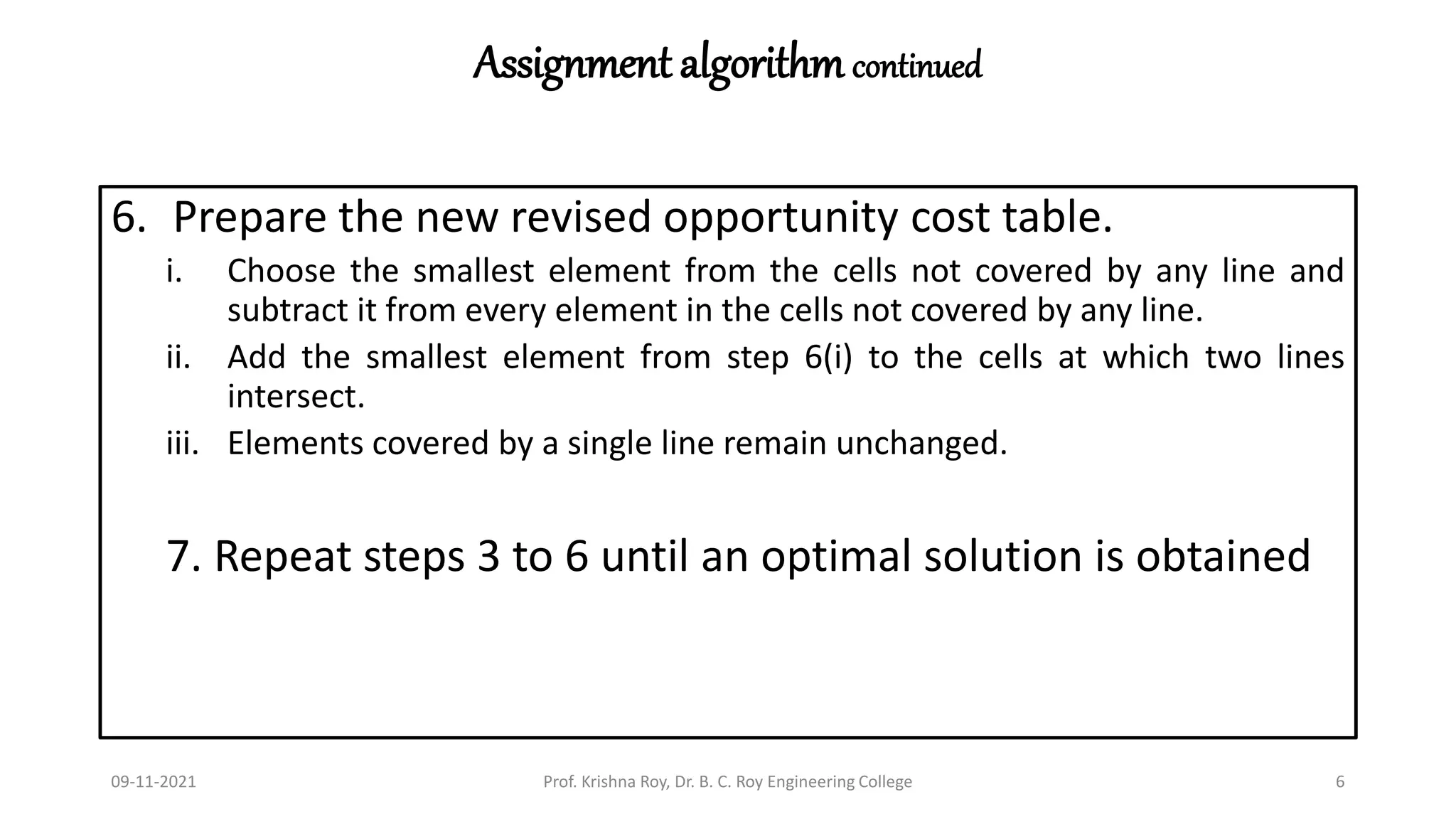
6. Prepare the new revised opportunity cost table.
i. Choose the smallest element from the cells not covered by any line and
subtract it from every element in the cells not covered by any line.
ii. Add the smallest element from step 6(i) to the cells at which two lines
intersect.
iii. Elements covered by a single line remain unchanged.
7. Repeat steps 3 to 6 until an optimal solution is obtained
09-11-2021 Prof. Krishna Roy, Dr. B. C. Roy Engineering College 6
Assignment problems
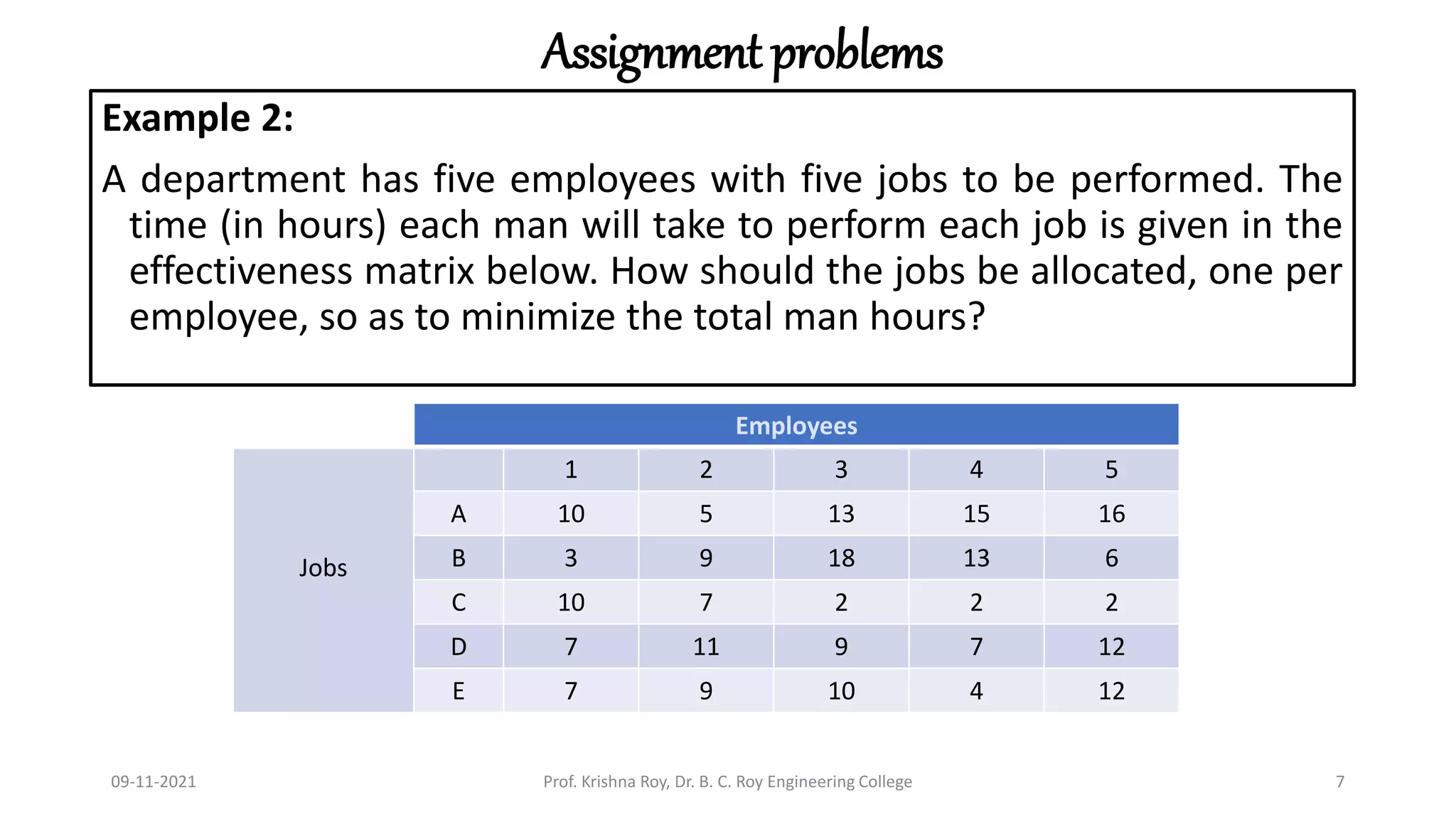
Example 2:
A department has five employees with five jobs to be performed. The
time (in hours) each man will take to perform each job is given in the
effectiveness matrix below. How should the jobs be allocated, one per
employee, so as to minimize the total man hours?
09-11-2021 Prof. Krishna Roy, Dr. B. C. Roy Engineering College 7
Employees
Jobs
1 2 3 4 5
A 10 5 13 15 16
B 3 9 18 13 6
C 10 7 2 2 2
D 7 11 9 7 12
E 7 9 10 4 12
Assignment problems
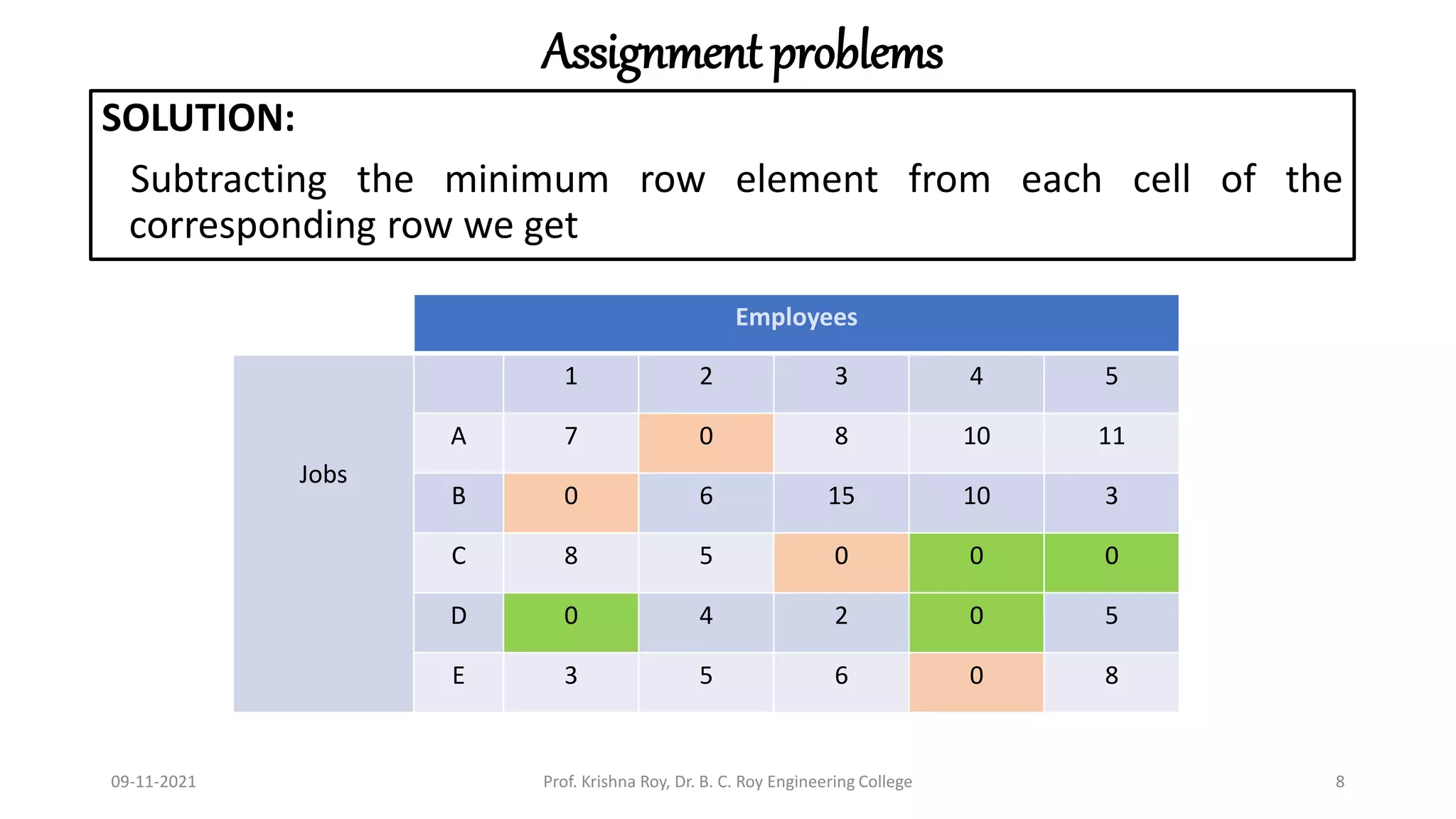
SOLUTION:
Subtracting the minimum row element from each cell of the
corresponding row we get
09-11-2021 Prof. Krishna Roy, Dr. B. C. Roy Engineering College 8
Employees
Jobs
1 2 3 4 5
A 7 0 8 10 11
B 0 6 15 10 3
C 8 5 0 0 0
D 0 4 2 0 5
E 3 5 6 0 8
Assignment problems
SOLUTION:
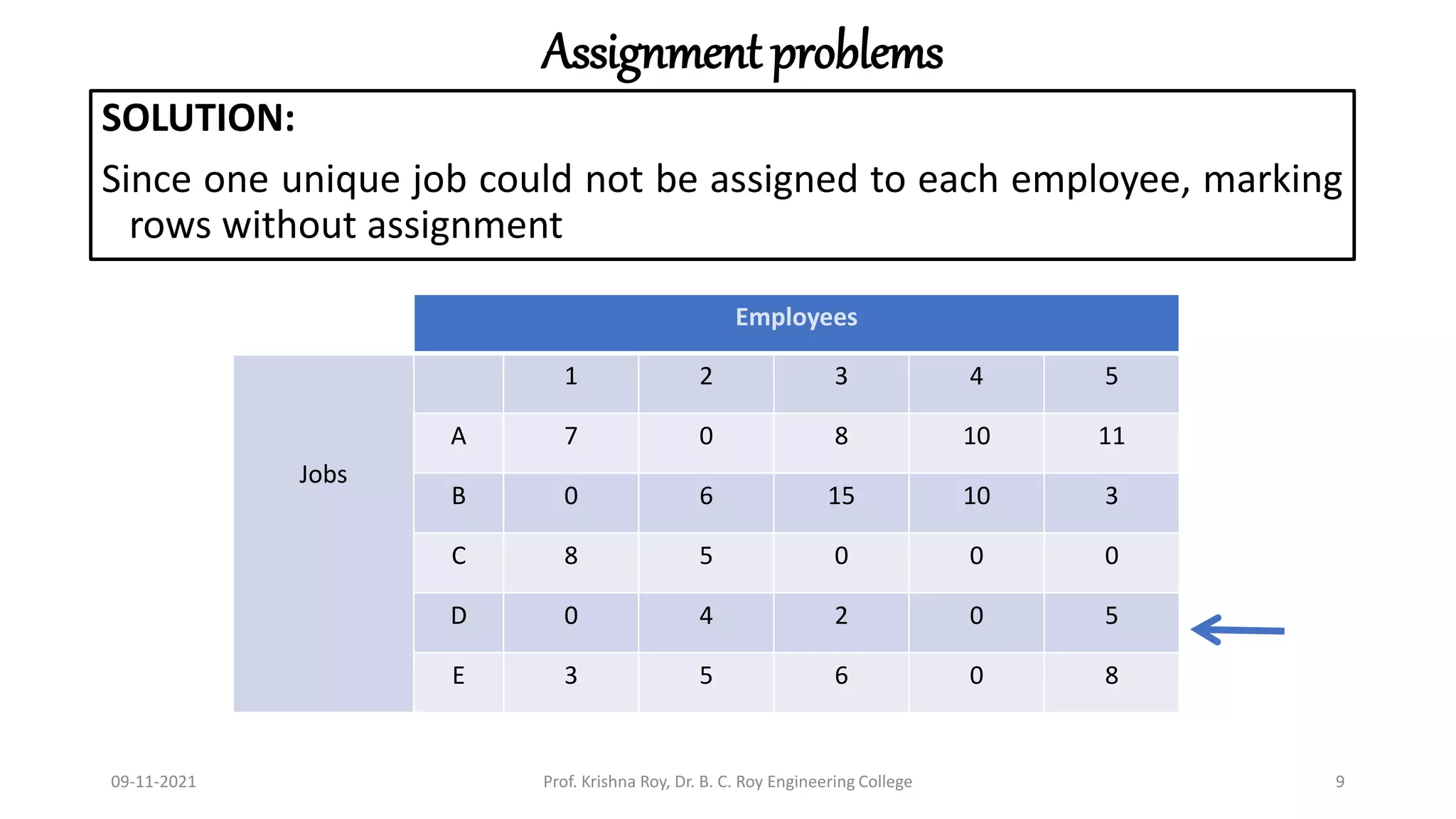
Since one unique job could not be assigned to each employee, marking
rows without assignment
09-11-2021 Prof. Krishna Roy, Dr. B. C. Roy Engineering College 9
Employees
Jobs
1 2 3 4 5
A 7 0 8 10 11
B 0 6 15 10 3
C 8 5 0 0 0
D 0 4 2 0 5
E 3 5 6 0 8
Assignment problems
SOLUTION:
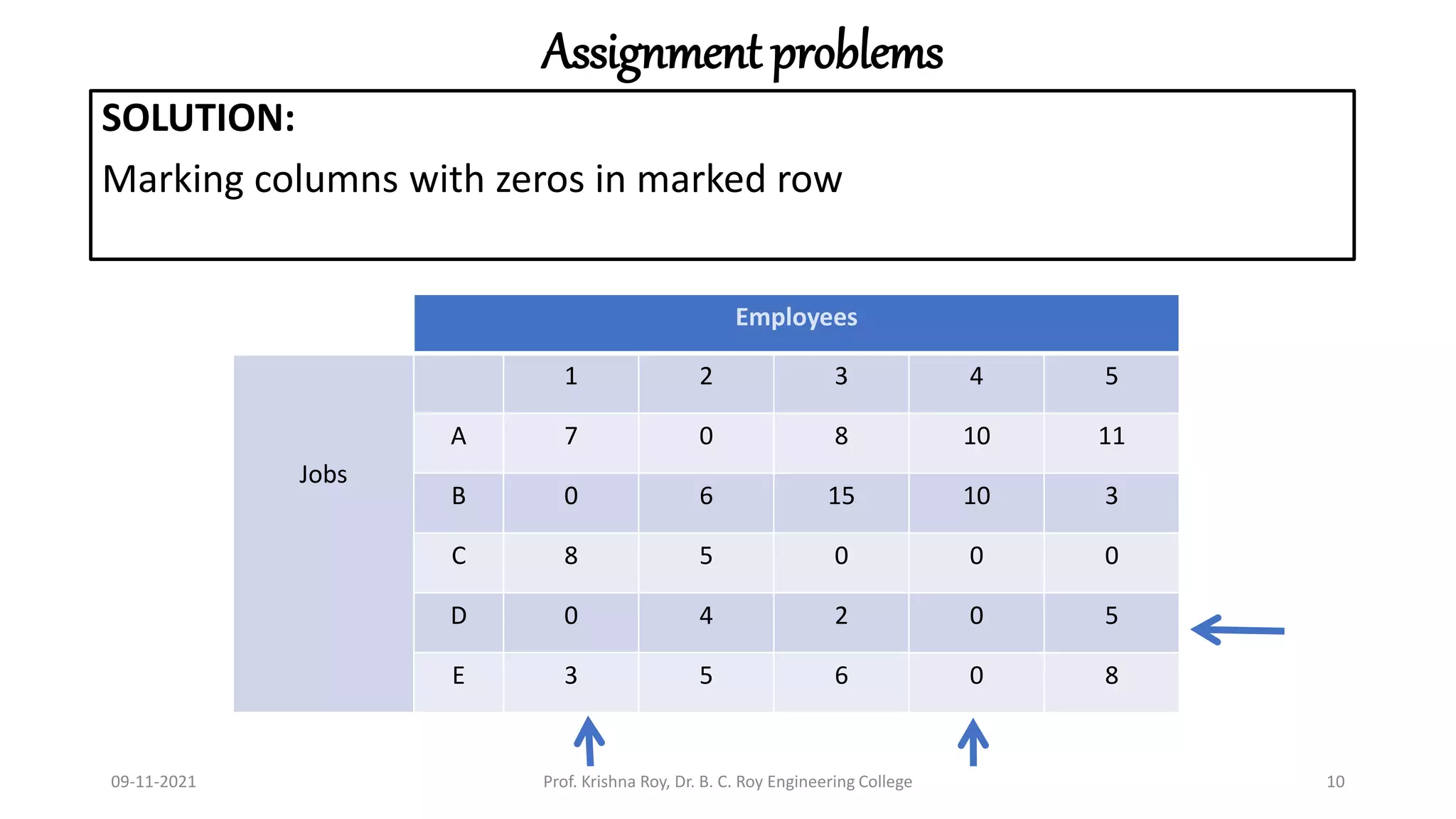
Marking columns with zeros in marked row
09-11-2021 Prof. Krishna Roy, Dr. B. C. Roy Engineering College 10
Employees
Jobs
1 2 3 4 5
A 7 0 8 10 11
B 0 6 15 10 3
C 8 5 0 0 0
D 0 4 2 0 5
E 3 5 6 0 8
Assignment problems
SOLUTION:
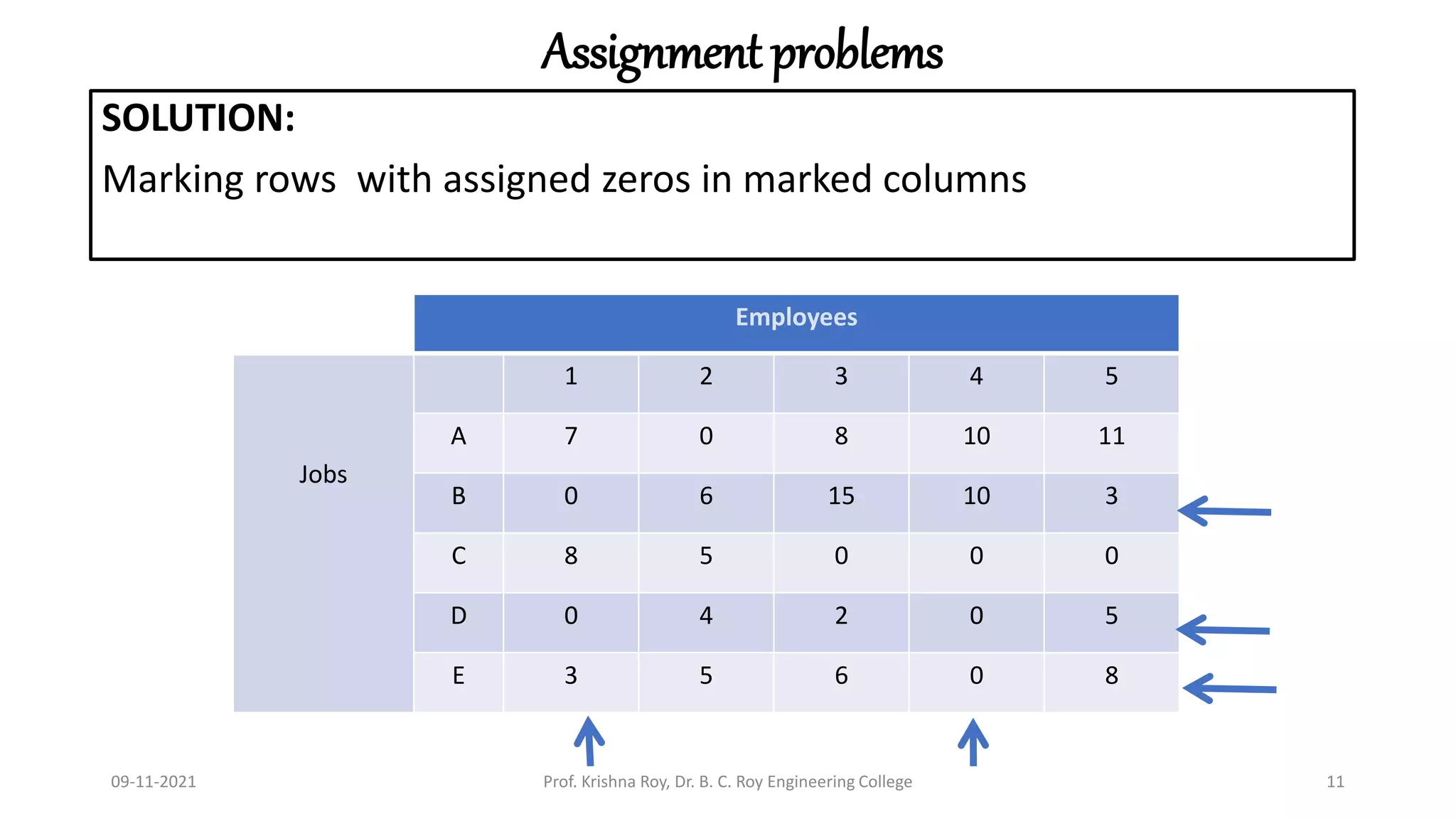
Marking rows with assigned zeros in marked columns
09-11-2021 Prof. Krishna Roy, Dr. B. C. Roy Engineering College 11
Employees
Jobs
1 2 3 4 5
A 7 0 8 10 11
B 0 6 15 10 3
C 8 5 0 0 0
D 0 4 2 0 5
E 3 5 6 0 8
Assignment problems
SOLUTION:
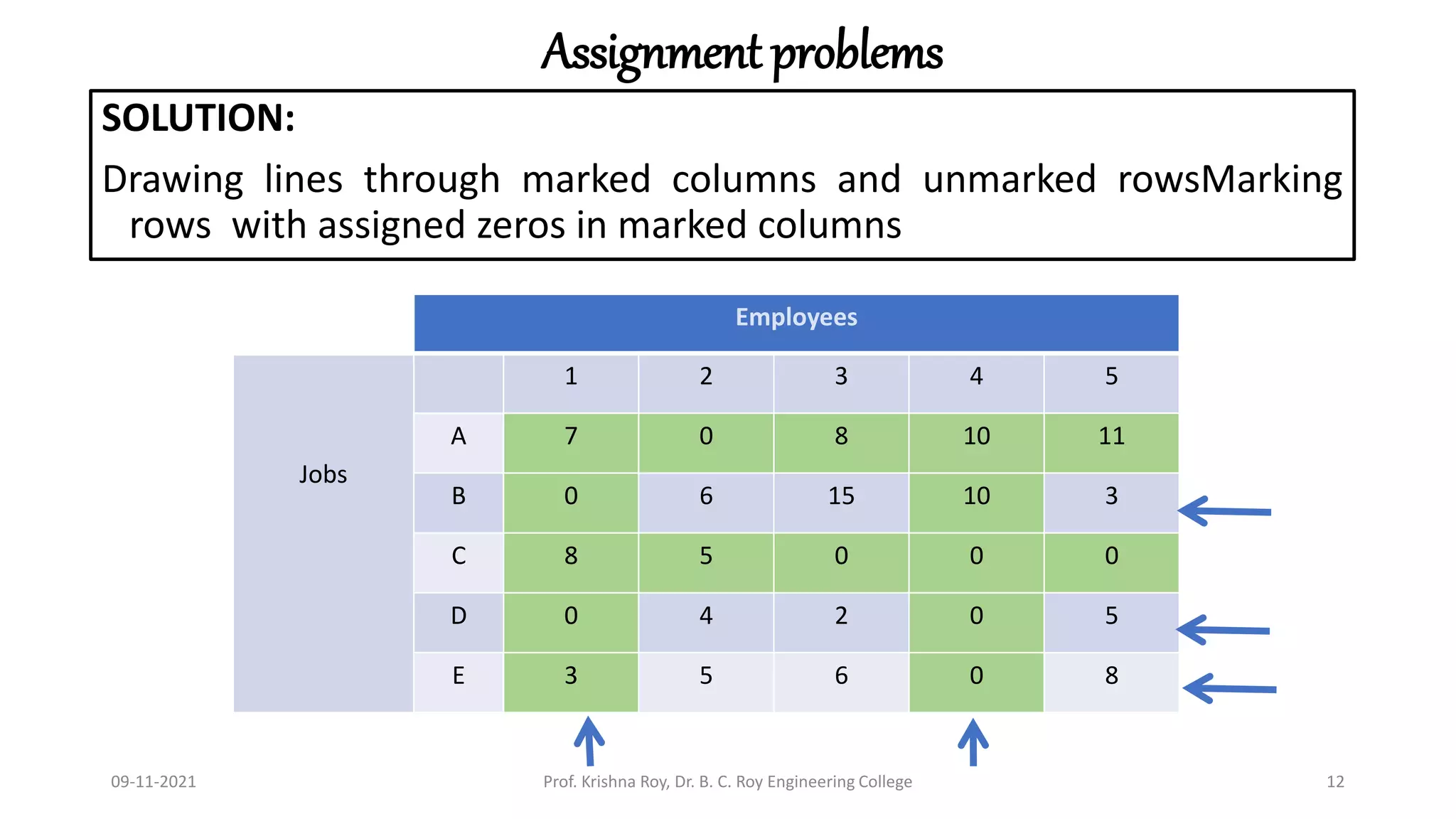
Drawing lines through marked columns and unmarked rowsMarking
rows with assigned zeros in marked columns
09-11-2021 Prof. Krishna Roy, Dr. B. C. Roy Engineering College 12
Employees
Jobs
1 2 3 4 5
A 7 0 8 10 11
B 0 6 15 10 3
C 8 5 0 0 0
D 0 4 2 0 5
E 3 5 6 0 8
Assignment problems
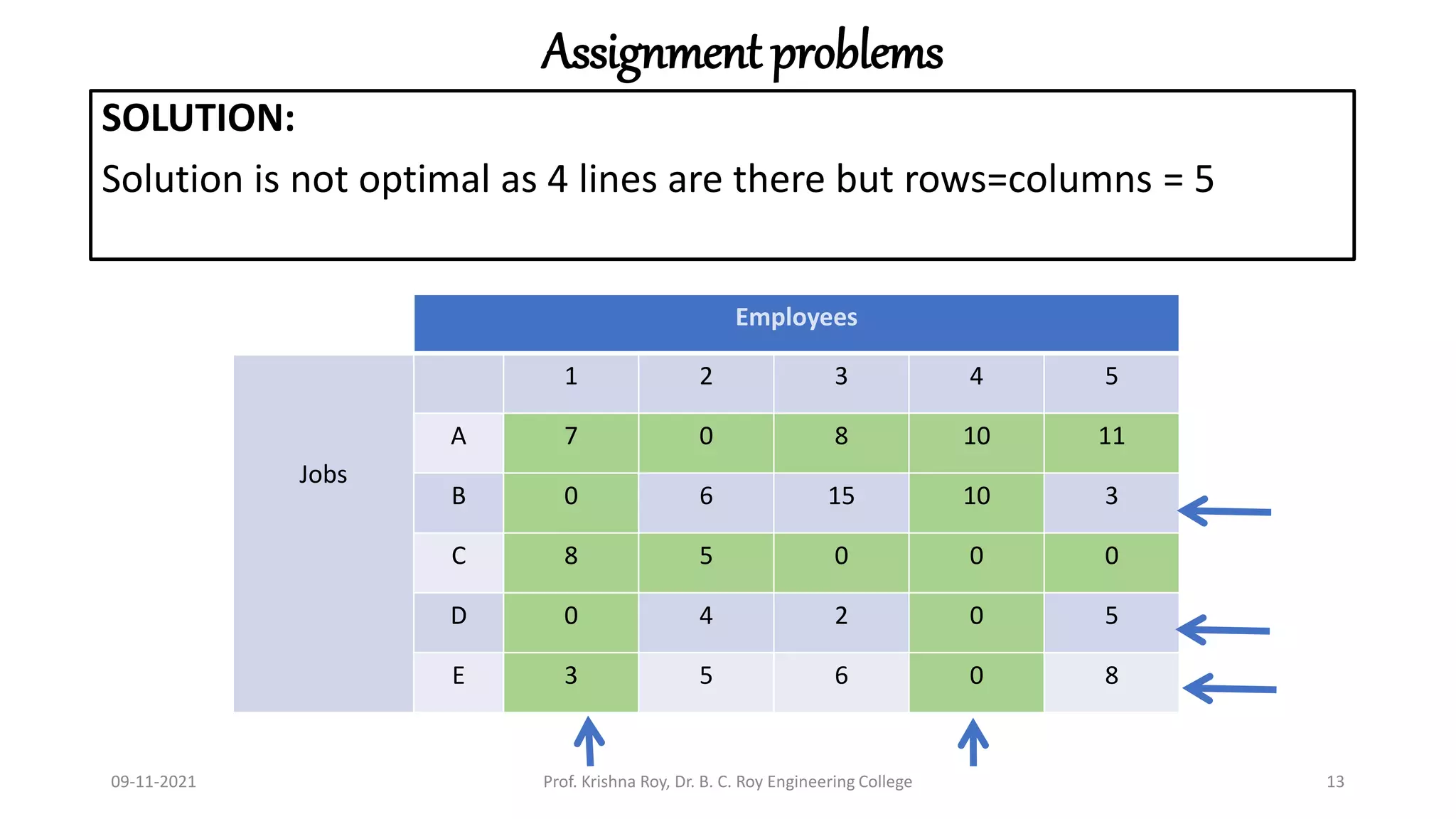
SOLUTION:
Solution is not optimal as 4 lines are there but rows=columns = 5
09-11-2021 Prof. Krishna Roy, Dr. B. C. Roy Engineering College 13
Employees
Jobs
1 2 3 4 5
A 7 0 8 10 11
B 0 6 15 10 3
C 8 5 0 0 0
D 0 4 2 0 5
E 3 5 6 0 8
Assignment problems
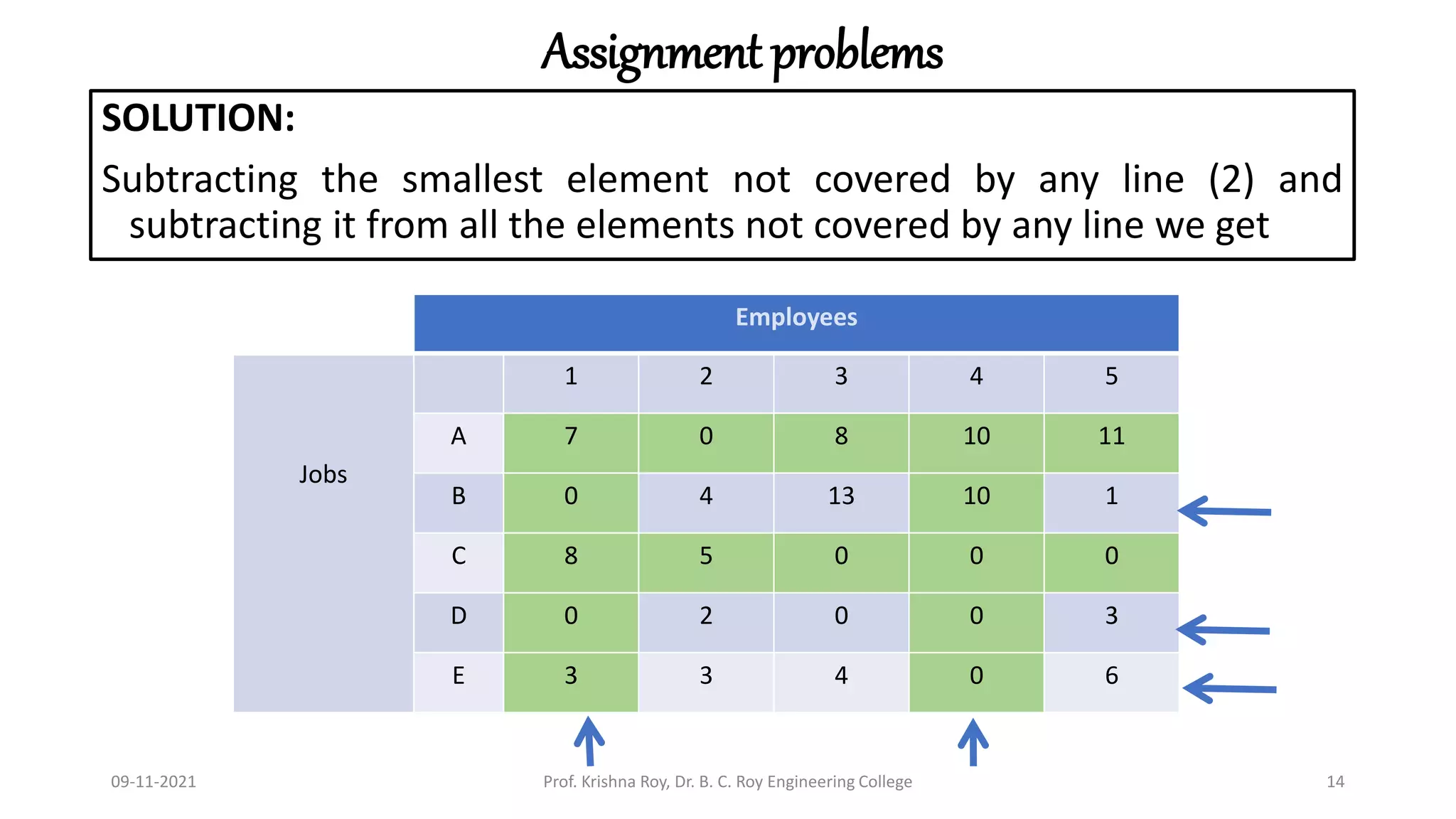
SOLUTION:
Subtracting the smallest element not covered by any line (2) and
subtracting it from all the elements not covered by any line we get
09-11-2021 Prof. Krishna Roy, Dr. B. C. Roy Engineering College 14
Employees
Jobs
1 2 3 4 5
A 7 0 8 10 11
B 0 4 13 10 1
C 8 5 0 0 0
D 0 2 0 0 3
E 3 3 4 0 6
Assignment problems
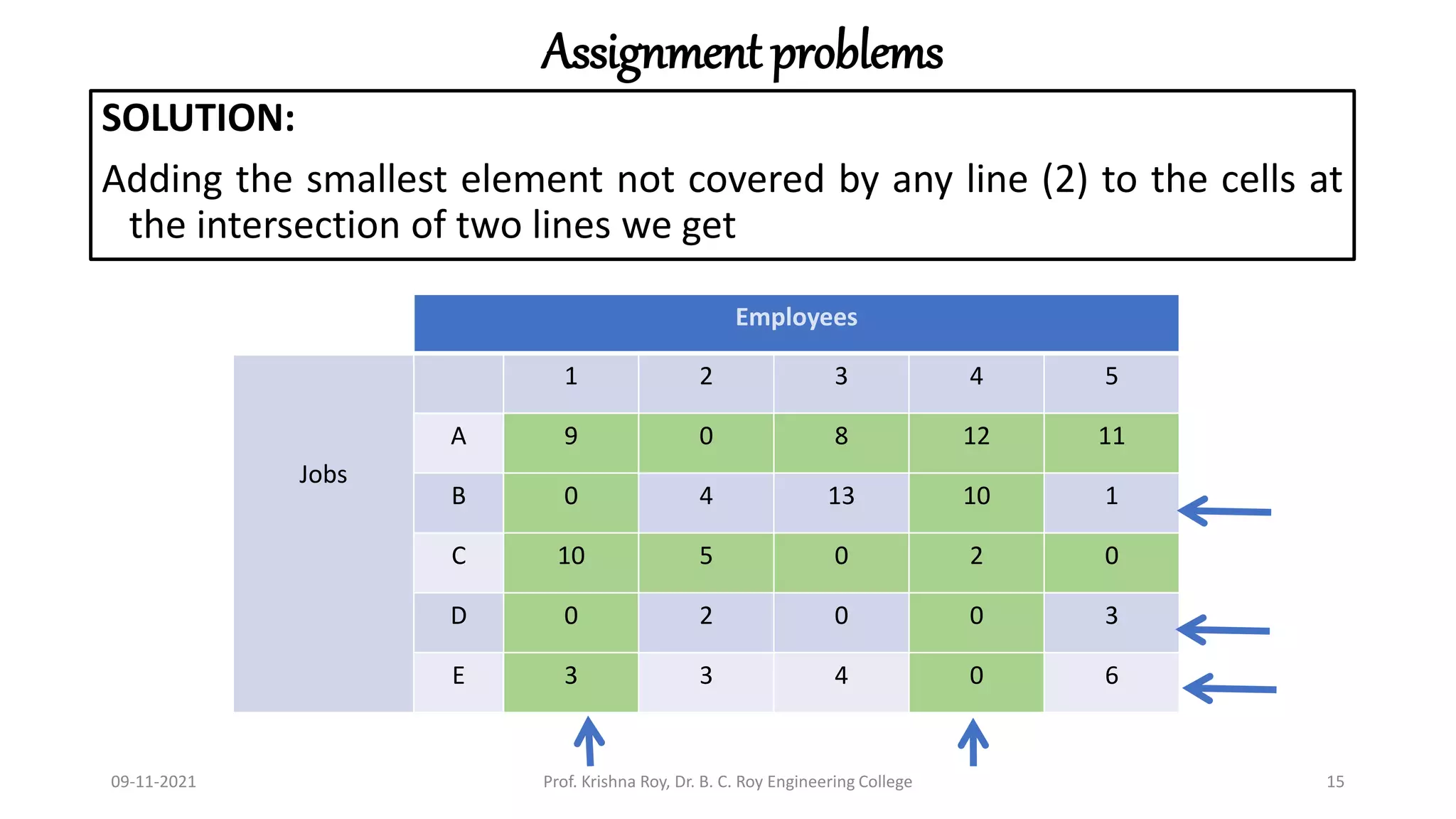
SOLUTION:
Adding the smallest element not covered by any line (2) to the cells at
the intersection of two lines we get
09-11-2021 Prof. Krishna Roy, Dr. B. C. Roy Engineering College 15
Employees
Jobs
1 2 3 4 5
A 9 0 8 12 11
B 0 4 13 10 1
C 10 5 0 2 0
D 0 2 0 0 3
E 3 3 4 0 6
Assignment problems
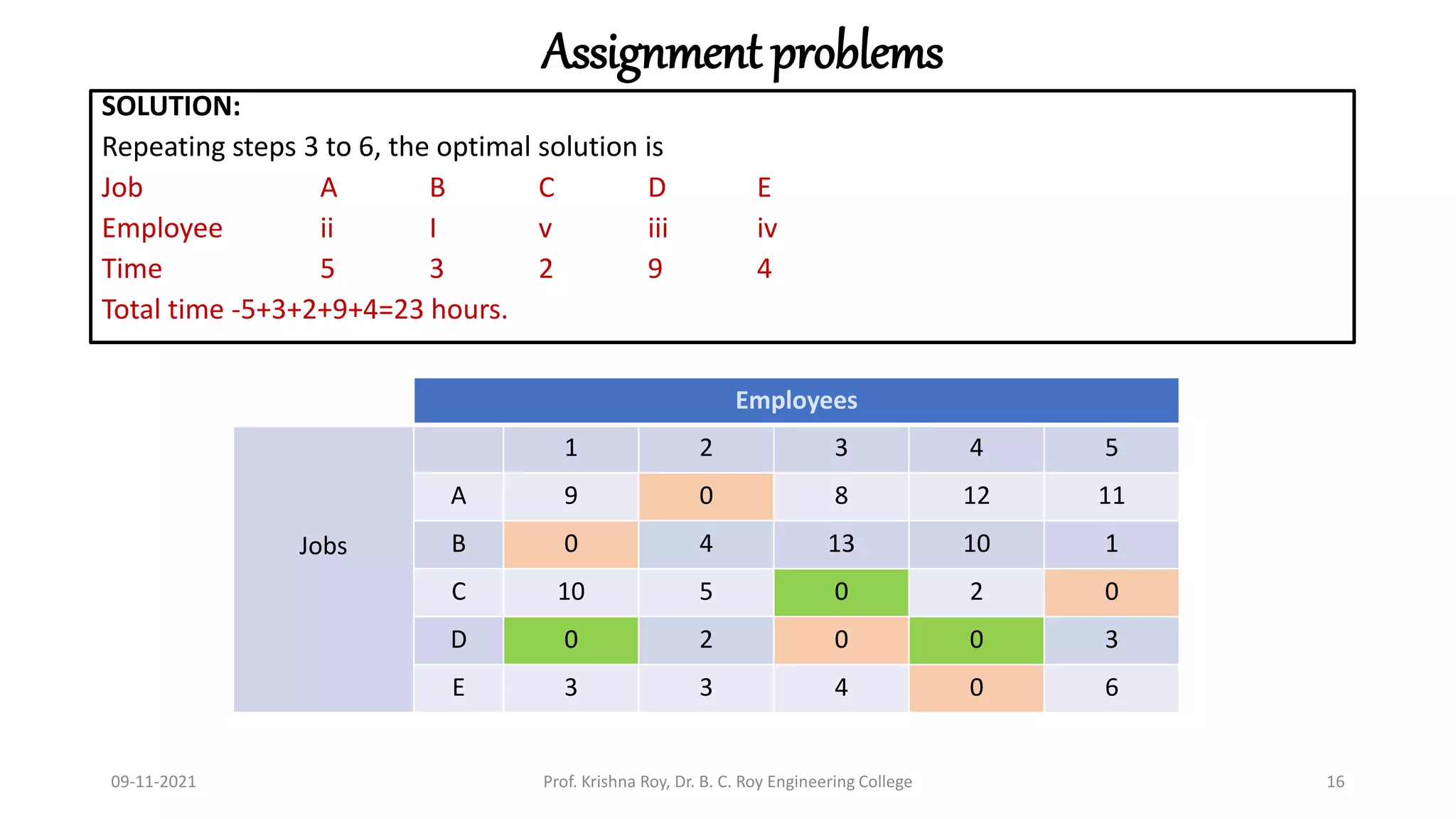
SOLUTION:
Repeating steps 3 to 6, the optimal solution is
Job A B C D E
Employee ii I v iii iv
Time 5 3 2 9 4
Total time -5+3+2+9+4=23 hours.
09-11-2021 Prof. Krishna Roy, Dr. B. C. Roy Engineering College 16
Employees
Jobs
1 2 3 4 5
A 9 0 8 12 11
B 0 4 13 10 1
C 10 5 0 2 0
D 0 2 0 0 3
E 3 3 4 0 6
• Till we meet again in the next class……….
PROF. KRISHNA ROY, FMS, BCREC 17
09-11-2021

Mb 106 quantitative techniques 15

  • 1.
    MB106 QUANTITATIVE TECHNIQUES MODULE I LECTURE15 Assignment Problems-Hungarian Method PROF. KRISHNA ROY
  • 2.
    Assignment problems Example: A manufacturingcompany decides to buy four subassemblies from four suppliers who can all supply each of the subassemblies. But the company policy is to buy one subassembly only from each supplier. Assign the different subassemblies to different suppliers so as to minimise cost. 09-11-2021 Prof. Krishna Roy, Dr. B. C. Roy Engineering College 2 SUPPLIERS SUBASSEMBLIES 1 2 3 4 1 15 13 14 17 2 11 12 15 13 3 13 12 10 11 4 15 17 14 16
  • 3.
    Assignment problems Solution: Subtracting thesmallest element of each row from the elements of the corresponding row we get 09-11-2021 Prof. Krishna Roy, Dr. B. C. Roy Engineering College 3 SUPPLIERS SUBASSEMBLIES 1 2 3 4 1 2 0 1 4 2 0 1 4 2 3 3 2 0 1 4 1 3 0 2 All columns do not contain zeroes. Therefore subtracting minimum column element from each element of the corresponding column we get SUPPLIERS SUBASSEMBLIES 1 2 3 4 1 2 0 1 3 2 0 1 4 1 3 3 2 0 0 4 1 3 0 1 Therefore assembly 2 is bought from supplier 1, 1 from 2, 4 from 3 and 3 from4 Total cost =13+11+11+14=49
  • 4.
    Assignment algorithm 1. Developthe cost matrix for the given problem. If number of rows and columns are not equal, dummy rows and columns are used, with zero cost elements, to make the matrix a square matrix. 2. Develop the opportunity cost matrix by subtracting the smallest cost in each row from all the cells in the corresponding row and then by subtracting the minimum cost element of each column from all the cells of the corresponding column of the resultant matrix. 3. Make assignments as follows : i. Examine the rows one by one till a row with exactly one zero is obtained. Mark this zero as assigned and cancel all other zeros corresponding to the column of the assigned zero. ii. Repeat step 3(i) for each column with a single unmarked zero cancelling other zeroes in the corresponding row. iii. If a row and/or column has two or more unmarked zeroes and one can not be selected by inspection, then the zero should be assigned arbitrarily. iv. Continue the above process till all zeros are either assigned or struck off. 09-11-2021 Prof. Krishna Roy, Dr. B. C. Roy Engineering College 4
  • 5.
    Assignment algorithmcontinued 4. Ifthe number of assigned zeroes are equal to the number of rows or columns of the cost matrix, assignment is optimal. If not, proceed to step 5. 5. Revise the opportunity cost table obtained in step 3 as follows: Draw a set of horizontal and vertical lines to cover all the zeroes in the revised cost matrix by i. Mark each row in which no assignment was made. ii. Examine the marked rows to see if any zero is present in any cell of the row, if yes mark the corresponding columns(containing those zeroes). iii. Examine the marked columns to see if any assigned zero occurs in these columns, if yes mark the corresponding rows with the assigned zeroes. iv. Repeat the above process until no more rows or columns can be marked. v. Draw straight lines through each marked column and unmarked row. If the number of lines i.e. total assignments is equal to the number of rows or columns, the solution is optimal. Otherwise proceed to step 6. 09-11-2021 Prof. Krishna Roy, Dr. B. C. Roy Engineering College 5
  • 6.
    Assignment algorithmcontinued 6. Preparethe new revised opportunity cost table. i. Choose the smallest element from the cells not covered by any line and subtract it from every element in the cells not covered by any line. ii. Add the smallest element from step 6(i) to the cells at which two lines intersect. iii. Elements covered by a single line remain unchanged. 7. Repeat steps 3 to 6 until an optimal solution is obtained 09-11-2021 Prof. Krishna Roy, Dr. B. C. Roy Engineering College 6
  • 7.
    Assignment problems Example 2: Adepartment has five employees with five jobs to be performed. The time (in hours) each man will take to perform each job is given in the effectiveness matrix below. How should the jobs be allocated, one per employee, so as to minimize the total man hours? 09-11-2021 Prof. Krishna Roy, Dr. B. C. Roy Engineering College 7 Employees Jobs 1 2 3 4 5 A 10 5 13 15 16 B 3 9 18 13 6 C 10 7 2 2 2 D 7 11 9 7 12 E 7 9 10 4 12
  • 8.
    Assignment problems SOLUTION: Subtracting theminimum row element from each cell of the corresponding row we get 09-11-2021 Prof. Krishna Roy, Dr. B. C. Roy Engineering College 8 Employees Jobs 1 2 3 4 5 A 7 0 8 10 11 B 0 6 15 10 3 C 8 5 0 0 0 D 0 4 2 0 5 E 3 5 6 0 8
  • 9.
    Assignment problems SOLUTION: Since oneunique job could not be assigned to each employee, marking rows without assignment 09-11-2021 Prof. Krishna Roy, Dr. B. C. Roy Engineering College 9 Employees Jobs 1 2 3 4 5 A 7 0 8 10 11 B 0 6 15 10 3 C 8 5 0 0 0 D 0 4 2 0 5 E 3 5 6 0 8
  • 10.
    Assignment problems SOLUTION: Marking columnswith zeros in marked row 09-11-2021 Prof. Krishna Roy, Dr. B. C. Roy Engineering College 10 Employees Jobs 1 2 3 4 5 A 7 0 8 10 11 B 0 6 15 10 3 C 8 5 0 0 0 D 0 4 2 0 5 E 3 5 6 0 8
  • 11.
    Assignment problems SOLUTION: Marking rowswith assigned zeros in marked columns 09-11-2021 Prof. Krishna Roy, Dr. B. C. Roy Engineering College 11 Employees Jobs 1 2 3 4 5 A 7 0 8 10 11 B 0 6 15 10 3 C 8 5 0 0 0 D 0 4 2 0 5 E 3 5 6 0 8
  • 12.
    Assignment problems SOLUTION: Drawing linesthrough marked columns and unmarked rowsMarking rows with assigned zeros in marked columns 09-11-2021 Prof. Krishna Roy, Dr. B. C. Roy Engineering College 12 Employees Jobs 1 2 3 4 5 A 7 0 8 10 11 B 0 6 15 10 3 C 8 5 0 0 0 D 0 4 2 0 5 E 3 5 6 0 8
  • 13.
    Assignment problems SOLUTION: Solution isnot optimal as 4 lines are there but rows=columns = 5 09-11-2021 Prof. Krishna Roy, Dr. B. C. Roy Engineering College 13 Employees Jobs 1 2 3 4 5 A 7 0 8 10 11 B 0 6 15 10 3 C 8 5 0 0 0 D 0 4 2 0 5 E 3 5 6 0 8
  • 14.
    Assignment problems SOLUTION: Subtracting thesmallest element not covered by any line (2) and subtracting it from all the elements not covered by any line we get 09-11-2021 Prof. Krishna Roy, Dr. B. C. Roy Engineering College 14 Employees Jobs 1 2 3 4 5 A 7 0 8 10 11 B 0 4 13 10 1 C 8 5 0 0 0 D 0 2 0 0 3 E 3 3 4 0 6
  • 15.
    Assignment problems SOLUTION: Adding thesmallest element not covered by any line (2) to the cells at the intersection of two lines we get 09-11-2021 Prof. Krishna Roy, Dr. B. C. Roy Engineering College 15 Employees Jobs 1 2 3 4 5 A 9 0 8 12 11 B 0 4 13 10 1 C 10 5 0 2 0 D 0 2 0 0 3 E 3 3 4 0 6
  • 16.
    Assignment problems SOLUTION: Repeating steps3 to 6, the optimal solution is Job A B C D E Employee ii I v iii iv Time 5 3 2 9 4 Total time -5+3+2+9+4=23 hours. 09-11-2021 Prof. Krishna Roy, Dr. B. C. Roy Engineering College 16 Employees Jobs 1 2 3 4 5 A 9 0 8 12 11 B 0 4 13 10 1 C 10 5 0 2 0 D 0 2 0 0 3 E 3 3 4 0 6
  • 17.
    • Till wemeet again in the next class………. PROF. KRISHNA ROY, FMS, BCREC 17 09-11-2021