Lesson 31 The Assignment Problem Math 20 Algebra and Multivariable Mathematics for Social Sciences December 10, 2007
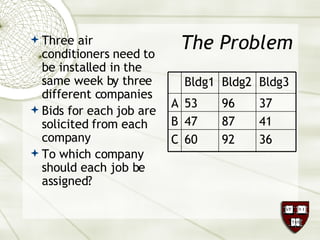
The Problem Three air conditioners need to be installed in the same week by three different companies Bids for each job are solicited from each company To which company should each job be assigned? 36 92 60 C 41 87 47 B 37 96 53 A Bldg3 Bldg2 Bldg1
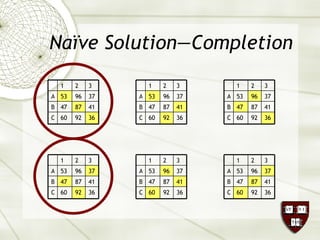
Na ïve Solution There are only 6 possible assignments of companies to jobs Check them and compare
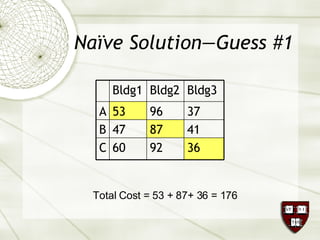
Na ïve Solution—Guess #1 Total Cost = 53 + 87+ 36 = 176 36 92 60 C 41 87 47 B 37 96 53 A Bldg3 Bldg2 Bldg1
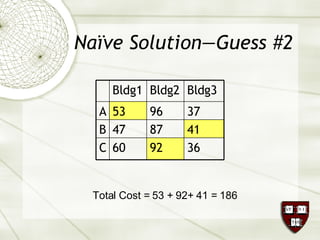
Na ïve Solution—Guess #2 Total Cost = 53 + 92+ 41 = 186 36 92 60 C 41 87 47 B 37 96 53 A Bldg3 Bldg2 Bldg1
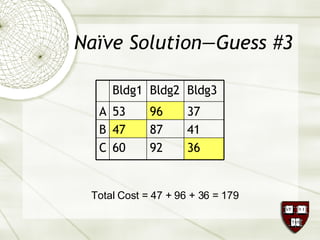
Na ïve Solution—Guess #3 Total Cost = 47 + 96 + 36 = 179 36 92 60 C 41 87 47 B 37 96 53 A Bldg3 Bldg2 Bldg1
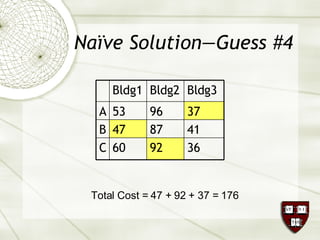
Na ïve Solution—Guess #4 Total Cost = 47 + 92 + 37 = 176 36 92 60 C 41 87 47 B 37 96 53 A Bldg3 Bldg2 Bldg1
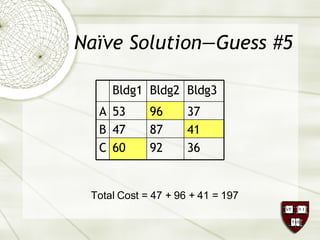
Na ïve Solution—Guess #5 Total Cost = 47 + 96 + 41 = 197 36 92 60 C 41 87 47 B 37 96 53 A Bldg3 Bldg2 Bldg1
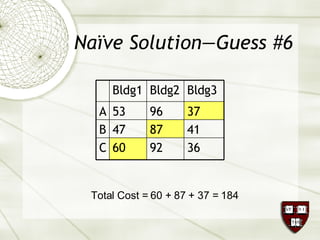
Na ïve Solution—Guess #6 Total Cost = 60 + 87 + 37 = 184 36 92 60 C 41 87 47 B 37 96 53 A Bldg3 Bldg2 Bldg1
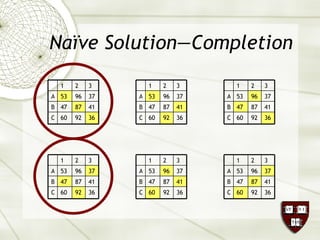
Na ïve Solution—Completion 36 92 60 C 41 87 47 B 37 96 53 A 3 2 1 36 92 60 C 41 87 47 B 37 96 53 A 3 2 1 36 92 60 C 41 87 47 B 37 96 53 A 3 2 1 36 92 60 C 41 87 47 B 37 96 53 A 3 2 1 36 92 60 C 41 87 47 B 37 96 53 A 3 2 1 36 92 60 C 41 87 47 B 37 96 53 A 3 2 1
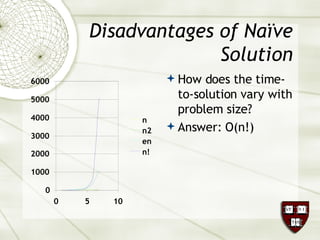
Disadvantages of Na ïve Solution How does the time-to-solution vary with problem size? Answer: O(n!)
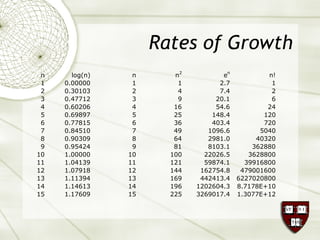
Rates of Growth
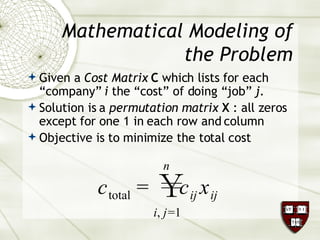
Mathematical Modeling of the Problem Given a  Cost Matrix   C  which lists for each “company”  i  the “cost” of doing “job”  j .  Solution is a  permutation matrix  X   : all zeros except for one 1 in each row and column Objective is to minimize the total cost
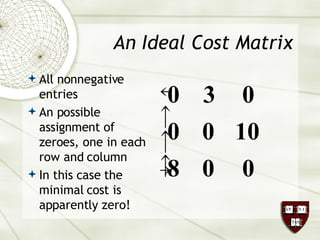
An Ideal Cost Matrix All nonnegative entries An possible assignment of zeroes, one in each row and column In this case the minimal cost is apparently zero!
The Hungarian Algorithm Find an “ideal” cost matrix that has the same optimal assignment as the given cost matrix From there the solution is easy!
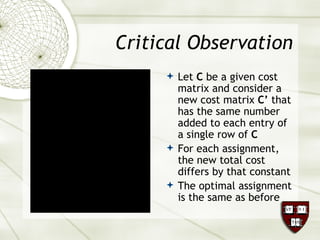
Critical Observation Let  C  be a given cost matrix and consider a new cost matrix  C’  that has the same number added to each entry of a single row of  C For each assignment, the new total cost differs by that constant The optimal assignment is the same as before
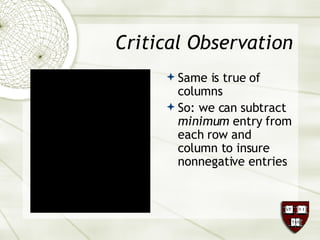
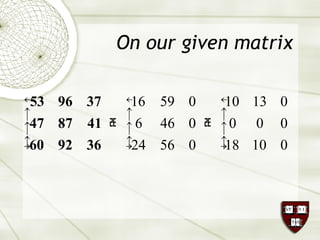
Critical Observation Same is true of columns So: we can subtract  minimum  entry from each row and column to insure nonnegative entries
On our given matrix
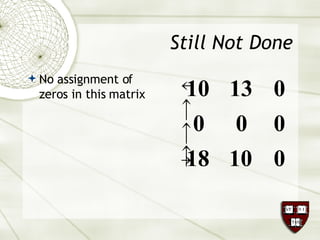
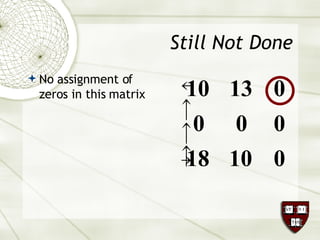
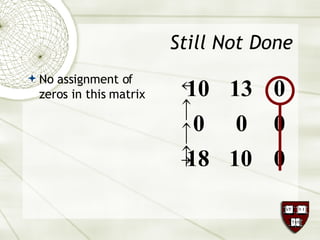
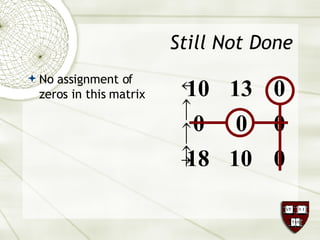
Still Not Done No assignment of zeros in this matrix
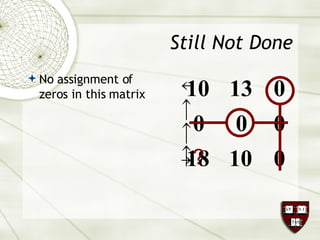
Still Not Done No assignment of zeros in this matrix ?
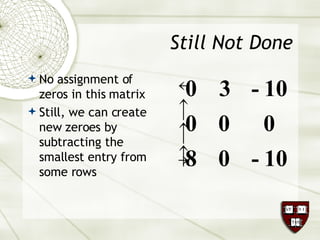
Still Not Done No assignment of zeros in this matrix Still, we can create new zeroes by subtracting the smallest entry from some rows
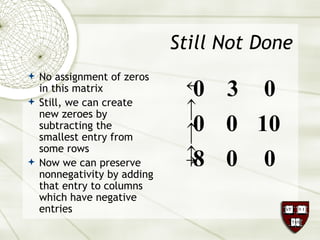
Still Not Done No assignment of zeros in this matrix Still, we can create new zeroes by subtracting the smallest entry from some rows Now we can preserve nonnegativity by adding that entry to columns which have negative entries
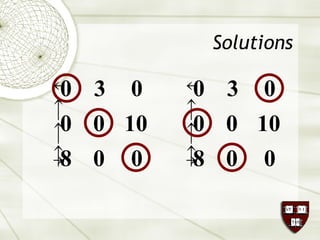
Solutions
Na ïve Solution—Completion 36 92 60 C 41 87 47 B 37 96 53 A 3 2 1 36 92 60 C 41 87 47 B 37 96 53 A 3 2 1 36 92 60 C 41 87 47 B 37 96 53 A 3 2 1 36 92 60 C 41 87 47 B 37 96 53 A 3 2 1 36 92 60 C 41 87 47 B 37 96 53 A 3 2 1 36 92 60 C 41 87 47 B 37 96 53 A 3 2 1
The Hungarian Algorithm Find the minimum entry in each row and subtract it from each row Find the minimum entry in each column and subtract it from each column Resulting matrix is nonnegative
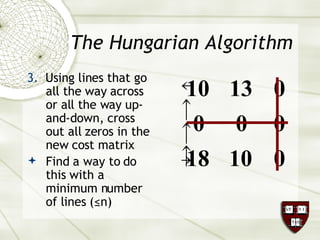
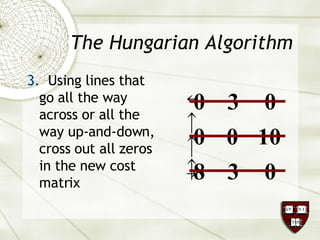
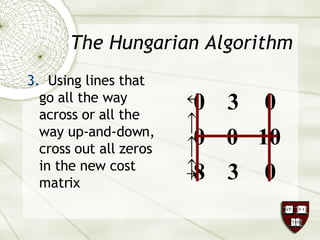
The Hungarian Algorithm 3.   Using lines that go all the way across or all the way up-and-down, cross out all zeros in the new cost matrix Find a way to do this with a minimum number of lines (≤n)
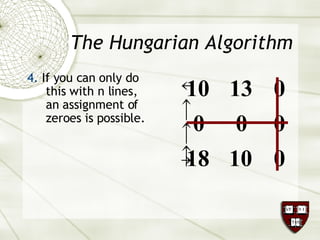
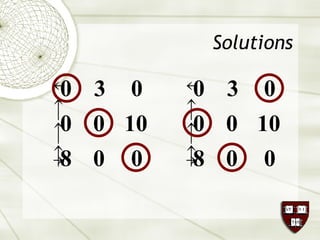
The Hungarian Algorithm 4.  If you can only do this with n lines, an assignment of zeroes is possible.
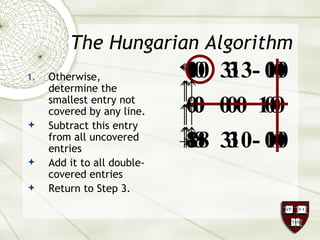
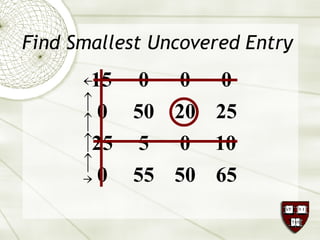
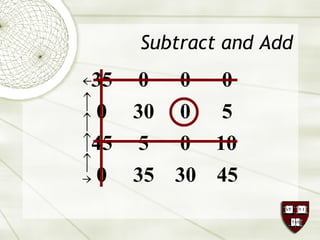
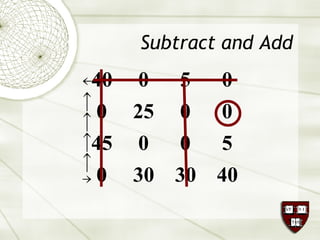
The Hungarian Algorithm Otherwise, determine the smallest entry not covered by any line. Subtract this entry from all uncovered entries Add it to all double-covered entries Return to Step 3.
The Hungarian Algorithm 3.   Using lines that go all the way across or all the way up-and-down, cross out all zeros in the new cost matrix
The Hungarian Algorithm 4.  If you can only do this with n lines, an assignment of zeroes is possible.
Solutions
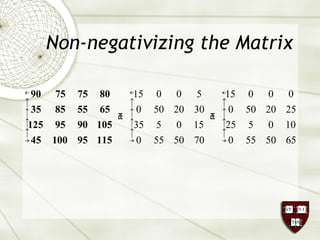
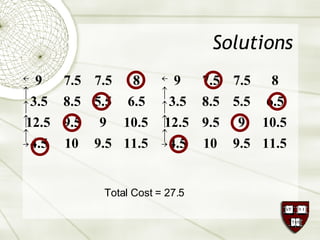
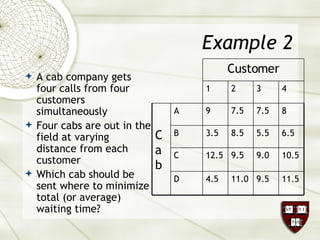
Example 2 A cab company gets four calls from four customers simultaneously Four cabs are out in the field at varying distance from each customer Which cab should be sent where to minimize total (or average) waiting time?  11.5 9.5 11.0 4.5 D 10.5 9.0 9.5 12.5 C 6.5 5.5 8.5 3.5 B 8 7.5 7.5 9 A Cab 4 3 2 1 Customer
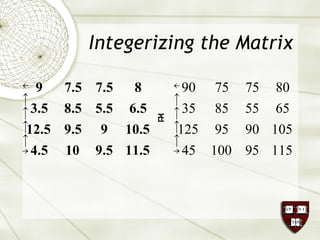
Integerizing the Matrix
Non-negativizing the Matrix
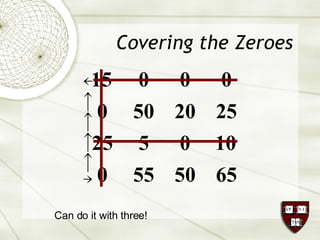
Covering the Zeroes Can do it with three!
Find Smallest Uncovered Entry
Subtract and Add
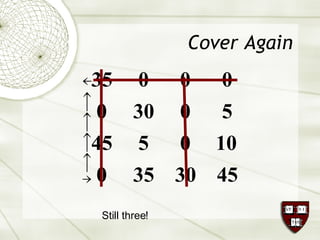
Cover Again Still three!
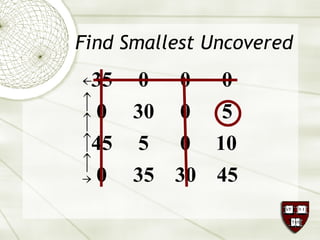
Find Smallest Uncovered
Subtract and Add
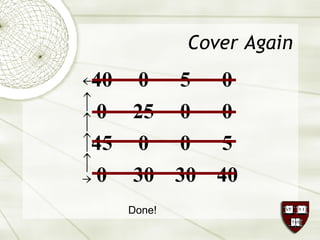
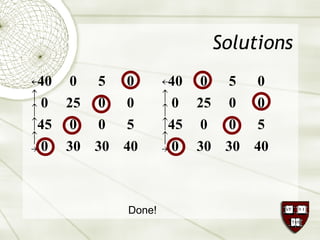
Cover Again Done!
Solutions Done!
Solutions Total Cost = 27.5
Other Applications of AP Assigning teaching fellows to time slots Assigning airplanes to flights Assigning project members to tasks Determining positions on a team Assigning brides to grooms (once called the  marriage problem )

Lesson 33: The Assignment Problem

  • 1.
    Lesson 31 TheAssignment Problem Math 20 Algebra and Multivariable Mathematics for Social Sciences December 10, 2007
  • 2.
    The Problem Threeair conditioners need to be installed in the same week by three different companies Bids for each job are solicited from each company To which company should each job be assigned? 36 92 60 C 41 87 47 B 37 96 53 A Bldg3 Bldg2 Bldg1
  • 3.
    Na ïve SolutionThere are only 6 possible assignments of companies to jobs Check them and compare
  • 4.
    Na ïve Solution—Guess#1 Total Cost = 53 + 87+ 36 = 176 36 92 60 C 41 87 47 B 37 96 53 A Bldg3 Bldg2 Bldg1
  • 5.
    Na ïve Solution—Guess#2 Total Cost = 53 + 92+ 41 = 186 36 92 60 C 41 87 47 B 37 96 53 A Bldg3 Bldg2 Bldg1
  • 6.
    Na ïve Solution—Guess#3 Total Cost = 47 + 96 + 36 = 179 36 92 60 C 41 87 47 B 37 96 53 A Bldg3 Bldg2 Bldg1
  • 7.
    Na ïve Solution—Guess#4 Total Cost = 47 + 92 + 37 = 176 36 92 60 C 41 87 47 B 37 96 53 A Bldg3 Bldg2 Bldg1
  • 8.
    Na ïve Solution—Guess#5 Total Cost = 47 + 96 + 41 = 197 36 92 60 C 41 87 47 B 37 96 53 A Bldg3 Bldg2 Bldg1
  • 9.
    Na ïve Solution—Guess#6 Total Cost = 60 + 87 + 37 = 184 36 92 60 C 41 87 47 B 37 96 53 A Bldg3 Bldg2 Bldg1
  • 10.
    Na ïve Solution—Completion36 92 60 C 41 87 47 B 37 96 53 A 3 2 1 36 92 60 C 41 87 47 B 37 96 53 A 3 2 1 36 92 60 C 41 87 47 B 37 96 53 A 3 2 1 36 92 60 C 41 87 47 B 37 96 53 A 3 2 1 36 92 60 C 41 87 47 B 37 96 53 A 3 2 1 36 92 60 C 41 87 47 B 37 96 53 A 3 2 1
  • 11.
    Disadvantages of Naïve Solution How does the time-to-solution vary with problem size? Answer: O(n!)
  • 12.
  • 13.
    Mathematical Modeling ofthe Problem Given a Cost Matrix C which lists for each “company” i the “cost” of doing “job” j . Solution is a permutation matrix X : all zeros except for one 1 in each row and column Objective is to minimize the total cost
  • 14.
    An Ideal CostMatrix All nonnegative entries An possible assignment of zeroes, one in each row and column In this case the minimal cost is apparently zero!
  • 15.
    The Hungarian AlgorithmFind an “ideal” cost matrix that has the same optimal assignment as the given cost matrix From there the solution is easy!
  • 16.
    Critical Observation Let C be a given cost matrix and consider a new cost matrix C’ that has the same number added to each entry of a single row of C For each assignment, the new total cost differs by that constant The optimal assignment is the same as before
  • 17.
    Critical Observation Sameis true of columns So: we can subtract minimum entry from each row and column to insure nonnegative entries
  • 18.
  • 19.
    Still Not DoneNo assignment of zeros in this matrix
  • 20.
    Still Not DoneNo assignment of zeros in this matrix
  • 21.
    Still Not DoneNo assignment of zeros in this matrix
  • 22.
    Still Not DoneNo assignment of zeros in this matrix
  • 23.
    Still Not DoneNo assignment of zeros in this matrix ?
  • 24.
    Still Not DoneNo assignment of zeros in this matrix Still, we can create new zeroes by subtracting the smallest entry from some rows
  • 25.
    Still Not DoneNo assignment of zeros in this matrix Still, we can create new zeroes by subtracting the smallest entry from some rows Now we can preserve nonnegativity by adding that entry to columns which have negative entries
  • 26.
  • 27.
    Na ïve Solution—Completion36 92 60 C 41 87 47 B 37 96 53 A 3 2 1 36 92 60 C 41 87 47 B 37 96 53 A 3 2 1 36 92 60 C 41 87 47 B 37 96 53 A 3 2 1 36 92 60 C 41 87 47 B 37 96 53 A 3 2 1 36 92 60 C 41 87 47 B 37 96 53 A 3 2 1 36 92 60 C 41 87 47 B 37 96 53 A 3 2 1
  • 28.
    The Hungarian AlgorithmFind the minimum entry in each row and subtract it from each row Find the minimum entry in each column and subtract it from each column Resulting matrix is nonnegative
  • 29.
    The Hungarian Algorithm3. Using lines that go all the way across or all the way up-and-down, cross out all zeros in the new cost matrix Find a way to do this with a minimum number of lines (≤n)
  • 30.
    The Hungarian Algorithm4. If you can only do this with n lines, an assignment of zeroes is possible.
  • 31.
    The Hungarian AlgorithmOtherwise, determine the smallest entry not covered by any line. Subtract this entry from all uncovered entries Add it to all double-covered entries Return to Step 3.
  • 32.
    The Hungarian Algorithm3. Using lines that go all the way across or all the way up-and-down, cross out all zeros in the new cost matrix
  • 33.
    The Hungarian Algorithm3. Using lines that go all the way across or all the way up-and-down, cross out all zeros in the new cost matrix
  • 34.
    The Hungarian Algorithm3. Using lines that go all the way across or all the way up-and-down, cross out all zeros in the new cost matrix
  • 35.
    The Hungarian Algorithm4. If you can only do this with n lines, an assignment of zeroes is possible.
  • 36.
  • 37.
    Example 2 Acab company gets four calls from four customers simultaneously Four cabs are out in the field at varying distance from each customer Which cab should be sent where to minimize total (or average) waiting time? 11.5 9.5 11.0 4.5 D 10.5 9.0 9.5 12.5 C 6.5 5.5 8.5 3.5 B 8 7.5 7.5 9 A Cab 4 3 2 1 Customer
  • 38.
  • 39.
  • 40.
    Covering the ZeroesCan do it with three!
  • 41.
  • 42.
  • 43.
  • 44.
  • 45.
  • 46.
  • 47.
  • 48.
  • 49.
    Other Applications ofAP Assigning teaching fellows to time slots Assigning airplanes to flights Assigning project members to tasks Determining positions on a team Assigning brides to grooms (once called the marriage problem )