Assignment problem
SUBMITTED BY:
PRADEEPA A
I.MCOM
25PACOM025
What is assignment problem?
 Assignment problem refers to special class of linear programming problems that
involves determining the most efficient assignment of people to project ,
salespeople to territories contracts to bidders and so on.
 It is often used to minimize the total cost or time of performing the task.
 One of the important characteristics of assignment problem is that only one job
is assigned to one machine.
 Each assignment problem has a matrix associated with it.
 The number in the table indicates the COST associated with the
assignment.
 The most efficient linear programming algorithm to find optimum solution
to the assignment problem is Hungarian method.
Assignment problem using Hungarian
Method
 The Hungarian method is a combinatorial optimization algorithm that
solves the assignment problem in polynomial time and which anticipated
later primal- dual methods.
 It was developed and published in 1955 by Harold Kuhn, who gave the
name “Hungarian method” because the algorithm was largely based on
the earilier works of two Hungarian mathematicians: Denes Konig and
Jeno Egervary.
Requirements of dummy rows and
column:
 To arrive at the solution, assignment problem requires equal number of
Row and Column.
 If the number of tasks that needs to be done exceeds the number of
resources available, dummy rows or a column just needs to be added as
the case may be.
 This creates a table of equal dimensions.
 The dummy row or column is not existent. Hence the value can be entered
as zeros.
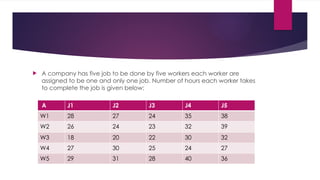
 A company has five job to be done by five workers each worker are
assigned to be one and only one job. Number of hours each worker takes
to complete the job is given below:
A J1 J2 J3 J4 J5
W1 28 27 24 35 38
W2 26 24 23 32 39
W3 18 20 22 30 32
W4 27 30 25 24 27
W5 29 31 28 40 36
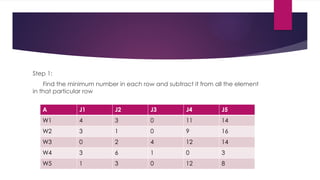
Step 1:
Find the minimum number in each row and subtract it from all the element
in that particular row
A J1 J2 J3 J4 J5
W1 4 3 0 11 14
W2 3 1 0 9 16
W3 0 2 4 12 14
W4 3 6 1 0 3
W5 1 3 0 12 8
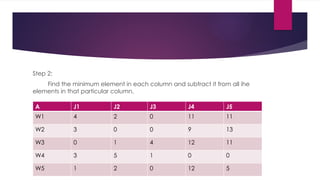
Step 2:
Find the minimum element in each column and subtract it from all ihe
elements in that particular column.
A J1 J2 J3 J4 J5
W1 4 2 0 11 11
W2 3 0 0 9 13
W3 0 1 4 12 11
W4 3 5 1 0 0
W5 1 2 0 12 5
Remark: Step 1 and 2 creates at least one zero ‘0’in each row and column.
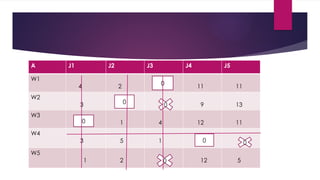
Step 3:
Starting from 1st row ,if there is exact one zero,make an assignment and
cancel all zero’s in that column and then draw a vertical line.Similarly, starting
from 1st column, if exact one zero, make an assignment and cancel an zero’s
in that row, and then draw a horizontal line. Continue this step till all zero’s are
an assignment or cancelled.
A J1 J2 J3 J4 J5
W1
4 2 11 11
W2
3 9 13
W3
1 4 12 11
W4
3 5 1
W5
1 2 12 5
0
0
0
0
0
0
0
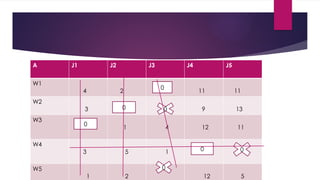
Step 3(Continued):
If optimal assignment is not formed go to step 4 i.e. There should be 5
straight lines.
A J1 J2 J3 J4 J5
W1
4 2 11 11
W2
3 9 13
W3
1 4 12 11
W4
3 5 1
W5
1 2 12 5
0
0 0
0
0 0
0
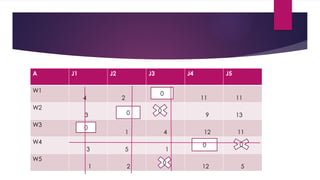
Step 4:
Ensure all zero’s “0” are covered with minimum one line.
Find the minimum element not covered by any line (in this sum “5” is the
minimum element not covered by any line).
A J1 J2 J3 J4 J5
W1
4 2 11 11
W2
3 9 13
W3
1 4 12 11
W4
3 5 1
W5
1 2 12 5
0
0
0
0
0 0
0
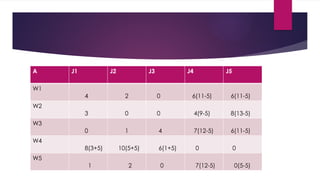
Step 5:
Subtract the element (i.e.5) from the elements not covered by the lines.
Also add the same element (i.e.5) to the elements which are at the
intersections.
A J1 J2 J3 J4 J5
W1
4 2 0 6(11-5) 6(11-5)
W2
3 0 0 4(9-5) 8(13-5)
W3
0 1 4 7(12-5) 6(11-5)
W4
8(3+5) 10(5+5) 6(1+5) 0 0
W5
1 2 0 7(12-5) 0(5-5)
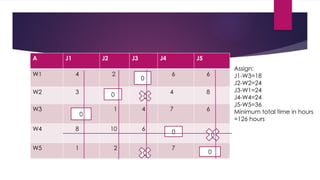
Follow step 3:
Cover all zero’s with straight lines again. Since five lines are needed,an
optimal assignment can be made.
A J1 J2 J3 J4 J5
W1 4 2 6 6
W2 3 4 8
W3 1 4 7 6
W4 8 10 6
W5 1 2 7
Assign:
J1-W3=18
J2-W2=24
J3-W1=24
J4-W4=24
J5-W5=36
Minimum total time in hours
=126 hours
0
0
0
0
0
0
0
0
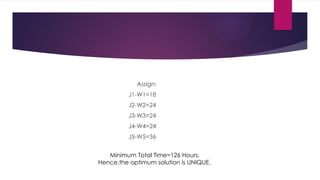
Assign:
J1-W1=18
J2-W2=24
J3-W3=24
J4-W4=24
J5-W5=36
Minimum Total Time=126 Hours.
Hence,the optimum solution is UNIQUE.
MAXIMISATION PROBLEM
 Assignment problems can also be used to solve casas of maximisation model.
 For instance, Travelling Salesman problem, milk van routings and so on.
 Problem can be solved by first subtracting the biggest element in the
problem from all other elements (i.e. connverting cost table in to opportunity
loss table.
 Later steps, are similar as the minimization problem.
SUMMARY
 Assignment problem deals with the problem of assigning jobs to machines
or men to jobs which are to be performed with varying efficiency.
 It can be used to solve cases of Travelling Salesman problem.
 It is basically a minimizing model but it can be used to solve cases of
maximization by converting cost table in to opportunity loss table.
DRAWBACK OF ASSIGNMENT PROBLEM
 Assignment becomes a problem because each job requires different skills
and the capacity or efficiency of each person with respect to these jobs
can be different. This gives rise to cost difference. If each person is able to
do all jobs equally efficiently then all costs will be the same and each job
can be assigned to any person.
 When assignment is a problem it becomes a typical optimization problem
it can therefore be compared to a transportation problem. The cost
elements are given and is a square matrix and requirement at each
destination is one and availability at each orgin is also one.
 In addition we have number of origins which equals the number of
destinations hence the total demand equals total supply. There is only one
assignment in each row and each column. However if we compare this to
a transportation problem we find that a general transportation problem
does not have the above mentioned limitations. These limitations are
pecullar to assignment problem only.
assignment problem (1).pptx case study 1

assignment problem (1).pptx case study 1

  • 1.
  • 2.
    What is assignmentproblem?  Assignment problem refers to special class of linear programming problems that involves determining the most efficient assignment of people to project , salespeople to territories contracts to bidders and so on.  It is often used to minimize the total cost or time of performing the task.  One of the important characteristics of assignment problem is that only one job is assigned to one machine.
  • 3.
     Each assignmentproblem has a matrix associated with it.  The number in the table indicates the COST associated with the assignment.  The most efficient linear programming algorithm to find optimum solution to the assignment problem is Hungarian method.
  • 4.
    Assignment problem usingHungarian Method  The Hungarian method is a combinatorial optimization algorithm that solves the assignment problem in polynomial time and which anticipated later primal- dual methods.  It was developed and published in 1955 by Harold Kuhn, who gave the name “Hungarian method” because the algorithm was largely based on the earilier works of two Hungarian mathematicians: Denes Konig and Jeno Egervary.
  • 5.
    Requirements of dummyrows and column:  To arrive at the solution, assignment problem requires equal number of Row and Column.  If the number of tasks that needs to be done exceeds the number of resources available, dummy rows or a column just needs to be added as the case may be.  This creates a table of equal dimensions.  The dummy row or column is not existent. Hence the value can be entered as zeros.
  • 6.
     A companyhas five job to be done by five workers each worker are assigned to be one and only one job. Number of hours each worker takes to complete the job is given below: A J1 J2 J3 J4 J5 W1 28 27 24 35 38 W2 26 24 23 32 39 W3 18 20 22 30 32 W4 27 30 25 24 27 W5 29 31 28 40 36
  • 7.
    Step 1: Find theminimum number in each row and subtract it from all the element in that particular row A J1 J2 J3 J4 J5 W1 4 3 0 11 14 W2 3 1 0 9 16 W3 0 2 4 12 14 W4 3 6 1 0 3 W5 1 3 0 12 8
  • 8.
    Step 2: Find theminimum element in each column and subtract it from all ihe elements in that particular column. A J1 J2 J3 J4 J5 W1 4 2 0 11 11 W2 3 0 0 9 13 W3 0 1 4 12 11 W4 3 5 1 0 0 W5 1 2 0 12 5
  • 9.
    Remark: Step 1and 2 creates at least one zero ‘0’in each row and column.
  • 10.
    Step 3: Starting from1st row ,if there is exact one zero,make an assignment and cancel all zero’s in that column and then draw a vertical line.Similarly, starting from 1st column, if exact one zero, make an assignment and cancel an zero’s in that row, and then draw a horizontal line. Continue this step till all zero’s are an assignment or cancelled.
  • 11.
    A J1 J2J3 J4 J5 W1 4 2 11 11 W2 3 9 13 W3 1 4 12 11 W4 3 5 1 W5 1 2 12 5 0 0 0 0 0 0 0
  • 12.
    Step 3(Continued): If optimalassignment is not formed go to step 4 i.e. There should be 5 straight lines.
  • 13.
    A J1 J2J3 J4 J5 W1 4 2 11 11 W2 3 9 13 W3 1 4 12 11 W4 3 5 1 W5 1 2 12 5 0 0 0 0 0 0 0
  • 14.
    Step 4: Ensure allzero’s “0” are covered with minimum one line. Find the minimum element not covered by any line (in this sum “5” is the minimum element not covered by any line).
  • 15.
    A J1 J2J3 J4 J5 W1 4 2 11 11 W2 3 9 13 W3 1 4 12 11 W4 3 5 1 W5 1 2 12 5 0 0 0 0 0 0 0
  • 16.
    Step 5: Subtract theelement (i.e.5) from the elements not covered by the lines. Also add the same element (i.e.5) to the elements which are at the intersections.
  • 17.
    A J1 J2J3 J4 J5 W1 4 2 0 6(11-5) 6(11-5) W2 3 0 0 4(9-5) 8(13-5) W3 0 1 4 7(12-5) 6(11-5) W4 8(3+5) 10(5+5) 6(1+5) 0 0 W5 1 2 0 7(12-5) 0(5-5)
  • 18.
    Follow step 3: Coverall zero’s with straight lines again. Since five lines are needed,an optimal assignment can be made.
  • 19.
    A J1 J2J3 J4 J5 W1 4 2 6 6 W2 3 4 8 W3 1 4 7 6 W4 8 10 6 W5 1 2 7 Assign: J1-W3=18 J2-W2=24 J3-W1=24 J4-W4=24 J5-W5=36 Minimum total time in hours =126 hours 0 0 0 0 0 0 0 0
  • 20.
  • 21.
    MAXIMISATION PROBLEM  Assignmentproblems can also be used to solve casas of maximisation model.  For instance, Travelling Salesman problem, milk van routings and so on.  Problem can be solved by first subtracting the biggest element in the problem from all other elements (i.e. connverting cost table in to opportunity loss table.  Later steps, are similar as the minimization problem.
  • 22.
    SUMMARY  Assignment problemdeals with the problem of assigning jobs to machines or men to jobs which are to be performed with varying efficiency.  It can be used to solve cases of Travelling Salesman problem.  It is basically a minimizing model but it can be used to solve cases of maximization by converting cost table in to opportunity loss table.
  • 23.
    DRAWBACK OF ASSIGNMENTPROBLEM  Assignment becomes a problem because each job requires different skills and the capacity or efficiency of each person with respect to these jobs can be different. This gives rise to cost difference. If each person is able to do all jobs equally efficiently then all costs will be the same and each job can be assigned to any person.  When assignment is a problem it becomes a typical optimization problem it can therefore be compared to a transportation problem. The cost elements are given and is a square matrix and requirement at each destination is one and availability at each orgin is also one.
  • 24.
     In additionwe have number of origins which equals the number of destinations hence the total demand equals total supply. There is only one assignment in each row and each column. However if we compare this to a transportation problem we find that a general transportation problem does not have the above mentioned limitations. These limitations are pecullar to assignment problem only.