CHAPTER 1
ASSESSMENT CONCEPTS AND ISSUES
Made by
Rahila Khan
SBK Women’s University
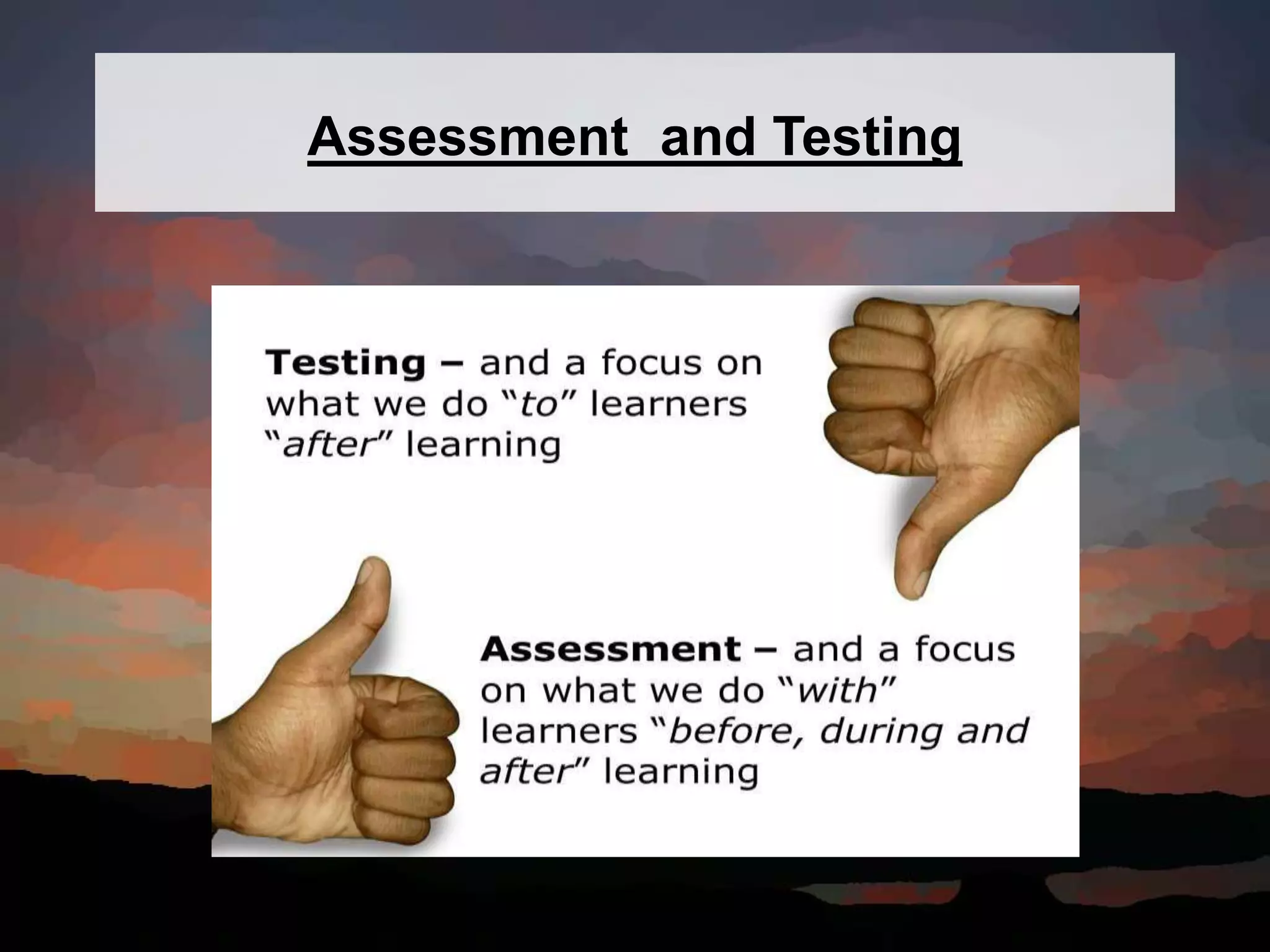
Assessment and Testing
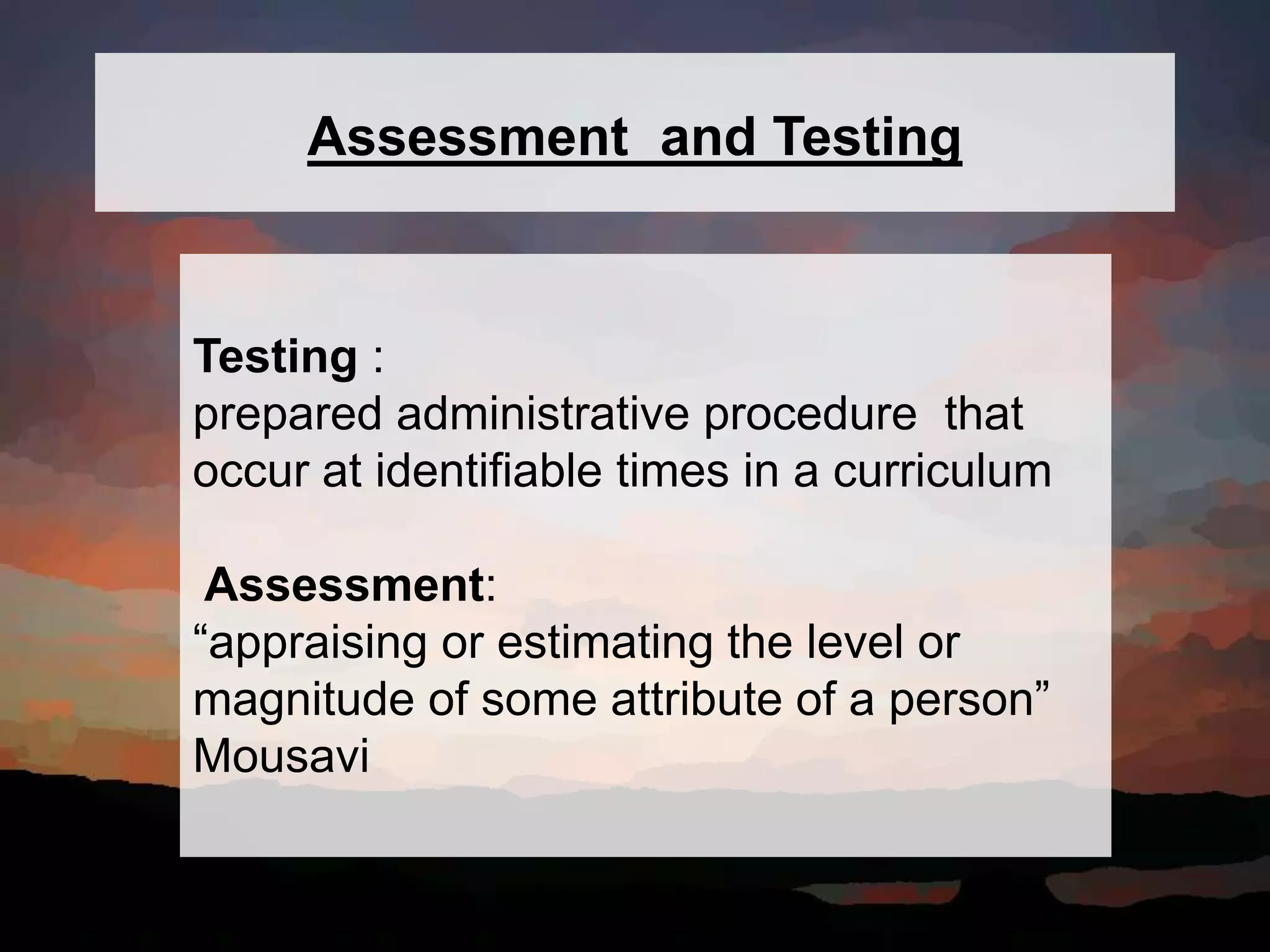
Testing :
prepared administrative procedure that
occur at identifiable times in a curriculum
Assessment:
“appraising or estimating the level or
magnitude of some attribute of a person”
Mousavi
Assessment and Testing
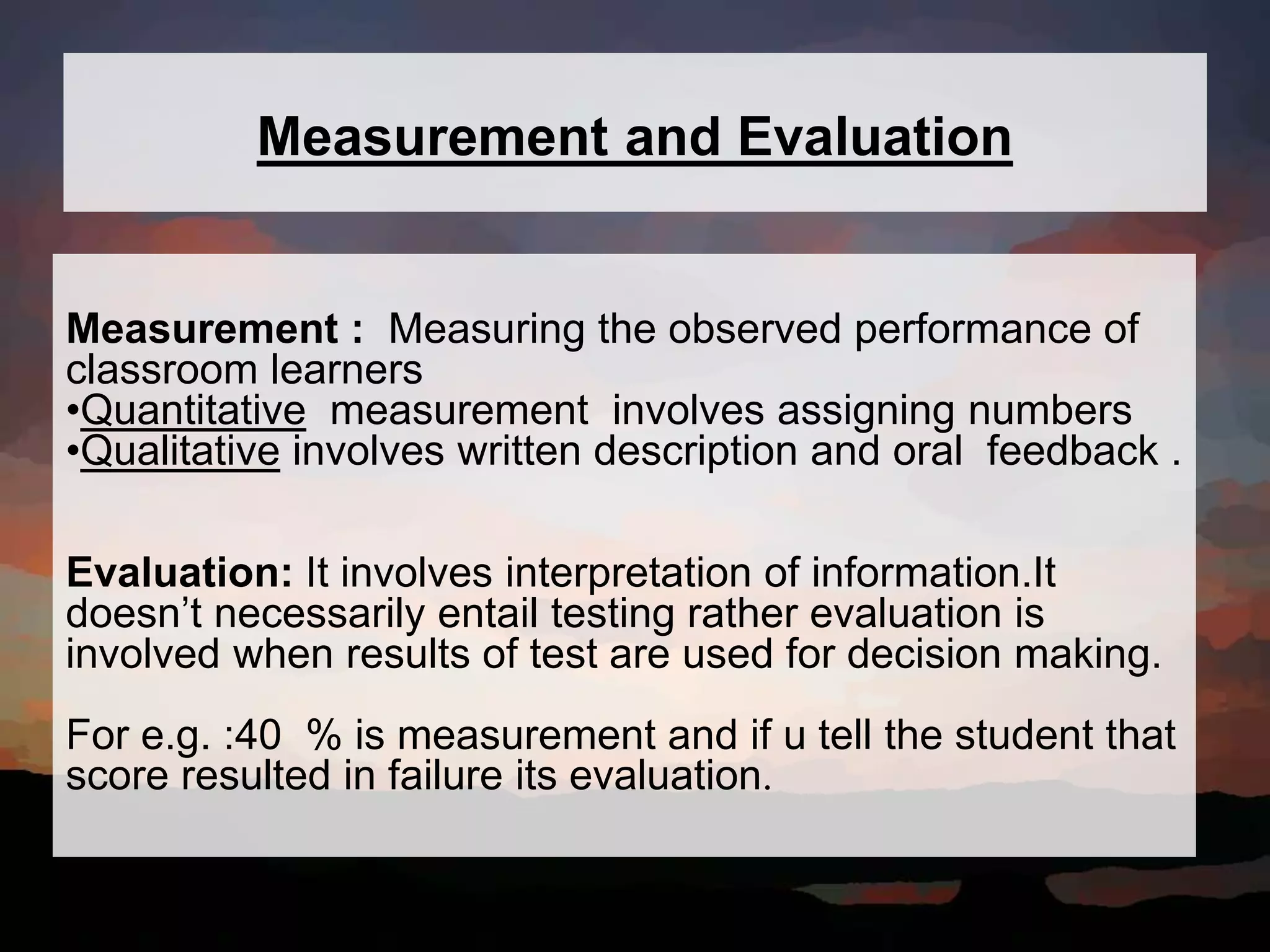
Measurement and Evaluation
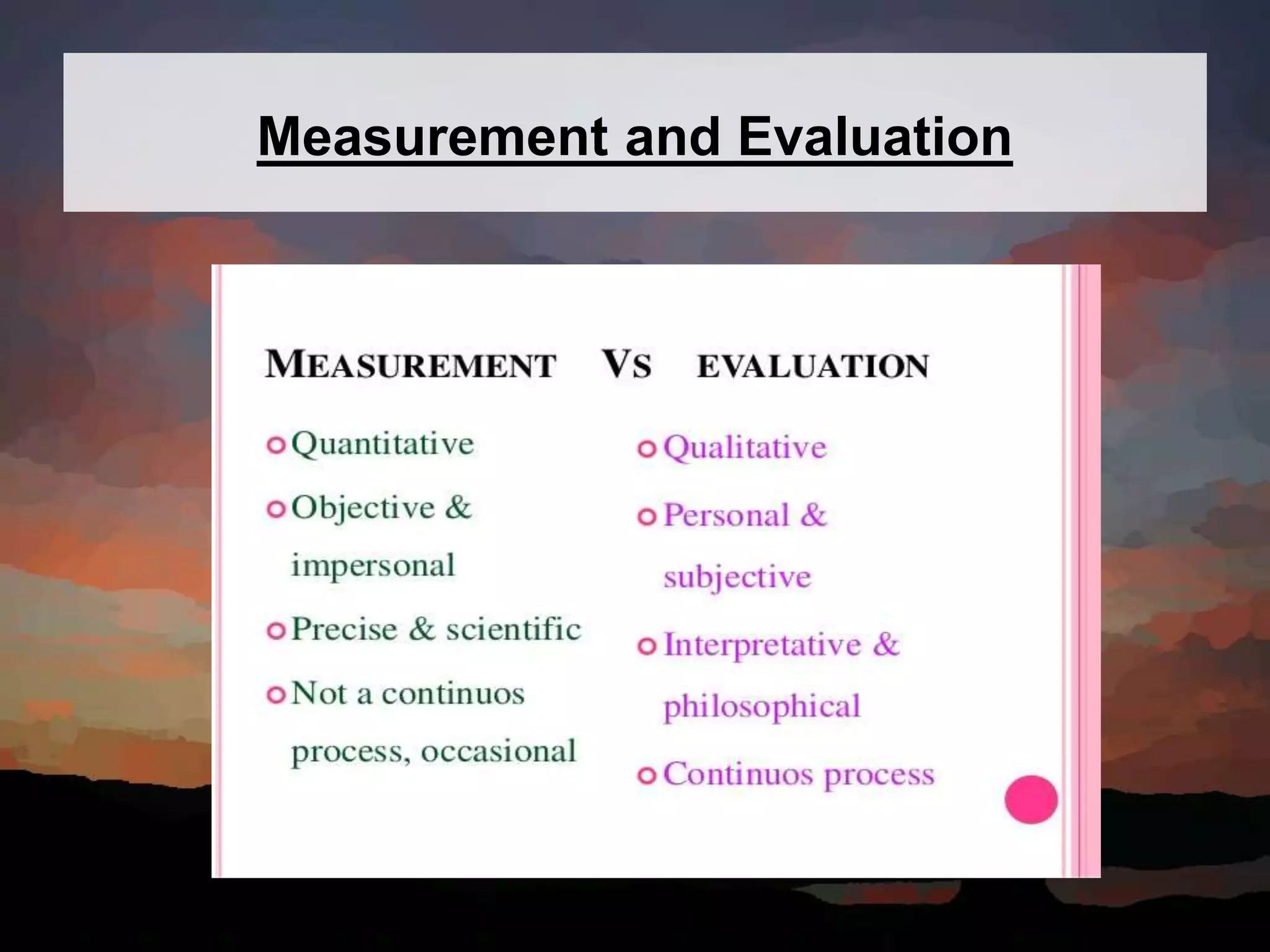
Measurement : Measuring the observed performance of
classroom learners
•Quantitative measurement involves assigning numbers
•Qualitative involves written description and oral feedback .
Evaluation: It involves interpretation of information.It
doesn’t necessarily entail testing rather evaluation is
involved when results of test are used for decision making.
For e.g. :40 % is measurement and if u tell the student that
score resulted in failure its evaluation.
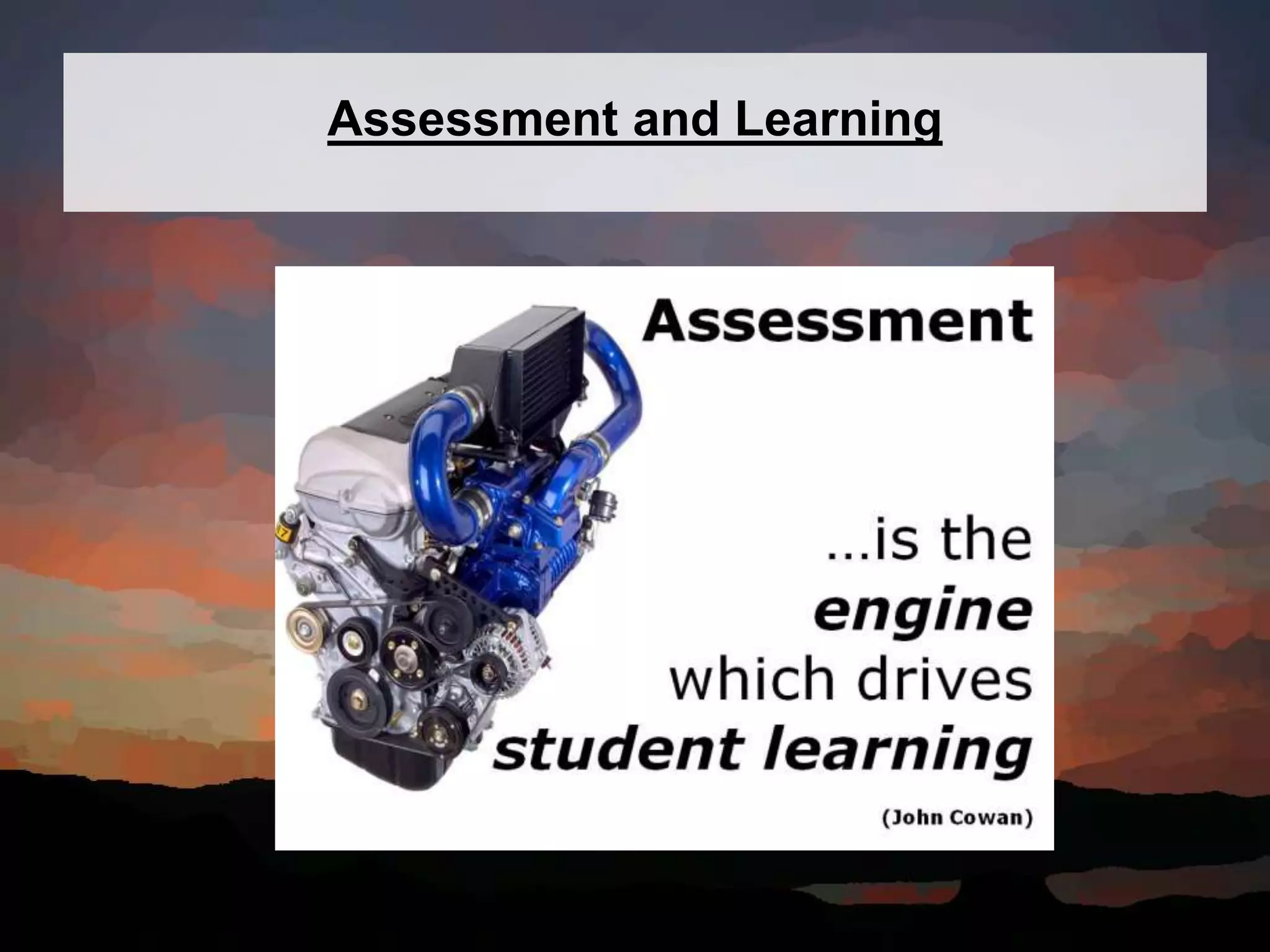
Assessment and Learning
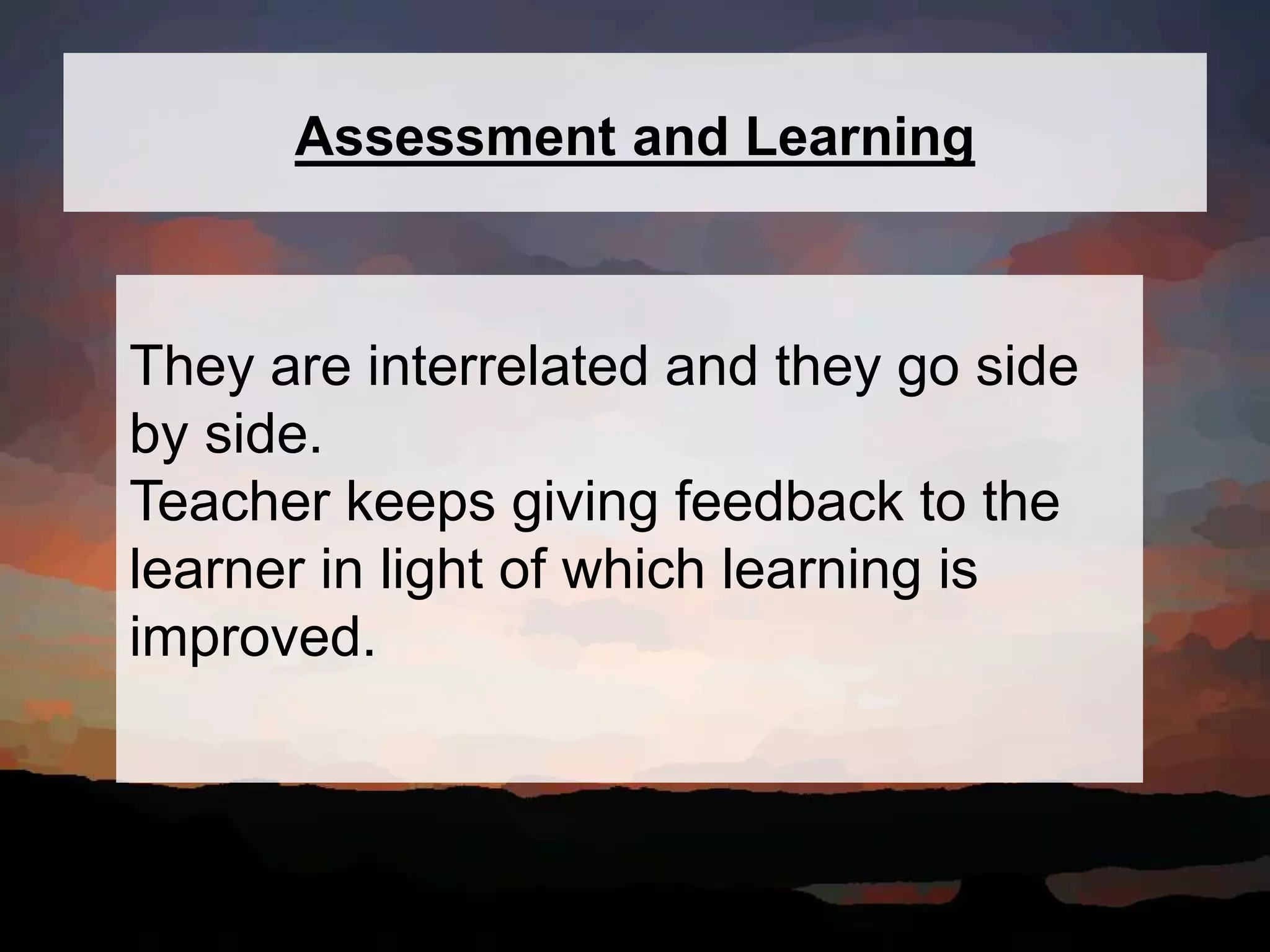
They are interrelated and they go side
by side.
Teacher keeps giving feedback to the
learner in light of which learning is
improved.
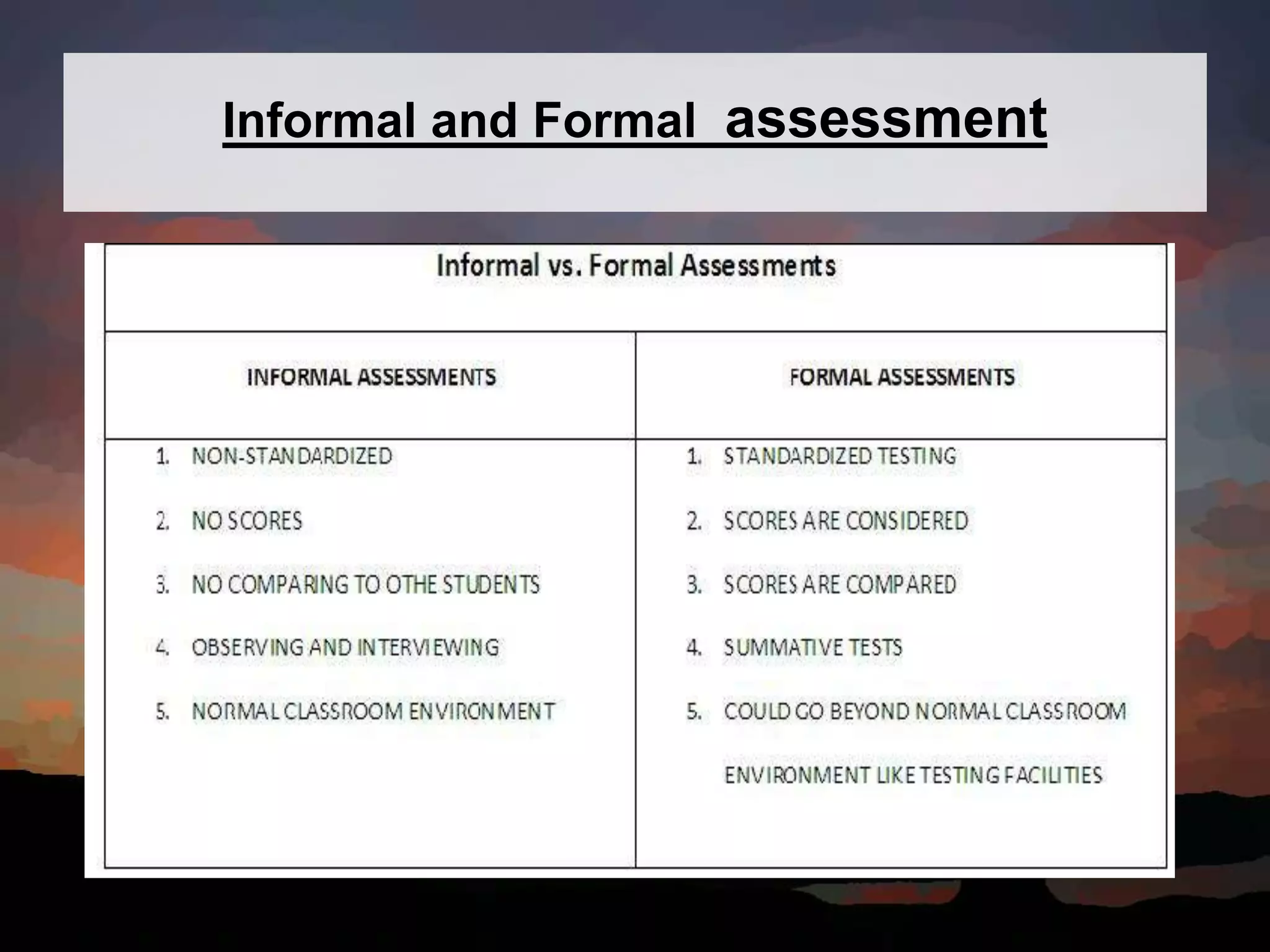
Informal and Formal assessment
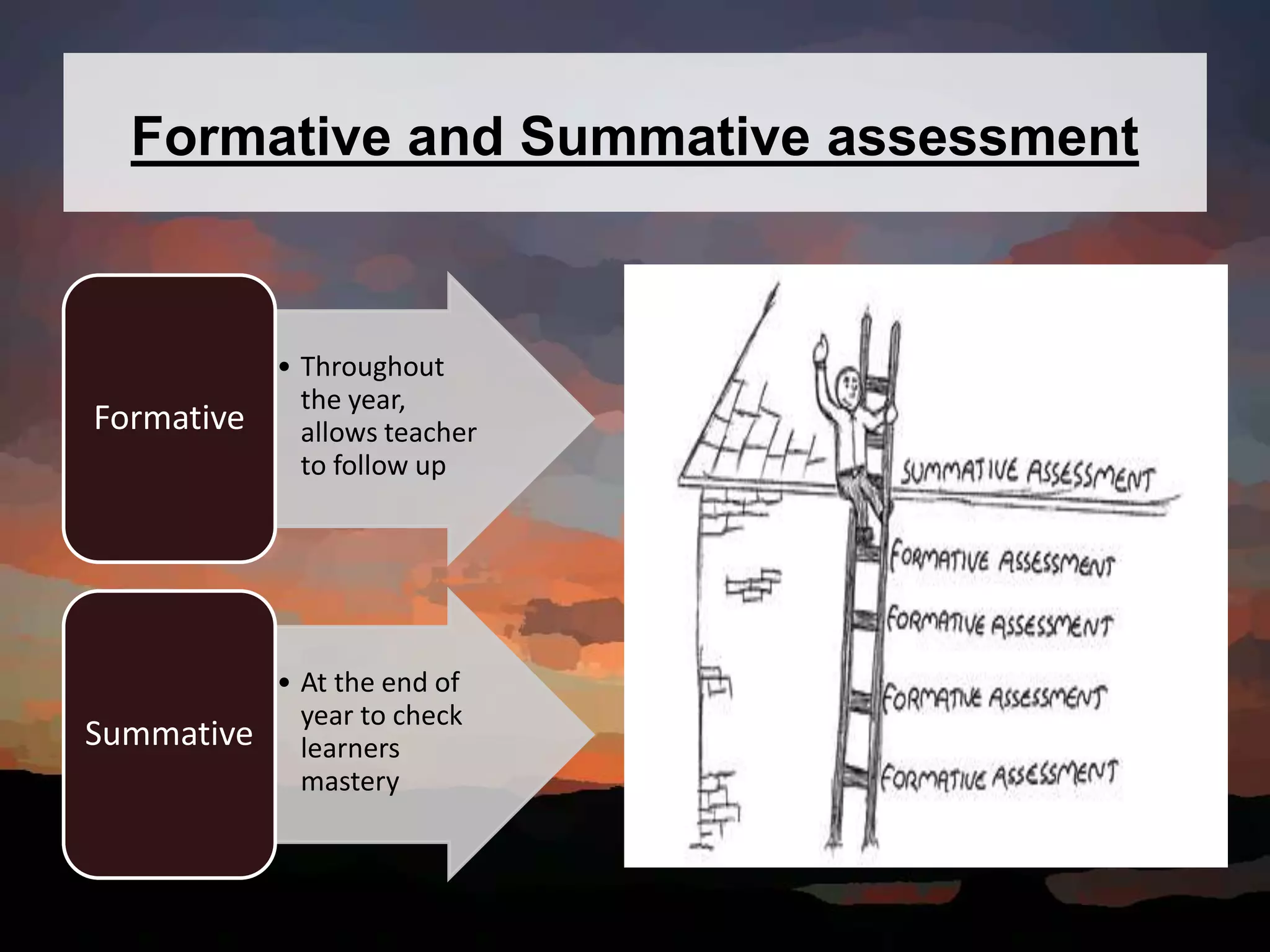
Formative and Summative assessment
• Throughout
the year,
allows teacher
to follow up
Formative
• At the end of
year to check
learners
mastery
Summative
Assessment and Learning
Formative: Evaluating students in the process of
developing skills with an aim to help them to
continue the growth.
Summative : It occurs at end of course.It aims to
measure what student has learned. And how well
have the accomplished the aims.
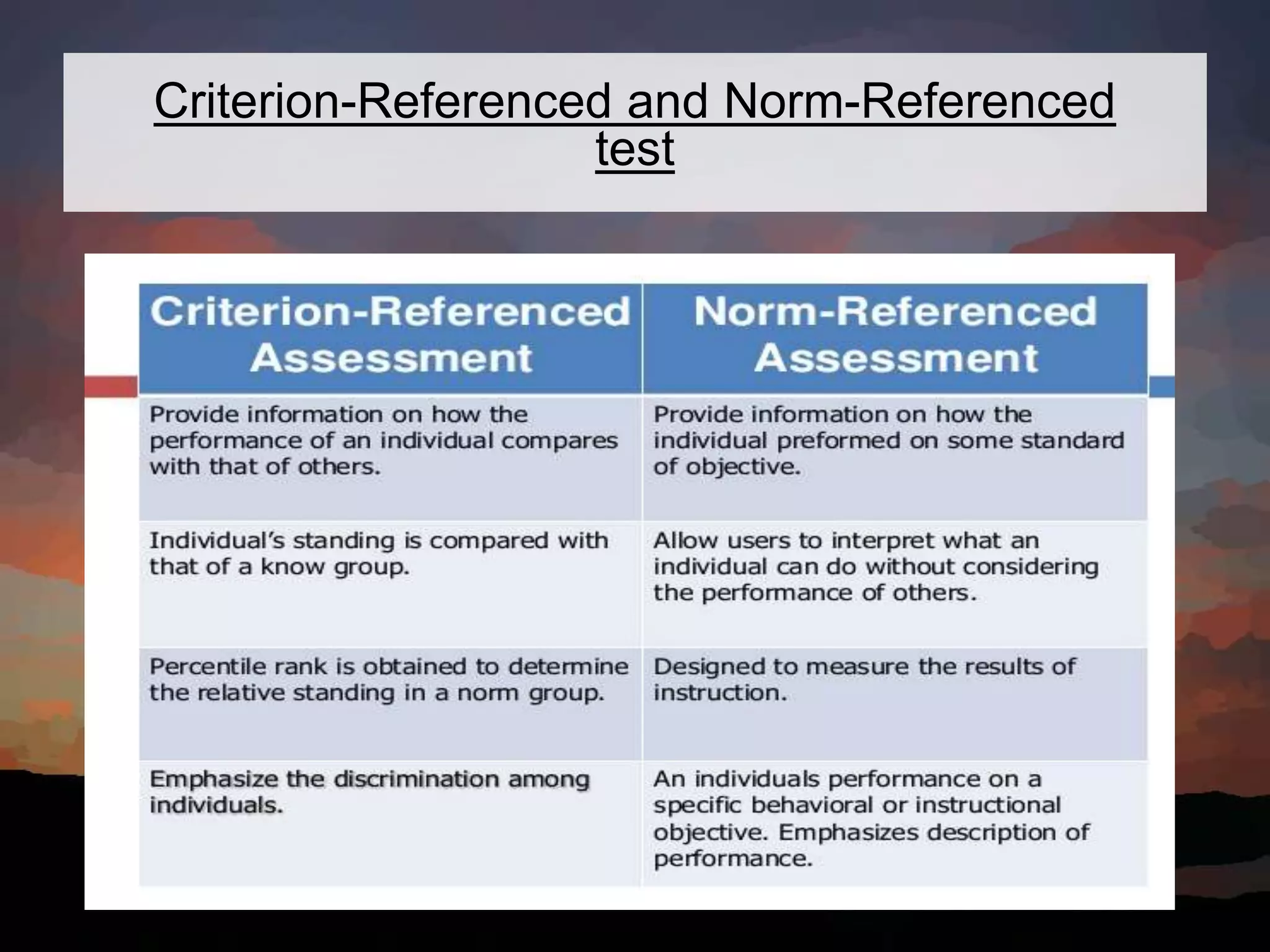
Criterion-Referenced and Norm-Referenced
test
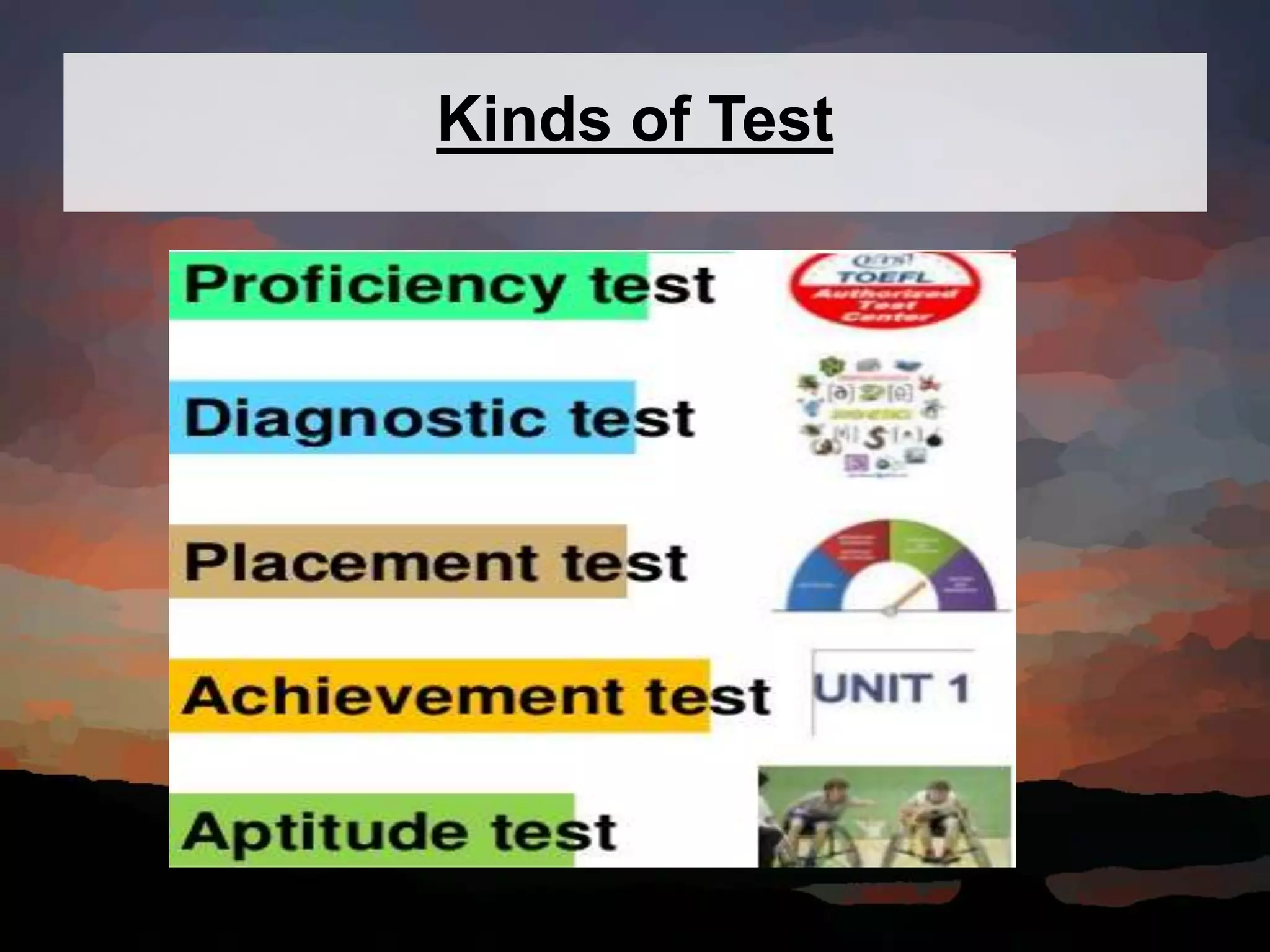
Kinds of Test
Proficiency Test
•The purpose of proficiency test is to test
global competence in a language.
•It tests overall ability regardless of any
training they previously had in the language.
For e.g. Cambridge IELTS and the American
TOEFL
Diagnostic Test
•The purpose is to diagnose specific aspects
of a language.
•These tests offer a checklist of features for
the teacher to use in discovering difficulties.
•Based on that identifying, teacher would
know the needs of students that should have
special focus.
Placement Test
•The purpose of placement test is to place a student
into a particular level or section of a language
curriculum .
•It usually includes a sampling of the material to be
covered in the various courses in a curriculum.
•Placement tests come in many varieties: assessing
comprehension and production, responding through
written and oral performance, multiple choice, and gap
filling formats.
For e.g :(ESLPT) English as a Second Language
Placement Test.
Aptitude Test
•The purpose of language aptitude test is to
predict a person’s success to exposure to the
foreign language.
•Language aptitude tests does not refer to
whether or not an individual can learn a foreign
language; but it refers to how well an individual
can learn a foreign language in a given amount
of time and under given conditions.
(John Carrol and Stanley Sapon)
Achievement Test
•The purpose of achievement tests is to
determine whether course objectives have
been met with skills acquired by the end of a
period of instruction.
•Achievement tests are summative because
they are administered at the end on a unit/term
of study. It analyzes the extent to which
students have acquired language that have
already been taught.
Issues in Language Assessment :
Then and Now
1. Behavioral Approaches
2. Integrative Approaches
3. Communicative Approaches
1.Behavioral Approach
•In the middle of 20th century , teaching and
testing were influenced by behaviorism.
•Testing focused sentence structure,
translation from L1 to L2 , grammar and
vocabulary items.
2.Integrative Approach
•In last quarter of 20th Century it was supposed
that communicative competence is global and
integrated ,thus it cannot be captured in
additive tests of grammar, reading , vocabulary
and other discrete points of languages.
•Cloze test and dictation was introduced .
3.Communicative Approach
•In this type of testing focus was on
communicative language-testing tasks and
learners were required to perform real world
tasks designed by test designer.
•Test designer believed that tasks designed,
needed to include strategic and pragmatic
abilities in the construction of language testing.
Current “ Hot Topics” in Classroom – Based
Assessment
1. Multiple Intelligence
2. Traditional and alternative Assessment
3. Computer- Based testing
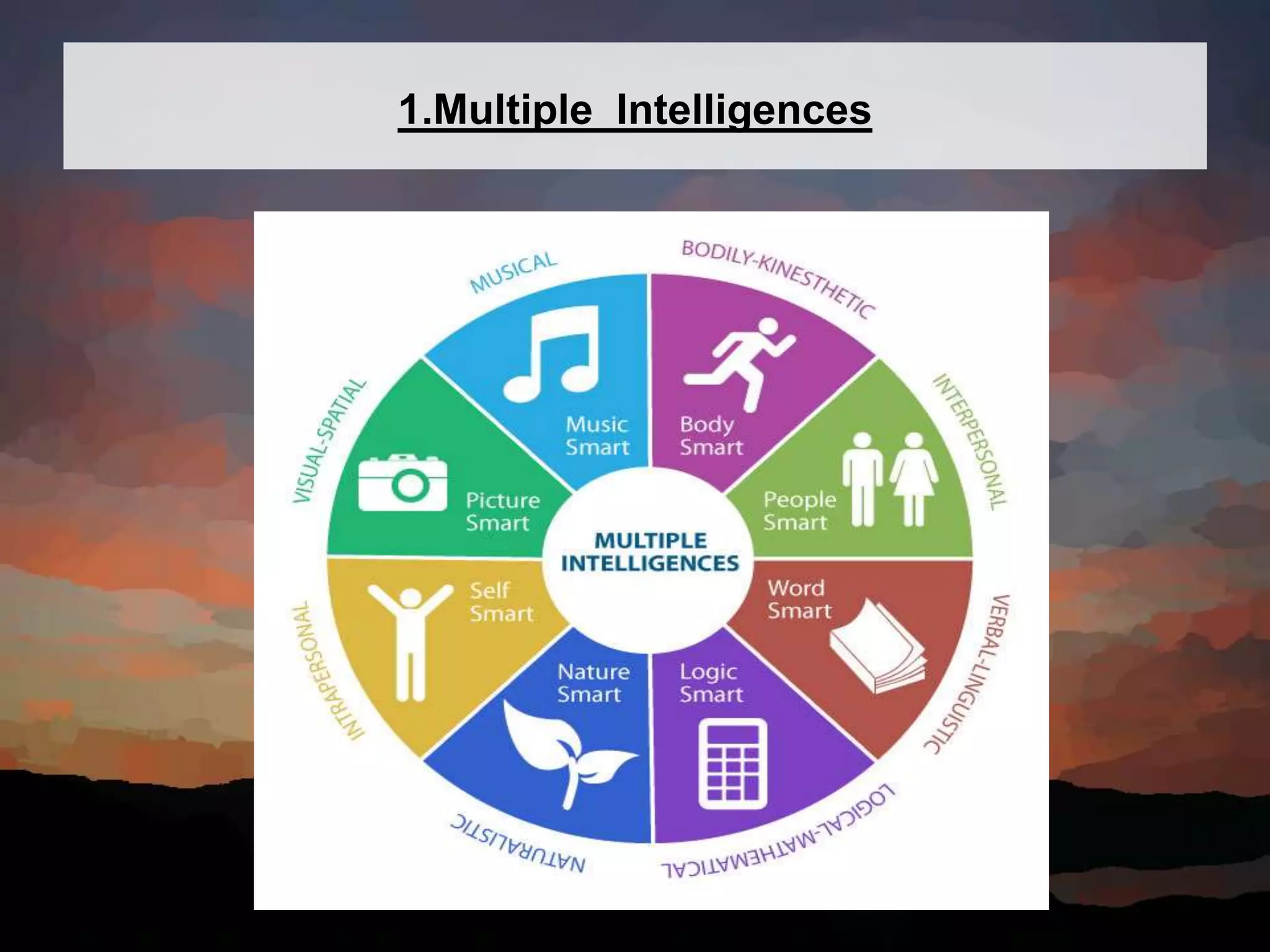
1.Multiple Intelligences
Howard Gardner divided intelligence in to
eight different components,
1. Spatial intelligence
2. Musical intelligence
3. Kinesthetic intelligence
4. Naturalistic intelligence
5. linguistic intelligence
6. logical intelligence
7. Interpersonal intelligence
8. Intrapersonal intelligence
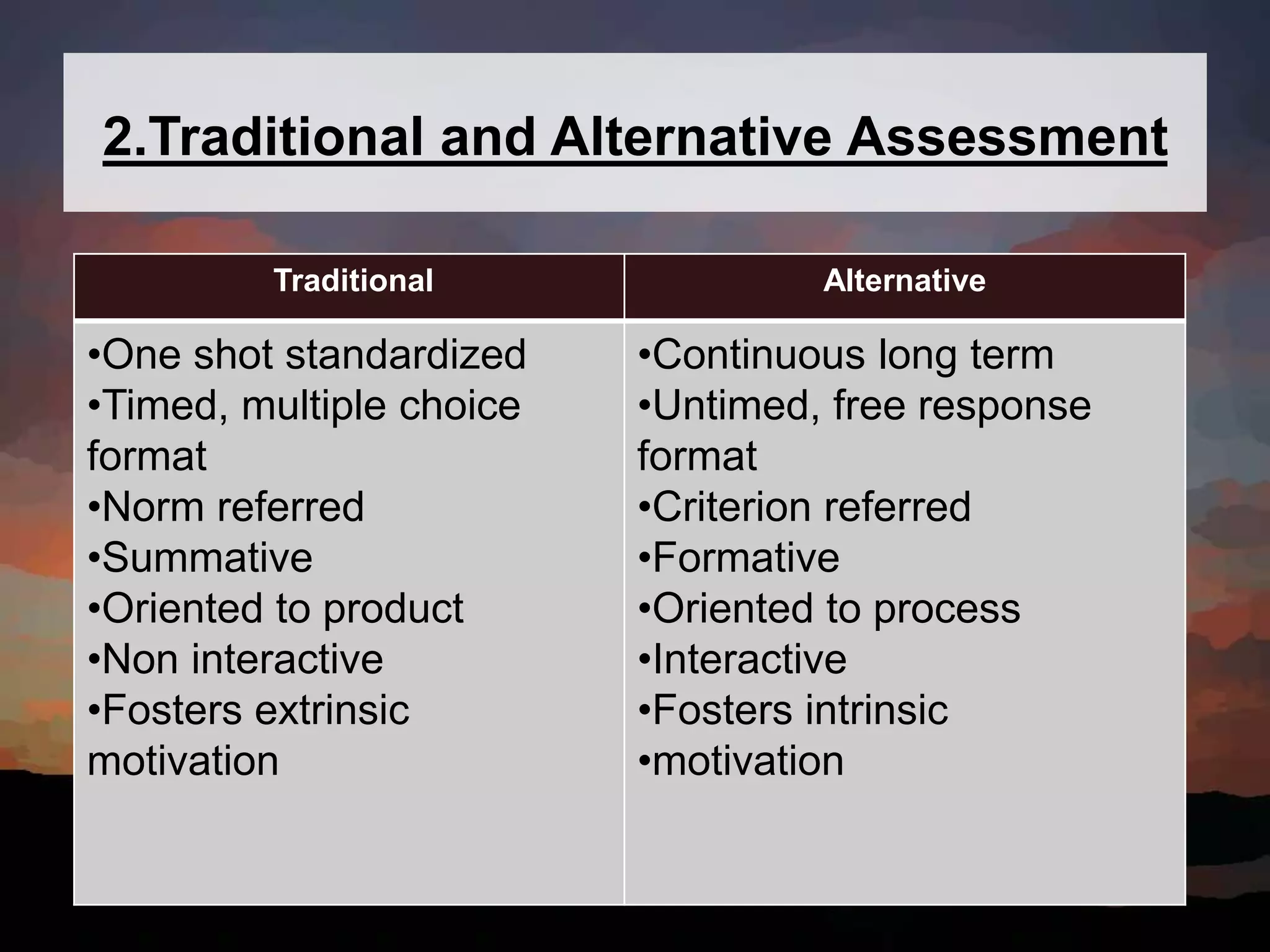
2.Traditional and Alternative Assessment
Traditional Alternative
•One shot standardized
•Timed, multiple choice
format
•Norm referred
•Summative
•Oriented to product
•Non interactive
•Fosters extrinsic
motivation
•Continuous long term
•Untimed, free response
format
•Criterion referred
•Formative
•Oriented to process
•Interactive
•Fosters intrinsic
•motivation
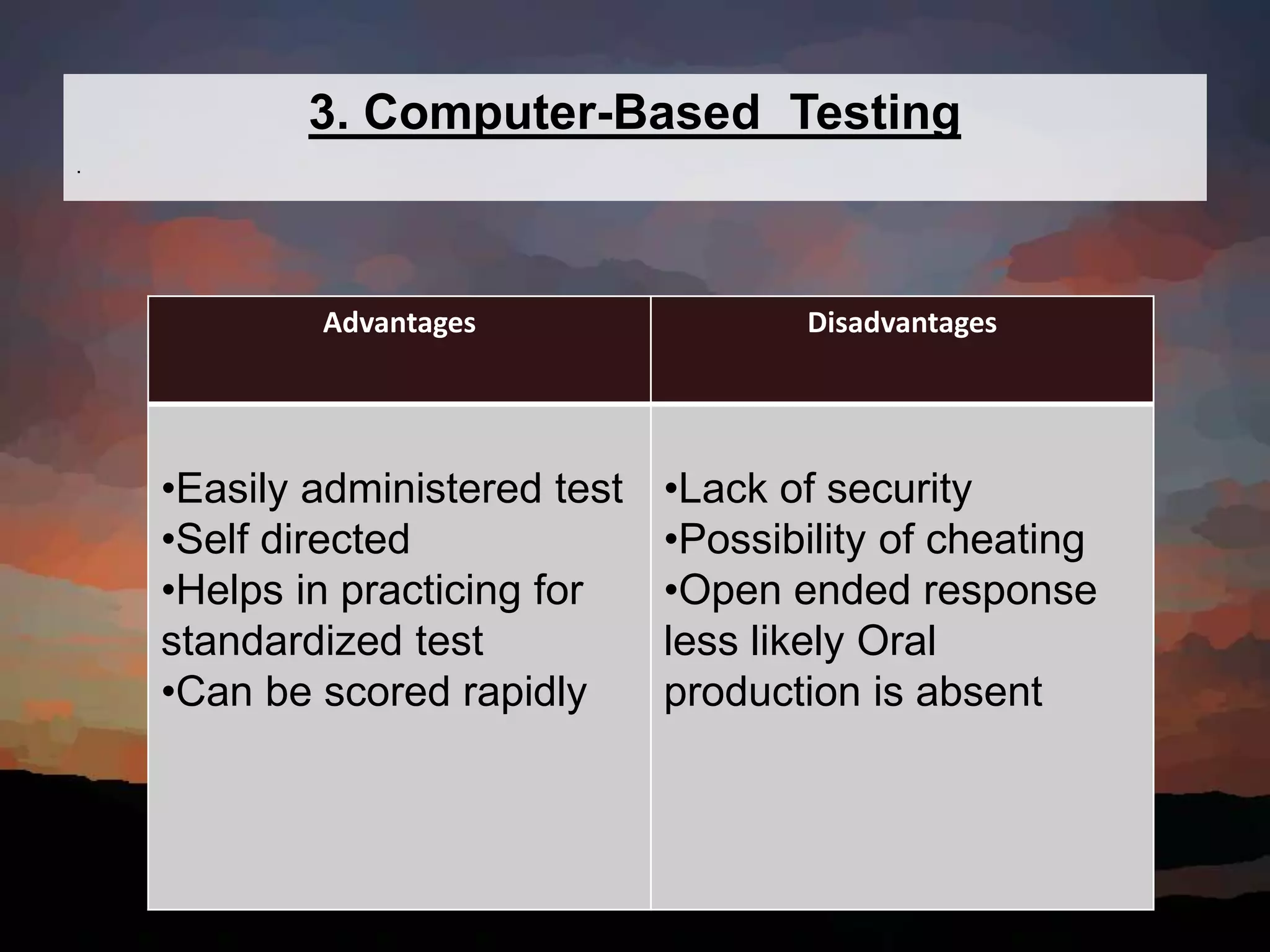
3. Computer-Based Testing
.
Advantages Disadvantages
•Easily administered test
•Self directed
•Helps in practicing for
standardized test
•Can be scored rapidly
•Lack of security
•Possibility of cheating
•Open ended response
less likely Oral
production is absent
CHAPTER 2
PRINCIPLES OF LANGUAGE ASSESSMENT
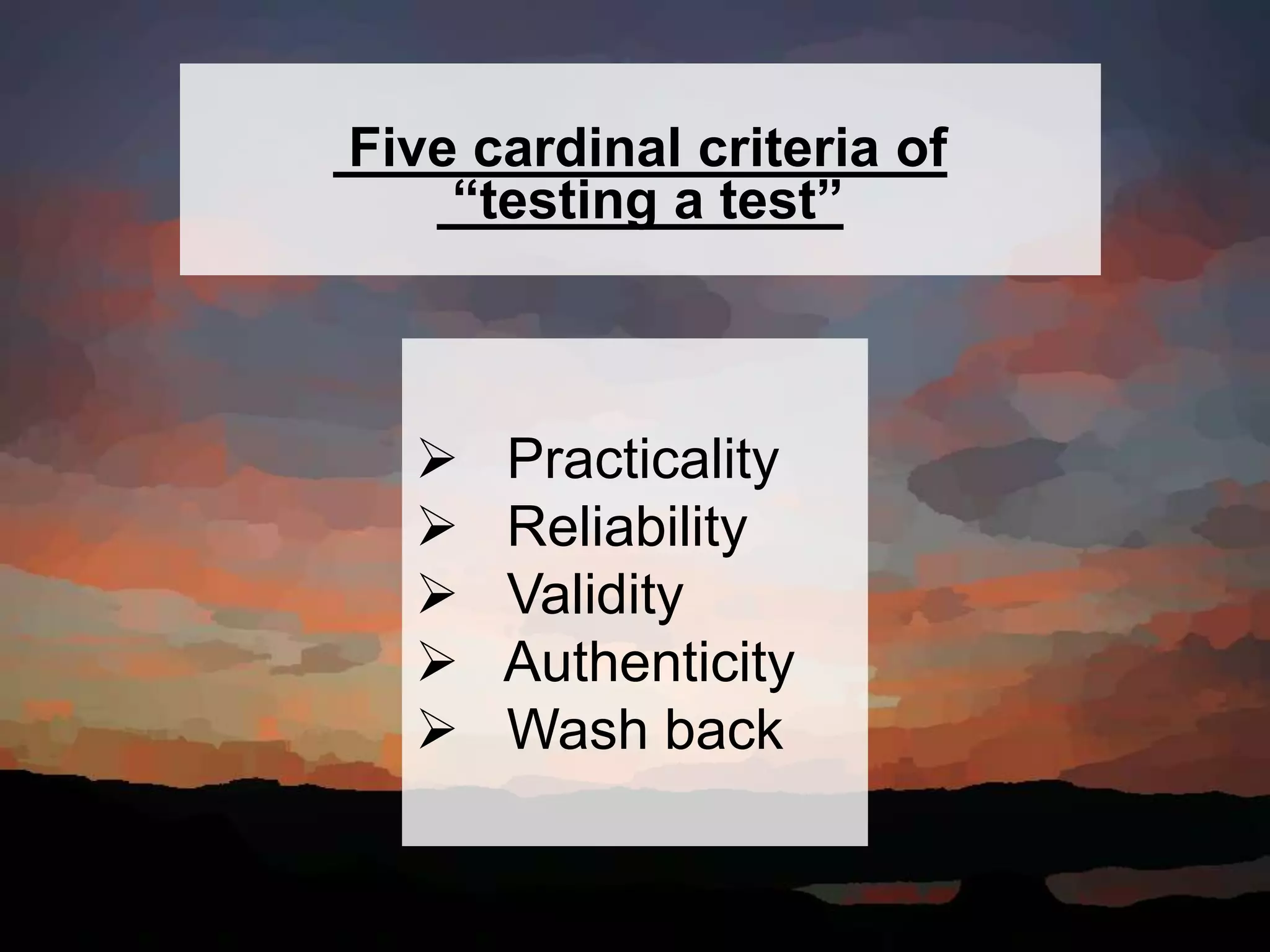
Five cardinal criteria of
“testing a test”
 Practicality
 Reliability
 Validity
 Authenticity
 Wash back
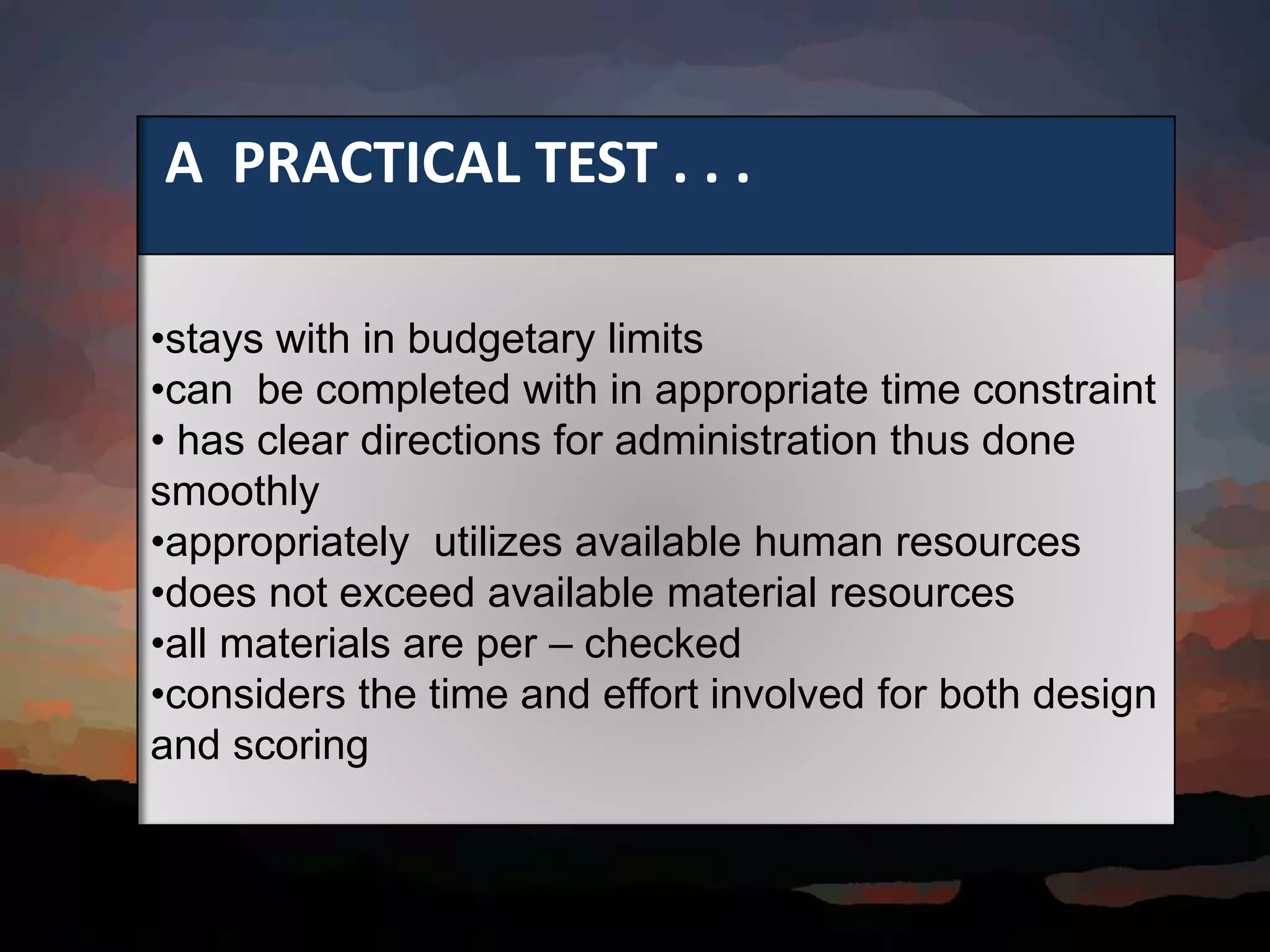
A PRACTICAL TEST . . .
•stays with in budgetary limits
•can be completed with in appropriate time constraint
• has clear directions for administration thus done
smoothly
•appropriately utilizes available human resources
•does not exceed available material resources
•all materials are per – checked
•considers the time and effort involved for both design
and scoring
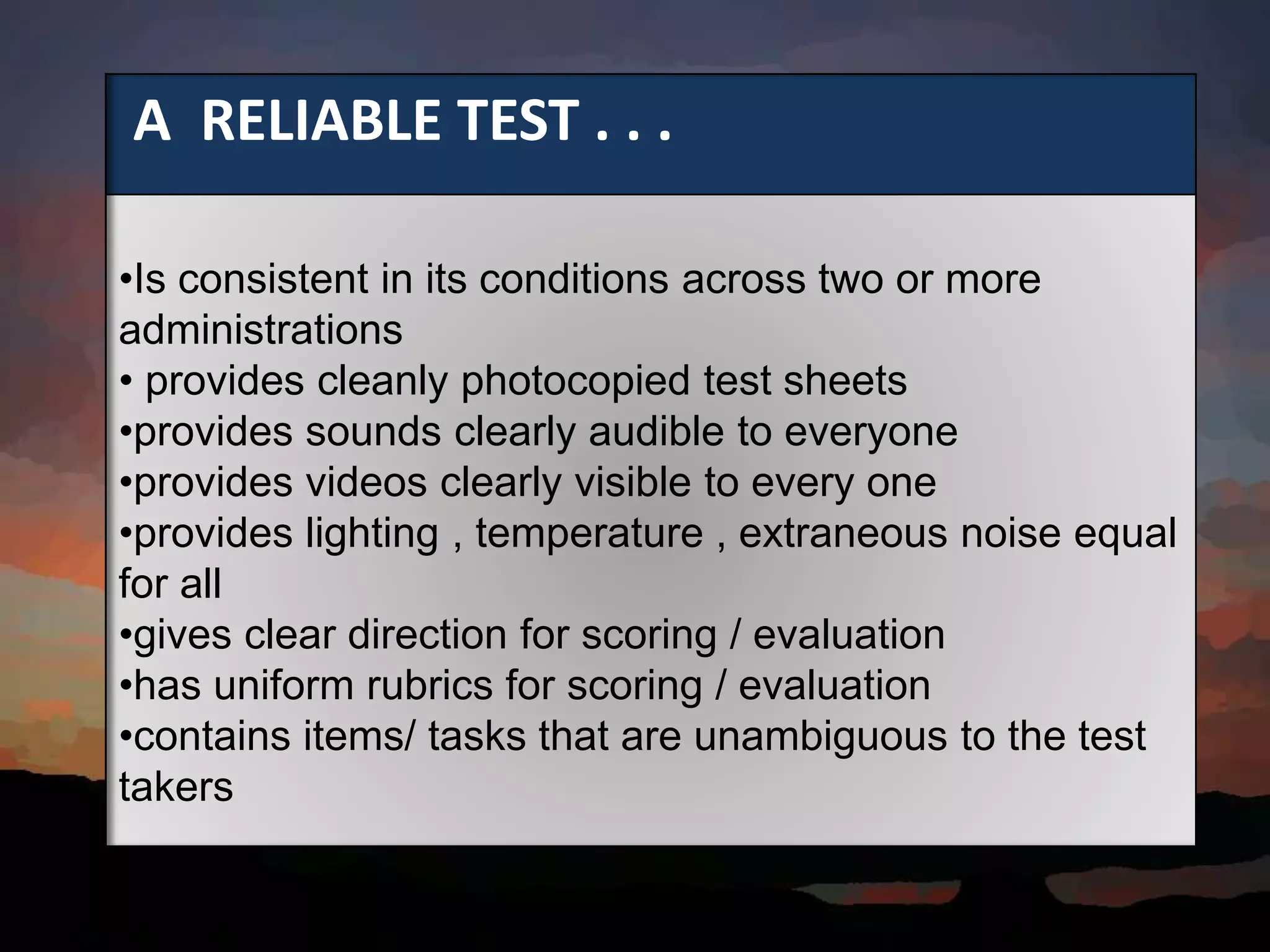
A RELIABLE TEST . . .
•Is consistent in its conditions across two or more
administrations
• provides cleanly photocopied test sheets
•provides sounds clearly audible to everyone
•provides videos clearly visible to every one
•provides lighting , temperature , extraneous noise equal
for all
•gives clear direction for scoring / evaluation
•has uniform rubrics for scoring / evaluation
•contains items/ tasks that are unambiguous to the test
takers
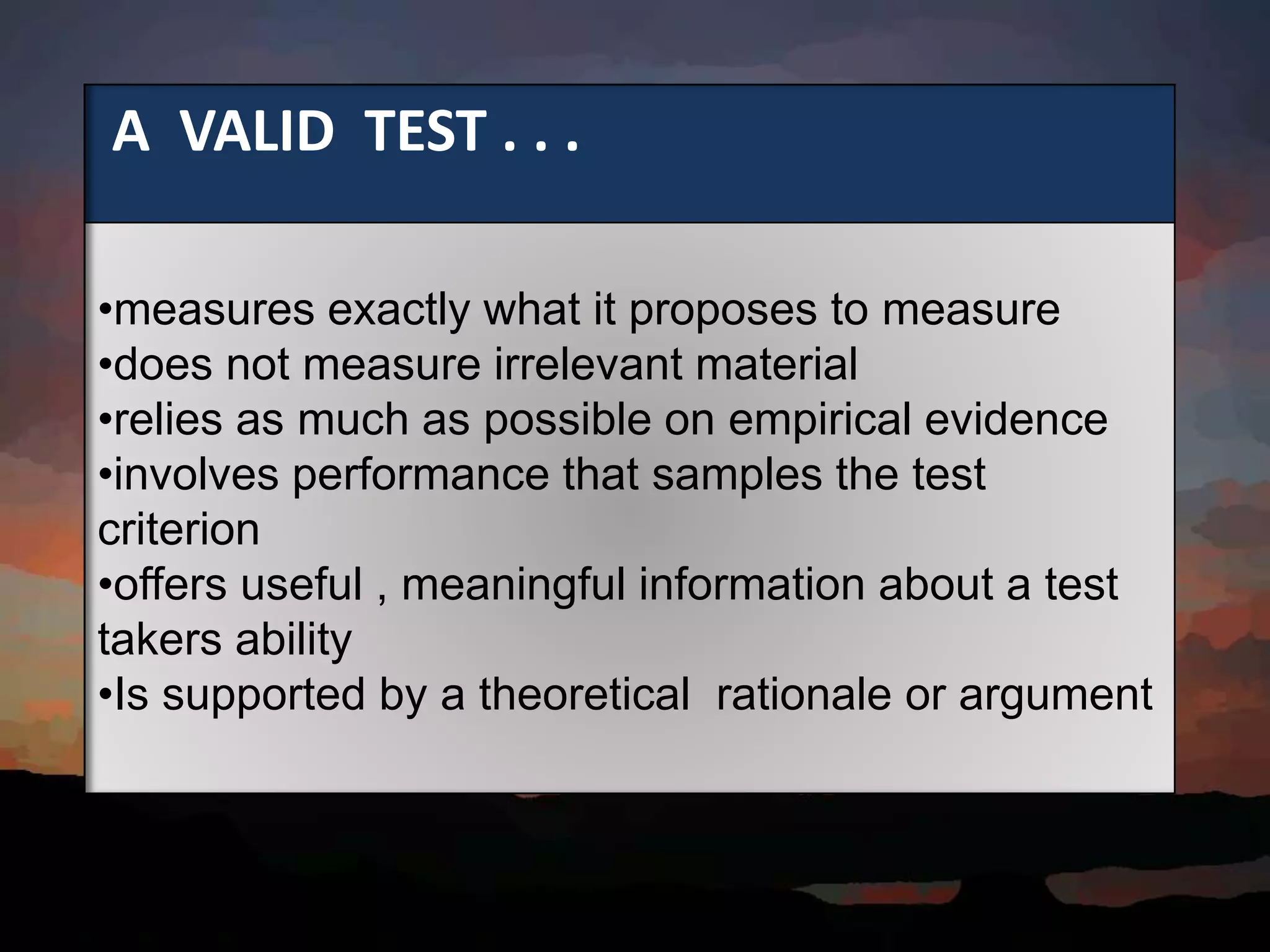
A VALID TEST . . .
•measures exactly what it proposes to measure
•does not measure irrelevant material
•relies as much as possible on empirical evidence
•involves performance that samples the test
criterion
•offers useful , meaningful information about a test
takers ability
•Is supported by a theoretical rationale or argument
AN AUTHENTIC TEST . . .
•contains language that is as natural as
possible
•has items that are contextualized rather than
isolated
•includes meaningful, relevant , interesting
topics
•provides thematic organization
•offers task that imitate real world test
A BENEFICIAL WASHBACK TEST . . .
• positively influences what and how teacher
teaches
•positively influences what and how learners
learn
•offers learners a chance to adequately prepare
• gives learner feedback that enhances their
language development
• is more formative in nature than summative
•provides conditions for peak performance by
the learner
THANKYOU FOR LISTENING

Assessments, concepts and issues

  • 1.
    CHAPTER 1 ASSESSMENT CONCEPTSAND ISSUES Made by Rahila Khan SBK Women’s University
  • 2.
  • 3.
    Testing : prepared administrativeprocedure that occur at identifiable times in a curriculum Assessment: “appraising or estimating the level or magnitude of some attribute of a person” Mousavi Assessment and Testing
  • 4.
  • 5.
    Measurement and Evaluation Measurement: Measuring the observed performance of classroom learners •Quantitative measurement involves assigning numbers •Qualitative involves written description and oral feedback . Evaluation: It involves interpretation of information.It doesn’t necessarily entail testing rather evaluation is involved when results of test are used for decision making. For e.g. :40 % is measurement and if u tell the student that score resulted in failure its evaluation.
  • 6.
  • 7.
    Assessment and Learning Theyare interrelated and they go side by side. Teacher keeps giving feedback to the learner in light of which learning is improved.
  • 8.
  • 9.
    Formative and Summativeassessment • Throughout the year, allows teacher to follow up Formative • At the end of year to check learners mastery Summative
  • 10.
    Assessment and Learning Formative:Evaluating students in the process of developing skills with an aim to help them to continue the growth. Summative : It occurs at end of course.It aims to measure what student has learned. And how well have the accomplished the aims.
  • 11.
  • 12.
  • 13.
    Proficiency Test •The purposeof proficiency test is to test global competence in a language. •It tests overall ability regardless of any training they previously had in the language. For e.g. Cambridge IELTS and the American TOEFL
  • 14.
    Diagnostic Test •The purposeis to diagnose specific aspects of a language. •These tests offer a checklist of features for the teacher to use in discovering difficulties. •Based on that identifying, teacher would know the needs of students that should have special focus.
  • 15.
    Placement Test •The purposeof placement test is to place a student into a particular level or section of a language curriculum . •It usually includes a sampling of the material to be covered in the various courses in a curriculum. •Placement tests come in many varieties: assessing comprehension and production, responding through written and oral performance, multiple choice, and gap filling formats. For e.g :(ESLPT) English as a Second Language Placement Test.
  • 16.
    Aptitude Test •The purposeof language aptitude test is to predict a person’s success to exposure to the foreign language. •Language aptitude tests does not refer to whether or not an individual can learn a foreign language; but it refers to how well an individual can learn a foreign language in a given amount of time and under given conditions. (John Carrol and Stanley Sapon)
  • 17.
    Achievement Test •The purposeof achievement tests is to determine whether course objectives have been met with skills acquired by the end of a period of instruction. •Achievement tests are summative because they are administered at the end on a unit/term of study. It analyzes the extent to which students have acquired language that have already been taught.
  • 18.
    Issues in LanguageAssessment : Then and Now 1. Behavioral Approaches 2. Integrative Approaches 3. Communicative Approaches
  • 19.
    1.Behavioral Approach •In themiddle of 20th century , teaching and testing were influenced by behaviorism. •Testing focused sentence structure, translation from L1 to L2 , grammar and vocabulary items.
  • 20.
    2.Integrative Approach •In lastquarter of 20th Century it was supposed that communicative competence is global and integrated ,thus it cannot be captured in additive tests of grammar, reading , vocabulary and other discrete points of languages. •Cloze test and dictation was introduced .
  • 21.
    3.Communicative Approach •In thistype of testing focus was on communicative language-testing tasks and learners were required to perform real world tasks designed by test designer. •Test designer believed that tasks designed, needed to include strategic and pragmatic abilities in the construction of language testing.
  • 22.
    Current “ HotTopics” in Classroom – Based Assessment 1. Multiple Intelligence 2. Traditional and alternative Assessment 3. Computer- Based testing
  • 23.
  • 24.
    1.Multiple Intelligences Howard Gardnerdivided intelligence in to eight different components, 1. Spatial intelligence 2. Musical intelligence 3. Kinesthetic intelligence 4. Naturalistic intelligence 5. linguistic intelligence 6. logical intelligence 7. Interpersonal intelligence 8. Intrapersonal intelligence
  • 25.
  • 26.
    2.Traditional and AlternativeAssessment Traditional Alternative •One shot standardized •Timed, multiple choice format •Norm referred •Summative •Oriented to product •Non interactive •Fosters extrinsic motivation •Continuous long term •Untimed, free response format •Criterion referred •Formative •Oriented to process •Interactive •Fosters intrinsic •motivation
  • 27.
    3. Computer-Based Testing . AdvantagesDisadvantages •Easily administered test •Self directed •Helps in practicing for standardized test •Can be scored rapidly •Lack of security •Possibility of cheating •Open ended response less likely Oral production is absent
  • 28.
    CHAPTER 2 PRINCIPLES OFLANGUAGE ASSESSMENT
  • 29.
    Five cardinal criteriaof “testing a test”  Practicality  Reliability  Validity  Authenticity  Wash back
  • 30.
    A PRACTICAL TEST. . . •stays with in budgetary limits •can be completed with in appropriate time constraint • has clear directions for administration thus done smoothly •appropriately utilizes available human resources •does not exceed available material resources •all materials are per – checked •considers the time and effort involved for both design and scoring
  • 31.
    A RELIABLE TEST. . . •Is consistent in its conditions across two or more administrations • provides cleanly photocopied test sheets •provides sounds clearly audible to everyone •provides videos clearly visible to every one •provides lighting , temperature , extraneous noise equal for all •gives clear direction for scoring / evaluation •has uniform rubrics for scoring / evaluation •contains items/ tasks that are unambiguous to the test takers
  • 32.
    A VALID TEST. . . •measures exactly what it proposes to measure •does not measure irrelevant material •relies as much as possible on empirical evidence •involves performance that samples the test criterion •offers useful , meaningful information about a test takers ability •Is supported by a theoretical rationale or argument
  • 33.
    AN AUTHENTIC TEST. . . •contains language that is as natural as possible •has items that are contextualized rather than isolated •includes meaningful, relevant , interesting topics •provides thematic organization •offers task that imitate real world test
  • 34.
    A BENEFICIAL WASHBACKTEST . . . • positively influences what and how teacher teaches •positively influences what and how learners learn •offers learners a chance to adequately prepare • gives learner feedback that enhances their language development • is more formative in nature than summative •provides conditions for peak performance by the learner
  • 35.