Drama
Made by
Rahila Khan
Lecturer English
1
Drama
•Comes from the Greek Word,
“Dran”
•Means “To do” or “To Act”
•The Doing/Acting Makes
Drama
2
Theatre
• Comes from the term “theatron”
• The place where ancient Greeks
sat to watch plays, and is translated
as “seeing place”
3
Aristotle
Aristotle (384-322 BC) was a Greek
philosopher whose writings still influence us
today. He was the first to write about the
essential elements of drama more than 2,000
years ago. While ideas have changed slightly
over the years, we still discuss Aristotle's list
when talking about what makes the best drama
4
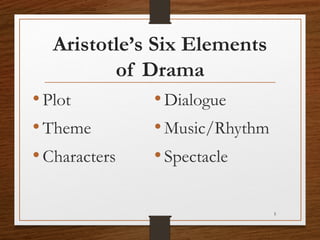
Aristotle’s Six Elements
of Drama
5
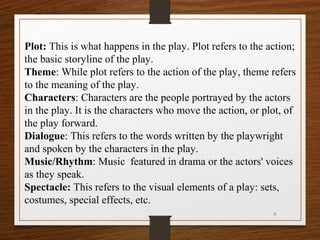
Plot: This is what happens in the play. Plot refers to the action;
the basic storyline of the play.
Theme: While plot refers to the action of the play, theme refers
to the meaning of the play.
Characters: Characters are the people portrayed by the actors
in the play. It is the characters who move the action, or plot, of
the play forward.
Dialogue: This refers to the words written by the playwright
and spoken by the characters in the play.
Music/Rhythm: Music featured in drama or the actors' voices
as they speak.
Spectacle: This refers to the visual elements of a play: sets,
costumes, special effects, etc.
6
Elements of Modern
Drama
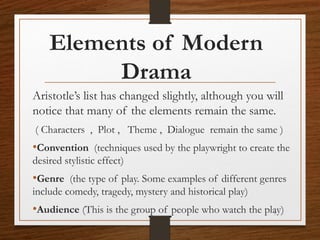
Aristotle’s list has changed slightly, although you will
notice that many of the elements remain the same.
( Characters , Plot , Theme , Dialogue remain the same )
•Convention (techniques used by the playwright to create the
desired stylistic effect)
•Genre (the type of play. Some examples of different genres
include comedy, tragedy, mystery and historical play)
•Audience (This is the group of people who watch the play)7
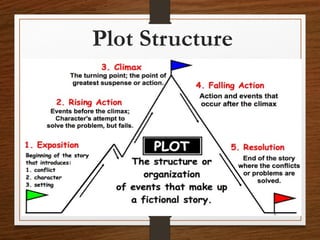
Plot Structure
8
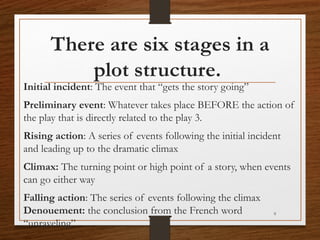
There are six stages in a
plot structure.
Initial incident: The event that “gets the story going”
Preliminary event: Whatever takes place BEFORE the action of
the play that is directly related to the play 3.
Rising action: A series of events following the initial incident
and leading up to the dramatic climax
Climax: The turning point or high point of a story, when events
can go either way
Falling action: The series of events following the climax
Denouement: the conclusion from the French word
“unraveling”
9
Some Other Elements
of Drama
1.Literary Elements
2.Technical Elements
3.Performance Elements
10
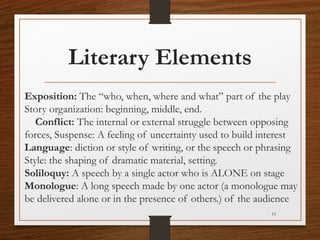
Literary Elements
Exposition: The “who, when, where and what” part of the play
Story organization: beginning, middle, end.
Conflict: The internal or external struggle between opposing
forces, Suspense: A feeling of uncertainty used to build interest
Language: diction or style of writing, or the speech or phrasing
Style: the shaping of dramatic material, setting.
Soliloquy: A speech by a single actor who is ALONE on stage
Monologue: A long speech made by one actor (a monologue may
be delivered alone or in the presence of others.) of the audience
11
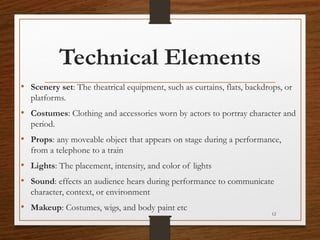
Technical Elements
• Scenery set: The theatrical equipment, such as curtains, flats, backdrops, or
platforms.
• Costumes: Clothing and accessories worn by actors to portray character and
period.
• Props: any moveable object that appears on stage during a performance,
from a telephone to a train
• Lights: The placement, intensity, and color of lights
• Sound: effects an audience hears during performance to communicate
character, context, or environment
• Makeup: Costumes, wigs, and body paint etc
12
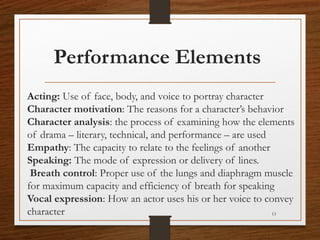
Performance Elements
Acting: Use of face, body, and voice to portray character
Character motivation: The reasons for a character’s behavior
Character analysis: the process of examining how the elements
of drama – literary, technical, and performance – are used
Empathy: The capacity to relate to the feelings of another
Speaking: The mode of expression or delivery of lines.
Breath control: Proper use of the lungs and diaphragm muscle
for maximum capacity and efficiency of breath for speaking
Vocal expression: How an actor uses his or her voice to convey
character 13
Performance Elements
(Cont…)
Inflection: Change in pitch or loudness of the voice.
Projection: How well the voice carries to the audience.
Speaking style:
Mode of expression/delivery of lines. Diction:
Selection and pronunciation of words; clarity of speech.
Gestures: Any movement of the actor’s head, shoulder,
arm, hand, leg, or foot to convey meaning.
Facial expression: Physical and vocal
aspects used by an actor to convey mood, feeling, or
14
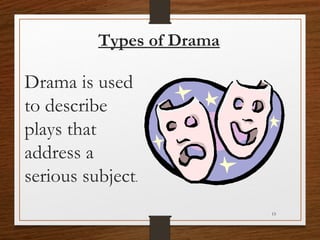
Types of Drama
Drama is used
to describe
plays that
address a
serious subject.
15
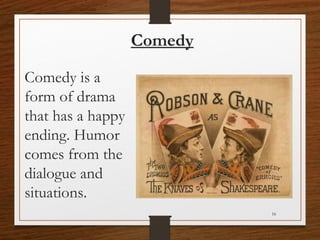
Comedy
Comedy is a
form of drama
that has a happy
ending. Humor
comes from the
dialogue and
situations.
16
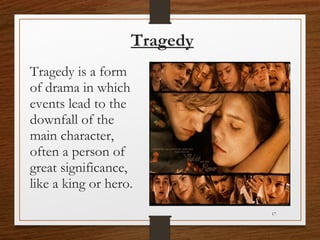
Tragedy
Tragedy is a form
of drama in which
events lead to the
downfall of the
main character,
often a person of
great significance,
like a king or hero.
17
FEW ELEMNTS OF
DRAMA
18
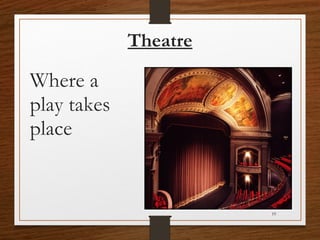
Theatre
Where a
play takes
place
19
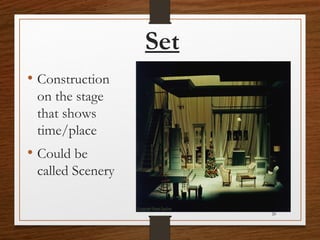
Set
• Construction
on the stage
that shows
time/place
• Could be
called Scenery
20
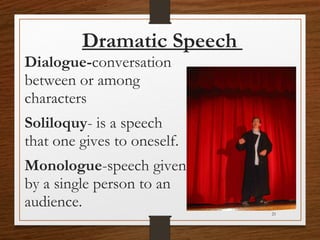
Dramatic Speech
Dialogue-conversation
between or among
characters
Soliloquy- is a speech
that one gives to oneself. 
Monologue-speech given
by a single person to an
audience. 
21
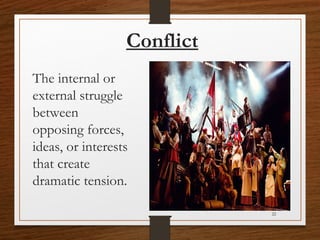
Conflict
The internal or
external struggle
between
opposing forces,
ideas, or interests
that create
dramatic tension.
22
Stage Directions
• Found in brackets [ ]
• Describe scenery and
how characters speak
• C, Center Stage
• L, Stage Left
• R, Stage Right
• U, Upstage or Rear
• D, Downstage or Front
23
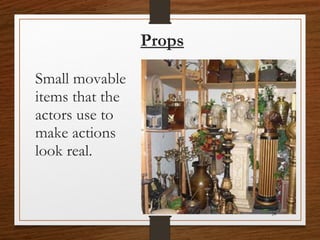
Props
Small movable
items that the
actors use to
make actions
look real.
24
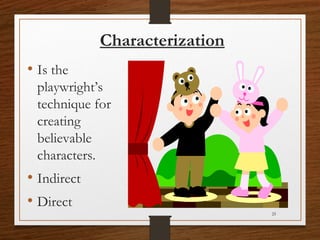
Characterization
• Is the
playwright’s
technique for
creating
believable
characters.
• Indirect
• Direct
25
THANKYOU FOR LISTENING
HOPE IT ADDED INTO YOUR
KNOWLEDGE
26

Drama

  • 1.
  • 2.
    Drama •Comes from theGreek Word, “Dran” •Means “To do” or “To Act” •The Doing/Acting Makes Drama 2
  • 3.
    Theatre • Comes fromthe term “theatron” • The place where ancient Greeks sat to watch plays, and is translated as “seeing place” 3
  • 4.
    Aristotle Aristotle (384-322 BC)was a Greek philosopher whose writings still influence us today. He was the first to write about the essential elements of drama more than 2,000 years ago. While ideas have changed slightly over the years, we still discuss Aristotle's list when talking about what makes the best drama 4
  • 5.
  • 6.
    Plot: This iswhat happens in the play. Plot refers to the action; the basic storyline of the play. Theme: While plot refers to the action of the play, theme refers to the meaning of the play. Characters: Characters are the people portrayed by the actors in the play. It is the characters who move the action, or plot, of the play forward. Dialogue: This refers to the words written by the playwright and spoken by the characters in the play. Music/Rhythm: Music featured in drama or the actors' voices as they speak. Spectacle: This refers to the visual elements of a play: sets, costumes, special effects, etc. 6
  • 7.
    Elements of Modern Drama Aristotle’slist has changed slightly, although you will notice that many of the elements remain the same. ( Characters , Plot , Theme , Dialogue remain the same ) •Convention (techniques used by the playwright to create the desired stylistic effect) •Genre (the type of play. Some examples of different genres include comedy, tragedy, mystery and historical play) •Audience (This is the group of people who watch the play)7
  • 8.
  • 9.
    There are sixstages in a plot structure. Initial incident: The event that “gets the story going” Preliminary event: Whatever takes place BEFORE the action of the play that is directly related to the play 3. Rising action: A series of events following the initial incident and leading up to the dramatic climax Climax: The turning point or high point of a story, when events can go either way Falling action: The series of events following the climax Denouement: the conclusion from the French word “unraveling” 9
  • 10.
    Some Other Elements ofDrama 1.Literary Elements 2.Technical Elements 3.Performance Elements 10
  • 11.
    Literary Elements Exposition: The“who, when, where and what” part of the play Story organization: beginning, middle, end. Conflict: The internal or external struggle between opposing forces, Suspense: A feeling of uncertainty used to build interest Language: diction or style of writing, or the speech or phrasing Style: the shaping of dramatic material, setting. Soliloquy: A speech by a single actor who is ALONE on stage Monologue: A long speech made by one actor (a monologue may be delivered alone or in the presence of others.) of the audience 11
  • 12.
    Technical Elements • Sceneryset: The theatrical equipment, such as curtains, flats, backdrops, or platforms. • Costumes: Clothing and accessories worn by actors to portray character and period. • Props: any moveable object that appears on stage during a performance, from a telephone to a train • Lights: The placement, intensity, and color of lights • Sound: effects an audience hears during performance to communicate character, context, or environment • Makeup: Costumes, wigs, and body paint etc 12
  • 13.
    Performance Elements Acting: Useof face, body, and voice to portray character Character motivation: The reasons for a character’s behavior Character analysis: the process of examining how the elements of drama – literary, technical, and performance – are used Empathy: The capacity to relate to the feelings of another Speaking: The mode of expression or delivery of lines. Breath control: Proper use of the lungs and diaphragm muscle for maximum capacity and efficiency of breath for speaking Vocal expression: How an actor uses his or her voice to convey character 13
  • 14.
    Performance Elements (Cont…) Inflection: Changein pitch or loudness of the voice. Projection: How well the voice carries to the audience. Speaking style: Mode of expression/delivery of lines. Diction: Selection and pronunciation of words; clarity of speech. Gestures: Any movement of the actor’s head, shoulder, arm, hand, leg, or foot to convey meaning. Facial expression: Physical and vocal aspects used by an actor to convey mood, feeling, or 14
  • 15.
    Types of Drama Dramais used to describe plays that address a serious subject. 15
  • 16.
    Comedy Comedy is a formof drama that has a happy ending. Humor comes from the dialogue and situations. 16
  • 17.
    Tragedy Tragedy is aform of drama in which events lead to the downfall of the main character, often a person of great significance, like a king or hero. 17
  • 18.
  • 19.
  • 20.
    Set • Construction on thestage that shows time/place • Could be called Scenery 20
  • 21.
    Dramatic Speech Dialogue-conversation between oramong characters Soliloquy- is a speech that one gives to oneself.  Monologue-speech given by a single person to an audience.  21
  • 22.
    Conflict The internal or externalstruggle between opposing forces, ideas, or interests that create dramatic tension. 22
  • 23.
    Stage Directions • Foundin brackets [ ] • Describe scenery and how characters speak • C, Center Stage • L, Stage Left • R, Stage Right • U, Upstage or Rear • D, Downstage or Front 23
  • 24.
    Props Small movable items thatthe actors use to make actions look real. 24
  • 25.
    Characterization • Is the playwright’s techniquefor creating believable characters. • Indirect • Direct 25
  • 26.
    THANKYOU FOR LISTENING HOPEIT ADDED INTO YOUR KNOWLEDGE 26