Assessment and evaluation:
Principles of language
assessment
Members: Dominguez, Diaz C. , Diaz M. , Egas, Encalada, and
Enríquez.
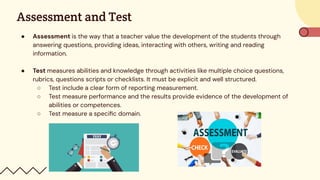
Assessment and Test
● Assessment is the way that a teacher value the development of the students through
answering questions, providing ideas, interacting with others, writing and reading
information.
● Test measures abilities and knowledge through activities like multiple choice questions,
rubrics, questions scripts or checklists. It must be explicit and well structured.
○ Test include a clear form of reporting measurement.
○ Test measure performance and the results provide evidence of the development of
abilities or competences.
○ Test measure a specific domain.
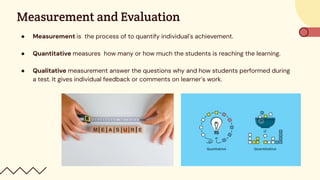
Measurement and Evaluation
● Measurement is the process of to quantify individual´s achievement.
● Quantitative measures how many or how much the students is reaching the learning.
● Qualitative measurement answer the questions why and how students performed during
a test. It gives individual feedback or comments on learner´s work.
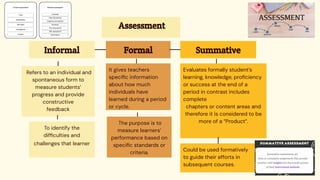
Assessment
Informal
Refers to an individual and
spontaneous form to
measure students’
progress and provide
constructive
feedback
To identify the
difficulties and
challenges that learner
Summative
Evaluates formally student’s
learning, knowledge, proficiency
or success at the end of a
period in contrast includes
complete
chapters or content areas and
therefore it is considered to be
more of a “Product”.
Could be used formatively
to guide their efforts in
subsequent courses.
Formal
It gives teachers
specific information
about how much
individuals have
learned during a period
or cycle.
The purpose is to
measure learners’
performance based on
specific standards or
criteria.
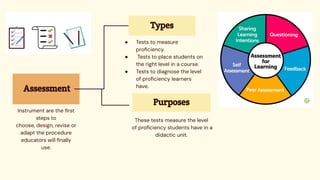
Types
● Tests to measure
proficiency.
● Tests to place students on
the right level in a course.
● Tests to diagnose the level
of proficiency learners
have.
Purposes
These tests measure the level
of proficiency students have in a
didactic unit.
Assessment
Instrument are the first
steps to
choose, design, revise or
adapt the procedure
educators will finally
use.
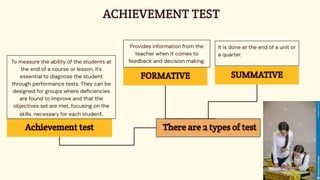
ACHIEVEMENT TEST
Achievement test
To measure the ability of the students at
the end of a course or lesson, it's
essential to diagnose the student
through performance tests. They can be
designed for groups where deficiencies
are found to improve and that the
objectives set are met, focusing on the
skills. necessary for each student.
SUMMATIVE
It is done at the end of a unit or
a quarter.
FORMATIVE
Provides information from the
teacher when it comes to
feedback and decision making.
There are 2 types of test
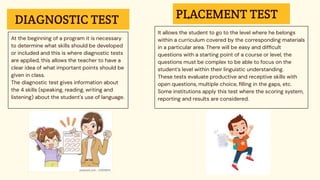
DIAGNOSTIC TEST
At the beginning of a program it is necessary
to determine what skills should be developed
or included and this is where diagnostic tests
are applied, this allows the teacher to have a
clear idea of what important points should be
given in class.
The diagnostic test gives information about
the 4 skills (speaking, reading, writing and
listening) about the student's use of language.
It allows the student to go to the level where he belongs
within a curriculum covered by the corresponding materials
in a particular area. There will be easy and difficult
questions with a starting point of a course or level, the
questions must be complex to be able to focus on the
student's level within their linguistic understanding.
These tests evaluate productive and receptive skills with
open questions, multiple choice, filling in the gaps, etc.
Some institutions apply this test where the scoring system,
reporting and results are considered.
PLACEMENT TEST
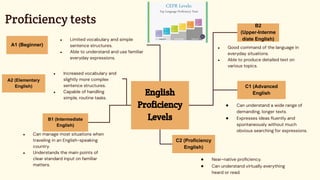
Proficiency tests
● Limited vocabulary and simple
sentence structures.
● Able to understand and use familiar
everyday expressions.
A1 (Beginner)
● Can manage most situations when
traveling in an English-speaking
country.
● Understands the main points of
clear standard input on familiar
matters.
B1 (Intermediate
English)
● Increased vocabulary and
slightly more complex
sentence structures.
● Capable of handling
simple, routine tasks.
A2 (Elementary
English)
● Near-native proficiency.
● Can understand virtually everything
heard or read.
C2 (Proficiency
English)
● Can understand a wide range of
demanding, longer texts.
● Expresses ideas fluently and
spontaneously without much
obvious searching for expressions.
C1 (Advanced
English
● Good command of the language in
everyday situations.
● Able to produce detailed text on
various topics.
B2
(Upper-Interme
diate English)
English
Proficiency
Levels
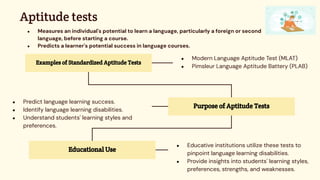
Aptitude tests
● Measures an individual's potential to learn a language, particularly a foreign or second
language, before starting a course.
● Predicts a learner's potential success in language courses.
Examples of Standardized Aptitude Tests
● Modern Language Aptitude Test (MLAT)
● Pimsleur Language Aptitude Battery (PLAB)
Educational Use
● Educative institutions utilize these tests to
pinpoint language learning disabilities.
● Provide insights into students' learning styles,
preferences, strengths, and weaknesses.
Purpose of Aptitude Tests
● Predict language learning success.
● Identify language learning disabilities.
● Understand students' learning styles and
preferences.
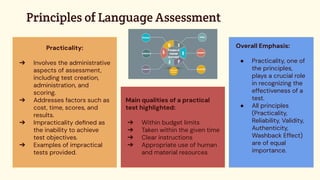
Principles of Language Assessment
Practicality:
➔ Involves the administrative
aspects of assessment,
including test creation,
administration, and
scoring.
➔ Addresses factors such as
cost, time, scores, and
results.
➔ Impracticality defined as
the inability to achieve
test objectives.
➔ Examples of impractical
tests provided.
Main qualities of a practical
test highlighted:
➔ Within budget limits
➔ Taken within the given time
➔ Clear instructions
➔ Appropriate use of human
and material resources
Overall Emphasis:
● Practicality, one of
the principles,
plays a crucial role
in recognizing the
effectiveness of a
test.
● All principles
(Practicality,
Reliability, Validity,
Authenticity,
Washback Effect)
are of equal
importance.
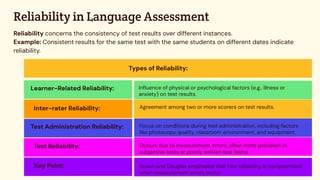
Reliability in Language Assessment
Reliability concerns the consistency of test results over different instances.
Example: Consistent results for the same test with the same students on different dates indicate
reliability.
Types of Reliability:
Learner-Related Reliability: Influence of physical or psychological factors (e.g., illness or
anxiety) on test results.
Inter-rater Reliability:
Test Administration Reliability:
Test Reliability:
Key Point:
Agreement among two or more scorers on test results.
Focus on conditions during test administration, including factors
like photocopy quality, classroom environment, and equipment.
Occurs due to measurement errors, often more prevalent in
subjective tests or poorly written test items.
Brown and Douglas emphasize that test reliability is compromised
when measurement errors occur.
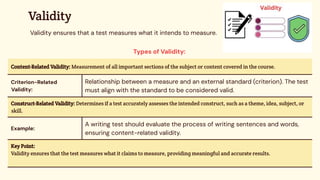
Validity
Content-Related Validity: Measurement of all important sections of the subject or content covered in the course.
Criterion-Related
Validity:
Relationship between a measure and an external standard (criterion). The test
must align with the standard to be considered valid.
Construct-Related Validity: Determines if a test accurately assesses the intended construct, such as a theme, idea, subject, or
skill.
Example:
A writing test should evaluate the process of writing sentences and words,
ensuring content-related validity.
Key Point:
Validity ensures that the test measures what it claims to measure, providing meaningful and accurate results.
Validity ensures that a test measures what it intends to measure.
Types of Validity:
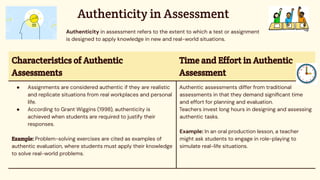
Authenticity in Assessment
Characteristics of Authentic
Assessments
Time and Effort in Authentic
Assessment
● Assignments are considered authentic if they are realistic
and replicate situations from real workplaces and personal
life.
● According to Grant Wiggins (1998), authenticity is
achieved when students are required to justify their
responses.
Example: Problem-solving exercises are cited as examples of
authentic evaluation, where students must apply their knowledge
to solve real-world problems.
Authentic assessments differ from traditional
assessments in that they demand significant time
and effort for planning and evaluation.
Teachers invest long hours in designing and assessing
authentic tasks.
Example: In an oral production lesson, a teacher
might ask students to engage in role-playing to
simulate real-life situations.
Authenticity in assessment refers to the extent to which a test or assignment
is designed to apply knowledge in new and real-world situations.
Washback Effect
The washback effect occurs when a test significantly influences the way a
professor teaches.
Teaching Practices and Summative Evaluation: Teachers may align their teaching practices closely with the format of
summative evaluations to better prepare students for examinations.
Impact of
Washback on
Teaching and
Learning
● Washback has a profound effect on both teaching and learning.
● It provides learners with insights into the test format in advance, allowing for better preparation.
● The feedback received through washback promotes language improvement among students.
Advantages of
Washback
● Students benefit from knowing the test format beforehand, reducing anxiety and enhancing
preparation.
● Washback creates a feedback loop that contributes to ongoing language development.
The relationship between assessment and teaching practices is crucial, and understanding the washback effect helps
educators optimize their teaching strategies for better student outcomes.
References
Authentic assessment. (n.d.). Center for Innovative Teaching and Learning. Retrieved December 4, 2023, from
https://citl.indiana.edu/teaching-resources/assessing-student-learning/authentic-assessment/index.html
Kagan, J. (2010, May 9). Aptitude test: Definition, how it’s used, types, and how to pass. Investopedia.
https://www.investopedia.com/terms/a/aptitude-test.asp
Fachrurrazy, M. A. (n.d.). Definitions and principles of language assessment. Ut.Ac.Id. Retrieved December 6, 2023, from
https://pustaka.ut.ac.id/lib/wp-content/uploads/pdfmk/MPBI5201-M1.pdf
Yeşilyurt, S. (2016). An attempt for the exploration of academicians’ experiences of the standard foreign language tests held
in turkey through metaphors. International Journal of Higher Education, 5(2).
https://doi.org/10.5430/ijhe.v5n2p263

Principles of language assessment

  • 1.
    Assessment and evaluation: Principlesof language assessment Members: Dominguez, Diaz C. , Diaz M. , Egas, Encalada, and Enríquez.
  • 2.
    Assessment and Test ●Assessment is the way that a teacher value the development of the students through answering questions, providing ideas, interacting with others, writing and reading information. ● Test measures abilities and knowledge through activities like multiple choice questions, rubrics, questions scripts or checklists. It must be explicit and well structured. ○ Test include a clear form of reporting measurement. ○ Test measure performance and the results provide evidence of the development of abilities or competences. ○ Test measure a specific domain.
  • 3.
    Measurement and Evaluation ●Measurement is the process of to quantify individual´s achievement. ● Quantitative measures how many or how much the students is reaching the learning. ● Qualitative measurement answer the questions why and how students performed during a test. It gives individual feedback or comments on learner´s work.
  • 4.
    Assessment Informal Refers to anindividual and spontaneous form to measure students’ progress and provide constructive feedback To identify the difficulties and challenges that learner Summative Evaluates formally student’s learning, knowledge, proficiency or success at the end of a period in contrast includes complete chapters or content areas and therefore it is considered to be more of a “Product”. Could be used formatively to guide their efforts in subsequent courses. Formal It gives teachers specific information about how much individuals have learned during a period or cycle. The purpose is to measure learners’ performance based on specific standards or criteria.
  • 5.
    Types ● Tests tomeasure proficiency. ● Tests to place students on the right level in a course. ● Tests to diagnose the level of proficiency learners have. Purposes These tests measure the level of proficiency students have in a didactic unit. Assessment Instrument are the first steps to choose, design, revise or adapt the procedure educators will finally use.
  • 6.
    ACHIEVEMENT TEST Achievement test Tomeasure the ability of the students at the end of a course or lesson, it's essential to diagnose the student through performance tests. They can be designed for groups where deficiencies are found to improve and that the objectives set are met, focusing on the skills. necessary for each student. SUMMATIVE It is done at the end of a unit or a quarter. FORMATIVE Provides information from the teacher when it comes to feedback and decision making. There are 2 types of test
  • 7.
    DIAGNOSTIC TEST At thebeginning of a program it is necessary to determine what skills should be developed or included and this is where diagnostic tests are applied, this allows the teacher to have a clear idea of what important points should be given in class. The diagnostic test gives information about the 4 skills (speaking, reading, writing and listening) about the student's use of language. It allows the student to go to the level where he belongs within a curriculum covered by the corresponding materials in a particular area. There will be easy and difficult questions with a starting point of a course or level, the questions must be complex to be able to focus on the student's level within their linguistic understanding. These tests evaluate productive and receptive skills with open questions, multiple choice, filling in the gaps, etc. Some institutions apply this test where the scoring system, reporting and results are considered. PLACEMENT TEST
  • 8.
    Proficiency tests ● Limitedvocabulary and simple sentence structures. ● Able to understand and use familiar everyday expressions. A1 (Beginner) ● Can manage most situations when traveling in an English-speaking country. ● Understands the main points of clear standard input on familiar matters. B1 (Intermediate English) ● Increased vocabulary and slightly more complex sentence structures. ● Capable of handling simple, routine tasks. A2 (Elementary English) ● Near-native proficiency. ● Can understand virtually everything heard or read. C2 (Proficiency English) ● Can understand a wide range of demanding, longer texts. ● Expresses ideas fluently and spontaneously without much obvious searching for expressions. C1 (Advanced English ● Good command of the language in everyday situations. ● Able to produce detailed text on various topics. B2 (Upper-Interme diate English) English Proficiency Levels
  • 9.
    Aptitude tests ● Measuresan individual's potential to learn a language, particularly a foreign or second language, before starting a course. ● Predicts a learner's potential success in language courses. Examples of Standardized Aptitude Tests ● Modern Language Aptitude Test (MLAT) ● Pimsleur Language Aptitude Battery (PLAB) Educational Use ● Educative institutions utilize these tests to pinpoint language learning disabilities. ● Provide insights into students' learning styles, preferences, strengths, and weaknesses. Purpose of Aptitude Tests ● Predict language learning success. ● Identify language learning disabilities. ● Understand students' learning styles and preferences.
  • 10.
    Principles of LanguageAssessment Practicality: ➔ Involves the administrative aspects of assessment, including test creation, administration, and scoring. ➔ Addresses factors such as cost, time, scores, and results. ➔ Impracticality defined as the inability to achieve test objectives. ➔ Examples of impractical tests provided. Main qualities of a practical test highlighted: ➔ Within budget limits ➔ Taken within the given time ➔ Clear instructions ➔ Appropriate use of human and material resources Overall Emphasis: ● Practicality, one of the principles, plays a crucial role in recognizing the effectiveness of a test. ● All principles (Practicality, Reliability, Validity, Authenticity, Washback Effect) are of equal importance.
  • 11.
    Reliability in LanguageAssessment Reliability concerns the consistency of test results over different instances. Example: Consistent results for the same test with the same students on different dates indicate reliability. Types of Reliability: Learner-Related Reliability: Influence of physical or psychological factors (e.g., illness or anxiety) on test results. Inter-rater Reliability: Test Administration Reliability: Test Reliability: Key Point: Agreement among two or more scorers on test results. Focus on conditions during test administration, including factors like photocopy quality, classroom environment, and equipment. Occurs due to measurement errors, often more prevalent in subjective tests or poorly written test items. Brown and Douglas emphasize that test reliability is compromised when measurement errors occur.
  • 12.
    Validity Content-Related Validity: Measurementof all important sections of the subject or content covered in the course. Criterion-Related Validity: Relationship between a measure and an external standard (criterion). The test must align with the standard to be considered valid. Construct-Related Validity: Determines if a test accurately assesses the intended construct, such as a theme, idea, subject, or skill. Example: A writing test should evaluate the process of writing sentences and words, ensuring content-related validity. Key Point: Validity ensures that the test measures what it claims to measure, providing meaningful and accurate results. Validity ensures that a test measures what it intends to measure. Types of Validity:
  • 13.
    Authenticity in Assessment Characteristicsof Authentic Assessments Time and Effort in Authentic Assessment ● Assignments are considered authentic if they are realistic and replicate situations from real workplaces and personal life. ● According to Grant Wiggins (1998), authenticity is achieved when students are required to justify their responses. Example: Problem-solving exercises are cited as examples of authentic evaluation, where students must apply their knowledge to solve real-world problems. Authentic assessments differ from traditional assessments in that they demand significant time and effort for planning and evaluation. Teachers invest long hours in designing and assessing authentic tasks. Example: In an oral production lesson, a teacher might ask students to engage in role-playing to simulate real-life situations. Authenticity in assessment refers to the extent to which a test or assignment is designed to apply knowledge in new and real-world situations.
  • 14.
    Washback Effect The washbackeffect occurs when a test significantly influences the way a professor teaches. Teaching Practices and Summative Evaluation: Teachers may align their teaching practices closely with the format of summative evaluations to better prepare students for examinations. Impact of Washback on Teaching and Learning ● Washback has a profound effect on both teaching and learning. ● It provides learners with insights into the test format in advance, allowing for better preparation. ● The feedback received through washback promotes language improvement among students. Advantages of Washback ● Students benefit from knowing the test format beforehand, reducing anxiety and enhancing preparation. ● Washback creates a feedback loop that contributes to ongoing language development. The relationship between assessment and teaching practices is crucial, and understanding the washback effect helps educators optimize their teaching strategies for better student outcomes.
  • 15.
    References Authentic assessment. (n.d.).Center for Innovative Teaching and Learning. Retrieved December 4, 2023, from https://citl.indiana.edu/teaching-resources/assessing-student-learning/authentic-assessment/index.html Kagan, J. (2010, May 9). Aptitude test: Definition, how it’s used, types, and how to pass. Investopedia. https://www.investopedia.com/terms/a/aptitude-test.asp Fachrurrazy, M. A. (n.d.). Definitions and principles of language assessment. Ut.Ac.Id. Retrieved December 6, 2023, from https://pustaka.ut.ac.id/lib/wp-content/uploads/pdfmk/MPBI5201-M1.pdf Yeşilyurt, S. (2016). An attempt for the exploration of academicians’ experiences of the standard foreign language tests held in turkey through metaphors. International Journal of Higher Education, 5(2). https://doi.org/10.5430/ijhe.v5n2p263