

ASSESSMENT
CONCEPTS AND
ISSUES
A.P. TACDERAS
Testing. Assessment. Evaluation. Teaching
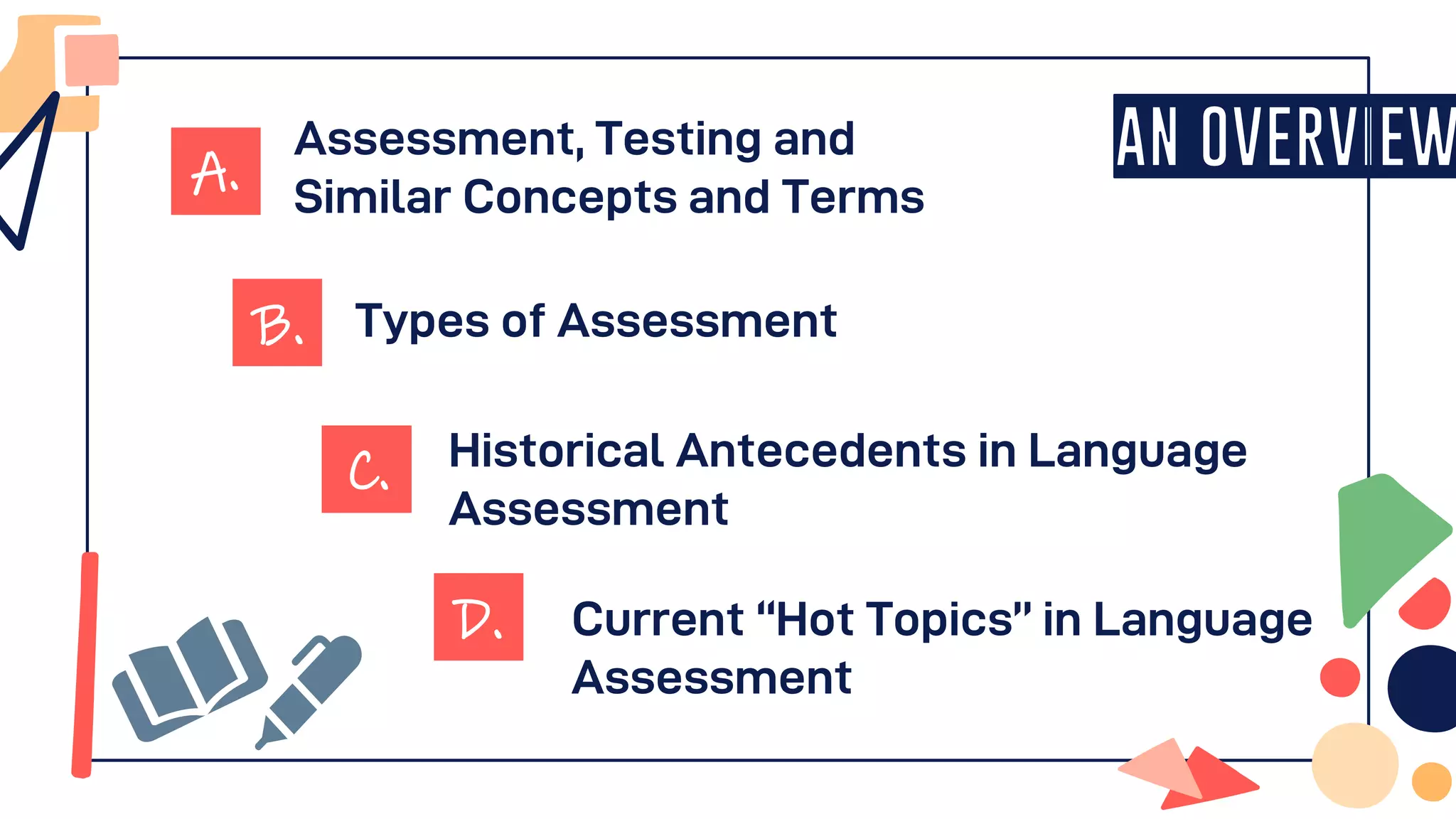
A.
Assessment, Testing and
Similar Concepts and Terms
AN OVERVIEW
Types of Assessment
Historical Antecedents in Language
Assessment
Current “Hot Topics” in Language
Assessment
B.
C.
C.
D.
INTRODUCTION
Language Assessment in the
Teaching-Learning Process
Assessment,
& Similar
Concepts
AAssessment • Testing • Measurement •
Evaluation • Learning
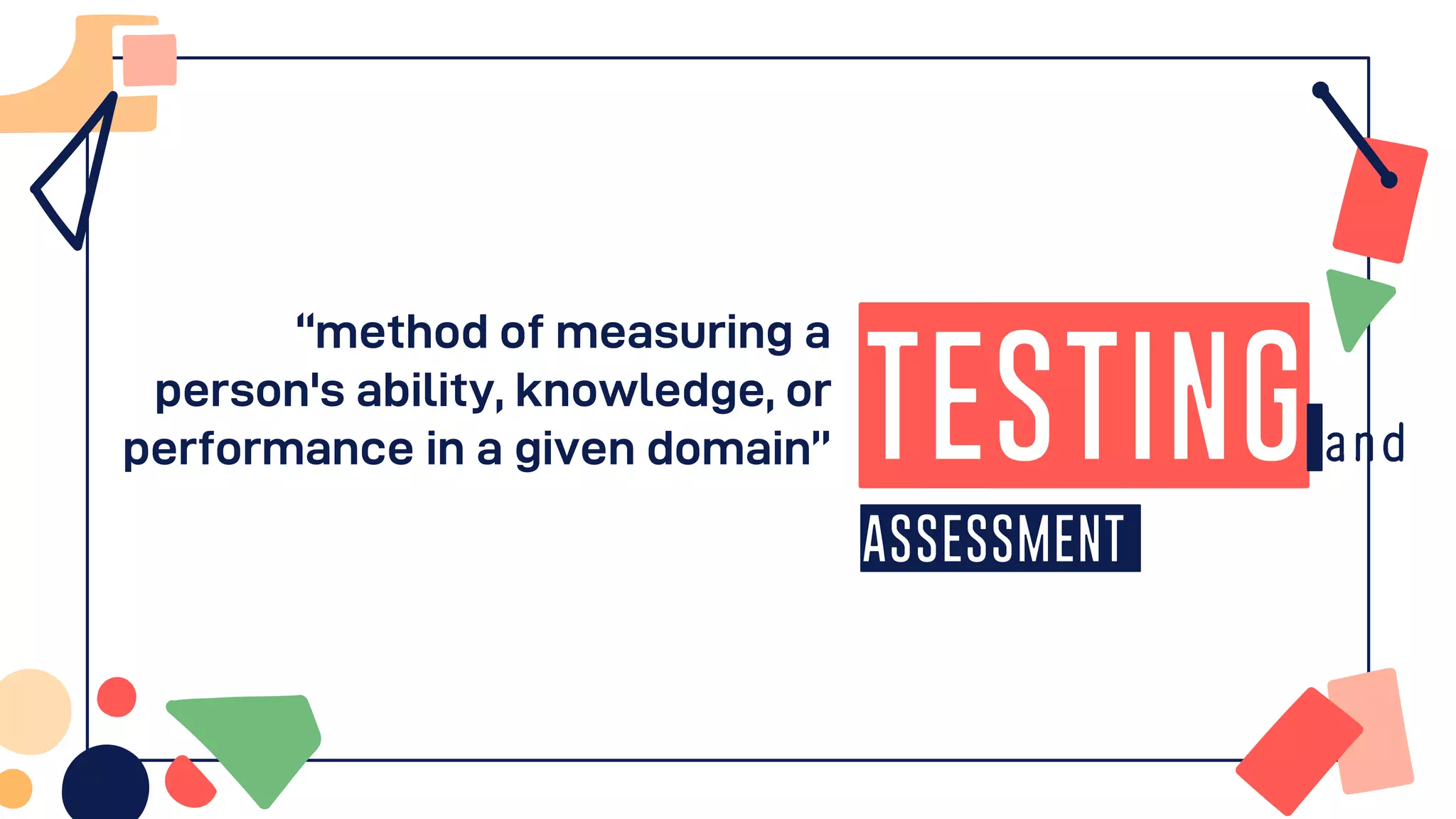
Testing
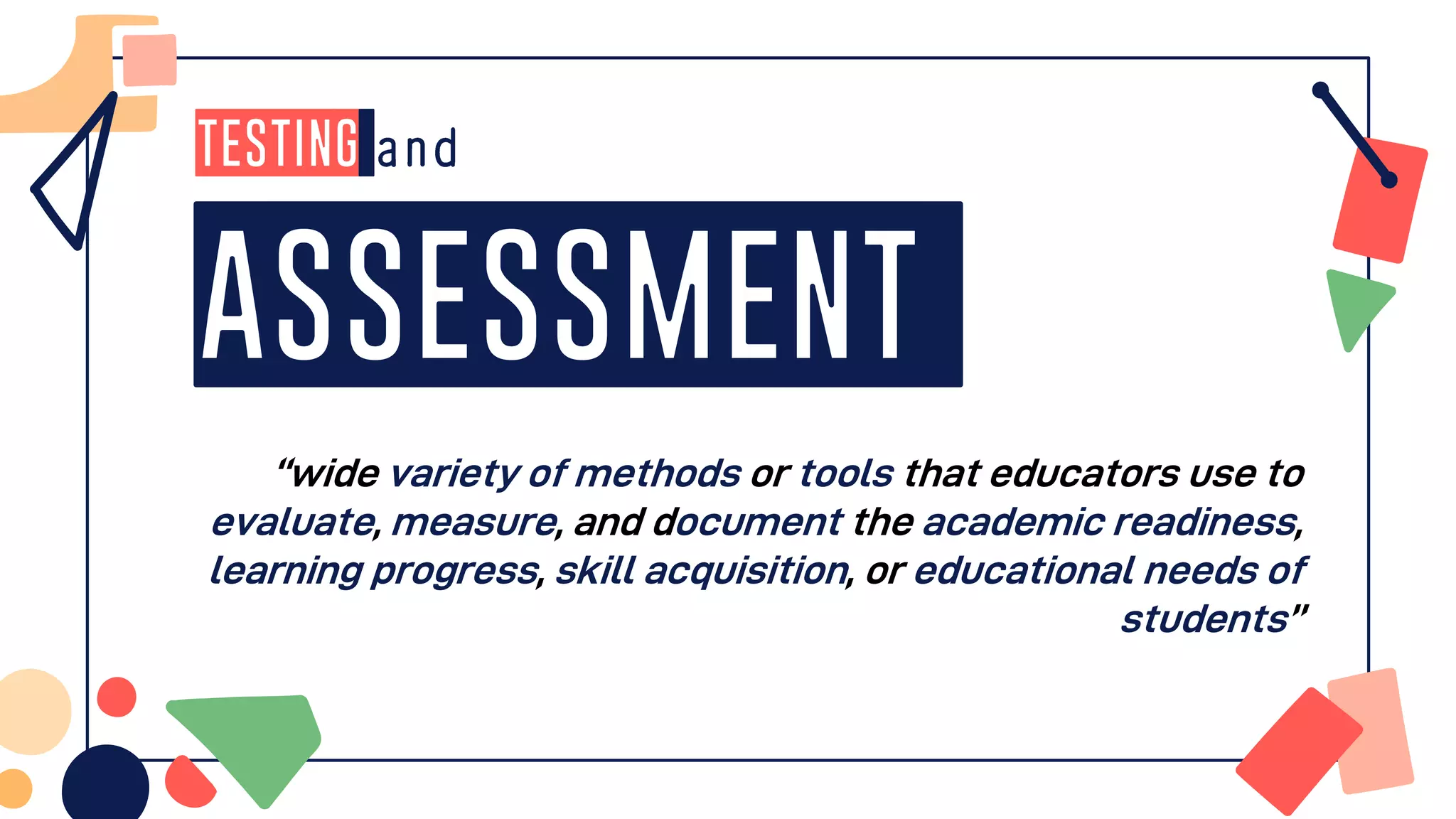
Assessment
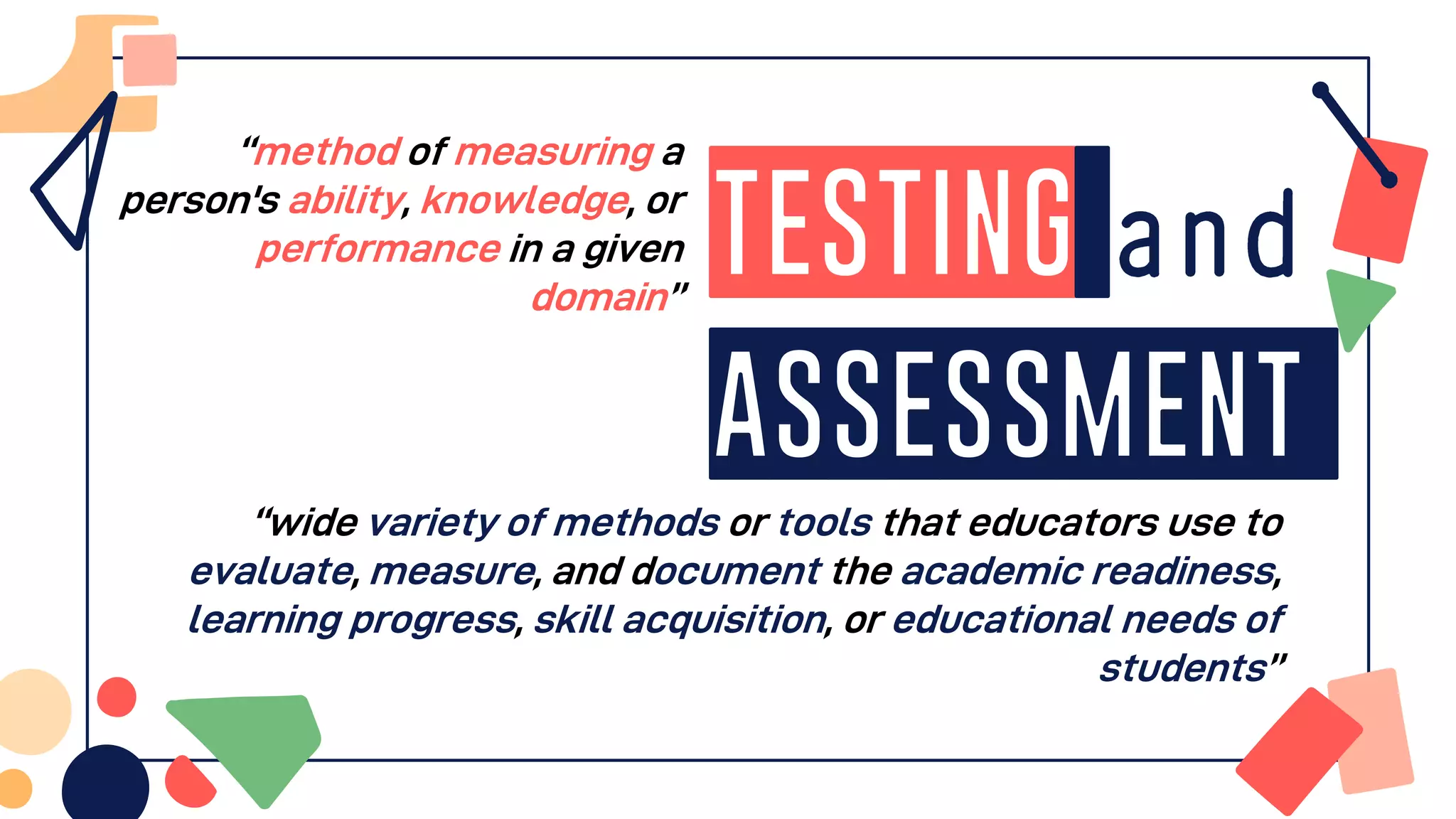
“method of measuring a
person's ability, knowledge, or
performance in a given
domain”
“wide variety of methods or tools that educators use to
evaluate, measure, and document the academic readiness,
learning progress, skill acquisition, or educational needs of
students”
“method of measuring a
person's ability, knowledge, or
performance in a given domain” Testing
Assessment
Testing
Assessment
“wide variety of methods or tools that educators use to
evaluate, measure, and document the academic readiness,
learning progress, skill acquisition, or educational needs of
students”
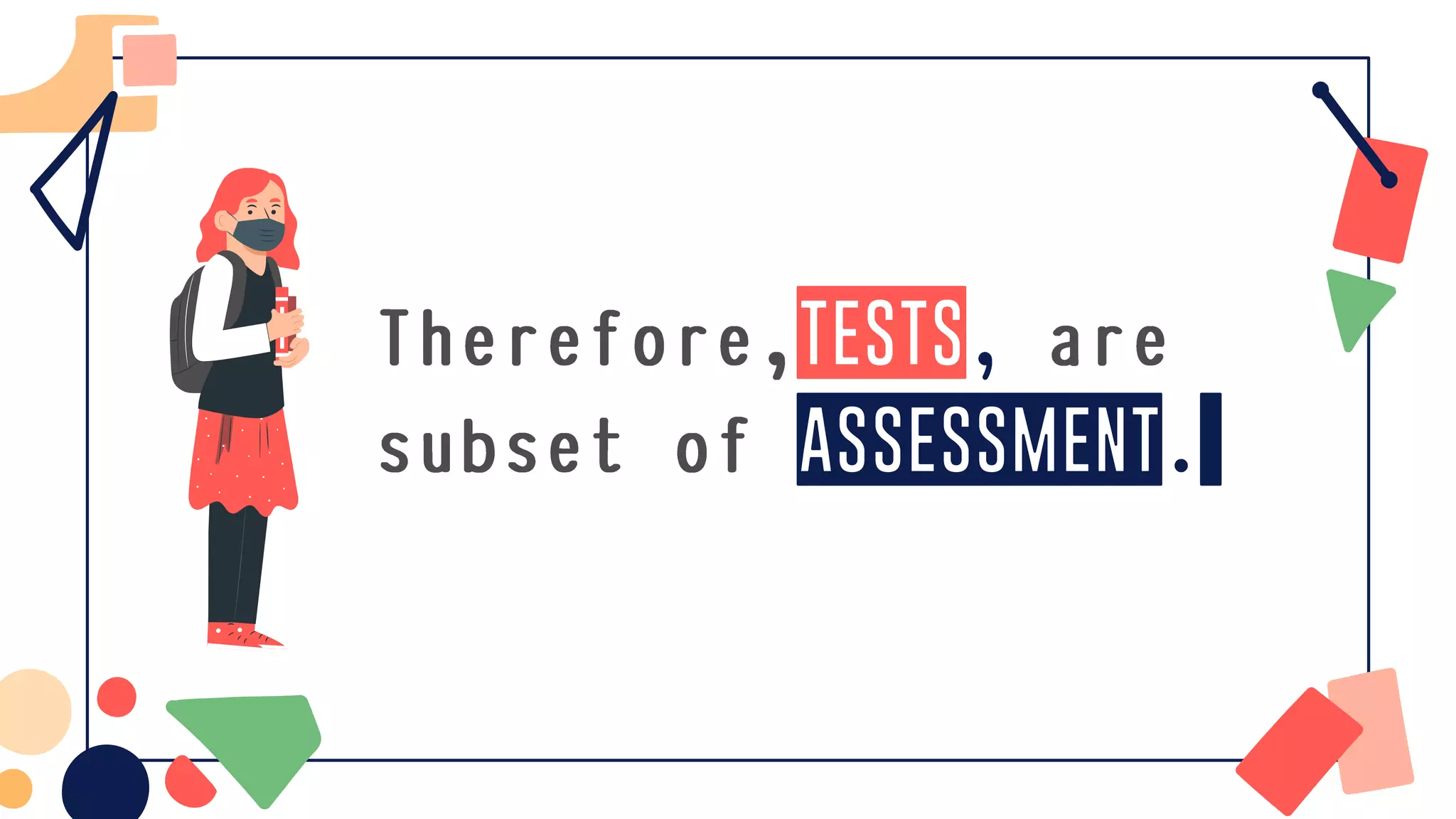
Tests
Assessment
MEASUREMENT
EVALUATION
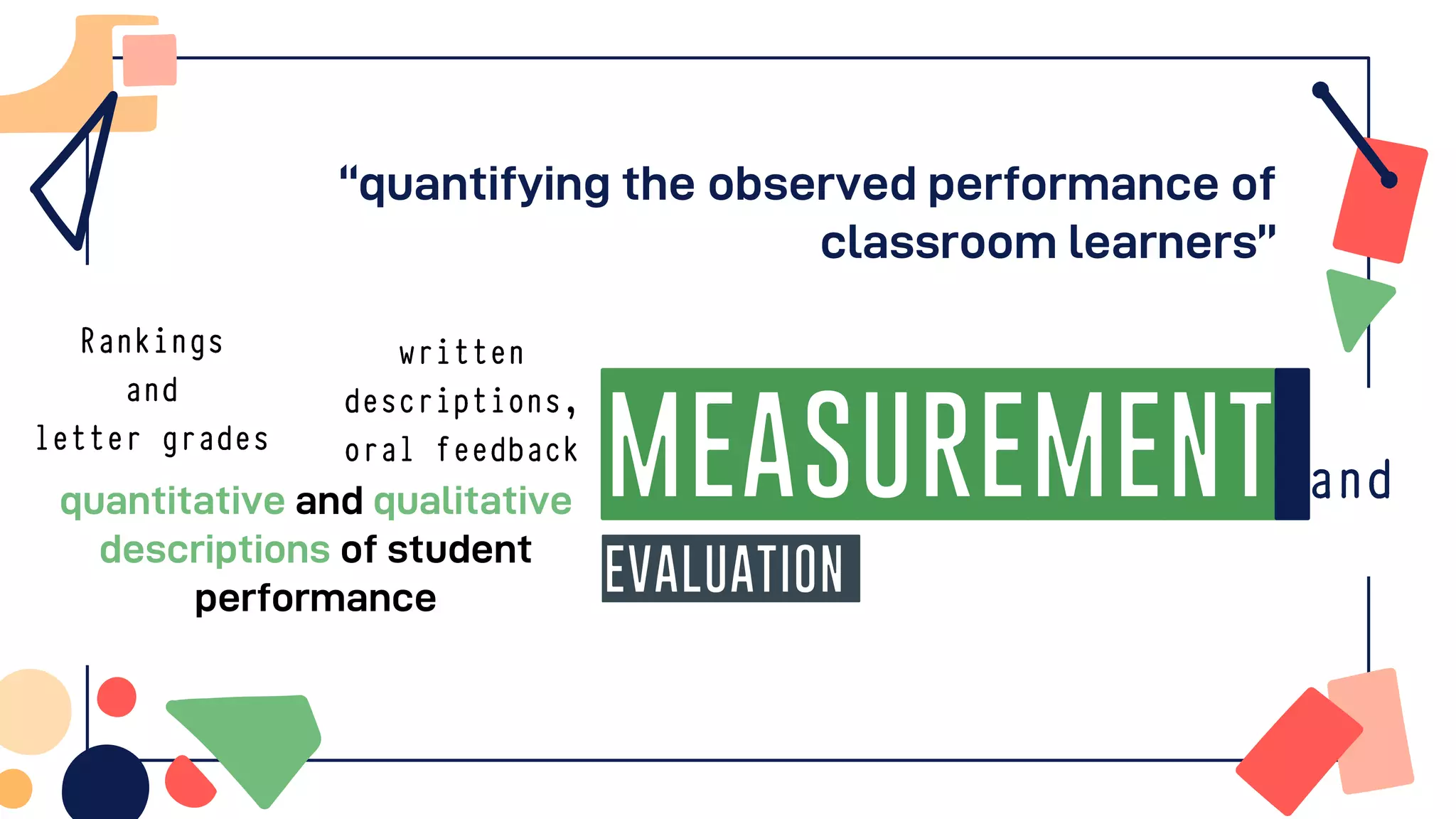
“quantifying the observed performance of
classroom learners”
quantitative and qualitative
descriptions of student
performance
MEASUREMENT
EVALUATION
MEASUREMENT
EVALUATION
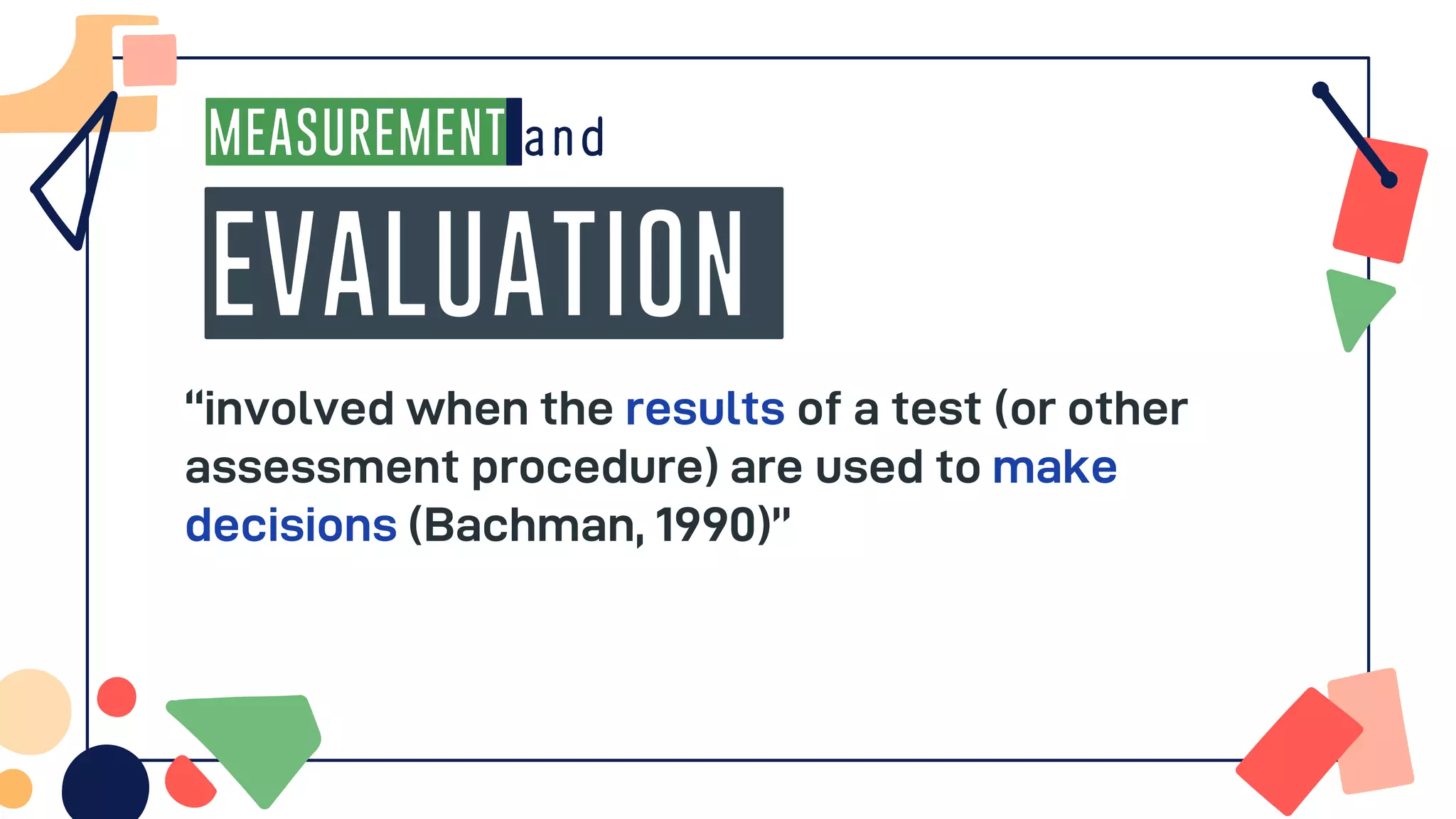
“involved when the results of a test (or other
assessment procedure) are used to make
decisions (Bachman, 1990)”
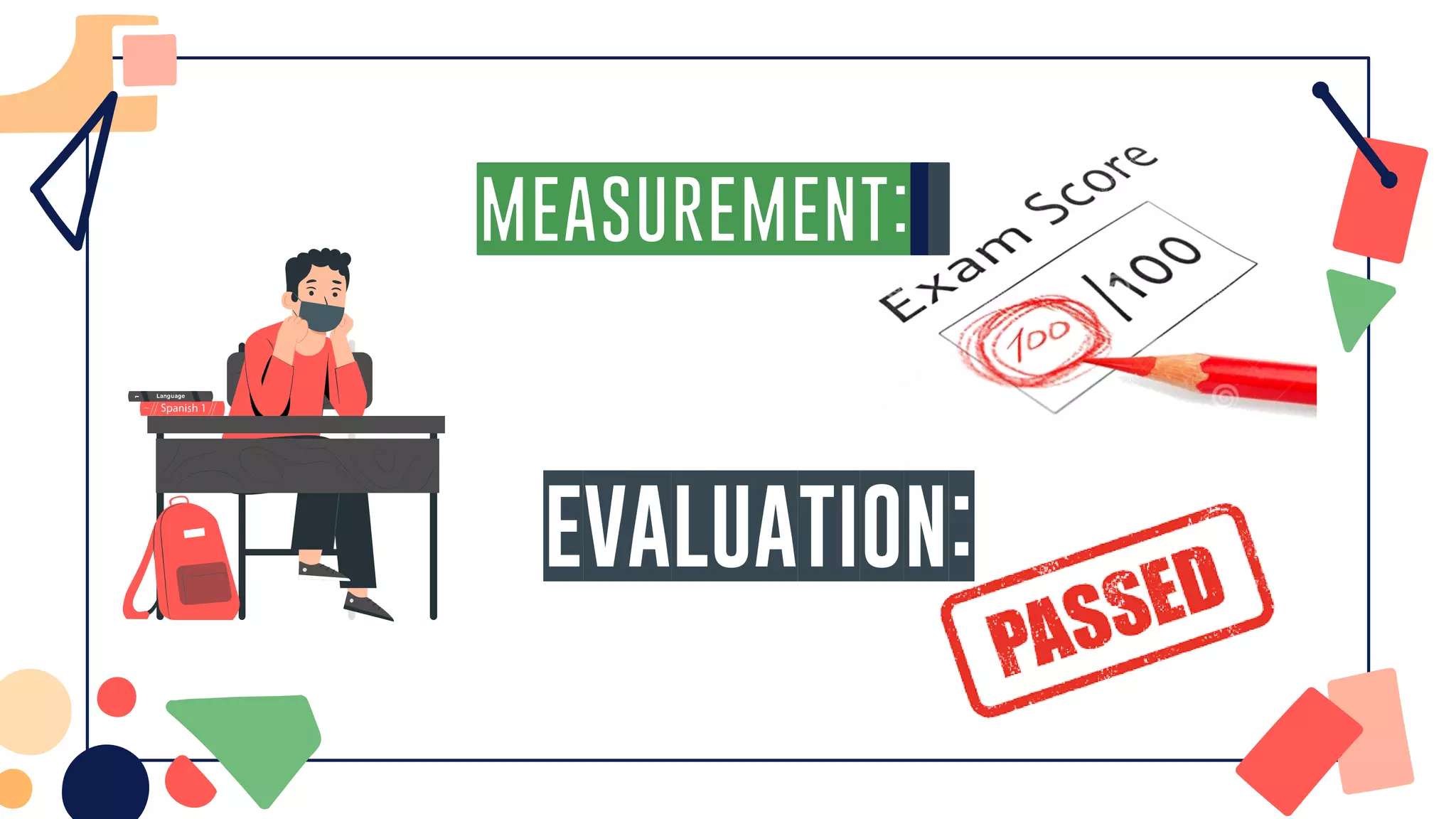
EVALUATION:
MEASUREMENT:
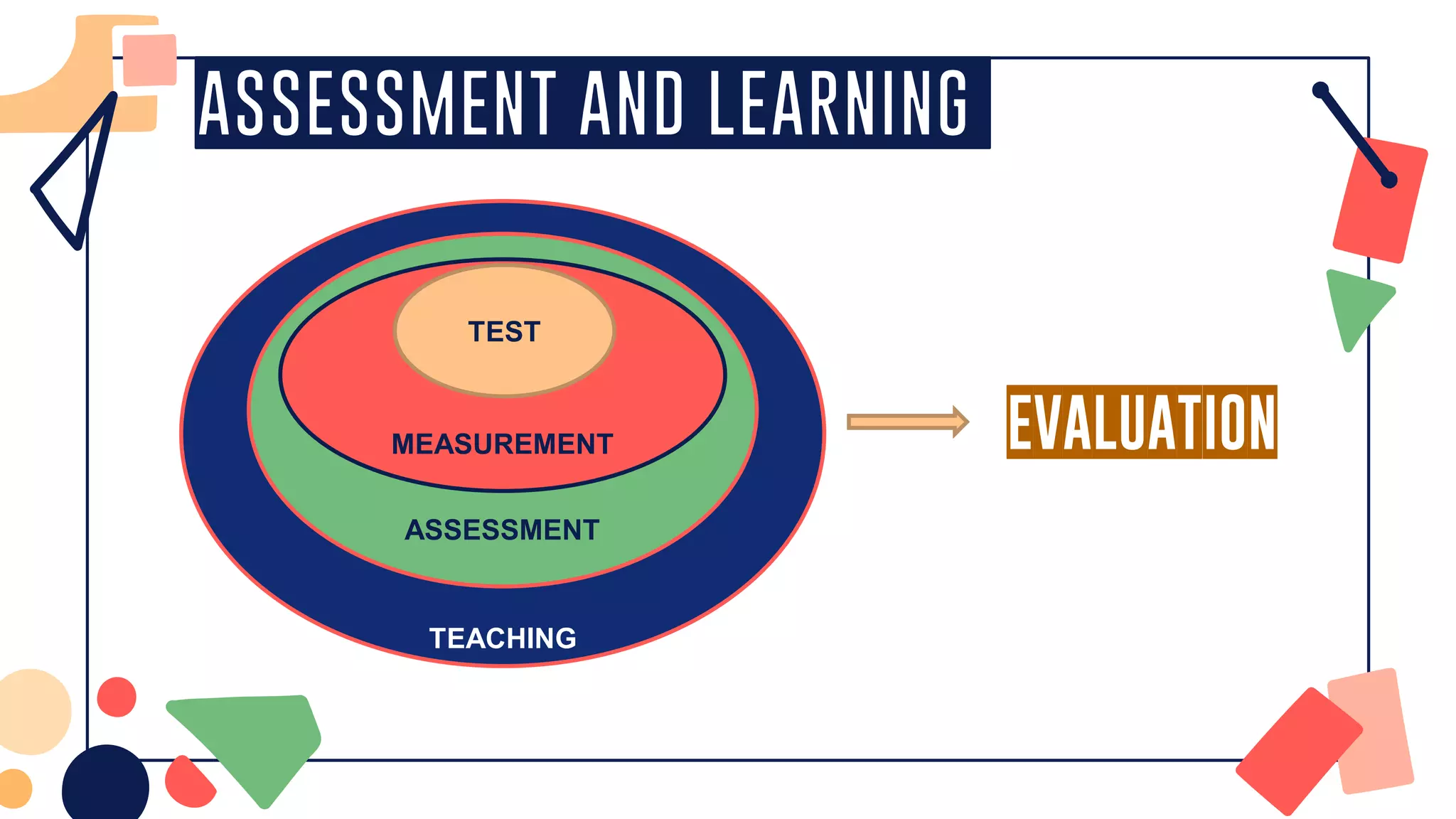
Assessment and Learning
TEACHING
ASSESSMENT
MEASUREMENT
TEST
EVALUATION
Types of
Assessment
BFormal and Informal • Formative and
Summative • Norm-Reference &
Criterion-Referenced
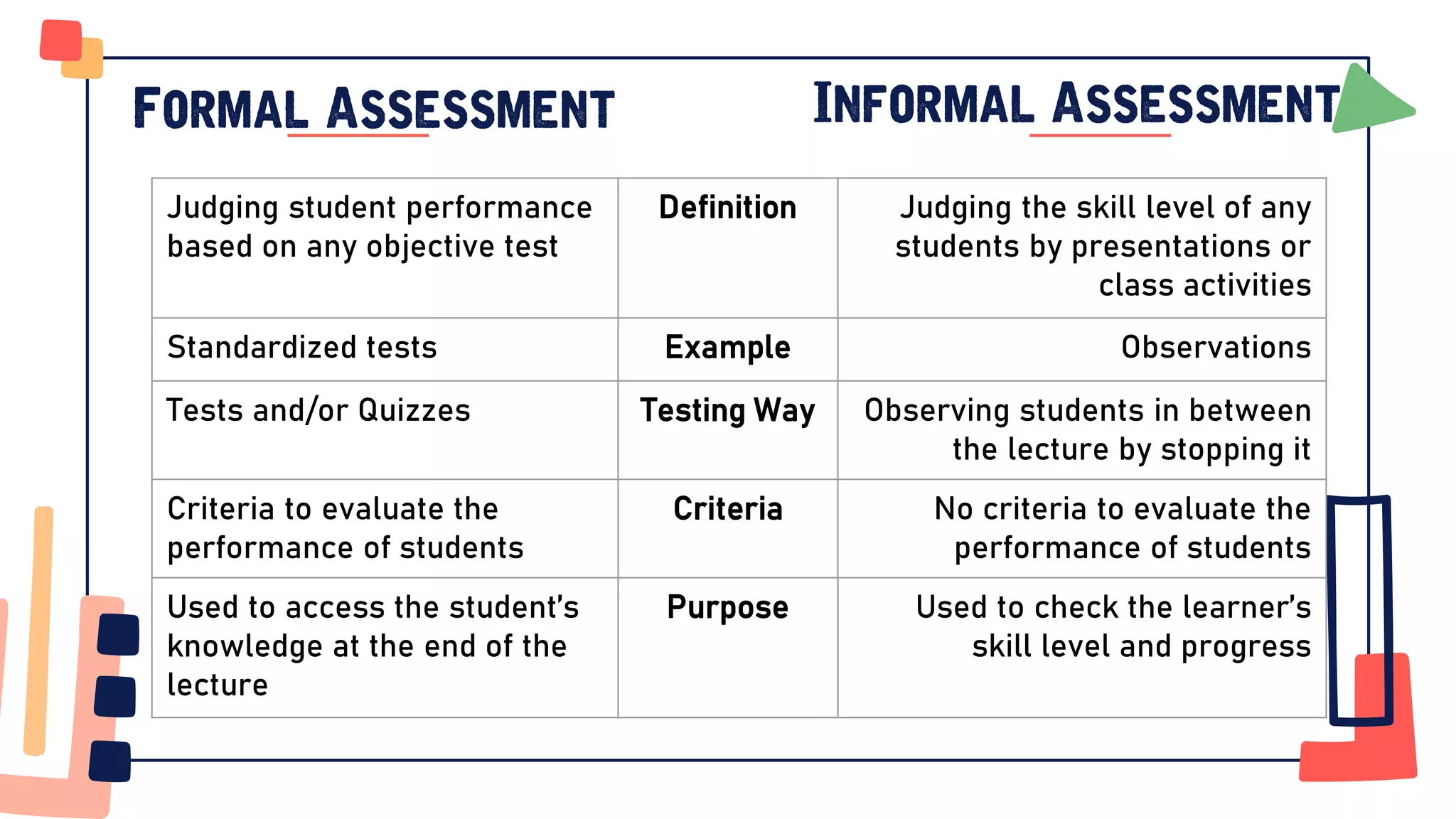
Judging student performance
based on any objective test
Definition Judging the skill level of any
students by presentations or
class activities
Standardized tests Example Observations
Tests and/or Quizzes Testing Way Observing students in between
the lecture by stopping it
Criteria to evaluate the
performance of students
Criteria No criteria to evaluate the
performance of students
Used to access the student’s
knowledge at the end of the
lecture
Purpose Used to check the learner’s
skill level and progress
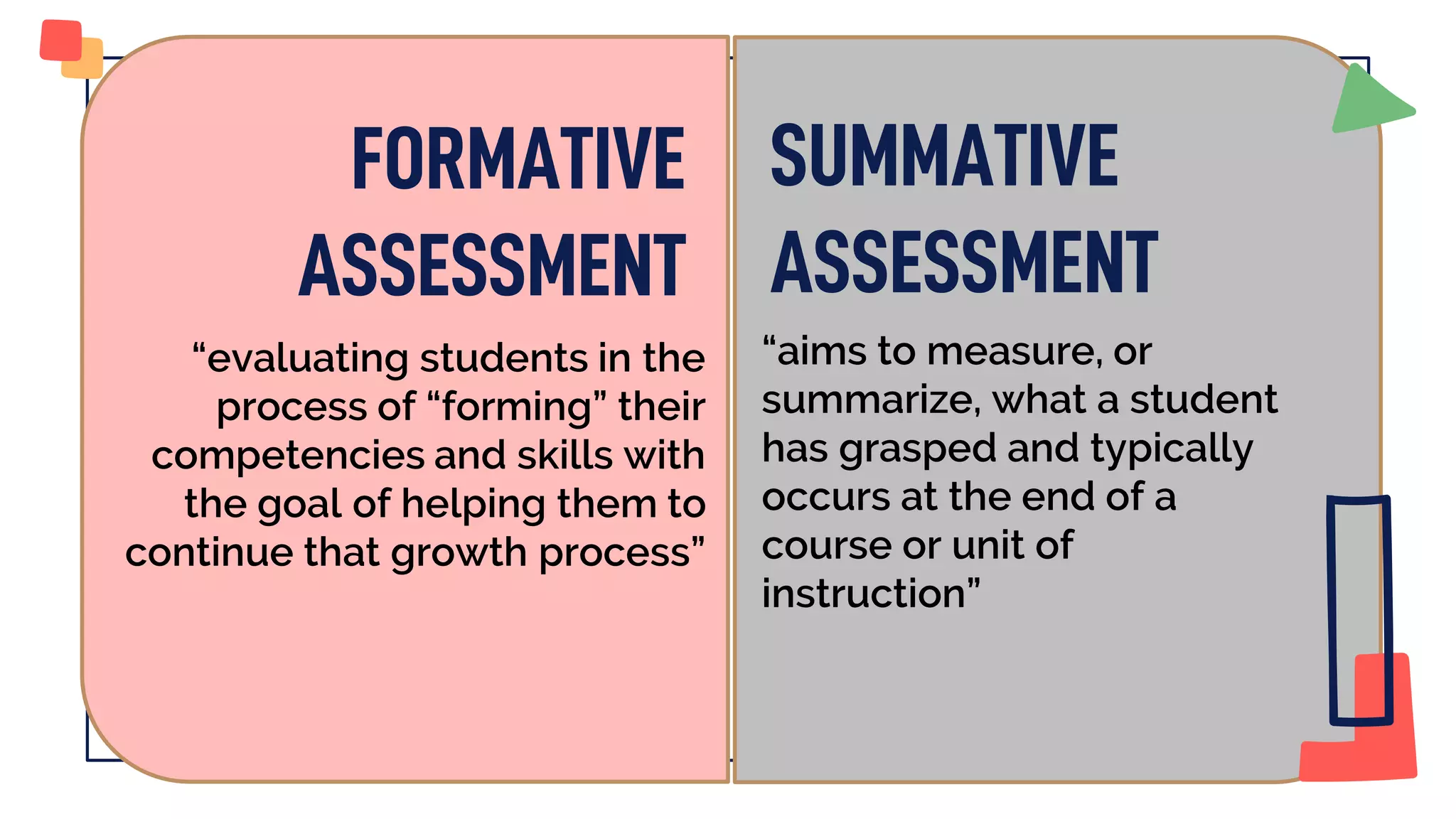
FORMATIVE
ASSESSMENT
“evaluating students in the
process of “forming” their
competencies and skills with
the goal of helping them to
continue that growth process”
“aims to measure, or
summarize, what a student
has grasped and typically
occurs at the end of a
course or unit of
instruction”
SUMMATIVE
ASSESSMENT
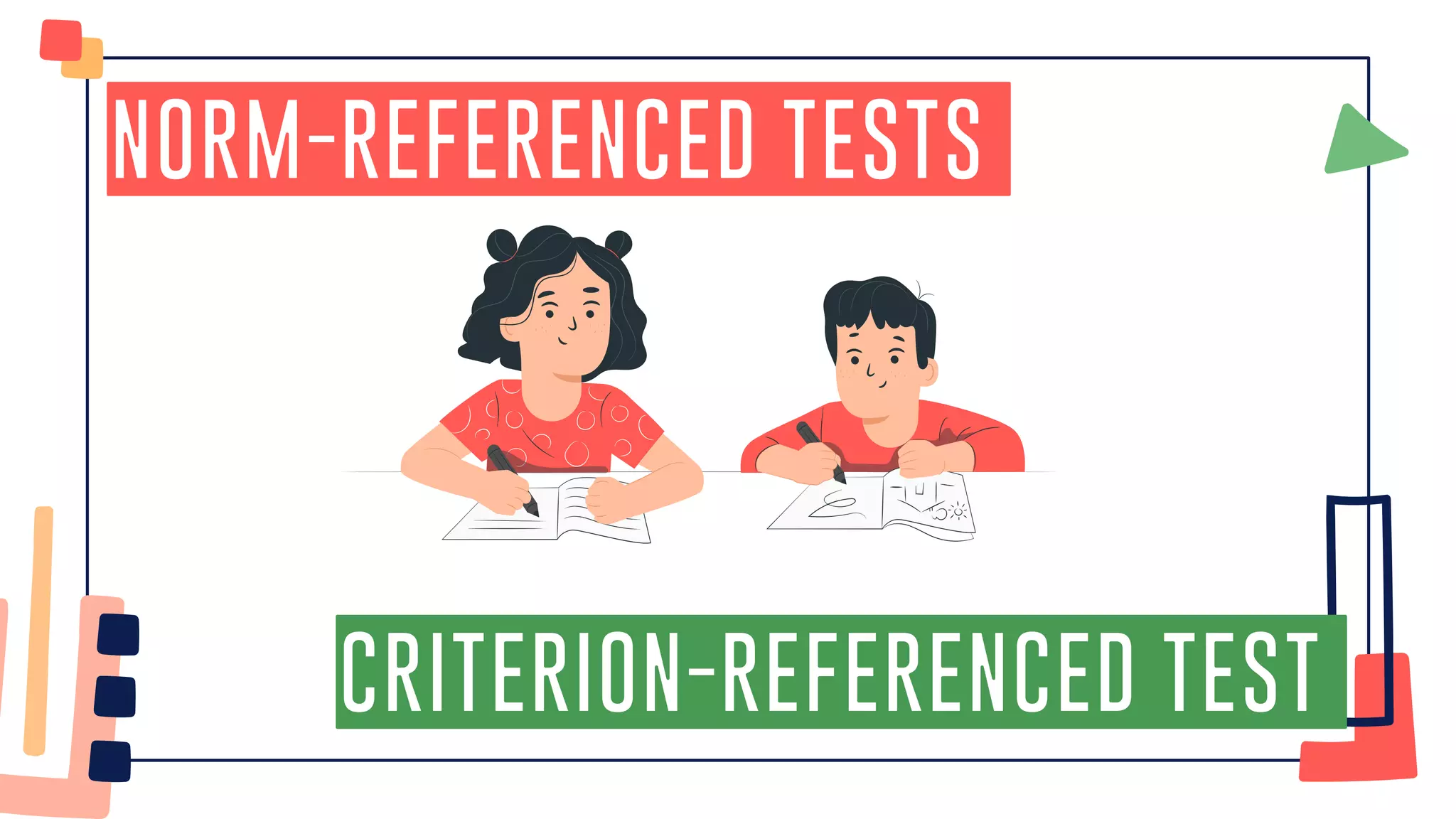
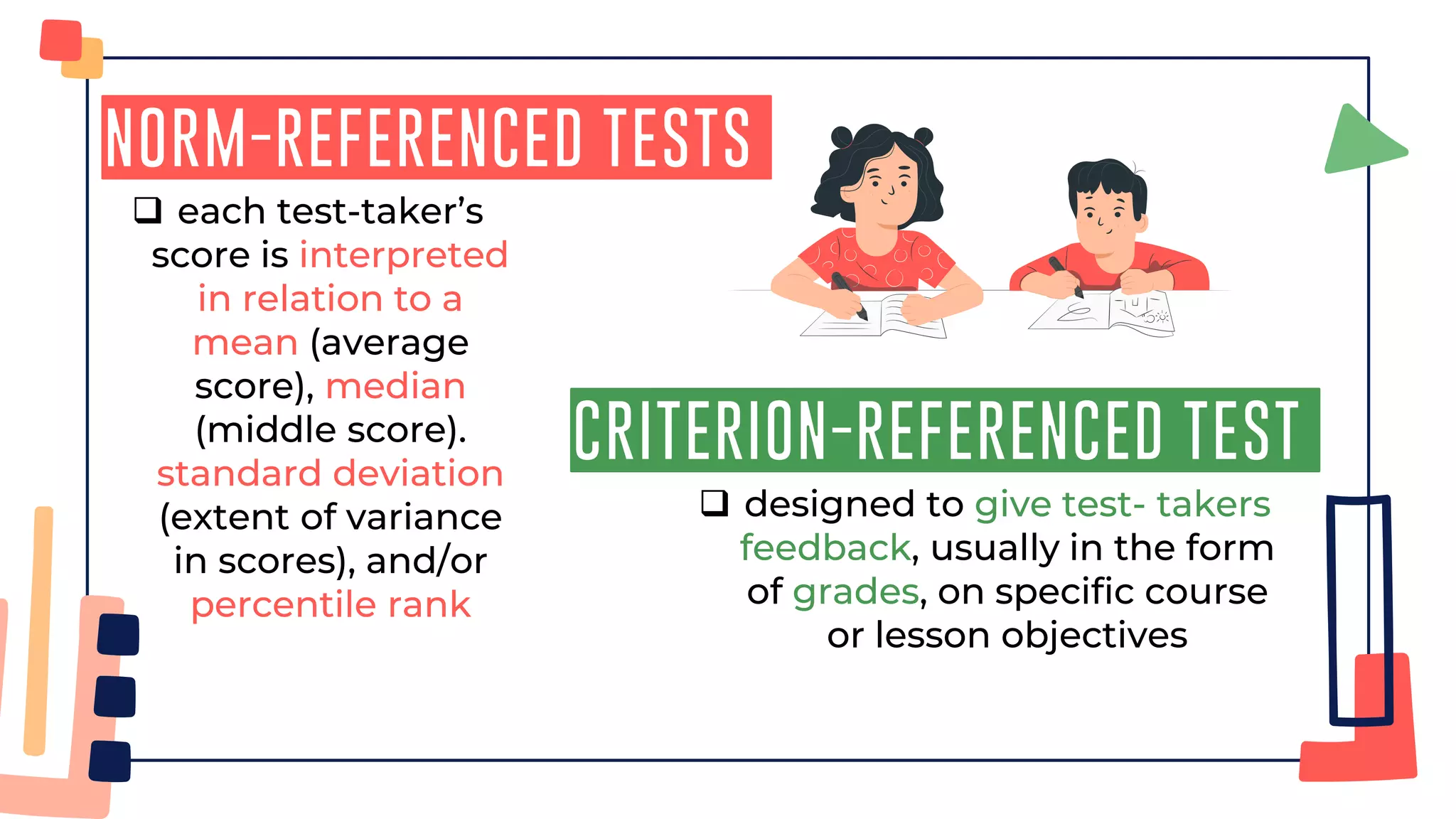
Norm-Referenced Tests
Criterion-Referenced Test
Norm-Referenced Tests
Criterion-Referenced Test
❑ each test-taker’s
score is interpreted
in relation to a
mean (average
score), median
(middle score).
standard deviation
(extent of variance
in scores), and/or
percentile rank
❑ designed to give test- takers
feedback, usually in the form
of grades, on specific course
or lesson objectives
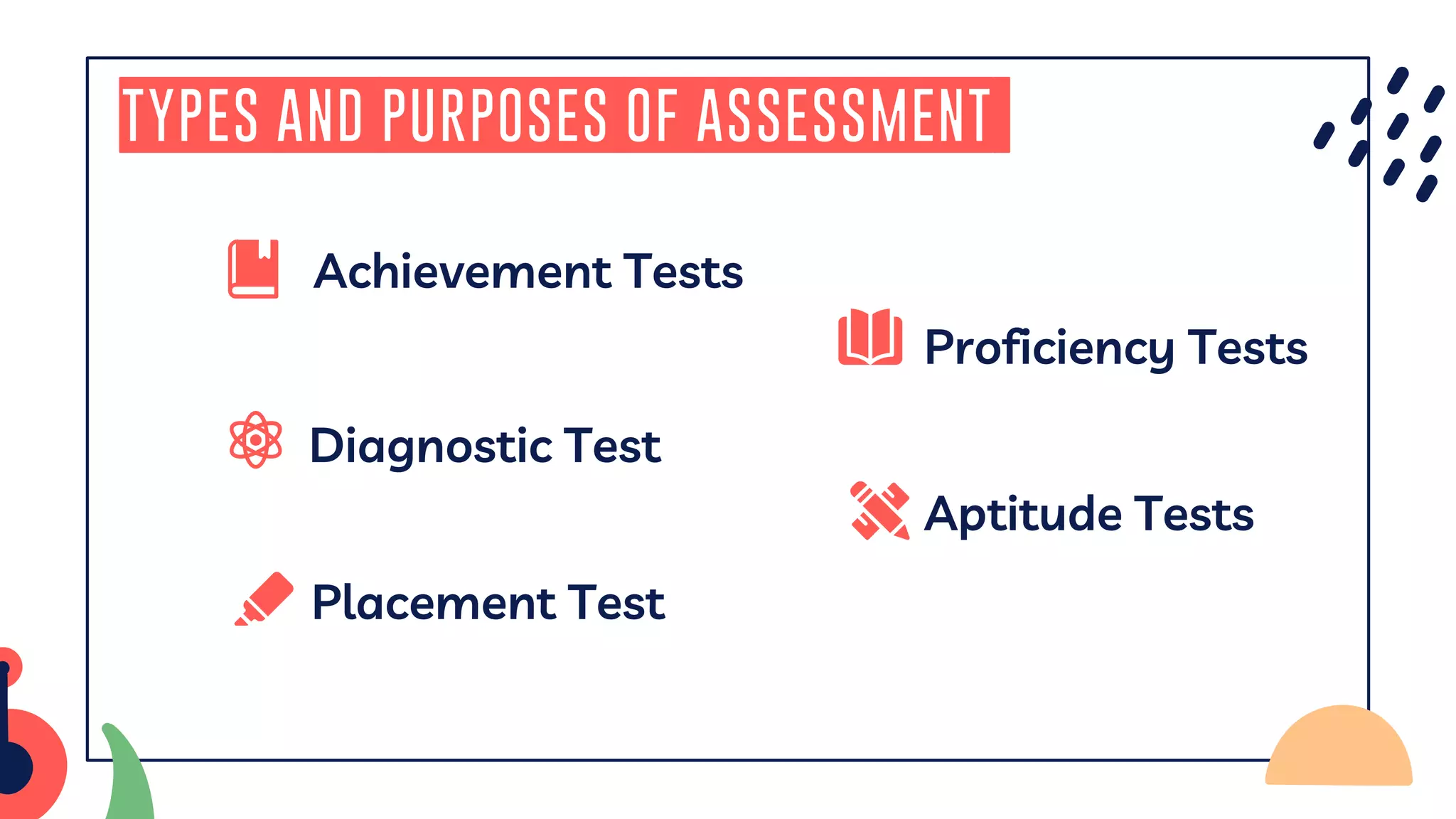
Diagnostic Test
Types and Purposes of Assessment
Aptitude Tests
Placement Test
Achievement Tests
Proficiency Tests
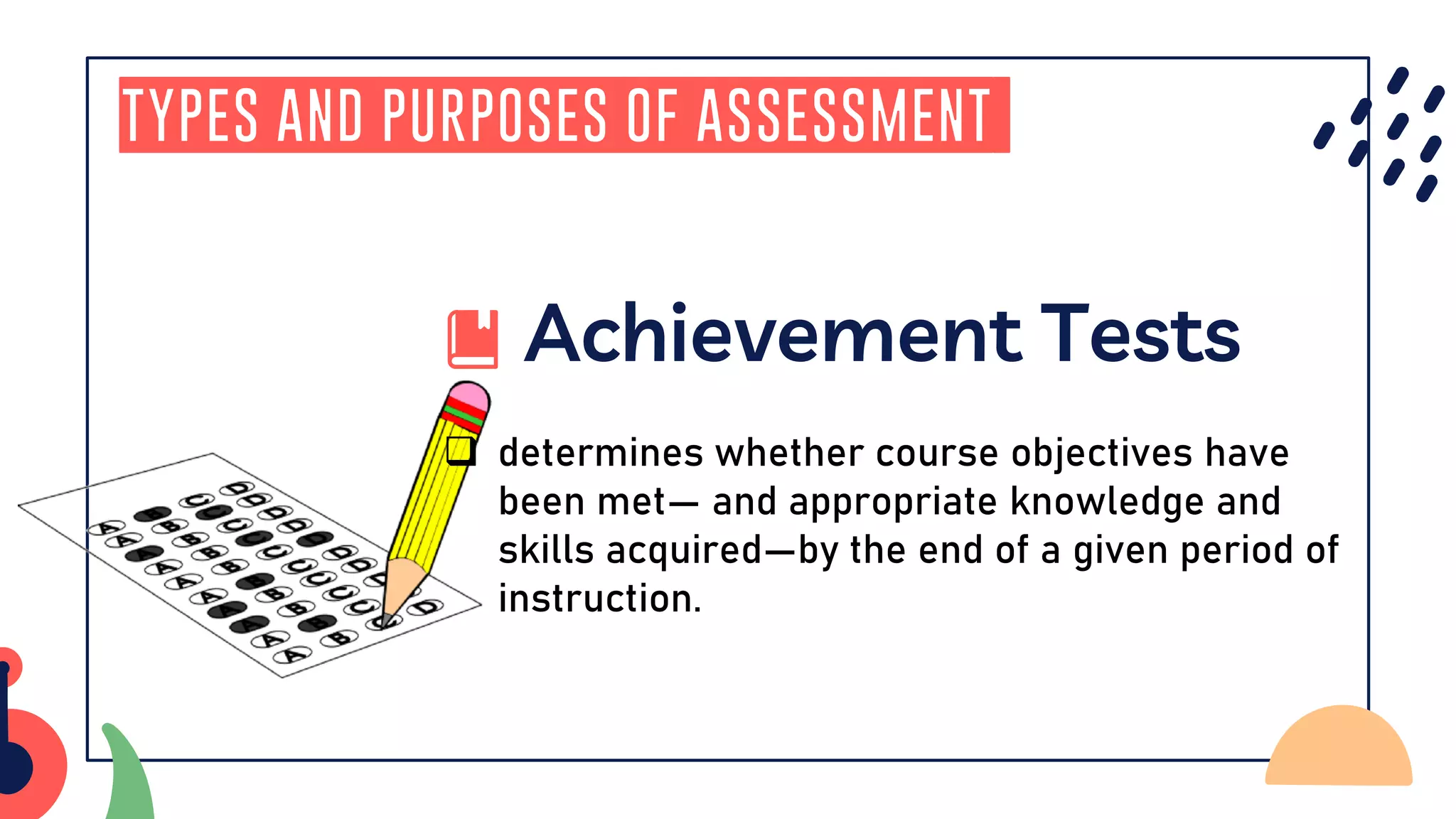
Types and Purposes of Assessment
Achievement Tests
❑ determines whether course objectives have
been met— and appropriate knowledge and
skills acquired—by the end of a given period of
instruction.
Diagnostic Test
Types and Purposes of Assessment
Achievement Tests
❑ identifies aspects of a language that a student
needs to develop or that a course should include
Diagnostic Test
Types and Purposes of Assessment
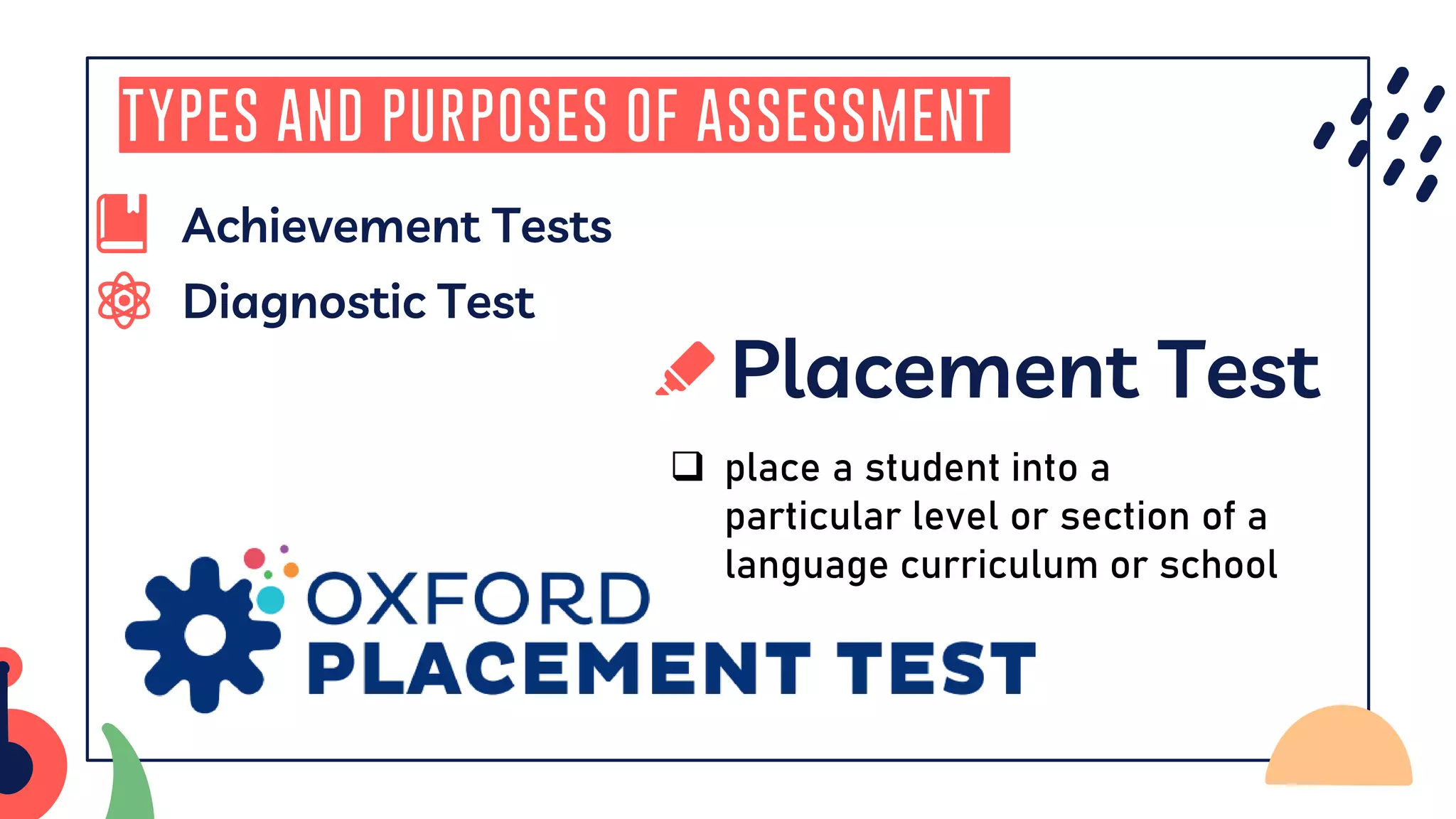
Placement Test
❑ place a student into a
particular level or section of a
language curriculum or school
Achievement Tests
Types and Purposes of Assessment
Placement Test
Proficiency Tests
❑ aims to test global
competence in a language
Diagnostic Test
Achievement Tests
Types and Purposes of Assessment
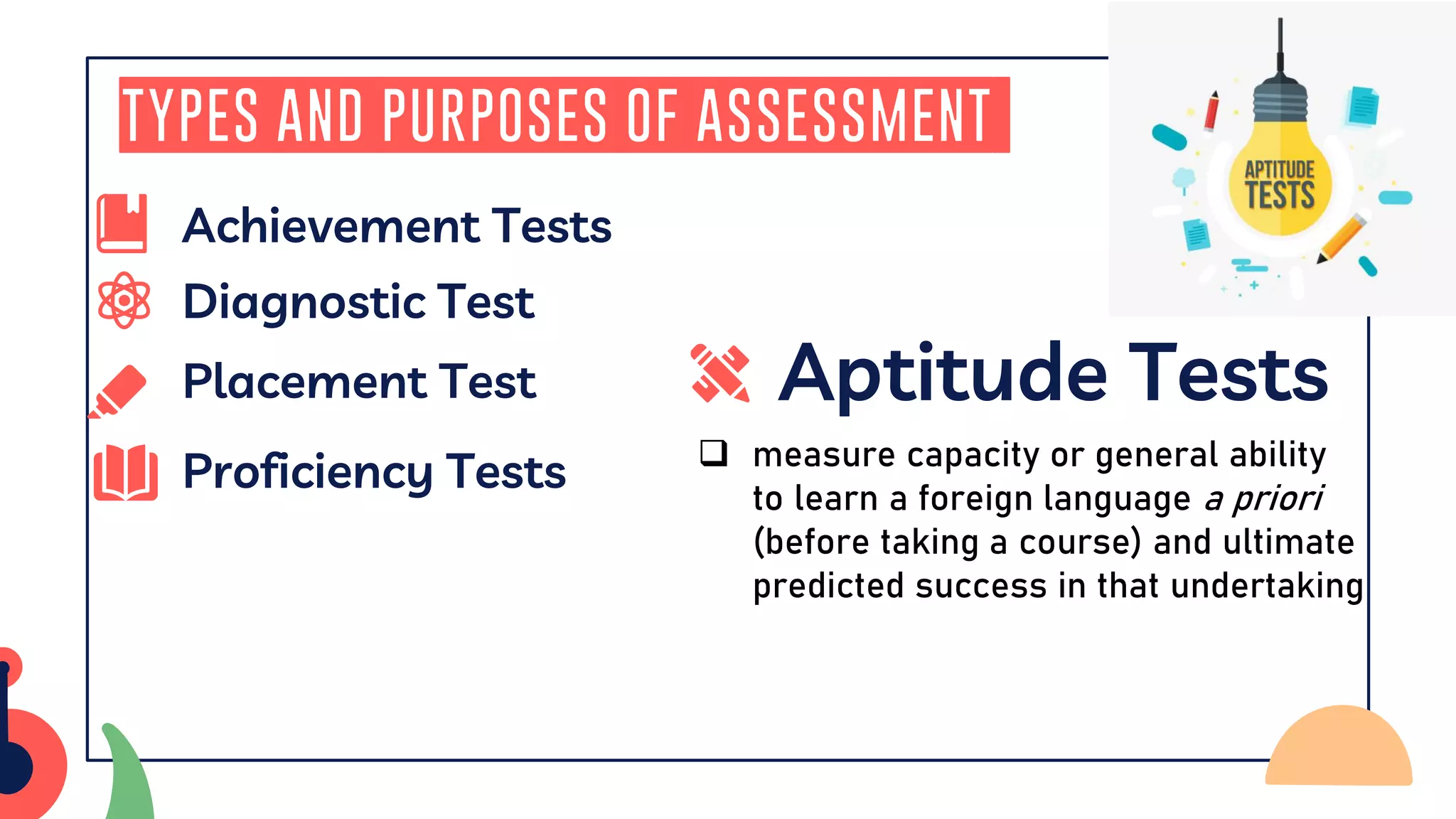
Aptitude Tests
Proficiency Tests ❑ measure capacity or general ability
to learn a foreign language a priori
(before taking a course) and ultimate
predicted success in that undertaking
Placement Test
Diagnostic Test
Achievement Tests
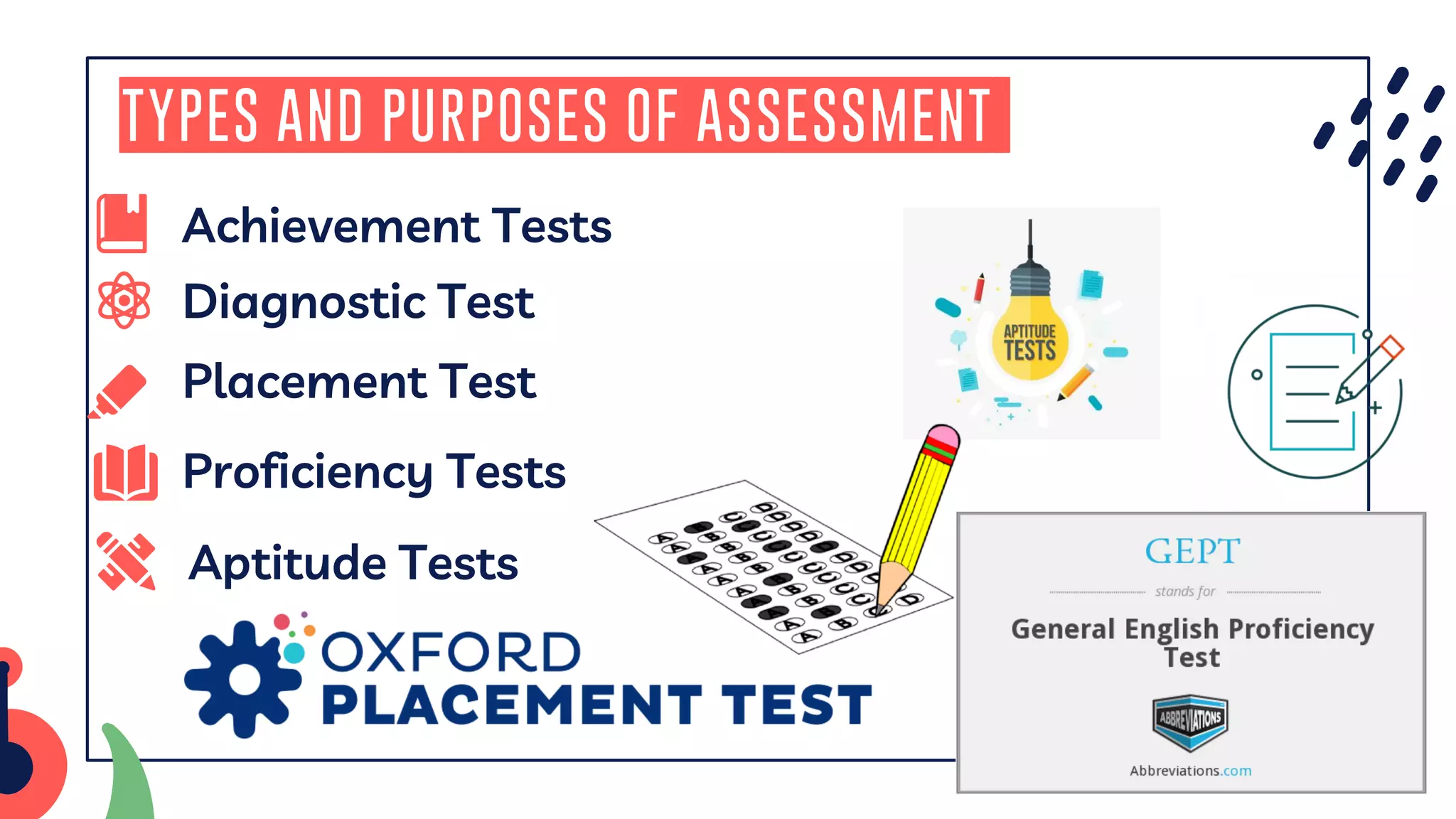
Types and Purposes of Assessment
Aptitude Tests
Proficiency Tests
Placement Test
Diagnostic Test
Achievement Tests
Issues in
Language
Assessment
c
Discrete-Point
Integrative Testing
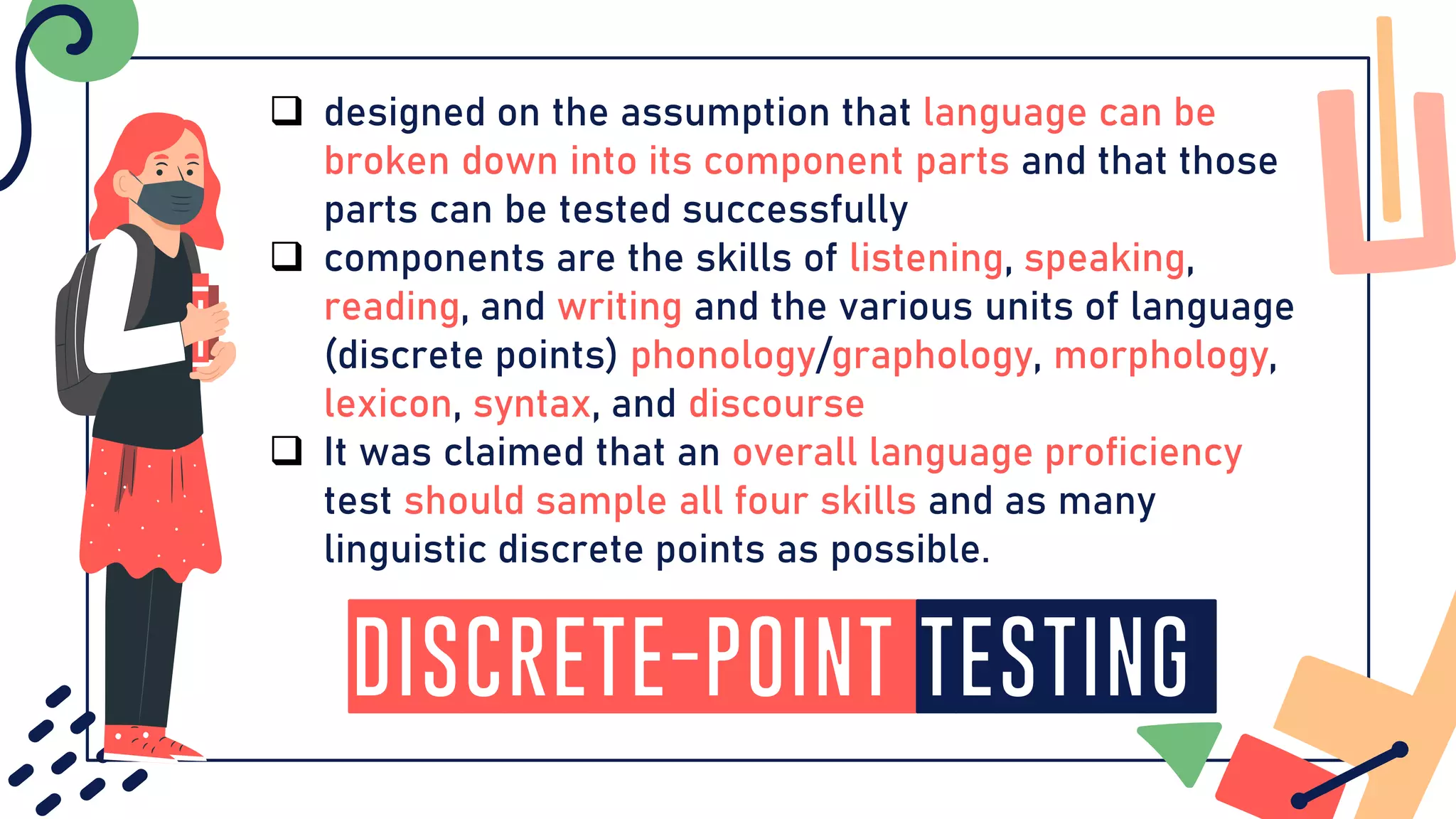
Discrete-Point Testing
❑ designed on the assumption that language can be
broken down into its component parts and that those
parts can be tested successfully
❑ components are the skills of listening, speaking,
reading, and writing and the various units of language
(discrete points) phonology/graphology, morphology,
lexicon, syntax, and discourse
❑ It was claimed that an overall language proficiency
test should sample all four skills and as many
linguistic discrete points as possible.
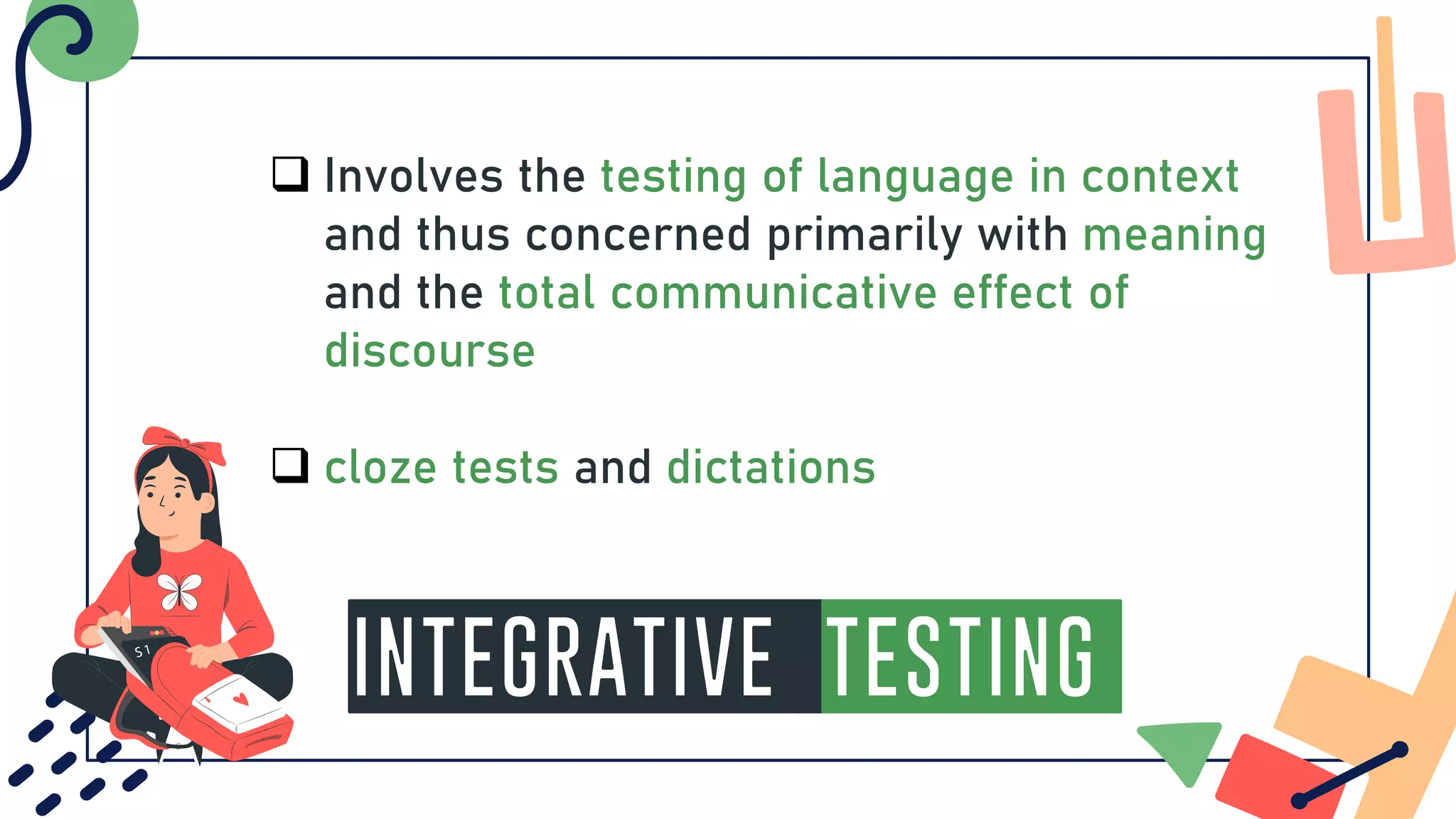
INTEGRATIVE Testing
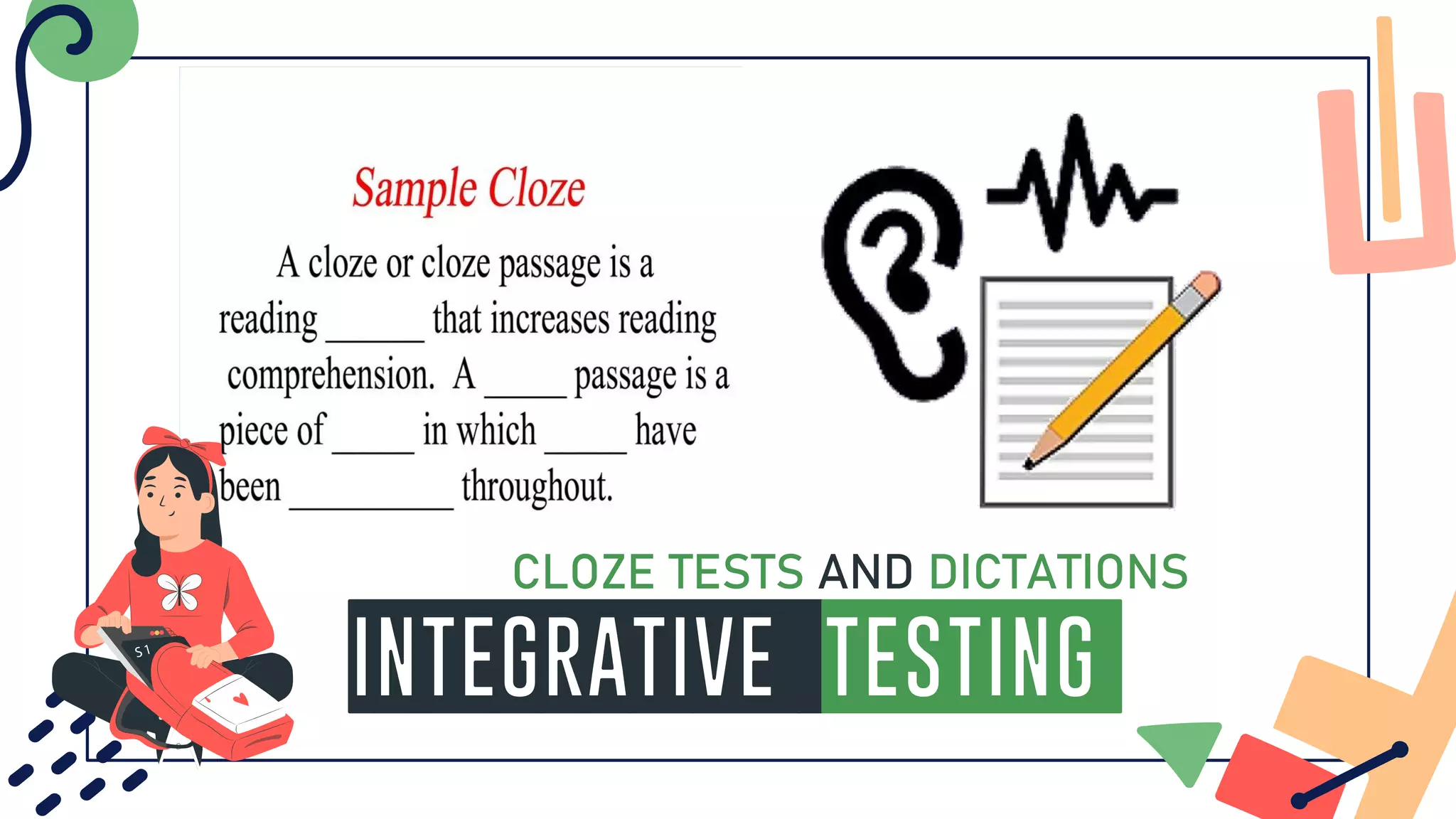
❑ Involves the testing of language in context
and thus concerned primarily with meaning
and the total communicative effect of
discourse
❑ cloze tests and dictations
INTEGRATIVE Testing
CLOZE TESTS AND DICTATIONS
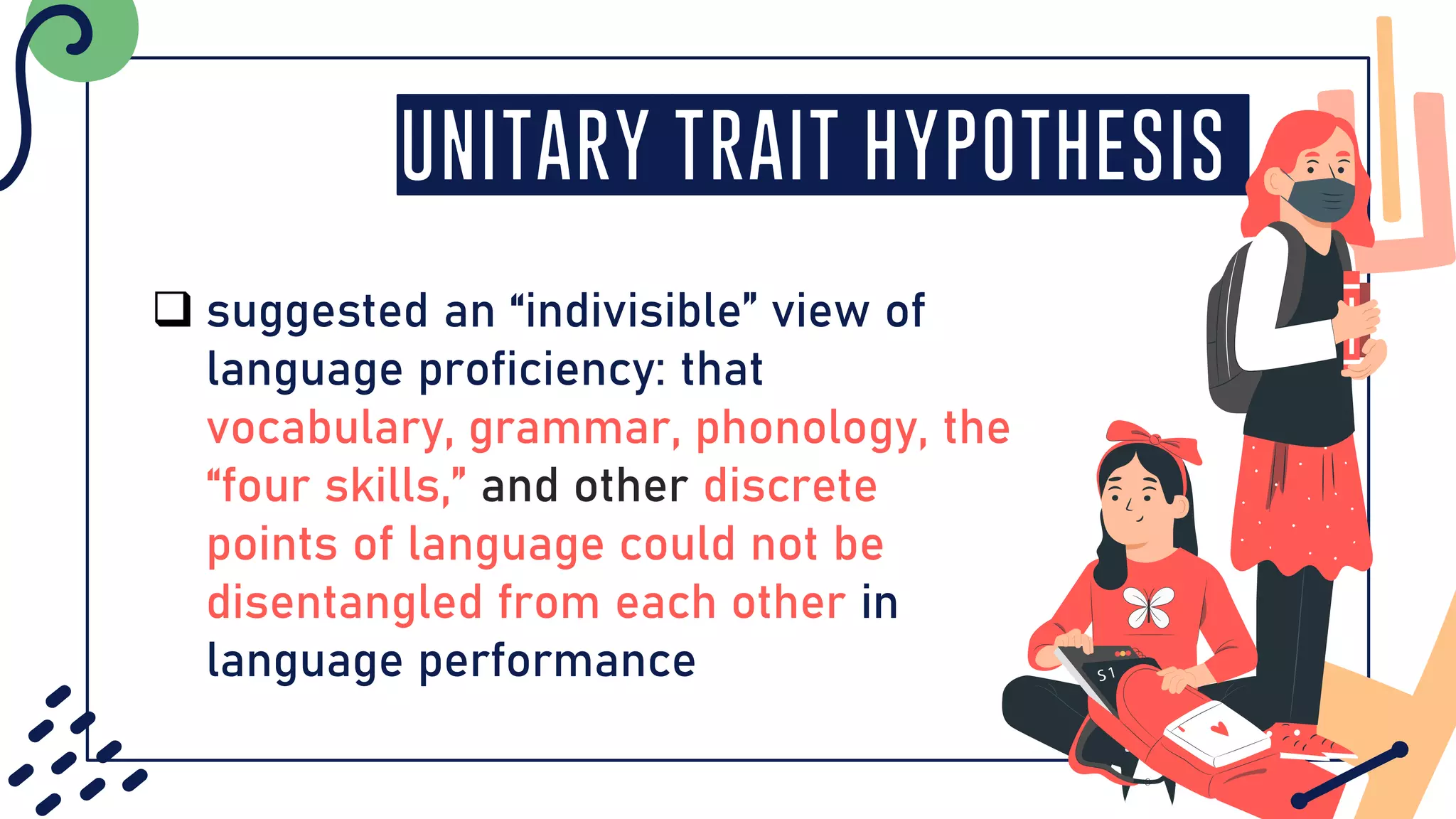
Unitary trait hypothesis
❑ suggested an “indivisible” view of
language proficiency: that
vocabulary, grammar, phonology, the
“four skills,” and other discrete
points of language could not be
disentangled from each other in
language performance
Communicative
Language Testing
language test performance
and language use
6th Grade
PERFORMANCE-BASED
ASSESSMENT
❑A characteristic of performance-
based assessments is the presence
of interactive tasks.
ESPAÑOL
Current “Hot
Topics” in
Language
Assessment
D
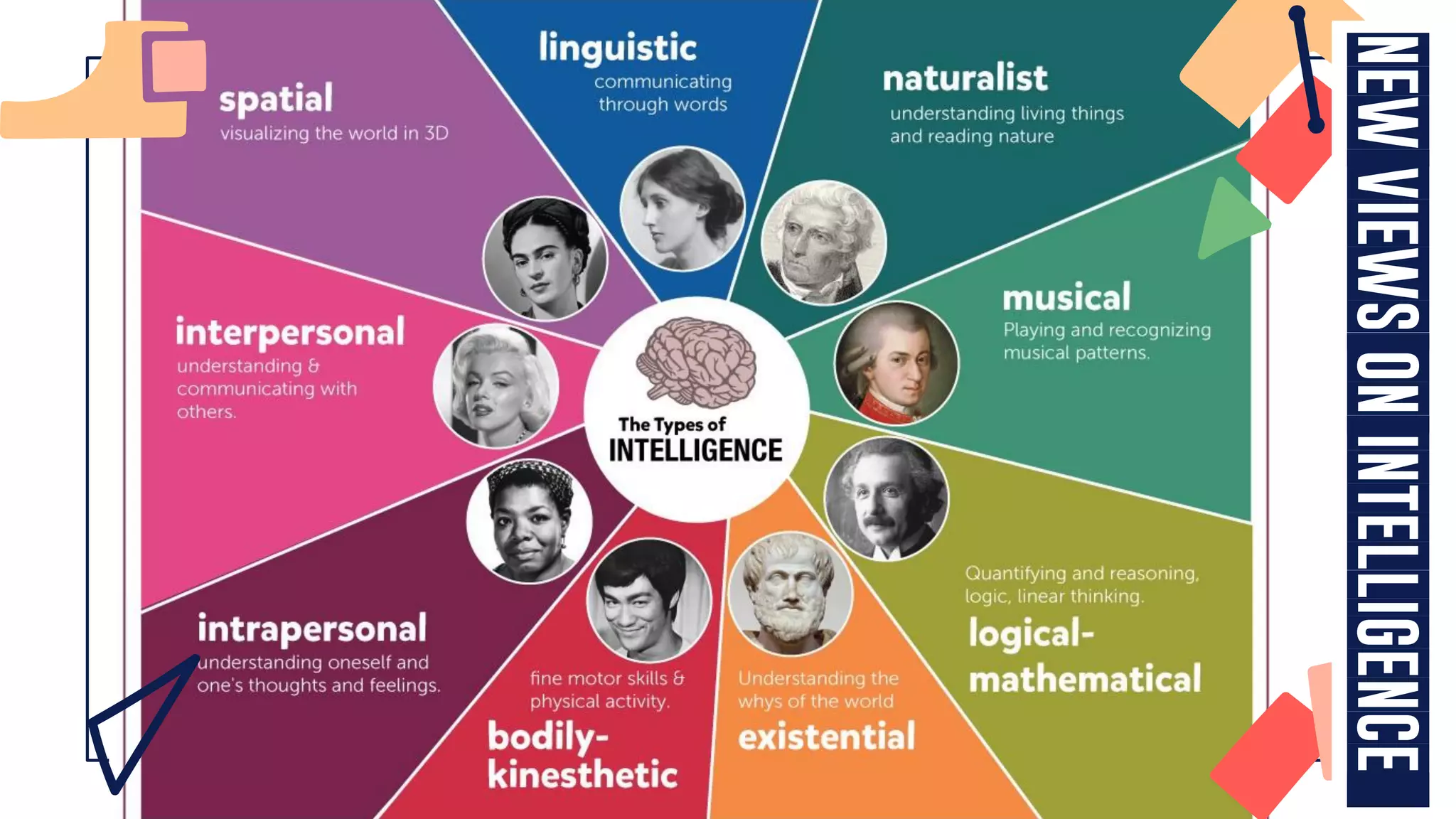
New
Views
on
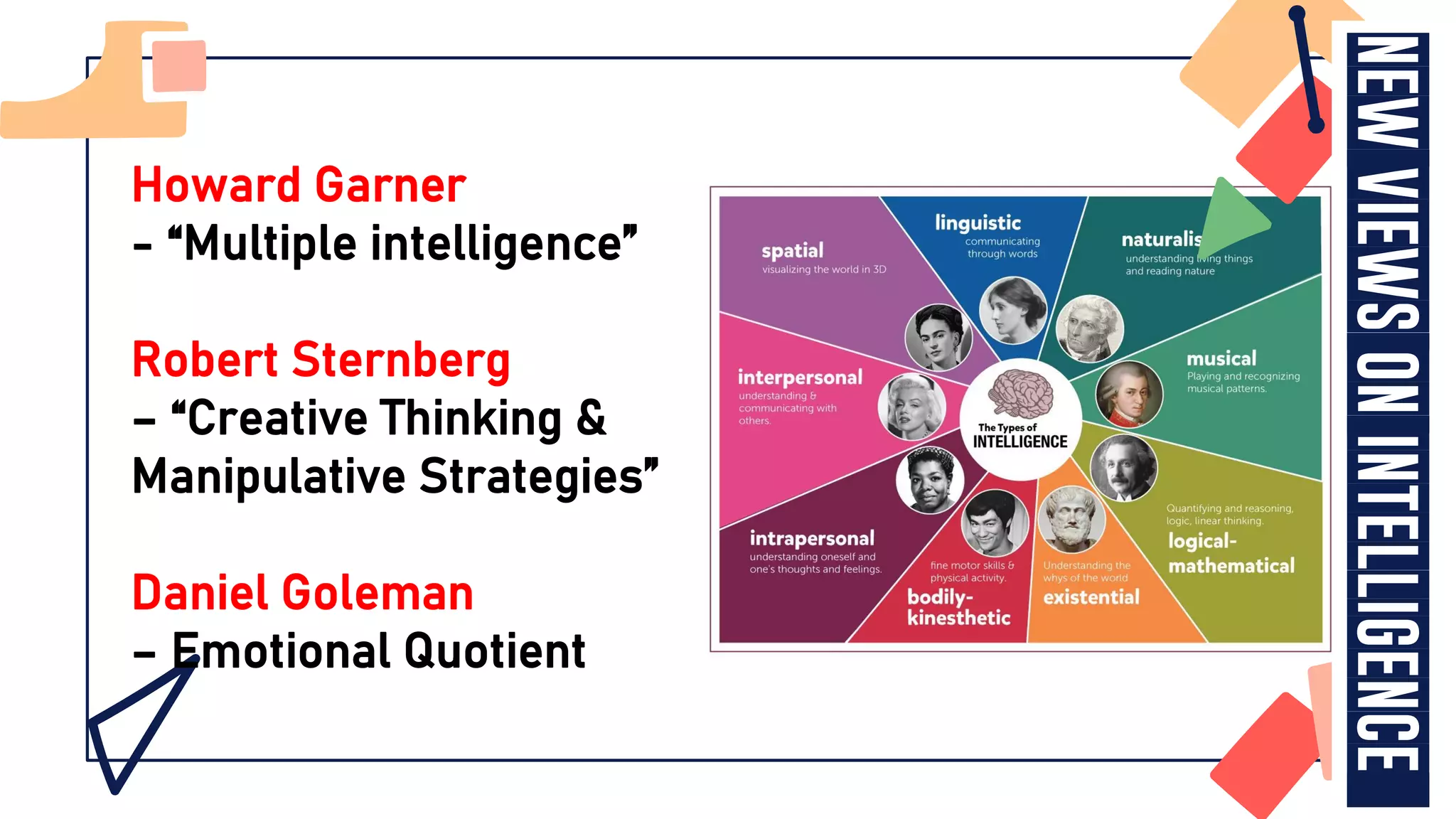
Intelligence
New
Views
on
Intelligence
Howard Garner
- “Multiple intelligence”
Robert Sternberg
– “Creative Thinking &
Manipulative Strategies”
Daniel Goleman
– Emotional Quotient
traditional
alternative assessment
traditional
alternative assessment
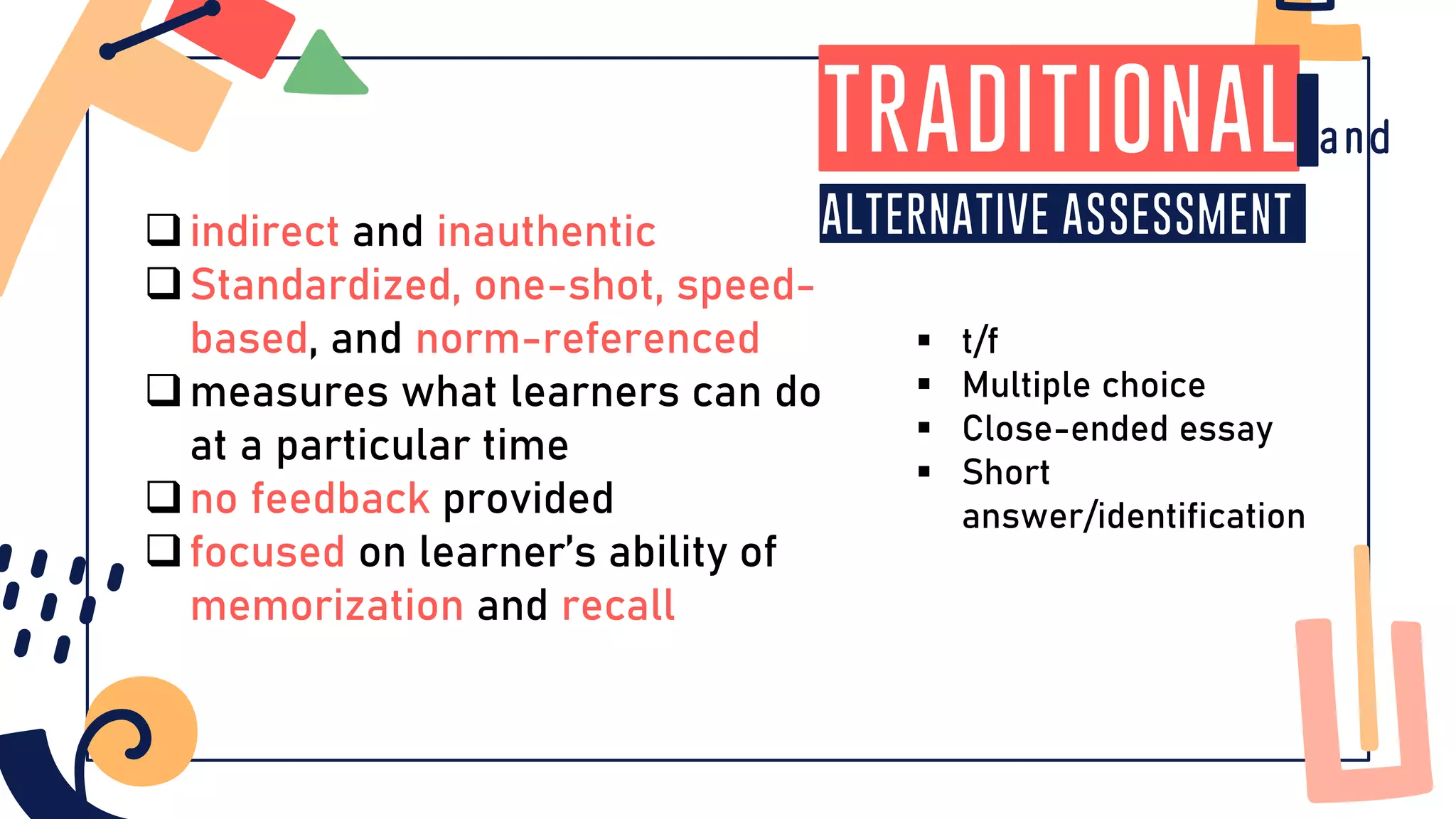
❑indirect and inauthentic
❑Standardized, one-shot, speed-
based, and norm-referenced
❑measures what learners can do
at a particular time
❑no feedback provided
❑focused on learner’s ability of
memorization and recall
▪ t/f
▪ Multiple choice
▪ Close-ended essay
▪ Short
answer/identification
traditional
alternative
assessment
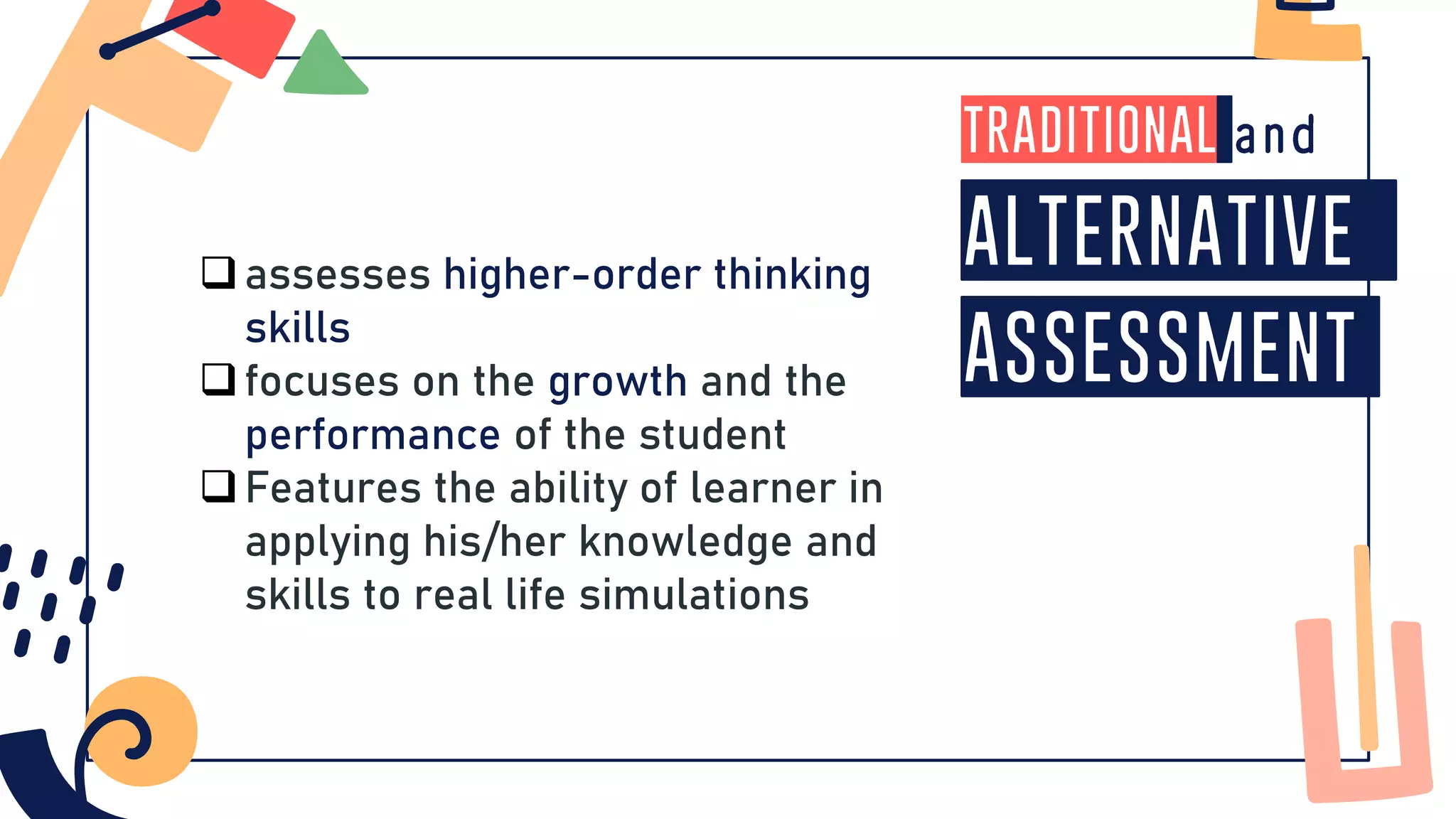
❑assesses higher-order thinking
skills
❑focuses on the growth and the
performance of the student
❑Features the ability of learner in
applying his/her knowledge and
skills to real life simulations
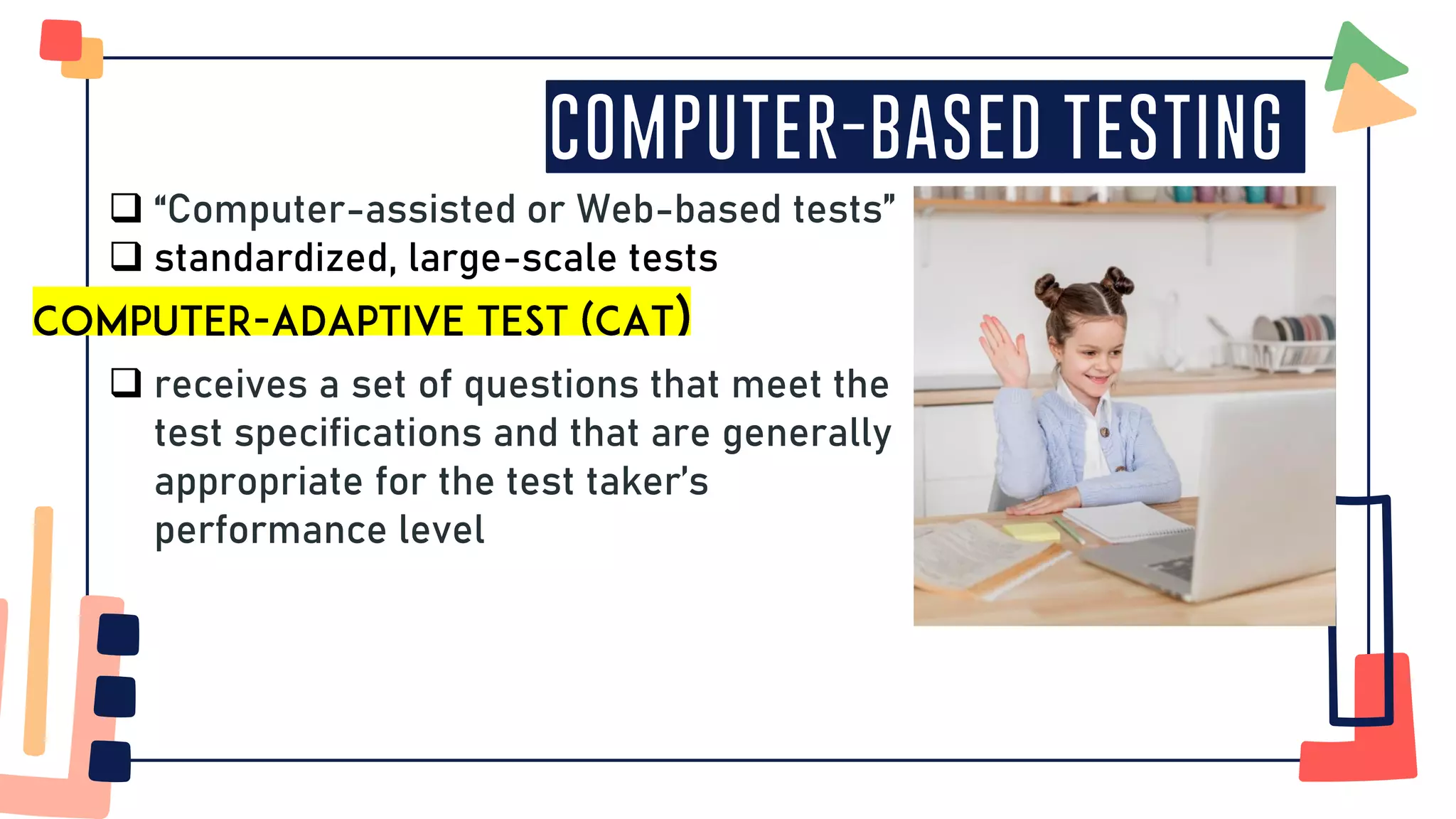
Computer-Based Testing
❑ “Computer-assisted or Web-based tests”
❑ standardized, large-scale tests
❑ receives a set of questions that meet the
test specifications and that are generally
appropriate for the test taker’s
performance level
Keep in mind
these basic principles:
1. Periodic assessments, both formal and informal,
can increase motivation by serving as milestones
of student progress.
2. Appropriate assessments aid in the
reinforcement and retention of information.
3. Assessments can confirm areas of strength and
pinpoint areas needing further work.
4. Assessments can provide a sense of periodic
closure to modules within a curriculum.
5. Assessments can promote student autonomy
by encouraging students' self evaluation of their
progress.
6. Assessments can spur learners to set goals for
themselves,
7. Assessments can aid in evaluating teaching
effectiveness
References:
ESPAÑ
OL
Books
Brown, D. & Abeywickrama, P. (2019) Language assessment: Principles and classroom
practices (1st & 3rd ed). Longman, Inc.
Hughes, A. (1989). Testing for Language Teachers. Cambridge Handbooks for Language
Teachers
Ocampo, D., Lucasan, K. L. (2019). Key issues in curriculum assessment, and ICT in basic
education. University of the Philippines, Center for Integrative and Development
Studies
Internet Sources
Cambridge Delta Preparation (2018). Testing for Language Teachers, A. Hughes, Cambridge
Handbooks for Language Teachers, 1989. Retrieved from:
https://cambridgedeltapreparation.wordpress.com/tag/unitary-competence-
hypothesis/
Vital, H. (2014). 9 Types Of Intelligence – Infographic. Adioma. Retrieved from:
https://adioma.com/9-types-of-intelligence-infographic/
References:
ESPAÑ
OL
Published Researches
Aranda, R., Zamora, J. (2016). Using differentiated instruction in improving the academic
erformance of students in Filipino language. National University, Manila
Cahapay, M. (2020). Reshaping assessment practices in a Philippine teacher educagion
insitution during the corona virus disease 2019 crisis. Modestum Open Access. 5(4).
Em0079. https://doi.org/10.29333/pr/8535
Lasaten, R.C. (2016). Assessment methods, problems, and training needs of public high school
teachers in English. International Journal of Language.2(2). DOI:
10.18178/ijlll.2016.2.2.67
Sandigan, A. P. (2018). Oral communicative competence of Filipino college students: levels
correlates, and characteristics. International Journal of English Literature and
Social Sciences. 3(5). https://dx.doi.org/10.292161/ijel.3.5.1.5
Von der Embse, N., Schultz, B. & Draughn, J. (2015). Readying student to test: The influence of
fear and efficacy appeals on anxierty and test performance. School Psychology
International. 36(6). pp 620-637.DOI:10.1177/0143034325609094

ASSESSMENT CONCEPTS AND ISSUES

  • 1.
  • 2.
    A. Assessment, Testing and SimilarConcepts and Terms AN OVERVIEW Types of Assessment Historical Antecedents in Language Assessment Current “Hot Topics” in Language Assessment B. C. C. D.
  • 3.
    INTRODUCTION Language Assessment inthe Teaching-Learning Process
  • 4.
    Assessment, & Similar Concepts AAssessment •Testing • Measurement • Evaluation • Learning
  • 5.
    Testing Assessment “method of measuringa person's ability, knowledge, or performance in a given domain” “wide variety of methods or tools that educators use to evaluate, measure, and document the academic readiness, learning progress, skill acquisition, or educational needs of students”
  • 6.
    “method of measuringa person's ability, knowledge, or performance in a given domain” Testing Assessment
  • 7.
    Testing Assessment “wide variety ofmethods or tools that educators use to evaluate, measure, and document the academic readiness, learning progress, skill acquisition, or educational needs of students”
  • 8.
  • 9.
  • 10.
    “quantifying the observedperformance of classroom learners” quantitative and qualitative descriptions of student performance MEASUREMENT EVALUATION
  • 11.
    MEASUREMENT EVALUATION “involved when theresults of a test (or other assessment procedure) are used to make decisions (Bachman, 1990)”
  • 12.
  • 13.
  • 14.
    Types of Assessment BFormal andInformal • Formative and Summative • Norm-Reference & Criterion-Referenced
  • 15.
    Judging student performance basedon any objective test Definition Judging the skill level of any students by presentations or class activities Standardized tests Example Observations Tests and/or Quizzes Testing Way Observing students in between the lecture by stopping it Criteria to evaluate the performance of students Criteria No criteria to evaluate the performance of students Used to access the student’s knowledge at the end of the lecture Purpose Used to check the learner’s skill level and progress
  • 16.
    FORMATIVE ASSESSMENT “evaluating students inthe process of “forming” their competencies and skills with the goal of helping them to continue that growth process” “aims to measure, or summarize, what a student has grasped and typically occurs at the end of a course or unit of instruction” SUMMATIVE ASSESSMENT
  • 17.
  • 18.
    Norm-Referenced Tests Criterion-Referenced Test ❑each test-taker’s score is interpreted in relation to a mean (average score), median (middle score). standard deviation (extent of variance in scores), and/or percentile rank ❑ designed to give test- takers feedback, usually in the form of grades, on specific course or lesson objectives
  • 19.
    Diagnostic Test Types andPurposes of Assessment Aptitude Tests Placement Test Achievement Tests Proficiency Tests
  • 20.
    Types and Purposesof Assessment Achievement Tests ❑ determines whether course objectives have been met— and appropriate knowledge and skills acquired—by the end of a given period of instruction.
  • 21.
    Diagnostic Test Types andPurposes of Assessment Achievement Tests ❑ identifies aspects of a language that a student needs to develop or that a course should include
  • 22.
    Diagnostic Test Types andPurposes of Assessment Placement Test ❑ place a student into a particular level or section of a language curriculum or school Achievement Tests
  • 23.
    Types and Purposesof Assessment Placement Test Proficiency Tests ❑ aims to test global competence in a language Diagnostic Test Achievement Tests
  • 24.
    Types and Purposesof Assessment Aptitude Tests Proficiency Tests ❑ measure capacity or general ability to learn a foreign language a priori (before taking a course) and ultimate predicted success in that undertaking Placement Test Diagnostic Test Achievement Tests
  • 25.
    Types and Purposesof Assessment Aptitude Tests Proficiency Tests Placement Test Diagnostic Test Achievement Tests
  • 26.
  • 27.
  • 28.
    Discrete-Point Testing ❑ designedon the assumption that language can be broken down into its component parts and that those parts can be tested successfully ❑ components are the skills of listening, speaking, reading, and writing and the various units of language (discrete points) phonology/graphology, morphology, lexicon, syntax, and discourse ❑ It was claimed that an overall language proficiency test should sample all four skills and as many linguistic discrete points as possible.
  • 29.
    INTEGRATIVE Testing ❑ Involvesthe testing of language in context and thus concerned primarily with meaning and the total communicative effect of discourse ❑ cloze tests and dictations
  • 30.
  • 31.
    Unitary trait hypothesis ❑suggested an “indivisible” view of language proficiency: that vocabulary, grammar, phonology, the “four skills,” and other discrete points of language could not be disentangled from each other in language performance
  • 32.
  • 33.
  • 34.
    PERFORMANCE-BASED ASSESSMENT ❑A characteristic ofperformance- based assessments is the presence of interactive tasks.
  • 35.
  • 36.
  • 37.
    New Views on Intelligence Howard Garner - “Multipleintelligence” Robert Sternberg – “Creative Thinking & Manipulative Strategies” Daniel Goleman – Emotional Quotient
  • 38.
  • 39.
    traditional alternative assessment ❑indirect andinauthentic ❑Standardized, one-shot, speed- based, and norm-referenced ❑measures what learners can do at a particular time ❑no feedback provided ❑focused on learner’s ability of memorization and recall ▪ t/f ▪ Multiple choice ▪ Close-ended essay ▪ Short answer/identification
  • 40.
    traditional alternative assessment ❑assesses higher-order thinking skills ❑focuseson the growth and the performance of the student ❑Features the ability of learner in applying his/her knowledge and skills to real life simulations
  • 41.
    Computer-Based Testing ❑ “Computer-assistedor Web-based tests” ❑ standardized, large-scale tests ❑ receives a set of questions that meet the test specifications and that are generally appropriate for the test taker’s performance level
  • 42.
    Keep in mind thesebasic principles: 1. Periodic assessments, both formal and informal, can increase motivation by serving as milestones of student progress. 2. Appropriate assessments aid in the reinforcement and retention of information. 3. Assessments can confirm areas of strength and pinpoint areas needing further work. 4. Assessments can provide a sense of periodic closure to modules within a curriculum. 5. Assessments can promote student autonomy by encouraging students' self evaluation of their progress. 6. Assessments can spur learners to set goals for themselves, 7. Assessments can aid in evaluating teaching effectiveness
  • 43.
    References: ESPAÑ OL Books Brown, D. &Abeywickrama, P. (2019) Language assessment: Principles and classroom practices (1st & 3rd ed). Longman, Inc. Hughes, A. (1989). Testing for Language Teachers. Cambridge Handbooks for Language Teachers Ocampo, D., Lucasan, K. L. (2019). Key issues in curriculum assessment, and ICT in basic education. University of the Philippines, Center for Integrative and Development Studies Internet Sources Cambridge Delta Preparation (2018). Testing for Language Teachers, A. Hughes, Cambridge Handbooks for Language Teachers, 1989. Retrieved from: https://cambridgedeltapreparation.wordpress.com/tag/unitary-competence- hypothesis/ Vital, H. (2014). 9 Types Of Intelligence – Infographic. Adioma. Retrieved from: https://adioma.com/9-types-of-intelligence-infographic/
  • 44.
    References: ESPAÑ OL Published Researches Aranda, R.,Zamora, J. (2016). Using differentiated instruction in improving the academic erformance of students in Filipino language. National University, Manila Cahapay, M. (2020). Reshaping assessment practices in a Philippine teacher educagion insitution during the corona virus disease 2019 crisis. Modestum Open Access. 5(4). Em0079. https://doi.org/10.29333/pr/8535 Lasaten, R.C. (2016). Assessment methods, problems, and training needs of public high school teachers in English. International Journal of Language.2(2). DOI: 10.18178/ijlll.2016.2.2.67 Sandigan, A. P. (2018). Oral communicative competence of Filipino college students: levels correlates, and characteristics. International Journal of English Literature and Social Sciences. 3(5). https://dx.doi.org/10.292161/ijel.3.5.1.5 Von der Embse, N., Schultz, B. & Draughn, J. (2015). Readying student to test: The influence of fear and efficacy appeals on anxierty and test performance. School Psychology International. 36(6). pp 620-637.DOI:10.1177/0143034325609094