Made By
Rahila Khan
GGPC Quetta
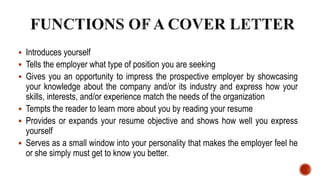
 Introduces yourself
 Tells the employer what type of position you are seeking
 Gives you an opportunity to impress the prospective employer by showcasing
your knowledge about the company and/or its industry and express how your
skills, interests, and/or experience match the needs of the organization
 Tempts the reader to learn more about you by reading your resume
 Provides or expands your resume objective and shows how well you express
yourself
 Serves as a small window into your personality that makes the employer feel he
or she simply must get to know you better.
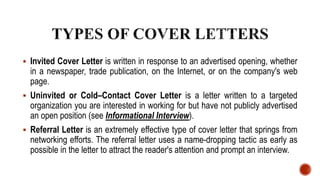
 Invited Cover Letter is written in response to an advertised opening, whether
in a newspaper, trade publication, on the Internet, or on the company's web
page.
 Uninvited or Cold–Contact Cover Letter is a letter written to a targeted
organization you are interested in working for but have not publicly advertised
an open position (see Informational Interview).
 Referral Letter is an extremely effective type of cover letter that springs from
networking efforts. The referral letter uses a name-dropping tactic as early as
possible in the letter to attract the reader's attention and prompt an interview.
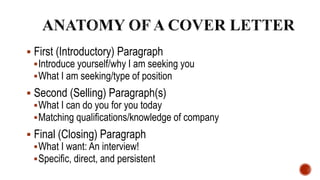
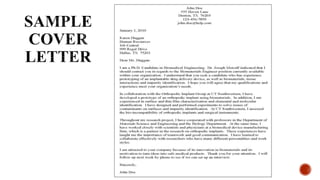
 First (Introductory) Paragraph
Introduce yourself/why I am seeking you
What I am seeking/type of position
 Second (Selling) Paragraph(s)
What I can do you for you today
Matching qualifications/knowledge of company
 Final (Closing) Paragraph
What I want: An interview!
Specific, direct, and persistent
Keep it short.
A cover letter is meant to be a summary of your
resume, so don’t write more than one page.
Use a different cover letter for each job you apply for. Your cover letter
needs to show that you know what the job involves, and what the
employer is looking for.
To do this, be specific about your skills and qualities. You also need to
show how they match the needs of the job or the organization.
Your name and contact details: Put your name and contact details at the top of your cover letter. You don't have to give
your postal address, but you do need to include your email and phone number.
The name and contact details of person you are writing to: Under your own name and contact details, you should
include:the name of the person you're writing to,their position or the name of their company, their contact details.
The name of the job you're going for: At the start of your cover letter you need to say which job you're applying for.(for
example, ‘Regarding: Application for Stock Controller position’).
A list of your relevant skills: Include a brief summary about how your skills and experiences match the job description. A
short bullet list is fine.
A summary of why you're right for the job: After listing your skills and experience, you should explain why these mean
you're suited to the job
Speak their language: Find out what the employer does, and how they talk about themselves. Use this language in your
cover letter.
Ask them to contact you: Your cover letter should finish by asking the employer to read your resume. It should also ask
them to contact you about an interview.
Typos or mistakes: Always spellcheck your cover letter. It's even better to get someone else to read it
and point out any mistakes or confusing things.
Including your whole resume in your cover letter:Don't cut and paste your resume into your cover
letter. Try to re-word the information in your resume, rather than just repeating it. Keep your cover letter
short and let your resume tell the whole story.
Using ‘I’ too much: Try not to over use phrases like ‘I believe’, ‘I have’ and ‘I am’. Remember, it’s not
about you – it’s about how you can help the employer.
Don't mention your other job applications: You're probably applying for more than one job at a time.
However, it’s best not to mention other job applications. Your letter should aim to convince the employer
that you really want this job.Even though most employers will assume you're applying for more than one
job, you don’t need to mention it.
Cover letter essentials , Business communication

Cover letter essentials , Business communication

  • 1.
  • 2.
     Introduces yourself Tells the employer what type of position you are seeking  Gives you an opportunity to impress the prospective employer by showcasing your knowledge about the company and/or its industry and express how your skills, interests, and/or experience match the needs of the organization  Tempts the reader to learn more about you by reading your resume  Provides or expands your resume objective and shows how well you express yourself  Serves as a small window into your personality that makes the employer feel he or she simply must get to know you better.
  • 3.
     Invited CoverLetter is written in response to an advertised opening, whether in a newspaper, trade publication, on the Internet, or on the company's web page.  Uninvited or Cold–Contact Cover Letter is a letter written to a targeted organization you are interested in working for but have not publicly advertised an open position (see Informational Interview).  Referral Letter is an extremely effective type of cover letter that springs from networking efforts. The referral letter uses a name-dropping tactic as early as possible in the letter to attract the reader's attention and prompt an interview.
  • 4.
     First (Introductory)Paragraph Introduce yourself/why I am seeking you What I am seeking/type of position  Second (Selling) Paragraph(s) What I can do you for you today Matching qualifications/knowledge of company  Final (Closing) Paragraph What I want: An interview! Specific, direct, and persistent
  • 5.
    Keep it short. Acover letter is meant to be a summary of your resume, so don’t write more than one page.
  • 6.
    Use a differentcover letter for each job you apply for. Your cover letter needs to show that you know what the job involves, and what the employer is looking for. To do this, be specific about your skills and qualities. You also need to show how they match the needs of the job or the organization.
  • 7.
    Your name andcontact details: Put your name and contact details at the top of your cover letter. You don't have to give your postal address, but you do need to include your email and phone number. The name and contact details of person you are writing to: Under your own name and contact details, you should include:the name of the person you're writing to,their position or the name of their company, their contact details. The name of the job you're going for: At the start of your cover letter you need to say which job you're applying for.(for example, ‘Regarding: Application for Stock Controller position’). A list of your relevant skills: Include a brief summary about how your skills and experiences match the job description. A short bullet list is fine. A summary of why you're right for the job: After listing your skills and experience, you should explain why these mean you're suited to the job Speak their language: Find out what the employer does, and how they talk about themselves. Use this language in your cover letter. Ask them to contact you: Your cover letter should finish by asking the employer to read your resume. It should also ask them to contact you about an interview.
  • 8.
    Typos or mistakes:Always spellcheck your cover letter. It's even better to get someone else to read it and point out any mistakes or confusing things. Including your whole resume in your cover letter:Don't cut and paste your resume into your cover letter. Try to re-word the information in your resume, rather than just repeating it. Keep your cover letter short and let your resume tell the whole story. Using ‘I’ too much: Try not to over use phrases like ‘I believe’, ‘I have’ and ‘I am’. Remember, it’s not about you – it’s about how you can help the employer. Don't mention your other job applications: You're probably applying for more than one job at a time. However, it’s best not to mention other job applications. Your letter should aim to convince the employer that you really want this job.Even though most employers will assume you're applying for more than one job, you don’t need to mention it.