Assertive
Communication
Presented by: Elizabeth Ibarra, MBA
Human Resources Department
Agenda
• Defining The Art of Assertiveness
• Human Behaviors and
Communication Styles
• Assertiveness Technics
• Conclusion
• Open Floor Discussion
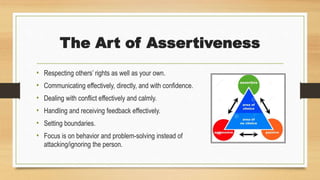
The Art of Assertiveness
• Respecting others’ rights as well as your own.
• Communicating effectively, directly, and with confidence.
• Dealing with conflict effectively and calmly.
• Handling and receiving feedback effectively.
• Setting boundaries.
• Focus is on behavior and problem-solving instead of
attacking/ignoring the person.
The Art of Assertiveness
Assertiveness is about self confidence which means having a positive attitude towards yourself and others.
Defining Assertiveness
Assertiveness is NOT:
•Aggressive
•Passive
•Passive-Aggressive
•Trying to Dominate Others
Assertiveness IS:
•Focusing on your goal
•Being self-aware
•Being true to yourself
•Building self esteem
•Showing respect
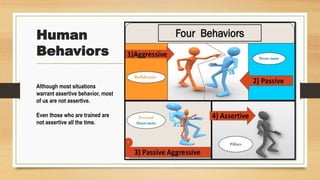
Human
Behaviors
Although most situations
warrant assertive behavior, most
of us are not assertive.
Even those who are trained are
not assertive all the time.
Human Behaviors
AGREESIVE Behavior
• Disrespecting others’ rights to retain your own rights.
• Winning at all costs.
• Communicating sarcastically.
• Attacking the person instead of focusing on the
behavior or problem-solving.
• Violating boundaries.
• Attempting to control others
Human Behaviors
PASSIVE Behavior
• Offering no opposition
• Lack of self-confidence and self-esteem
• Feelings of inferiority compared to others
• Like others to be in control of people and situations
• Downplaying their own needs and willing to fit in with
the wishes of others in order to keep the peace
• Nervousness and lack of eye contact
Human Behaviors
ASSERTIVE Behavior
• Self confidence and high self-esteem
• Respect for self and towards others
• Take responsibility for self
• Motivated to do a good job
• Interested in others’ feelings and thoughts
• Ask questions
• Honest and direct
• Listen to others
• Ask others for feedback
Human Behaviors
PASSIVE-AGGRESSIVE Behavior
• Fight-Flight pattern.
• Either respecting ONLY your rights OR other’s
rights.
• Not addressing the problem or behavior.
• Talking about people behind their back/Gossip
• Fluctuating between violating others’
boundaries or having your boundaries violated
Communication
Styles
Communication Styles
Article Link: http://www.rightattitudes.com/2008/10/04/7-38-55-rule-personal-communication/
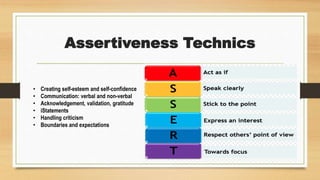
Assertiveness Technics
• Creating self-esteem and self-confidence
• Communication: verbal and non-verbal
• Acknowledgement, validation, gratitude
• iStatements
• Handling criticism
• Boundaries and expectations
Assertiveness Technics
Self-esteem and Self-confidence
• Be conscious of your abilities
• Feel proud of your achievements
• Take care of yourself: Eat health, exercise regularly, learn something
new every day!
Creating Self-esteem:
• I am
• I can
• I think
• I believe
Assertiveness Technics
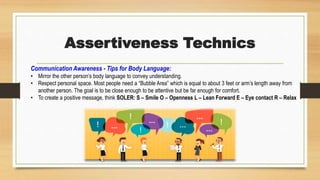
Communication Awareness - Tips for Body Language:
• Mirror the other person’s body language to convey understanding.
• Respect personal space. Most people need a “Bubble Area” which is equal to about 3 feet or arm’s length away from
another person. The goal is to be close enough to be attentive but be far enough for comfort.
• To create a positive message, think SOLER: S – Smile O – Openness L – Lean Forward E – Eye contact R – Relax
Assertiveness Technics
iStatements and Assertive Word Choice
• When communicating use: “I feel…” or “I would like…”
• Prevents using “You…” which may be perceived as a
personal attack or accusation
• Replace: “You are so egotistical and full of yourself and your
own ideas!” to “I would like you to consider this idea”
• Use factual descriptions instead of judgements or
exaggerations
• Express thoughts, feelings, and opinions reflecting ownership
• Use clear, direct requests or directives when you ask
something from others
Assertiveness Technics
Acknowledgement, Validation, Gratitude
• Receiving a compliment or feedback is an assertive act.
• Validate that someone has spoken, even if using minimal
responses as demonstrated in active listening skills.
• As you focus on behaviors, facts, and the problem to be
solved, make sure to validate the other person’s feelings:
“I know it was a hard day…”
• Thank you (for feedback…positive or negative) – a life of
gratitude
Conclusion
Benefits of Assertiveness
• Teach individuals how to solve problems through
cooperation and negotiation.
• Helps employees become problem-solvers rather than
victims of a system they believe they can’t control
• Assertive behavior can actually reduce physical and
mental stress because people feel less like victims and
more like influencers
• Communication becomes clearer and more concise,
which reduces misunderstandings and clarifies
expectations.
Assert
• Listen – understand, put yourself in
others shoes and ask for clarification
• Keep calm – deep breaths, take your
time, and allow others to express their
feelings
• Be prepared – Stick to facts
• Compromise – try and find a “win-win”
solution
Open Floor Discussion
Assertive Communication

Assertive Communication

  • 1.
    Assertive Communication Presented by: ElizabethIbarra, MBA Human Resources Department
  • 2.
    Agenda • Defining TheArt of Assertiveness • Human Behaviors and Communication Styles • Assertiveness Technics • Conclusion • Open Floor Discussion
  • 3.
    The Art ofAssertiveness • Respecting others’ rights as well as your own. • Communicating effectively, directly, and with confidence. • Dealing with conflict effectively and calmly. • Handling and receiving feedback effectively. • Setting boundaries. • Focus is on behavior and problem-solving instead of attacking/ignoring the person.
  • 4.
    The Art ofAssertiveness Assertiveness is about self confidence which means having a positive attitude towards yourself and others.
  • 5.
    Defining Assertiveness Assertiveness isNOT: •Aggressive •Passive •Passive-Aggressive •Trying to Dominate Others Assertiveness IS: •Focusing on your goal •Being self-aware •Being true to yourself •Building self esteem •Showing respect
  • 6.
    Human Behaviors Although most situations warrantassertive behavior, most of us are not assertive. Even those who are trained are not assertive all the time.
  • 7.
    Human Behaviors AGREESIVE Behavior •Disrespecting others’ rights to retain your own rights. • Winning at all costs. • Communicating sarcastically. • Attacking the person instead of focusing on the behavior or problem-solving. • Violating boundaries. • Attempting to control others
  • 8.
    Human Behaviors PASSIVE Behavior •Offering no opposition • Lack of self-confidence and self-esteem • Feelings of inferiority compared to others • Like others to be in control of people and situations • Downplaying their own needs and willing to fit in with the wishes of others in order to keep the peace • Nervousness and lack of eye contact
  • 9.
    Human Behaviors ASSERTIVE Behavior •Self confidence and high self-esteem • Respect for self and towards others • Take responsibility for self • Motivated to do a good job • Interested in others’ feelings and thoughts • Ask questions • Honest and direct • Listen to others • Ask others for feedback
  • 10.
    Human Behaviors PASSIVE-AGGRESSIVE Behavior •Fight-Flight pattern. • Either respecting ONLY your rights OR other’s rights. • Not addressing the problem or behavior. • Talking about people behind their back/Gossip • Fluctuating between violating others’ boundaries or having your boundaries violated
  • 11.
  • 12.
    Communication Styles Article Link:http://www.rightattitudes.com/2008/10/04/7-38-55-rule-personal-communication/
  • 13.
    Assertiveness Technics • Creatingself-esteem and self-confidence • Communication: verbal and non-verbal • Acknowledgement, validation, gratitude • iStatements • Handling criticism • Boundaries and expectations
  • 14.
    Assertiveness Technics Self-esteem andSelf-confidence • Be conscious of your abilities • Feel proud of your achievements • Take care of yourself: Eat health, exercise regularly, learn something new every day! Creating Self-esteem: • I am • I can • I think • I believe
  • 15.
    Assertiveness Technics Communication Awareness- Tips for Body Language: • Mirror the other person’s body language to convey understanding. • Respect personal space. Most people need a “Bubble Area” which is equal to about 3 feet or arm’s length away from another person. The goal is to be close enough to be attentive but be far enough for comfort. • To create a positive message, think SOLER: S – Smile O – Openness L – Lean Forward E – Eye contact R – Relax
  • 16.
    Assertiveness Technics iStatements andAssertive Word Choice • When communicating use: “I feel…” or “I would like…” • Prevents using “You…” which may be perceived as a personal attack or accusation • Replace: “You are so egotistical and full of yourself and your own ideas!” to “I would like you to consider this idea” • Use factual descriptions instead of judgements or exaggerations • Express thoughts, feelings, and opinions reflecting ownership • Use clear, direct requests or directives when you ask something from others
  • 17.
    Assertiveness Technics Acknowledgement, Validation,Gratitude • Receiving a compliment or feedback is an assertive act. • Validate that someone has spoken, even if using minimal responses as demonstrated in active listening skills. • As you focus on behaviors, facts, and the problem to be solved, make sure to validate the other person’s feelings: “I know it was a hard day…” • Thank you (for feedback…positive or negative) – a life of gratitude
  • 18.
    Conclusion Benefits of Assertiveness •Teach individuals how to solve problems through cooperation and negotiation. • Helps employees become problem-solvers rather than victims of a system they believe they can’t control • Assertive behavior can actually reduce physical and mental stress because people feel less like victims and more like influencers • Communication becomes clearer and more concise, which reduces misunderstandings and clarifies expectations. Assert • Listen – understand, put yourself in others shoes and ask for clarification • Keep calm – deep breaths, take your time, and allow others to express their feelings • Be prepared – Stick to facts • Compromise – try and find a “win-win” solution
  • 19.