




03/23/14 1
03/23/14 2
Learning Outcomes
By the end of the course you will :
Have knowledge and understanding of where you need to be as a person before you
can act assertively
Have identified your rights as an individual (Believe in?)
Have knowledge and understanding of how we communicate assertively and the
value of listening and questioning skills in doing so
Have knowledge and understanding of the 3 main types of behaviour and how to use
this to deal with difficult people and situations
Have identified and know how to remove your “blockers” to behaving assertively
Have knowledge and understanding of why a “Win – Win” mentality is critical for
long term individual survival
Have knowledge and understanding of the Thomas Kilmann Conflict Model
Have identified the positive behaviours we need to work productively
03/23/14 3
Creating an Environment which supports
Positive Behaviour
Beginning with YOU
03/23/14 4
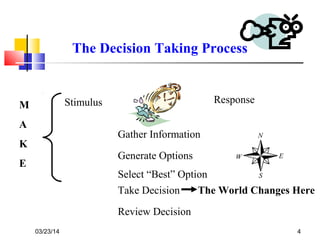
Stimulus Response
Gather Information
Generate Options
Select “Best” Option
Take Decision
Review Decision
The Decision Taking Process
Make
M
A
K
E
The World Changes Here
03/23/14 5
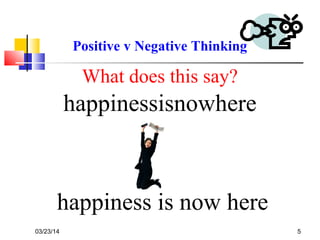
What does this say?
happinessisnowhere
happiness is now here
Positive v Negative Thinking
03/23/14 6
Is your view of the world the only one?
What do
you see?
What might
they see?
03/23/14 7
Are things always as they seem?
03/23/14 8
The way an individual perceives, understands and
interprets the surrounding world
– a mental map
Paradigms
03/23/14 9
“If you want small changes, work on your
behaviour. If you want quantum leap changes
work on your paradigms”
Stephen R.Covey- “The Seven Habits of Highly
Effective People”
Changing YOUR Paradigm
03/23/14 10
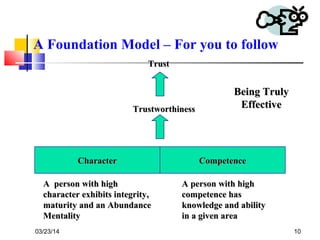
A Foundation Model – For you to follow
CharacterCharacter CompetenceCompetence
A person with highA person with high
character exhibits integrity,character exhibits integrity,
maturity and an Abundancematurity and an Abundance
MentalityMentality
A person with highA person with high
competence hascompetence has
knowledge and abilityknowledge and ability
in a given areain a given area
TrustworthinessTrustworthiness
TrustTrust
Being TrulyBeing Truly
EffectiveEffective
03/23/14 11
““WeWe who lived in concentration camps can remember thewho lived in concentration camps can remember the
men who walked throughout the huts comforting others,men who walked throughout the huts comforting others,
giving away their last piece of bread. They may have beengiving away their last piece of bread. They may have been
few in number, but they offer sufficient proof thatfew in number, but they offer sufficient proof that
everything can be taken away from a man but one thing :everything can be taken away from a man but one thing :
the last of the human freedomsthe last of the human freedoms – to choose ones’ attitude in– to choose ones’ attitude in
any given set of circumstances, to choose ones own way”any given set of circumstances, to choose ones own way”
Viktor Frankl – Man’s Search for MeaningViktor Frankl – Man’s Search for Meaning
Attitude is everything – Who chooses yours?
03/23/14 12
Dealing with People
Only YOU can develop the model of
YOU required to act assertively
03/23/14 13
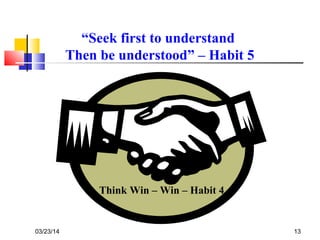
“Seek first to understand
Then be understood” – Habit 5
Think Win – Win – Habit 4
03/23/14 14
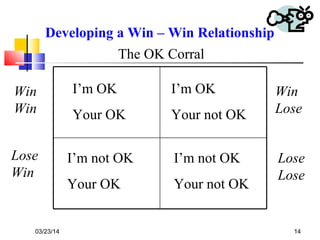
Developing a Win – Win Relationship
The OK Corral
I’m OK
Your OK
I’m OK
Your not OK
I’m not OK
Your OK
I’m not OK
Your not OK
Win
Win
Lose
Win
Win
Lose
Lose
Lose
03/23/14 15
The Three Main Behaviours
Aggressive – Assertive – Non-assertive (Submissive)
Productive v Unproductive Behaviours
03/23/14 16
Levels of Listening
• Ignoring – Making no effort to listen
• Pretend Listening – Giving the appearance of listening
• Selective Listening – Hearing the bits that interest you
• Attentive Listening – Paying attention, focusing, comparing to
personal experiences
• Empathetic Listening – Listening and responding with both heart and
mind
03/23/14 17
The Power of QuestionsThe Power of Questions
• Reflective – You seem unhappy about …?
• Open – Tell me about …? To what extent does …?
• Probing – Tell me more about …? Better in what way …?
• Link – You mentioned that …?
• Direct – When do you need this by …?
• Closed – Are you happy with the proposal?
• Silence
03/23/14 18
12
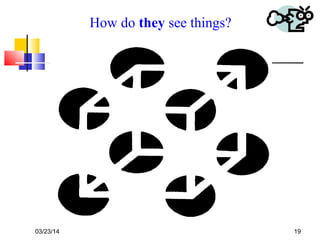
Can you see what they see?
03/23/14 19
How do they see things?
03/23/14 20
Assertiveness means ..
• Standing up for your own rights in such a way that you do not
violate another persons rights
• Expressing your needs, wants, opinions feelings and beliefs in
direct, honest and appropriate ways
03/23/14 21
Assertiveness
Assertiveness is based on the belief that in any situation;
• You have needs to be met
• The other people involved have needs to be met
• You have rights, so do others
• You have something to contribute, so do others
Aim - To achieve “Win – Win”
03/23/14 22
Submissiveness means ..
• Failing to stand up for your rights or doing so in such a way that
others can disregard them
• Expressing your needs, wants, opinions feelings and beliefs in
apologetic, diffident or self effacing ways
03/23/14 23
Submissiveness
Submissiveness is based on the belief that in any situation:
• The other persons needs and wants are more important than your
own
• The other person has rights, but you do not
• You have little or nothing to contribute, the other person has a
great deal to contribute
Aim – To avoid conflict and please others – “perceived
benefits”
03/23/14 24
AGGRESSION MEANS ..
• STANDING UP FOR YOUR OWN RIGHTS BUT DOING
SO IN SUCH A WAY THAT YOU VIOLATE THE RIGHTS
OF OTHER PEOPLE
• IGNORING OR DISMISSING THE NEEDS, WANTS AND
OPINIONS, FEELINGS OR BELIEFS OF OTHERS
• EXPRESSING YOUR OWN NEEDS, WANTS AND
OPINIONS (WHICH MAY BE HONEST OR DISHONEST)
IN INAPPROPRIATE WAYS
03/23/14 25
AGGRESSION
AGGRESSION is based on the belief that in any situation:
• YOUR OWN NEEDS, WANTS AND OPINIONS ARE
MORE IMPORTANT THAN OTHER PEOPLE’S
• YOU HAVE RIGHTS BUT OTHER PEOPLE DO NOT
• YOU HAVE SOMETHING TO CONTRIBUTE, OTHERS
HAVE LITTLE OR NOTHING TO CONTRIBUTE
AIM – TO WIN. IF NECESSARY AT THE EXPENSE OF
OTHERS.
03/23/14 26
Assertive “Persuasion”
• Relax (as far as possible)
• Have your information ready
• Be sure of your facts
• Calmly state your feelings
• Keep to the point
• Acknowledge the other persons point of view
• Encourage joint solutions where possible
• Go for “Win – Win”
• Summarise the agreement
Acknowledge Feelings
Make positive statements
Listen & Question
03/23/14 27
Dealing with things Assertively
Dealing Assertively with submissive/aggressive behaviour
• Self Awareness – Know the potential affects and exercise control
• The“Self-fulfilling prophesy” – Make it positive
• The “Inner Dialogue” – Make the right choices
• Assertive Persuasion – Memorise the process and choose to use it
(Listening and Questioning – a Team of Two)
03/23/14 28
Have we agreed the Principles?
• We all have rights to which we are entitled
• Others have rights to which they are entitled
• Everyone has the right to be treated with respect
• In working towards a solution these rights must be respected at
all times
• Our style of behaviour is by personal choice
03/23/14 29
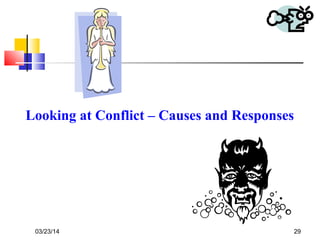
Looking at Conflict – Causes and Responses
03/23/14 30
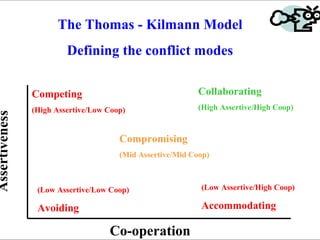
The Thomas - Kilmann Model
Defining the conflict modes
Assertiveness
Co-operation
Collaborating
(High Assertive/High Coop)
(Low Assertive/High Coop)
Accommodating
Compromising
(Mid Assertive/Mid Coop)
Competing
(High Assertive/Low Coop)
(Low Assertive/Low Coop)
Avoiding
Avoidance (low coop, low assertiveness)
Denial, under-responsiveness, shifting, semantic
focus, postponement,
– Advantage - takes out the heat of the moment
– Disadvantage - conflict remains unresolved,
may lead to larger outbreak
Competition (low coop, high assertiveness)
Presumptive attribution, prescription
– Advantage - increased creativity and enthusiasm
– Disadvantage - violence, driving opponent
underground
Compromise (moderate coop and assert)
Reaching for a middle ground
– Advantage - often actually resolves the conflict
– Disadvantage - may actually be bad policy or
decision by not staying true to either set of goals
Accommodation (High coop, Low assert.)
Appeasement, smoothing over
– Advantage - often quickly leads to solution
– Disadvantage - may, in the long run, be detrimental,
denies the legitimacy of the claims of one of the
participants
Collaboration (High coop, High assert.)
–Use description, qualification, accept responsibility,
initiating problem solving
– Advantage - Achieves trusting relationships
– Disadvantage - difficult and many are not trained to
do it very well
The Thomas - Kilmann Model
Defining the conflict modes
Assertiveness
Co-operation
Collaborating
(High Assertive/High Coop)
(Low Assertive/High Coop)
Accommodating
Compromising
(Mid Assertive/Mid Coop)
Competing
(High Assertive/Low Coop)
(Low Assertive/Low Coop)
Avoiding
03/23/14 31
Learning Outcomes
By the end of the course you will :
Have knowledge and understanding of where you need to be as a person before you
can act assertively
Have identified your rights as an individual (Believe in?)
Have knowledge and understanding of how we communicate assertively and the
value of listening and questioning skills in doing so
Have knowledge and understanding of the 3 main types of behaviour and how to use
this to deal with difficult people and situations
Have identified and know how to remove your “blockers” to behaving assertively
Have knowledge and understanding of why a “Win – Win” mentality is critical for
long term individual survival
Have knowledge and understanding of the Thomas Kilmann Conflict Model
Have identified the positive behaviours we need to work productively
03/23/14 32
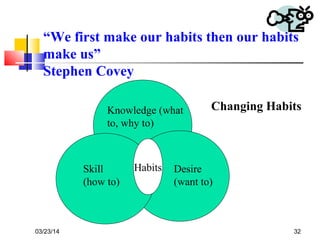
“We first make our habits then our habits
make us”
Stephen Covey
Knowledge (what
to, why to)
Desire
(want to)
Skill
(how to)
Habits
Changing Habits
03/23/14 33
Within (Team Name ) we will build effective working relationships
by:
Creating a safe and comfortable working environment
Being open, trusting and honest with one another
Valuing and respecting all fellow workers
Having two-way communication
Accepting that you can say “no” without feeling guilty
Encouraging equality by showing no favouritism and not allowing cliques to
03/23/14 34
Within (Team Name) we will build effective
working relationships by:
RESPECT – Respecting and valuing fellow workers
COMMUNICATION – Effective two-way
communication
TRUST – Being open, honest and approachable
EQUALITY – Treating everyone equally and fairly
ATTITUDE – Being positive and focused
SUPPORT – Showing compassion and sincerity
DIVERSITY – Respecting individuality

Assertiveness Course for Extra Confidence

  • 1.
  • 2.
    03/23/14 2 Learning Outcomes Bythe end of the course you will : Have knowledge and understanding of where you need to be as a person before you can act assertively Have identified your rights as an individual (Believe in?) Have knowledge and understanding of how we communicate assertively and the value of listening and questioning skills in doing so Have knowledge and understanding of the 3 main types of behaviour and how to use this to deal with difficult people and situations Have identified and know how to remove your “blockers” to behaving assertively Have knowledge and understanding of why a “Win – Win” mentality is critical for long term individual survival Have knowledge and understanding of the Thomas Kilmann Conflict Model Have identified the positive behaviours we need to work productively
  • 3.
    03/23/14 3 Creating anEnvironment which supports Positive Behaviour Beginning with YOU
  • 4.
    03/23/14 4 Stimulus Response GatherInformation Generate Options Select “Best” Option Take Decision Review Decision The Decision Taking Process Make M A K E The World Changes Here
  • 5.
    03/23/14 5 What doesthis say? happinessisnowhere happiness is now here Positive v Negative Thinking
  • 6.
    03/23/14 6 Is yourview of the world the only one? What do you see? What might they see?
  • 7.
    03/23/14 7 Are thingsalways as they seem?
  • 8.
    03/23/14 8 The wayan individual perceives, understands and interprets the surrounding world – a mental map Paradigms
  • 9.
    03/23/14 9 “If youwant small changes, work on your behaviour. If you want quantum leap changes work on your paradigms” Stephen R.Covey- “The Seven Habits of Highly Effective People” Changing YOUR Paradigm
  • 10.
    03/23/14 10 A FoundationModel – For you to follow CharacterCharacter CompetenceCompetence A person with highA person with high character exhibits integrity,character exhibits integrity, maturity and an Abundancematurity and an Abundance MentalityMentality A person with highA person with high competence hascompetence has knowledge and abilityknowledge and ability in a given areain a given area TrustworthinessTrustworthiness TrustTrust Being TrulyBeing Truly EffectiveEffective
  • 11.
    03/23/14 11 ““WeWe wholived in concentration camps can remember thewho lived in concentration camps can remember the men who walked throughout the huts comforting others,men who walked throughout the huts comforting others, giving away their last piece of bread. They may have beengiving away their last piece of bread. They may have been few in number, but they offer sufficient proof thatfew in number, but they offer sufficient proof that everything can be taken away from a man but one thing :everything can be taken away from a man but one thing : the last of the human freedomsthe last of the human freedoms – to choose ones’ attitude in– to choose ones’ attitude in any given set of circumstances, to choose ones own way”any given set of circumstances, to choose ones own way” Viktor Frankl – Man’s Search for MeaningViktor Frankl – Man’s Search for Meaning Attitude is everything – Who chooses yours?
  • 12.
    03/23/14 12 Dealing withPeople Only YOU can develop the model of YOU required to act assertively
  • 13.
    03/23/14 13 “Seek firstto understand Then be understood” – Habit 5 Think Win – Win – Habit 4
  • 14.
    03/23/14 14 Developing aWin – Win Relationship The OK Corral I’m OK Your OK I’m OK Your not OK I’m not OK Your OK I’m not OK Your not OK Win Win Lose Win Win Lose Lose Lose
  • 15.
    03/23/14 15 The ThreeMain Behaviours Aggressive – Assertive – Non-assertive (Submissive) Productive v Unproductive Behaviours
  • 16.
    03/23/14 16 Levels ofListening • Ignoring – Making no effort to listen • Pretend Listening – Giving the appearance of listening • Selective Listening – Hearing the bits that interest you • Attentive Listening – Paying attention, focusing, comparing to personal experiences • Empathetic Listening – Listening and responding with both heart and mind
  • 17.
    03/23/14 17 The Powerof QuestionsThe Power of Questions • Reflective – You seem unhappy about …? • Open – Tell me about …? To what extent does …? • Probing – Tell me more about …? Better in what way …? • Link – You mentioned that …? • Direct – When do you need this by …? • Closed – Are you happy with the proposal? • Silence
  • 18.
    03/23/14 18 12 Can yousee what they see?
  • 19.
    03/23/14 19 How dothey see things?
  • 20.
    03/23/14 20 Assertiveness means.. • Standing up for your own rights in such a way that you do not violate another persons rights • Expressing your needs, wants, opinions feelings and beliefs in direct, honest and appropriate ways
  • 21.
    03/23/14 21 Assertiveness Assertiveness isbased on the belief that in any situation; • You have needs to be met • The other people involved have needs to be met • You have rights, so do others • You have something to contribute, so do others Aim - To achieve “Win – Win”
  • 22.
    03/23/14 22 Submissiveness means.. • Failing to stand up for your rights or doing so in such a way that others can disregard them • Expressing your needs, wants, opinions feelings and beliefs in apologetic, diffident or self effacing ways
  • 23.
    03/23/14 23 Submissiveness Submissiveness isbased on the belief that in any situation: • The other persons needs and wants are more important than your own • The other person has rights, but you do not • You have little or nothing to contribute, the other person has a great deal to contribute Aim – To avoid conflict and please others – “perceived benefits”
  • 24.
    03/23/14 24 AGGRESSION MEANS.. • STANDING UP FOR YOUR OWN RIGHTS BUT DOING SO IN SUCH A WAY THAT YOU VIOLATE THE RIGHTS OF OTHER PEOPLE • IGNORING OR DISMISSING THE NEEDS, WANTS AND OPINIONS, FEELINGS OR BELIEFS OF OTHERS • EXPRESSING YOUR OWN NEEDS, WANTS AND OPINIONS (WHICH MAY BE HONEST OR DISHONEST) IN INAPPROPRIATE WAYS
  • 25.
    03/23/14 25 AGGRESSION AGGRESSION isbased on the belief that in any situation: • YOUR OWN NEEDS, WANTS AND OPINIONS ARE MORE IMPORTANT THAN OTHER PEOPLE’S • YOU HAVE RIGHTS BUT OTHER PEOPLE DO NOT • YOU HAVE SOMETHING TO CONTRIBUTE, OTHERS HAVE LITTLE OR NOTHING TO CONTRIBUTE AIM – TO WIN. IF NECESSARY AT THE EXPENSE OF OTHERS.
  • 26.
    03/23/14 26 Assertive “Persuasion” •Relax (as far as possible) • Have your information ready • Be sure of your facts • Calmly state your feelings • Keep to the point • Acknowledge the other persons point of view • Encourage joint solutions where possible • Go for “Win – Win” • Summarise the agreement Acknowledge Feelings Make positive statements Listen & Question
  • 27.
    03/23/14 27 Dealing withthings Assertively Dealing Assertively with submissive/aggressive behaviour • Self Awareness – Know the potential affects and exercise control • The“Self-fulfilling prophesy” – Make it positive • The “Inner Dialogue” – Make the right choices • Assertive Persuasion – Memorise the process and choose to use it (Listening and Questioning – a Team of Two)
  • 28.
    03/23/14 28 Have weagreed the Principles? • We all have rights to which we are entitled • Others have rights to which they are entitled • Everyone has the right to be treated with respect • In working towards a solution these rights must be respected at all times • Our style of behaviour is by personal choice
  • 29.
    03/23/14 29 Looking atConflict – Causes and Responses
  • 30.
    03/23/14 30 The Thomas- Kilmann Model Defining the conflict modes Assertiveness Co-operation Collaborating (High Assertive/High Coop) (Low Assertive/High Coop) Accommodating Compromising (Mid Assertive/Mid Coop) Competing (High Assertive/Low Coop) (Low Assertive/Low Coop) Avoiding Avoidance (low coop, low assertiveness) Denial, under-responsiveness, shifting, semantic focus, postponement, – Advantage - takes out the heat of the moment – Disadvantage - conflict remains unresolved, may lead to larger outbreak Competition (low coop, high assertiveness) Presumptive attribution, prescription – Advantage - increased creativity and enthusiasm – Disadvantage - violence, driving opponent underground Compromise (moderate coop and assert) Reaching for a middle ground – Advantage - often actually resolves the conflict – Disadvantage - may actually be bad policy or decision by not staying true to either set of goals Accommodation (High coop, Low assert.) Appeasement, smoothing over – Advantage - often quickly leads to solution – Disadvantage - may, in the long run, be detrimental, denies the legitimacy of the claims of one of the participants Collaboration (High coop, High assert.) –Use description, qualification, accept responsibility, initiating problem solving – Advantage - Achieves trusting relationships – Disadvantage - difficult and many are not trained to do it very well The Thomas - Kilmann Model Defining the conflict modes Assertiveness Co-operation Collaborating (High Assertive/High Coop) (Low Assertive/High Coop) Accommodating Compromising (Mid Assertive/Mid Coop) Competing (High Assertive/Low Coop) (Low Assertive/Low Coop) Avoiding
  • 31.
    03/23/14 31 Learning Outcomes Bythe end of the course you will : Have knowledge and understanding of where you need to be as a person before you can act assertively Have identified your rights as an individual (Believe in?) Have knowledge and understanding of how we communicate assertively and the value of listening and questioning skills in doing so Have knowledge and understanding of the 3 main types of behaviour and how to use this to deal with difficult people and situations Have identified and know how to remove your “blockers” to behaving assertively Have knowledge and understanding of why a “Win – Win” mentality is critical for long term individual survival Have knowledge and understanding of the Thomas Kilmann Conflict Model Have identified the positive behaviours we need to work productively
  • 32.
    03/23/14 32 “We firstmake our habits then our habits make us” Stephen Covey Knowledge (what to, why to) Desire (want to) Skill (how to) Habits Changing Habits
  • 33.
    03/23/14 33 Within (TeamName ) we will build effective working relationships by: Creating a safe and comfortable working environment Being open, trusting and honest with one another Valuing and respecting all fellow workers Having two-way communication Accepting that you can say “no” without feeling guilty Encouraging equality by showing no favouritism and not allowing cliques to
  • 34.
    03/23/14 34 Within (TeamName) we will build effective working relationships by: RESPECT – Respecting and valuing fellow workers COMMUNICATION – Effective two-way communication TRUST – Being open, honest and approachable EQUALITY – Treating everyone equally and fairly ATTITUDE – Being positive and focused SUPPORT – Showing compassion and sincerity DIVERSITY – Respecting individuality

Editor's Notes

  • #6 What does this say about us? Happiness is now here or nowhere? We need to keep a positive frame of mind.