Manual Assembly Lines
Most manufactured consumer products are
assembled. Products are assembled by
various assembly processes.
• Assembly Workstations
• Work Transport System
• Line Pacing
• Coping with Product Variety
Manual Assembly Lines
This manufacturing system consist of two
or more stations (n>1), with one or more
workers at each station (wi > 1). The
operations are sequential, usually fixed
routing, same as production line. Work
transport between stations is either
manual or mechanized.
Consumer products manufacturing.
Products usually made on manual
assembly lines
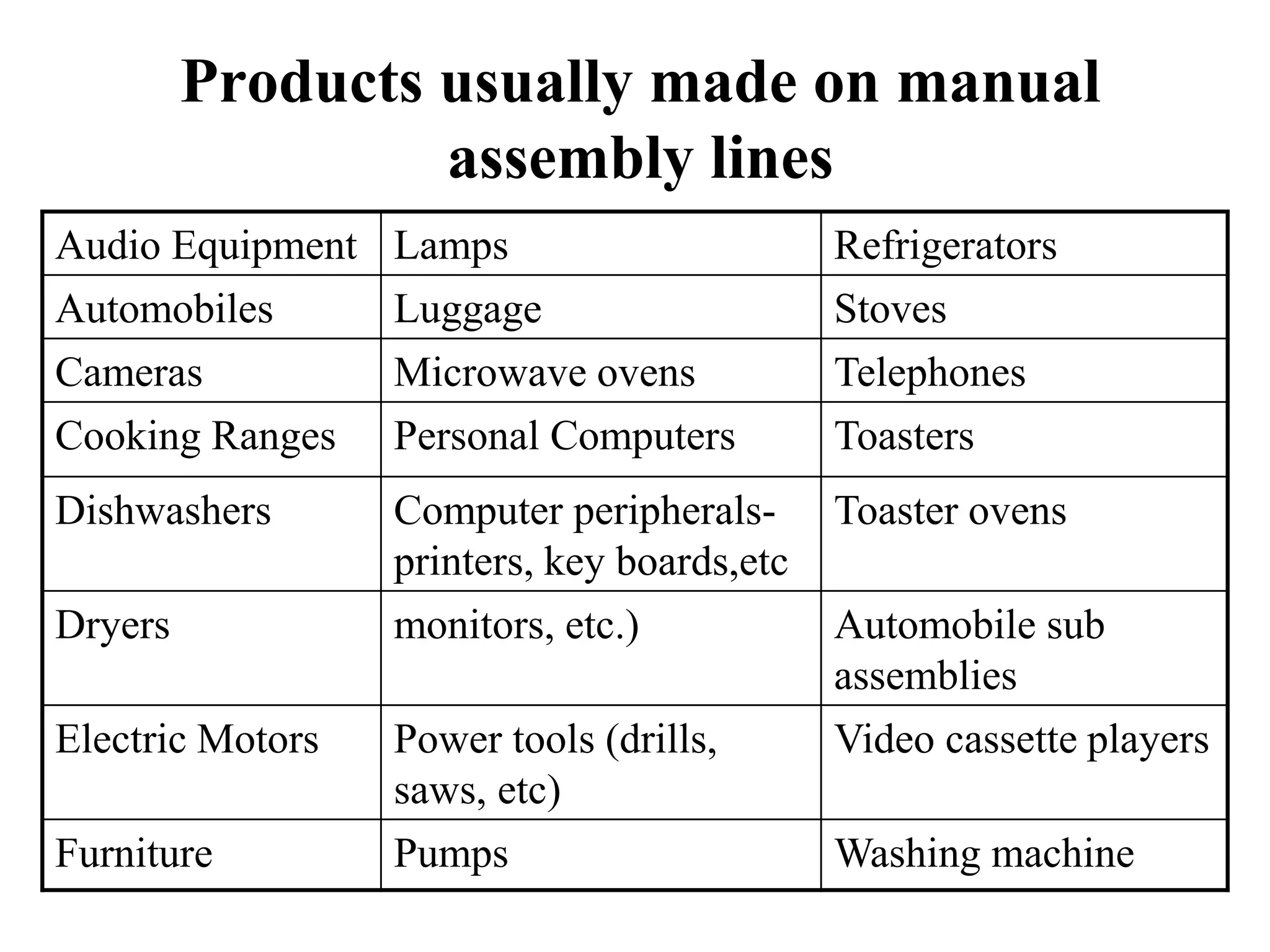
Audio Equipment Lamps Refrigerators
Automobiles Luggage Stoves
Cameras Microwave ovens Telephones
Cooking Ranges Personal Computers Toasters
Dishwashers Computer peripherals-
printers, key boards,etc
Toaster ovens
Dryers monitors, etc.) Automobile sub
assemblies
Electric Motors Power tools (drills,
saws, etc)
Video cassette players
Furniture Pumps Washing machine
Factors for the use of Manual
Assembly Line
• Demand for the product is high or Medium.
• The products made on the line are identical or
similar.
• The total work required to assembly the
product can be divided into small work
elements.
• It is technology impossible or economically
infeasible to automate the assembly operations.
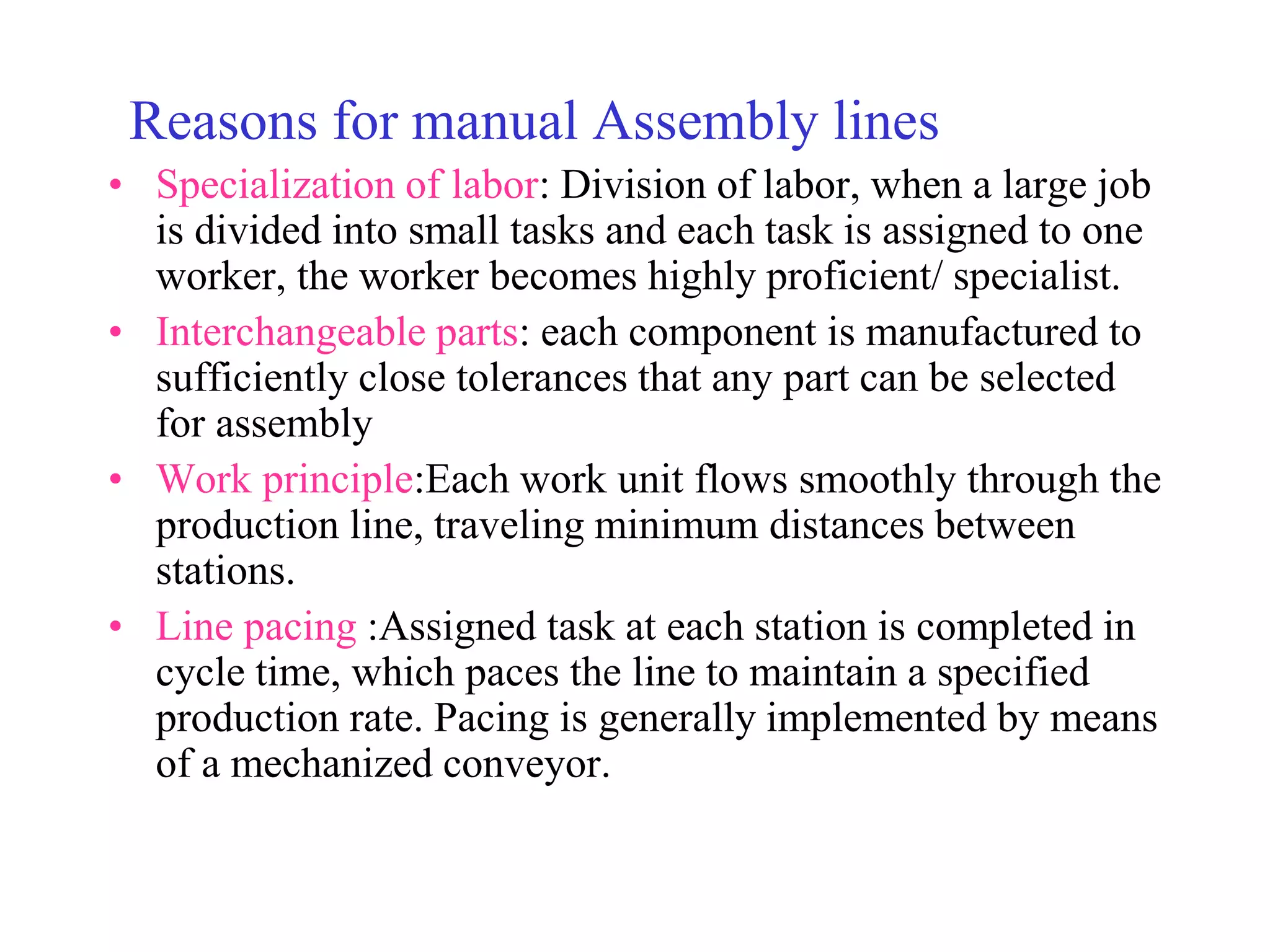
Reasons for manual Assembly lines
• Specialization of labor: Division of labor, when a large job
is divided into small tasks and each task is assigned to one
worker, the worker becomes highly proficient/ specialist.
• Interchangeable parts: each component is manufactured to
sufficiently close tolerances that any part can be selected
for assembly
• Work principle:Each work unit flows smoothly through the
production line, traveling minimum distances between
stations.
• Line pacing :Assigned task at each station is completed in
cycle time, which paces the line to maintain a specified
production rate. Pacing is generally implemented by means
of a mechanized conveyor.
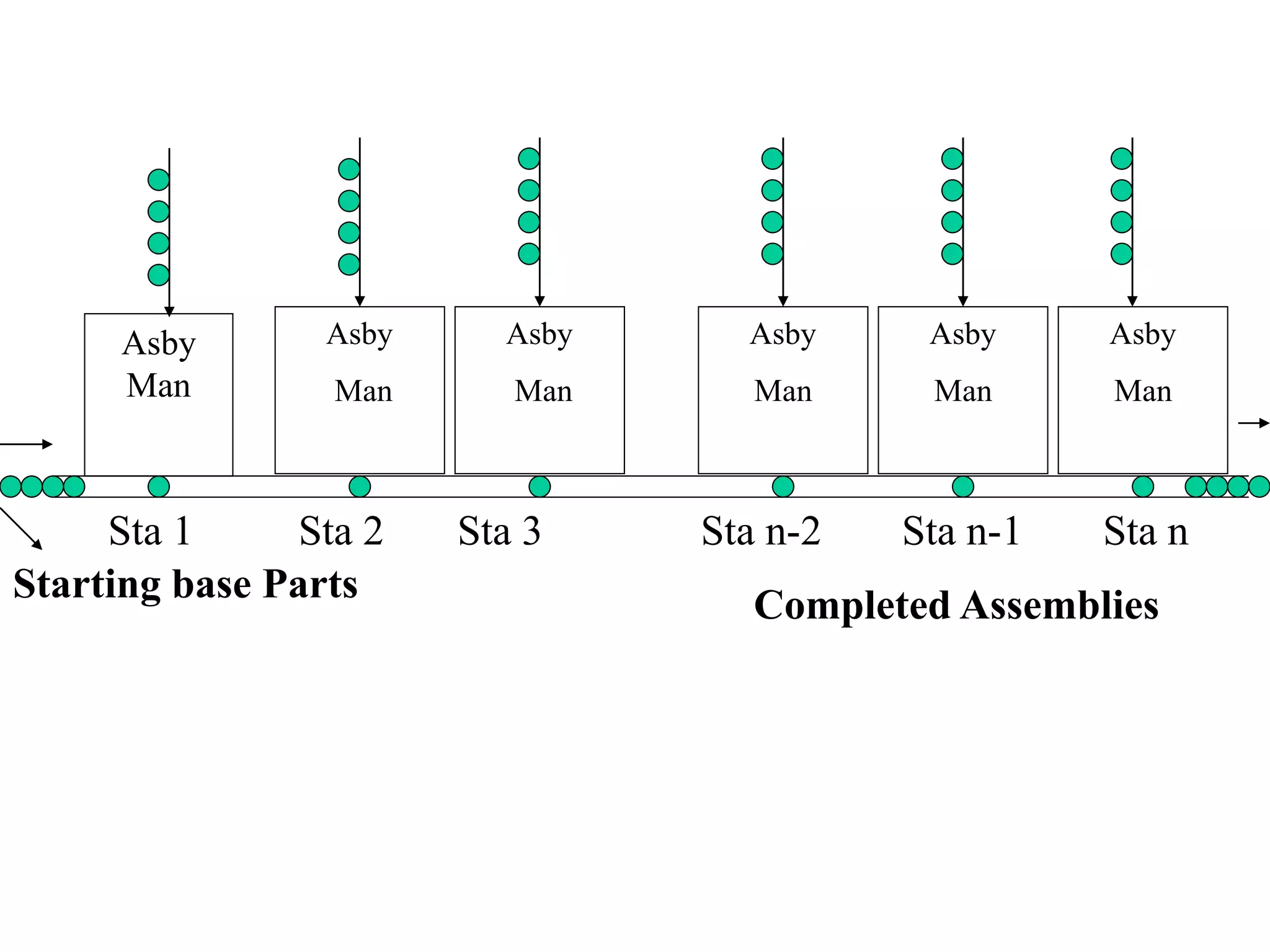
Asby
Man
Asby
Man
Asby
Man
Asby
Man
Asby
Man
Asby
Man
Starting base Parts
Completed Assemblies
Sta 1 Sta 2 Sta 3 Sta n-2 Sta n-1 Sta n
ASSEMBLY WORKSTATIONS
It is a designated location along the flow path at
which one or more work elements are
performed by one or more workers. The worker
begins the task at up stream and move with the
work until it completed. For small products
worker sit and complete the work. Depending
on the product work station is designed.
Manual Assembly Operations
• Arc Welding
• Brazing
• Fitting operation
• Adhesive / sealant
• Press fitting
• Filing
• Taping
• Riveting
• Shrink fitting
• Snap fitting
• Soldering
• Spot welding
• Stamping
• Thread fastening
Line Pacing
• Assembly line operates at certain cycle time
which is established to achieve the required
production rate of the time.
• On an average, each worker must complete the
assigned task at his station with in this cycle time
or else the required production rate will not be
achieved.
• This pacing of the workers is one of the reason
why a manual assembly line is successful. Pacing
provides a discipline for the assembly line
workers that more or less guarantees a certain
Production rate.
Three levels of pacing
• Rigid pacing: Fixed time
• Pacing with margin: Time with
margin
• No pacing: No fixed time.
Rigid pacing
• In this worker is allowed only a certain
fixed time each cycle to complete the
assigned task.
Pacing with Margin
• Task is completed with in the specified
tyime range. The maximum time of the
range is longer than the cycle time, so that a
worker is permitted to take more time if
required.
No pacing:
• It has no time limit exists within which the
task at the station must be finised. It effect
each assembly operator worker at the staion.
Design for Manufacturing
It is the concept of Product design to facilitate
in assembly.
Design the product with few as parts as
possible.
Design the remaining parts so they are easy to
assemble.
To achieve the required design function:
• Use the fewest number of parts posible to
reduce the amount of assembly
• Reduce the number of threaded fasteners
required.
• Standardize fasteners required
• Reduce parts orientation difficulties
• Avoid parts that tangle.
Manual Assembly Lines
FACTORS
• Demand for the product is high or medium.
• Products are identical or similar.
• Total work required can be divided into small
work elements.
• It is technically impossible or economically
infeasible to automate the assembly operations.
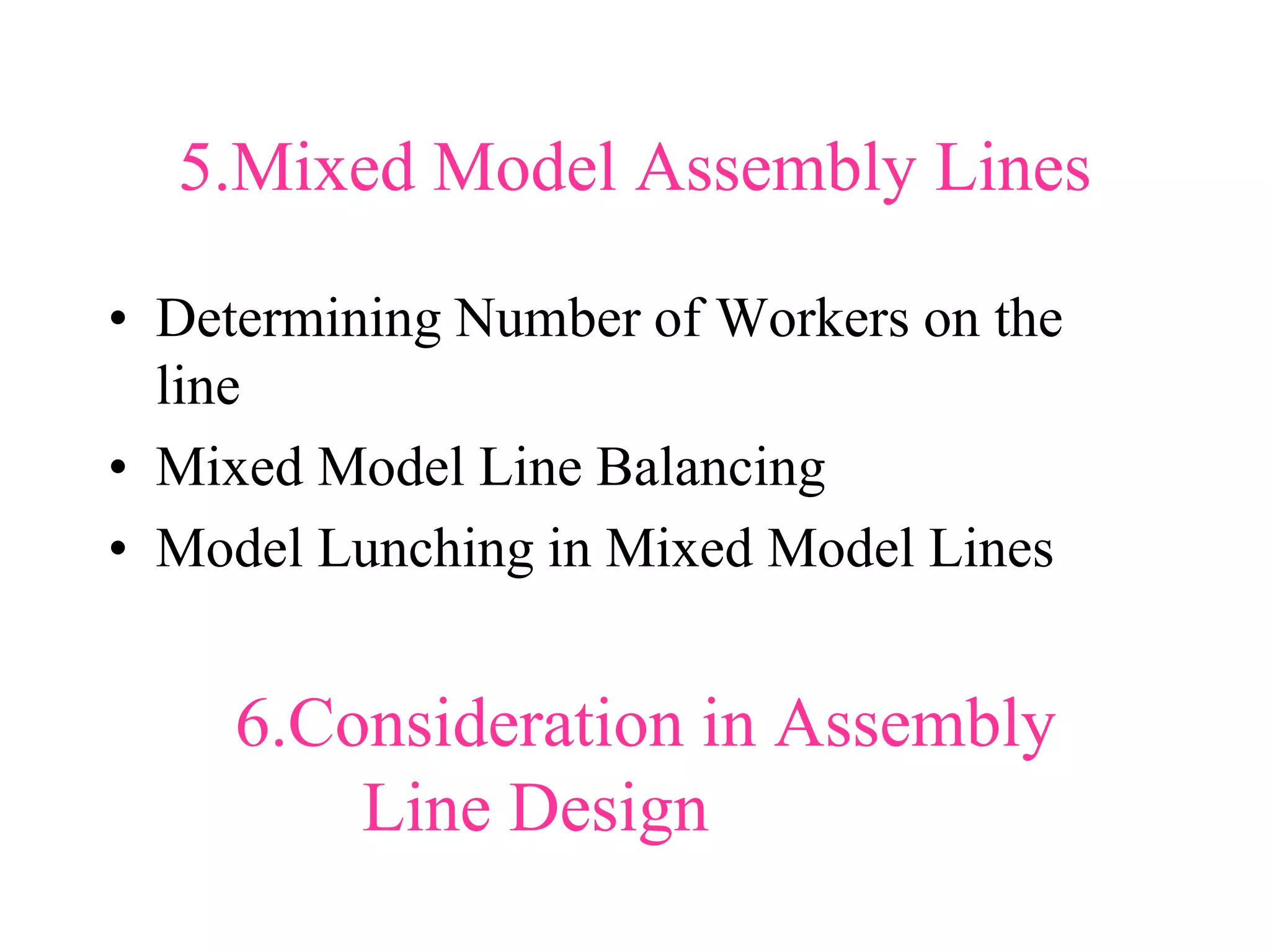
5.Mixed Model Assembly Lines
• Determining Number of Workers on the
line
• Mixed Model Line Balancing
• Model Lunching in Mixed Model Lines
6.Consideration in Assembly
Line Design
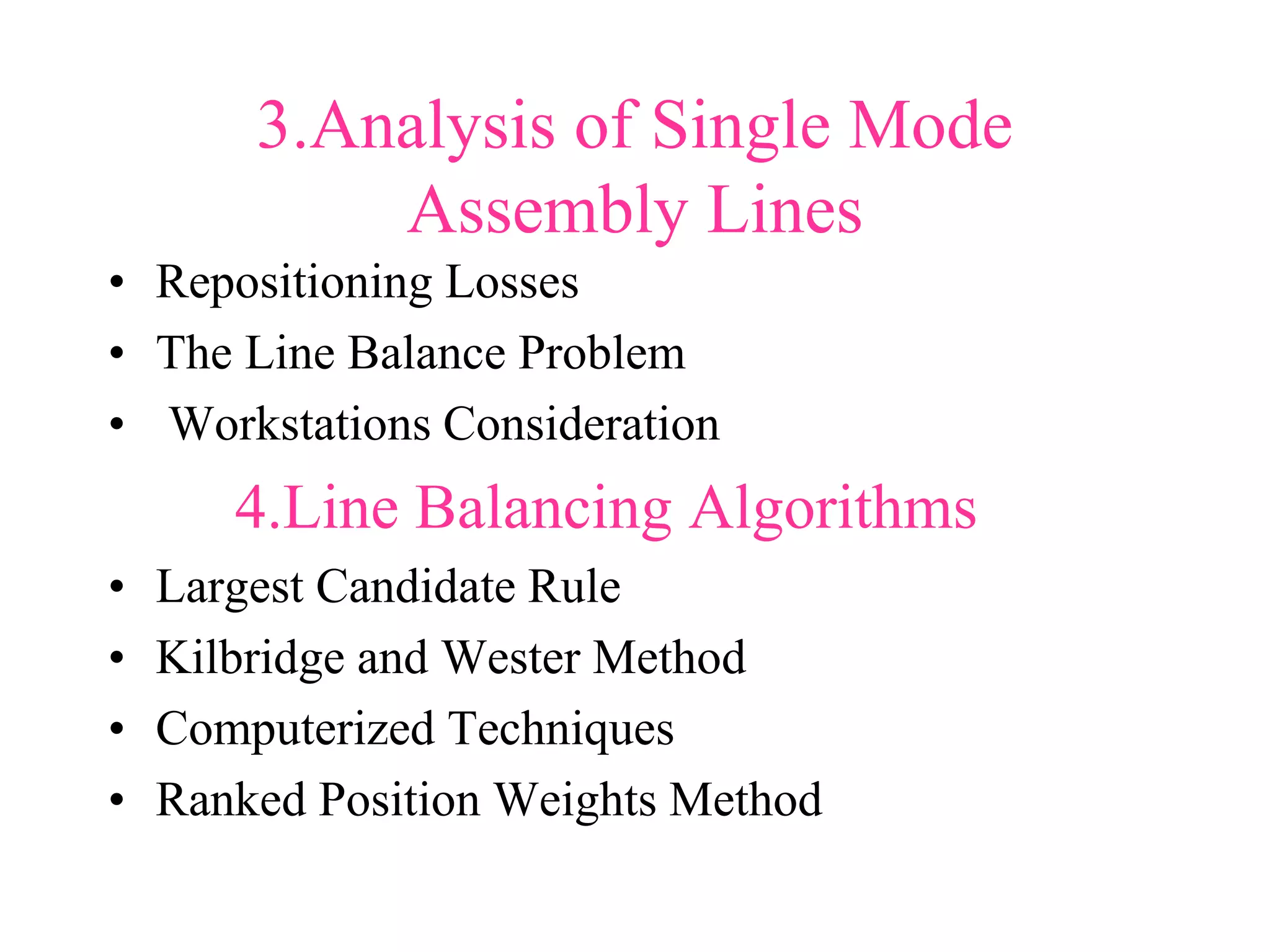
3.Analysis of Single Mode
Assembly Lines
• Repositioning Losses
• The Line Balance Problem
• Workstations Consideration
4.Line Balancing Algorithms
• Largest Candidate Rule
• Kilbridge and Wester Method
• Computerized Techniques
• Ranked Position Weights Method
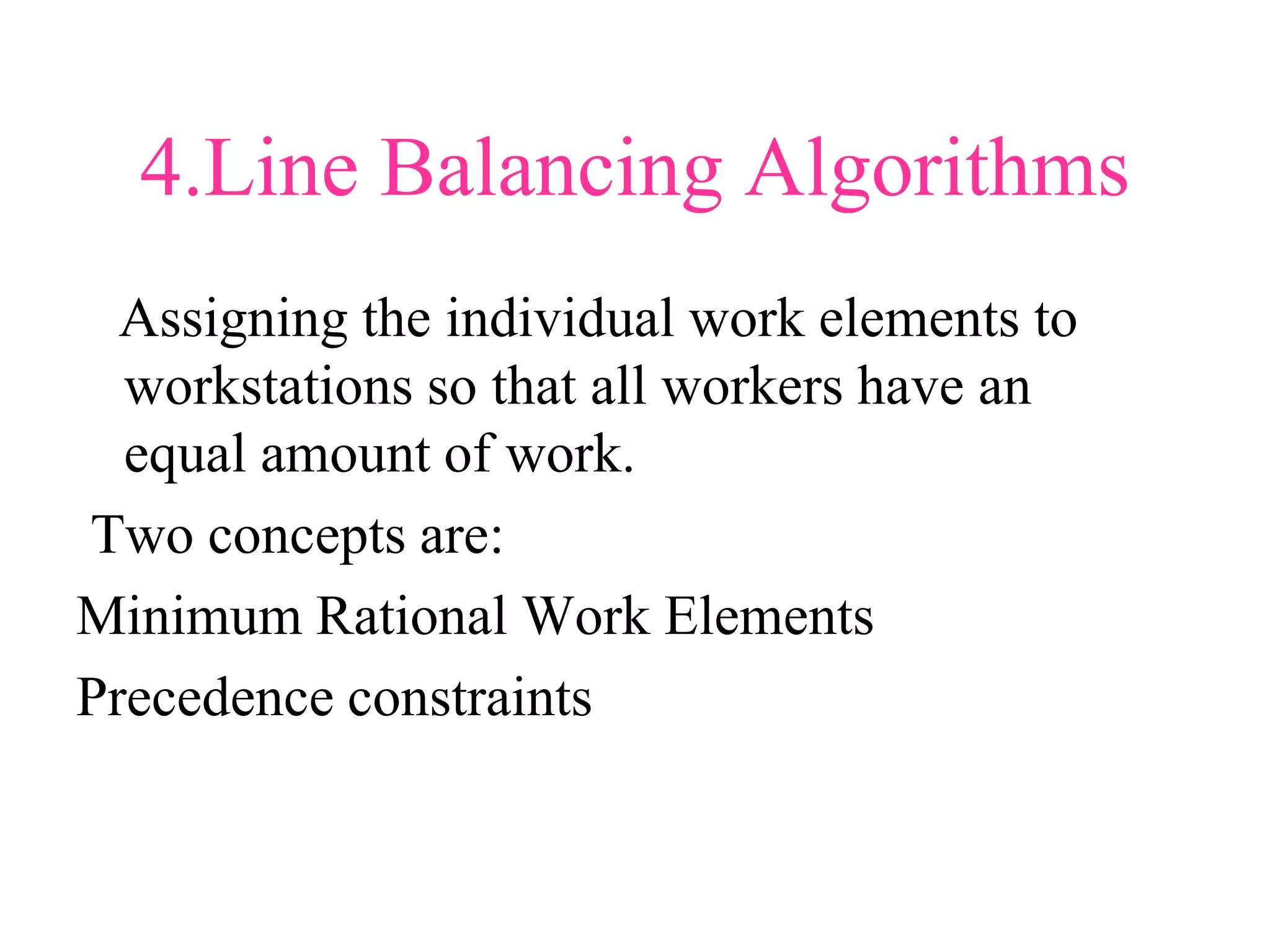
4.Line Balancing Algorithms
Assigning the individual work elements to
workstations so that all workers have an
equal amount of work.
Two concepts are:
Minimum Rational Work Elements
Precedence constraints
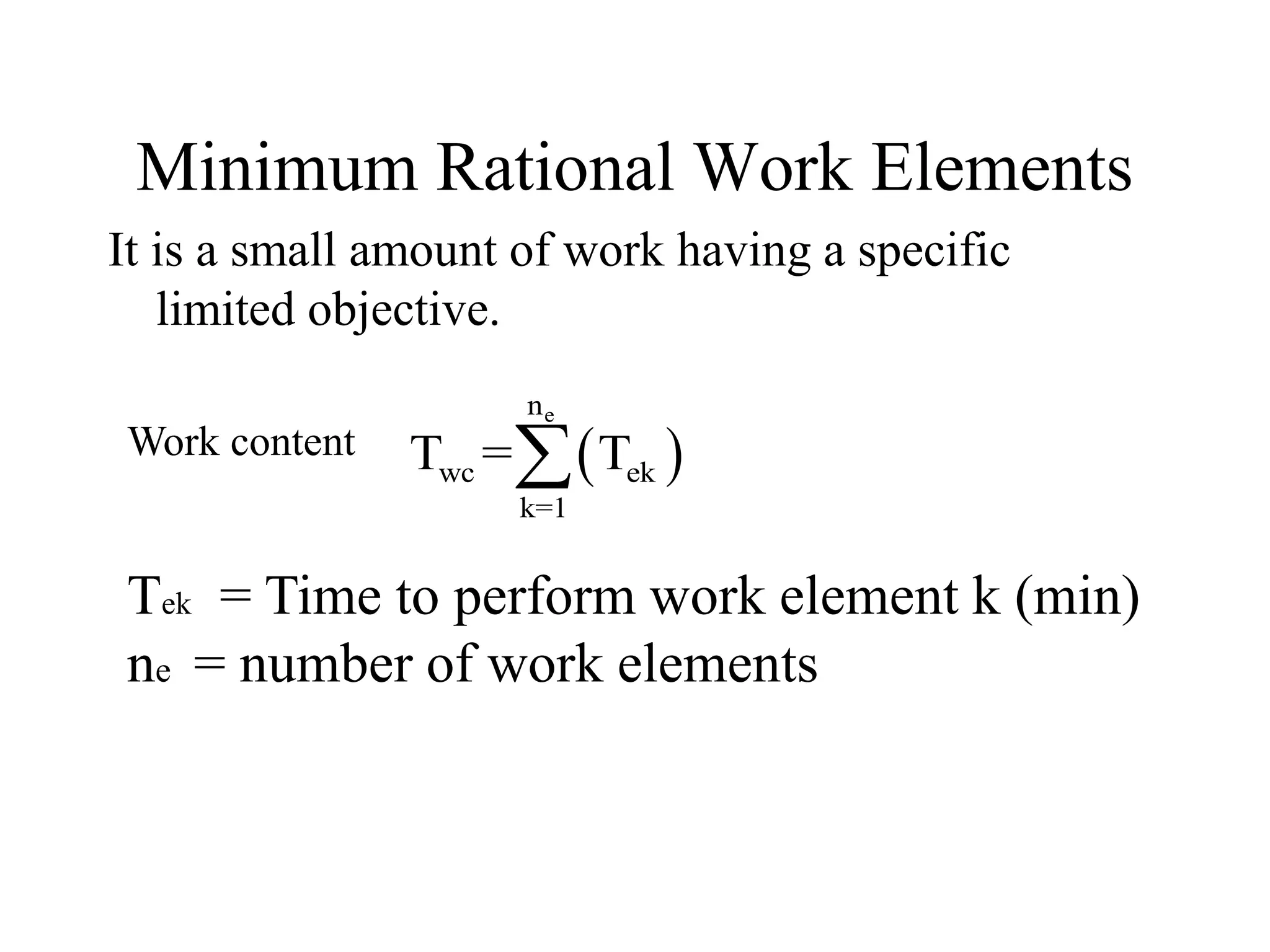
Minimum Rational Work Elements
It is a small amount of work having a specific
limited objective.
 
e
n
wc ek
k=1
T = T

Tek = Time to perform work element k (min)
ne = number of work elements
Work content
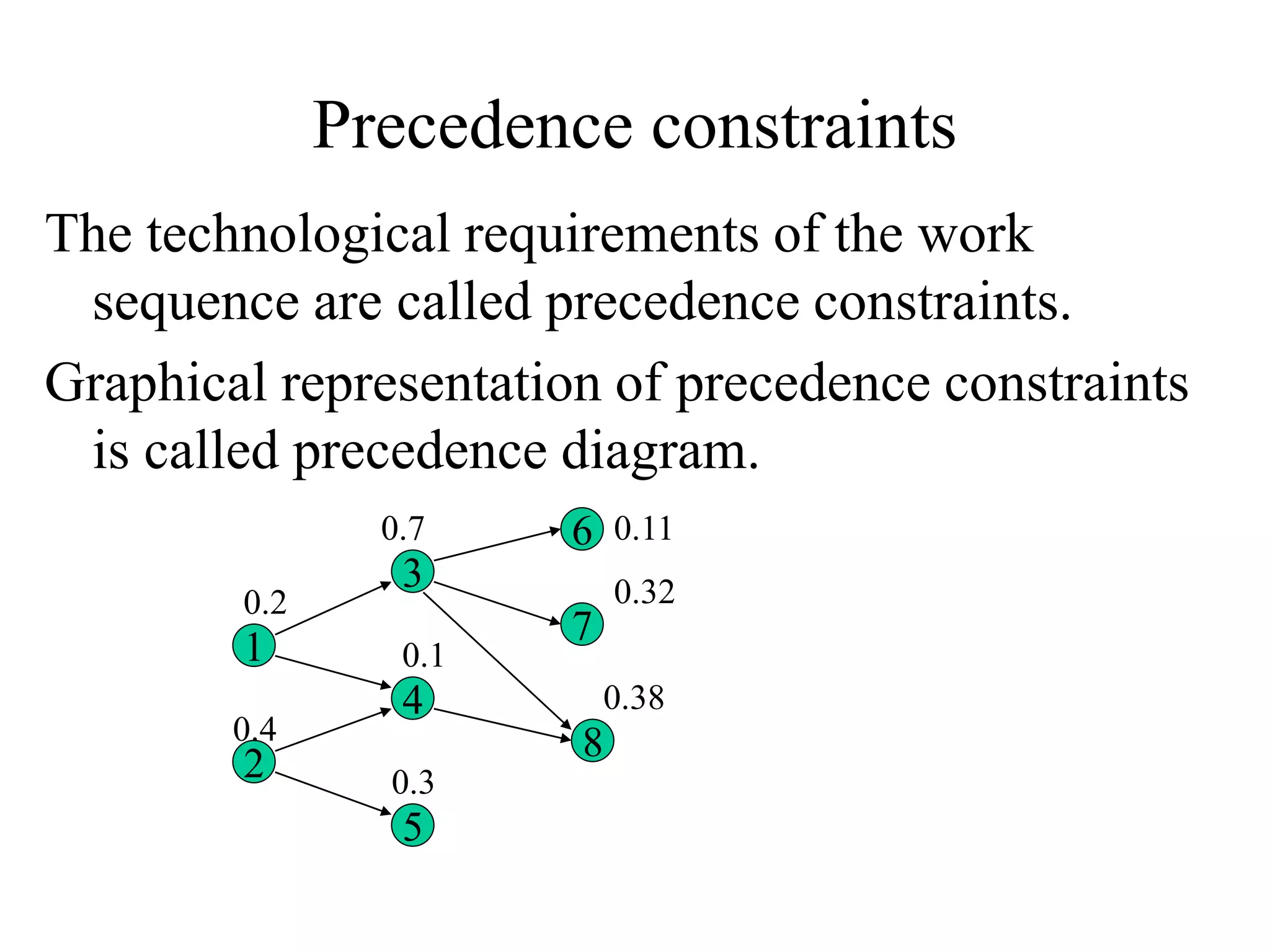
Precedence constraints
The technological requirements of the work
sequence are called precedence constraints.
Graphical representation of precedence constraints
is called precedence diagram.
1
2
3
4
5
7
6
0.2
0.4
0.7
0.1
0.3
0.11
0.32
8
0.38
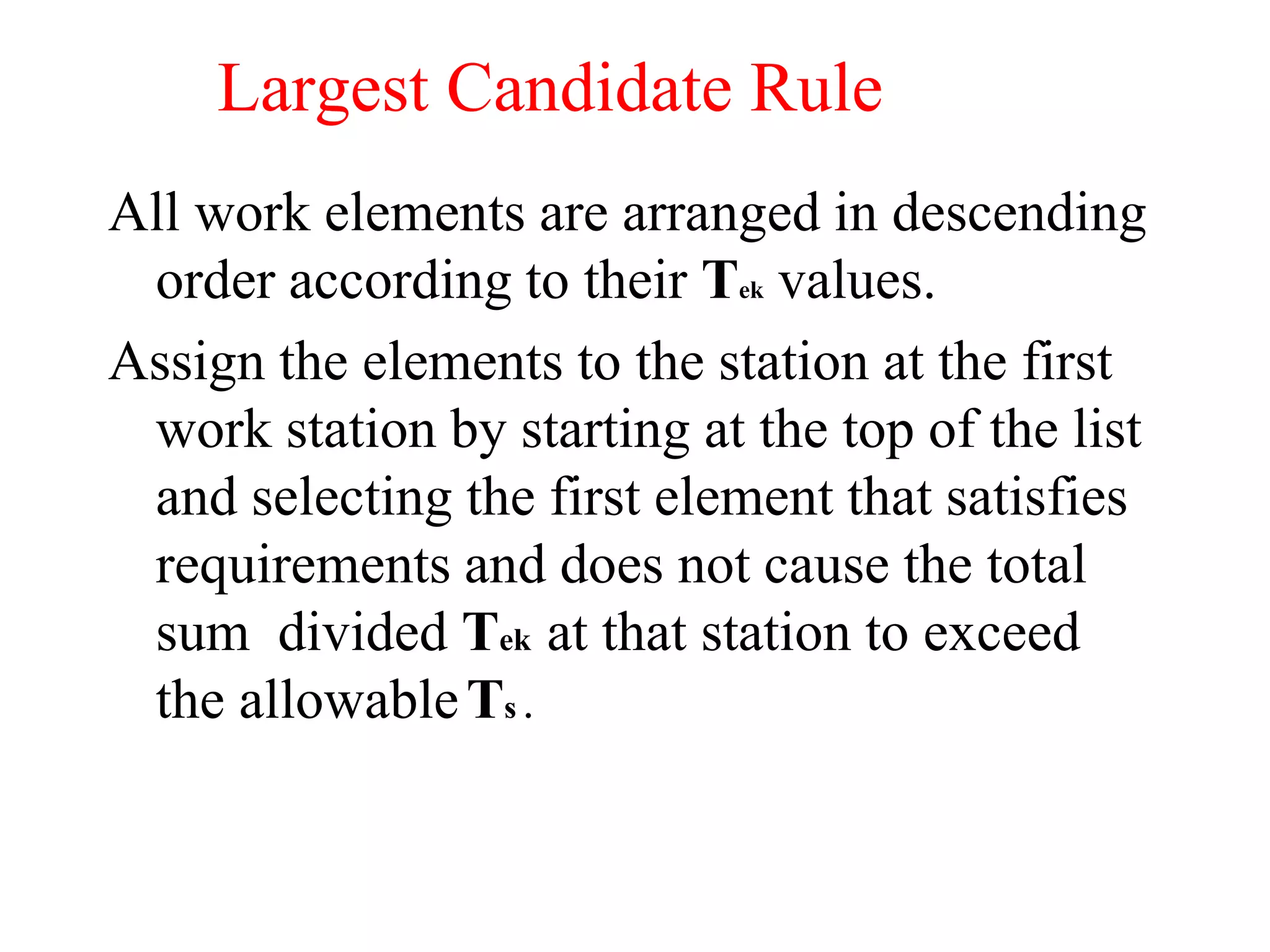
Largest Candidate Rule
All work elements are arranged in descending
order according to their Tek values.
Assign the elements to the station at the first
work station by starting at the top of the list
and selecting the first element that satisfies
requirements and does not cause the total
sum divided Tek at that station to exceed
the allowableTs .
UNIT -III
Manual Assembly Lines, Fundamentals of Manual
Assembly Lines, Alternative Assembly Systems,
Design for Assembly, Analysis of Single Model
Assembly Lines, Line balancing problem, largest
candidate rule, Kilbridge and Wester method and
Ranked Positional Weights Method. Mixed Model
Assembly Lines, Considerations in assembly line
design.
Unit 3
Manual Assembly lines, Fundamentals,
Design for assembly,
Analysis of Assembly lines,
Line balancing problem,
Largest candidate rule,
Kilbridge and Wester Method, and
Ranked position weights Method,
Considerations in Assembly line Design.

LINE PACING ETC..-2.ppt

  • 2.
    Manual Assembly Lines Mostmanufactured consumer products are assembled. Products are assembled by various assembly processes. • Assembly Workstations • Work Transport System • Line Pacing • Coping with Product Variety
  • 3.
    Manual Assembly Lines Thismanufacturing system consist of two or more stations (n>1), with one or more workers at each station (wi > 1). The operations are sequential, usually fixed routing, same as production line. Work transport between stations is either manual or mechanized. Consumer products manufacturing.
  • 4.
    Products usually madeon manual assembly lines Audio Equipment Lamps Refrigerators Automobiles Luggage Stoves Cameras Microwave ovens Telephones Cooking Ranges Personal Computers Toasters Dishwashers Computer peripherals- printers, key boards,etc Toaster ovens Dryers monitors, etc.) Automobile sub assemblies Electric Motors Power tools (drills, saws, etc) Video cassette players Furniture Pumps Washing machine
  • 5.
    Factors for theuse of Manual Assembly Line • Demand for the product is high or Medium. • The products made on the line are identical or similar. • The total work required to assembly the product can be divided into small work elements. • It is technology impossible or economically infeasible to automate the assembly operations.
  • 6.
    Reasons for manualAssembly lines • Specialization of labor: Division of labor, when a large job is divided into small tasks and each task is assigned to one worker, the worker becomes highly proficient/ specialist. • Interchangeable parts: each component is manufactured to sufficiently close tolerances that any part can be selected for assembly • Work principle:Each work unit flows smoothly through the production line, traveling minimum distances between stations. • Line pacing :Assigned task at each station is completed in cycle time, which paces the line to maintain a specified production rate. Pacing is generally implemented by means of a mechanized conveyor.
  • 7.
  • 8.
    ASSEMBLY WORKSTATIONS It isa designated location along the flow path at which one or more work elements are performed by one or more workers. The worker begins the task at up stream and move with the work until it completed. For small products worker sit and complete the work. Depending on the product work station is designed.
  • 9.
    Manual Assembly Operations •Arc Welding • Brazing • Fitting operation • Adhesive / sealant • Press fitting • Filing • Taping • Riveting • Shrink fitting • Snap fitting • Soldering • Spot welding • Stamping • Thread fastening
  • 10.
    Line Pacing • Assemblyline operates at certain cycle time which is established to achieve the required production rate of the time. • On an average, each worker must complete the assigned task at his station with in this cycle time or else the required production rate will not be achieved. • This pacing of the workers is one of the reason why a manual assembly line is successful. Pacing provides a discipline for the assembly line workers that more or less guarantees a certain Production rate.
  • 11.
    Three levels ofpacing • Rigid pacing: Fixed time • Pacing with margin: Time with margin • No pacing: No fixed time.
  • 12.
    Rigid pacing • Inthis worker is allowed only a certain fixed time each cycle to complete the assigned task.
  • 13.
    Pacing with Margin •Task is completed with in the specified tyime range. The maximum time of the range is longer than the cycle time, so that a worker is permitted to take more time if required.
  • 14.
    No pacing: • Ithas no time limit exists within which the task at the station must be finised. It effect each assembly operator worker at the staion.
  • 15.
    Design for Manufacturing Itis the concept of Product design to facilitate in assembly. Design the product with few as parts as possible. Design the remaining parts so they are easy to assemble.
  • 16.
    To achieve therequired design function: • Use the fewest number of parts posible to reduce the amount of assembly • Reduce the number of threaded fasteners required. • Standardize fasteners required • Reduce parts orientation difficulties • Avoid parts that tangle.
  • 17.
    Manual Assembly Lines FACTORS •Demand for the product is high or medium. • Products are identical or similar. • Total work required can be divided into small work elements. • It is technically impossible or economically infeasible to automate the assembly operations.
  • 18.
    5.Mixed Model AssemblyLines • Determining Number of Workers on the line • Mixed Model Line Balancing • Model Lunching in Mixed Model Lines 6.Consideration in Assembly Line Design
  • 19.
    3.Analysis of SingleMode Assembly Lines • Repositioning Losses • The Line Balance Problem • Workstations Consideration 4.Line Balancing Algorithms • Largest Candidate Rule • Kilbridge and Wester Method • Computerized Techniques • Ranked Position Weights Method
  • 20.
    4.Line Balancing Algorithms Assigningthe individual work elements to workstations so that all workers have an equal amount of work. Two concepts are: Minimum Rational Work Elements Precedence constraints
  • 21.
    Minimum Rational WorkElements It is a small amount of work having a specific limited objective.   e n wc ek k=1 T = T  Tek = Time to perform work element k (min) ne = number of work elements Work content
  • 22.
    Precedence constraints The technologicalrequirements of the work sequence are called precedence constraints. Graphical representation of precedence constraints is called precedence diagram. 1 2 3 4 5 7 6 0.2 0.4 0.7 0.1 0.3 0.11 0.32 8 0.38
  • 23.
    Largest Candidate Rule Allwork elements are arranged in descending order according to their Tek values. Assign the elements to the station at the first work station by starting at the top of the list and selecting the first element that satisfies requirements and does not cause the total sum divided Tek at that station to exceed the allowableTs .
  • 24.
    UNIT -III Manual AssemblyLines, Fundamentals of Manual Assembly Lines, Alternative Assembly Systems, Design for Assembly, Analysis of Single Model Assembly Lines, Line balancing problem, largest candidate rule, Kilbridge and Wester method and Ranked Positional Weights Method. Mixed Model Assembly Lines, Considerations in assembly line design.
  • 25.
    Unit 3 Manual Assemblylines, Fundamentals, Design for assembly, Analysis of Assembly lines, Line balancing problem, Largest candidate rule, Kilbridge and Wester Method, and Ranked position weights Method, Considerations in Assembly line Design.