PASSIVE AGGLUTINATION
GROUP-K
• What is passive agglutination?
• What are various types of passive agglutination tests?
AREAS OF INTERESTS…
LET’S GET STARTED…
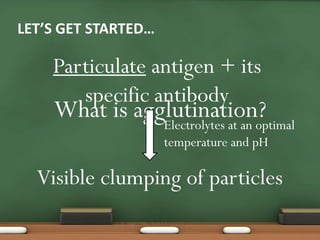
What is agglutination?
Particulate antigen + its
specific antibody
Electrolytes at an optimal
temperature and pH
Visible clumping of particles
LET’S GET STARTED…
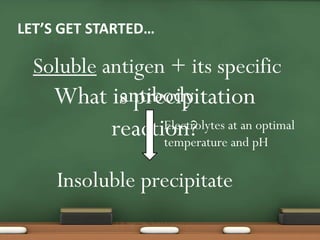
What is precipitation
reaction?
Soluble antigen + its specific
antibody
Electrolytes at an optimal
temperature and pH
Insoluble precipitate
LET’S GET STARTED…
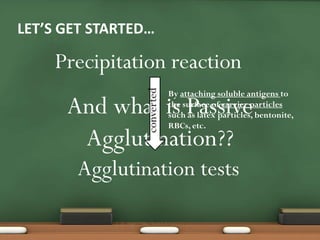
And what is Passive
Agglutination??
Precipitation reaction
Agglutination tests
By attaching soluble antigens to
the surface of carrier particles
such as latex particles, bentonite,
RBCs, etc.
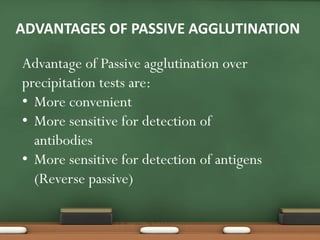
ADVANTAGES OF PASSIVE AGGLUTINATION
Advantage of Passive agglutination over
precipitation tests are:
• More convenient
• More sensitive for detection of
antibodies
• More sensitive for detection of antigens
(Reverse passive)
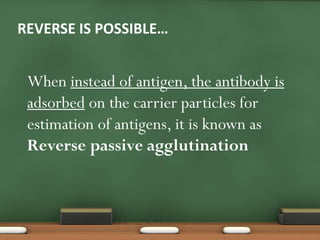
REVERSE IS POSSIBLE…
When instead of antigen, the antibody is
adsorbed on the carrier particles for
estimation of antigens, it is known as
Reverse passive agglutination
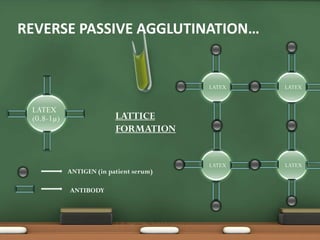
LATEX
(0.8-1µ)
ANTIBODY
LATEX LATEX
LATEX LATEX
ANTIGEN (in patient serum)
LATTICE
FORMATION
REVERSE PASSIVE AGGLUTINATION…
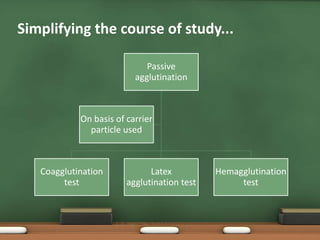
Simplifying the course of study...
Passive
agglutination
Coagglutination
test
Latex
agglutination test
Hemagglutination
test
On basis of carrier
particle used
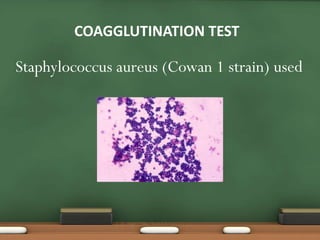
COAGGLUTINATION TEST
Staphylococcus aureus (Cowan 1 strain) used
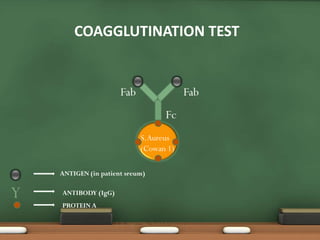
COAGGLUTINATION TEST
S.Aureus
(Cowan 1)
Fc
FabFab
ANTIBODY (IgG)
ANTIGEN (in patient sreum)
PROTEIN A
Y
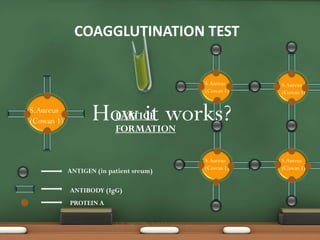
COAGGLUTINATION TEST
S.Aureus
(Cowan 1)
ANTIBODY (IgG)
S.Aureus
(Cowan 1)
ANTIGEN (in patient sreum)
LATTICE
FORMATION
S.Aureus
(Cowan 1)
S.Aureus
(Cowan 1)
S.Aureus
(Cowan 1)
PROTEIN A
How it works?
LATEX AGGLUTINATION TEST...
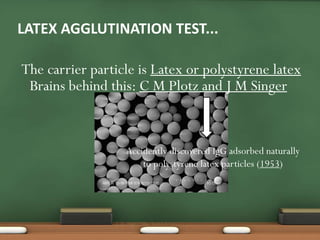
The carrier particle is Latex or polystyrene latex
Brains behind this: C M Plotz and J M Singer
Accidently discovered IgG adsorbed naturally
to polystyrene latex particles (1953)
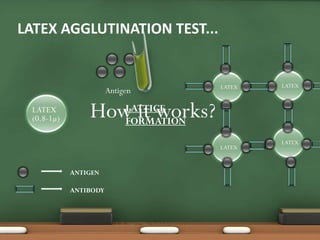
LATEX AGGLUTINATION TEST...
How it works?LATEX
(0.8-1µ)
Antigen LATEX
LATEX
LATEX
LATEX
LATTICE
FORMATION
ANTIBODY
ANTIGEN
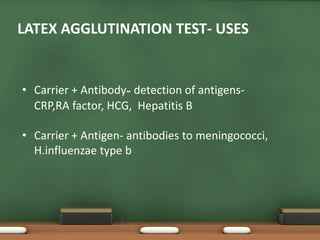
LATEX AGGLUTINATION TEST- USES
• Carrier + Antibody- detection of antigens-
CRP,RA factor, HCG, Hepatitis B
• Carrier + Antigen- antibodies to meningococci,
H.influenzae type b
 Large number of antigens can adsorbed on carrier
 Better visualization of Ag-Ab reaction due to larger
particle size of Latex beads preventing previous
cumbersome process involved in precipitation
reactions (no sophisticated equipments required)
 Latex particles do not cross-react with other
antibodies
 Less time consuming
LATEX AGGLUTINATION TEST- ADVANTAGES
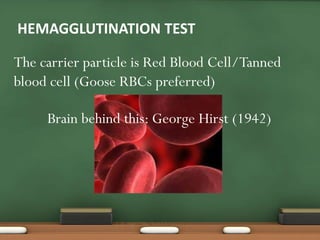
HEMAGGLUTINATION TEST
The carrier particle is Red Blood Cell/Tanned
blood cell (Goose RBCs preferred)
Brain behind this: George Hirst (1942)
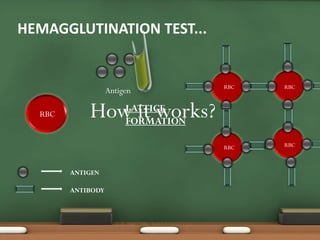
HEMAGGLUTINATION TEST...
How it works?RBC
Antigen RBC
LATTICE
FORMATION
ANTIBODY
ANTIGEN
RBC
RBC RBC
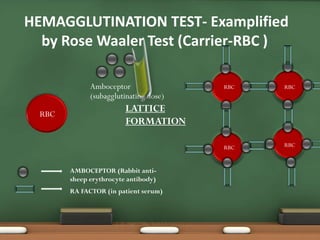
HEMAGGLUTINATION TEST- Examplified
by Rose Waaler Test (Carrier-RBC )
RBC
Amboceptor
(subagglutinating dose)
RBC
LATTICE
FORMATION
RA FACTOR (in patient serum)
AMBOCEPTOR (Rabbit anti-
sheep erythrocyte antibody)
RBC
RBC RBC
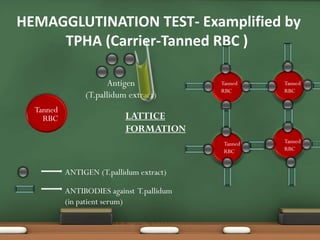
HEMAGGLUTINATION TEST- Examplified by
TPHA (Carrier-Tanned RBC )
Tanned
RBC
Antigen
(T.pallidum extract)
Tanned
RBC
LATTICE
FORMATION
ANTIBODIES against T.pallidum
(in patient serum)
ANTIGEN (T.pallidum extract)
Tanned
RBC
Tanned
RBC
Tanned
RBC
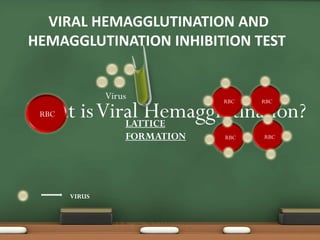
VIRAL HEMAGGLUTINATION AND
HEMAGGLUTINATION INHIBITION TEST
What isViral Hemagglutination?RBC
Virus RBC
LATTICE
FORMATION
VIRUS
RBC
RBC RBC
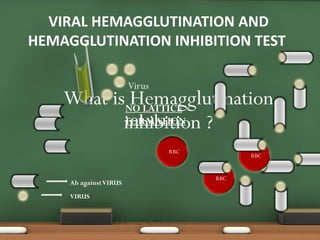
VIRAL HEMAGGLUTINATION AND
HEMAGGLUTINATION INHIBITION TEST
What is Hemagglutination
inhibition ?
Virus
NO LATTICE
FORMATION
VIRUS
RBC
Ab againstVIRUS
RBC
RBC
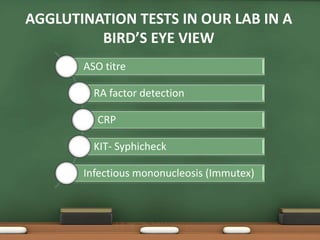
AGGLUTINATION TESTS IN OUR LAB IN A
BIRD’S EYE VIEW
ASO titre
RA factor detection
CRP
KIT- Syphicheck
Infectious mononucleosis (Immutex)
LET’S END BY LOOKING AT RECENT ADVANCES
• Determination of anti-streptolysin O antibody titer by a
new passive agglutination method using sensitized
toraysphere particles.
THANK
YOU
 References from:
Anantnarayan and
Paniker’s Textbook of
microbiology
C.P. Baweja’s Textbook
of Microbiology
Subhash Chandra
Parija’s Textbook of
microbiology and
Immunology
American Society for
microbiolgy-Journal of Clinical
Microbiology

All about Passive agglutination

  • 1.
  • 2.
    • What ispassive agglutination? • What are various types of passive agglutination tests? AREAS OF INTERESTS…
  • 3.
    LET’S GET STARTED… Whatis agglutination? Particulate antigen + its specific antibody Electrolytes at an optimal temperature and pH Visible clumping of particles
  • 4.
    LET’S GET STARTED… Whatis precipitation reaction? Soluble antigen + its specific antibody Electrolytes at an optimal temperature and pH Insoluble precipitate
  • 5.
    LET’S GET STARTED… Andwhat is Passive Agglutination?? Precipitation reaction Agglutination tests By attaching soluble antigens to the surface of carrier particles such as latex particles, bentonite, RBCs, etc.
  • 6.
    ADVANTAGES OF PASSIVEAGGLUTINATION Advantage of Passive agglutination over precipitation tests are: • More convenient • More sensitive for detection of antibodies • More sensitive for detection of antigens (Reverse passive)
  • 7.
    REVERSE IS POSSIBLE… Wheninstead of antigen, the antibody is adsorbed on the carrier particles for estimation of antigens, it is known as Reverse passive agglutination
  • 8.
    LATEX (0.8-1µ) ANTIBODY LATEX LATEX LATEX LATEX ANTIGEN(in patient serum) LATTICE FORMATION REVERSE PASSIVE AGGLUTINATION…
  • 9.
    Simplifying the courseof study... Passive agglutination Coagglutination test Latex agglutination test Hemagglutination test On basis of carrier particle used
  • 10.
  • 11.
    COAGGLUTINATION TEST S.Aureus (Cowan 1) Fc FabFab ANTIBODY(IgG) ANTIGEN (in patient sreum) PROTEIN A Y
  • 12.
    COAGGLUTINATION TEST S.Aureus (Cowan 1) ANTIBODY(IgG) S.Aureus (Cowan 1) ANTIGEN (in patient sreum) LATTICE FORMATION S.Aureus (Cowan 1) S.Aureus (Cowan 1) S.Aureus (Cowan 1) PROTEIN A How it works?
  • 13.
    LATEX AGGLUTINATION TEST... Thecarrier particle is Latex or polystyrene latex Brains behind this: C M Plotz and J M Singer Accidently discovered IgG adsorbed naturally to polystyrene latex particles (1953)
  • 14.
    LATEX AGGLUTINATION TEST... Howit works?LATEX (0.8-1µ) Antigen LATEX LATEX LATEX LATEX LATTICE FORMATION ANTIBODY ANTIGEN
  • 15.
    LATEX AGGLUTINATION TEST-USES • Carrier + Antibody- detection of antigens- CRP,RA factor, HCG, Hepatitis B • Carrier + Antigen- antibodies to meningococci, H.influenzae type b
  • 16.
     Large numberof antigens can adsorbed on carrier  Better visualization of Ag-Ab reaction due to larger particle size of Latex beads preventing previous cumbersome process involved in precipitation reactions (no sophisticated equipments required)  Latex particles do not cross-react with other antibodies  Less time consuming LATEX AGGLUTINATION TEST- ADVANTAGES
  • 17.
    HEMAGGLUTINATION TEST The carrierparticle is Red Blood Cell/Tanned blood cell (Goose RBCs preferred) Brain behind this: George Hirst (1942)
  • 18.
    HEMAGGLUTINATION TEST... How itworks?RBC Antigen RBC LATTICE FORMATION ANTIBODY ANTIGEN RBC RBC RBC
  • 19.
    HEMAGGLUTINATION TEST- Examplified byRose Waaler Test (Carrier-RBC ) RBC Amboceptor (subagglutinating dose) RBC LATTICE FORMATION RA FACTOR (in patient serum) AMBOCEPTOR (Rabbit anti- sheep erythrocyte antibody) RBC RBC RBC
  • 20.
    HEMAGGLUTINATION TEST- Examplifiedby TPHA (Carrier-Tanned RBC ) Tanned RBC Antigen (T.pallidum extract) Tanned RBC LATTICE FORMATION ANTIBODIES against T.pallidum (in patient serum) ANTIGEN (T.pallidum extract) Tanned RBC Tanned RBC Tanned RBC
  • 21.
    VIRAL HEMAGGLUTINATION AND HEMAGGLUTINATIONINHIBITION TEST What isViral Hemagglutination?RBC Virus RBC LATTICE FORMATION VIRUS RBC RBC RBC
  • 22.
    VIRAL HEMAGGLUTINATION AND HEMAGGLUTINATIONINHIBITION TEST What is Hemagglutination inhibition ? Virus NO LATTICE FORMATION VIRUS RBC Ab againstVIRUS RBC RBC
  • 23.
    AGGLUTINATION TESTS INOUR LAB IN A BIRD’S EYE VIEW ASO titre RA factor detection CRP KIT- Syphicheck Infectious mononucleosis (Immutex)
  • 24.
    LET’S END BYLOOKING AT RECENT ADVANCES • Determination of anti-streptolysin O antibody titer by a new passive agglutination method using sensitized toraysphere particles.
  • 25.
    THANK YOU  References from: Anantnarayanand Paniker’s Textbook of microbiology C.P. Baweja’s Textbook of Microbiology Subhash Chandra Parija’s Textbook of microbiology and Immunology American Society for microbiolgy-Journal of Clinical Microbiology