LABORATORY DIAGNOSIS
OF
FILARIASIS
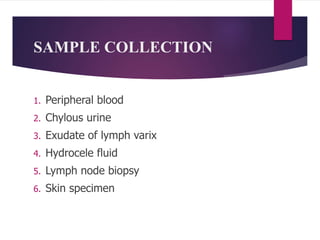
SAMPLE COLLECTION
1. Peripheral blood
2. Chylous urine
3. Exudate of lymph varix
4. Hydrocele fluid
5. Lymph node biopsy
6. Skin specimen
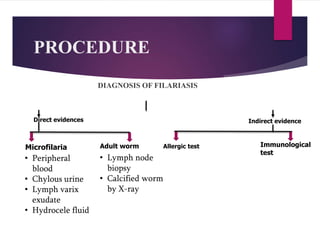
PROCEDURE
Direct evidences
DIAGNOSIS OF FILARIASIS
Indirect evidence
Microfilaria Adult worm Immunological
test
• Peripheral
blood
• Chylous urine
• Lymph varix
exudate
• Hydrocele fluid
• Lymph node
biopsy
• Calcified worm
by X-ray
Allergic test
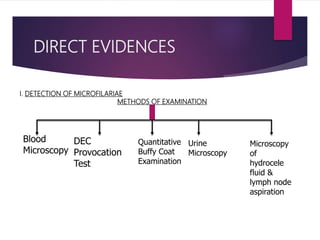
DIRECT EVIDENCES
I. DETECTION OF MICROFILARIAE
METHODS OF EXAMINATION
Blood
Microscopy
DEC
Provocation
Test
Quantitative
Buffy Coat
Examination
Urine
Microscopy
Microscopy
of
hydrocele
fluid &
lymph node
aspiration
I.BLOOD MICROSCOPY
• Microfilariae of Wuchereria bancrofti circulate in the peripheral blood
(nocturnal periodicity).
• Blood is collected between 10pm & 4am.
• Non-periodic microfilaria ( the blood may be taken at any time,
preferably in the morning)
• Microfilariae are not found in the peripheral blood in the
following conditions:
1. Elephantiasis ( due to lymphatic obstruction)
2. After an attack of lymphangitis (due to death of the adult worm).
3. Early allergic manifestation.
4. Occult filariasis
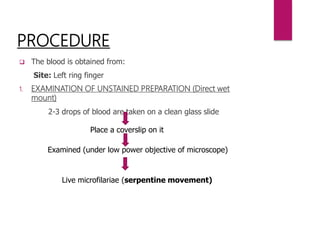
PROCEDURE
 The blood is obtained from:
Site: Left ring finger
1. EXAMINATION OF UNSTAINED PREPARATION (Direct wet
mount)
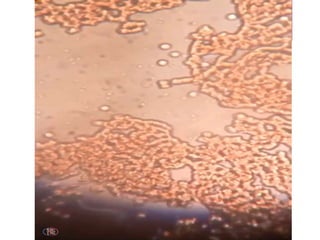
2-3 drops of blood are taken on a clean glass slide
Place a coverslip on it
Examined (under low power objective of microscope)
Live microfilariae (serpentine movement)
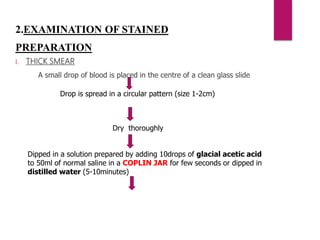
2.EXAMINATION OF STAINED
PREPARATION
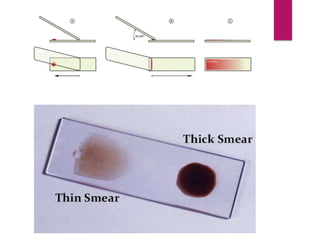
I. THICK SMEAR
A small drop of blood is placed in the centre of a clean glass slide
Drop is spread in a circular pattern (size 1-2cm)
Dry thoroughly
Dipped in a solution prepared by adding 10drops of glacial acetic acid
to 50ml of normal saline in a COPLIN JAR for few seconds or dipped in
distilled water (5-10minutes)
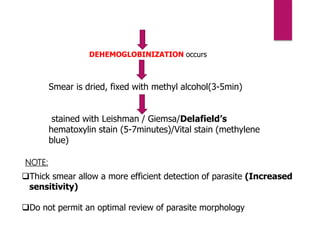
DEHEMOGLOBINIZATION occurs
Smear is dried, fixed with methyl alcohol(3-5min)
stained with Leishman / Giemsa/Delafield’s
hematoxylin stain (5-7minutes)/Vital stain (methylene
blue)
Thick smear allow a more efficient detection of parasite (Increased
sensitivity)
Do not permit an optimal review of parasite morphology
NOTE:
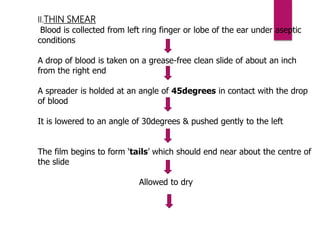
II.THIN SMEAR
Blood is collected from left ring finger or lobe of the ear under aseptic
conditions
A drop of blood is taken on a grease-free clean slide of about an inch
from the right end
A spreader is holded at an angle of 45degrees in contact with the drop
of blood
It is lowered to an angle of 30degrees & pushed gently to the left
The film begins to form ‘tails’ which should end near about the centre of
the slide
Allowed to dry
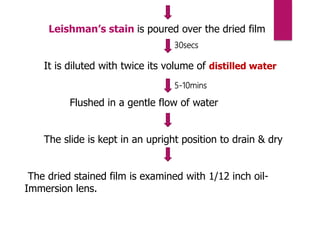
Leishman’s stain is poured over the dried film
It is diluted with twice its volume of distilled water
Flushed in a gentle flow of water
The slide is kept in an upright position to drain & dry
The dried stained film is examined with 1/12 inch oil-
Immersion lens.
5-10mins
30secs
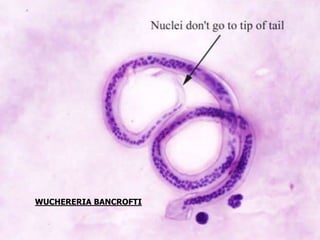
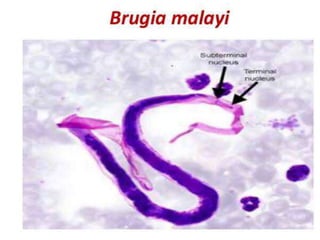
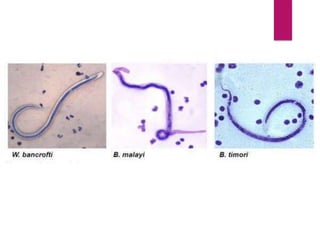
WUCHERERIA BANCROFTI
BRUGIA TIMORI
CONCENTRATION OF BLOOD
• For detecting low-density microfilaria.
• The various concentration methods are as follows:
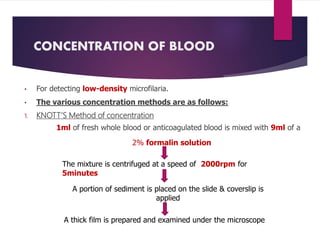
1. KNOTT’S Method of concentration
1ml of fresh whole blood or anticoagulated blood is mixed with 9ml of a
2% formalin solution
The mixture is centrifuged at a speed of 2000rpm for
5minutes
A portion of sediment is placed on the slide & coverslip is
applied
A thick film is prepared and examined under the microscope
2. MEMBRANE FILTRATION METHOD
• Done by millipore membrane or Nucleopore filter.
• The microfilariae liberated from measured quantity of
heparinised blood are examined fresh or after staining
• Most sensitive method
3. 1-2ml of blood is taken in a test tube containing 5-
10ml of 2% acetic acid solution. The blood is
centrifuged next morning and a smear made from the
deposit is stained and examined.
4. About 20drops of blood is placed in 10ml normal saline. A
few drops of 10% saponin solution is added to Haemolyse the
RBCs. The specimen is then centrifuged and examined.
5.About 5ml of blood is taken in 10ml of citrated saline &
1% saponin solution in normal saline is added & a drop of
heparin is added and mixture is centrifuged.
6.COUNTING CHAMBER TECHNIQUE
II. DIETHYLCARBAMAZINE (DEC)
PROVOCATION TEST
 Also known as HETRAZAN PROVOCATIVE TEST.
 A single dose of Diethylcarbamazine (DEC) 100mg or 2mg/kg is
administered orally.
 It induces the nocturnally periodic microfilariae to circulate in the
peripheral blood during the daytime.
 Blood is collected 30-45 minutes after administration of Diethylcarbamazine.
 Microfilariae begin to reach their peak at within 15mintues and begin to
decrease 2hours later.
 It is examined by concentration methods.
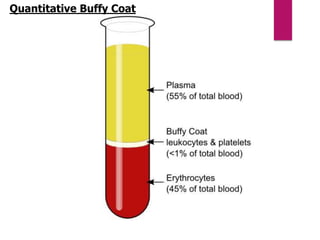
III. QUANTITATIVE BUFFY COAT
EXAMINATION
• The Buffy coat is the fraction of an anticoagulated
blood sample that contains most of the white blood
cells & platelets following density gradient
centrifugation of blood.
• Quantitative Buffy coat(QBC) is used to detect infection
with blood parasites.
PRINCIPLE: It is based on the principle of Centrifugal
stratification of blood components.
PROCEDURE
Blood is taken in a Microhaematocrit tube(QBC capillary tube)
[It is coated with acridine orange, EDTA & Heparin]
Centrifugation (5minutes)
Fluorescing parasites become concentrated in
the Buffy coat
The parasites can be visualized through the clear
glass wall of the tube
The acridine orange stains the DNA of the parasites.
The morphological characteristics, including the nuclear patterns
can be examined by ‘Flourescence microscopy’.
Very sensitive test.
NOTE:
Quantitative Buffy Coat
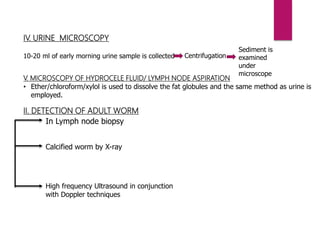
IV. URINE MICROSCOPY
10-20 ml of early morning urine sample is collected Centrifugation
Sediment is
examined
under
microscope
V. MICROSCOPY OF HYDROCELE FLUID/ LYMPH NODE ASPIRATION
• Ether/chloroform/xylol is used to dissolve the fat globules and the same method as urine is
employed.
II. DETECTION OF ADULT WORM
In Lymph node biopsy
Calcified worm by X-ray
High frequency Ultrasound in conjunction
with Doppler techniques
INDIRECT EVIDENCES
A. ALLERGIC TEST
Blood
examination
-Eosinophilia
Intradermal Test
• Immediate type of hypersensitivity
• Filarial antigen is injected on skin
B. IMMUNODIAGNOSIS
1. Enzyme-linked immunosorbent assay( ELISA)
2. Hemagglutination Test
3. Direct/Indirect Immunoflourescent antibody Test
4. Complement fixation Test
5. Immunoblotting
 RAPID DIAGNOSTIC TEST: Immunochromatography filariasis card test
[93-100% sensitive]
Molecular method
- Polymerase chain reaction (PCR)
XENODIAGNOSIS
• The mosquitoes are allowed to feed on the patient.
• It is dissected 2weeks later.
• Demonstration of microfilariae in the stomach-blood of the
specific mosquito vector is done.
IMAGING METHODS
• Chest X-ray
• Ultrasound
TREATMENT
• Drug of choice: Diethylcarbamazine [6mg/kg oral daily for 12 days]
• Albendazole [400mg twice daily orally for 21days
• Ivermectin [200mcg/kg]
• Doxycycline
PREVENTION AND CONTROL
i. Mass drug administration( MDA)
ii. DEC-Medicated salt
iii. Vector control
THANK YOU

Filariasis laboratory diagnosis

  • 1.
  • 2.
    SAMPLE COLLECTION 1. Peripheralblood 2. Chylous urine 3. Exudate of lymph varix 4. Hydrocele fluid 5. Lymph node biopsy 6. Skin specimen
  • 3.
    PROCEDURE Direct evidences DIAGNOSIS OFFILARIASIS Indirect evidence Microfilaria Adult worm Immunological test • Peripheral blood • Chylous urine • Lymph varix exudate • Hydrocele fluid • Lymph node biopsy • Calcified worm by X-ray Allergic test
  • 4.
    DIRECT EVIDENCES I. DETECTIONOF MICROFILARIAE METHODS OF EXAMINATION Blood Microscopy DEC Provocation Test Quantitative Buffy Coat Examination Urine Microscopy Microscopy of hydrocele fluid & lymph node aspiration
  • 5.
    I.BLOOD MICROSCOPY • Microfilariaeof Wuchereria bancrofti circulate in the peripheral blood (nocturnal periodicity). • Blood is collected between 10pm & 4am. • Non-periodic microfilaria ( the blood may be taken at any time, preferably in the morning) • Microfilariae are not found in the peripheral blood in the following conditions: 1. Elephantiasis ( due to lymphatic obstruction) 2. After an attack of lymphangitis (due to death of the adult worm). 3. Early allergic manifestation. 4. Occult filariasis
  • 6.
    PROCEDURE  The bloodis obtained from: Site: Left ring finger 1. EXAMINATION OF UNSTAINED PREPARATION (Direct wet mount) 2-3 drops of blood are taken on a clean glass slide Place a coverslip on it Examined (under low power objective of microscope) Live microfilariae (serpentine movement)
  • 8.
    2.EXAMINATION OF STAINED PREPARATION I.THICK SMEAR A small drop of blood is placed in the centre of a clean glass slide Drop is spread in a circular pattern (size 1-2cm) Dry thoroughly Dipped in a solution prepared by adding 10drops of glacial acetic acid to 50ml of normal saline in a COPLIN JAR for few seconds or dipped in distilled water (5-10minutes)
  • 9.
    DEHEMOGLOBINIZATION occurs Smear isdried, fixed with methyl alcohol(3-5min) stained with Leishman / Giemsa/Delafield’s hematoxylin stain (5-7minutes)/Vital stain (methylene blue) Thick smear allow a more efficient detection of parasite (Increased sensitivity) Do not permit an optimal review of parasite morphology NOTE:
  • 10.
    II.THIN SMEAR Blood iscollected from left ring finger or lobe of the ear under aseptic conditions A drop of blood is taken on a grease-free clean slide of about an inch from the right end A spreader is holded at an angle of 45degrees in contact with the drop of blood It is lowered to an angle of 30degrees & pushed gently to the left The film begins to form ‘tails’ which should end near about the centre of the slide Allowed to dry
  • 11.
    Leishman’s stain ispoured over the dried film It is diluted with twice its volume of distilled water Flushed in a gentle flow of water The slide is kept in an upright position to drain & dry The dried stained film is examined with 1/12 inch oil- Immersion lens. 5-10mins 30secs
  • 13.
  • 15.
  • 17.
    CONCENTRATION OF BLOOD •For detecting low-density microfilaria. • The various concentration methods are as follows: 1. KNOTT’S Method of concentration 1ml of fresh whole blood or anticoagulated blood is mixed with 9ml of a 2% formalin solution The mixture is centrifuged at a speed of 2000rpm for 5minutes A portion of sediment is placed on the slide & coverslip is applied A thick film is prepared and examined under the microscope
  • 18.
    2. MEMBRANE FILTRATIONMETHOD • Done by millipore membrane or Nucleopore filter. • The microfilariae liberated from measured quantity of heparinised blood are examined fresh or after staining • Most sensitive method 3. 1-2ml of blood is taken in a test tube containing 5- 10ml of 2% acetic acid solution. The blood is centrifuged next morning and a smear made from the deposit is stained and examined.
  • 19.
    4. About 20dropsof blood is placed in 10ml normal saline. A few drops of 10% saponin solution is added to Haemolyse the RBCs. The specimen is then centrifuged and examined. 5.About 5ml of blood is taken in 10ml of citrated saline & 1% saponin solution in normal saline is added & a drop of heparin is added and mixture is centrifuged. 6.COUNTING CHAMBER TECHNIQUE
  • 20.
    II. DIETHYLCARBAMAZINE (DEC) PROVOCATIONTEST  Also known as HETRAZAN PROVOCATIVE TEST.  A single dose of Diethylcarbamazine (DEC) 100mg or 2mg/kg is administered orally.  It induces the nocturnally periodic microfilariae to circulate in the peripheral blood during the daytime.  Blood is collected 30-45 minutes after administration of Diethylcarbamazine.  Microfilariae begin to reach their peak at within 15mintues and begin to decrease 2hours later.  It is examined by concentration methods.
  • 21.
    III. QUANTITATIVE BUFFYCOAT EXAMINATION • The Buffy coat is the fraction of an anticoagulated blood sample that contains most of the white blood cells & platelets following density gradient centrifugation of blood. • Quantitative Buffy coat(QBC) is used to detect infection with blood parasites. PRINCIPLE: It is based on the principle of Centrifugal stratification of blood components.
  • 22.
    PROCEDURE Blood is takenin a Microhaematocrit tube(QBC capillary tube) [It is coated with acridine orange, EDTA & Heparin] Centrifugation (5minutes) Fluorescing parasites become concentrated in the Buffy coat The parasites can be visualized through the clear glass wall of the tube The acridine orange stains the DNA of the parasites. The morphological characteristics, including the nuclear patterns can be examined by ‘Flourescence microscopy’. Very sensitive test. NOTE:
  • 23.
  • 24.
    IV. URINE MICROSCOPY 10-20ml of early morning urine sample is collected Centrifugation Sediment is examined under microscope V. MICROSCOPY OF HYDROCELE FLUID/ LYMPH NODE ASPIRATION • Ether/chloroform/xylol is used to dissolve the fat globules and the same method as urine is employed. II. DETECTION OF ADULT WORM In Lymph node biopsy Calcified worm by X-ray High frequency Ultrasound in conjunction with Doppler techniques
  • 25.
    INDIRECT EVIDENCES A. ALLERGICTEST Blood examination -Eosinophilia Intradermal Test • Immediate type of hypersensitivity • Filarial antigen is injected on skin B. IMMUNODIAGNOSIS 1. Enzyme-linked immunosorbent assay( ELISA) 2. Hemagglutination Test 3. Direct/Indirect Immunoflourescent antibody Test 4. Complement fixation Test 5. Immunoblotting  RAPID DIAGNOSTIC TEST: Immunochromatography filariasis card test [93-100% sensitive]
  • 26.
    Molecular method - Polymerasechain reaction (PCR) XENODIAGNOSIS • The mosquitoes are allowed to feed on the patient. • It is dissected 2weeks later. • Demonstration of microfilariae in the stomach-blood of the specific mosquito vector is done. IMAGING METHODS • Chest X-ray • Ultrasound
  • 27.
    TREATMENT • Drug ofchoice: Diethylcarbamazine [6mg/kg oral daily for 12 days] • Albendazole [400mg twice daily orally for 21days • Ivermectin [200mcg/kg] • Doxycycline PREVENTION AND CONTROL i. Mass drug administration( MDA) ii. DEC-Medicated salt iii. Vector control
  • 28.