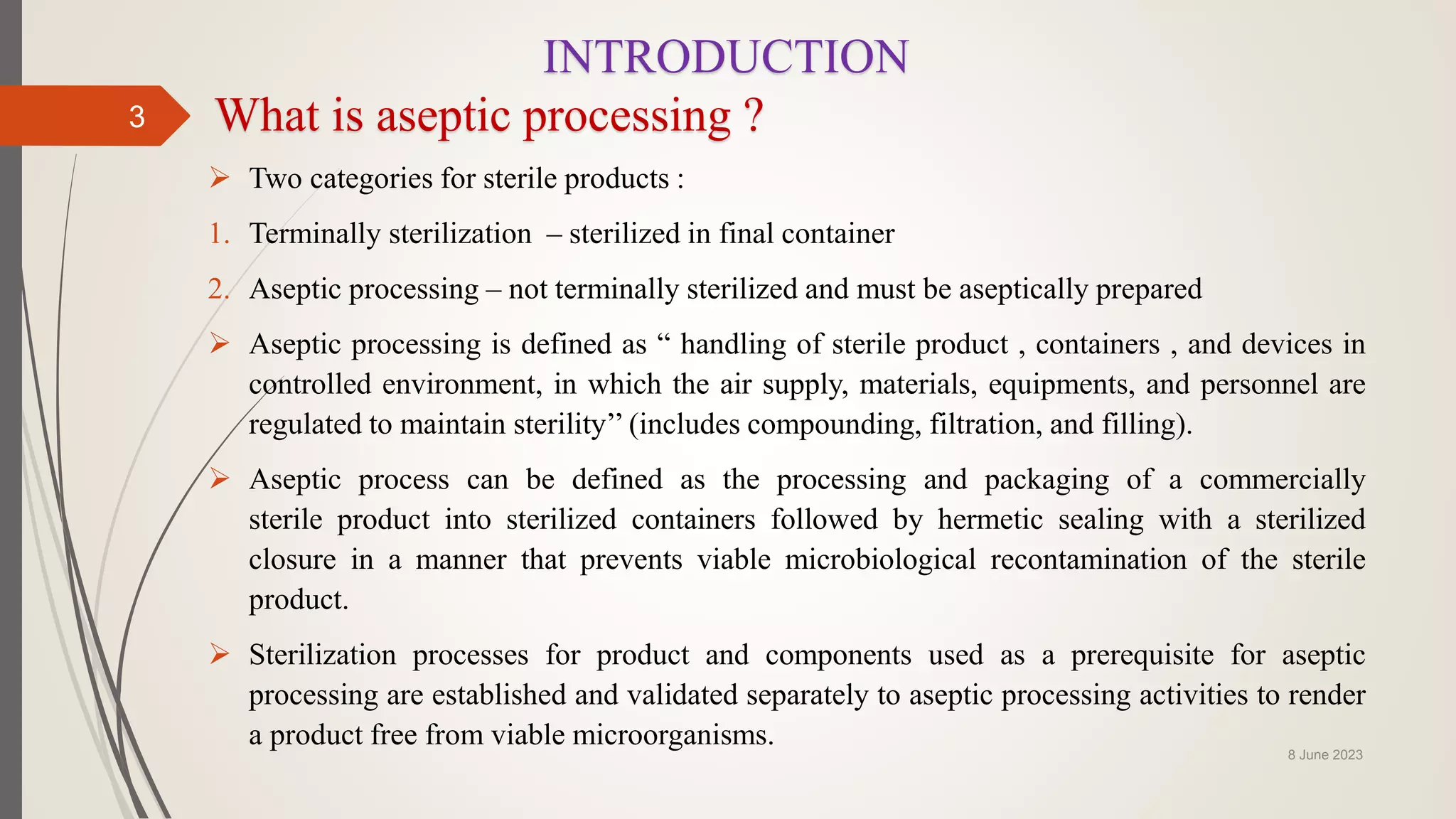
Aseptic Media Fill Validation
Prepared by : Mansi Vadodariya
Enrollment No. 222280824015
M.Pharm
Semester II
DEPARTMENT OF PHARMACEUTICAL QUALITY ASSURANCE
L.M. COLLEGE OF PHARMACY
Contents
 INTRODUCTION
 What is aseptic processing ?
 Aseptic process validation
 Aseptic process simulation / media fill
 OBJECTIVES
 PROTOCOL
 PROCESS STEPS
 MEDIA FILL PROCEDURE FOR POWDER DRUG PRODUCTS
 DATA GUIDANCE FOR MEDIA FILL
 REFERENCES
8 June 2023
2
INTRODUCTION
What is aseptic processing ?
 Two categories for sterile products :
1. Terminally sterilization – sterilized in final container
2. Aseptic processing – not terminally sterilized and must be aseptically prepared
 Aseptic processing is defined as “ handling of sterile product , containers , and devices in
controlled environment, in which the air supply, materials, equipments, and personnel are
regulated to maintain sterility’’ (includes compounding, filtration, and filling).
 Aseptic process can be defined as the processing and packaging of a commercially
sterile product into sterilized containers followed by hermetic sealing with a sterilized
closure in a manner that prevents viable microbiological recontamination of the sterile
product.
 Sterilization processes for product and components used as a prerequisite for aseptic
processing are established and validated separately to aseptic processing activities to render
a product free from viable microorganisms.
8 June 2023
3
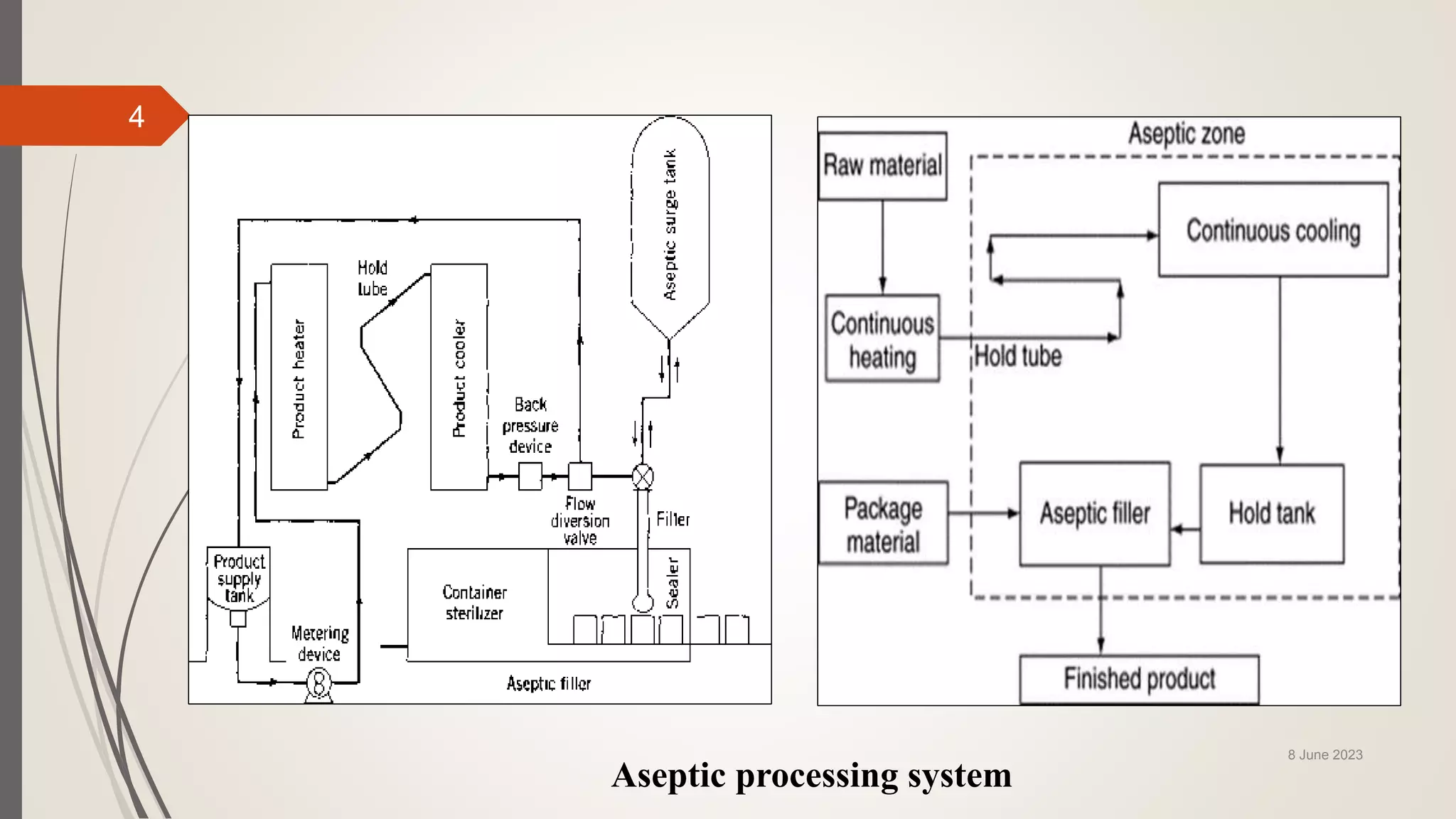
Aseptic processing system
8 June 2023
4
 Aseptic processing produces a sterile product in its final container by the assembly of
component parts (e.g. product, container and closure) that have been sterilized
separately by validated and controlled processes suitable for each component part.
Aseptic Process Validation
 Validation of aseptic processes relies upon prospective, concurrent and retrospective
validation as well as re-validation.
 Prospective studies would include installation and operational qualification for a new or
renovated facility as well as product simulation studies and a prospective process
validation with the original product.
 Concurrent validation includes a process validation with the same requirements as for
prospective studies, but performed during routine production on qualified equipment.
 Retrospective validation uses the data of earlier manufactures, but is not a recommended
technique for aseptic processes.
8 June 2023
5
 Revalidation includes ;
 Regular performance of process simulation studies
 Monitoring of environment, disinfection procedures, equipment cleaning and
sterilization (including containers and closures)
 Routine maintenance and re-qualification of equipment, e.g. autoclaves, ovens,
HVAC (heating, ventilation and air conditioning) systems, water systems, etc.
 Regular integrity testing of product filters, containers, closures and vent filters
 Re-validation after changes
 It is the sum total of all validation data that provides the necessary level of
assurance for aseptically produced products.
8 June 2023
6
Aseptic Process Simulation / Media Fill
 A “Media Fill” (sometimes known as a “process simulation”) is the performance of an
aseptic manufacturing procedure using a sterile microbiological growth medium in
place of the drug solution during media fills to test whether the aseptic procedures are
adequate to prevent contamination during actual drug production. A media fill is one
part of the validation of an aseptic manufacturing process.
 This aseptic process simulation, or media fill, normally includes exposing the
microbiological growth medium to product contact surfaces of equipment, container
closure systems, critical environments, and process interventions to closely simulate the
same exposure that the product itself will undergo.
 Simulations are made to ensure that the regular process for commercial batches
repeatedly and reliably produces the finished product of the required quality.
 Media fills are conducted to initially qualify a new filling line, a new product, and/or a
change in product container configuration.
 Media fills are required on a semi-annual basis to provide minimal assurance that good
aseptic conditions and practices have been maintained. 8 June 2023
7
Media fill procedure :
8 June 2023
8
 Objectives
The aseptic process simulations are designed to:
 Evaluate capabilities of aseptic processing operation, Simulate the aseptic process
from the point of sterilization to closure of the container, substituting a
microbiological growth medium for the sterile product.
 To assess contamination risk factors of the process.
 To assess changes made to an aseptic processing operation which might impact
the sterility of the final product.
 Evaluate aseptic processing personnel activities.
 Demostrate aseptic operating practices and procedures are appropriate.
 Demostrate Compliance with GMP and regulatory expectations.
8 June 2023
9
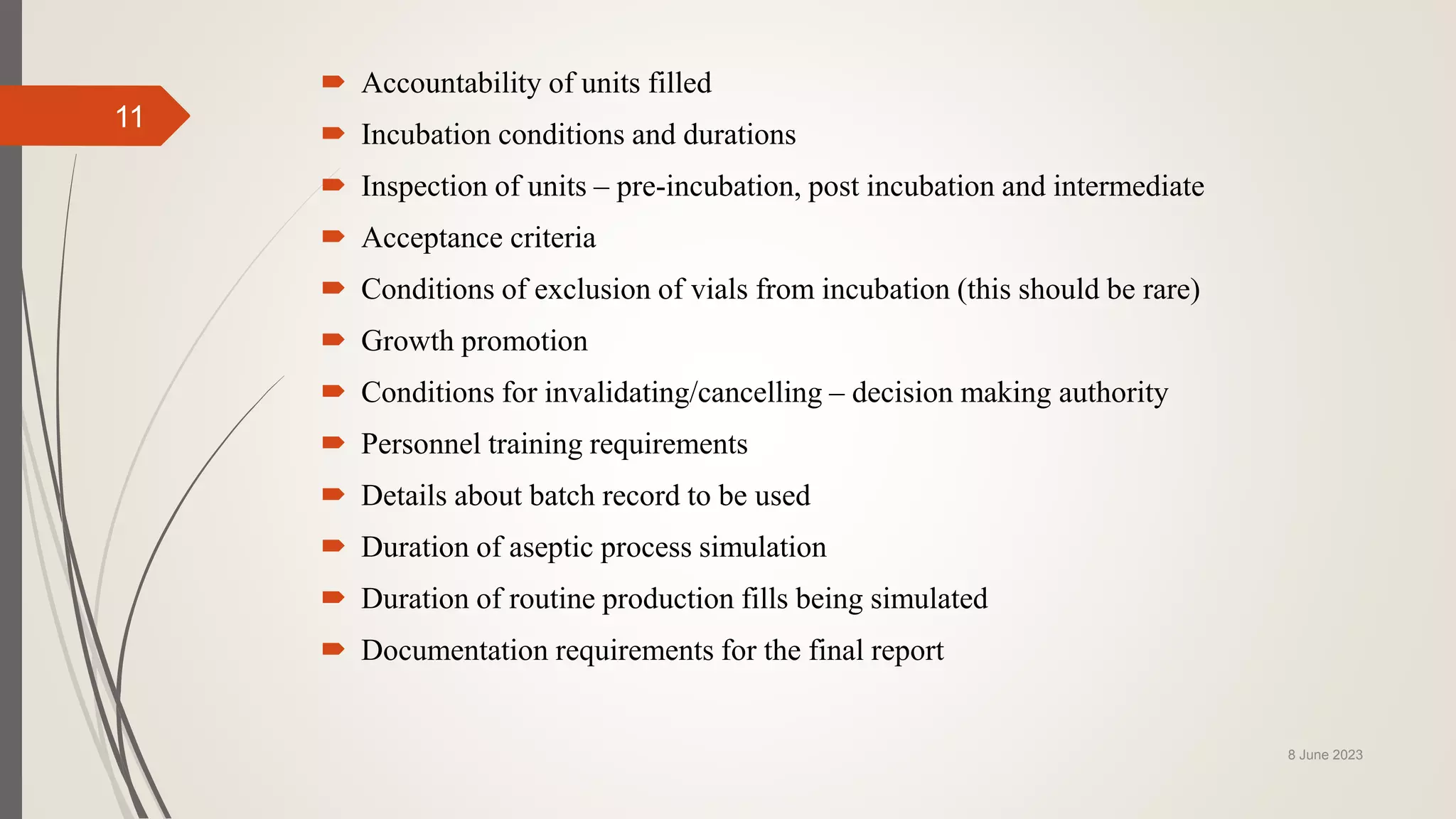
 PROTOCOL
 Responsible groups for execution, testing and approval of study
 Rationale for “worst case” scenarios
 Identification of room, filling line, equipment, process flow.
 Types of container closure to be used
 Fill volume
 Minimum number of units to be filled
 Line speed
 Type of media to be used with rationale
 Number and types of interventions
 Number, identity and roles of personnel
 Environmental monitoring to be performed
8 June 2023
10
 Accountability of units filled
 Incubation conditions and durations
 Inspection of units – pre-incubation, post incubation and intermediate
 Acceptance criteria
 Conditions of exclusion of vials from incubation (this should be rare)
 Growth promotion
 Conditions for invalidating/cancelling – decision making authority
 Personnel training requirements
 Details about batch record to be used
 Duration of aseptic process simulation
 Duration of routine production fills being simulated
 Documentation requirements for the final report
8 June 2023
11
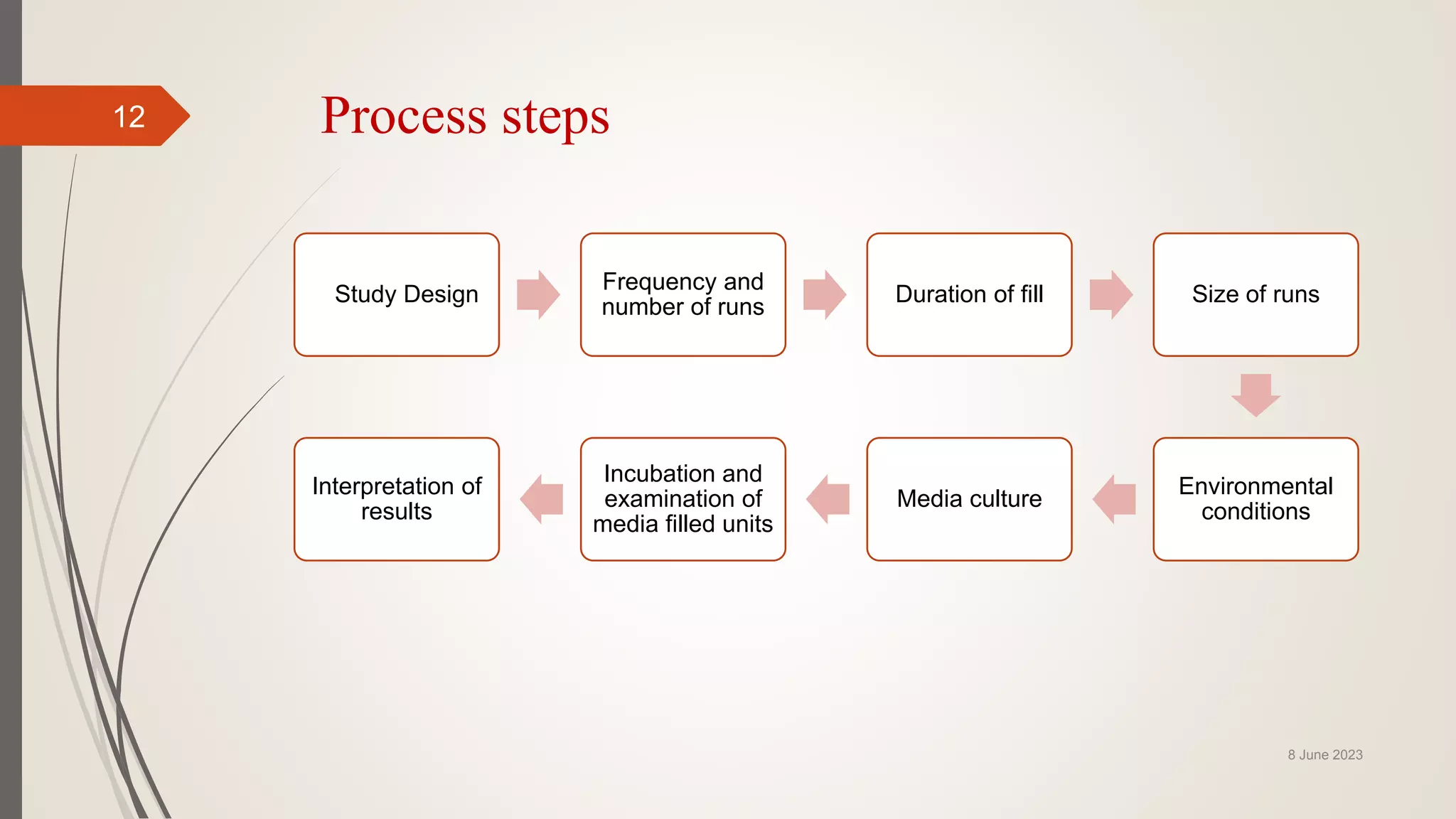
Process steps
Study Design
Frequency and
number of runs
Duration of fill Size of runs
Environmental
conditions
Media culture
Incubation and
examination of
media filled units
Interpretation of
results
8 June 2023
12
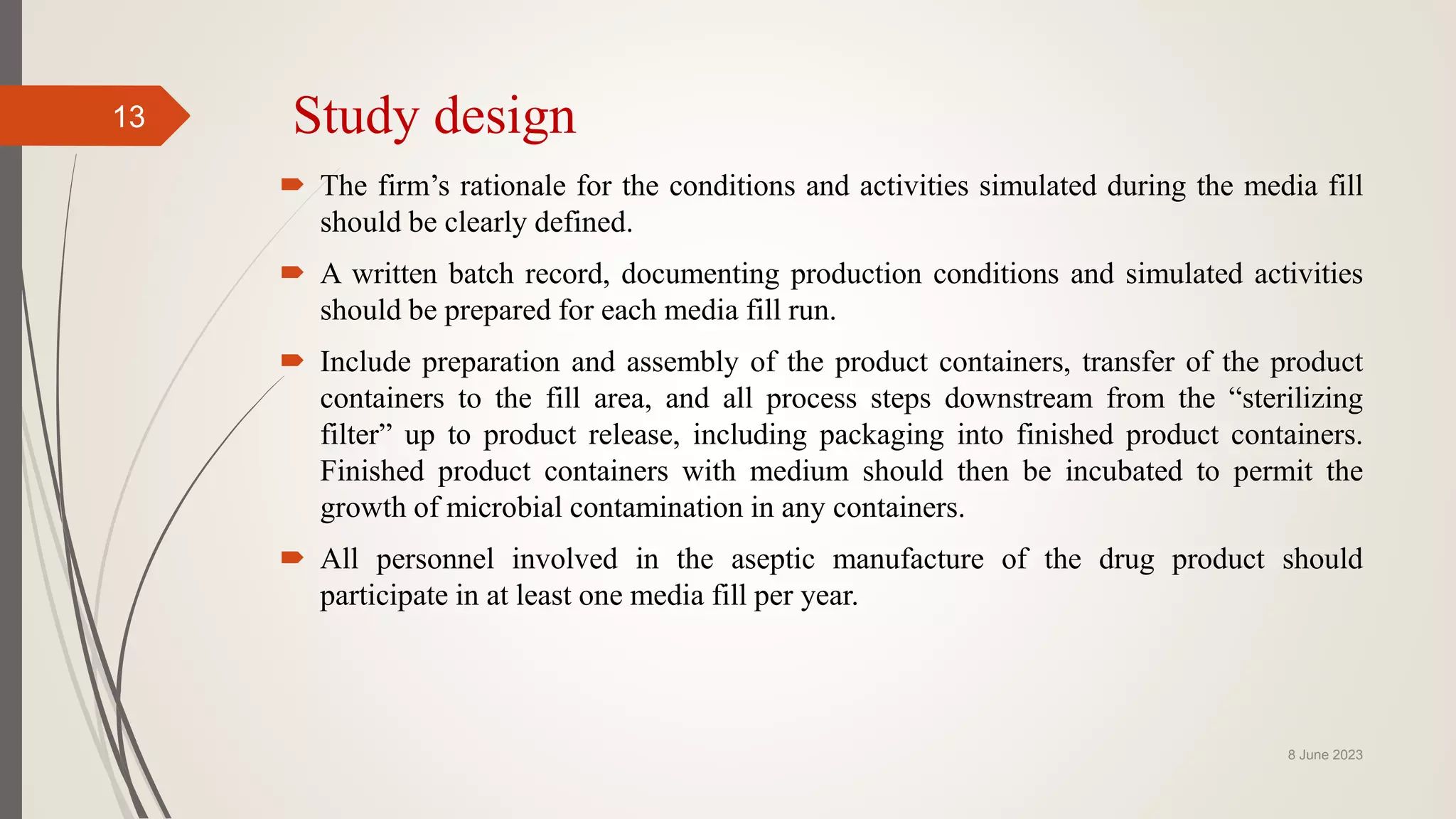
Study design
 The firm’s rationale for the conditions and activities simulated during the media fill
should be clearly defined.
 A written batch record, documenting production conditions and simulated activities
should be prepared for each media fill run.
 Include preparation and assembly of the product containers, transfer of the product
containers to the fill area, and all process steps downstream from the “sterilizing
filter” up to product release, including packaging into finished product containers.
Finished product containers with medium should then be incubated to permit the
growth of microbial contamination in any containers.
 All personnel involved in the aseptic manufacture of the drug product should
participate in at least one media fill per year.
8 June 2023
13
Numbers and frequency of runs
 In start up simulation at least three consecutive separate successful runs should
be performed (it is recommended they are performed in different days).
 For on-going simulation, a routine semi-annual qualification is recommended (one
run)
 Extraordinary media fill should be performed after all changes to a product or line
changes evaluated as a potential danger for the aseptic process.
8 June 2023
14
Container size
 The extremes of size containers should be considered.
 The largest container (often filled at the lowest speed because of its large fill
volume) often has the large opening , so the potential for microbial entry from the
environment should be the greatest for that size.
 The smallest container (often filled at the highest speed for its lower fill volume)
represents the greatest handling difficulty; the smaller container are more fragile
and less stable and be more subjected to breakage and jamming in the equipment.
 In the initial qualification two runs might be performed using the largest
container and the third run using the smallest container.
 Clear containers should be used as a substitute for amber containers to allow
visual detection of microbial growth.
8 June 2023
15
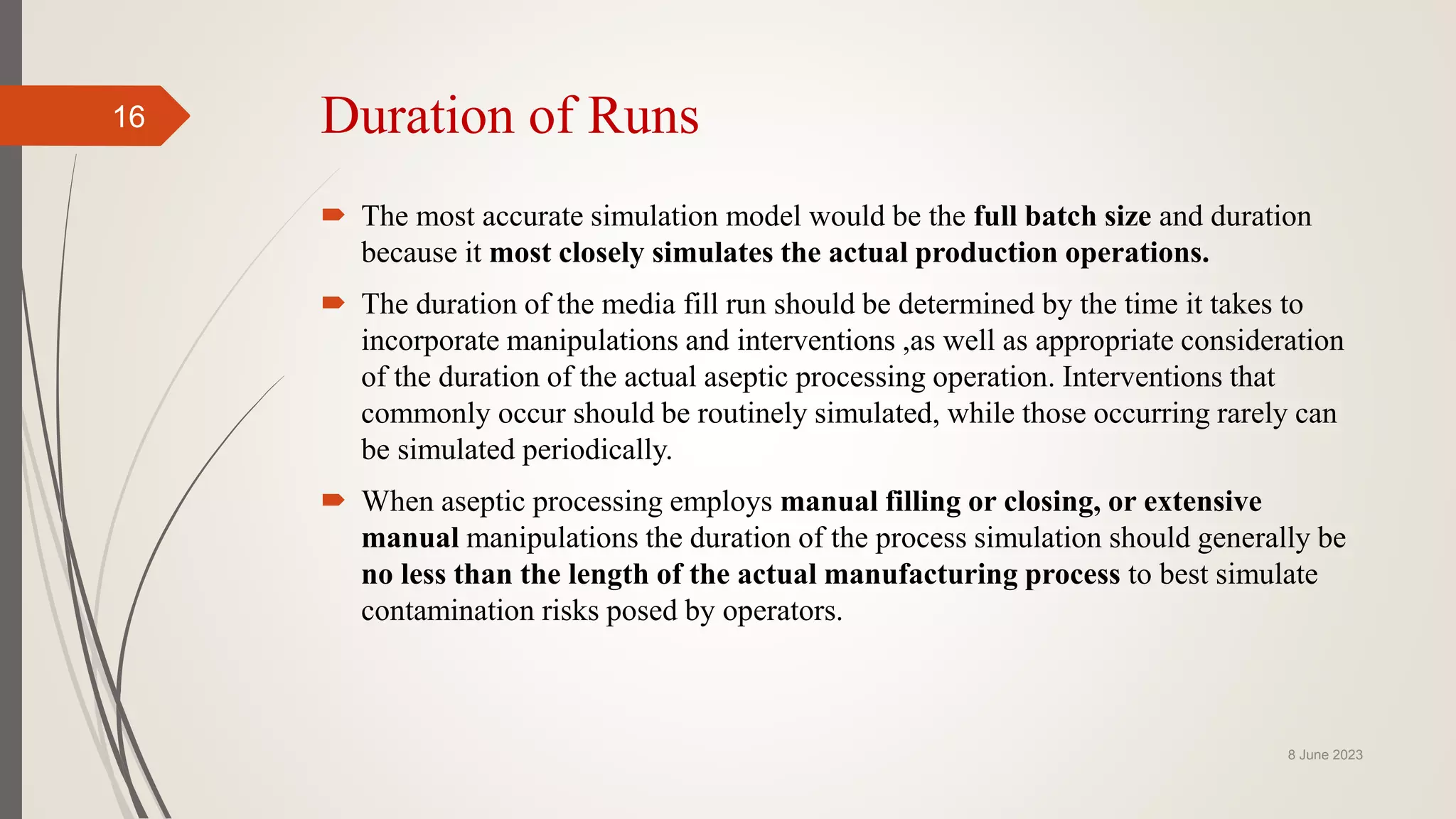
Duration of Runs
 The most accurate simulation model would be the full batch size and duration
because it most closely simulates the actual production operations.
 The duration of the media fill run should be determined by the time it takes to
incorporate manipulations and interventions ,as well as appropriate consideration
of the duration of the actual aseptic processing operation. Interventions that
commonly occur should be routinely simulated, while those occurring rarely can
be simulated periodically.
 When aseptic processing employs manual filling or closing, or extensive
manual manipulations the duration of the process simulation should generally be
no less than the length of the actual manufacturing process to best simulate
contamination risks posed by operators.
8 June 2023
16
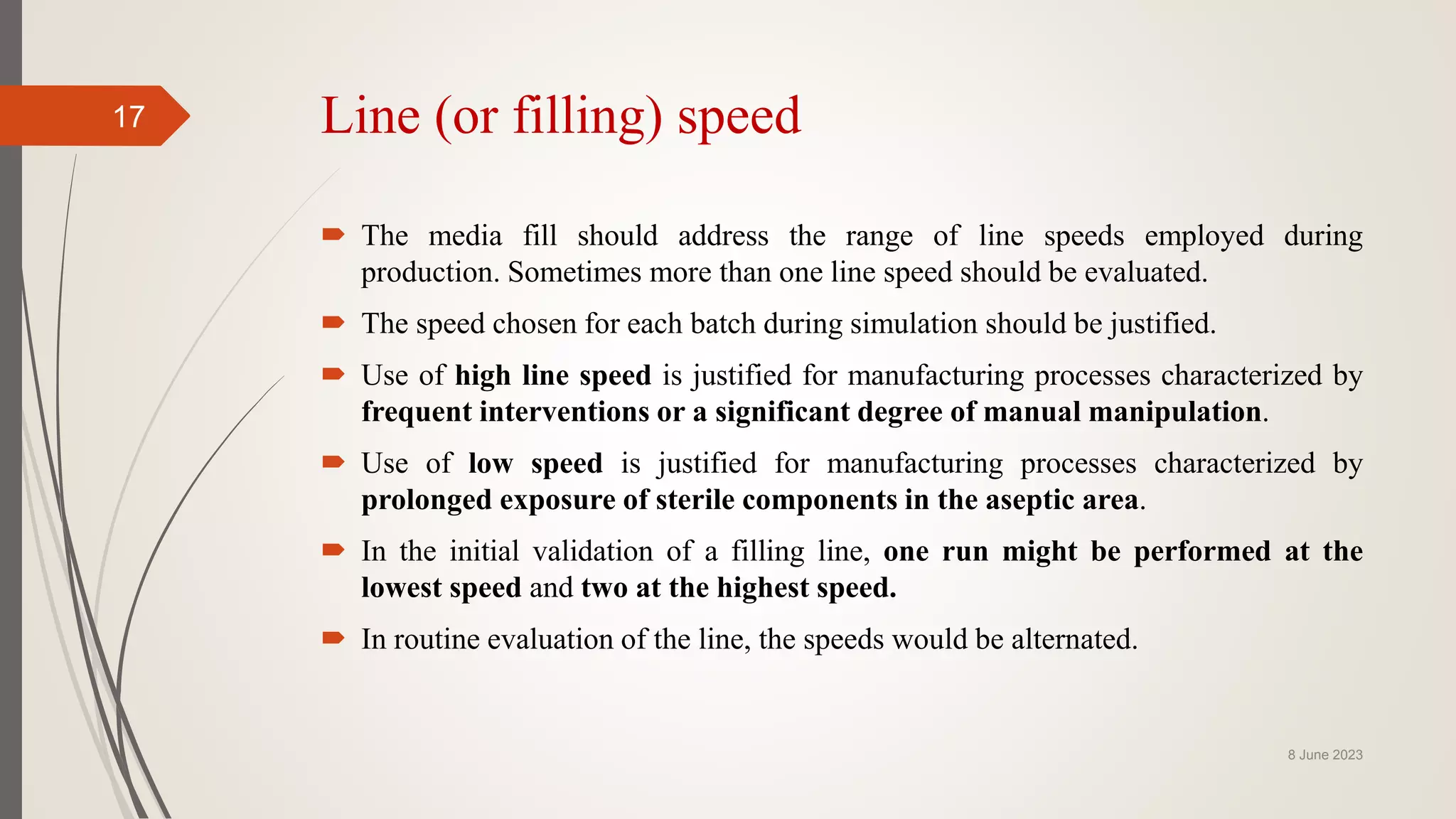
Line (or filling) speed
 The media fill should address the range of line speeds employed during
production. Sometimes more than one line speed should be evaluated.
 The speed chosen for each batch during simulation should be justified.
 Use of high line speed is justified for manufacturing processes characterized by
frequent interventions or a significant degree of manual manipulation.
 Use of low speed is justified for manufacturing processes characterized by
prolonged exposure of sterile components in the aseptic area.
 In the initial validation of a filling line, one run might be performed at the
lowest speed and two at the highest speed.
 In routine evaluation of the line, the speeds would be alternated.
8 June 2023
17
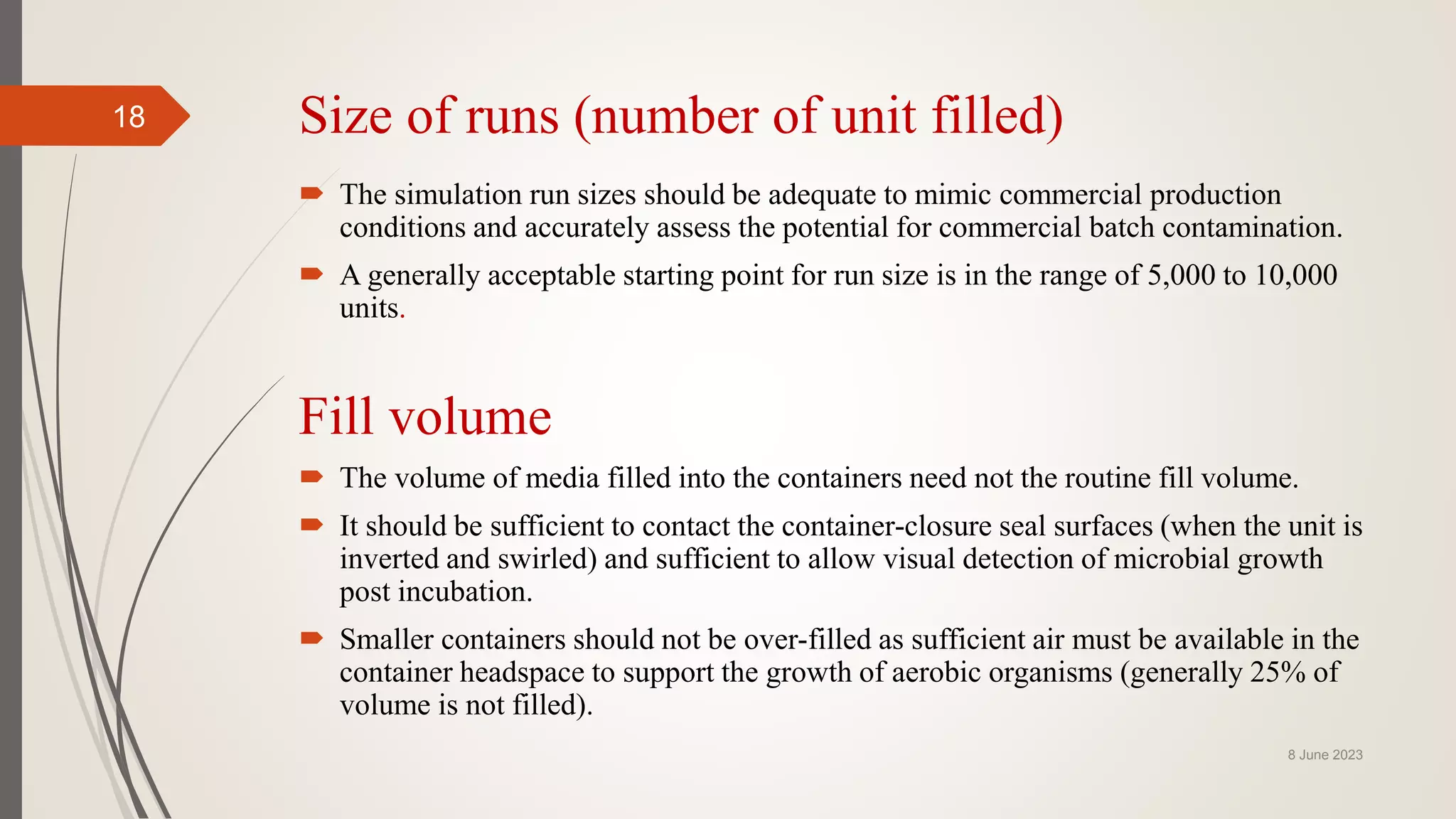
Size of runs (number of unit filled)
 The simulation run sizes should be adequate to mimic commercial production
conditions and accurately assess the potential for commercial batch contamination.
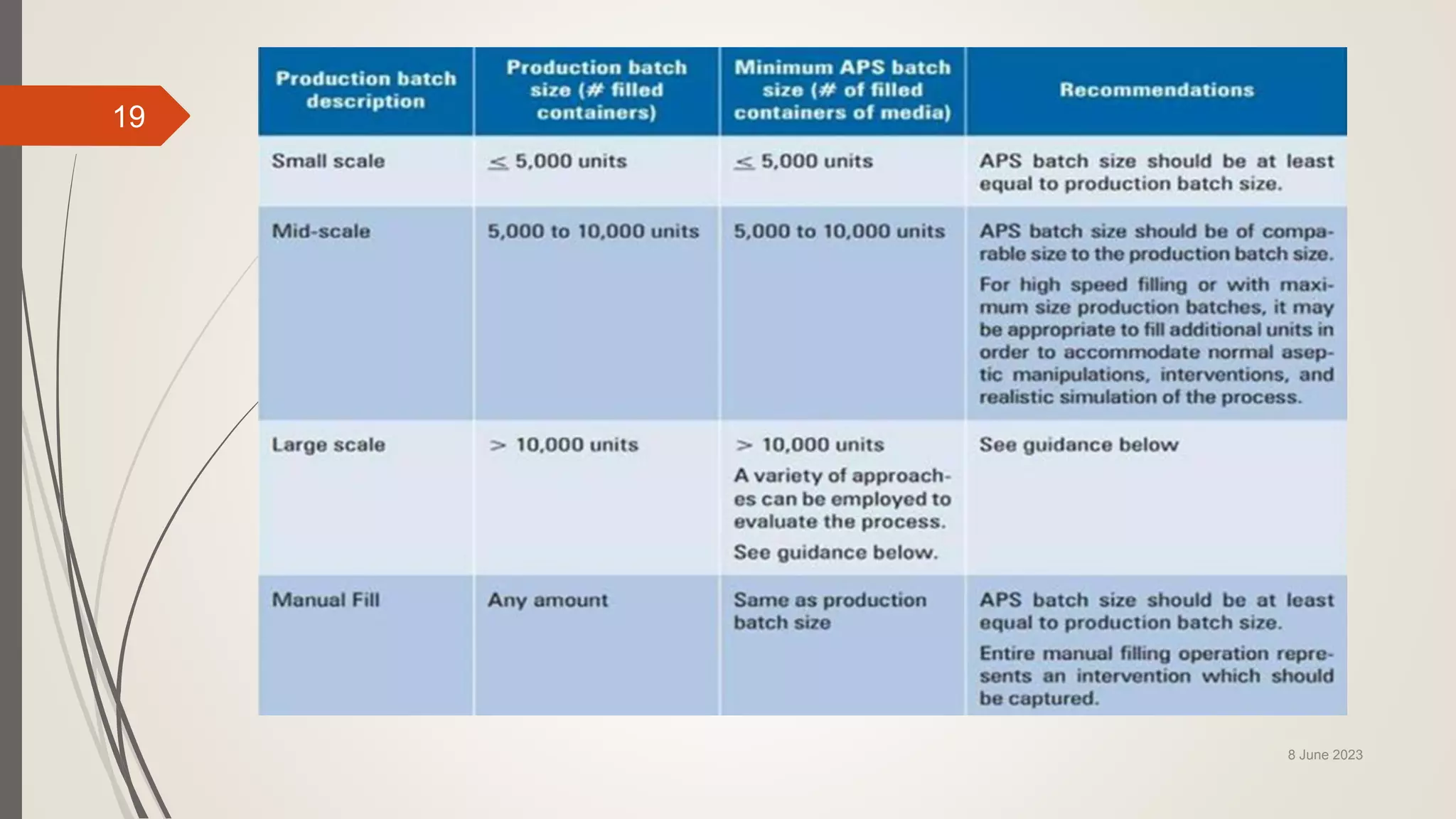
 A generally acceptable starting point for run size is in the range of 5,000 to 10,000
units.
Fill volume
 The volume of media filled into the containers need not the routine fill volume.
 It should be sufficient to contact the container-closure seal surfaces (when the unit is
inverted and swirled) and sufficient to allow visual detection of microbial growth
post incubation.
 Smaller containers should not be over-filled as sufficient air must be available in the
container headspace to support the growth of aerobic organisms (generally 25% of
volume is not filled).
8 June 2023
18
8 June 2023
19
Environmental monitoring activities
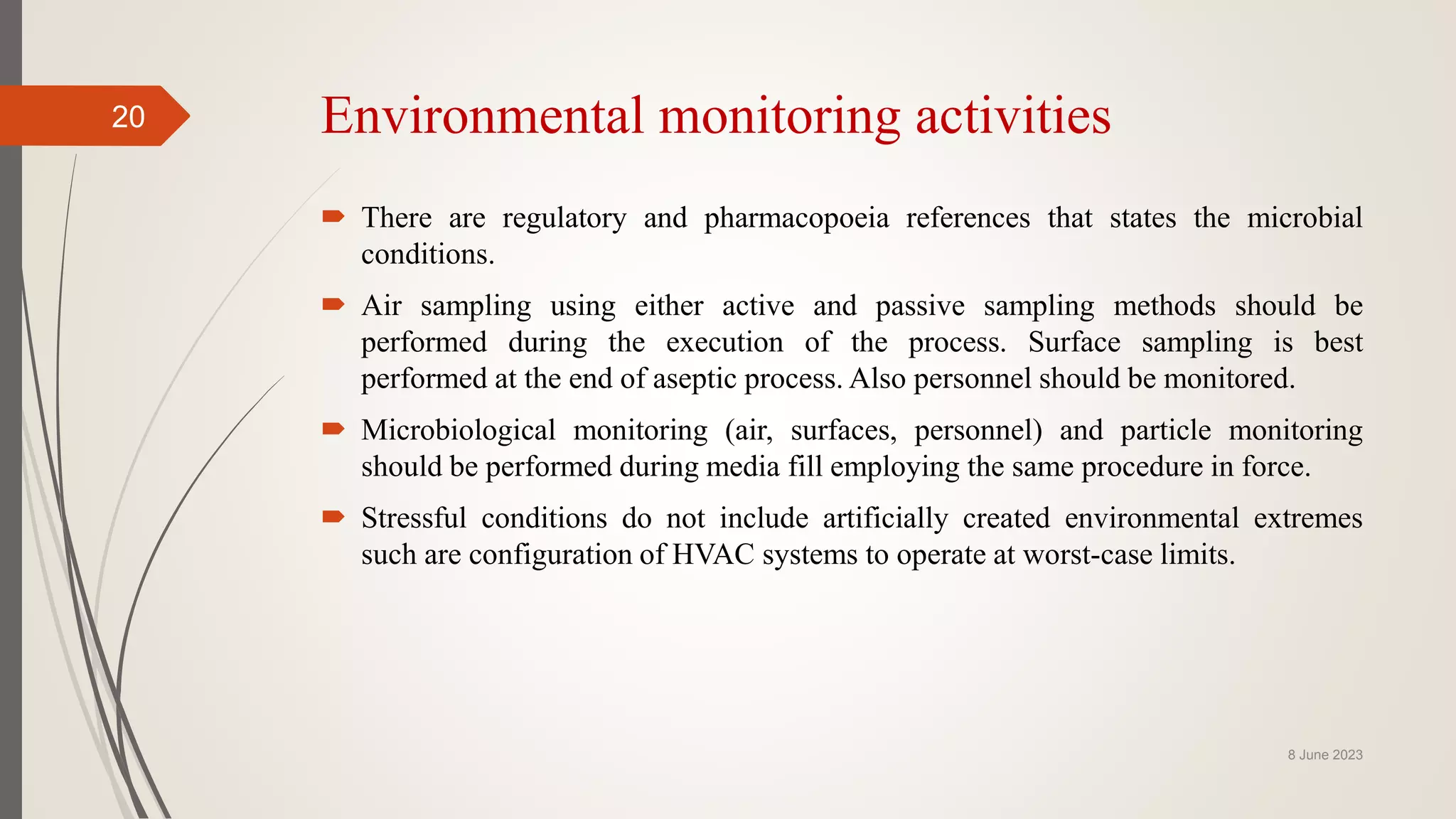
 There are regulatory and pharmacopoeia references that states the microbial
conditions.
 Air sampling using either active and passive sampling methods should be
performed during the execution of the process. Surface sampling is best
performed at the end of aseptic process. Also personnel should be monitored.
 Microbiological monitoring (air, surfaces, personnel) and particle monitoring
should be performed during media fill employing the same procedure in force.
 Stressful conditions do not include artificially created environmental extremes
such are configuration of HVAC systems to operate at worst-case limits.
8 June 2023
20
Media culture
 A microbiological growth medium, such as soybean casein digest medium is most
commonly used (culture of both fungi and aerobic bacteria).Fluid thioglycolate media can
also be used in special case of anaerobic bacteria culture.
 The medium should have low selectivity; i.e., it should support the growth of a broad
spectrum of organisms including fungi and yeasts.
 In conducting process simulation tests, there are two basic alternative techniques available :
 Use unsterilized medium and filter the medium through the normal sterilizing membrane
hooked directly to the filing equipment The media may be prefiltered to reduce bioburden
and increase filtration efficiency.
 Presterilize the medium in a separate operation. after verification of medium sterility(such
as examining the bulk medium for absence of growth), use the medium in the process
simulation test. For the test, pass the sterilized medium through normal processing
equipment. .
 Micro-organisms referenced in the USP for sterility test growth promotion tests- S.aureus,
P. aeruginosa, C. albicans, B. subtilis and A. brasiliensis. Growth promotion units should
be inoculated with <100 CFU.
8 June 2023
21
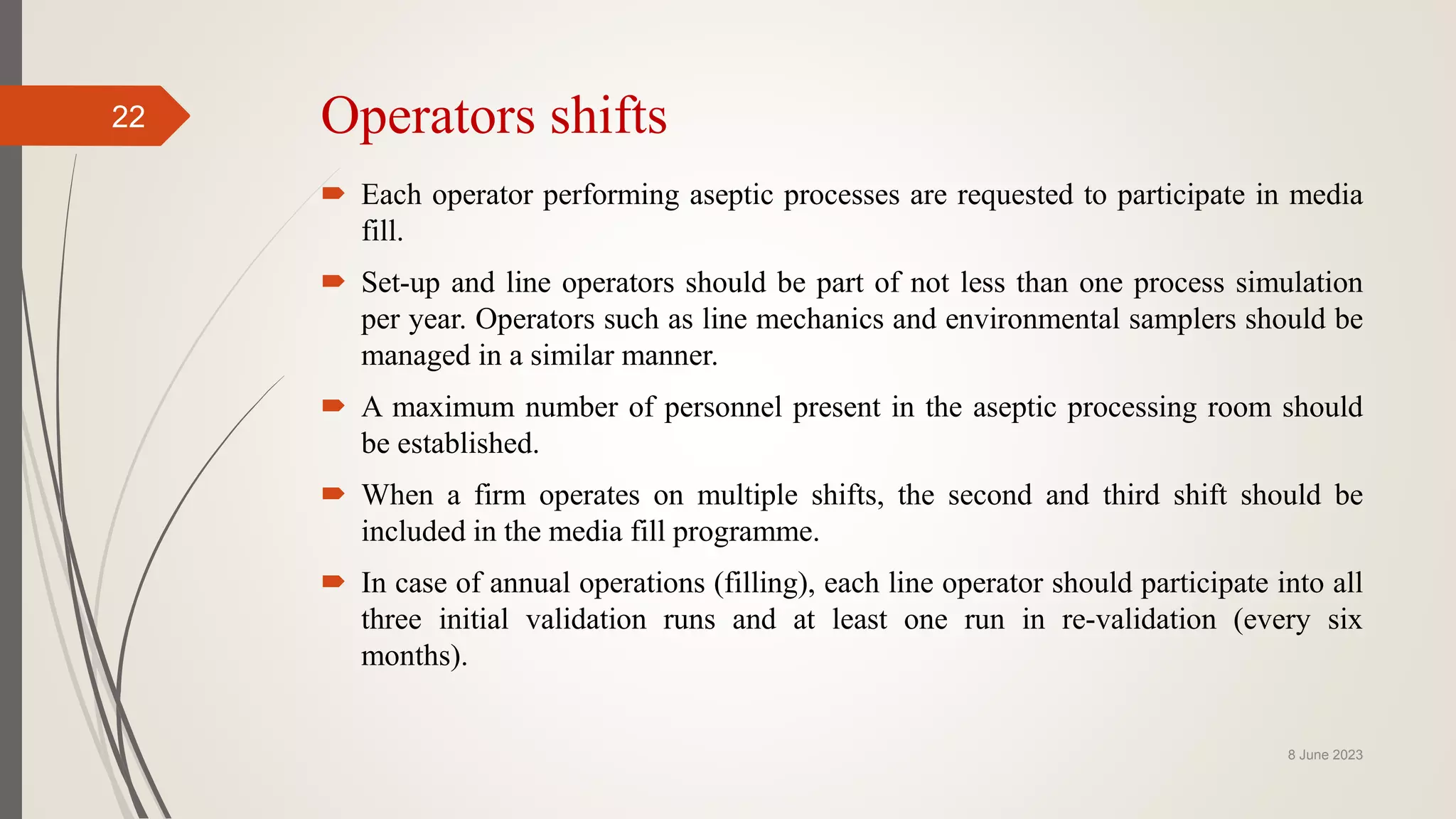
Operators shifts
 Each operator performing aseptic processes are requested to participate in media
fill.
 Set-up and line operators should be part of not less than one process simulation
per year. Operators such as line mechanics and environmental samplers should be
managed in a similar manner.
 A maximum number of personnel present in the aseptic processing room should
be established.
 When a firm operates on multiple shifts, the second and third shift should be
included in the media fill programme.
 In case of annual operations (filling), each line operator should participate into all
three initial validation runs and at least one run in re-validation (every six
months).
8 June 2023
22
Incubation methods
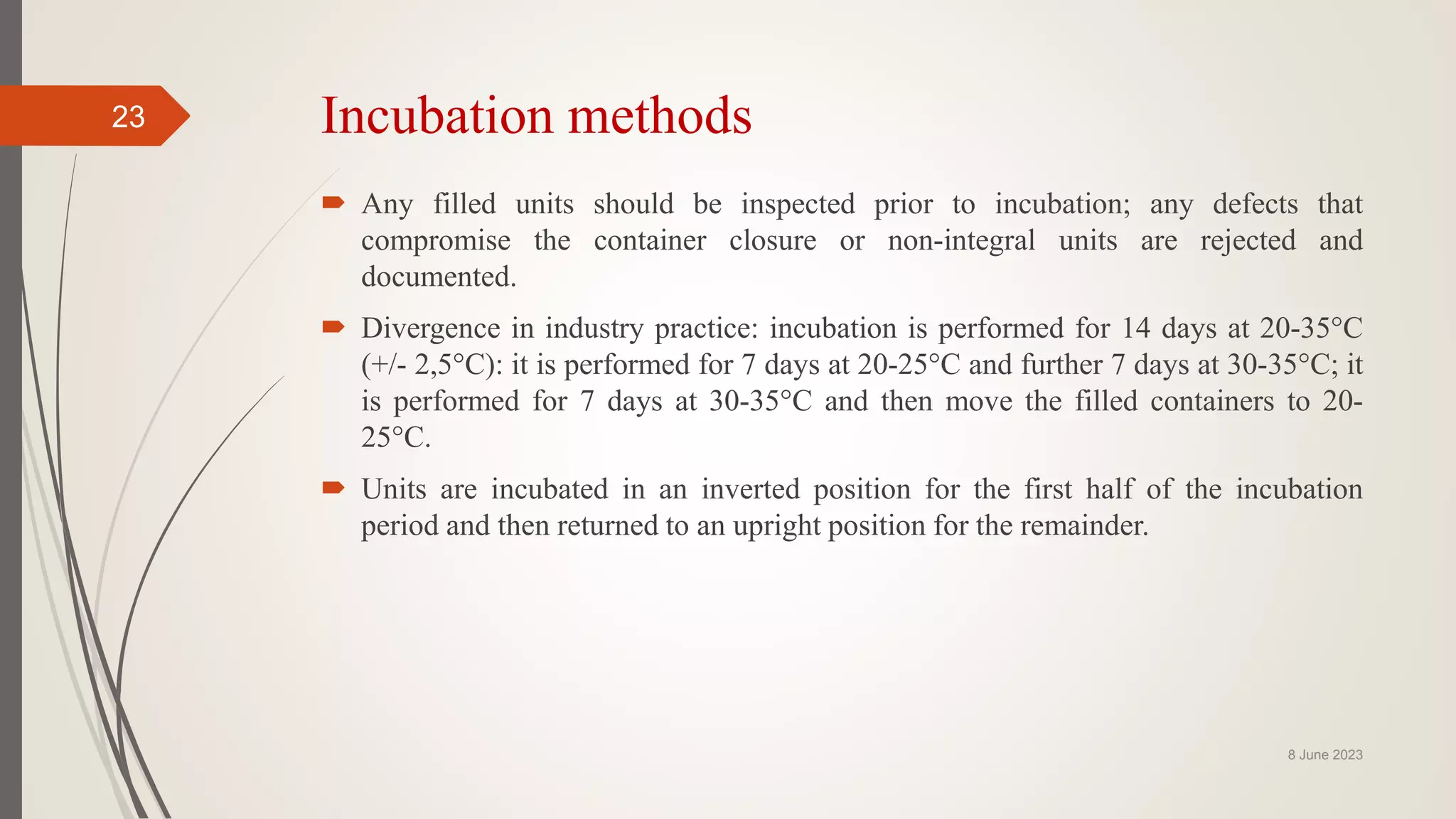
 Any filled units should be inspected prior to incubation; any defects that
compromise the container closure or non-integral units are rejected and
documented.
 Divergence in industry practice: incubation is performed for 14 days at 20-35°C
(+/- 2,5°C): it is performed for 7 days at 20-25°C and further 7 days at 30-35°C; it
is performed for 7 days at 30-35°C and then move the filled containers to 20-
25°C.
 Units are incubated in an inverted position for the first half of the incubation
period and then returned to an upright position for the remainder.
8 June 2023
23
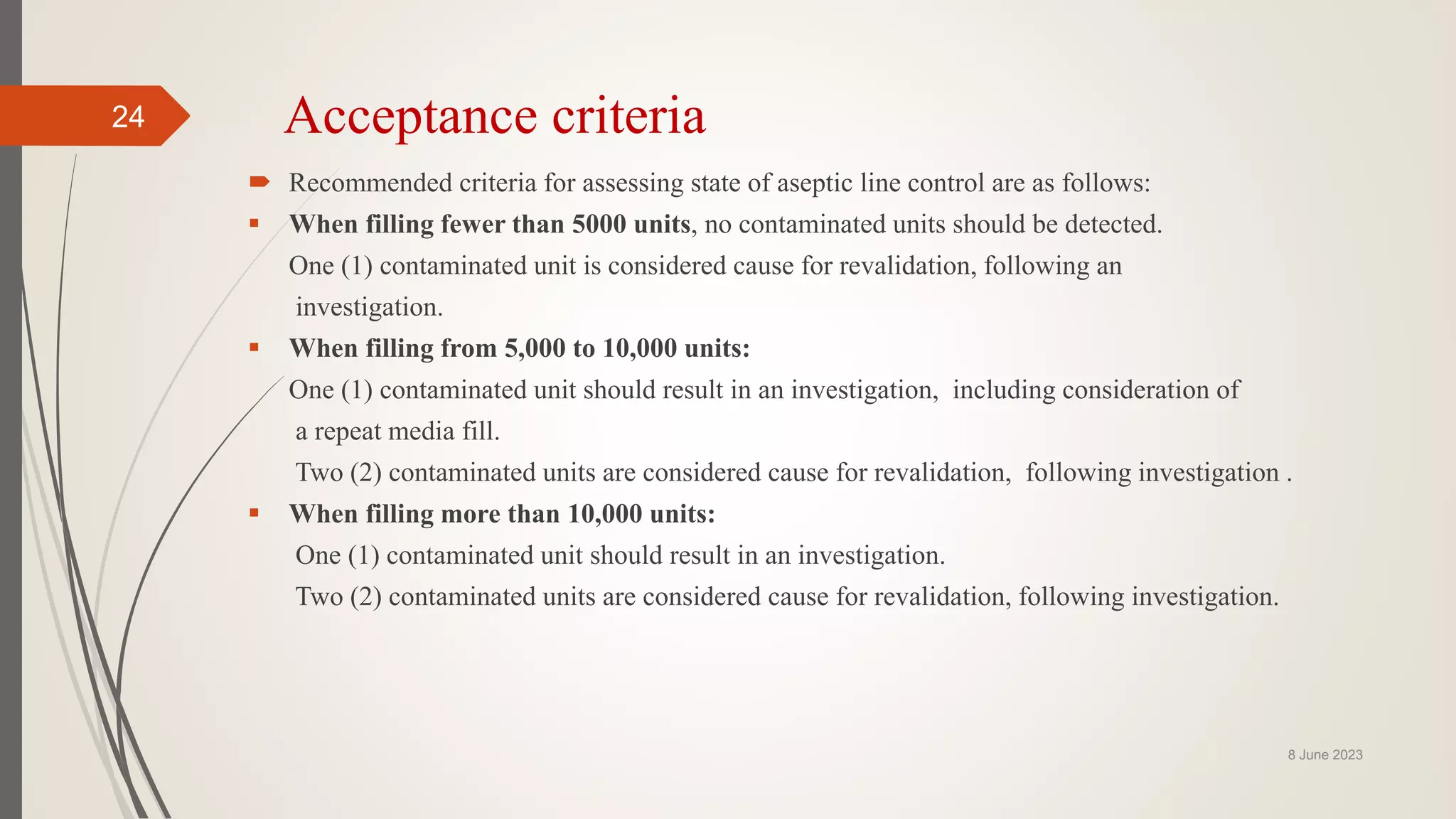
Acceptance criteria
 Recommended criteria for assessing state of aseptic line control are as follows:
 When filling fewer than 5000 units, no contaminated units should be detected.
One (1) contaminated unit is considered cause for revalidation, following an
investigation.
 When filling from 5,000 to 10,000 units:
One (1) contaminated unit should result in an investigation, including consideration of
a repeat media fill.
Two (2) contaminated units are considered cause for revalidation, following investigation .
 When filling more than 10,000 units:
One (1) contaminated unit should result in an investigation.
Two (2) contaminated units are considered cause for revalidation, following investigation.
8 June 2023
24
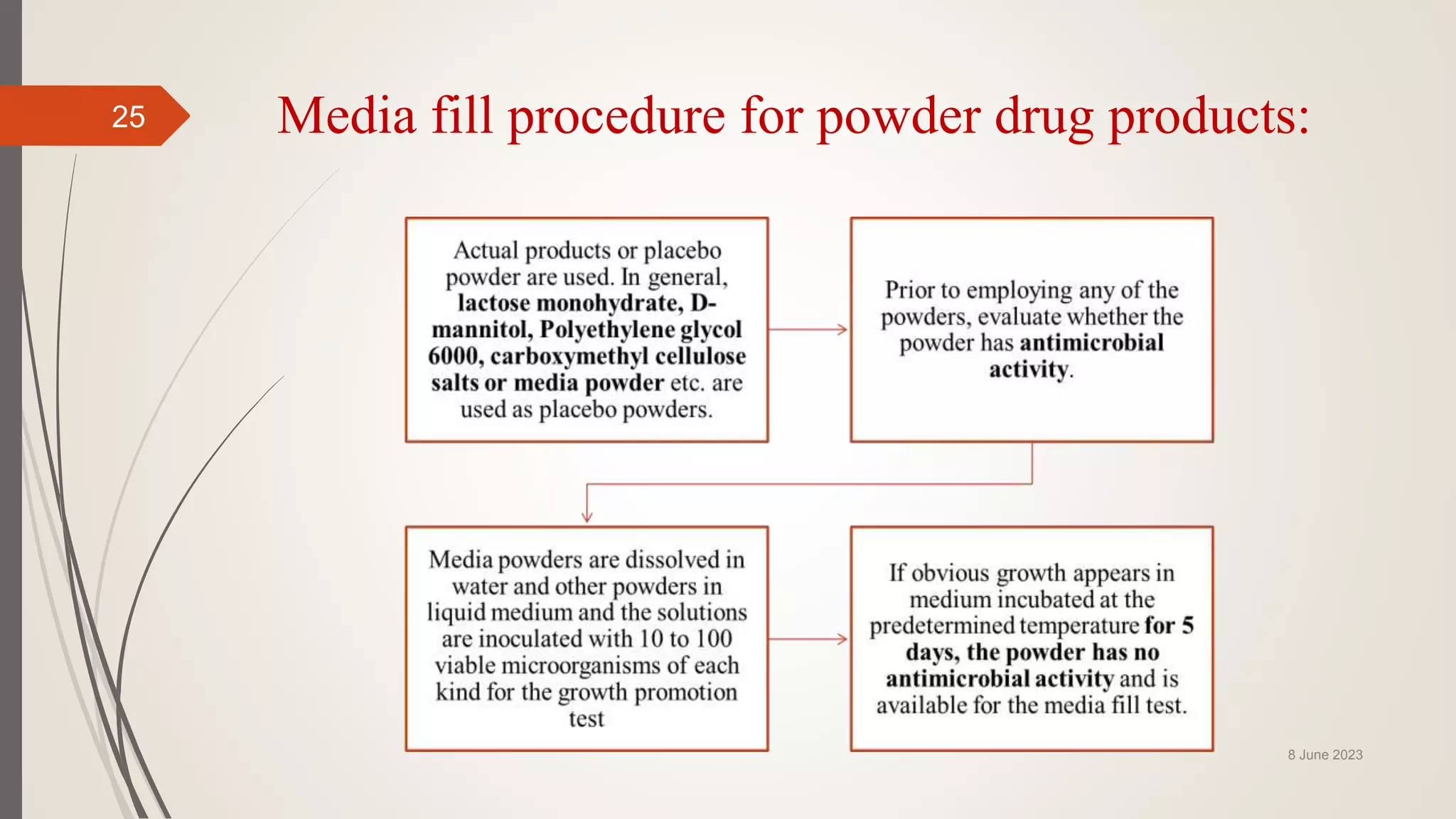
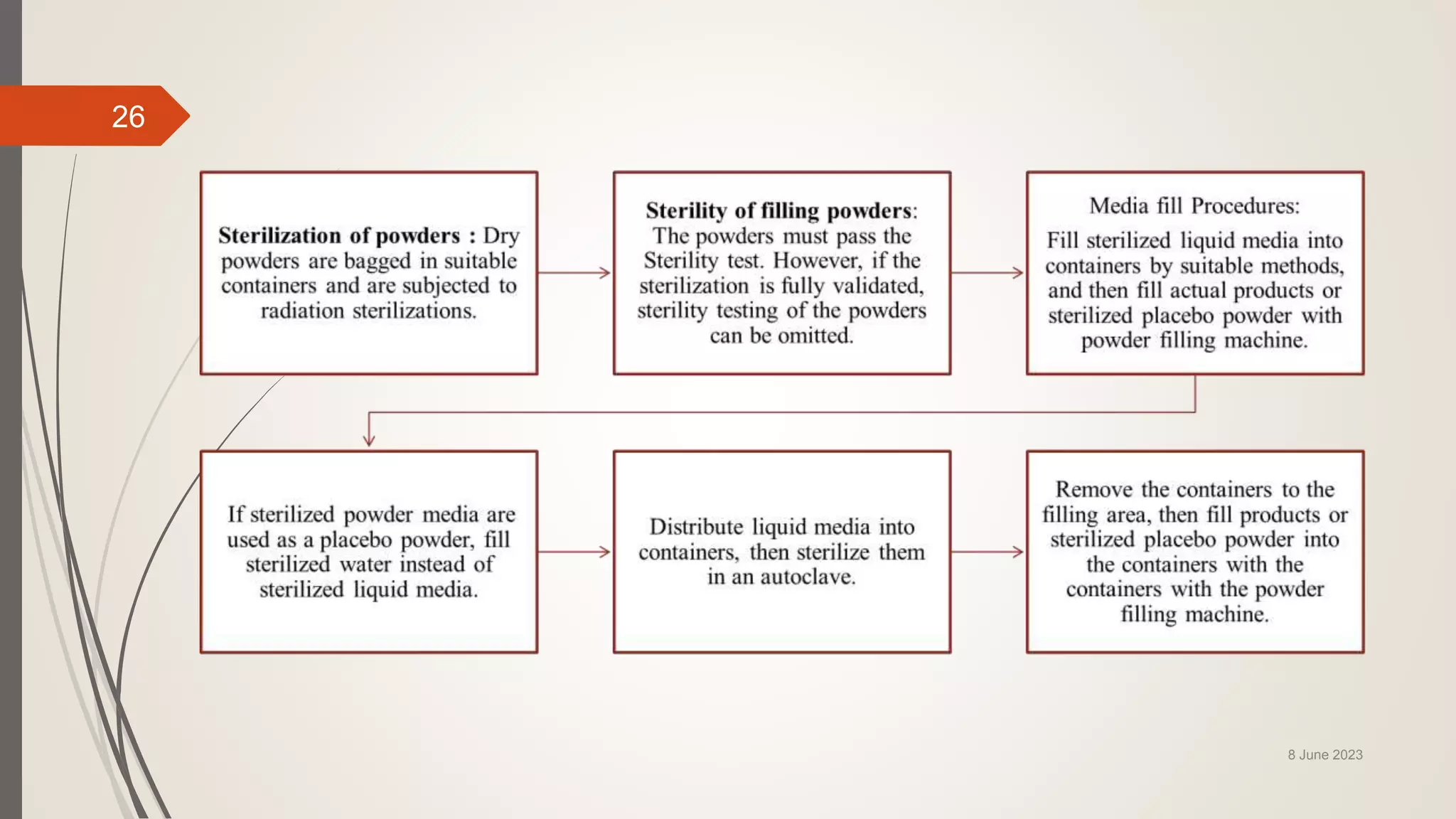
Media fill procedure for powder drug products:
8 June 2023
25
8 June 2023
26
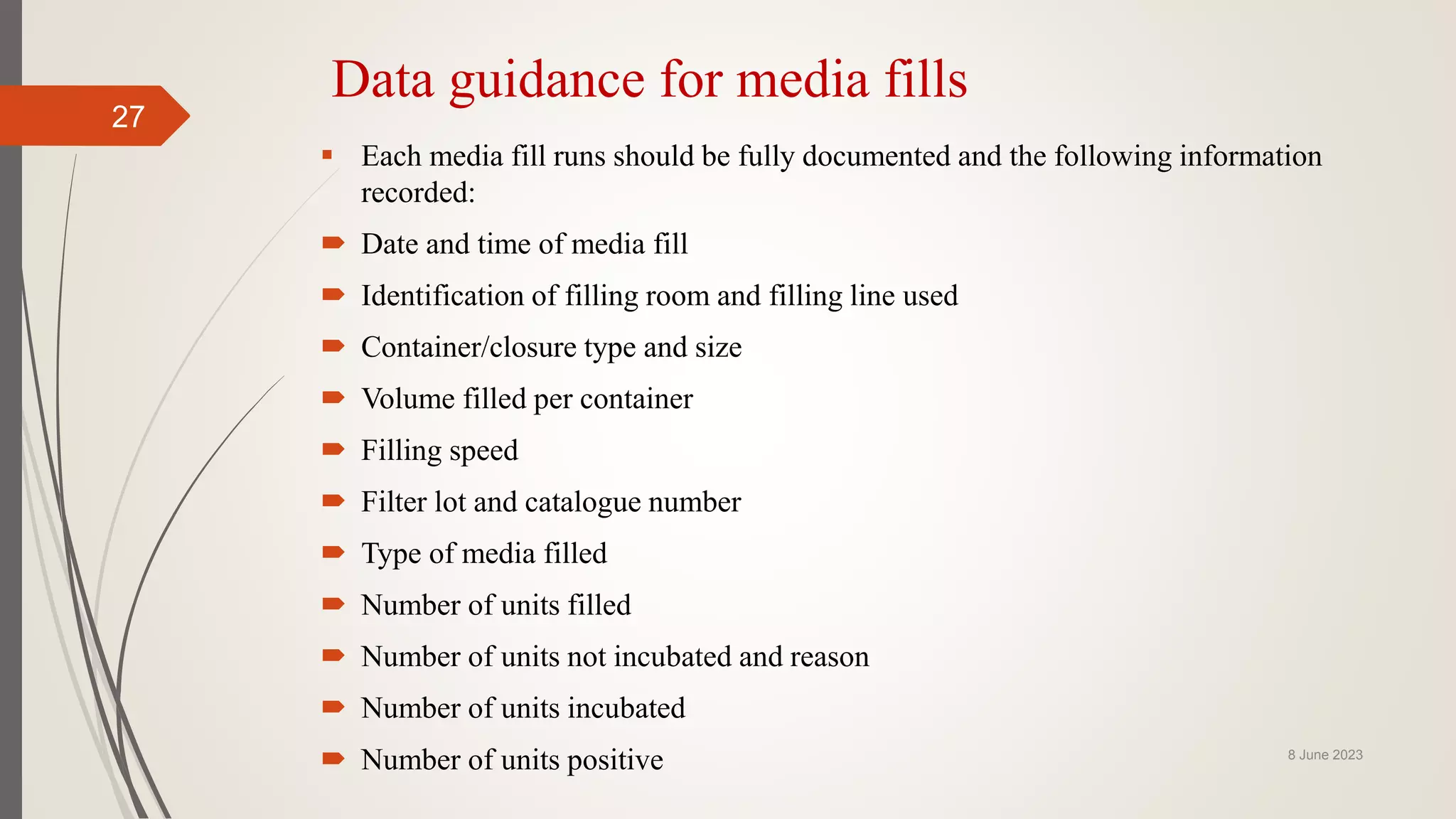
Data guidance for media fills
 Each media fill runs should be fully documented and the following information
recorded:
 Date and time of media fill
 Identification of filling room and filling line used
 Container/closure type and size
 Volume filled per container
 Filling speed
 Filter lot and catalogue number
 Type of media filled
 Number of units filled
 Number of units not incubated and reason
 Number of units incubated
 Number of units positive 8 June 2023
27
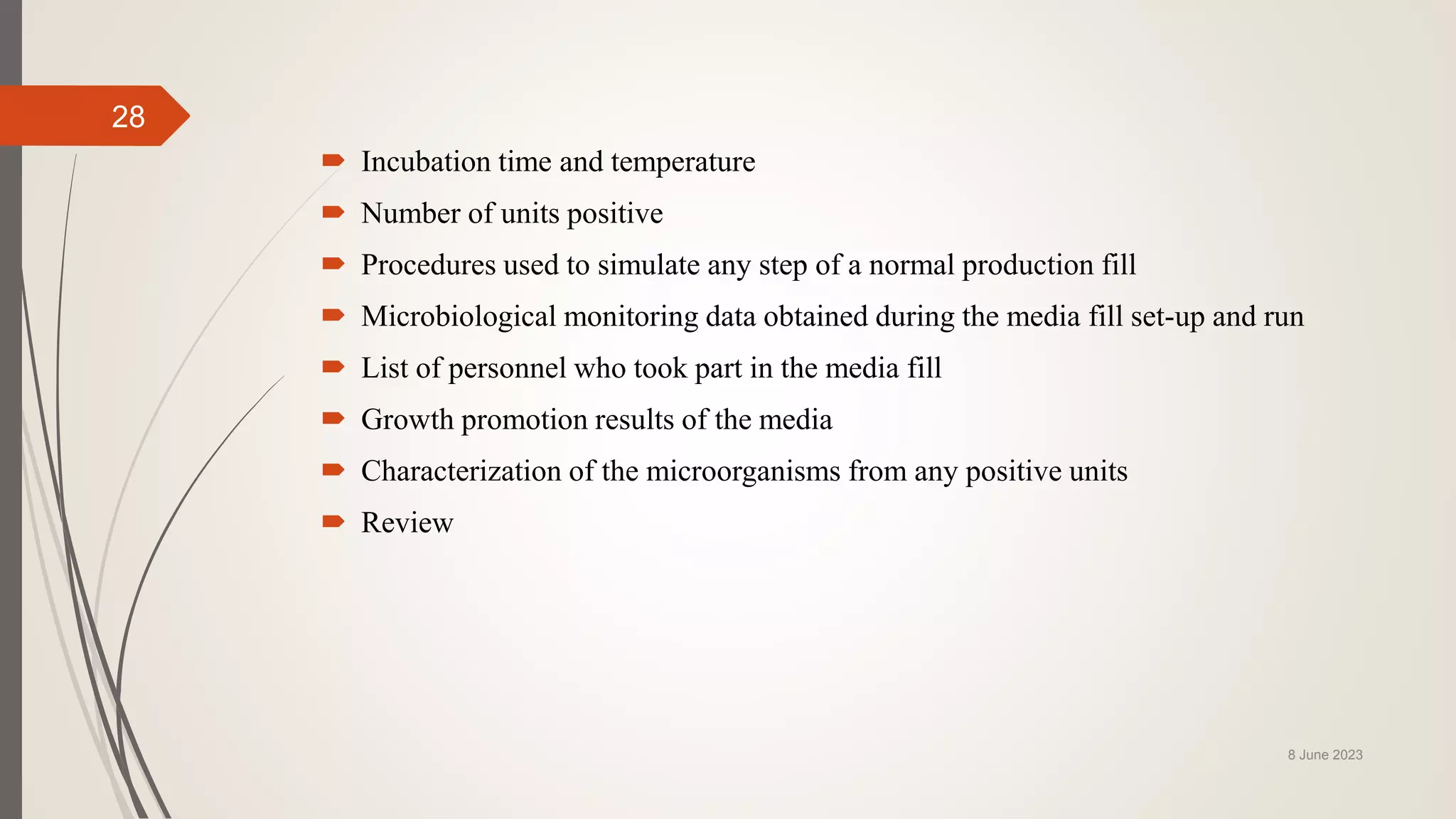
 Incubation time and temperature
 Number of units positive
 Procedures used to simulate any step of a normal production fill
 Microbiological monitoring data obtained during the media fill set-up and run
 List of personnel who took part in the media fill
 Growth promotion results of the media
 Characterization of the microorganisms from any positive units
 Review
8 June 2023
28
References
 Nash, R., & Watcher, A. H. (2003).Pharmaceutical Process Validation. In
Pharmaceutical Process Validation: An International, An International Third Edition,
Revised and Expanded (Third).Drugs and Pharmaceutical Sciences volume 129 page
no. 139-141.
 Parenteral Drug Association.(2012).Process Simulation for Aseptically Filled
Products : PDA Technical Report No . 22 ( Revised 2011 ).
 U.S.FDA. (2012).Guidance Media Fills for Validation of Aseptic Preparations for
Positron Emission Tomography (PET) Drugs. April, 1–9.
http://www.fda.gov/downloads/drugs/guidancecomplianceregulatoryinformation/gui
dances/ucm273766.pdf
 PHARMACEUTICAL INSPECTION CONVENTION, & SCHEME, P. I. C.-O.
(2007). Recommendations on Validation MasterPlan, Installation and Operational
Qualification, Non-sterile Process Validation, Cleaning Validation.PI 006-
3(September),1–26. 8 June 2023
29
 PHARMACEUTICAL INSPECTION CONVENTION, & SCHEME, P. I. C.-O.
(2011) recommendation on the validation of aseptic processes. pi 007-
6(january),101–116. https://doi.org/10.1201/9781003070467-5.
 WHO Technical Report Series, N. 961. (2011).WHO good manufacturing
practices for sterile pharmaceutical products.961, 10–11.
https://www.who.int/medicines/areas/quality_safety/quality_assurance/GMPSteril
ePharmaceuticalProductsTRS961Annex6.pdf
 EU Guidelines to Good Manufacturing Practice Medicinal Products for Human
and Veterinary Use. (2009).Annex 1 Manufacture of Sterile Medicinal
Products(corrected version).EudraLex The Rules Governing Medicinal Products
in the European Union, 4(Nov 2005),79-92.
 USP <1211> ‘sterilization and sterility assurance’ general chapters volume 1 page
no. 1748.
8 June 2023
30
8 June 2023
31

Aseptic Media Fill Validation.pptx

  • 1.
    Aseptic Media FillValidation Prepared by : Mansi Vadodariya Enrollment No. 222280824015 M.Pharm Semester II DEPARTMENT OF PHARMACEUTICAL QUALITY ASSURANCE L.M. COLLEGE OF PHARMACY
  • 2.
    Contents  INTRODUCTION  Whatis aseptic processing ?  Aseptic process validation  Aseptic process simulation / media fill  OBJECTIVES  PROTOCOL  PROCESS STEPS  MEDIA FILL PROCEDURE FOR POWDER DRUG PRODUCTS  DATA GUIDANCE FOR MEDIA FILL  REFERENCES 8 June 2023 2
  • 3.
    INTRODUCTION What is asepticprocessing ?  Two categories for sterile products : 1. Terminally sterilization – sterilized in final container 2. Aseptic processing – not terminally sterilized and must be aseptically prepared  Aseptic processing is defined as “ handling of sterile product , containers , and devices in controlled environment, in which the air supply, materials, equipments, and personnel are regulated to maintain sterility’’ (includes compounding, filtration, and filling).  Aseptic process can be defined as the processing and packaging of a commercially sterile product into sterilized containers followed by hermetic sealing with a sterilized closure in a manner that prevents viable microbiological recontamination of the sterile product.  Sterilization processes for product and components used as a prerequisite for aseptic processing are established and validated separately to aseptic processing activities to render a product free from viable microorganisms. 8 June 2023 3
  • 4.
  • 5.
     Aseptic processingproduces a sterile product in its final container by the assembly of component parts (e.g. product, container and closure) that have been sterilized separately by validated and controlled processes suitable for each component part. Aseptic Process Validation  Validation of aseptic processes relies upon prospective, concurrent and retrospective validation as well as re-validation.  Prospective studies would include installation and operational qualification for a new or renovated facility as well as product simulation studies and a prospective process validation with the original product.  Concurrent validation includes a process validation with the same requirements as for prospective studies, but performed during routine production on qualified equipment.  Retrospective validation uses the data of earlier manufactures, but is not a recommended technique for aseptic processes. 8 June 2023 5
  • 6.
     Revalidation includes;  Regular performance of process simulation studies  Monitoring of environment, disinfection procedures, equipment cleaning and sterilization (including containers and closures)  Routine maintenance and re-qualification of equipment, e.g. autoclaves, ovens, HVAC (heating, ventilation and air conditioning) systems, water systems, etc.  Regular integrity testing of product filters, containers, closures and vent filters  Re-validation after changes  It is the sum total of all validation data that provides the necessary level of assurance for aseptically produced products. 8 June 2023 6
  • 7.
    Aseptic Process Simulation/ Media Fill  A “Media Fill” (sometimes known as a “process simulation”) is the performance of an aseptic manufacturing procedure using a sterile microbiological growth medium in place of the drug solution during media fills to test whether the aseptic procedures are adequate to prevent contamination during actual drug production. A media fill is one part of the validation of an aseptic manufacturing process.  This aseptic process simulation, or media fill, normally includes exposing the microbiological growth medium to product contact surfaces of equipment, container closure systems, critical environments, and process interventions to closely simulate the same exposure that the product itself will undergo.  Simulations are made to ensure that the regular process for commercial batches repeatedly and reliably produces the finished product of the required quality.  Media fills are conducted to initially qualify a new filling line, a new product, and/or a change in product container configuration.  Media fills are required on a semi-annual basis to provide minimal assurance that good aseptic conditions and practices have been maintained. 8 June 2023 7
  • 8.
    Media fill procedure: 8 June 2023 8
  • 9.
     Objectives The asepticprocess simulations are designed to:  Evaluate capabilities of aseptic processing operation, Simulate the aseptic process from the point of sterilization to closure of the container, substituting a microbiological growth medium for the sterile product.  To assess contamination risk factors of the process.  To assess changes made to an aseptic processing operation which might impact the sterility of the final product.  Evaluate aseptic processing personnel activities.  Demostrate aseptic operating practices and procedures are appropriate.  Demostrate Compliance with GMP and regulatory expectations. 8 June 2023 9
  • 10.
     PROTOCOL  Responsiblegroups for execution, testing and approval of study  Rationale for “worst case” scenarios  Identification of room, filling line, equipment, process flow.  Types of container closure to be used  Fill volume  Minimum number of units to be filled  Line speed  Type of media to be used with rationale  Number and types of interventions  Number, identity and roles of personnel  Environmental monitoring to be performed 8 June 2023 10
  • 11.
     Accountability ofunits filled  Incubation conditions and durations  Inspection of units – pre-incubation, post incubation and intermediate  Acceptance criteria  Conditions of exclusion of vials from incubation (this should be rare)  Growth promotion  Conditions for invalidating/cancelling – decision making authority  Personnel training requirements  Details about batch record to be used  Duration of aseptic process simulation  Duration of routine production fills being simulated  Documentation requirements for the final report 8 June 2023 11
  • 12.
    Process steps Study Design Frequencyand number of runs Duration of fill Size of runs Environmental conditions Media culture Incubation and examination of media filled units Interpretation of results 8 June 2023 12
  • 13.
    Study design  Thefirm’s rationale for the conditions and activities simulated during the media fill should be clearly defined.  A written batch record, documenting production conditions and simulated activities should be prepared for each media fill run.  Include preparation and assembly of the product containers, transfer of the product containers to the fill area, and all process steps downstream from the “sterilizing filter” up to product release, including packaging into finished product containers. Finished product containers with medium should then be incubated to permit the growth of microbial contamination in any containers.  All personnel involved in the aseptic manufacture of the drug product should participate in at least one media fill per year. 8 June 2023 13
  • 14.
    Numbers and frequencyof runs  In start up simulation at least three consecutive separate successful runs should be performed (it is recommended they are performed in different days).  For on-going simulation, a routine semi-annual qualification is recommended (one run)  Extraordinary media fill should be performed after all changes to a product or line changes evaluated as a potential danger for the aseptic process. 8 June 2023 14
  • 15.
    Container size  Theextremes of size containers should be considered.  The largest container (often filled at the lowest speed because of its large fill volume) often has the large opening , so the potential for microbial entry from the environment should be the greatest for that size.  The smallest container (often filled at the highest speed for its lower fill volume) represents the greatest handling difficulty; the smaller container are more fragile and less stable and be more subjected to breakage and jamming in the equipment.  In the initial qualification two runs might be performed using the largest container and the third run using the smallest container.  Clear containers should be used as a substitute for amber containers to allow visual detection of microbial growth. 8 June 2023 15
  • 16.
    Duration of Runs The most accurate simulation model would be the full batch size and duration because it most closely simulates the actual production operations.  The duration of the media fill run should be determined by the time it takes to incorporate manipulations and interventions ,as well as appropriate consideration of the duration of the actual aseptic processing operation. Interventions that commonly occur should be routinely simulated, while those occurring rarely can be simulated periodically.  When aseptic processing employs manual filling or closing, or extensive manual manipulations the duration of the process simulation should generally be no less than the length of the actual manufacturing process to best simulate contamination risks posed by operators. 8 June 2023 16
  • 17.
    Line (or filling)speed  The media fill should address the range of line speeds employed during production. Sometimes more than one line speed should be evaluated.  The speed chosen for each batch during simulation should be justified.  Use of high line speed is justified for manufacturing processes characterized by frequent interventions or a significant degree of manual manipulation.  Use of low speed is justified for manufacturing processes characterized by prolonged exposure of sterile components in the aseptic area.  In the initial validation of a filling line, one run might be performed at the lowest speed and two at the highest speed.  In routine evaluation of the line, the speeds would be alternated. 8 June 2023 17
  • 18.
    Size of runs(number of unit filled)  The simulation run sizes should be adequate to mimic commercial production conditions and accurately assess the potential for commercial batch contamination.  A generally acceptable starting point for run size is in the range of 5,000 to 10,000 units. Fill volume  The volume of media filled into the containers need not the routine fill volume.  It should be sufficient to contact the container-closure seal surfaces (when the unit is inverted and swirled) and sufficient to allow visual detection of microbial growth post incubation.  Smaller containers should not be over-filled as sufficient air must be available in the container headspace to support the growth of aerobic organisms (generally 25% of volume is not filled). 8 June 2023 18
  • 19.
  • 20.
    Environmental monitoring activities There are regulatory and pharmacopoeia references that states the microbial conditions.  Air sampling using either active and passive sampling methods should be performed during the execution of the process. Surface sampling is best performed at the end of aseptic process. Also personnel should be monitored.  Microbiological monitoring (air, surfaces, personnel) and particle monitoring should be performed during media fill employing the same procedure in force.  Stressful conditions do not include artificially created environmental extremes such are configuration of HVAC systems to operate at worst-case limits. 8 June 2023 20
  • 21.
    Media culture  Amicrobiological growth medium, such as soybean casein digest medium is most commonly used (culture of both fungi and aerobic bacteria).Fluid thioglycolate media can also be used in special case of anaerobic bacteria culture.  The medium should have low selectivity; i.e., it should support the growth of a broad spectrum of organisms including fungi and yeasts.  In conducting process simulation tests, there are two basic alternative techniques available :  Use unsterilized medium and filter the medium through the normal sterilizing membrane hooked directly to the filing equipment The media may be prefiltered to reduce bioburden and increase filtration efficiency.  Presterilize the medium in a separate operation. after verification of medium sterility(such as examining the bulk medium for absence of growth), use the medium in the process simulation test. For the test, pass the sterilized medium through normal processing equipment. .  Micro-organisms referenced in the USP for sterility test growth promotion tests- S.aureus, P. aeruginosa, C. albicans, B. subtilis and A. brasiliensis. Growth promotion units should be inoculated with <100 CFU. 8 June 2023 21
  • 22.
    Operators shifts  Eachoperator performing aseptic processes are requested to participate in media fill.  Set-up and line operators should be part of not less than one process simulation per year. Operators such as line mechanics and environmental samplers should be managed in a similar manner.  A maximum number of personnel present in the aseptic processing room should be established.  When a firm operates on multiple shifts, the second and third shift should be included in the media fill programme.  In case of annual operations (filling), each line operator should participate into all three initial validation runs and at least one run in re-validation (every six months). 8 June 2023 22
  • 23.
    Incubation methods  Anyfilled units should be inspected prior to incubation; any defects that compromise the container closure or non-integral units are rejected and documented.  Divergence in industry practice: incubation is performed for 14 days at 20-35°C (+/- 2,5°C): it is performed for 7 days at 20-25°C and further 7 days at 30-35°C; it is performed for 7 days at 30-35°C and then move the filled containers to 20- 25°C.  Units are incubated in an inverted position for the first half of the incubation period and then returned to an upright position for the remainder. 8 June 2023 23
  • 24.
    Acceptance criteria  Recommendedcriteria for assessing state of aseptic line control are as follows:  When filling fewer than 5000 units, no contaminated units should be detected. One (1) contaminated unit is considered cause for revalidation, following an investigation.  When filling from 5,000 to 10,000 units: One (1) contaminated unit should result in an investigation, including consideration of a repeat media fill. Two (2) contaminated units are considered cause for revalidation, following investigation .  When filling more than 10,000 units: One (1) contaminated unit should result in an investigation. Two (2) contaminated units are considered cause for revalidation, following investigation. 8 June 2023 24
  • 25.
    Media fill procedurefor powder drug products: 8 June 2023 25
  • 26.
  • 27.
    Data guidance formedia fills  Each media fill runs should be fully documented and the following information recorded:  Date and time of media fill  Identification of filling room and filling line used  Container/closure type and size  Volume filled per container  Filling speed  Filter lot and catalogue number  Type of media filled  Number of units filled  Number of units not incubated and reason  Number of units incubated  Number of units positive 8 June 2023 27
  • 28.
     Incubation timeand temperature  Number of units positive  Procedures used to simulate any step of a normal production fill  Microbiological monitoring data obtained during the media fill set-up and run  List of personnel who took part in the media fill  Growth promotion results of the media  Characterization of the microorganisms from any positive units  Review 8 June 2023 28
  • 29.
    References  Nash, R.,& Watcher, A. H. (2003).Pharmaceutical Process Validation. In Pharmaceutical Process Validation: An International, An International Third Edition, Revised and Expanded (Third).Drugs and Pharmaceutical Sciences volume 129 page no. 139-141.  Parenteral Drug Association.(2012).Process Simulation for Aseptically Filled Products : PDA Technical Report No . 22 ( Revised 2011 ).  U.S.FDA. (2012).Guidance Media Fills for Validation of Aseptic Preparations for Positron Emission Tomography (PET) Drugs. April, 1–9. http://www.fda.gov/downloads/drugs/guidancecomplianceregulatoryinformation/gui dances/ucm273766.pdf  PHARMACEUTICAL INSPECTION CONVENTION, & SCHEME, P. I. C.-O. (2007). Recommendations on Validation MasterPlan, Installation and Operational Qualification, Non-sterile Process Validation, Cleaning Validation.PI 006- 3(September),1–26. 8 June 2023 29
  • 30.
     PHARMACEUTICAL INSPECTIONCONVENTION, & SCHEME, P. I. C.-O. (2011) recommendation on the validation of aseptic processes. pi 007- 6(january),101–116. https://doi.org/10.1201/9781003070467-5.  WHO Technical Report Series, N. 961. (2011).WHO good manufacturing practices for sterile pharmaceutical products.961, 10–11. https://www.who.int/medicines/areas/quality_safety/quality_assurance/GMPSteril ePharmaceuticalProductsTRS961Annex6.pdf  EU Guidelines to Good Manufacturing Practice Medicinal Products for Human and Veterinary Use. (2009).Annex 1 Manufacture of Sterile Medicinal Products(corrected version).EudraLex The Rules Governing Medicinal Products in the European Union, 4(Nov 2005),79-92.  USP <1211> ‘sterilization and sterility assurance’ general chapters volume 1 page no. 1748. 8 June 2023 30
  • 31.