Aseptic Processing
Operation
Presented by
Contents
• Introduction to aseptic processing,
Aseptic Processing vs. Terminal
Sterilization
• Contamination:
Sources and control
• Microbial environmental monitoring
• Media Fill
• Quality Control
• References
Aseptic Processing
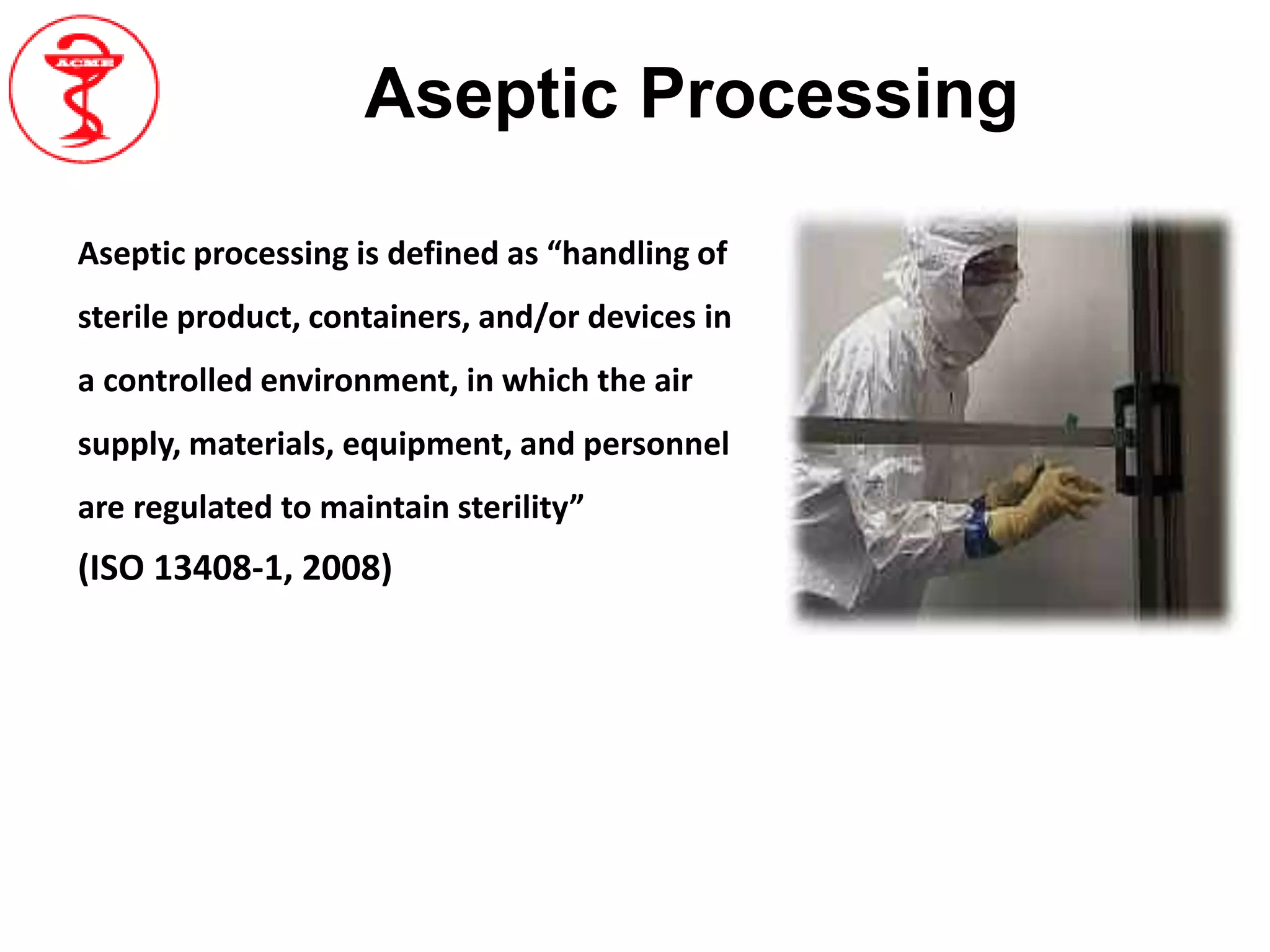
Aseptic processing is defined as “handling of
sterile product, containers, and/or devices in
a controlled environment, in which the air
supply, materials, equipment, and personnel
are regulated to maintain sterility”
(ISO 13408-1, 2008)
Producing Drug Products By
Terminal sterilization
• Product containers are filled and sealed under
high-quality environmental conditions
designed to minimize contamination, but not
to guarantee sterility.
• Product in its final container is subject to a
sterilization process such as heat or
irradiation.
Aseptic processing
• Drug product, container, and closure are
subject to sterilization separately, and then
brought together.
• Because there is no process to sterilize the
product in its final container, it is critical
that containers be filled and sealed in an
extremely high –quality environment.
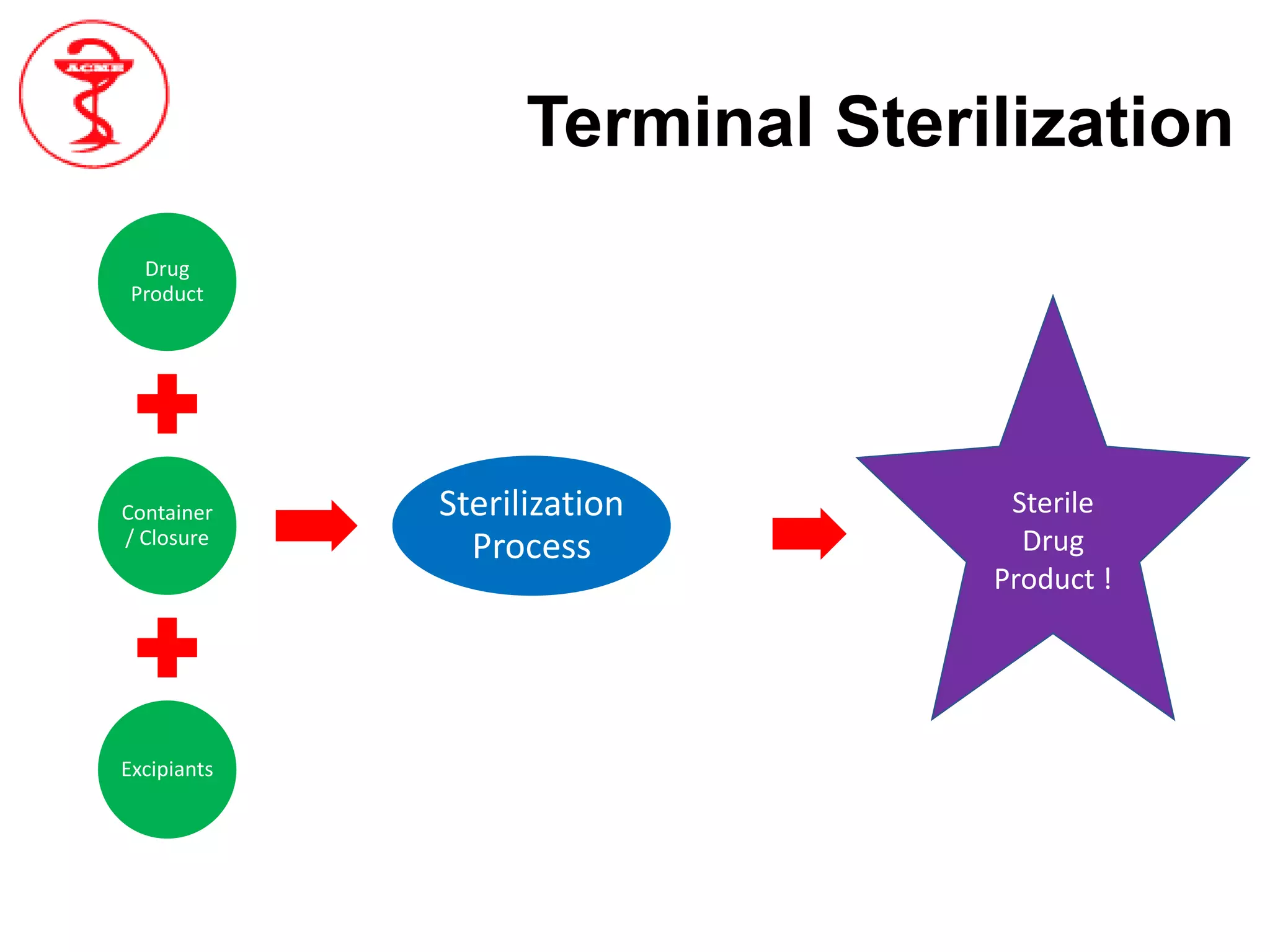
Terminal Sterilization
Drug
Product
Container
/ Closure
Excipiants
Sterilization
Process
Sterile
Drug
Product !
Aseptic Processing
Drug
Product
Sterilization
Process
Container
Closure
Excipient
Sterilization
Process
Sterilization
Process
Sterilization
Process
Sterile
Closure
Sterile
Excipient
Aseptic
Processing
Sterile
Drug
Product
Sterile
Container
Sterile
Final
Product
Can use multiple sterilization processes each optimized for the individual component
 Bacteria, virus, fungi and other viable microbes
 Bacterial spores and endotoxins
 Non viable Particles like dust, fibers, glass and other
visible and sub-visible particulates suspended in the air
and may contaminate product.
Contaminating Agents
Sources of Contamination
• Personnel born contaminants
• Poor or improper Sanitization: Procedures deficient, or poorly
executed
• Air born contaminants.
• Inadequate HEPA seal (over 90% vials contaminated)
• Velocity through HEPA Filters: Variable velocities between
filters. Inadequate laminar flow resulted. Low or undetectable
velocity at work surface.
• Mechanical failure of filling tank; main pump failure; cooling
system leaks at joints.
Control
Quality risk management (QRM)
Holistic Contamination Control Strategy (CCS) focused on minimizing
contamination control with respect to sterile manufacturing
Reduce the risk of contamination through
Quality Risk Management (QRM)
Processes, equipment, facilities and manufacturing activities
should be managed in accordance with QRM principles to ensure
Prevention of microbial, particulate and pyrogen contamination in
the final product.
 Proactive use of risk management
 Regular review of risk assessment
 Use of effective root cause and CAPA
 Employing staff with expertise to undertake risk assessment
Risk assessment should not simply confined to manufacturing, it
needs to extend to packaging and to the distribution of the
finished medicinal product, thereby embracing the requirements
of Good Distribution Practice (GDP)
Contamination Control Strategy
(CCS)
A formal, holistic CCS which reflects the site-wide strategy
to define all critical control points and assess the
effectiveness of all the controls (design, procedural,
technical and organisational) and monitoring measures
employed to manage risks associated with contamination
respect to sterile manufacturing.
Contamination Control Strategy
(CCS)
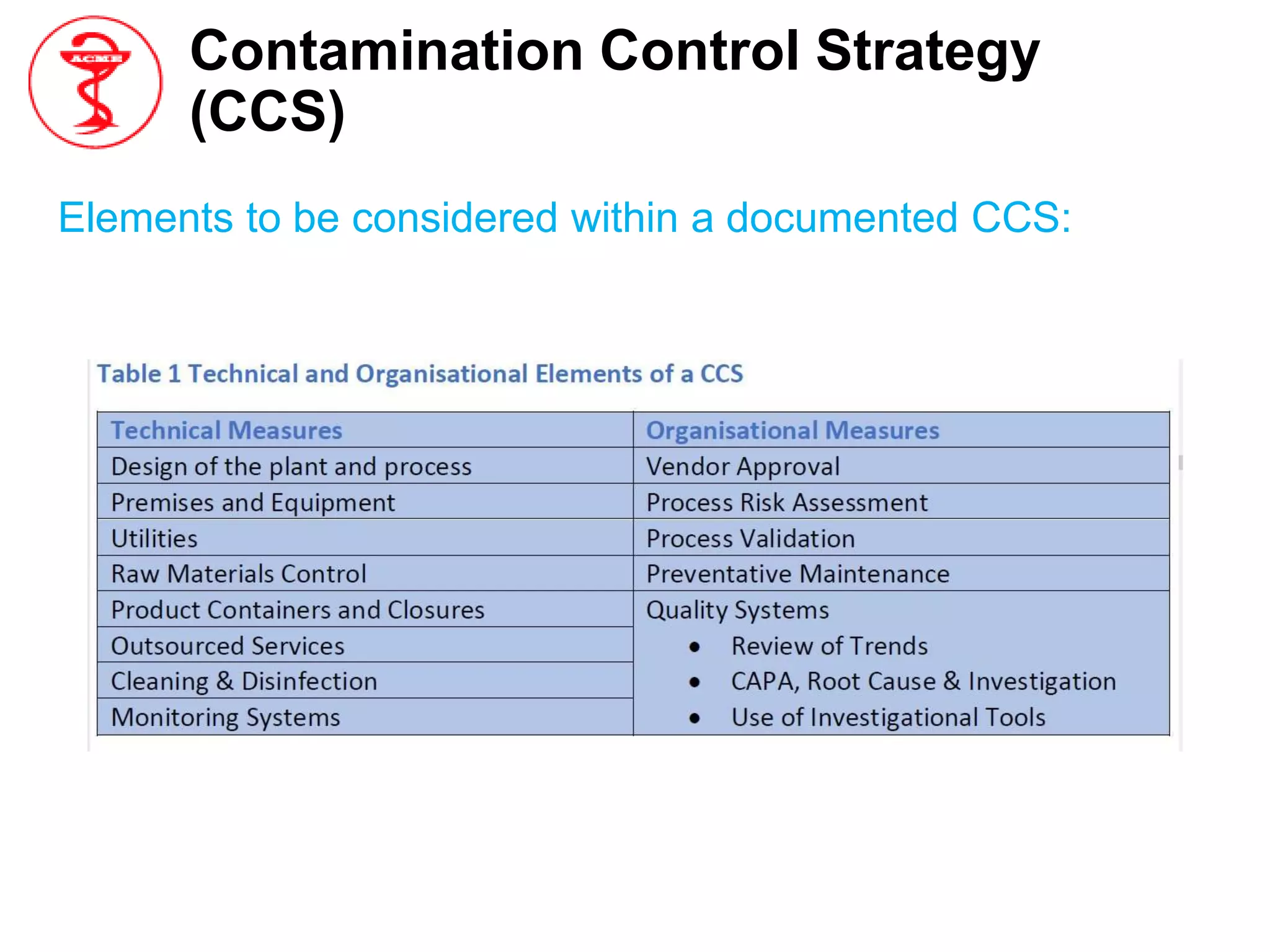
Elements to be considered within a documented CCS:
Premises
• Airlock for personnel
• Airlock for equipment and materials
• Technical and operational separation measures for component
preparation, product preparation and filling
• Wider use of barrier technology such as Restricted Access
Barriers Systems (RABS) or isolators
• Smooth, impervious and unbroken surfaces to minimize the
contamination and to permit proper cleaning and disinfection
• Floor drains designed to prevent back flow
Premises
• Maintain Pressure differentials minimum 10 pascals
• Indicators of pressure differences and warning system for failure
• Permit observation of production activities from outside the
Grade A zone and Grade B area
• No ingress of airflow from lower grade to higher grade areas
demonstrated by Airflow patterns visualization
• Clean Air and Clean Air Equipment Qualification
• Cleaning and Disinfection
Clean Air and Clean Air Equipment
Qualification
Qualification of cleanrooms and clean air equipment should
include
• Installed filter leakage and integrity testing
• Airflow measurement - Volume and velocity
• Air pressure difference measurement
• Airflow direction and visualization
• Microbial airborne and surface contamination
• Temperature measurement
• Relative humidity measurement
• Recovery testing
• Containment leak testing
Cleaning and Disinfection
 Cleaning :
The process of removing product residues and contaminants such as
dirt, dust, grease from the surface. Cleaning is the first step for
sanitation
●Contaminants can be – Physical, - Microbiological, - Biological, -
Chemical agents
Disinfection:
The process by which the reduction of the number of microorganisms is
achieved by the irreversible action of a product on their structure or
metabolism, to a level judged to be appropriate for a defined purpose
• Sporicidal agent – An agent that destroys bacterial and fungal spores
when used in sufficient concentration for specified contact time
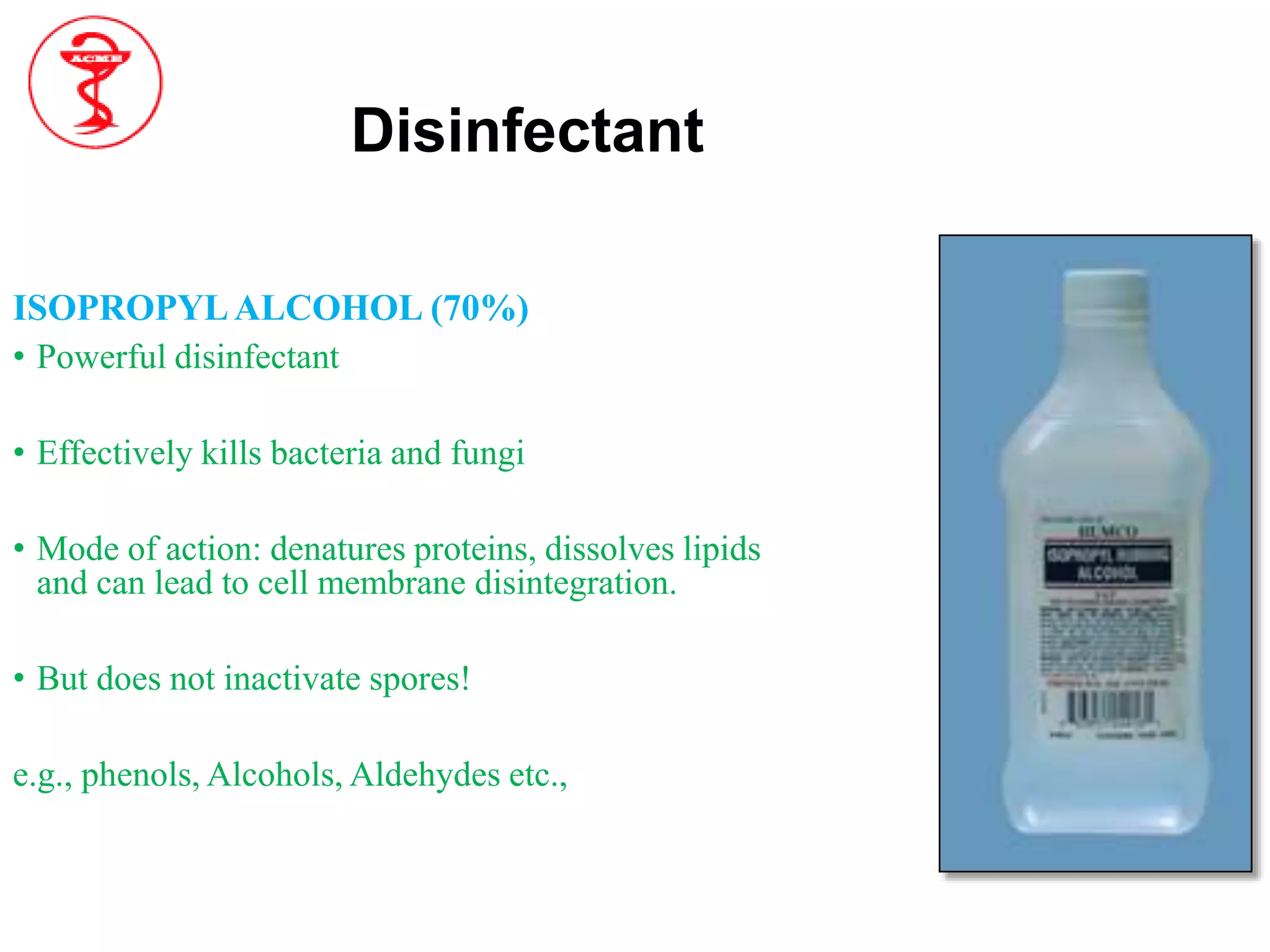
ISOPROPYLALCOHOL (70%)
• Powerful disinfectant
• Effectively kills bacteria and fungi
• Mode of action: denatures proteins, dissolves lipids
and can lead to cell membrane disintegration.
• But does not inactivate spores!
e.g., phenols, Alcohols, Aldehydes etc.,
Disinfectant
Sporicidal Agents
Effectively kills bacterial and
fungal spores
Common Sporicidal Agents
• Glutaraldehyde
• Formaldehyde
• sodium hypochlorite
• Iodine and iodophors
• Peroxygens
• Ethylene oxide
• P- Propiolactone
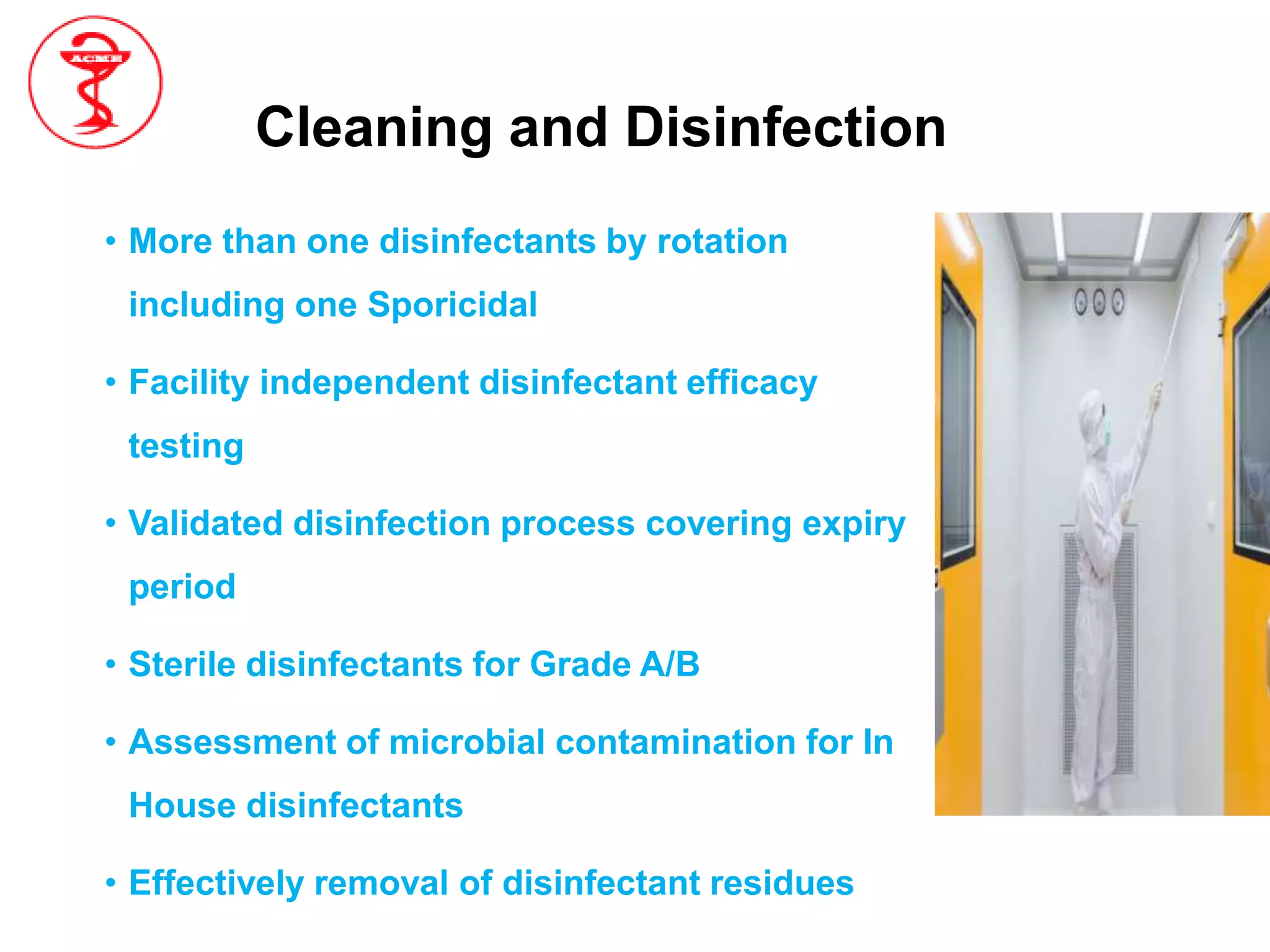
Cleaning and Disinfection
• More than one disinfectants by rotation
including one Sporicidal
• Facility independent disinfectant efficacy
testing
• Validated disinfection process covering expiry
period
• Sterile disinfectants for Grade A/B
• Assessment of microbial contamination for In
House disinfectants
• Effectively removal of disinfectant residues
Personnel
• Sufficient appropriate personnel
• Minimum number of personnel permitted to enter cleanroom
• Gowning Qualification for entering Grade A zone and Grade
B areas
• Minimum basic training
-Personnel Hygiene
-Gowning
-Cleanroom practices
-Contamination control
-Aseptic techniques
-Effect on patients due to loss of sterility
Gowning (Sterile Barrier)
People are a major source of
contamination, avoid contaminating
the product while process
Personnel Hygiene
 Personal hygiene procedures including wearing
protective clothing apply to all persons entering into
production areas:
● Full-time employees
● Temporary workers
● Contractor's employees
● Visitors
● Inspectors
Personnel Hygiene
Illness or open lesions:
●May affect the quality of products
●Should not handle starting materials, intermediates or finished
products, etc.
●Instruction and encouragement to report to supervisors
Direct contact between product and operator:
●Should be avoided
●Starting materials, primary packaging materials, intermediate
and bulk product
Personnel Hygiene
Protection of product from contamination:
●Clean clothes appropriate to personnel activities
●Including hair covering (e.g. caps)
Check change rooms/changing facilities:
●Hand washing, signs, drying of hands
●Used clothing stored in separate closed containers while
awaiting cleaning
●Laundering of clean area clothing according to an SOP and in
an appropriate facility
●Procedure for disinfecting and sterilizing when required
Activities To Be Done
Personnel Hygiene
●Smoking, eating and drinking not allowed in production areas,
laboratories and storage areas
●No chewing (e.g. gum), or keeping food or drinks allowed
●No plants kept inside these areas
●Rest and refreshment areas should be separate from
manufacturing and control areas
Other Activities
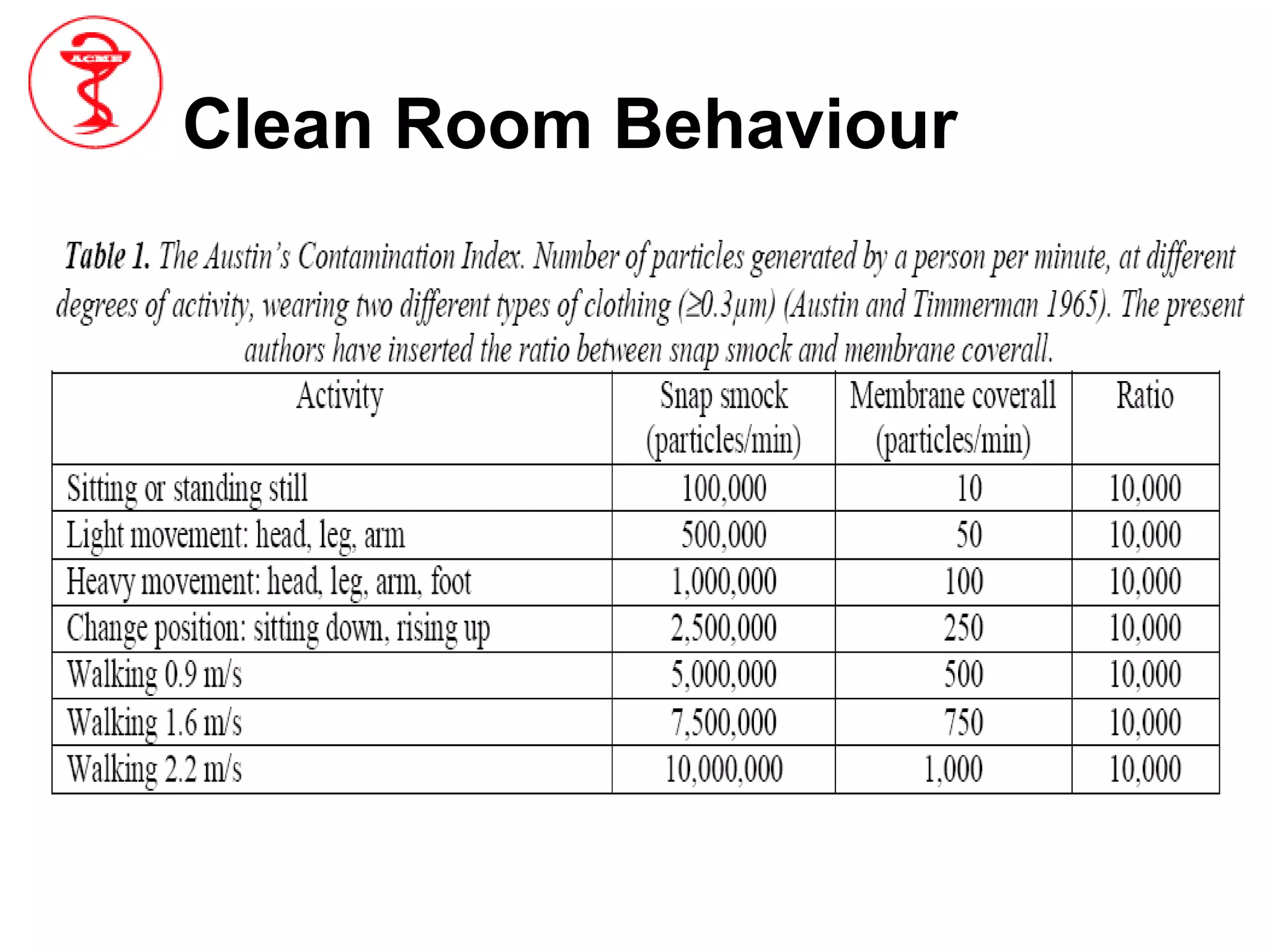
Clean Room Behaviour
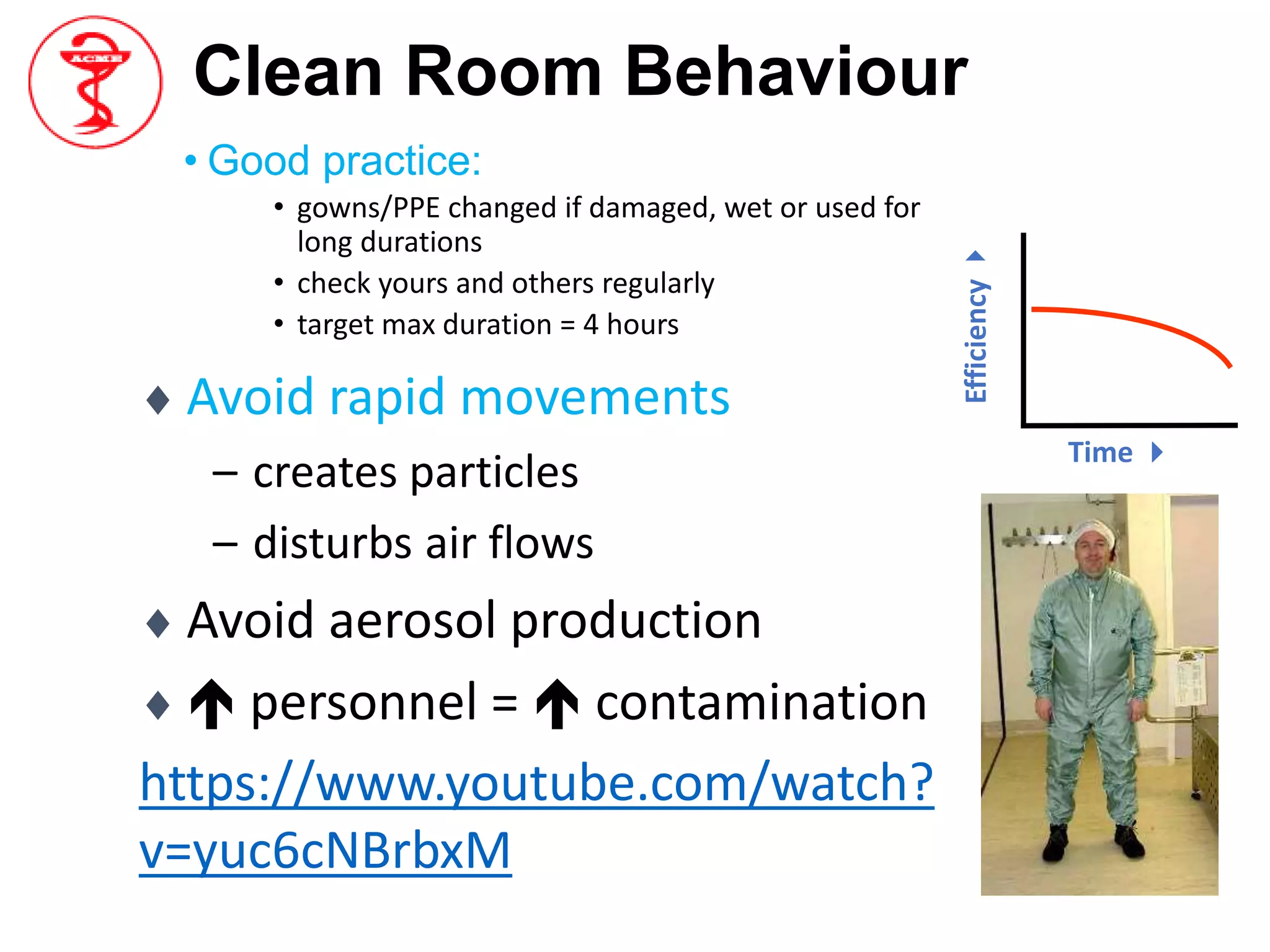
• Good practice:
• gowns/PPE changed if damaged, wet or used for
long durations
• check yours and others regularly
• target max duration = 4 hours
Time 
 Avoid rapid movements
– creates particles
– disturbs air flows
 Avoid aerosol production
  personnel =  contamination
https://www.youtube.com/watch?
v=yuc6cNBrbxM
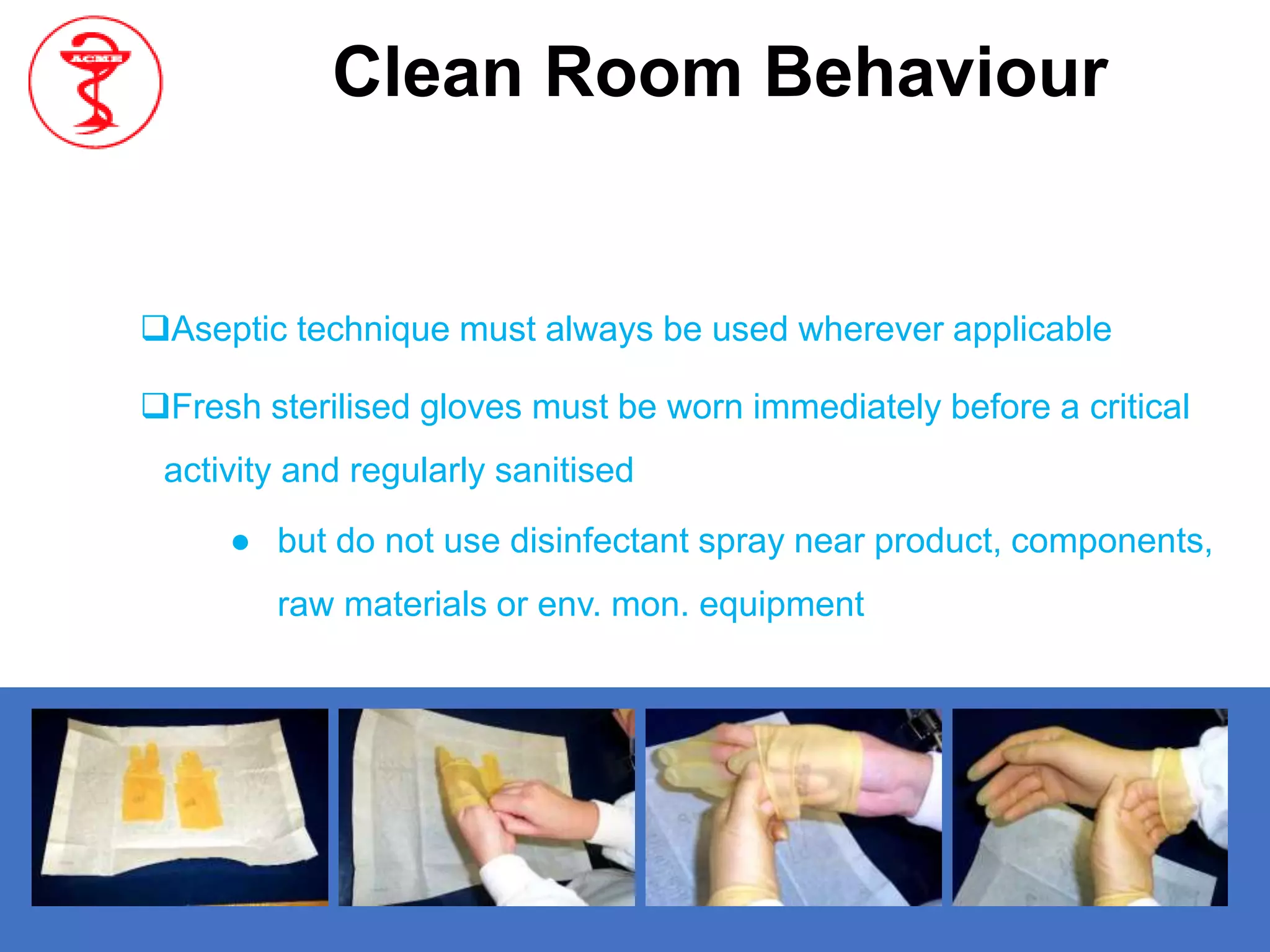
Clean Room Behaviour
Aseptic technique must always be used wherever applicable
Fresh sterilised gloves must be worn immediately before a critical
activity and regularly sanitised
● but do not use disinfectant spray near product, components,
raw materials or env. mon. equipment
Clean Room Behaviour
Minimise spread of contamination during critical
activities:
● avoid touching your person or other people
● avoid touching human contact sites such as:
♦ pens bin handles
♦ keyboards paperwork
♦ keypads desks
♦ doors plugs/switches
♦ chairs any unclean equipment
♦ telephones containers (disinfectant cans?!)
●if you do make contact - sanitise gloves
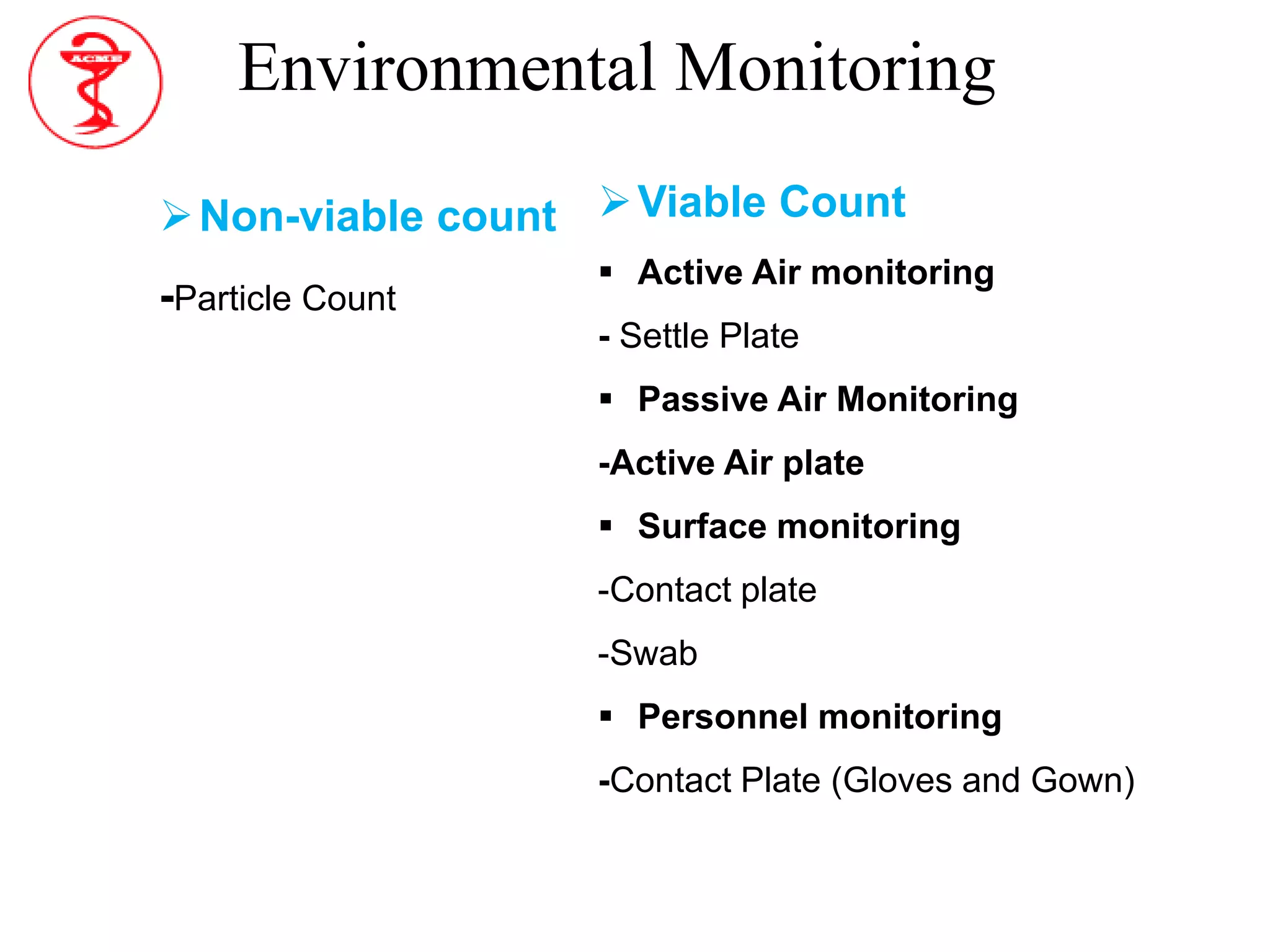
Environmental Monitoring
The goal of the environmental monitoring program is to
provide meaningful information on the quality of the
aseptic processing environment during production as well
as environmental trends.
Environmental Monitoring
Non-viable count
-Particle Count
Viable Count
 Active Air monitoring
- Settle Plate
 Passive Air Monitoring
-Active Air plate
 Surface monitoring
-Contact plate
-Swab
 Personnel monitoring
-Contact Plate (Gloves and Gown)
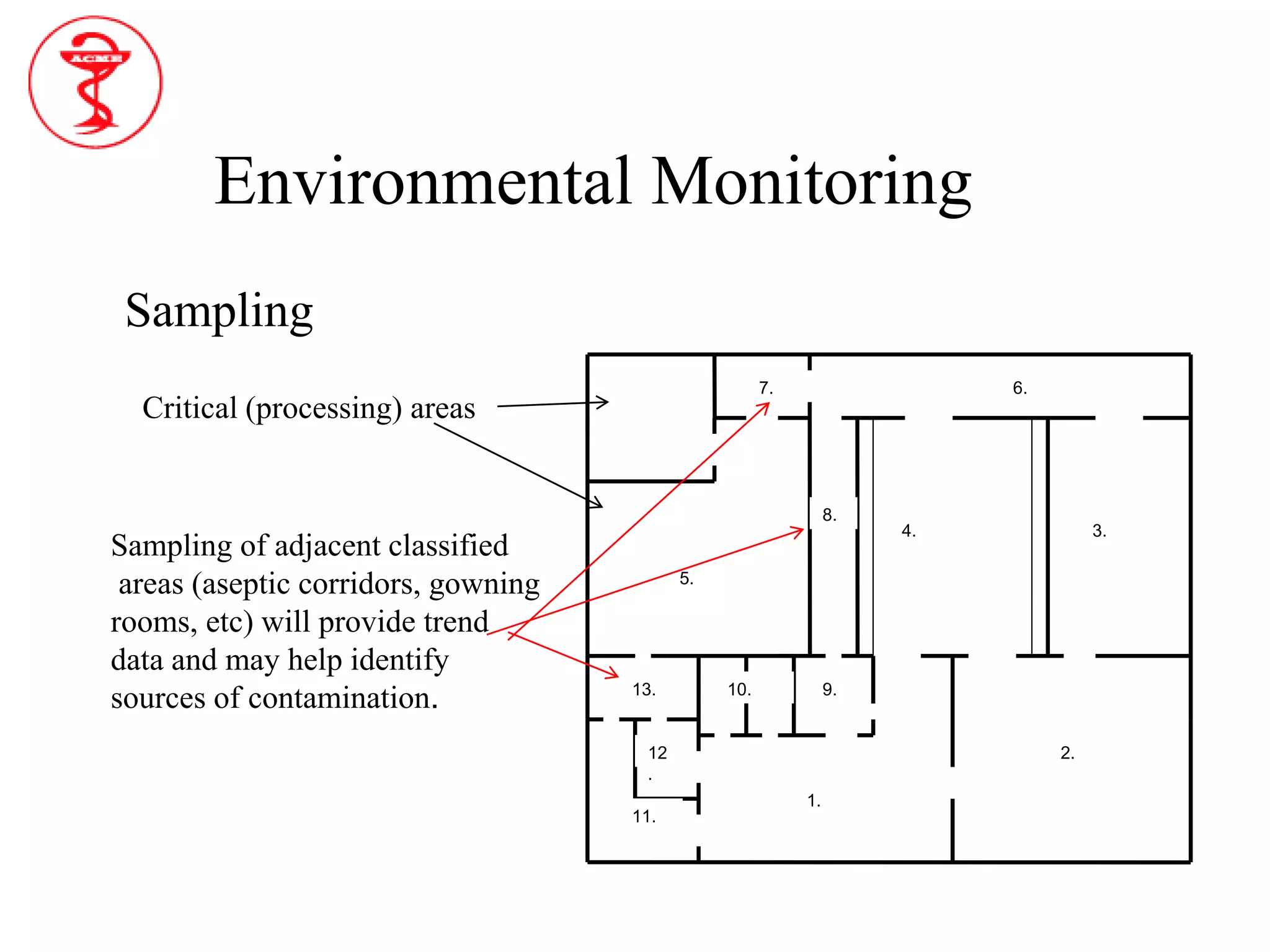
1.
2.
3.
4.
5.
6.
7.
8.
9.
10.
11.
13.
12
.
Environmental Monitoring
Critical (processing) areas
Sampling
Sampling of adjacent classified
areas (aseptic corridors, gowning
rooms, etc) will provide trend
data and may help identify
sources of contamination.
Aseptic Process Simulation (APS)/
Media Fill
A simulation of the entire aseptic formulation and filling process in
order to determine the capability of the process to assure product
sterility
 Used to validate the aseptic process
Media Fill
 Use microbial growth media instead of drug product-any
contamination will result in microbial growth.
 It doesn’t provide a direct relation for sterility but gives
an adequate evaluation for operational processing steps
 Accessed Prefilled time as part of media fill
 Accessed time limit for aseptic assembly
 Maximum exposure time of Sterilized containers to
closures
Product Inspection
• Inspection for particulate matter
• Container Closure integrity (CCIT):
• CCIT – Needs to consider impact of transportation -GDP
• Microbial Ingress test to determine acceptable stopper height
displacement
Quality Control
• Examination of Raw materials based on required microbial quality
as defined in contamination control strategy .
• Strengthen sterility testing
• Sampling from the beginning middle and end of batch , plus
following any significant intervention
• Endotoxin Testing
Extremely heat stable – recommended conditions for
inactivation are 180 0 C for 3 hours.
Endotoxin: a pyrogenic (fever inducing) substance (e.g. lipopolysaccharide)
present in the bacterial cell wall. Endotoxin reactions range from fever to death.
Endotoxin Testing
LAL Assay (Limulus amoebocyte lysate)
ENDOTOXIN LIMIT FOR WFI IS
0.25 EU/ml
Quality Control
References
EU GMP Annex 1: Manufacture of Sterile Medicinal
Products – Draft revision 2020
Thanks

Aseptic Process Operation.pptx

  • 1.
  • 2.
    Contents • Introduction toaseptic processing, Aseptic Processing vs. Terminal Sterilization • Contamination: Sources and control • Microbial environmental monitoring • Media Fill • Quality Control • References
  • 3.
    Aseptic Processing Aseptic processingis defined as “handling of sterile product, containers, and/or devices in a controlled environment, in which the air supply, materials, equipment, and personnel are regulated to maintain sterility” (ISO 13408-1, 2008)
  • 4.
    Producing Drug ProductsBy Terminal sterilization • Product containers are filled and sealed under high-quality environmental conditions designed to minimize contamination, but not to guarantee sterility. • Product in its final container is subject to a sterilization process such as heat or irradiation. Aseptic processing • Drug product, container, and closure are subject to sterilization separately, and then brought together. • Because there is no process to sterilize the product in its final container, it is critical that containers be filled and sealed in an extremely high –quality environment.
  • 5.
  • 6.
  • 7.
     Bacteria, virus,fungi and other viable microbes  Bacterial spores and endotoxins  Non viable Particles like dust, fibers, glass and other visible and sub-visible particulates suspended in the air and may contaminate product. Contaminating Agents
  • 8.
    Sources of Contamination •Personnel born contaminants • Poor or improper Sanitization: Procedures deficient, or poorly executed • Air born contaminants. • Inadequate HEPA seal (over 90% vials contaminated) • Velocity through HEPA Filters: Variable velocities between filters. Inadequate laminar flow resulted. Low or undetectable velocity at work surface. • Mechanical failure of filling tank; main pump failure; cooling system leaks at joints.
  • 9.
    Control Quality risk management(QRM) Holistic Contamination Control Strategy (CCS) focused on minimizing contamination control with respect to sterile manufacturing Reduce the risk of contamination through
  • 10.
    Quality Risk Management(QRM) Processes, equipment, facilities and manufacturing activities should be managed in accordance with QRM principles to ensure Prevention of microbial, particulate and pyrogen contamination in the final product.  Proactive use of risk management  Regular review of risk assessment  Use of effective root cause and CAPA  Employing staff with expertise to undertake risk assessment Risk assessment should not simply confined to manufacturing, it needs to extend to packaging and to the distribution of the finished medicinal product, thereby embracing the requirements of Good Distribution Practice (GDP)
  • 11.
    Contamination Control Strategy (CCS) Aformal, holistic CCS which reflects the site-wide strategy to define all critical control points and assess the effectiveness of all the controls (design, procedural, technical and organisational) and monitoring measures employed to manage risks associated with contamination respect to sterile manufacturing.
  • 12.
    Contamination Control Strategy (CCS) Elementsto be considered within a documented CCS:
  • 13.
    Premises • Airlock forpersonnel • Airlock for equipment and materials • Technical and operational separation measures for component preparation, product preparation and filling • Wider use of barrier technology such as Restricted Access Barriers Systems (RABS) or isolators • Smooth, impervious and unbroken surfaces to minimize the contamination and to permit proper cleaning and disinfection • Floor drains designed to prevent back flow
  • 14.
    Premises • Maintain Pressuredifferentials minimum 10 pascals • Indicators of pressure differences and warning system for failure • Permit observation of production activities from outside the Grade A zone and Grade B area • No ingress of airflow from lower grade to higher grade areas demonstrated by Airflow patterns visualization • Clean Air and Clean Air Equipment Qualification • Cleaning and Disinfection
  • 15.
    Clean Air andClean Air Equipment Qualification Qualification of cleanrooms and clean air equipment should include • Installed filter leakage and integrity testing • Airflow measurement - Volume and velocity • Air pressure difference measurement • Airflow direction and visualization • Microbial airborne and surface contamination • Temperature measurement • Relative humidity measurement • Recovery testing • Containment leak testing
  • 16.
    Cleaning and Disinfection Cleaning : The process of removing product residues and contaminants such as dirt, dust, grease from the surface. Cleaning is the first step for sanitation ●Contaminants can be – Physical, - Microbiological, - Biological, - Chemical agents Disinfection: The process by which the reduction of the number of microorganisms is achieved by the irreversible action of a product on their structure or metabolism, to a level judged to be appropriate for a defined purpose • Sporicidal agent – An agent that destroys bacterial and fungal spores when used in sufficient concentration for specified contact time
  • 17.
    ISOPROPYLALCOHOL (70%) • Powerfuldisinfectant • Effectively kills bacteria and fungi • Mode of action: denatures proteins, dissolves lipids and can lead to cell membrane disintegration. • But does not inactivate spores! e.g., phenols, Alcohols, Aldehydes etc., Disinfectant
  • 18.
    Sporicidal Agents Effectively killsbacterial and fungal spores Common Sporicidal Agents • Glutaraldehyde • Formaldehyde • sodium hypochlorite • Iodine and iodophors • Peroxygens • Ethylene oxide • P- Propiolactone
  • 19.
    Cleaning and Disinfection •More than one disinfectants by rotation including one Sporicidal • Facility independent disinfectant efficacy testing • Validated disinfection process covering expiry period • Sterile disinfectants for Grade A/B • Assessment of microbial contamination for In House disinfectants • Effectively removal of disinfectant residues
  • 20.
    Personnel • Sufficient appropriatepersonnel • Minimum number of personnel permitted to enter cleanroom • Gowning Qualification for entering Grade A zone and Grade B areas • Minimum basic training -Personnel Hygiene -Gowning -Cleanroom practices -Contamination control -Aseptic techniques -Effect on patients due to loss of sterility
  • 21.
    Gowning (Sterile Barrier) Peopleare a major source of contamination, avoid contaminating the product while process
  • 22.
    Personnel Hygiene  Personalhygiene procedures including wearing protective clothing apply to all persons entering into production areas: ● Full-time employees ● Temporary workers ● Contractor's employees ● Visitors ● Inspectors
  • 23.
    Personnel Hygiene Illness oropen lesions: ●May affect the quality of products ●Should not handle starting materials, intermediates or finished products, etc. ●Instruction and encouragement to report to supervisors Direct contact between product and operator: ●Should be avoided ●Starting materials, primary packaging materials, intermediate and bulk product
  • 24.
    Personnel Hygiene Protection ofproduct from contamination: ●Clean clothes appropriate to personnel activities ●Including hair covering (e.g. caps) Check change rooms/changing facilities: ●Hand washing, signs, drying of hands ●Used clothing stored in separate closed containers while awaiting cleaning ●Laundering of clean area clothing according to an SOP and in an appropriate facility ●Procedure for disinfecting and sterilizing when required Activities To Be Done
  • 25.
    Personnel Hygiene ●Smoking, eatingand drinking not allowed in production areas, laboratories and storage areas ●No chewing (e.g. gum), or keeping food or drinks allowed ●No plants kept inside these areas ●Rest and refreshment areas should be separate from manufacturing and control areas Other Activities
  • 26.
    Clean Room Behaviour •Good practice: • gowns/PPE changed if damaged, wet or used for long durations • check yours and others regularly • target max duration = 4 hours Time   Avoid rapid movements – creates particles – disturbs air flows  Avoid aerosol production   personnel =  contamination https://www.youtube.com/watch? v=yuc6cNBrbxM
  • 27.
  • 28.
    Clean Room Behaviour Aseptictechnique must always be used wherever applicable Fresh sterilised gloves must be worn immediately before a critical activity and regularly sanitised ● but do not use disinfectant spray near product, components, raw materials or env. mon. equipment
  • 29.
    Clean Room Behaviour Minimisespread of contamination during critical activities: ● avoid touching your person or other people ● avoid touching human contact sites such as: ♦ pens bin handles ♦ keyboards paperwork ♦ keypads desks ♦ doors plugs/switches ♦ chairs any unclean equipment ♦ telephones containers (disinfectant cans?!) ●if you do make contact - sanitise gloves
  • 30.
    Environmental Monitoring The goalof the environmental monitoring program is to provide meaningful information on the quality of the aseptic processing environment during production as well as environmental trends.
  • 31.
    Environmental Monitoring Non-viable count -ParticleCount Viable Count  Active Air monitoring - Settle Plate  Passive Air Monitoring -Active Air plate  Surface monitoring -Contact plate -Swab  Personnel monitoring -Contact Plate (Gloves and Gown)
  • 32.
    1. 2. 3. 4. 5. 6. 7. 8. 9. 10. 11. 13. 12 . Environmental Monitoring Critical (processing)areas Sampling Sampling of adjacent classified areas (aseptic corridors, gowning rooms, etc) will provide trend data and may help identify sources of contamination.
  • 33.
    Aseptic Process Simulation(APS)/ Media Fill A simulation of the entire aseptic formulation and filling process in order to determine the capability of the process to assure product sterility  Used to validate the aseptic process
  • 34.
    Media Fill  Usemicrobial growth media instead of drug product-any contamination will result in microbial growth.  It doesn’t provide a direct relation for sterility but gives an adequate evaluation for operational processing steps  Accessed Prefilled time as part of media fill  Accessed time limit for aseptic assembly  Maximum exposure time of Sterilized containers to closures
  • 35.
    Product Inspection • Inspectionfor particulate matter • Container Closure integrity (CCIT): • CCIT – Needs to consider impact of transportation -GDP • Microbial Ingress test to determine acceptable stopper height displacement
  • 36.
    Quality Control • Examinationof Raw materials based on required microbial quality as defined in contamination control strategy . • Strengthen sterility testing • Sampling from the beginning middle and end of batch , plus following any significant intervention • Endotoxin Testing
  • 37.
    Extremely heat stable– recommended conditions for inactivation are 180 0 C for 3 hours. Endotoxin: a pyrogenic (fever inducing) substance (e.g. lipopolysaccharide) present in the bacterial cell wall. Endotoxin reactions range from fever to death. Endotoxin Testing LAL Assay (Limulus amoebocyte lysate) ENDOTOXIN LIMIT FOR WFI IS 0.25 EU/ml Quality Control
  • 38.
    References EU GMP Annex1: Manufacture of Sterile Medicinal Products – Draft revision 2020
  • 39.