
DRAWING
Definition
Characteristics
Plates 1- 5
DRAWING
By definition
• a form of visual art in which a person uses various drawing
instruments to mark paper or another two-dimensional
medium.
• a picture or diagram made with a pencil, pen, or crayon
rather than paint, especially one drawn in monochrome.
synonyms: sketch, picture, illustration, representation,
portrayal, delineation, depiction, rendering, composition, study;
diagram, outline, design, plan
common mediums used: graphite pencils, pen and ink, inked
brushes, wax color pencils, crayons, charcoal, chalk, pastels,
various kinds of erasers, markers, styluses, various metals (such
as silverpoint) and electronic drawing.
TWO TYPES OF MEDIUMS
Dry Medium
• Pencil
• Crayon
• Charcoal
• Graphite
• Pastels
Liquid Medium
• Pen and Ink
• Brush and Ink
• Ink Wash
IMPORTANCE OF DRAWING TO THE
ARTIST
• Drawing is the foundation of Visual Arts
• Drawing is the primary visual language, essential for communication and expression,
drawing is as important as the development of written and verbal skills.
• Drawing gives the basic idea and concept of the artist (sketch) but pushed further it
can become the art work itself.
• Drawing helps in the mind and hand coordination of the artist developing a more
fine psychomotor skills.
CREATING YOUR PLATES
General Instructions
PLATE GENERAL INSTRUCTIONS
Landscape/Portrait must follow the following details:
• Top and side margins will always be at .5 inches and the bottom margin is 1 inch.
• Indicate the plate number, title, materials, score, and date submitted at the bottom margin; This
will be written on the 1 in margin at the bottom of the plate and should measure .5 in each
• Use only HB pencil to line your margin and in writing the details at the title margin area.
 Not following of instruction will constitute a -2.
 Plates should be checked graded first before proceeding to the next plate, unless instructed
otherwise.
 Plates with a grade 12 and below would need to repeated immediately at the next pag and the
plate no. will have an indicator of R example: PLATE NO. 1R.
 Repeated Plates will only have an additional points of not more than 5 added to first graded
plate.
GRADING CRITERIA
TECHNICALITY 15 POINTS
The accuracy of drawing of the intended task
CLEANLINESS 5 POINTS
The over-all look of the work.
WORK ATTITUDE 5 POINTS
Work displayed shows dedication of doing the task properly and has followed the instruction for
the task
TOTAL GRADE is 25 pts PER PLATE
If a plate will constitute a score of 11, the plate must be redone again regardless of reason. To earn
a grade no higher than 13 points.
PLATE NO 1: PENCIL WORKS SCORE:
MATERIALS: DATE SUBMITTED:
PLATE NO 1: PENCIL WORKS SCORE:
MATERIALS: DATE SUBMITTED:
FIRST SET OF PLATES FOR DRAWING
Plate 1: Kinds of Line
Plate 2 – 5
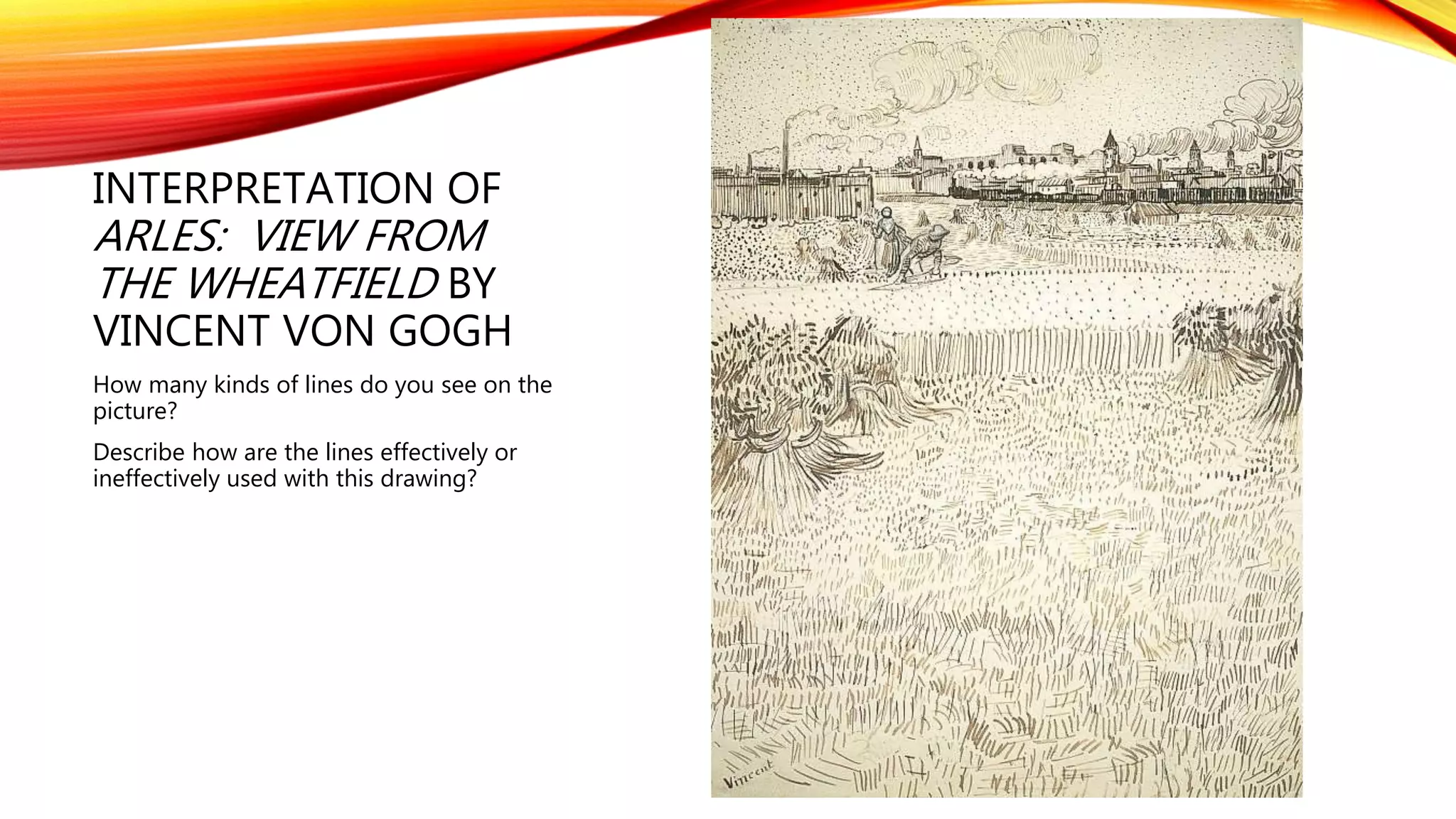
INTERPRETATION OF
ARLES: VIEW FROM
THE WHEATFIELD BY
VINCENT VON GOGH
How many kinds of lines do you see on the
picture?
Describe how are the lines effectively or
ineffectively used with this drawing?
PLATE 1: CHART OF LINES
Type of Lines
Based in Form
Curve
Straight
Zigzag
Wavy
Dashed
Dotted
Spiral
Type of Lines
based on
Direction
Horizontal
Vertical
Diagonal
Type of Lines
based on
Quality
Thick Line
Thin Line
PLATE 1: CHART OF LINES
• Create a chart that will showcase the different types of
lines.
• You will use only your HB pencil in creating your chart.
• Each type of line must have a box of at least 1 x 3 in and
properly labelled. These boxes must be adequately filled
with the drawing sample line.
• The chart will be done in a portrait orientation.
SAMPLE FOR PLATE 1
PLATE NO 1: Chart of Lines SCORE:
MATERIALS: HB Pencil, Eraser, Ruler DATE SUBMITTED:
Type of Line based in Form
Type of Line based on Direction
Type of Line based on Quality
PENCIL AND TECHNICAL PEN LINE WORKS TO
CREATE VALUE AND TEXTURE
HATCHING AND CROSSHATCHING
Technique in using lines to create value (dark to light or light to dark)
Hatching- lines going in the same direction; the closer the lines, the darker
the art work will be.
Crosshatching- lines that cross; the more lines that are crosshatched, the
more darker is the work
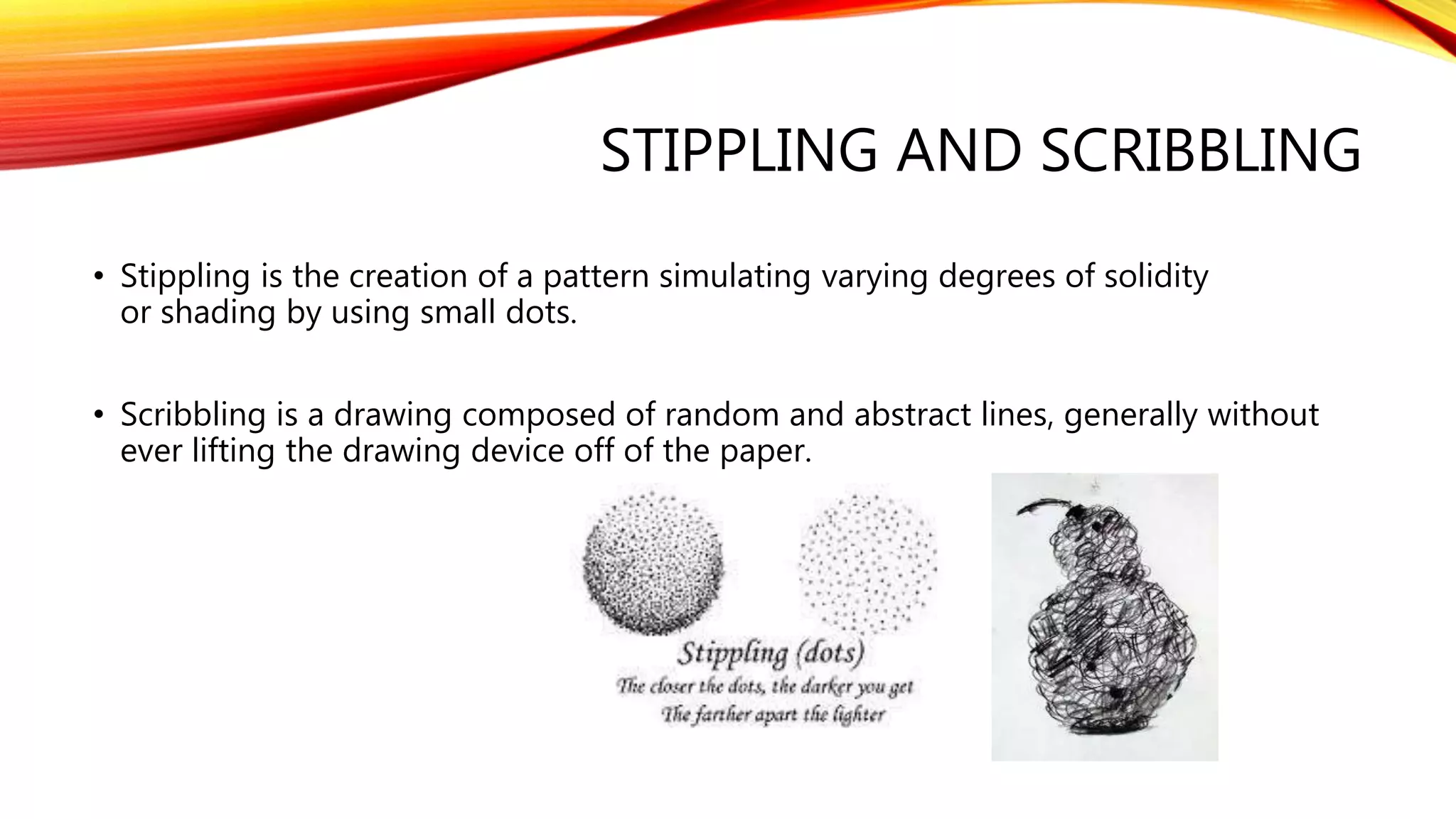
STIPPLING AND SCRIBBLING
• Stippling is the creation of a pattern simulating varying degrees of solidity
or shading by using small dots.
• Scribbling is a drawing composed of random and abstract lines, generally without
ever lifting the drawing device off of the paper.
PLATE 2: HATCHING PLATE 3: CROSSHATCHING
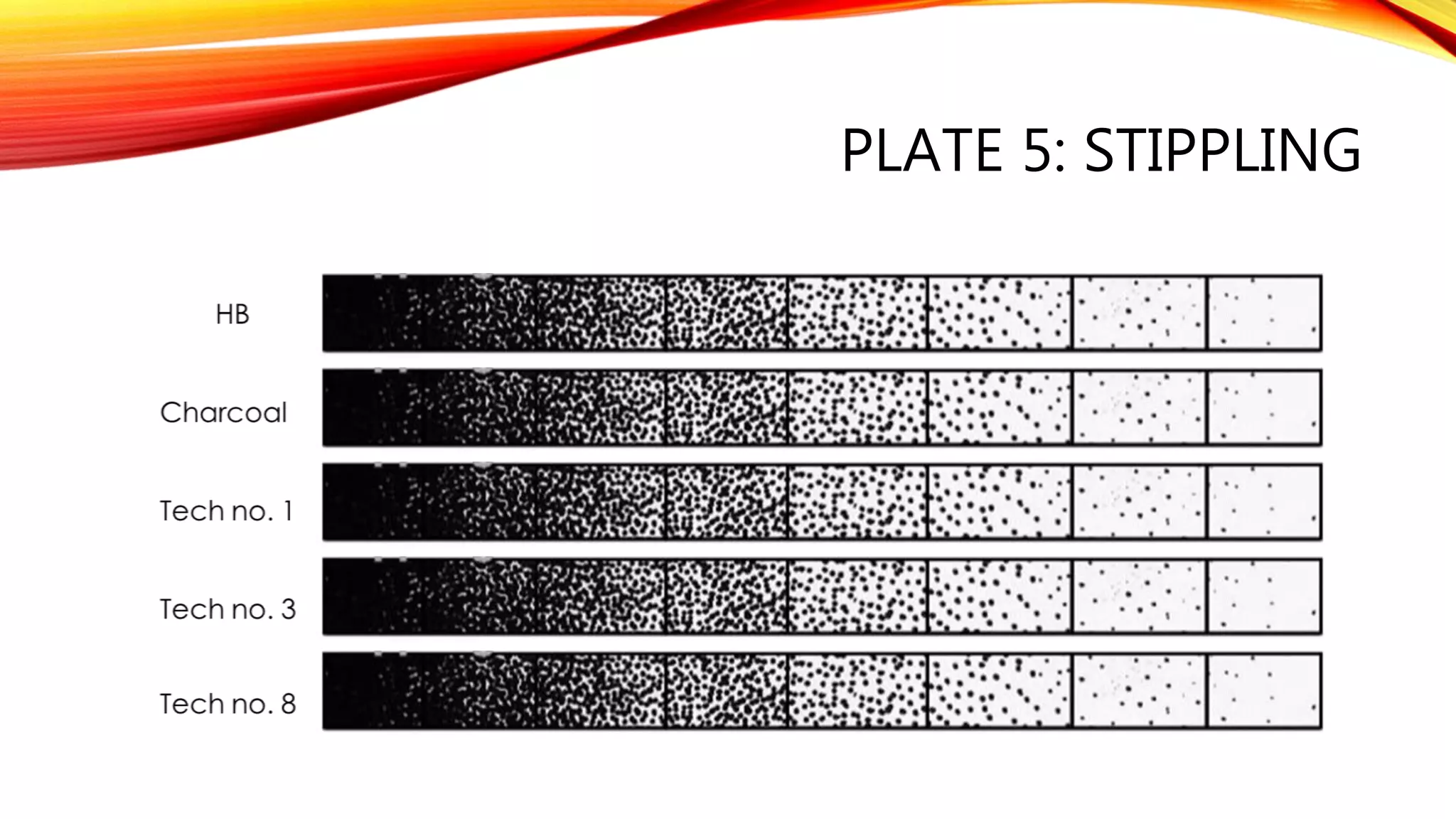
PLATE 4: SCRIBBLING PLATE 5: STIPPLING
Use your HB pencil, Charcoal and 3 Techpens in creating each Plate.
FREEHAND no using of ruler for doing line activity
PLATE NO 2: HATCHING
HB
Charcoal
Tech no. 1
Tech no. 3
Tech no. 8
10 in
1 in
1.5 in
PLATE NO 3: CROSSHATCHING
HB
Charcoal
Tech no. 1
Tech no. 3
Tech no. 8
PLATE NO 4: SCRIBBLING
PLATE 5: STIPPLING

Cci1 lec 3 drawing and plates 1 to 6

  • 1.
  • 2.
    DRAWING By definition • aform of visual art in which a person uses various drawing instruments to mark paper or another two-dimensional medium. • a picture or diagram made with a pencil, pen, or crayon rather than paint, especially one drawn in monochrome. synonyms: sketch, picture, illustration, representation, portrayal, delineation, depiction, rendering, composition, study; diagram, outline, design, plan common mediums used: graphite pencils, pen and ink, inked brushes, wax color pencils, crayons, charcoal, chalk, pastels, various kinds of erasers, markers, styluses, various metals (such as silverpoint) and electronic drawing.
  • 3.
    TWO TYPES OFMEDIUMS Dry Medium • Pencil • Crayon • Charcoal • Graphite • Pastels Liquid Medium • Pen and Ink • Brush and Ink • Ink Wash
  • 4.
    IMPORTANCE OF DRAWINGTO THE ARTIST • Drawing is the foundation of Visual Arts • Drawing is the primary visual language, essential for communication and expression, drawing is as important as the development of written and verbal skills. • Drawing gives the basic idea and concept of the artist (sketch) but pushed further it can become the art work itself. • Drawing helps in the mind and hand coordination of the artist developing a more fine psychomotor skills.
  • 5.
  • 6.
    PLATE GENERAL INSTRUCTIONS Landscape/Portraitmust follow the following details: • Top and side margins will always be at .5 inches and the bottom margin is 1 inch. • Indicate the plate number, title, materials, score, and date submitted at the bottom margin; This will be written on the 1 in margin at the bottom of the plate and should measure .5 in each • Use only HB pencil to line your margin and in writing the details at the title margin area.  Not following of instruction will constitute a -2.  Plates should be checked graded first before proceeding to the next plate, unless instructed otherwise.  Plates with a grade 12 and below would need to repeated immediately at the next pag and the plate no. will have an indicator of R example: PLATE NO. 1R.  Repeated Plates will only have an additional points of not more than 5 added to first graded plate.
  • 7.
    GRADING CRITERIA TECHNICALITY 15POINTS The accuracy of drawing of the intended task CLEANLINESS 5 POINTS The over-all look of the work. WORK ATTITUDE 5 POINTS Work displayed shows dedication of doing the task properly and has followed the instruction for the task TOTAL GRADE is 25 pts PER PLATE If a plate will constitute a score of 11, the plate must be redone again regardless of reason. To earn a grade no higher than 13 points.
  • 8.
    PLATE NO 1:PENCIL WORKS SCORE: MATERIALS: DATE SUBMITTED: PLATE NO 1: PENCIL WORKS SCORE: MATERIALS: DATE SUBMITTED:
  • 9.
    FIRST SET OFPLATES FOR DRAWING Plate 1: Kinds of Line Plate 2 – 5
  • 10.
    INTERPRETATION OF ARLES: VIEWFROM THE WHEATFIELD BY VINCENT VON GOGH How many kinds of lines do you see on the picture? Describe how are the lines effectively or ineffectively used with this drawing?
  • 11.
    PLATE 1: CHARTOF LINES Type of Lines Based in Form Curve Straight Zigzag Wavy Dashed Dotted Spiral Type of Lines based on Direction Horizontal Vertical Diagonal Type of Lines based on Quality Thick Line Thin Line
  • 12.
    PLATE 1: CHARTOF LINES • Create a chart that will showcase the different types of lines. • You will use only your HB pencil in creating your chart. • Each type of line must have a box of at least 1 x 3 in and properly labelled. These boxes must be adequately filled with the drawing sample line. • The chart will be done in a portrait orientation.
  • 13.
    SAMPLE FOR PLATE1 PLATE NO 1: Chart of Lines SCORE: MATERIALS: HB Pencil, Eraser, Ruler DATE SUBMITTED: Type of Line based in Form Type of Line based on Direction Type of Line based on Quality
  • 14.
    PENCIL AND TECHNICALPEN LINE WORKS TO CREATE VALUE AND TEXTURE
  • 15.
    HATCHING AND CROSSHATCHING Techniquein using lines to create value (dark to light or light to dark) Hatching- lines going in the same direction; the closer the lines, the darker the art work will be. Crosshatching- lines that cross; the more lines that are crosshatched, the more darker is the work
  • 16.
    STIPPLING AND SCRIBBLING •Stippling is the creation of a pattern simulating varying degrees of solidity or shading by using small dots. • Scribbling is a drawing composed of random and abstract lines, generally without ever lifting the drawing device off of the paper.
  • 17.
    PLATE 2: HATCHINGPLATE 3: CROSSHATCHING PLATE 4: SCRIBBLING PLATE 5: STIPPLING Use your HB pencil, Charcoal and 3 Techpens in creating each Plate. FREEHAND no using of ruler for doing line activity
  • 18.
    PLATE NO 2:HATCHING HB Charcoal Tech no. 1 Tech no. 3 Tech no. 8 10 in 1 in 1.5 in
  • 19.
    PLATE NO 3:CROSSHATCHING HB Charcoal Tech no. 1 Tech no. 3 Tech no. 8
  • 20.
    PLATE NO 4:SCRIBBLING
  • 21.