
LEADERSHIP AND ARTS
MANAGEMENT IN THE
DIFFERENT ART FIELDS
Overview of Course
Definition of Arts
Management
Understanding
Management
COURSE
DESCRIPTIO
N
The learner
demonstrates a basic
understanding of
concepts, elements
and processes in arts
management through
appreciation, analysis
and practical
application, as well as
develop his/her self
mastery for leadership
in the arts.
WHAT DOES CLIO WANT AND HOW
DOES SHE GET IT?
Clio creates, collects, preserves, or connects compelling works of human
expressions (ART)
Clio realizes that her work is bigger than her and for her to continue her task she
needs PEOPLE, MONEY and STUFF but must be able to CONNECT, give MEANING
and requires ENERGY to be able to achieve her goal.
Clio then realizes that she needs to MANAGE the PEOPLE, MONEY and STUFF so
that the PRODUCTION will not be wasted on going on the mill or people
complaining. (MANAGEMENT)
Clio and her people started to work in a collective it became an ORGANIZATION
Clio must then utilize her PEOPLE, MONEY and STUFF efficiently (FINANCIAL
MANAGEMENT/FINANCIAL)
Clio must form PARTNERS and SUPPLIERS that may help their organization
through collaboration and she must have the right skill to lead this working
relationship (LEADERSHIP)
Clio realizes that there is more than managing her people, money and stuff, she
needs to connect and reach out to the right people to be able to supply her the
additional money and stuff (MARKETING)
ARTS MANAGEMENT
The discipline of Arts Management combines the tools
of business (such as management, marketing,
planning) with the tools of audience- and community
building (such as fundraising, development,
education, volunteerism, etc.) to build bridges
between art, artists and audiences.
DEFINITION OF
MANAGEMENT
WHAT IS MANAGEMENT?
“Management is an art of getting things done through and with the
people in formally organized groups. It is an art of creating an
environment in which people can perform and individuals and can co-
operate towards attainment of group goals”.
- Harold
Koontz
Organizational
Theorist
“Management is an art of knowing what to do, when to do and see
that it is done in the best and cheapest way”
- Frederick
Winslow Taylor
One of the First Management
WHAT IS MANAGEMENT?
Management is a purposive activity. It is something that directs group
efforts towards the attainment of certain pre - determined goals. It is
the process of working with and through others to effectively achieve
the goals of the organization, by efficiently using limited resources in
the changing world. These goals may vary from one enterprise to
another.
E.g.: For an Art Group will be creating an Art Biennale and must set
up a system in selecting artists’ exhibition and art activities but must
have profit maximization by minimizing cost.
WHAT IS MANAGEMENT?
Management involves creating an internal environment: - It is the
management which puts into use the various factors of production.
It is the responsibility of management to create such conditions
which are conducive to maximum efforts so that people are able to
perform their task efficiently and effectively.
It includes ensuring availability of raw materials, determination of
wages and salaries, formulation of rules & regulations etc.
CHARACTERISTICS OF
MANAGEMENT
MANAGEMENT IS BOTH A SCIENCE
AND ART
Management is a science because it has an organized body of
knowledge which contains certain universal truth.
Management is can art because managing requires certain skills
which are personal possessions of managers.
Science provides the knowledge and art deals with the
application of knowledge and skills.
MANAGEMENT IS A SCIENCE
Science is a systematic body of knowledge pertaining to a specific field of
study that contains general facts which explains a phenomenon. It
establishes cause and effect relationship between two or more variables and
underlines the principles governing their relationship. These principles are
developed through scientific method of observation and verification through
testing.
Science is characterized by following main features:
1. Universally accepted principles - Scientific principles represents basic
truth about a particular field of enquiry. These principles may be applied in
all situations, at all time & at all places. E.g. - law of gravitation which can be
applied in all countries irrespective of the time.
Management also contains some fundamental principles which can be
applied universally like the Principle of Unity of Command i.e. one man, one
boss. This principle is applicable to all type of organization - business or
MANAGEMENT IS A SCIENCE
2. Experimentation & Observation - Scientific principles are derived
through scientific investigation & researching i.e. they are based on logic.
E.g. the principle that earth goes round the sun has been scientifically
proved.
Management principles are also based on scientific enquiry & observation
and not only on the opinion of Henry Fayol. They have been developed
through experiments & practical experiences of large no. of managers. E.g. it
is observed that fair remuneration to personal helps in creating a satisfied
work force.
3. Cause & Effect Relationship - Principles of science lay down cause and
effect relationship between various variables. E.g. when metals are heated,
they are expanded. The cause is heating & result is expansion.
The same is true for management, therefore it also establishes cause and
effect relationship. E.g. lack of parity (balance) between authority &
responsibility will lead to ineffectiveness. If you know the cause i.e. lack of
balance, the effect can be ascertained easily i.e. in effectiveness. Similarly if
workers are given bonuses, fair wages they will work hard but when not
treated in fair and just manner, reduces productivity of organization
MANAGEMENT IS A SCIENCE
4. Test of Validity & Predictability - Validity of scientific principles
can be tested at any time or any number of times i.e. they stand the
test of time. Each time these tests will give same result. Moreover
future events can be predicted with reasonable accuracy by using
scientific principles. E.g. H2 & O2 will always give H2O.
Principles of management can also be tested for validity. E.g.
principle of unity of command can be tested by comparing two
persons - one having single boss and one having 2 bosses. The
performance of 1st person will be better than 2nd.
DIFFERENCE OF MANAGEMENT
FROM PURE SCIENCE
It cannot be denied that management has a systematic body of
knowledge but it is not as exact as that of other physical sciences like
biology, physics, and chemistry etc. The main reason for the
inexactness of science of management is that it deals with human
beings and it is very difficult to predict their behavior accurately.
Since Managment is a social process, therefore it falls in the area of
social sciences. It is a flexible science and that is why its theories and
principles may produce different results at different times and
therefore it is a behavior science.
Ernest Dale has called Management as a Soft Science.
MANAGEMENT AS AN ART
Art implies application of knowledge and skill to trying about desired
results. An art may be defined as personalized application of general
theoretical principles for achieving best possible results.
Art has the following characters:
Practical Knowledge: Every art requires practical knowledge therefore
learning of theory is not sufficient. It is very important to know
practical application of theoretical principles. E.g. to become a good
painter, the person may not only be knowing different colour and
brushes but different designs, dimensions, situations etc. to use
them appropriately. A manager can never be successful just by
obtaining degree or diploma in management; he must have also know
how to apply various principles in real situations by functioning in
capacity of manager.
MANAGEMENT IS AN ART
Personal Skill: Although theoretical base may be same for every artist,
but each one has his own style and approach towards his job. That is
why the level of success and quality of performance differs from one
person to another. E.g. there are several qualified painters but M.F.
Hussain is recognized for his style. Similarly management as an art is
also personalized. Every manager has his own way of managing
things based on his knowledge, experience and personality, that is
why some managers are known as good managers (like Aditya Birla,
Rahul Bajaj) whereas others as bad.
Creativity: Every artist has an element of creativity in line. That is why
he aims at producing something that has never existed before which
requires combination of intelligence & imagination. Management is
also creative in nature like any other art. It combines human and
non-human resources in useful way so as to achieve desired results.
MANAGEMENT IS AN ART
Perfection through practice: Practice makes a man perfect. Every artist
becomes more and more proficient through constant practice.
Similarly managers learn through an art of trial and error initially but
application of management principles over the years makes them
perfect in the job of managing.
Goal-Oriented: Every art is result oriented as it seeks to achieve
concrete results. In the same manner, management is also directed
towards accomplishment of pre-determined goals. Managers use
various resources like men, money, material, machinery & methods to
promote growth of an organization.
Thus, management is an art therefore it requires application of
certain principles rather it is an art of highest order because it deals
with moulding the attitude and behavior of people at work towards
desired goals.
PRESENTATION OF
DIFFERENT DAVAO
ART/PERFORMING
GROUPS
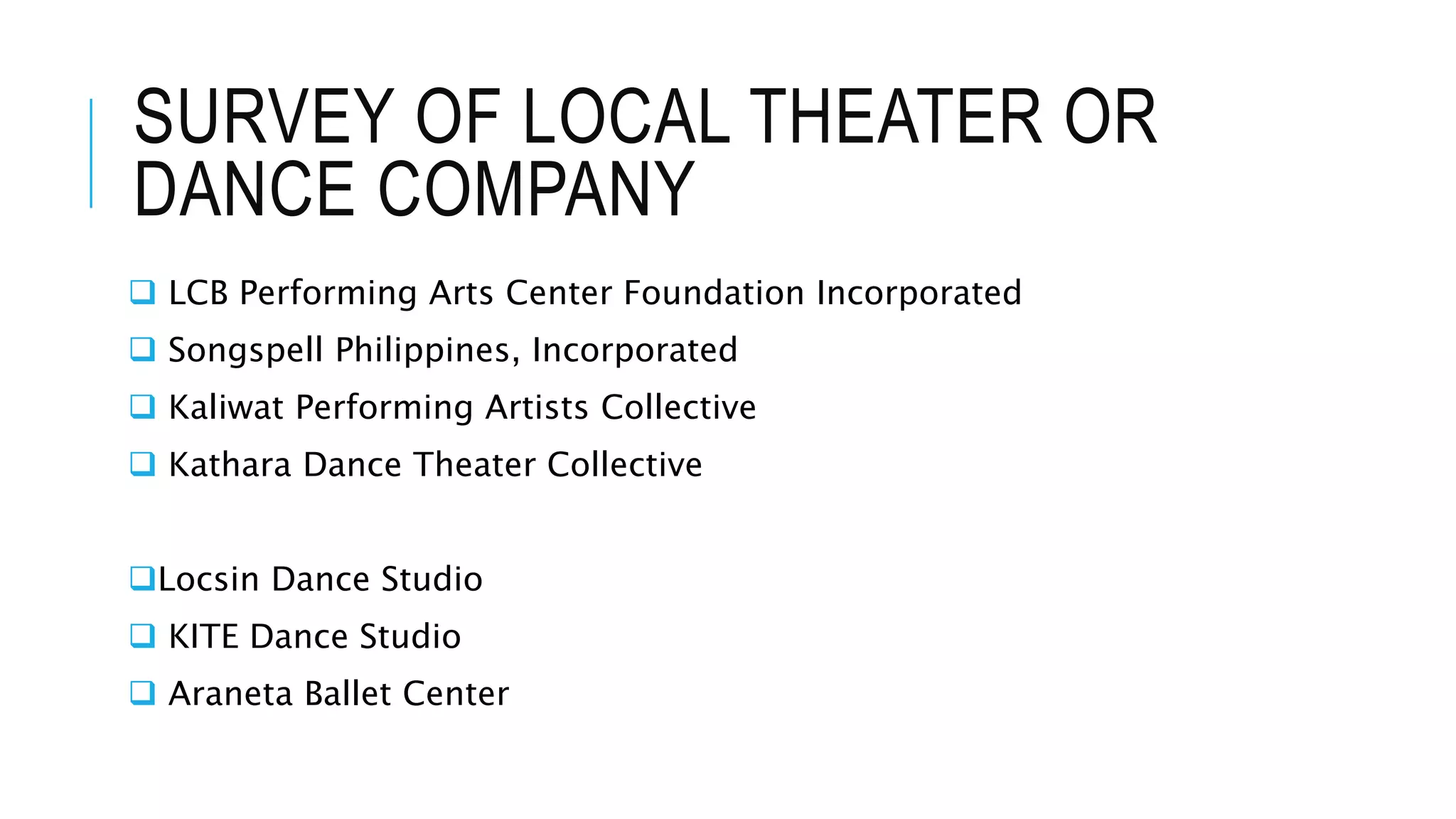
SURVEY OF LOCAL THEATER OR
DANCE COMPANY
 LCB Performing Arts Center Foundation Incorporated
 Songspell Philippines, Incorporated
 Kaliwat Performing Artists Collective
 Kathara Dance Theater Collective
Locsin Dance Studio
 KITE Dance Studio
 Araneta Ballet Center
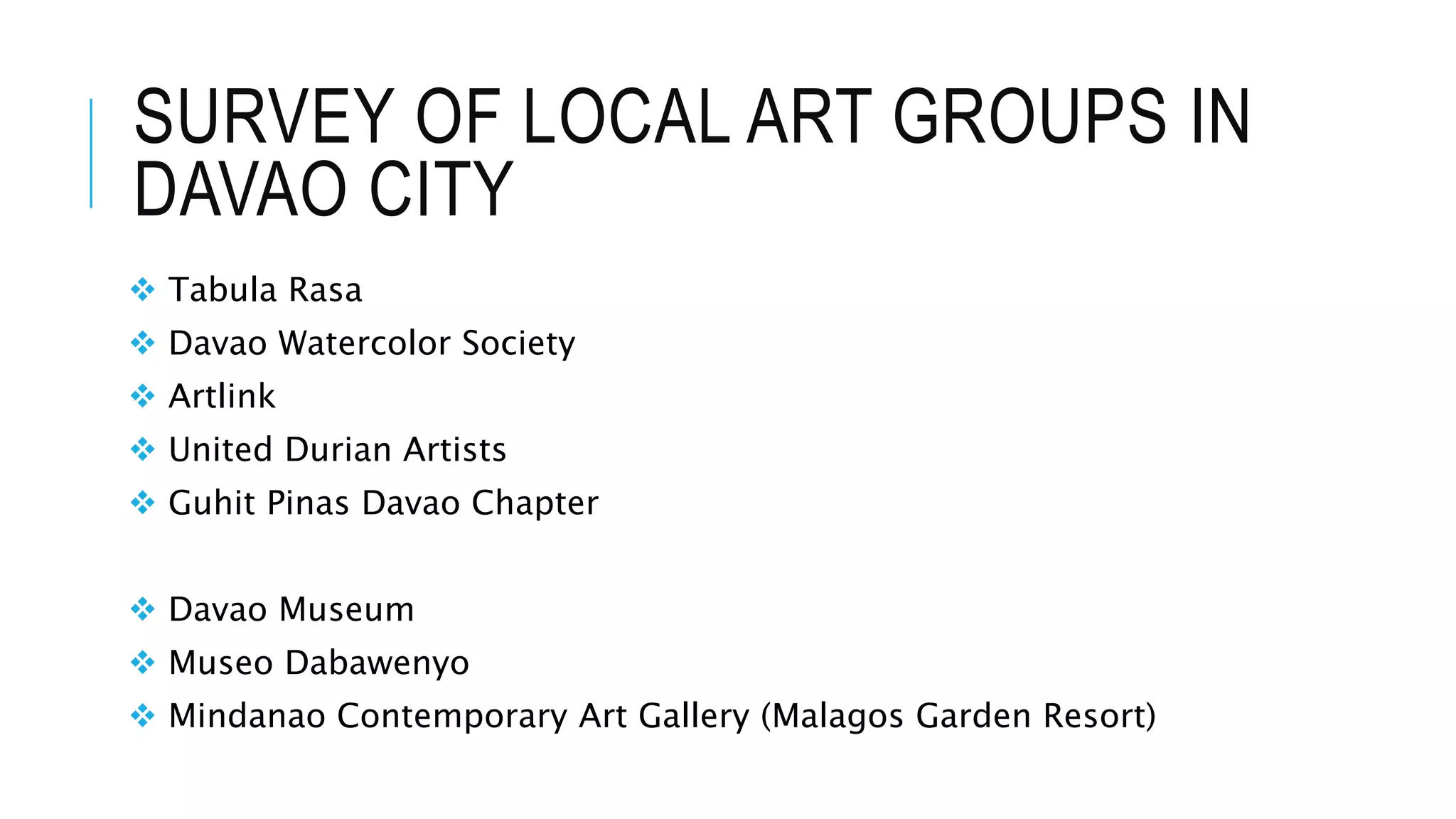
SURVEY OF LOCAL ART GROUPS IN
DAVAO CITY
 Tabula Rasa
 Davao Watercolor Society
 Artlink
 United Durian Artists
 Guhit Pinas Davao Chapter
 Davao Museum
 Museo Dabawenyo
 Mindanao Contemporary Art Gallery (Malagos Garden Resort)
SOURCES
https://www.youtube.com/watch?v=qIofduNdcq4

Lmdaf lec 1 definition

  • 1.
    LEADERSHIP AND ARTS MANAGEMENTIN THE DIFFERENT ART FIELDS Overview of Course Definition of Arts Management Understanding Management
  • 2.
    COURSE DESCRIPTIO N The learner demonstrates abasic understanding of concepts, elements and processes in arts management through appreciation, analysis and practical application, as well as develop his/her self mastery for leadership in the arts.
  • 3.
    WHAT DOES CLIOWANT AND HOW DOES SHE GET IT? Clio creates, collects, preserves, or connects compelling works of human expressions (ART) Clio realizes that her work is bigger than her and for her to continue her task she needs PEOPLE, MONEY and STUFF but must be able to CONNECT, give MEANING and requires ENERGY to be able to achieve her goal. Clio then realizes that she needs to MANAGE the PEOPLE, MONEY and STUFF so that the PRODUCTION will not be wasted on going on the mill or people complaining. (MANAGEMENT) Clio and her people started to work in a collective it became an ORGANIZATION Clio must then utilize her PEOPLE, MONEY and STUFF efficiently (FINANCIAL MANAGEMENT/FINANCIAL) Clio must form PARTNERS and SUPPLIERS that may help their organization through collaboration and she must have the right skill to lead this working relationship (LEADERSHIP) Clio realizes that there is more than managing her people, money and stuff, she needs to connect and reach out to the right people to be able to supply her the additional money and stuff (MARKETING)
  • 4.
    ARTS MANAGEMENT The disciplineof Arts Management combines the tools of business (such as management, marketing, planning) with the tools of audience- and community building (such as fundraising, development, education, volunteerism, etc.) to build bridges between art, artists and audiences.
  • 5.
  • 6.
    WHAT IS MANAGEMENT? “Managementis an art of getting things done through and with the people in formally organized groups. It is an art of creating an environment in which people can perform and individuals and can co- operate towards attainment of group goals”. - Harold Koontz Organizational Theorist “Management is an art of knowing what to do, when to do and see that it is done in the best and cheapest way” - Frederick Winslow Taylor One of the First Management
  • 7.
    WHAT IS MANAGEMENT? Managementis a purposive activity. It is something that directs group efforts towards the attainment of certain pre - determined goals. It is the process of working with and through others to effectively achieve the goals of the organization, by efficiently using limited resources in the changing world. These goals may vary from one enterprise to another. E.g.: For an Art Group will be creating an Art Biennale and must set up a system in selecting artists’ exhibition and art activities but must have profit maximization by minimizing cost.
  • 8.
    WHAT IS MANAGEMENT? Managementinvolves creating an internal environment: - It is the management which puts into use the various factors of production. It is the responsibility of management to create such conditions which are conducive to maximum efforts so that people are able to perform their task efficiently and effectively. It includes ensuring availability of raw materials, determination of wages and salaries, formulation of rules & regulations etc.
  • 9.
  • 10.
    MANAGEMENT IS BOTHA SCIENCE AND ART Management is a science because it has an organized body of knowledge which contains certain universal truth. Management is can art because managing requires certain skills which are personal possessions of managers. Science provides the knowledge and art deals with the application of knowledge and skills.
  • 11.
    MANAGEMENT IS ASCIENCE Science is a systematic body of knowledge pertaining to a specific field of study that contains general facts which explains a phenomenon. It establishes cause and effect relationship between two or more variables and underlines the principles governing their relationship. These principles are developed through scientific method of observation and verification through testing. Science is characterized by following main features: 1. Universally accepted principles - Scientific principles represents basic truth about a particular field of enquiry. These principles may be applied in all situations, at all time & at all places. E.g. - law of gravitation which can be applied in all countries irrespective of the time. Management also contains some fundamental principles which can be applied universally like the Principle of Unity of Command i.e. one man, one boss. This principle is applicable to all type of organization - business or
  • 12.
    MANAGEMENT IS ASCIENCE 2. Experimentation & Observation - Scientific principles are derived through scientific investigation & researching i.e. they are based on logic. E.g. the principle that earth goes round the sun has been scientifically proved. Management principles are also based on scientific enquiry & observation and not only on the opinion of Henry Fayol. They have been developed through experiments & practical experiences of large no. of managers. E.g. it is observed that fair remuneration to personal helps in creating a satisfied work force. 3. Cause & Effect Relationship - Principles of science lay down cause and effect relationship between various variables. E.g. when metals are heated, they are expanded. The cause is heating & result is expansion. The same is true for management, therefore it also establishes cause and effect relationship. E.g. lack of parity (balance) between authority & responsibility will lead to ineffectiveness. If you know the cause i.e. lack of balance, the effect can be ascertained easily i.e. in effectiveness. Similarly if workers are given bonuses, fair wages they will work hard but when not treated in fair and just manner, reduces productivity of organization
  • 13.
    MANAGEMENT IS ASCIENCE 4. Test of Validity & Predictability - Validity of scientific principles can be tested at any time or any number of times i.e. they stand the test of time. Each time these tests will give same result. Moreover future events can be predicted with reasonable accuracy by using scientific principles. E.g. H2 & O2 will always give H2O. Principles of management can also be tested for validity. E.g. principle of unity of command can be tested by comparing two persons - one having single boss and one having 2 bosses. The performance of 1st person will be better than 2nd.
  • 14.
    DIFFERENCE OF MANAGEMENT FROMPURE SCIENCE It cannot be denied that management has a systematic body of knowledge but it is not as exact as that of other physical sciences like biology, physics, and chemistry etc. The main reason for the inexactness of science of management is that it deals with human beings and it is very difficult to predict their behavior accurately. Since Managment is a social process, therefore it falls in the area of social sciences. It is a flexible science and that is why its theories and principles may produce different results at different times and therefore it is a behavior science. Ernest Dale has called Management as a Soft Science.
  • 15.
    MANAGEMENT AS ANART Art implies application of knowledge and skill to trying about desired results. An art may be defined as personalized application of general theoretical principles for achieving best possible results. Art has the following characters: Practical Knowledge: Every art requires practical knowledge therefore learning of theory is not sufficient. It is very important to know practical application of theoretical principles. E.g. to become a good painter, the person may not only be knowing different colour and brushes but different designs, dimensions, situations etc. to use them appropriately. A manager can never be successful just by obtaining degree or diploma in management; he must have also know how to apply various principles in real situations by functioning in capacity of manager.
  • 16.
    MANAGEMENT IS ANART Personal Skill: Although theoretical base may be same for every artist, but each one has his own style and approach towards his job. That is why the level of success and quality of performance differs from one person to another. E.g. there are several qualified painters but M.F. Hussain is recognized for his style. Similarly management as an art is also personalized. Every manager has his own way of managing things based on his knowledge, experience and personality, that is why some managers are known as good managers (like Aditya Birla, Rahul Bajaj) whereas others as bad. Creativity: Every artist has an element of creativity in line. That is why he aims at producing something that has never existed before which requires combination of intelligence & imagination. Management is also creative in nature like any other art. It combines human and non-human resources in useful way so as to achieve desired results.
  • 17.
    MANAGEMENT IS ANART Perfection through practice: Practice makes a man perfect. Every artist becomes more and more proficient through constant practice. Similarly managers learn through an art of trial and error initially but application of management principles over the years makes them perfect in the job of managing. Goal-Oriented: Every art is result oriented as it seeks to achieve concrete results. In the same manner, management is also directed towards accomplishment of pre-determined goals. Managers use various resources like men, money, material, machinery & methods to promote growth of an organization. Thus, management is an art therefore it requires application of certain principles rather it is an art of highest order because it deals with moulding the attitude and behavior of people at work towards desired goals.
  • 18.
  • 19.
    SURVEY OF LOCALTHEATER OR DANCE COMPANY  LCB Performing Arts Center Foundation Incorporated  Songspell Philippines, Incorporated  Kaliwat Performing Artists Collective  Kathara Dance Theater Collective Locsin Dance Studio  KITE Dance Studio  Araneta Ballet Center
  • 20.
    SURVEY OF LOCALART GROUPS IN DAVAO CITY  Tabula Rasa  Davao Watercolor Society  Artlink  United Durian Artists  Guhit Pinas Davao Chapter  Davao Museum  Museo Dabawenyo  Mindanao Contemporary Art Gallery (Malagos Garden Resort)
  • 21.

Editor's Notes

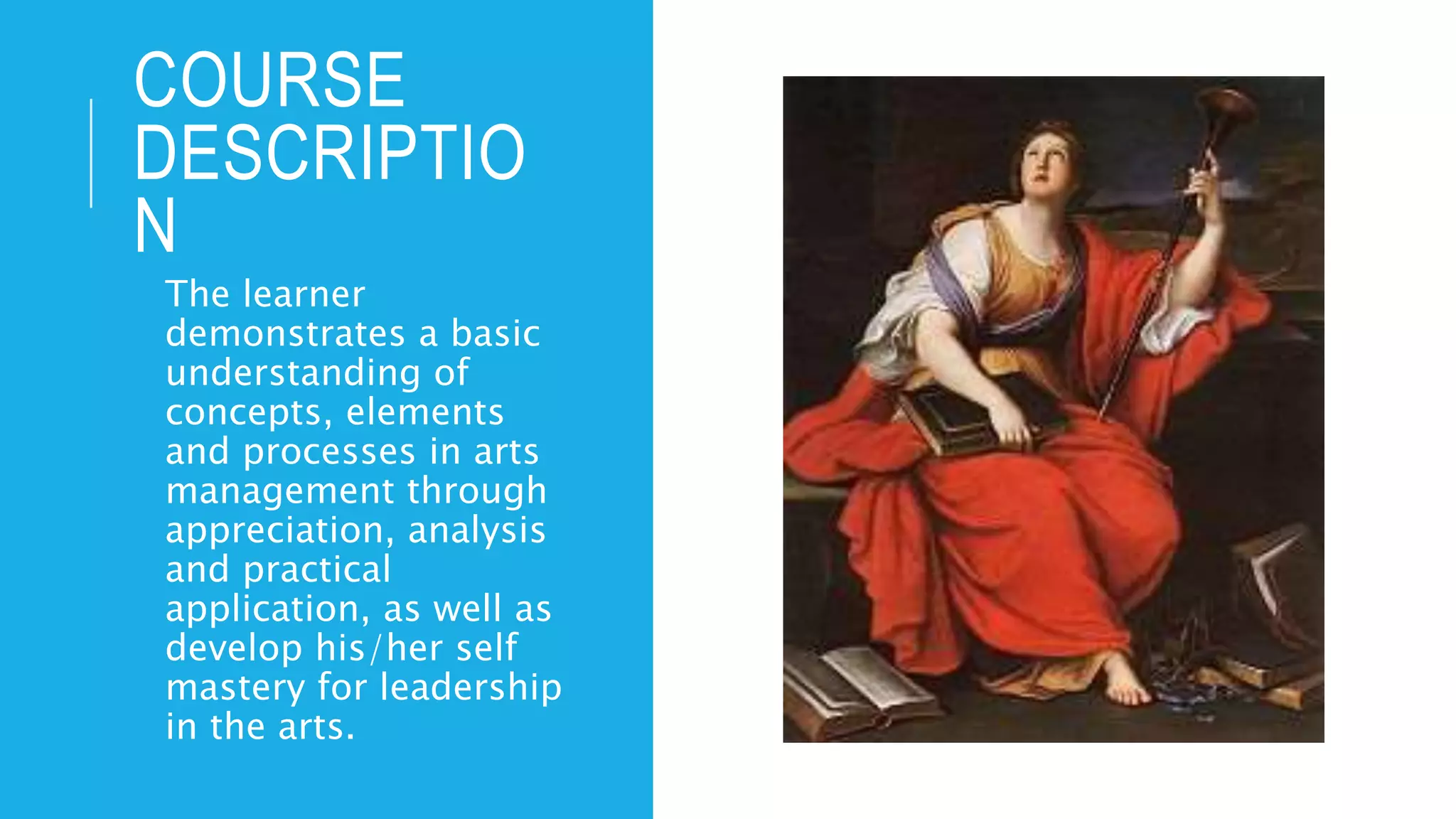
  • #3 Greek: Κλειώ, Kleiṓ; "made famous" or "to make famous"), also spelled Kleio, is the muse of history, or in a few mythological accounts, the muse of lyre playing. Like all the muses, she is a daughter of Zeus and the Titaness Mnemosyne.
  • #4 Development is the growth and diversification of the Organization Formation of the Board of Trustees for proper Governance through Policy-Making. Clio made her organization/enterprise NON-PROFIT
  • #7 All organizations - business, political, cultural or social are involved in management because it is the management which helps and directs the various efforts towards a definite purpose.