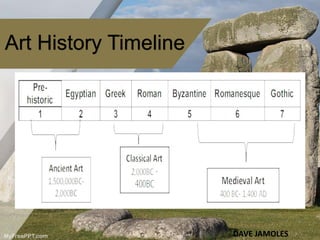
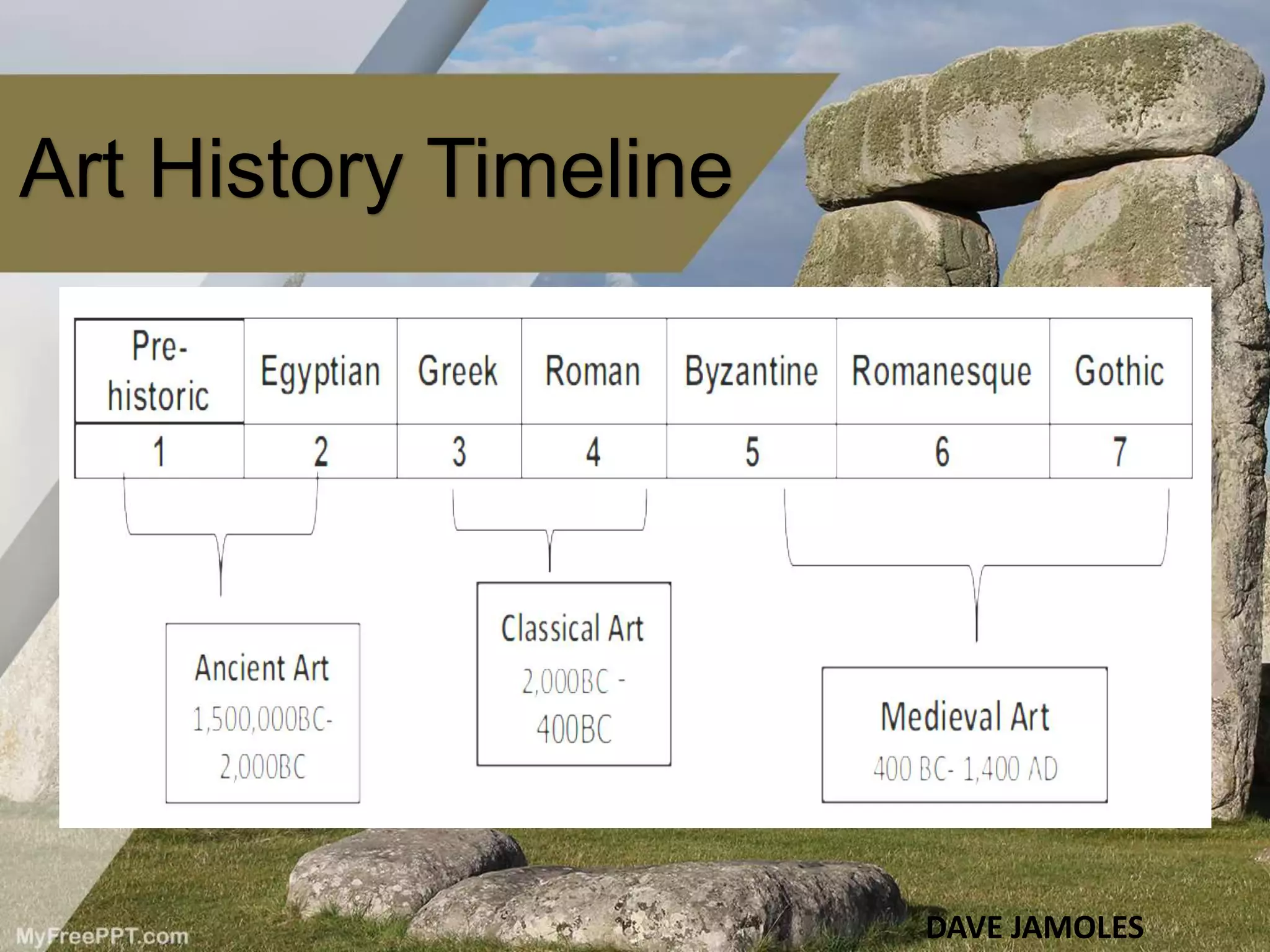
Art History Timeline
DAVE JAMOLES
Pre-historic art is classified
into three periods such as;
Paleolithic (Old Stone Age),
Mesolithic(Middle Stone
Age), and Neolithic (New
Stone Age) Eras.
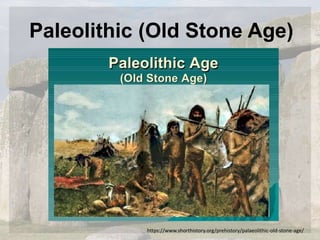
Paleolithic (Old Stone Age)
https://www.shorthistory.org/prehistory/palaeolithic-old-stone-age/
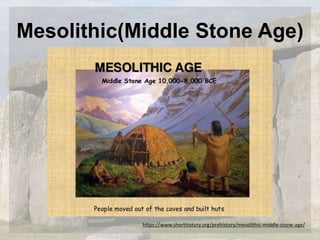
Mesolithic(Middle Stone Age)
https://www.shorthistory.org/prehistory/mesolithic-middle-stone-age/
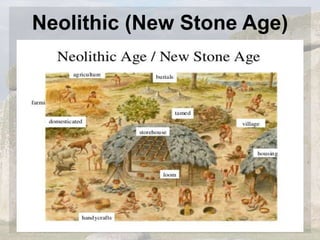
Neolithic (New Stone Age)
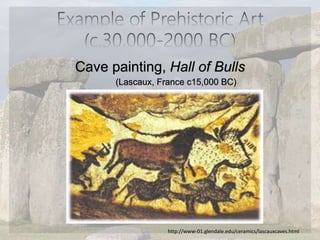
Cave painting, Hall of Bulls
(Lascaux, France c15,000 BC)
http://www-01.glendale.edu/ceramics/lascauxcaves.html
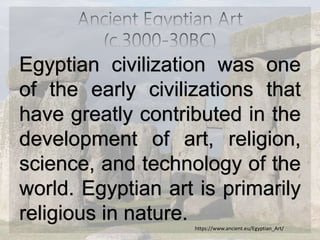
Egyptian civilization was one
of the early civilizations that
have greatly contributed in the
development of art, religion,
science, and technology of the
world. Egyptian art is primarily
religious in nature.
https://www.ancient.eu/Egyptian_Art/
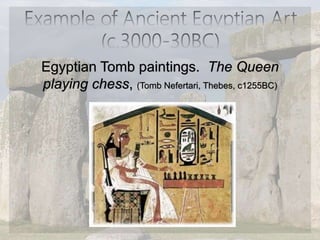
Egyptian Tomb paintings. The Queen
playing chess, (Tomb Nefertari, Thebes, c1255BC)
(2000 BC - 400BC
THE GREEK AND ROMANS
Ancient Greek art depicts
naturalism. They portray
human forms in a realistic and
anatomically correct manner.
Their art has a conservative
form with a very complex
detail. https://www.history.com/topics/ancient-history/ancient-greek-art
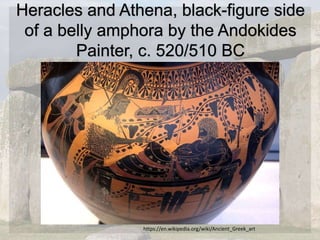
Heracles and Athena, black-figure side
of a belly amphora by the Andokides
Painter, c. 520/510 BC
https://en.wikipedia.org/wiki/Ancient_Greek_art
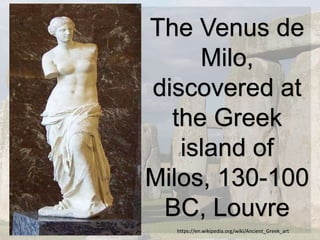
The Venus de
Milo,
discovered at
the Greek
island of
Milos, 130-100
BC, Louvre
https://en.wikipedia.org/wiki/Ancient_Greek_art
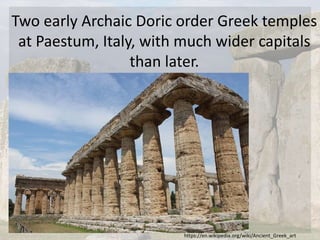
Two early Archaic Doric order Greek temples
at Paestum, Italy, with much wider capitals
than later.
https://en.wikipedia.org/wiki/Ancient_Greek_art
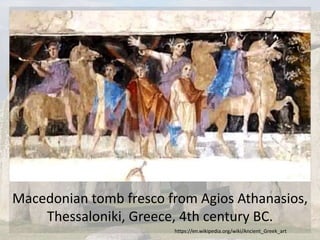
Macedonian tomb fresco from Agios Athanasios,
Thessaloniki, Greece, 4th century BC.
https://en.wikipedia.org/wiki/Ancient_Greek_art
Roman art developed as a
new source of artistic
creativity much more
progressive than the
conservative Greek art. The
diversity of its form and its
variety inspired the modern
attitude in art.
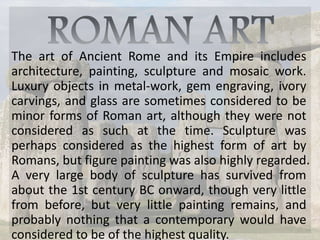
The art of Ancient Rome and its Empire includes
architecture, painting, sculpture and mosaic work.
Luxury objects in metal-work, gem engraving, ivory
carvings, and glass are sometimes considered to be
minor forms of Roman art, although they were not
considered as such at the time. Sculpture was
perhaps considered as the highest form of art by
Romans, but figure painting was also highly regarded.
A very large body of sculpture has survived from
about the 1st century BC onward, though very little
from before, but very little painting remains, and
probably nothing that a contemporary would have
considered to be of the highest quality.
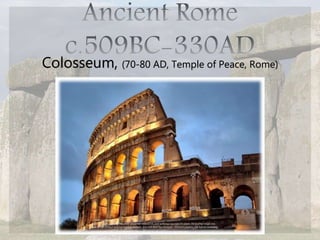
Colosseum, (70-80 AD, Temple of Peace, Rome)
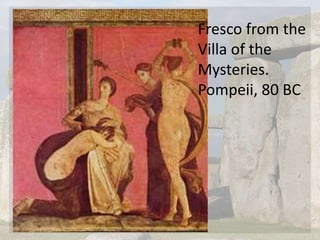
Fresco from the
Villa of the
Mysteries.
Pompeii, 80 BC
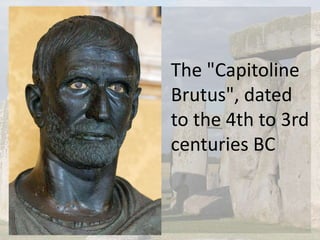
The "Capitoline
Brutus", dated
to the 4th to 3rd
centuries BC
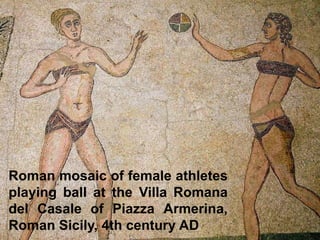
Roman mosaic of female athletes
playing ball at the Villa Romana
del Casale of Piazza Armerina,
Roman Sicily, 4th century AD
MEDIEVAL
ART
(400 BC - 1400AD)
BYZANTINE - ROMANESQUE - GOTHIC
Byzantine art was purposely made
to glorify the Christian religion and
to express its mystery. It is filled
with spiritual symbolism, illustrates
a love of splendor. It was a
combination of Eastern (decorative
art forms) and classical Western art
(naturalistic art).
Byzantine art comprises the body
of Christian Greek artistic products
of the Eastern Roman (Byzantine)
Empire,[1] as well as the nations
and states that inherited culturally
from the empire.
Though the empire itself emerged
from the decline of Rome and
lasted until the Fall of
Constantinople in 1453,the start
date of the Byzantine period is
rather clearer in art history than in
political history, if still imprecise.
Many Eastern Orthodox states in
Eastern Europe, as well as to some
degree the Muslim states of the
eastern Mediterranean, preserved
many aspects of the empire's
culture and art for centuries
afterward.
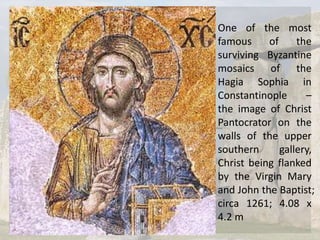
One of the most
famous of the
surviving Byzantine
mosaics of the
Hagia Sophia in
Constantinople –
the image of Christ
Pantocrator on the
walls of the upper
southern gallery,
Christ being flanked
by the Virgin Mary
and John the Baptist;
circa 1261; 4.08 x
4.2 m
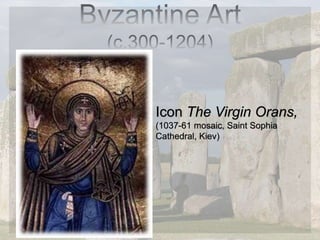
Icon The Virgin Orans,
(1037-61 mosaic, Saint Sophia
Cathedral, Kiev)
ROMANESQUE ART
Romanesque art was
characterized by its very vigorous
style in painting and sculpture,
lavishly decorated manuscripts,
and retained many basic features
of Roman architectural styles. It
was also greatly influenced by
Byzantine art with a highly
innovative and coherent style.
ROMANESQUE ART
Romanesque art is the art of Europe from
approximately 1000 AD to the rise of the Gothic
style in the 12th century, or later, depending on
region. The preceding period is known as the
Pre-Romanesque period. The term was
invented by 19th-century art historians,
especially for Romanesque architecture, which
retained many basic features of Roman
architectural style – most notably round-headed
arches, but also barrel vaults, apses, and
acanthus-leaf decoration – but had also
developed many very different characteristics.
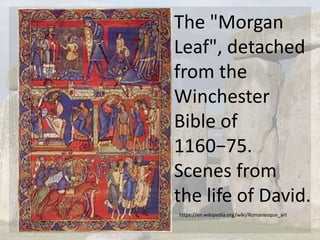
The "Morgan
Leaf", detached
from the
Winchester
Bible of
1160−75.
Scenes from
the life of David.
https://en.wikipedia.org/wiki/Romanesque_art
GOTHIC ART•The basic characteristics of Gothic art styles
reinforce symbolic meanings. The church
symbolizes the transcendence of the soul, and
the underlying philosophy is to create buildings
of height and light.
•Gothic art was a style of medieval art that
developed in Northern France out of
Romanesque art in the 12th century AD, led by
the concurrent development of Gothic
architecture. It spread to all of Western Europe,
and much of Southern and Central Europe,
never quite effacing more classical styles in
GOTHIC ART
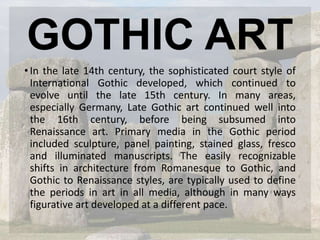
•In the late 14th century, the sophisticated court style of
International Gothic developed, which continued to
evolve until the late 15th century. In many areas,
especially Germany, Late Gothic art continued well into
the 16th century, before being subsumed into
Renaissance art. Primary media in the Gothic period
included sculpture, panel painting, stained glass, fresco
and illuminated manuscripts. The easily recognizable
shifts in architecture from Romanesque to Gothic, and
Gothic to Renaissance styles, are typically used to define
the periods in art in all media, although in many ways
figurative art developed at a different pace.
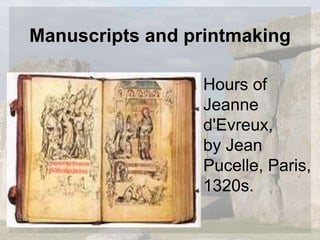
Manuscripts and printmaking
Hours of
Jeanne
d'Evreux,
by Jean
Pucelle, Paris,
1320s.
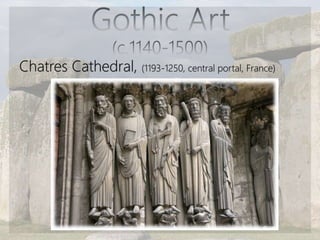
Chatres Cathedral, (1193-1250, central portal, France)
Different eras different styles, different
characteristics and functions of the arts
occurred but all of those contributed in the
development and establishing the importance
of arts in our lives today.

The art History timeline

  • 1.
  • 2.
    Pre-historic art isclassified into three periods such as; Paleolithic (Old Stone Age), Mesolithic(Middle Stone Age), and Neolithic (New Stone Age) Eras.
  • 3.
    Paleolithic (Old StoneAge) https://www.shorthistory.org/prehistory/palaeolithic-old-stone-age/
  • 4.
  • 5.
  • 6.
    Cave painting, Hallof Bulls (Lascaux, France c15,000 BC) http://www-01.glendale.edu/ceramics/lascauxcaves.html
  • 7.
    Egyptian civilization wasone of the early civilizations that have greatly contributed in the development of art, religion, science, and technology of the world. Egyptian art is primarily religious in nature. https://www.ancient.eu/Egyptian_Art/
  • 8.
    Egyptian Tomb paintings.The Queen playing chess, (Tomb Nefertari, Thebes, c1255BC)
  • 9.
    (2000 BC -400BC THE GREEK AND ROMANS
  • 10.
    Ancient Greek artdepicts naturalism. They portray human forms in a realistic and anatomically correct manner. Their art has a conservative form with a very complex detail. https://www.history.com/topics/ancient-history/ancient-greek-art
  • 11.
    Heracles and Athena,black-figure side of a belly amphora by the Andokides Painter, c. 520/510 BC https://en.wikipedia.org/wiki/Ancient_Greek_art
  • 12.
    The Venus de Milo, discoveredat the Greek island of Milos, 130-100 BC, Louvre https://en.wikipedia.org/wiki/Ancient_Greek_art
  • 13.
    Two early ArchaicDoric order Greek temples at Paestum, Italy, with much wider capitals than later. https://en.wikipedia.org/wiki/Ancient_Greek_art
  • 14.
    Macedonian tomb frescofrom Agios Athanasios, Thessaloniki, Greece, 4th century BC. https://en.wikipedia.org/wiki/Ancient_Greek_art
  • 15.
    Roman art developedas a new source of artistic creativity much more progressive than the conservative Greek art. The diversity of its form and its variety inspired the modern attitude in art.
  • 16.
    The art ofAncient Rome and its Empire includes architecture, painting, sculpture and mosaic work. Luxury objects in metal-work, gem engraving, ivory carvings, and glass are sometimes considered to be minor forms of Roman art, although they were not considered as such at the time. Sculpture was perhaps considered as the highest form of art by Romans, but figure painting was also highly regarded. A very large body of sculpture has survived from about the 1st century BC onward, though very little from before, but very little painting remains, and probably nothing that a contemporary would have considered to be of the highest quality.
  • 17.
    Colosseum, (70-80 AD,Temple of Peace, Rome)
  • 18.
    Fresco from the Villaof the Mysteries. Pompeii, 80 BC
  • 19.
    The "Capitoline Brutus", dated tothe 4th to 3rd centuries BC
  • 20.
    Roman mosaic offemale athletes playing ball at the Villa Romana del Casale of Piazza Armerina, Roman Sicily, 4th century AD
  • 21.
    MEDIEVAL ART (400 BC -1400AD) BYZANTINE - ROMANESQUE - GOTHIC
  • 22.
    Byzantine art waspurposely made to glorify the Christian religion and to express its mystery. It is filled with spiritual symbolism, illustrates a love of splendor. It was a combination of Eastern (decorative art forms) and classical Western art (naturalistic art).
  • 23.
    Byzantine art comprisesthe body of Christian Greek artistic products of the Eastern Roman (Byzantine) Empire,[1] as well as the nations and states that inherited culturally from the empire.
  • 24.
    Though the empireitself emerged from the decline of Rome and lasted until the Fall of Constantinople in 1453,the start date of the Byzantine period is rather clearer in art history than in political history, if still imprecise.
  • 25.
    Many Eastern Orthodoxstates in Eastern Europe, as well as to some degree the Muslim states of the eastern Mediterranean, preserved many aspects of the empire's culture and art for centuries afterward.
  • 26.
    One of themost famous of the surviving Byzantine mosaics of the Hagia Sophia in Constantinople – the image of Christ Pantocrator on the walls of the upper southern gallery, Christ being flanked by the Virgin Mary and John the Baptist; circa 1261; 4.08 x 4.2 m
  • 27.
    Icon The VirginOrans, (1037-61 mosaic, Saint Sophia Cathedral, Kiev)
  • 28.
    ROMANESQUE ART Romanesque artwas characterized by its very vigorous style in painting and sculpture, lavishly decorated manuscripts, and retained many basic features of Roman architectural styles. It was also greatly influenced by Byzantine art with a highly innovative and coherent style.
  • 29.
    ROMANESQUE ART Romanesque artis the art of Europe from approximately 1000 AD to the rise of the Gothic style in the 12th century, or later, depending on region. The preceding period is known as the Pre-Romanesque period. The term was invented by 19th-century art historians, especially for Romanesque architecture, which retained many basic features of Roman architectural style – most notably round-headed arches, but also barrel vaults, apses, and acanthus-leaf decoration – but had also developed many very different characteristics.
  • 30.
    The "Morgan Leaf", detached fromthe Winchester Bible of 1160−75. Scenes from the life of David. https://en.wikipedia.org/wiki/Romanesque_art
  • 31.
    GOTHIC ART•The basiccharacteristics of Gothic art styles reinforce symbolic meanings. The church symbolizes the transcendence of the soul, and the underlying philosophy is to create buildings of height and light. •Gothic art was a style of medieval art that developed in Northern France out of Romanesque art in the 12th century AD, led by the concurrent development of Gothic architecture. It spread to all of Western Europe, and much of Southern and Central Europe, never quite effacing more classical styles in
  • 32.
    GOTHIC ART •In thelate 14th century, the sophisticated court style of International Gothic developed, which continued to evolve until the late 15th century. In many areas, especially Germany, Late Gothic art continued well into the 16th century, before being subsumed into Renaissance art. Primary media in the Gothic period included sculpture, panel painting, stained glass, fresco and illuminated manuscripts. The easily recognizable shifts in architecture from Romanesque to Gothic, and Gothic to Renaissance styles, are typically used to define the periods in art in all media, although in many ways figurative art developed at a different pace.
  • 33.
    Manuscripts and printmaking Hoursof Jeanne d'Evreux, by Jean Pucelle, Paris, 1320s.
  • 34.
    Chatres Cathedral, (1193-1250,central portal, France)
  • 35.
    Different eras differentstyles, different characteristics and functions of the arts occurred but all of those contributed in the development and establishing the importance of arts in our lives today.