Areas covered today
Diagnosing Adults with
High Functioning Autism                                        1. Background information

or Asperger Syndrome                                           2. Issues for adults suspected of having HFA/AS
                                                               3. Diagnostic processes
                                                               4. Clinical experience
                                                               5. Literature, information, support & resources for
Tanya Breen
                                                                  professionals
NZPsS Conference August 2011
                                                               6. Post diagnosis support


                                                           1                                                                 2


                                                               Asperger’s disorder
Autistic disorder or autism
 Pervasive developmental disorder characterised by
                                                               (or Asperger syndrome)
 impairment in:
   Social skills
                                                                 Essentially the same as autism but:
   Communication skills
                                                                   no clinically significant impairment in langauage
   Or by the presence of stereotyped behaviour and
   interests                                                       no clinically significant delay in cognitive development
                                                                   or age-appropriate adaptive behaviour
 Delay/abnormality before age of 3 in at least one of:
 social interaction, language, symbolic/imaginative play
 High functioning autism (HFA) simply means “autism
 with an IQ 70 or above”
                                                           3                                                                 4
Autism Spectrum Disorder                                      Basic facts
                                                               NZ Autism Spectrum Disorder Guideline suggests that
                                                               over 40,000 people in NZ have ASD, & most are
 Research indicates that after the age of 3, when IQ is        undiagnosed adults
 accounted for, there is no difference between people
                                                               More males than females (but this seems to be
 with autistic disorder (autism) & Asperger syndrome
                                                               changing)
 2008 - NZ Autism Spectrum Disorder Guideline
                                                               Probably genetic
 2013 - DSM-V will use ASD only
                                                               Not related to MMR vaccine
                                                               Cannot be “cured”


                                                          5                                                                   6


Issues for adults                                             Impact varies time/situation
                                                               Relationships (friends, partners, children, colleagues)
 ASD is a lifelong condition, not only a disorder of           Education (academic, organisational & physical
 childhood                                                     demands)
 Pervasive - effects all aspects of life                       Work (unemployment, under-employment, income)
 Often undiagnosed                                             Emotional well-being (self-esteem, depression, anxiety,
                                                               abuse)
 Diagnostic overshadowing (ADHD, depression)
                                                               Health (attention to needs, sensory sensitivity, epilepsy)
 Misdiagnosed (atpical schizophrenia, personality
 disorder)                                                     Rights & responsibilities (citizenship, participation, legal
                                                               issues)

                                                          7                                                                   8
Being undiagnosed means                                               Being diagnosed means
                                                                      Understanding of self & by others
                                                                      Finding a peer group
 Feeling different (“wrong planet”) or crazy                          Learning how to manage impact of symptoms
 Being misunderstood, & often blamed unfairly                         Getting the right help
 Almost constant anxiety                                              Relief to some, shock to others
 Isolation                                                            “Congratulations It’s Asperger Syndrome” Jen Birch
                                                                      2003 www.aspergers.co.nz
                                                                      "Beyond diagnosis: Welcome to the autism spectrum"
                                                                      ASK Trust 2011 www.asknz.net
                                                                  9                                                           10


                                                                      Reason for today’s
But ...
                                                                      presentation
 Few formal or funded pathways for diagnosis exist for                Help you increase your skills
 adults without an intellectual disability or not “in trouble”
                                                                      Increase your confidence
 Mental health services lack relevant experience &
 training                                                             Increase the number of psychologists willing/able to
                                                                      conduct these assessments
 Private practitioners lack skills &/or confidence
                                                                      Improve life experiences of adults with HFA/AS
 The experience of adults seeking diagnosis is too often
 one of being fobbed off, referred on, or poorly served               Please put your name and contact details on the list!


                                                                 11                                                           12
Diagnostic assessment                                            Assessment components
                                                                 Detailed health, developmental & behavioural history
See NZ ASD Guideline & www.asdguideline.com
                                                                 Pattern of skills, disabilities & behaviours
Multidisciplinary gold standard, but sole practitioner
possible (supervision & peer support essential)                  Comprehensive file review
Methodical                                                       Medical evaluation
Match complexity of assessment to reason for referral:           Direct evaluation (interview &/or observation)
  Curiosity vs. Trouble                                          IQ & other cognitive sills
  Legal vs. Clinical                                             Adaptive functioning
  Referrer / payee                                               Mental health

                                                            13                                                           14


Assessment components                               (ctd)        What do I do?
Neurological assessment
Communication & audiology                                        Minimum: interview the person, observe how they
                                                                 respond in meet/greet & interview, administer screens
Sensory, motor & perceptual
                                                                 or self-report tests
Vision
                                                                 Medium: as above, plus interview significant others &
Occupational & physical therapy                                  review historical documents
Social competence                                                Comprehensive: as above, try to cover or have covered
                                                                 all apects on previous slides, & use “gold standard”
Family resources & needs                                         tests like the Autism Diagnostic Interview - Revised
Consideration of co-morbid & co-existing conditions

                                                            15                                                           16
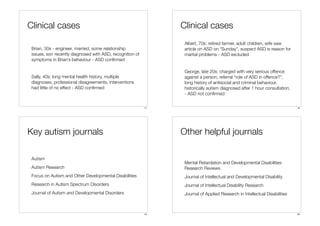
Clinical cases                                                  Clinical cases
                                                                 Albert, 70s: retired farmer, adult children, wife saw
 Brian, 30s - engineer, married, some relationship               article on ASD on “Sunday”, suspect ASD is reason for
 issues, son recently diagnosed with ASD, recognition of         marital problems - ASD excluded
 symptoms in Brian’s behaviour - ASD confirmed

                                                                 George, late 20s: charged with very serious offence
 Sally, 40s: long mental health history, multiple                against a person, referral “role of ASD in offence?”,
 diagnoses, professional disagreements, interventions            long history of antisocial and criminal behaviour,
 had little of no effect - ASD confirmed                          historically autism diagnosed after 1 hour consultation,
                                                                 - ASD not confirmed


                                                           17                                                               18


Key autism journals                                             Other helpful journals

 Autism
                                                                 Mental Retardation and Developmental Disabilities
 Autism Research                                                 Research Reviews
 Focus on Autism and Other Developmental Disabilities            Journal of Intellectual and Developmental Disability
 Research in Autism Spectrum Disorders                           Journal of Intellectual Disability Research
 Journal of Autism and Developmental Disorders                   Journal of Applied Research in Intellectual Disabilities


                                                           19                                                               20
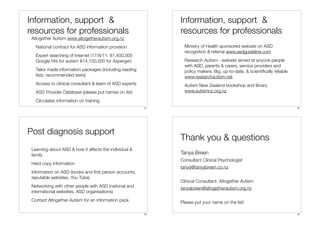
Information, support &                                        Information, support &
resources for professionals                                   resources for professionals
 Altogether Autism www.altogetherautism.org.nz
   National contract for ASD information provision              Ministry of Health sponsored website on ASD
                                                                recognition & referral www.asdguideline.com
   Expert searching of Internet (17/8/11: 81,400,000
   Google hits for autism &14,100,000 for Asperger)             Research Autism - website aimed at anyone people
                                                                with ASD, parents & carers, service providers and
   Tailor made information packages (including reading          policy makers. Big, up-to-date, & scientifically reliable
   lists, recommended texts)                                    www.researchautism.net
   Access to clinical consultant & team of ASD experts          Autism New Zealand bookshop and library
   ASD Provider Database (please put names on list)             www.autismnz.org.nz

   Circulates information on training
                                                         21                                                                22


Post diagnosis support
                                                              Thank you & questions
 Learning about ASD & how it affects the individual &
 family                                                       Tanya Breen
                                                              Consultant Clinical Psychologist
 Hard copy information
                                                              tanya@tanyabreen.co.nz
 Information on ASD (books and first person accounts,
 reputable websites, You Tube)
                                                              Clinical Consultant, Altogether Autism
 Networking with other people with ASD (national and          tanyabreen@altogetherautism.org.nz
 international websites, ASD organisations)
 Contact Altogether Autism for an information pack            Please put your name on the list!

                                                         23                                                                24

Diagnosing high functioning autism or Asperger syndrome

  • 1.
    Areas covered today DiagnosingAdults with High Functioning Autism 1. Background information or Asperger Syndrome 2. Issues for adults suspected of having HFA/AS 3. Diagnostic processes 4. Clinical experience 5. Literature, information, support & resources for Tanya Breen professionals NZPsS Conference August 2011 6. Post diagnosis support 1 2 Asperger’s disorder Autistic disorder or autism Pervasive developmental disorder characterised by (or Asperger syndrome) impairment in: Social skills Essentially the same as autism but: Communication skills no clinically significant impairment in langauage Or by the presence of stereotyped behaviour and interests no clinically significant delay in cognitive development or age-appropriate adaptive behaviour Delay/abnormality before age of 3 in at least one of: social interaction, language, symbolic/imaginative play High functioning autism (HFA) simply means “autism with an IQ 70 or above” 3 4
  • 2.
    Autism Spectrum Disorder Basic facts NZ Autism Spectrum Disorder Guideline suggests that over 40,000 people in NZ have ASD, & most are Research indicates that after the age of 3, when IQ is undiagnosed adults accounted for, there is no difference between people More males than females (but this seems to be with autistic disorder (autism) & Asperger syndrome changing) 2008 - NZ Autism Spectrum Disorder Guideline Probably genetic 2013 - DSM-V will use ASD only Not related to MMR vaccine Cannot be “cured” 5 6 Issues for adults Impact varies time/situation Relationships (friends, partners, children, colleagues) ASD is a lifelong condition, not only a disorder of Education (academic, organisational & physical childhood demands) Pervasive - effects all aspects of life Work (unemployment, under-employment, income) Often undiagnosed Emotional well-being (self-esteem, depression, anxiety, abuse) Diagnostic overshadowing (ADHD, depression) Health (attention to needs, sensory sensitivity, epilepsy) Misdiagnosed (atpical schizophrenia, personality disorder) Rights & responsibilities (citizenship, participation, legal issues) 7 8
  • 3.
    Being undiagnosed means Being diagnosed means Understanding of self & by others Finding a peer group Feeling different (“wrong planet”) or crazy Learning how to manage impact of symptoms Being misunderstood, & often blamed unfairly Getting the right help Almost constant anxiety Relief to some, shock to others Isolation “Congratulations It’s Asperger Syndrome” Jen Birch 2003 www.aspergers.co.nz "Beyond diagnosis: Welcome to the autism spectrum" ASK Trust 2011 www.asknz.net 9 10 Reason for today’s But ... presentation Few formal or funded pathways for diagnosis exist for Help you increase your skills adults without an intellectual disability or not “in trouble” Increase your confidence Mental health services lack relevant experience & training Increase the number of psychologists willing/able to conduct these assessments Private practitioners lack skills &/or confidence Improve life experiences of adults with HFA/AS The experience of adults seeking diagnosis is too often one of being fobbed off, referred on, or poorly served Please put your name and contact details on the list! 11 12
  • 4.
    Diagnostic assessment Assessment components Detailed health, developmental & behavioural history See NZ ASD Guideline & www.asdguideline.com Pattern of skills, disabilities & behaviours Multidisciplinary gold standard, but sole practitioner possible (supervision & peer support essential) Comprehensive file review Methodical Medical evaluation Match complexity of assessment to reason for referral: Direct evaluation (interview &/or observation) Curiosity vs. Trouble IQ & other cognitive sills Legal vs. Clinical Adaptive functioning Referrer / payee Mental health 13 14 Assessment components (ctd) What do I do? Neurological assessment Communication & audiology Minimum: interview the person, observe how they respond in meet/greet & interview, administer screens Sensory, motor & perceptual or self-report tests Vision Medium: as above, plus interview significant others & Occupational & physical therapy review historical documents Social competence Comprehensive: as above, try to cover or have covered all apects on previous slides, & use “gold standard” Family resources & needs tests like the Autism Diagnostic Interview - Revised Consideration of co-morbid & co-existing conditions 15 16
  • 5.
    Clinical cases Clinical cases Albert, 70s: retired farmer, adult children, wife saw Brian, 30s - engineer, married, some relationship article on ASD on “Sunday”, suspect ASD is reason for issues, son recently diagnosed with ASD, recognition of marital problems - ASD excluded symptoms in Brian’s behaviour - ASD confirmed George, late 20s: charged with very serious offence Sally, 40s: long mental health history, multiple against a person, referral “role of ASD in offence?”, diagnoses, professional disagreements, interventions long history of antisocial and criminal behaviour, had little of no effect - ASD confirmed historically autism diagnosed after 1 hour consultation, - ASD not confirmed 17 18 Key autism journals Other helpful journals Autism Mental Retardation and Developmental Disabilities Autism Research Research Reviews Focus on Autism and Other Developmental Disabilities Journal of Intellectual and Developmental Disability Research in Autism Spectrum Disorders Journal of Intellectual Disability Research Journal of Autism and Developmental Disorders Journal of Applied Research in Intellectual Disabilities 19 20
  • 6.
    Information, support & Information, support & resources for professionals resources for professionals Altogether Autism www.altogetherautism.org.nz National contract for ASD information provision Ministry of Health sponsored website on ASD recognition & referral www.asdguideline.com Expert searching of Internet (17/8/11: 81,400,000 Google hits for autism &14,100,000 for Asperger) Research Autism - website aimed at anyone people with ASD, parents & carers, service providers and Tailor made information packages (including reading policy makers. Big, up-to-date, & scientifically reliable lists, recommended texts) www.researchautism.net Access to clinical consultant & team of ASD experts Autism New Zealand bookshop and library ASD Provider Database (please put names on list) www.autismnz.org.nz Circulates information on training 21 22 Post diagnosis support Thank you & questions Learning about ASD & how it affects the individual & family Tanya Breen Consultant Clinical Psychologist Hard copy information tanya@tanyabreen.co.nz Information on ASD (books and first person accounts, reputable websites, You Tube) Clinical Consultant, Altogether Autism Networking with other people with ASD (national and tanyabreen@altogetherautism.org.nz international websites, ASD organisations) Contact Altogether Autism for an information pack Please put your name on the list! 23 24