By: Mary Alyssa Botin & Reafe
Bulalacao
CONTINGENCY
THEORY
CONTINGENCY THEORY
•is a behavioral theory based on their
views that there is no “one best way”
to lead an organization, organize a
cooperation or to make a decision.
Contingency theory states that these
actions are dependent (contingent)
to the internal and external factors.
Thus it states that there is no single
theory of contingency management.
THERE ARE SOME IMPORTANT
CONTINGENCIES FOR ORGANIZATIONS:
•Technology
•Suppliers and Distributers
•Customers and Competitors
•Consumer Interest Groups
•Government
•Unions
states that the decision making process
depends on a number of variables
which are:
•The importance of the decision – is
the decision a strategic or difficult
decisions to reverse.
•The amount of information available to
the leaders and subordinates- has a
similar decision been made before
and is there available information on
the results.
•The relationship between leaders and
subordinates more leaders are likely the
greater support they will have from
subordinates.
•The likelihood of subordinates accepting
on autocratic decision or cooperate with
taking a few good decisions if allowed to
participate- how well motivated are the
staff?
•The amount of disagreement among
subordinates with respect to the preferred
alternative- the greater need for an
FOUR IMPORTANT IDEAS OF CT:
•There is no universal or one best way to
manage
•The design of an organizations and its
subsystems must fit with the environment
•Effective organizations not only have a
proper ‘fit’ with the environment but also
between its subsystems
•The needs of an organization are better
satisfied when it is properly designed and
the management style is appropriate both to
the tasks undertaken and the nature of the
THEORISTS OF CONTINGENCY
THEORY
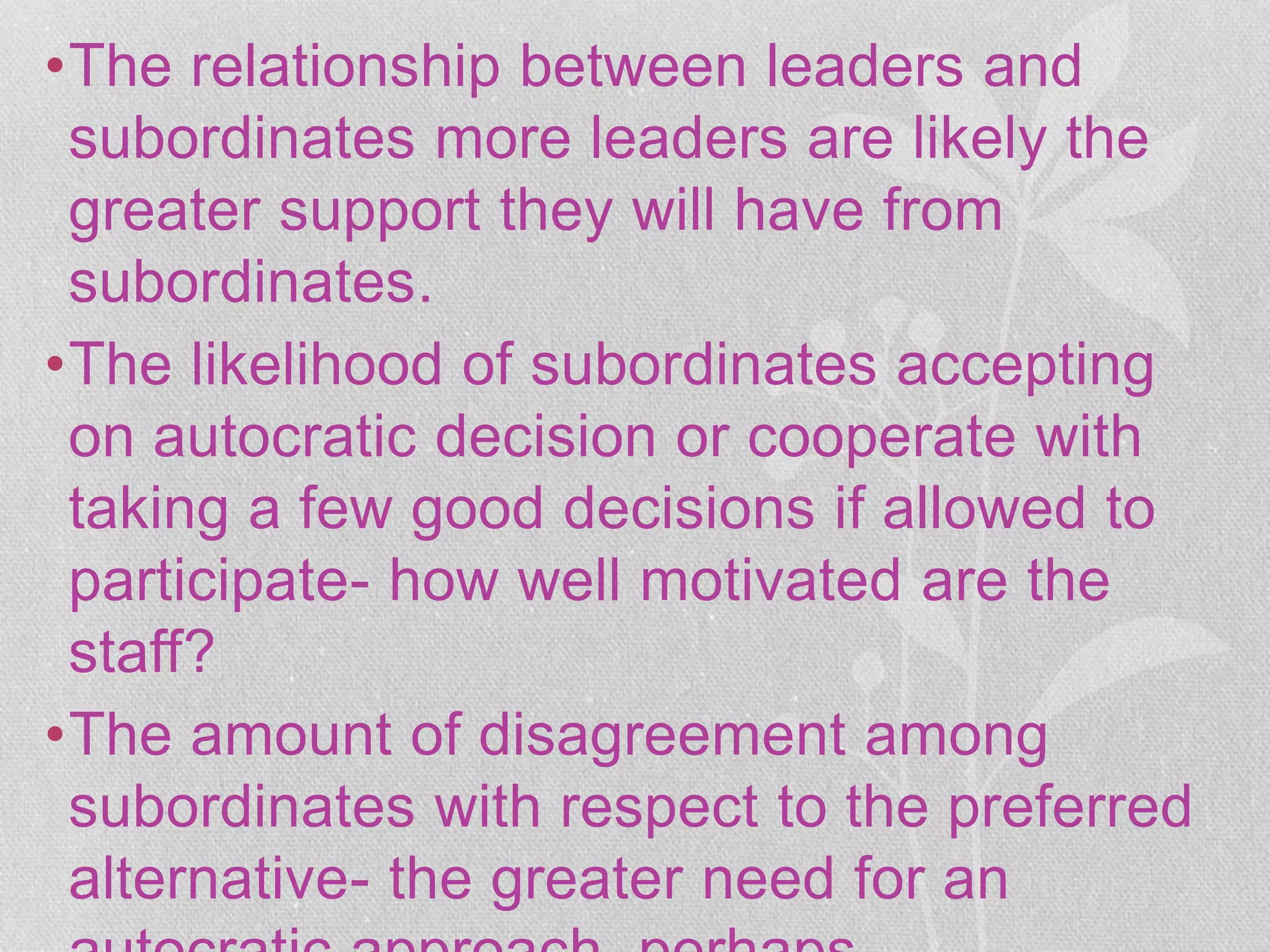
•FRED EDWARD FIEDLER
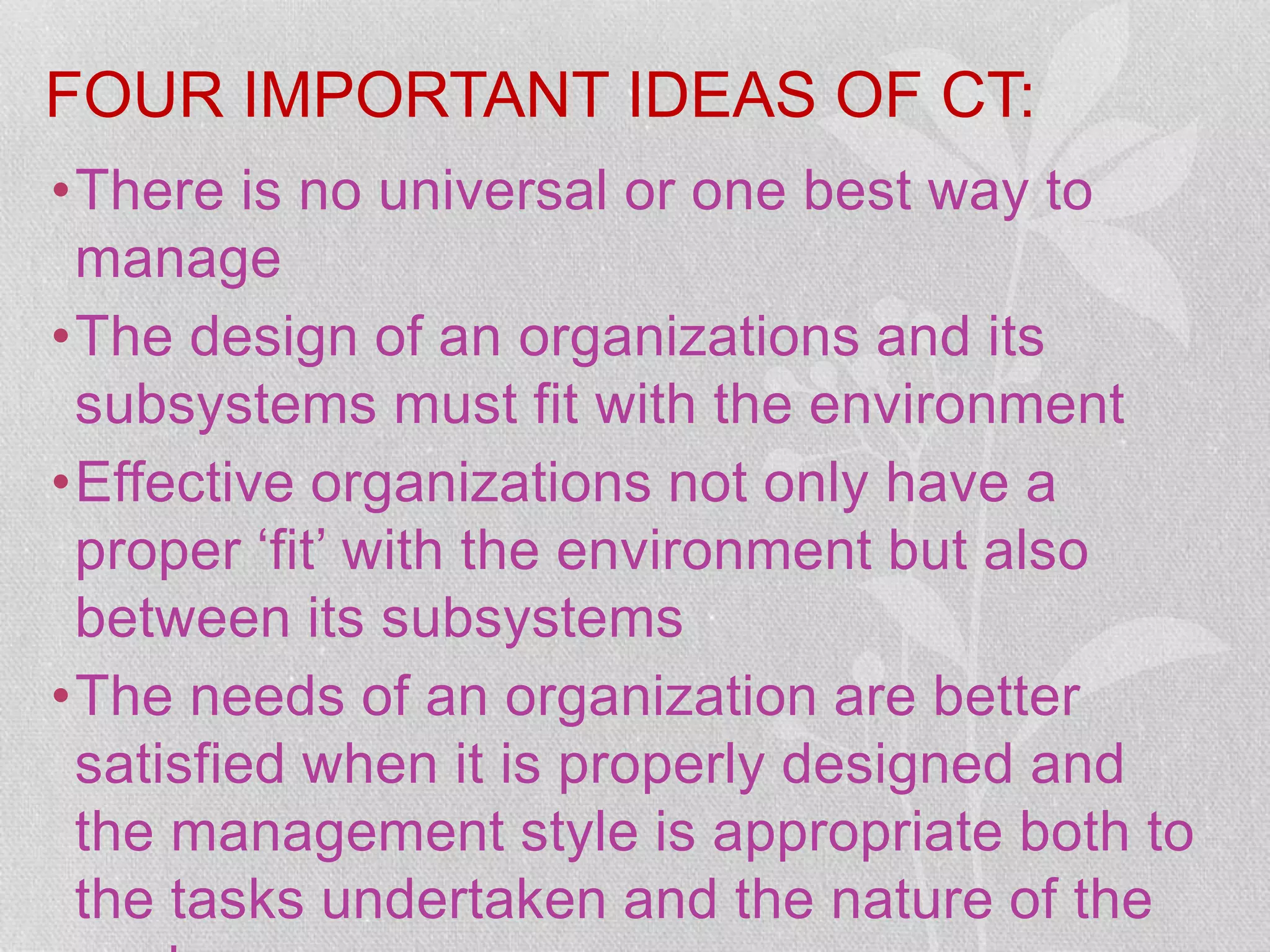
•KENNETH H. BLANCHARD
•PAUL HERSEY
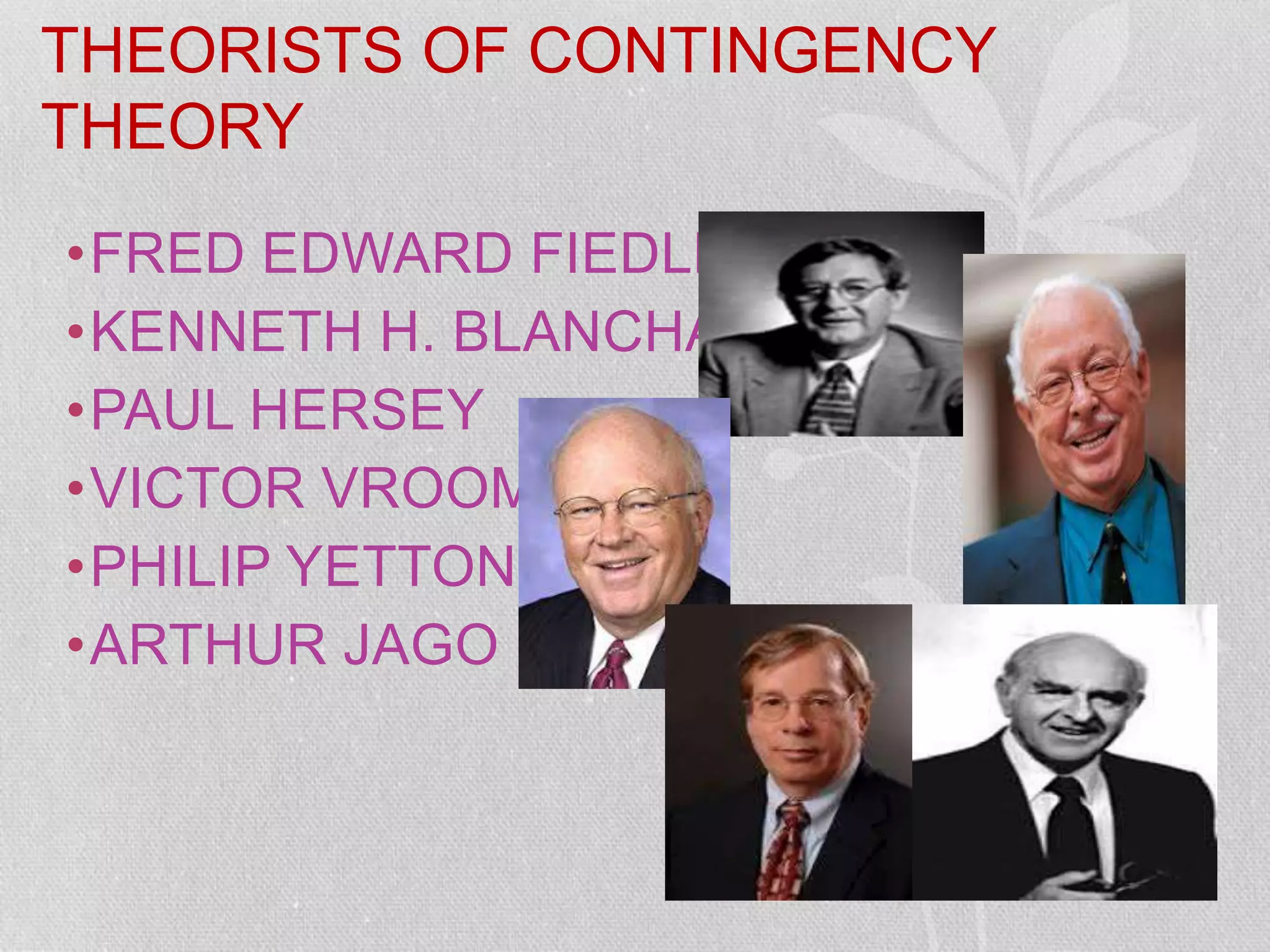
•VICTOR VROOM
•PHILIP YETTON
•ARTHUR JAGO
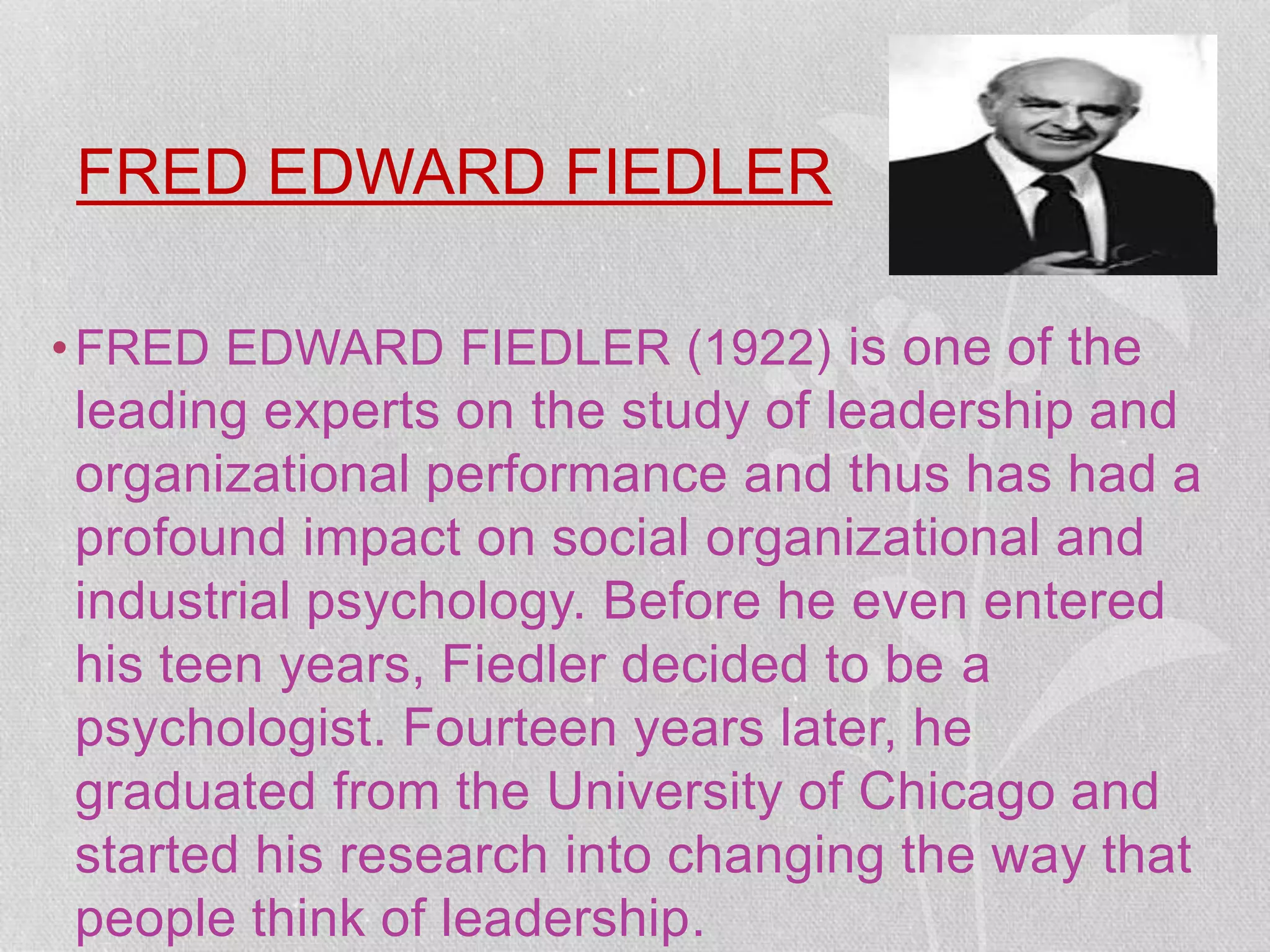
FRED EDWARD FIEDLER
•FRED EDWARD FIEDLER (1922) is one of the
leading experts on the study of leadership and
organizational performance and thus has had a
profound impact on social organizational and
industrial psychology. Before he even entered
his teen years, Fiedler decided to be a
psychologist. Fourteen years later, he
graduated from the University of Chicago and
started his research into changing the way that
people think of leadership.
FRED EDWARD FIEDLER
Beginning in 1954, Fiedler began studying
leadership in high school basketball teams.
This lead to the development of the Least
Preferred Co-worker scale. The result of his
research, in 1967 lead to the publishing of his
famous book, ‘A Theory of Leadership
Effectiveness.” This book proposed his
contingency model of leadership, the first
leadership theory to measure member- leader
relationships.
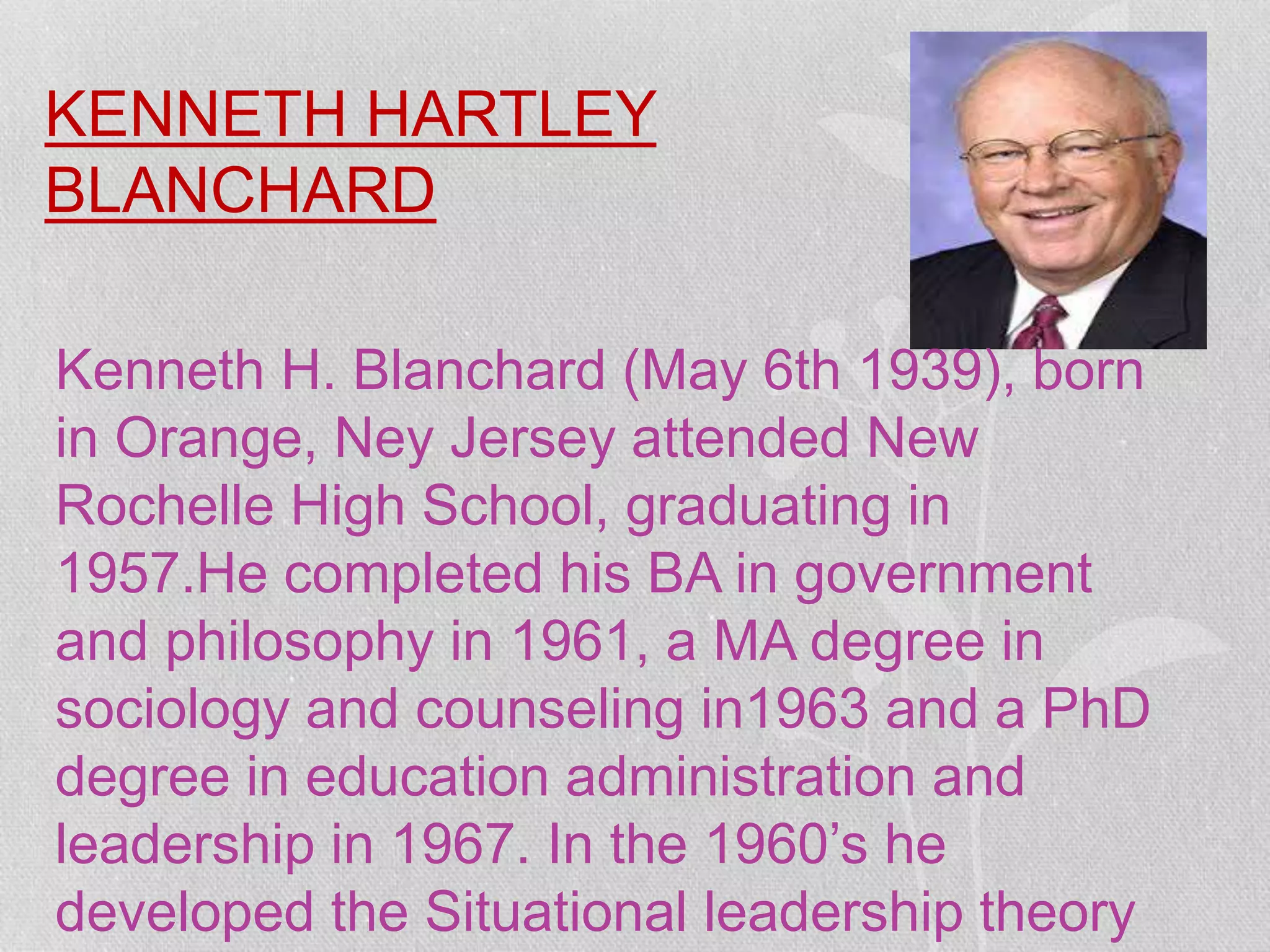
KENNETH HARTLEY
BLANCHARD
Kenneth H. Blanchard (May 6th 1939), born
in Orange, Ney Jersey attended New
Rochelle High School, graduating in
1957.He completed his BA in government
and philosophy in 1961, a MA degree in
sociology and counseling in1963 and a PhD
degree in education administration and
leadership in 1967. In the 1960’s he
developed the Situational leadership theory
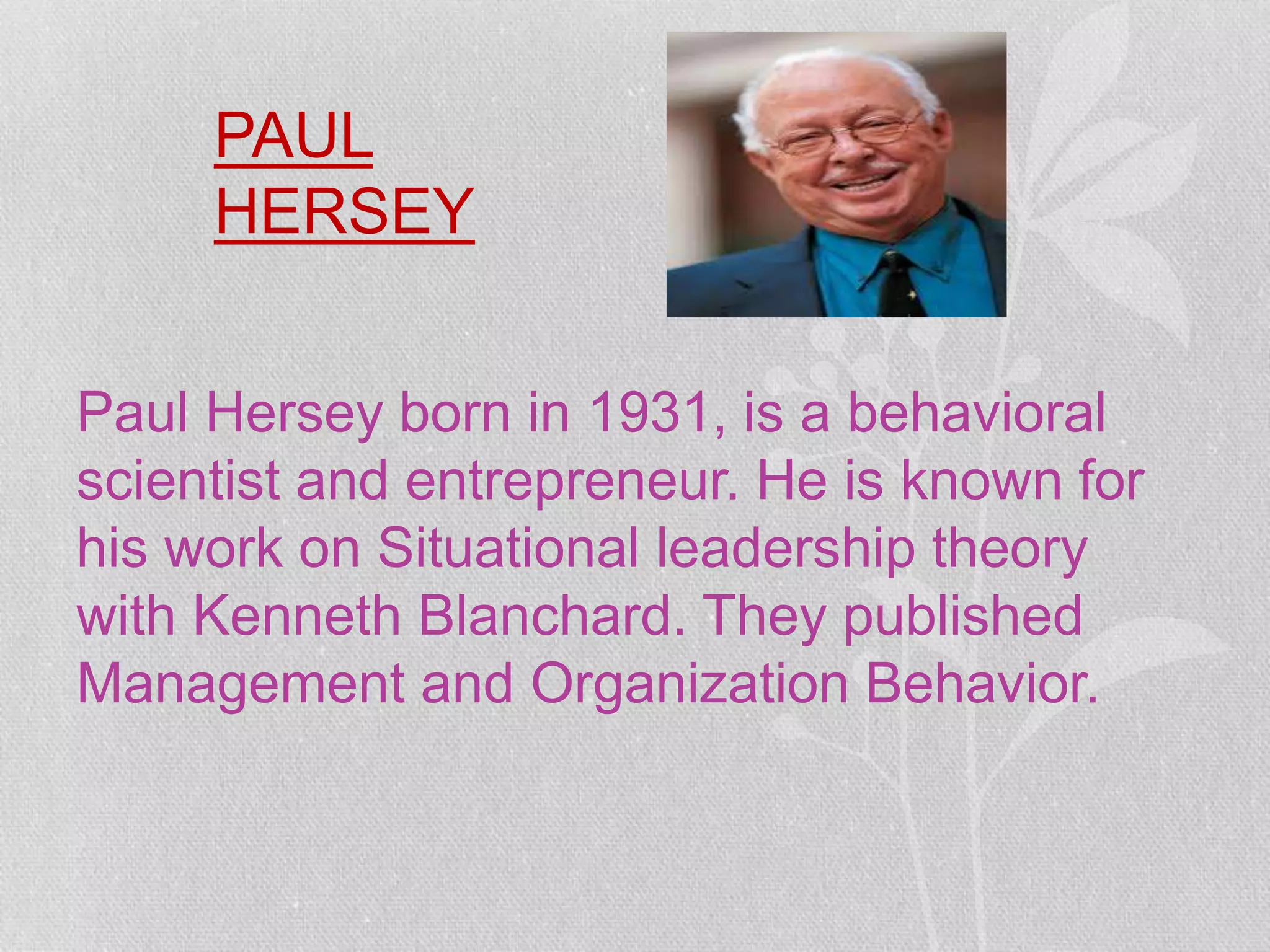
PAUL
HERSEY
Paul Hersey born in 1931, is a behavioral
scientist and entrepreneur. He is known for
his work on Situational leadership theory
with Kenneth Blanchard. They published
Management and Organization Behavior.
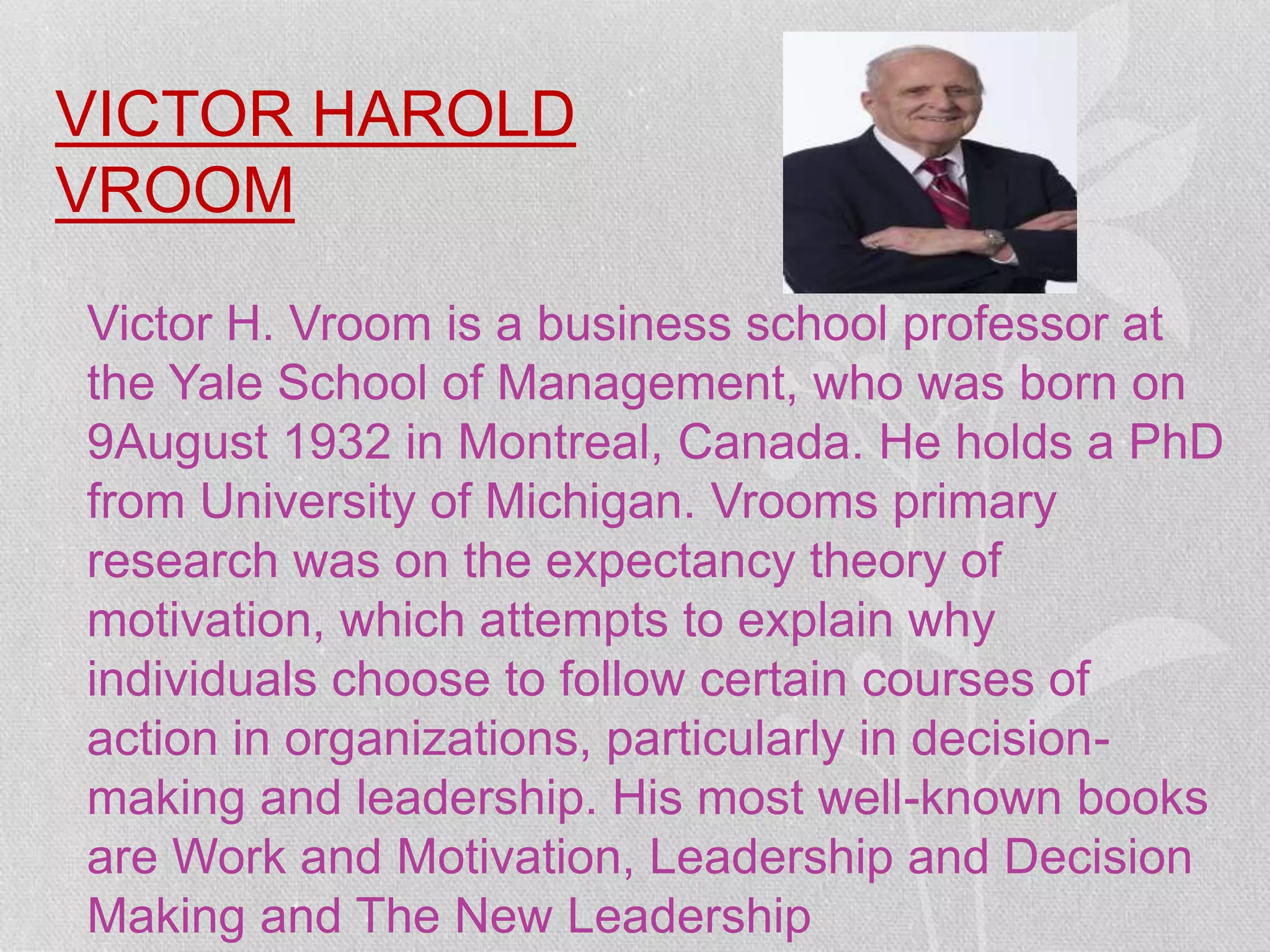
VICTOR HAROLD
VROOM
Victor H. Vroom is a business school professor at
the Yale School of Management, who was born on
9August 1932 in Montreal, Canada. He holds a PhD
from University of Michigan. Vrooms primary
research was on the expectancy theory of
motivation, which attempts to explain why
individuals choose to follow certain courses of
action in organizations, particularly in decision-
making and leadership. His most well-known books
are Work and Motivation, Leadership and Decision
Making and The New Leadership
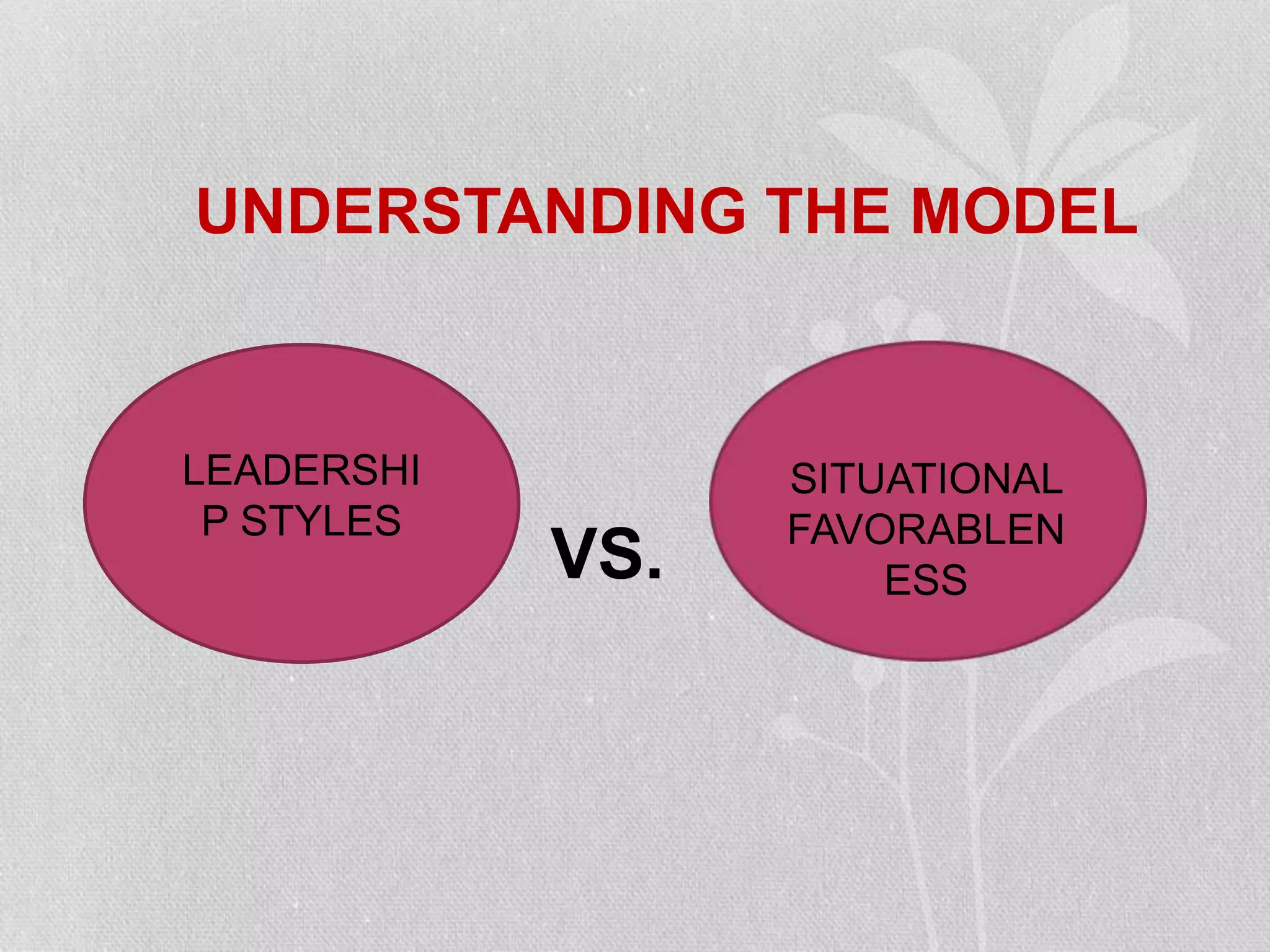
UNDERSTANDING THE MODEL
VS.
LEADERSHI
P STYLES
SITUATIONAL
FAVORABLEN
ESS
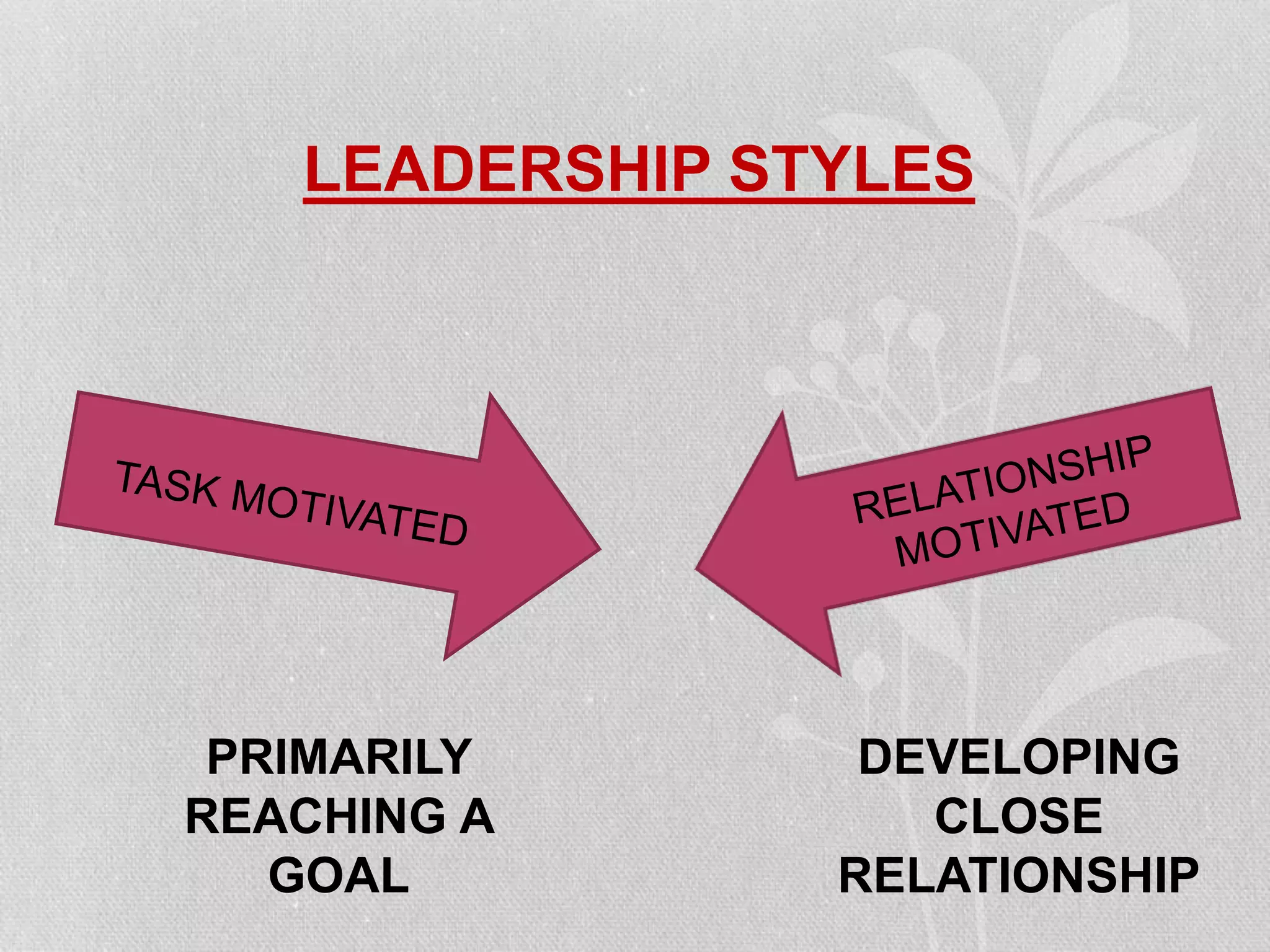
LEADERSHIP STYLES
PRIMARILY
REACHING A
GOAL
DEVELOPING
CLOSE
RELATIONSHIP
LEADERSHIP STYLES
•S1: Telling / Directing Follower:
-R1: Low competence, low commitment /
Unable and unwilling or insecure
-Leader: High task focus, low relationship
focus When the follower cannot do the job and is
unwilling or afraid to try, then the leader takes a
highly directive role, telling them what to do but
without a great deal of concern for the
relationship. The leader may also provide a
working structure, both for the job and in terms
of how the person is controlled.
Continuation…
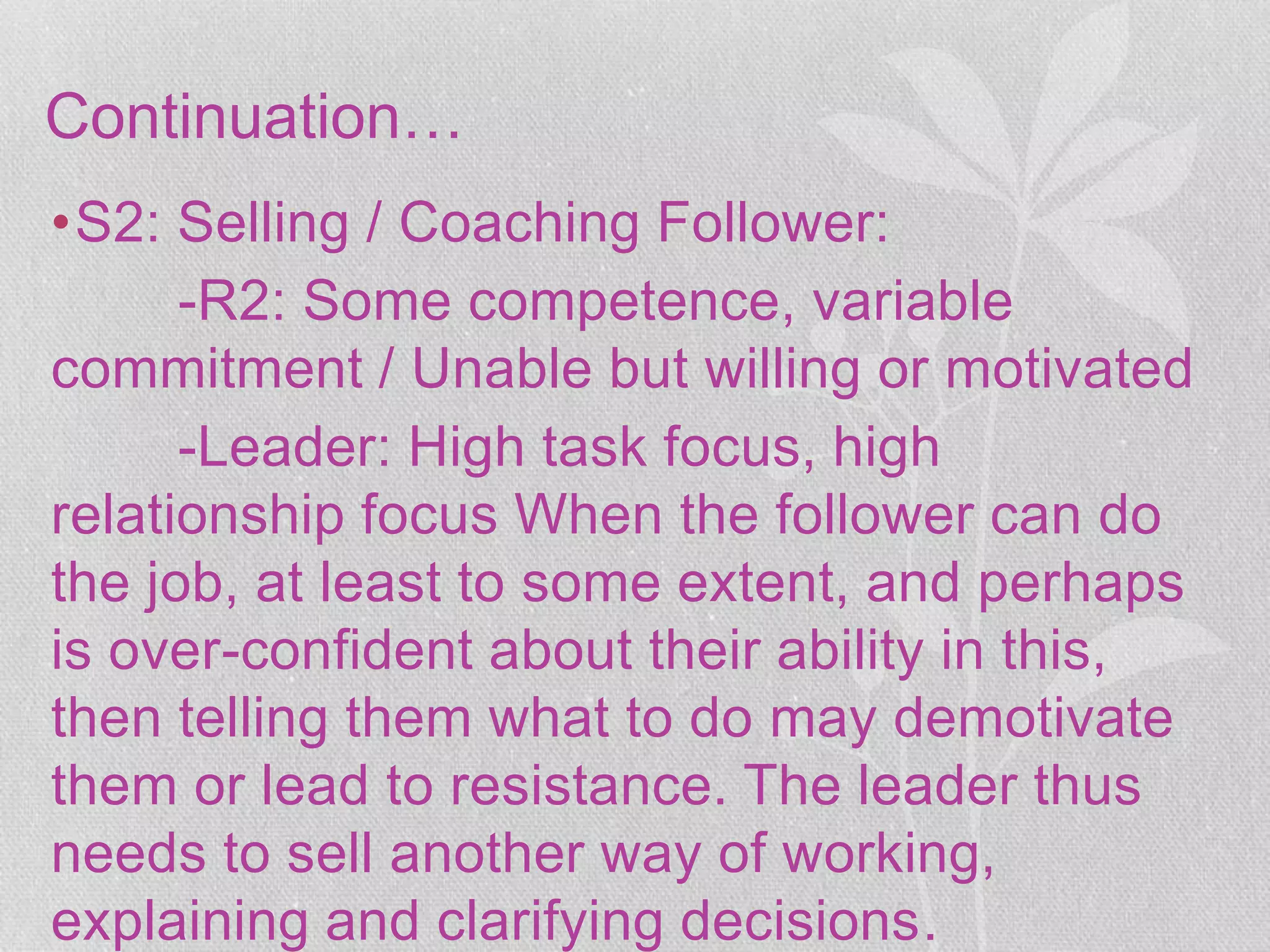
•S2: Selling / Coaching Follower:
-R2: Some competence, variable
commitment / Unable but willing or motivated
-Leader: High task focus, high
relationship focus When the follower can do
the job, at least to some extent, and perhaps
is over-confident about their ability in this,
then telling them what to do may demotivate
them or lead to resistance. The leader thus
needs to sell another way of working,
explaining and clarifying decisions.
…
•S3: Participating / Supporting Follower:
-R3: High competence, variable
commitment/able but unwilling or insecure
-Leader: Low task focus, high relationship
focus When the follower can do the job, but is
refusing to do it or otherwise showing
insufficient commitment, the leader need not
worry about showing them what to do, and
instead is concerned with finding out why the
person is refusing and thence persuading them
to cooperate.
…
•S4: Delegating / Observing Follower:
-R4: High competence, high commitment
/able and willing or motivated
-Leader: Low task focus, low relationship
focus When the follower can do the job and is
motivated to do it, then the leader can
basically leave them to it, largely trusting them
to get on with the job although they also may
need to keep a relatively distant eye on things
to ensure everything is going to plan.
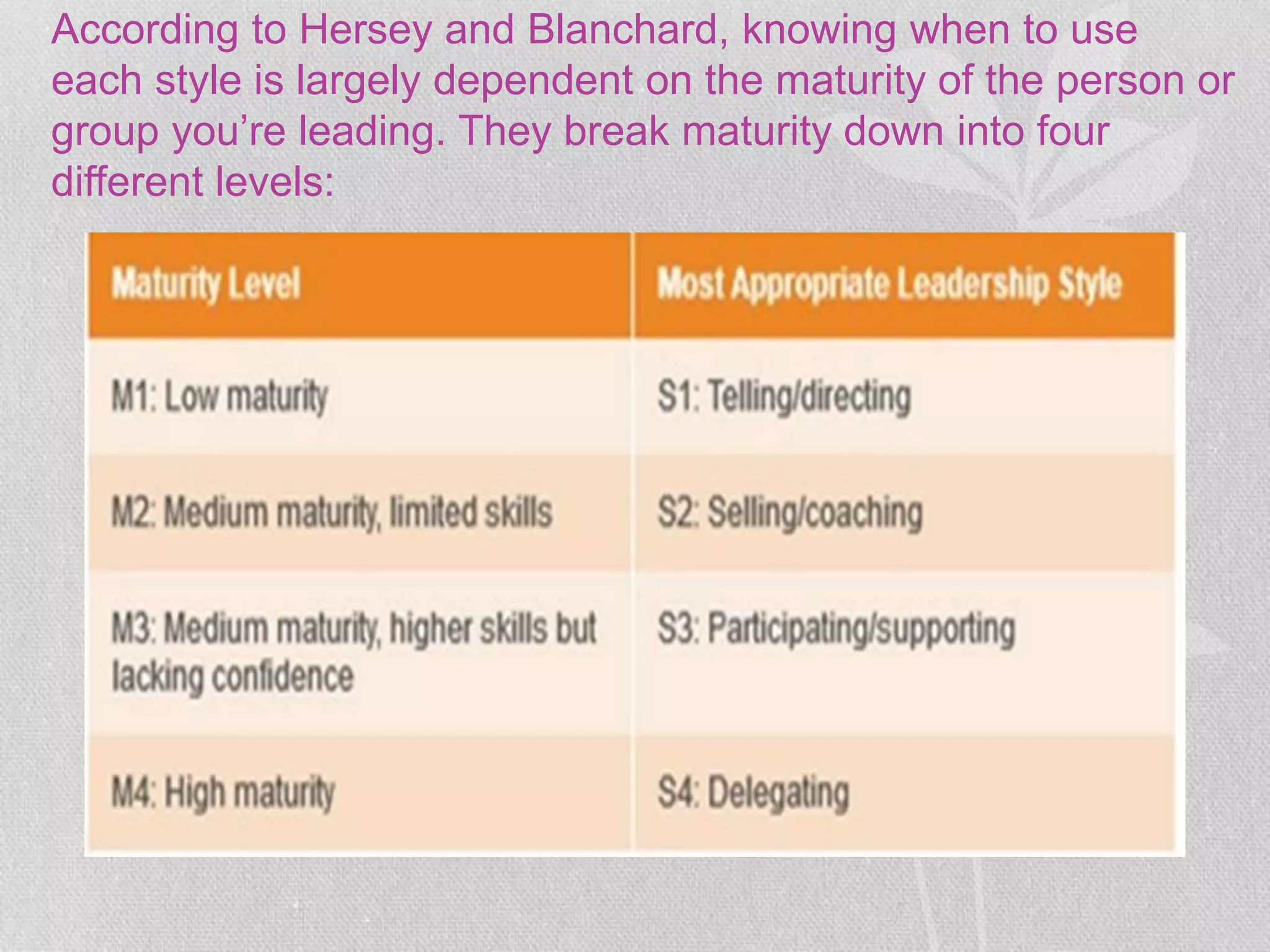
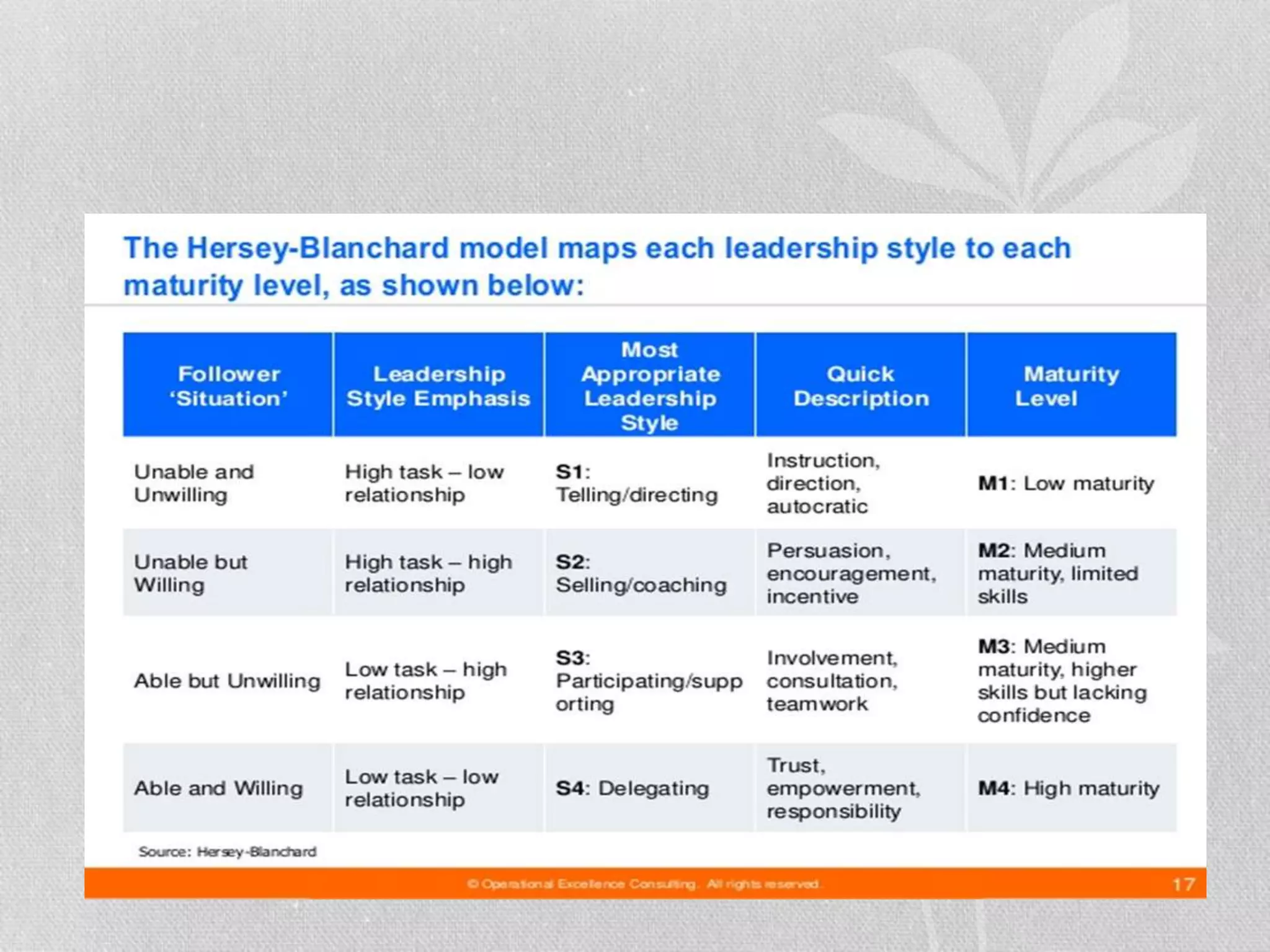
According to Hersey and Blanchard, knowing when to use
each style is largely dependent on the maturity of the person or
group you’re leading. They break maturity down into four
different levels:
Identifying leadership style is the first step in
using the model. Fiedler believed that leadership
style is fixed, and it can be measured using a scale
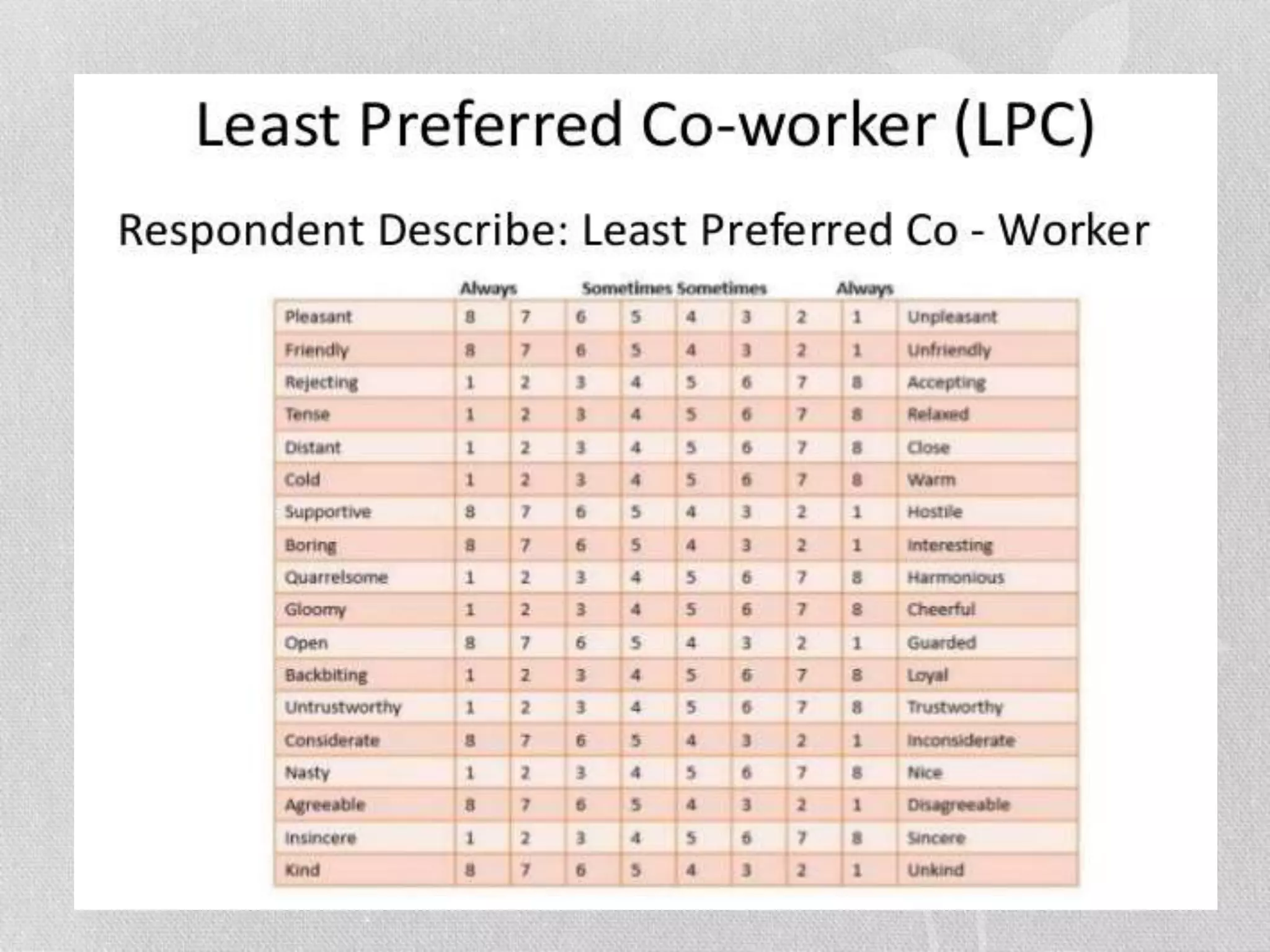
he developed called Least-Preferred Co-Worker
(LPC) Scale
The scale asks you to think about the person
who you've least enjoyed working with. This can be
a person who you've worked with in your job, or in
education or training.
You then rate how you feel about this person
for each factor, and add up your scores. If your total
score is high, you're likely to be a relationship-
orientated leader. If your total score is low, you're
more likely to be task-orientated leader.
The model says that task-oriented leaders
usually view their LPCs more negatively,
resulting in a lower score. Fiedler called
these low LPC-leaders. He said that low
LPCs are very effective at completing tasks.
They're quick to organize a group to get tasks
and projects done. Relationship-building is a
low priority. However, relationship-oriented
leaders usually view their LPCs more
positively, giving them a higher score. These
are high-LPC leaders. High LPCs focus more
on personal connections, and they're good at
avoiding and managing conflict. They're
Fred Edward Fiedler Contingency theory of
leadership emphasizes that the effectiveness of
leadership is dependent (contingent) on matching
its leadership style to right situations. This theory
was originally developed by Fred E. Fiedler after
studying various leaders in different context. It is
contradictory to “situational leadership” which stress
for leaders to adapt to the situation. Situation in this
context may have different meanings. As it relates
to the development/readiness level of the
organization, it also relates to three factors in
contingency.
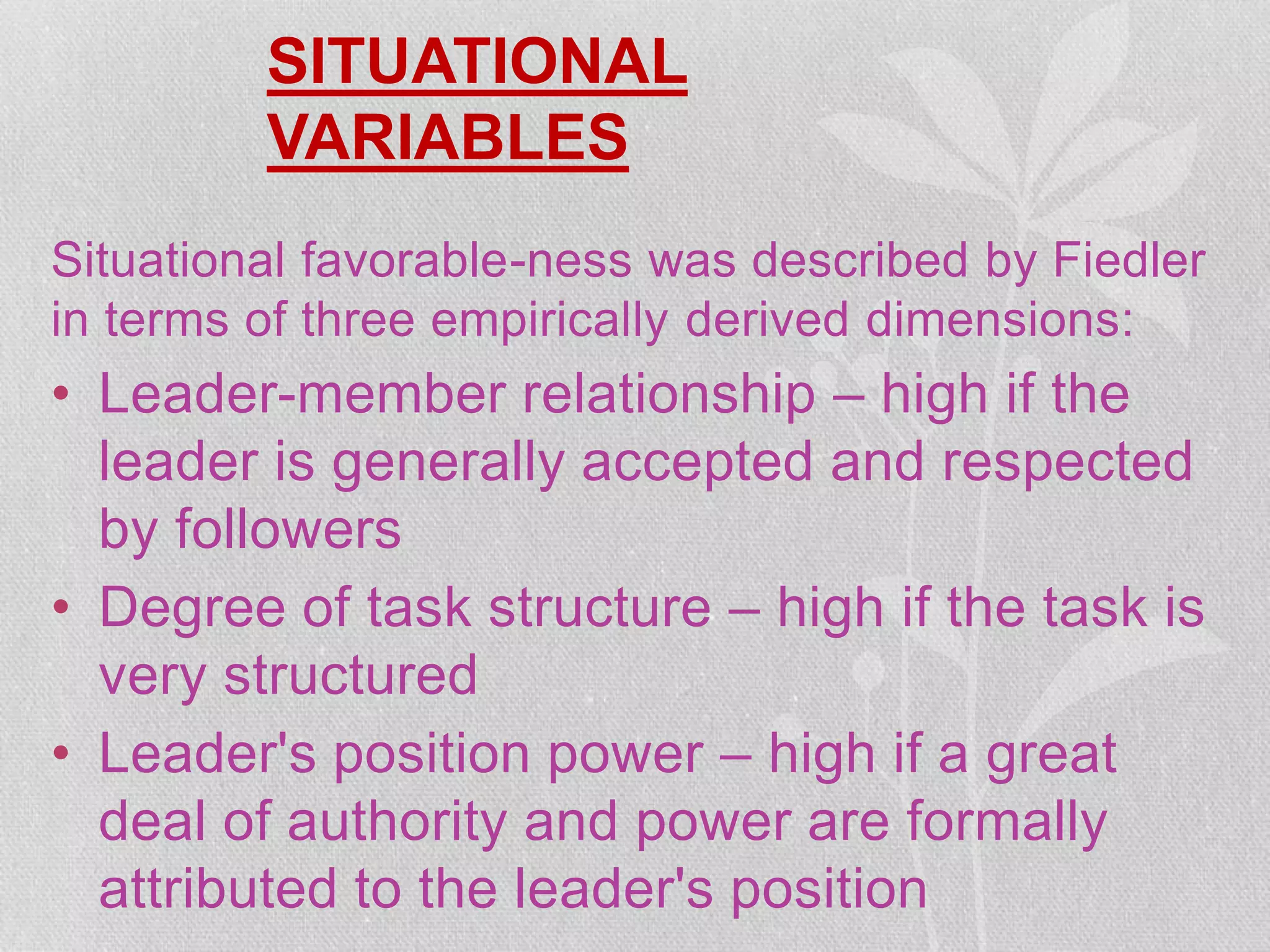
SITUATIONAL
VARIABLES
Situational favorable-ness was described by Fiedler
in terms of three empirically derived dimensions:
• Leader-member relationship – high if the
leader is generally accepted and respected
by followers
• Degree of task structure – high if the task is
very structured
• Leader's position power – high if a great
deal of authority and power are formally
attributed to the leader's position
KEY POINTS ABOUT CT:
•The Fiedler Contingency Model asks you to think
about your natural leadership style, and the
situations in which it will be most effective. The
model says that leaders are either task-focused, or
relationship-focused. Once you understand your
style, it says that you can match it to situations in
which that style is most effective. However, the
model has some disadvantages. It doesn't allow for
leadership flexibility, and the LPC score might give
an inaccurate picture of your leadership style. As
with all models and theories, use your best
judgment when applying the Fiedler Contingency
Model to your own situation.
THANK YOU
FOR YOUR
ATTENTION! 

Contingency theory

  • 1.
    By: Mary AlyssaBotin & Reafe Bulalacao CONTINGENCY THEORY
  • 2.
    CONTINGENCY THEORY •is abehavioral theory based on their views that there is no “one best way” to lead an organization, organize a cooperation or to make a decision. Contingency theory states that these actions are dependent (contingent) to the internal and external factors. Thus it states that there is no single theory of contingency management.
  • 3.
    THERE ARE SOMEIMPORTANT CONTINGENCIES FOR ORGANIZATIONS: •Technology •Suppliers and Distributers •Customers and Competitors •Consumer Interest Groups •Government •Unions
  • 4.
    states that thedecision making process depends on a number of variables which are: •The importance of the decision – is the decision a strategic or difficult decisions to reverse. •The amount of information available to the leaders and subordinates- has a similar decision been made before and is there available information on the results.
  • 5.
    •The relationship betweenleaders and subordinates more leaders are likely the greater support they will have from subordinates. •The likelihood of subordinates accepting on autocratic decision or cooperate with taking a few good decisions if allowed to participate- how well motivated are the staff? •The amount of disagreement among subordinates with respect to the preferred alternative- the greater need for an
  • 6.
    FOUR IMPORTANT IDEASOF CT: •There is no universal or one best way to manage •The design of an organizations and its subsystems must fit with the environment •Effective organizations not only have a proper ‘fit’ with the environment but also between its subsystems •The needs of an organization are better satisfied when it is properly designed and the management style is appropriate both to the tasks undertaken and the nature of the
  • 7.
    THEORISTS OF CONTINGENCY THEORY •FREDEDWARD FIEDLER •KENNETH H. BLANCHARD •PAUL HERSEY •VICTOR VROOM •PHILIP YETTON •ARTHUR JAGO
  • 8.
    FRED EDWARD FIEDLER •FREDEDWARD FIEDLER (1922) is one of the leading experts on the study of leadership and organizational performance and thus has had a profound impact on social organizational and industrial psychology. Before he even entered his teen years, Fiedler decided to be a psychologist. Fourteen years later, he graduated from the University of Chicago and started his research into changing the way that people think of leadership.
  • 9.
    FRED EDWARD FIEDLER Beginningin 1954, Fiedler began studying leadership in high school basketball teams. This lead to the development of the Least Preferred Co-worker scale. The result of his research, in 1967 lead to the publishing of his famous book, ‘A Theory of Leadership Effectiveness.” This book proposed his contingency model of leadership, the first leadership theory to measure member- leader relationships.
  • 10.
    KENNETH HARTLEY BLANCHARD Kenneth H.Blanchard (May 6th 1939), born in Orange, Ney Jersey attended New Rochelle High School, graduating in 1957.He completed his BA in government and philosophy in 1961, a MA degree in sociology and counseling in1963 and a PhD degree in education administration and leadership in 1967. In the 1960’s he developed the Situational leadership theory
  • 11.
    PAUL HERSEY Paul Hersey bornin 1931, is a behavioral scientist and entrepreneur. He is known for his work on Situational leadership theory with Kenneth Blanchard. They published Management and Organization Behavior.
  • 12.
    VICTOR HAROLD VROOM Victor H.Vroom is a business school professor at the Yale School of Management, who was born on 9August 1932 in Montreal, Canada. He holds a PhD from University of Michigan. Vrooms primary research was on the expectancy theory of motivation, which attempts to explain why individuals choose to follow certain courses of action in organizations, particularly in decision- making and leadership. His most well-known books are Work and Motivation, Leadership and Decision Making and The New Leadership
  • 13.
    UNDERSTANDING THE MODEL VS. LEADERSHI PSTYLES SITUATIONAL FAVORABLEN ESS
  • 14.
  • 15.
    LEADERSHIP STYLES •S1: Telling/ Directing Follower: -R1: Low competence, low commitment / Unable and unwilling or insecure -Leader: High task focus, low relationship focus When the follower cannot do the job and is unwilling or afraid to try, then the leader takes a highly directive role, telling them what to do but without a great deal of concern for the relationship. The leader may also provide a working structure, both for the job and in terms of how the person is controlled.
  • 16.
    Continuation… •S2: Selling /Coaching Follower: -R2: Some competence, variable commitment / Unable but willing or motivated -Leader: High task focus, high relationship focus When the follower can do the job, at least to some extent, and perhaps is over-confident about their ability in this, then telling them what to do may demotivate them or lead to resistance. The leader thus needs to sell another way of working, explaining and clarifying decisions.
  • 17.
    … •S3: Participating /Supporting Follower: -R3: High competence, variable commitment/able but unwilling or insecure -Leader: Low task focus, high relationship focus When the follower can do the job, but is refusing to do it or otherwise showing insufficient commitment, the leader need not worry about showing them what to do, and instead is concerned with finding out why the person is refusing and thence persuading them to cooperate.
  • 18.
    … •S4: Delegating /Observing Follower: -R4: High competence, high commitment /able and willing or motivated -Leader: Low task focus, low relationship focus When the follower can do the job and is motivated to do it, then the leader can basically leave them to it, largely trusting them to get on with the job although they also may need to keep a relatively distant eye on things to ensure everything is going to plan.
  • 19.
    According to Herseyand Blanchard, knowing when to use each style is largely dependent on the maturity of the person or group you’re leading. They break maturity down into four different levels:
  • 21.
    Identifying leadership styleis the first step in using the model. Fiedler believed that leadership style is fixed, and it can be measured using a scale he developed called Least-Preferred Co-Worker (LPC) Scale The scale asks you to think about the person who you've least enjoyed working with. This can be a person who you've worked with in your job, or in education or training. You then rate how you feel about this person for each factor, and add up your scores. If your total score is high, you're likely to be a relationship- orientated leader. If your total score is low, you're more likely to be task-orientated leader.
  • 23.
    The model saysthat task-oriented leaders usually view their LPCs more negatively, resulting in a lower score. Fiedler called these low LPC-leaders. He said that low LPCs are very effective at completing tasks. They're quick to organize a group to get tasks and projects done. Relationship-building is a low priority. However, relationship-oriented leaders usually view their LPCs more positively, giving them a higher score. These are high-LPC leaders. High LPCs focus more on personal connections, and they're good at avoiding and managing conflict. They're
  • 24.
    Fred Edward FiedlerContingency theory of leadership emphasizes that the effectiveness of leadership is dependent (contingent) on matching its leadership style to right situations. This theory was originally developed by Fred E. Fiedler after studying various leaders in different context. It is contradictory to “situational leadership” which stress for leaders to adapt to the situation. Situation in this context may have different meanings. As it relates to the development/readiness level of the organization, it also relates to three factors in contingency.
  • 25.
    SITUATIONAL VARIABLES Situational favorable-ness wasdescribed by Fiedler in terms of three empirically derived dimensions: • Leader-member relationship – high if the leader is generally accepted and respected by followers • Degree of task structure – high if the task is very structured • Leader's position power – high if a great deal of authority and power are formally attributed to the leader's position
  • 26.
    KEY POINTS ABOUTCT: •The Fiedler Contingency Model asks you to think about your natural leadership style, and the situations in which it will be most effective. The model says that leaders are either task-focused, or relationship-focused. Once you understand your style, it says that you can match it to situations in which that style is most effective. However, the model has some disadvantages. It doesn't allow for leadership flexibility, and the LPC score might give an inaccurate picture of your leadership style. As with all models and theories, use your best judgment when applying the Fiedler Contingency Model to your own situation.
  • 27.