Dr. Vajiravelu Sivamurugan
Professor in Chemistry
Pachaiyappa’s College
E mail: sivamu1177@gmail.com
+91-9444316582
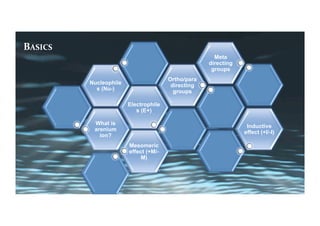
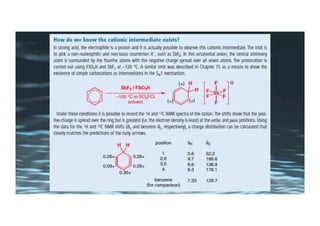
What is
arenium
ion?
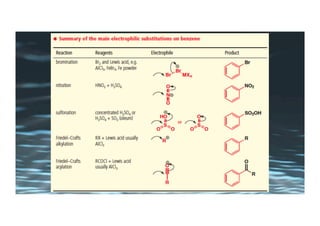
Electrophile
s (E+)
Nucleophile
s (Nu-)
Ortho/para
directing
groups
Meta
directing
groups
Inductive
effect (+I/-I)
Mesomeric
effect (+M/-
M)
BASICS
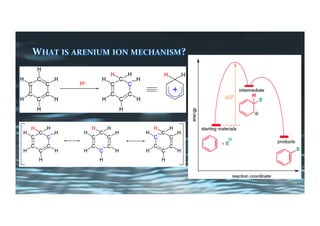
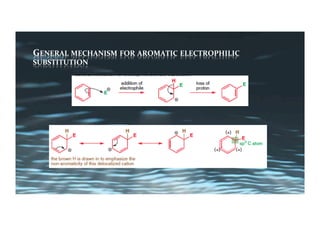
GENERAL	MECHANISM	FOR	AROMATIC	ELECTROPHILIC	
SUBSTITUTION
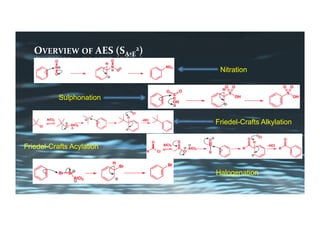
OVERVIEW	OF	AES	(SARE
2)	
Nitration
Sulphonation
Friedel-Crafts Alkylation
Friedel-Crafts Acylation
Halogenation
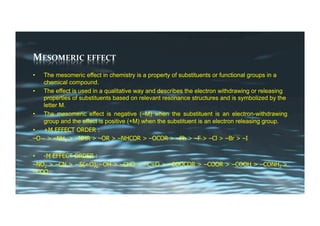
MESOMERIC	EFFECT	
•  The mesomeric effect in chemistry is a property of substituents or functional groups in a
chemical compound.
•  The effect is used in a qualitative way and describes the electron withdrawing or releasing
properties of substituents based on relevant resonance structures and is symbolized by the
letter M.
•  The mesomeric effect is negative (–M) when the substituent is an electron-withdrawing
group and the effect is positive (+M) when the substituent is an electron releasing group.
•  +M EFFECT ORDER :
–O− > –NH2 > –NHR > –OR > –NHCOR > –OCOR > –Ph > –F > –Cl > –Br > –I
•  -M EFFECT ORDER :
–NO2 > –CN > --S(=O)2−OH > –CHO > –C=O > –COOCOR > –COOR > –COOH > –CONH2 >
–COO−
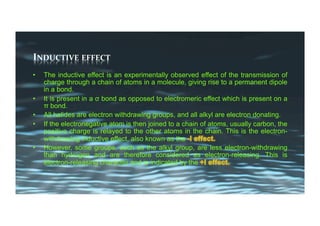
INDUCTIVE	EFFECT	
•  The inductive effect is an experimentally observed effect of the transmission of
charge through a chain of atoms in a molecule, giving rise to a permanent dipole
in a bond.
•  It is present in a σ bond as opposed to electromeric effect which is present on a
π bond.
•  All halides are electron withdrawing groups, and all alkyl are electron donating.
•  If the electronegative atom is then joined to a chain of atoms, usually carbon, the
positive charge is relayed to the other atoms in the chain. This is the electron-
withdrawing inductive effect, also known as the
•  However, some groups, such as the alkyl group, are less electron-withdrawing
than hydrogen and are therefore considered as electron-releasing. This is
electron-releasing character and is indicated by the
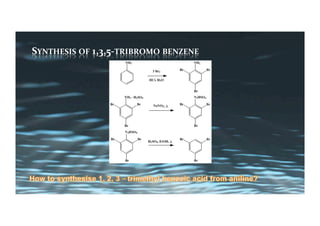
SYNTHESIS	OF	1,3,5-TRIBROMO	BENZENE
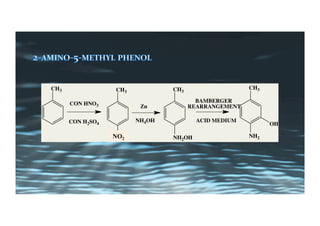
CH3
CON HNO3
CON H2SO4
CH3
NH2
NH4OH
Zn
CH3
NH2OH
CH3
NH2
BAMBERGER
REARRANGEMENT
ACID MEDIUM
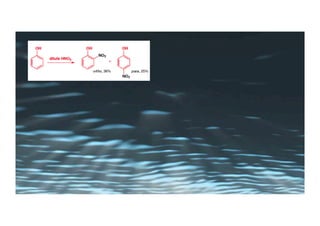
OH
NO2
Con HNO3
Con H2SO4
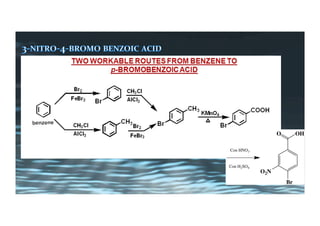
O OH
Br
O2N
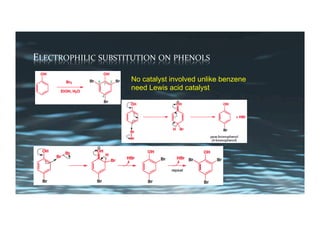
ELECTROPHILIC	SUBSTITUTION	ON	PHENOLS	
No catalyst involved unlike benzene
need Lewis acid catalyst
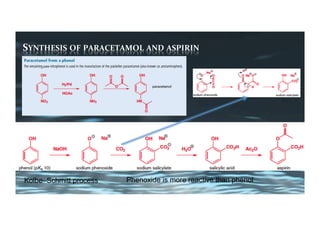
SYNTHESIS	OF	PARACETAMOL	AND	ASPIRIN	
Kolbe–Schmitt process Phenoxide is more reactive than phenol
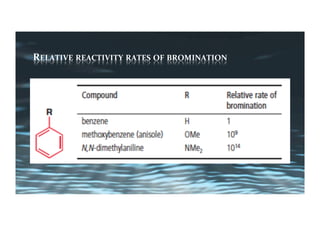
RELATIVE	REACTIVITY	RATES	OF	BROMINATION
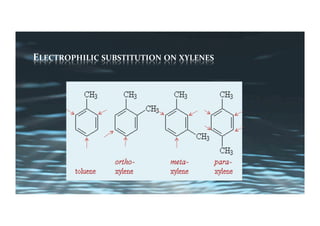
ELECTROPHILIC	SUBSTITUTION	ON	XYLENES
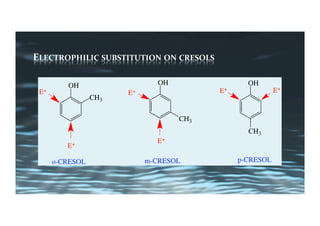
ELECTROPHILIC	SUBSTITUTION	ON	CRESOLS	
OH
CH3
OH
CH3
OH
CH3
E+
E+
E+
E+ E+E+
o-CRESOL m-CRESOL p-CRESOL
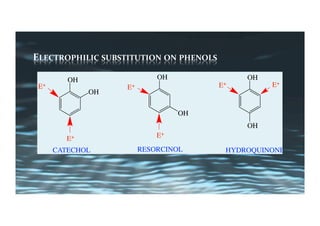
ELECTROPHILIC	SUBSTITUTION	ON	PHENOLS	
OH
OH
OH
OH
OH
OH
E+
E+
E+
E+ E+E+
RESORCINOLCATECHOL HYDROQUINONE
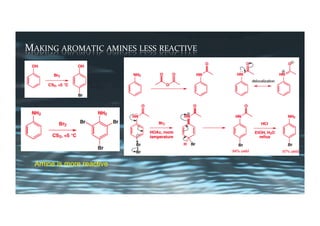
MAKING	AROMATIC	AMINES	LESS	REACTIVE	
Amine is more reactive
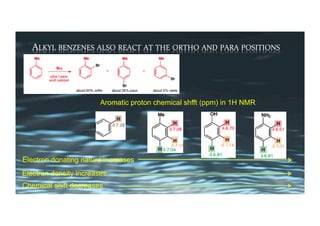
ALKYL	BENZENES	ALSO	REACT	AT	THE	ORTHO	AND	PARA	POSITIONS	
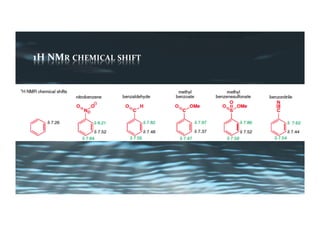
Aromatic proton chemical shfft (ppm) in 1H NMR
Electron donating nature increases
Electron density increases
Chemical shift decreases
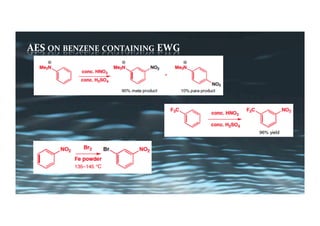
AES	ON	BENZENE	CONTAINING	EWG
1H	NMR	CHEMICAL	SHIFT
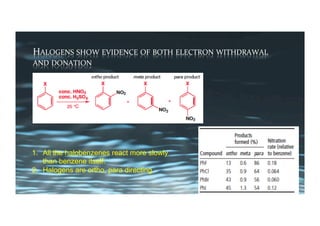
HALOGENS	SHOW	EVIDENCE	OF	BOTH	ELECTRON	WITHDRAWAL	
AND	DONATION	
1.  All the halobenzenes react more slowly
than benzene itself.
2.  Halogens are ortho, para directing
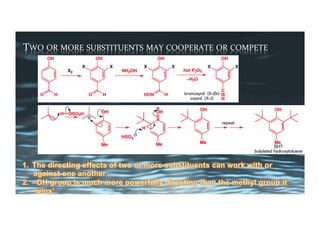
TWO	OR	MORE	SUBSTITUENTS	MAY	COOPERATE	OR	COMPETE
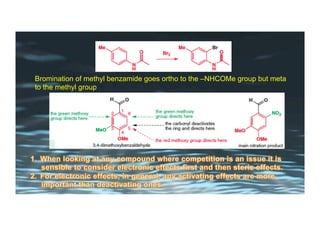
Bromination of methyl benzamide goes ortho to the –NHCOMe group but meta
to the methyl group
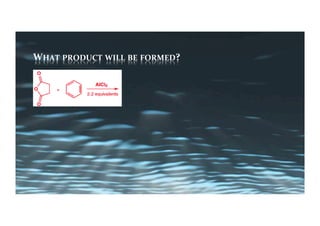
WHAT	PRODUCT	WILL	BE	FORMED?
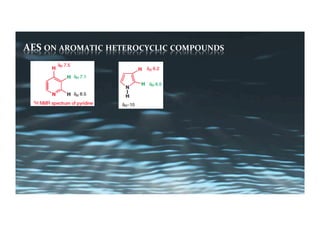
AES	ON	AROMATIC	HETEROCYCLIC	COMPOUNDS
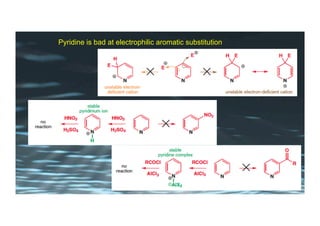
Pyridine is bad at electrophilic aromatic substitution
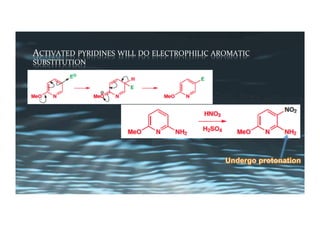
ACTIVATED	PYRIDINES	WILL	DO	ELECTROPHILIC	AROMATIC	
SUBSTITUTION
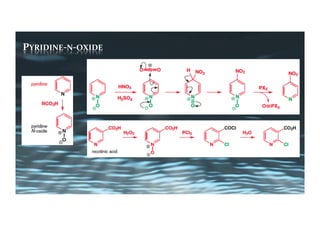
PYRIDINE-N-OXIDE
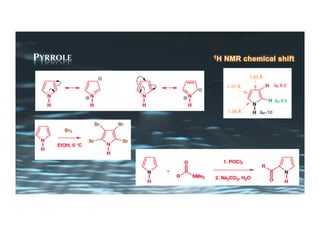
PYRROLE
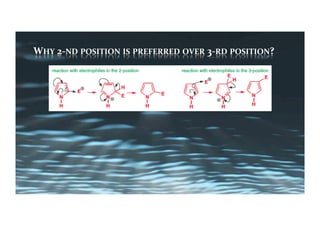
WHY	2-ND	POSITION	IS	PREFERRED	OVER	3-RD	POSITION?
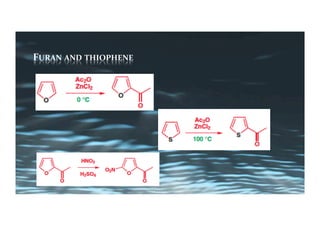
FURAN	AND	THIOPHENE
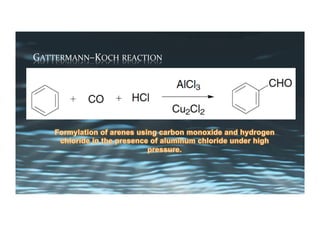
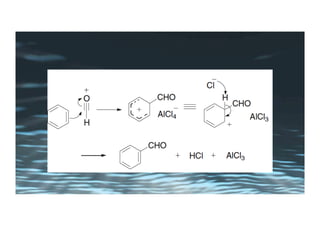
GATTERMANN–KOCH	REACTION
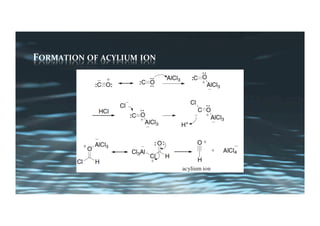
FORMATION	OF	ACYLIUM	ION
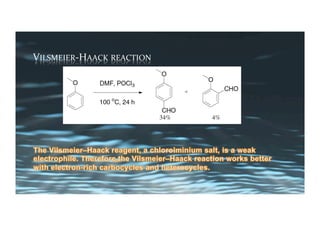
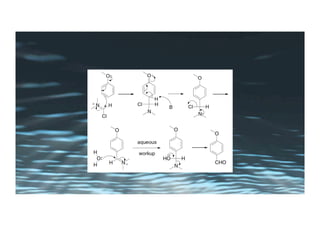
VILSMEIER-HAACK	REACTION
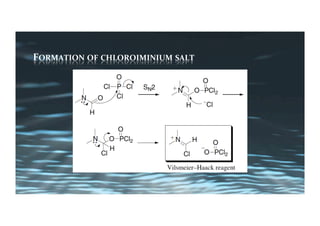
FORMATION	OF	CHLOROIMINIUM	SALT
ACKNOWLEDGEMENT	
Chapter 21 : Aromatic electrophilic substitution
Aromatic electrophilic substitution

Aromatic electrophilic substitution