INDUCTIVE EFFECT
DEFINITION:
EXPLANATION:
CHARACTERISTICS:
TYPES:
FACTORS AFFECTING I.E:
PHARMACEUTICAL APPLICATION:
DEFINITION:
• The transmission of polarity which is induced in a molecule due to electronegativity
difference along the straight chain or ring is called inductive effect.
• The polarity induced by adjacent polar bond or electronegative atoms which is
transmitted along the chain or ring is known as inductive effect.
REPRESENTED:
• Inductive effect is represented by I.E.
• The inductive effect is represented by the symbol, → the arrow pointing towards the
more electronegative element or group of elements.
EXPLANATION:
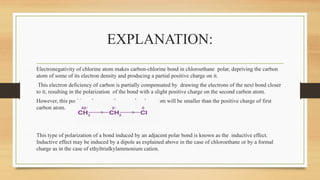
Electronegativity of chlorine atom makes carbon-chlorine bond in chloroethane polar, depriving the carbon
atom of some of its electron density and producing a partial positive charge on it.
This electron deficiency of carbon is partially compensated by drawing the electrons of the next bond closer
to it, resulting in the polarization of the bond with a slight positive charge on the second carbon atom.
However, this positive charge on the second carbon atom will be smaller than the positive charge of first
carbon atom.
This type of polarization of a bond induced by an adjacent polar bond is known as the inductive effect.
Inductive effect may be induced by a dipole as explained above in the case of chloroethane or by a formal
charge as in the case of ethyltrialkylammonium cation.
CHARACTERISTICS:
• I.E arise due to the E.N difference between two atoms.
• I.E will transmitted along the sigma bond.
• The magnitude of I.E will decrease as we move away from the group which are
responsible for induction.
• I.E is a permanent effect.
• I.E is transmitted through sigma bond.
• I.E does not need any attacking reagent.
• I.E influence the chemical and physical properties of compounds.
TYPES:
• POSITIVE INDUCTIVE EFFECT
• NEGATIVE INDUCTIVE EFFECT
POSITIVE INDUCTIVE EFFECT:
• If the substituent “Y” bonded to Carbon atom is ELECTRON RELEASING ( alkyl
group) then Y atom acquires +ve charge and such Inductive effect is termed as +I Effect.
• If the I.E is due to electron donating group it is called positive inductive effect.
• Represented by + I.
• EDG:
• Examples of such functional groups are,
• -CH2-, -NH-, -O-, -COO-, -C(CH3)3, -CH(CH3)2, -CH2CH3, -CH3
NEGATIVE INDUCTIVE EFFECT:
• If the substituent “X” bonded to Carbon atom is ELECTRON WITHDRAWING (halogens)
then X atom acquires -ve charge and such Inductive effect is termed as -I Effect.
• If the I.E is due to electron withdrawing group it is called negative inductive effect.
• Represented by _ I.
• EWG:
• Examples of such functional groups are,
• -NR3+, -NH3+, -CH2+, -NO2, -CN, -SO3H, -CHO, -CO-, -COOH, -COCl, -CONH2, -F, -
Cl, -Br, -I, -OR, -OH, -NR2, -NH2, -CH=CH2, -Ar
-
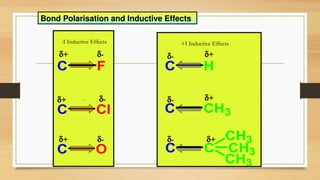
Bond Polarisation and Inductive Effects
-I Inductive Effects +I Inductive Effects
C F
C O
C Cl
C H
d+
C C
CH3
CH3
CH3
d+
d+
d-
d-
C CH3
d-
d+
d+
d+
d-
d-
d-
FACTORS AFFECTING I.E:
• 1:E.N
• 2:CHARGE
• 3:BONDING POSITION
1:Electronegativity:
• Inductive effect also depends on electronegativity.
• The more electronegative the atoms and the closer it is to the site of the negative charge, the
greater the (-I) effect.
• More electronegative atoms stabilize regions of high electron density by an electron
withdrawing inductive effect.
• The acidity of H—A (an Acid) increases with the presence of electron withdrawing groups in A.
Continue:
Example 1:
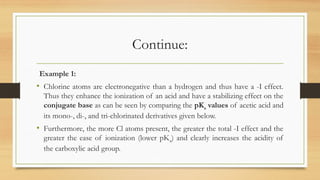
• Chlorine atoms are electronegative than a hydrogen and thus have a -I effect.
Thus they enhance the ionization of an acid and have a stabilizing effect on the
conjugate base as can be seen by comparing the pKa values of acetic acid and
its mono-, di-, and tri-chlorinated derivatives given below.
• Furthermore, the more Cl atoms present, the greater the total -I effect and the
greater the ease of ionization (lower pKa) and clearly increases the acidity of
the carboxylic acid group.
Continue:
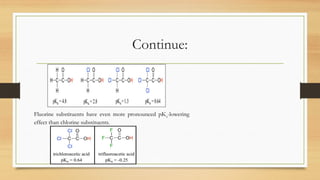
Fluorine substituents have even more pronounced pKa-lowering
effect than chlorine substituents.
2:Bonding Order and Charge:
• It is important to consider both the electronegativity and bonding order when analyzing
the inductive potential of an atom.
• For example, oxygen in a hydroxyl group (OH) is electron withdrawing by induction
(-I) because the oxygen atom is relatively electronegative and is uncharged in that bonding
arrangement.
• However, oxygen in an "alkoxide” (conjugate base of an alcohol, written as RO−
)
structure is electron donating (+I) by induction because in this bonding order, the oxygen
atom has an "excess" of electron density.
• Thus an OH group would help to stabilize a negative charge within a structure, while it's
ionized form, the alkoxide, would stabilize a positive charge.
3:Bonding Position:
• The strength of the inductive effect produced by a particular atom or functional group is dependent on it's position
within a structure.
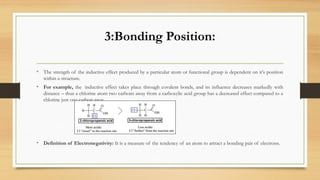
• For example, the inductive effect takes place through covalent bonds, and its influence decreases markedly with
distance – thus a chlorine atom two carbons away from a carboxylic acid group has a decreased effect compared to a
chlorine just one carbon away.
• Definition of Electronegativity: It is a measure of the tendency of an atom to attract a bonding pair of electrons.
PHARMACEUTICAL APPLICATION:
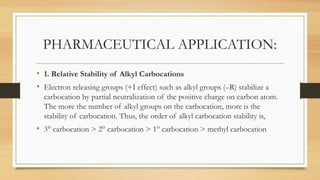
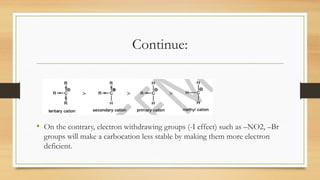
• 1. Relative Stability of Alkyl Carbocations
• Electron releasing groups (+I effect) such as alkyl groups (–R) stabilize a
carbocation by partial neutralization of the positive charge on carbon atom.
The more the number of alkyl groups on the carbocation, more is the
stability of carbocation. Thus, the order of alkyl carbocation stability is,
• 3° carbocation > 2° carbocation > 1° carbocation > methyl carbocation
Continue:
• On the contrary, electron withdrawing groups (-I effect) such as –NO2, –Br
groups will make a carbocation less stable by making them more electron
deficient.
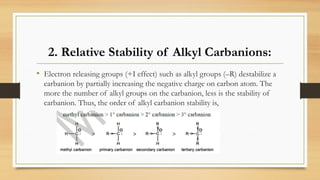
2. Relative Stability of Alkyl Carbanions:
• Electron releasing groups (+I effect) such as alkyl groups (–R) destabilize a
carbanion by partially increasing the negative charge on carbon atom. The
more the number of alkyl groups on the carbanion, less is the stability of
carbanion. Thus, the order of alkyl carbanion stability is,
Continue:
• On the other hand, electron withdrawing groups (-I effect) such as –NO2, –
Br groups stabilize a carbanion by partially decreasing the negative charge on
carbon atom.
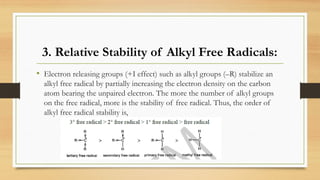
3. Relative Stability of Alkyl Free Radicals:
• Electron releasing groups (+I effect) such as alkyl groups (–R) stabilize an
alkyl free radical by partially increasing the electron density on the carbon
atom bearing the unpaired electron. The more the number of alkyl groups
on the free radical, more is the stability of free radical. Thus, the order of
alkyl free radical stability is,
Continue:
• Whereas, electron withdrawing groups (-I effect) such as –NO2, –Br groups
will make an alkyl free radical less stable and more reactive.
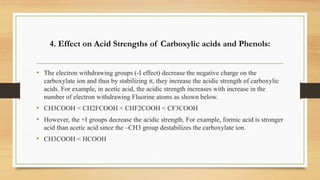
4. Effect on Acid Strengths of Carboxylic acids and Phenols:
• The electron withdrawing groups (-I effect) decrease the negative charge on the
carboxylate ion and thus by stabilizing it, they increase the acidic strength of carboxylic
acids. For example, in acetic acid, the acidic strength increases with increase in the
number of electron withdrawing Fluorine atoms as shown below.
• CH3COOH < CH2FCOOH < CHF2COOH < CF3COOH
• However, the +I groups decrease the acidic strength. For example, formic acid is stronger
acid than acetic acid since the –CH3 group destabilizes the carboxylate ion.
• CH3COOH < HCOOH
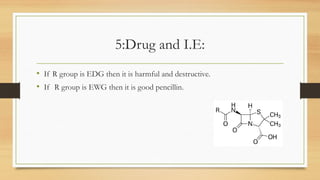
5:Drug and I.E:
• If R group is EDG then it is harmful and destructive.
• If R group is EWG then it is good pencillin.
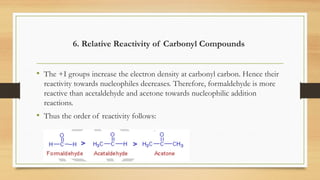
6. Relative Reactivity of Carbonyl Compounds
• The +I groups increase the electron density at carbonyl carbon. Hence their
reactivity towards nucleophiles decreases. Therefore, formaldehyde is more
reactive than acetaldehyde and acetone towards nucleophilic addition
reactions.
• Thus the order of reactivity follows:
7. Effect on Basic Strength of Amines
• The electron donating groups (+I) like alkyl groups, increase the basic
strength of amines. Whereas, the electron withdrawing groups (-I) like aryl
groups, decrease the basic nature. Therefore alkyl amines are stronger Lewis
bases than ammonia, whereas aryl amines are weaker than ammonia.
• Thus the order of basic strength of alkyl and aryl amines with respect to
ammonia is:
• CH3NH2 > NH3 > C6H5NH2
8:Effect of substituent on the acid strength of aliphatic acids:
• [1]. Acidic strength decreases as +I effect of the alkyl group increases and vice versa.
• Acid strength: HCOOH > CH3COOH > (CH3)2CHCOOH
• [2]. Acidic strength decreases as the number of halogen atoms decreases and vice versa.
• Acid strength: Cl3CCOOH > Cl2CHCOOH> ClCH2COOH > CH3COOH
• [3]. Acidic strength decreases as the distance of the halogen from carboxylic group increases and vice
versa.
• Acid strength: CH3CHClCOOH > CH2ClCH2COOH
• [4]. Benzoic acid is stronger than acetic acid due to –I effect of phenyl group.
Continue:
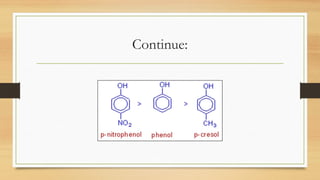
• Acidic strength of phenols increases when -I groups are present on the
ring.
• E.g. The p-nitrophenol is stronger acid than phenol since the -NO2 group is
a -I group and withdraws electron density.
• Whereas the para-cresol is weaker acid than phenol since the -CH3 group
shows positive (+I) inductive effect.
• Therefore the decreasing order of acidic strength is:
Continue:

INDUCTIVE EFFECT slide for first prof pharamacy students

  • 1.
  • 2.
    DEFINITION: • The transmissionof polarity which is induced in a molecule due to electronegativity difference along the straight chain or ring is called inductive effect. • The polarity induced by adjacent polar bond or electronegative atoms which is transmitted along the chain or ring is known as inductive effect.
  • 3.
    REPRESENTED: • Inductive effectis represented by I.E. • The inductive effect is represented by the symbol, → the arrow pointing towards the more electronegative element or group of elements.
  • 4.
    EXPLANATION: Electronegativity of chlorineatom makes carbon-chlorine bond in chloroethane polar, depriving the carbon atom of some of its electron density and producing a partial positive charge on it. This electron deficiency of carbon is partially compensated by drawing the electrons of the next bond closer to it, resulting in the polarization of the bond with a slight positive charge on the second carbon atom. However, this positive charge on the second carbon atom will be smaller than the positive charge of first carbon atom. This type of polarization of a bond induced by an adjacent polar bond is known as the inductive effect. Inductive effect may be induced by a dipole as explained above in the case of chloroethane or by a formal charge as in the case of ethyltrialkylammonium cation.
  • 5.
    CHARACTERISTICS: • I.E arisedue to the E.N difference between two atoms. • I.E will transmitted along the sigma bond. • The magnitude of I.E will decrease as we move away from the group which are responsible for induction. • I.E is a permanent effect. • I.E is transmitted through sigma bond. • I.E does not need any attacking reagent. • I.E influence the chemical and physical properties of compounds.
  • 6.
    TYPES: • POSITIVE INDUCTIVEEFFECT • NEGATIVE INDUCTIVE EFFECT
  • 7.
    POSITIVE INDUCTIVE EFFECT: •If the substituent “Y” bonded to Carbon atom is ELECTRON RELEASING ( alkyl group) then Y atom acquires +ve charge and such Inductive effect is termed as +I Effect. • If the I.E is due to electron donating group it is called positive inductive effect. • Represented by + I. • EDG: • Examples of such functional groups are, • -CH2-, -NH-, -O-, -COO-, -C(CH3)3, -CH(CH3)2, -CH2CH3, -CH3
  • 8.
    NEGATIVE INDUCTIVE EFFECT: •If the substituent “X” bonded to Carbon atom is ELECTRON WITHDRAWING (halogens) then X atom acquires -ve charge and such Inductive effect is termed as -I Effect. • If the I.E is due to electron withdrawing group it is called negative inductive effect. • Represented by _ I. • EWG: • Examples of such functional groups are, • -NR3+, -NH3+, -CH2+, -NO2, -CN, -SO3H, -CHO, -CO-, -COOH, -COCl, -CONH2, -F, - Cl, -Br, -I, -OR, -OH, -NR2, -NH2, -CH=CH2, -Ar
  • 9.
    - Bond Polarisation andInductive Effects -I Inductive Effects +I Inductive Effects C F C O C Cl C H d+ C C CH3 CH3 CH3 d+ d+ d- d- C CH3 d- d+ d+ d+ d- d- d-
  • 10.
    FACTORS AFFECTING I.E: •1:E.N • 2:CHARGE • 3:BONDING POSITION
  • 11.
    1:Electronegativity: • Inductive effectalso depends on electronegativity. • The more electronegative the atoms and the closer it is to the site of the negative charge, the greater the (-I) effect. • More electronegative atoms stabilize regions of high electron density by an electron withdrawing inductive effect. • The acidity of H—A (an Acid) increases with the presence of electron withdrawing groups in A.
  • 12.
    Continue: Example 1: • Chlorineatoms are electronegative than a hydrogen and thus have a -I effect. Thus they enhance the ionization of an acid and have a stabilizing effect on the conjugate base as can be seen by comparing the pKa values of acetic acid and its mono-, di-, and tri-chlorinated derivatives given below. • Furthermore, the more Cl atoms present, the greater the total -I effect and the greater the ease of ionization (lower pKa) and clearly increases the acidity of the carboxylic acid group.
  • 13.
    Continue: Fluorine substituents haveeven more pronounced pKa-lowering effect than chlorine substituents.
  • 14.
    2:Bonding Order andCharge: • It is important to consider both the electronegativity and bonding order when analyzing the inductive potential of an atom. • For example, oxygen in a hydroxyl group (OH) is electron withdrawing by induction (-I) because the oxygen atom is relatively electronegative and is uncharged in that bonding arrangement. • However, oxygen in an "alkoxide” (conjugate base of an alcohol, written as RO− ) structure is electron donating (+I) by induction because in this bonding order, the oxygen atom has an "excess" of electron density. • Thus an OH group would help to stabilize a negative charge within a structure, while it's ionized form, the alkoxide, would stabilize a positive charge.
  • 15.
    3:Bonding Position: • Thestrength of the inductive effect produced by a particular atom or functional group is dependent on it's position within a structure. • For example, the inductive effect takes place through covalent bonds, and its influence decreases markedly with distance – thus a chlorine atom two carbons away from a carboxylic acid group has a decreased effect compared to a chlorine just one carbon away. • Definition of Electronegativity: It is a measure of the tendency of an atom to attract a bonding pair of electrons.
  • 16.
    PHARMACEUTICAL APPLICATION: • 1.Relative Stability of Alkyl Carbocations • Electron releasing groups (+I effect) such as alkyl groups (–R) stabilize a carbocation by partial neutralization of the positive charge on carbon atom. The more the number of alkyl groups on the carbocation, more is the stability of carbocation. Thus, the order of alkyl carbocation stability is, • 3° carbocation > 2° carbocation > 1° carbocation > methyl carbocation
  • 17.
    Continue: • On thecontrary, electron withdrawing groups (-I effect) such as –NO2, –Br groups will make a carbocation less stable by making them more electron deficient.
  • 18.
    2. Relative Stabilityof Alkyl Carbanions: • Electron releasing groups (+I effect) such as alkyl groups (–R) destabilize a carbanion by partially increasing the negative charge on carbon atom. The more the number of alkyl groups on the carbanion, less is the stability of carbanion. Thus, the order of alkyl carbanion stability is,
  • 19.
    Continue: • On theother hand, electron withdrawing groups (-I effect) such as –NO2, – Br groups stabilize a carbanion by partially decreasing the negative charge on carbon atom.
  • 20.
    3. Relative Stabilityof Alkyl Free Radicals: • Electron releasing groups (+I effect) such as alkyl groups (–R) stabilize an alkyl free radical by partially increasing the electron density on the carbon atom bearing the unpaired electron. The more the number of alkyl groups on the free radical, more is the stability of free radical. Thus, the order of alkyl free radical stability is,
  • 21.
    Continue: • Whereas, electronwithdrawing groups (-I effect) such as –NO2, –Br groups will make an alkyl free radical less stable and more reactive.
  • 22.
    4. Effect onAcid Strengths of Carboxylic acids and Phenols: • The electron withdrawing groups (-I effect) decrease the negative charge on the carboxylate ion and thus by stabilizing it, they increase the acidic strength of carboxylic acids. For example, in acetic acid, the acidic strength increases with increase in the number of electron withdrawing Fluorine atoms as shown below. • CH3COOH < CH2FCOOH < CHF2COOH < CF3COOH • However, the +I groups decrease the acidic strength. For example, formic acid is stronger acid than acetic acid since the –CH3 group destabilizes the carboxylate ion. • CH3COOH < HCOOH
  • 23.
    5:Drug and I.E: •If R group is EDG then it is harmful and destructive. • If R group is EWG then it is good pencillin.
  • 24.
    6. Relative Reactivityof Carbonyl Compounds • The +I groups increase the electron density at carbonyl carbon. Hence their reactivity towards nucleophiles decreases. Therefore, formaldehyde is more reactive than acetaldehyde and acetone towards nucleophilic addition reactions. • Thus the order of reactivity follows:
  • 25.
    7. Effect onBasic Strength of Amines • The electron donating groups (+I) like alkyl groups, increase the basic strength of amines. Whereas, the electron withdrawing groups (-I) like aryl groups, decrease the basic nature. Therefore alkyl amines are stronger Lewis bases than ammonia, whereas aryl amines are weaker than ammonia. • Thus the order of basic strength of alkyl and aryl amines with respect to ammonia is: • CH3NH2 > NH3 > C6H5NH2
  • 26.
    8:Effect of substituenton the acid strength of aliphatic acids: • [1]. Acidic strength decreases as +I effect of the alkyl group increases and vice versa. • Acid strength: HCOOH > CH3COOH > (CH3)2CHCOOH • [2]. Acidic strength decreases as the number of halogen atoms decreases and vice versa. • Acid strength: Cl3CCOOH > Cl2CHCOOH> ClCH2COOH > CH3COOH • [3]. Acidic strength decreases as the distance of the halogen from carboxylic group increases and vice versa. • Acid strength: CH3CHClCOOH > CH2ClCH2COOH • [4]. Benzoic acid is stronger than acetic acid due to –I effect of phenyl group.
  • 27.
    Continue: • Acidic strengthof phenols increases when -I groups are present on the ring. • E.g. The p-nitrophenol is stronger acid than phenol since the -NO2 group is a -I group and withdraws electron density. • Whereas the para-cresol is weaker acid than phenol since the -CH3 group shows positive (+I) inductive effect. • Therefore the decreasing order of acidic strength is:
  • 28.