Types of Instructions
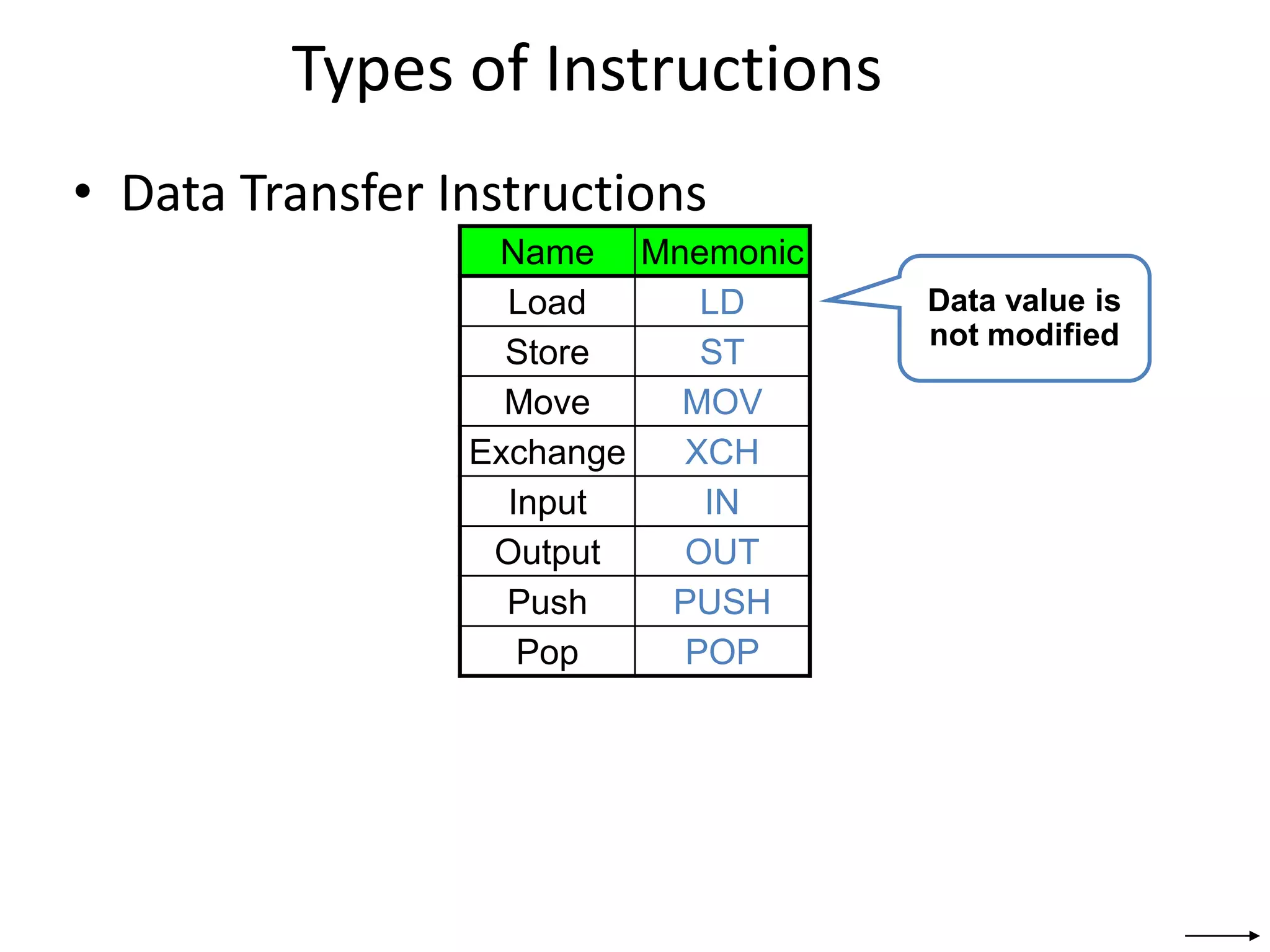
• Data Transfer Instructions
Name Mnemonic
Load LD
Store ST
Move MOV
Exchange XCH
Input IN
Output OUT
Push PUSH
Pop POP
Data value is
not modified
Data Transfer Instructions
Mode Assembly Register Transfer
Direct address LD ADR AC ← M[ADR]
Indirect address LD @ADR AC ← M[M[ADR]]
Relative address LD $ADR AC ← M[PC+ADR]
Immediate operand LD #NBR AC ← NBR
Index addressing LD ADR(X) AC ← M[ADR+XR]
Register LD R1 AC ← R1
Register indirect LD (R1) AC ← M[R1]
Autoincrement LD (R1)+ AC ← M[R1], R1 ← R1+1
Data Manipulation Instructions
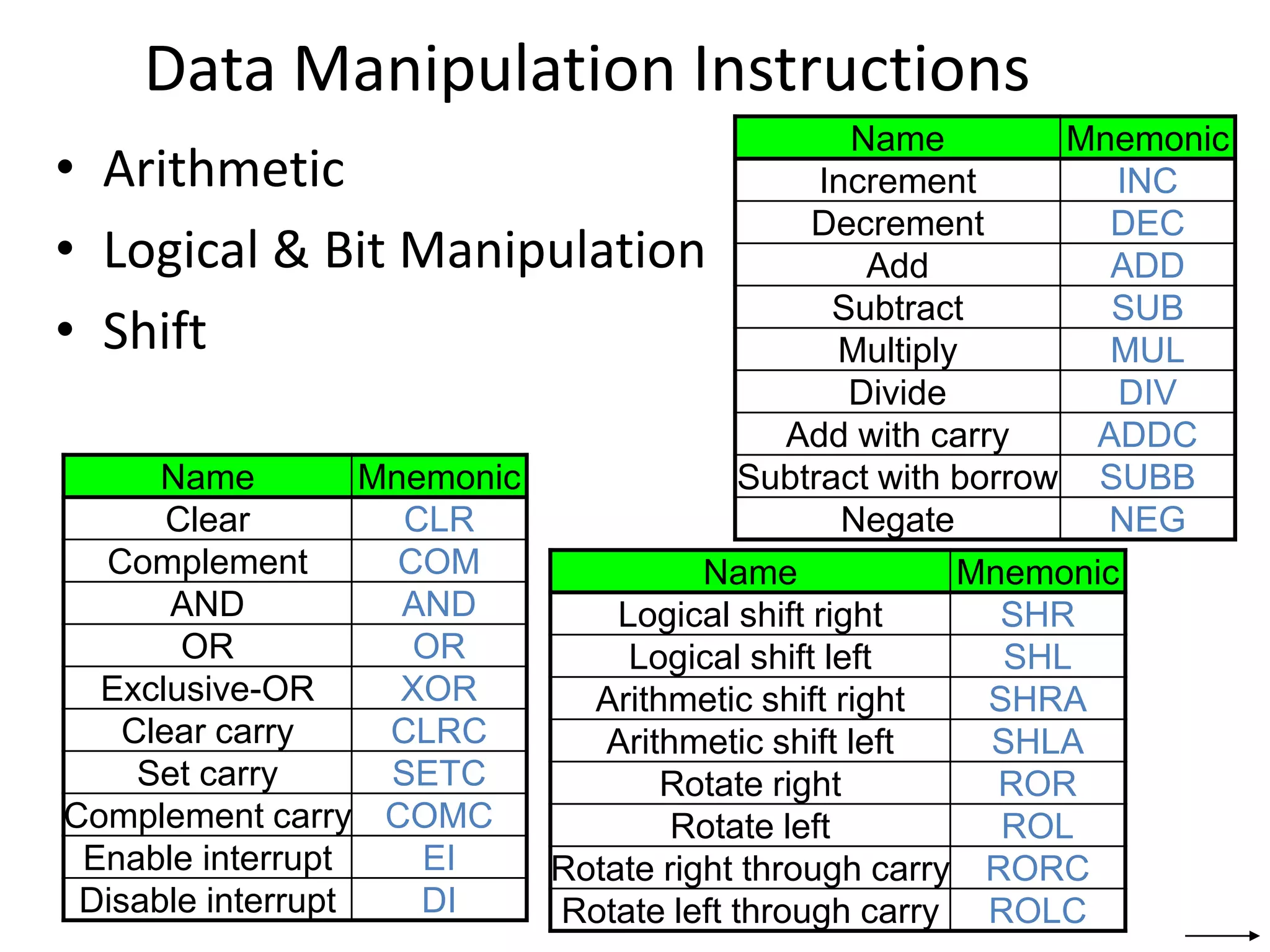
• Arithmetic
• Logical & Bit Manipulation
• Shift
Name Mnemonic
Increment INC
Decrement DEC
Add ADD
Subtract SUB
Multiply MUL
Divide DIV
Add with carry ADDC
Subtract with borrow SUBB
Negate NEG
Name Mnemonic
Clear CLR
Complement COM
AND AND
OR OR
Exclusive-OR XOR
Clear carry CLRC
Set carry SETC
Complement carry COMC
Enable interrupt EI
Disable interrupt DI
Name Mnemonic
Logical shift right SHR
Logical shift left SHL
Arithmetic shift right SHRA
Arithmetic shift left SHLA
Rotate right ROR
Rotate left ROL
Rotate right through carry RORC
Rotate left through carry ROLC
Program Control Instructions
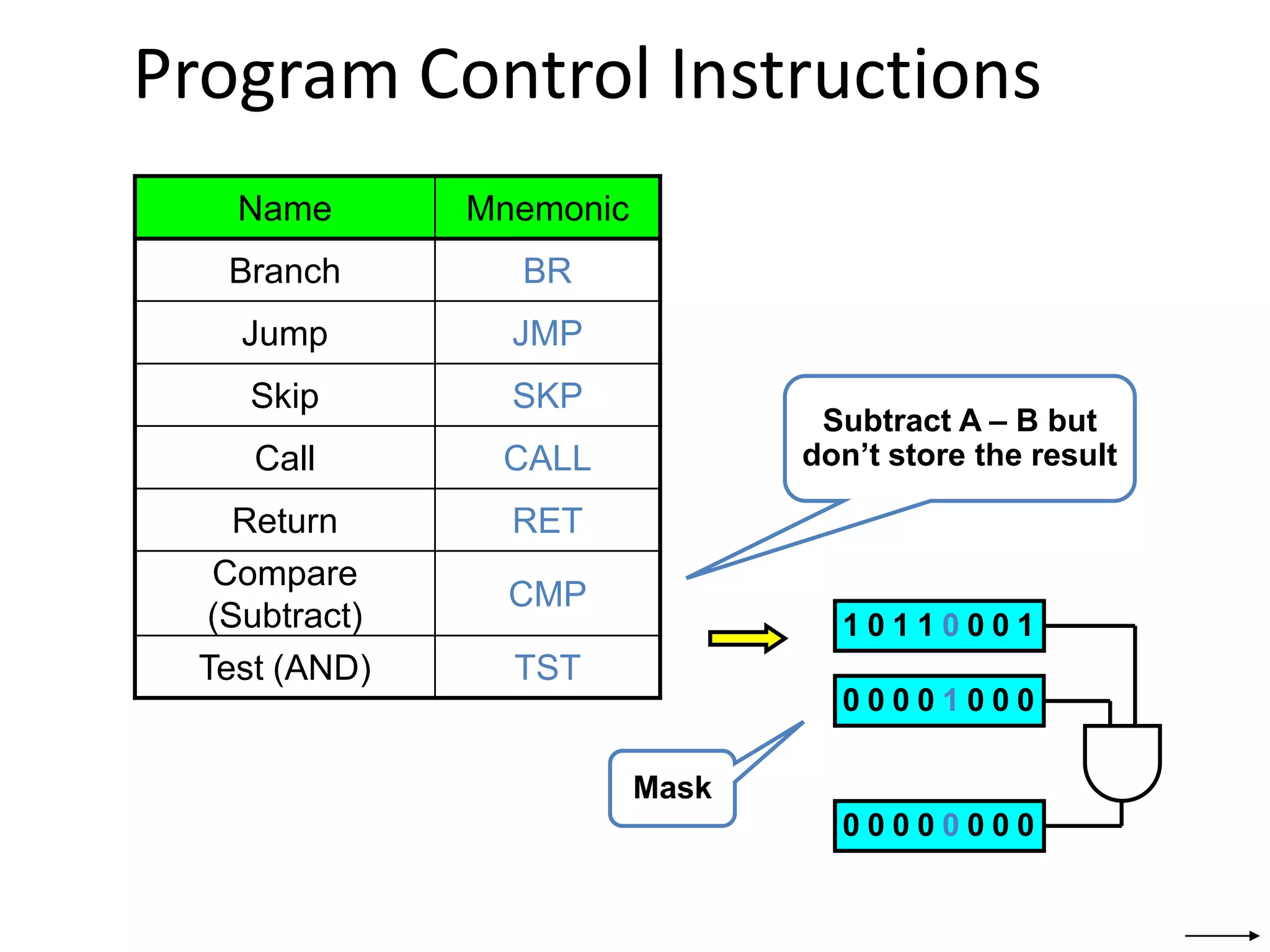
Name Mnemonic
Branch BR
Jump JMP
Skip SKP
Call CALL
Return RET
Compare
(Subtract)
CMP
Test (AND) TST
Subtract A – B but
don’t store the result
1 0 1 1 0 0 0 1
0 0 0 0 1 0 0 0
0 0 0 0 0 0 0 0
Mask
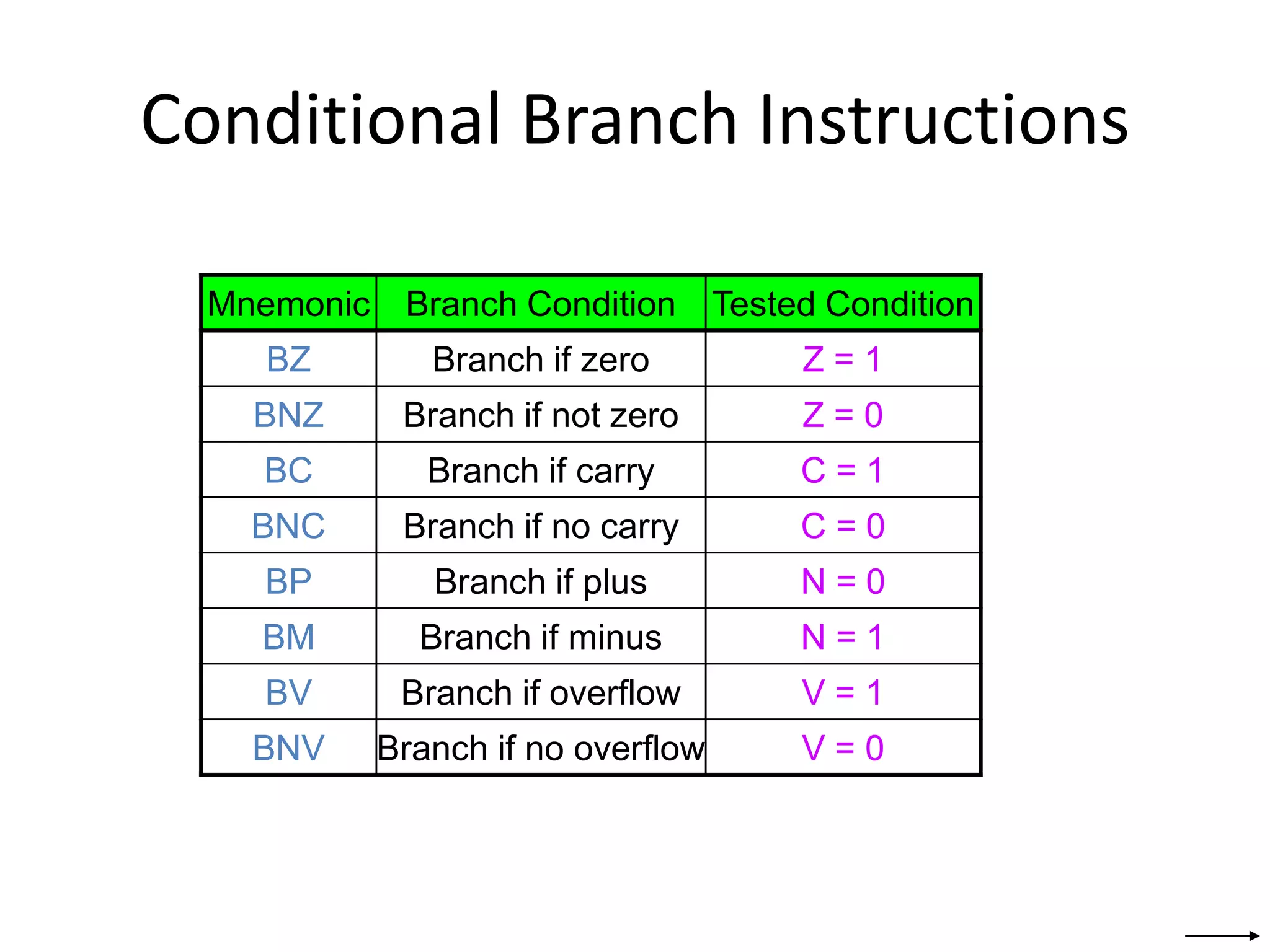
Conditional Branch Instructions
Mnemonic Branch Condition Tested Condition
BZ Branch if zero Z = 1
BNZ Branch if not zero Z = 0
BC Branch if carry C = 1
BNC Branch if no carry C = 0
BP Branch if plus N = 0
BM Branch if minus N = 1
BV Branch if overflow V = 1
BNV Branch if no overflow V = 0
Basic Input/Output Operations
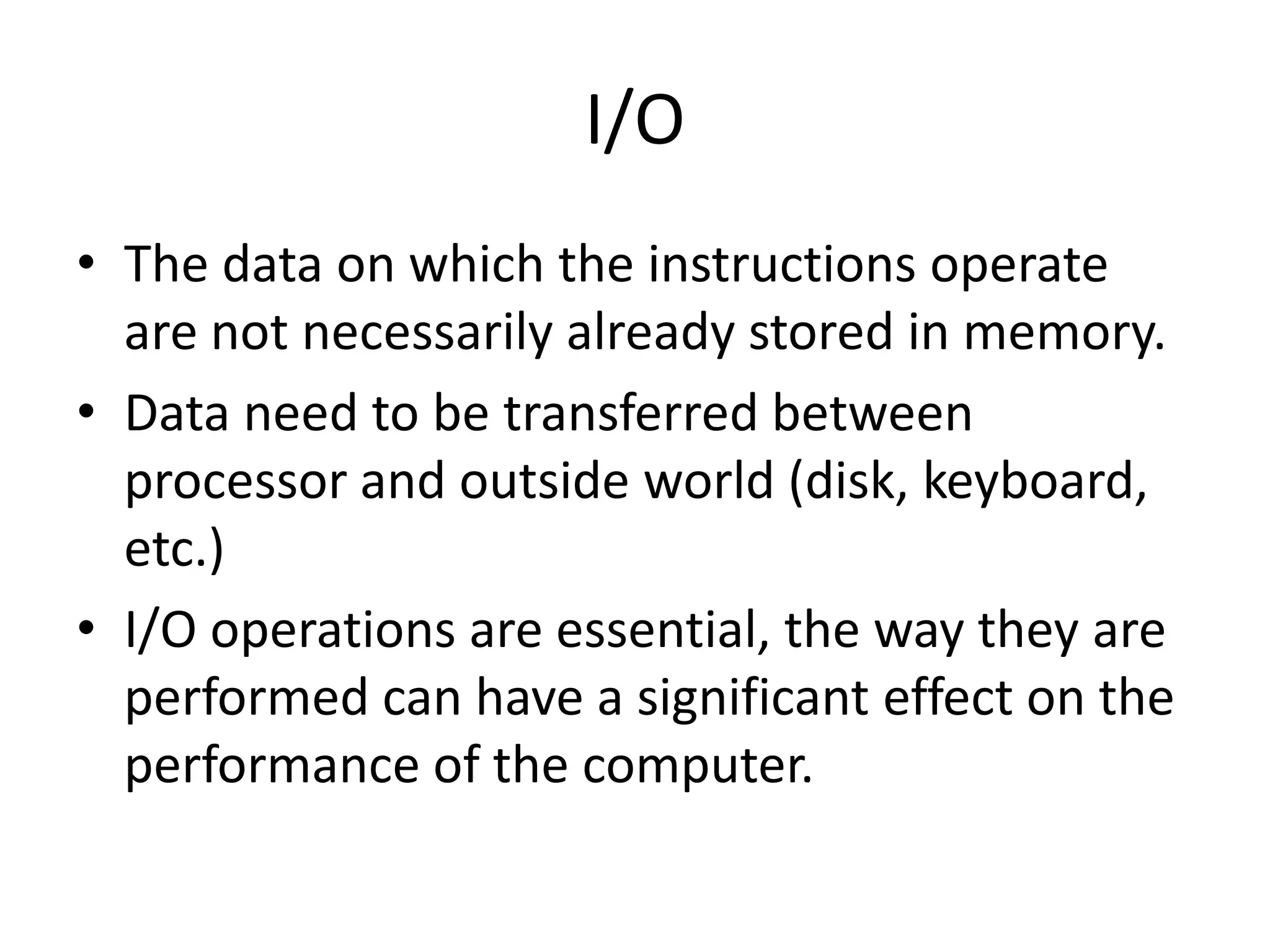
I/O
• The data on which the instructions operate
are not necessarily already stored in memory.
• Data need to be transferred between
processor and outside world (disk, keyboard,
etc.)
• I/O operations are essential, the way they are
performed can have a significant effect on the
performance of the computer.
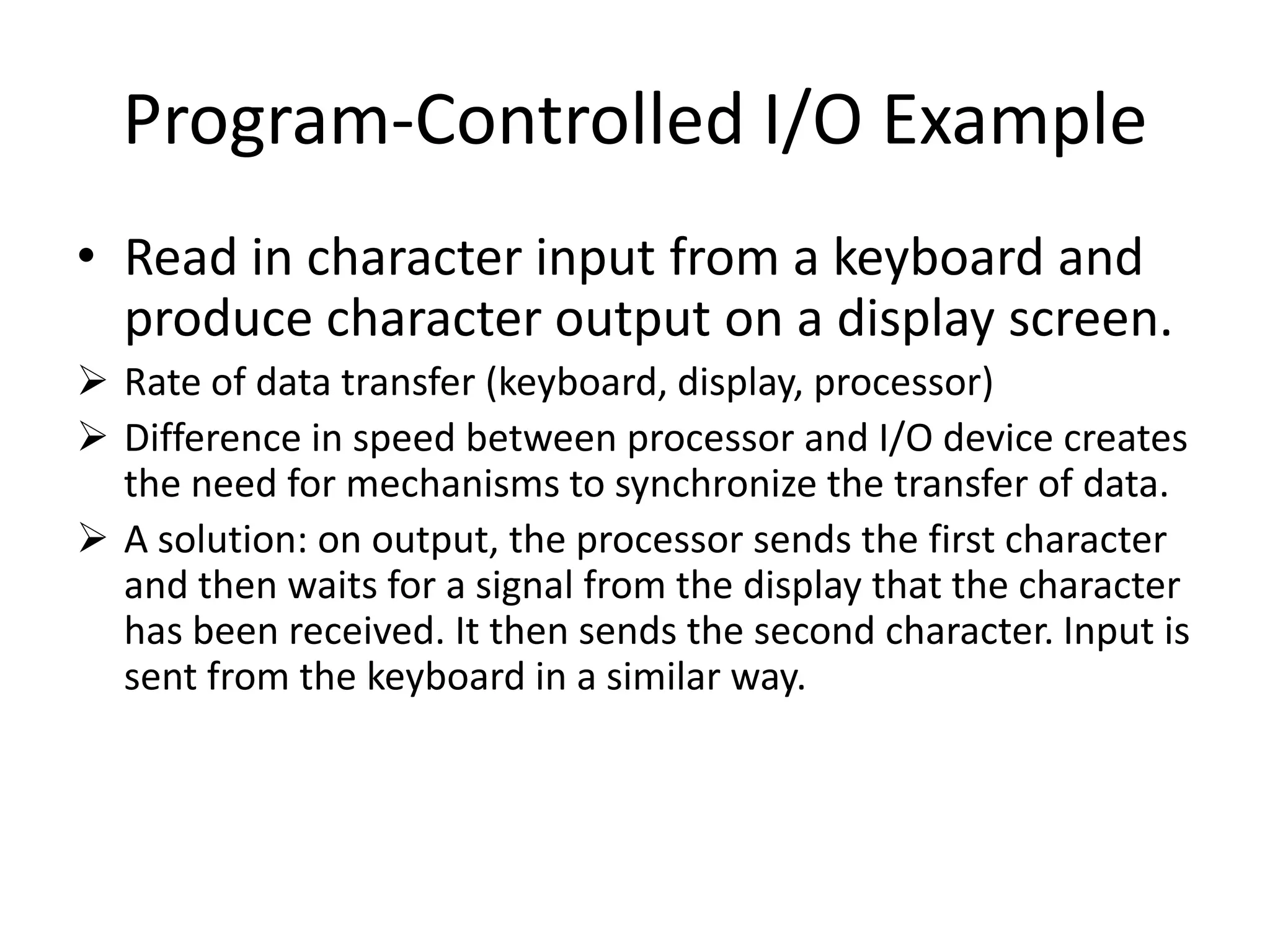
Program-Controlled I/O Example
• Read in character input from a keyboard and
produce character output on a display screen.
 Rate of data transfer (keyboard, display, processor)
 Difference in speed between processor and I/O device creates
the need for mechanisms to synchronize the transfer of data.
 A solution: on output, the processor sends the first character
and then waits for a signal from the display that the character
has been received. It then sends the second character. Input is
sent from the keyboard in a similar way.
Program-Controlled I/O Example
- Registers
- Flags
- Device interface
Program-Controlled I/O Example
• Machine instructions that can check the state
of the status flags and transfer data:
READWAIT Branch to READWAIT if SIN = 0
Input from DATAIN to R1
WRITEWAIT Branch to WRITEWAIT if SOUT = 0
Output from R1 to DATAOUT
Program-Controlled I/O Example
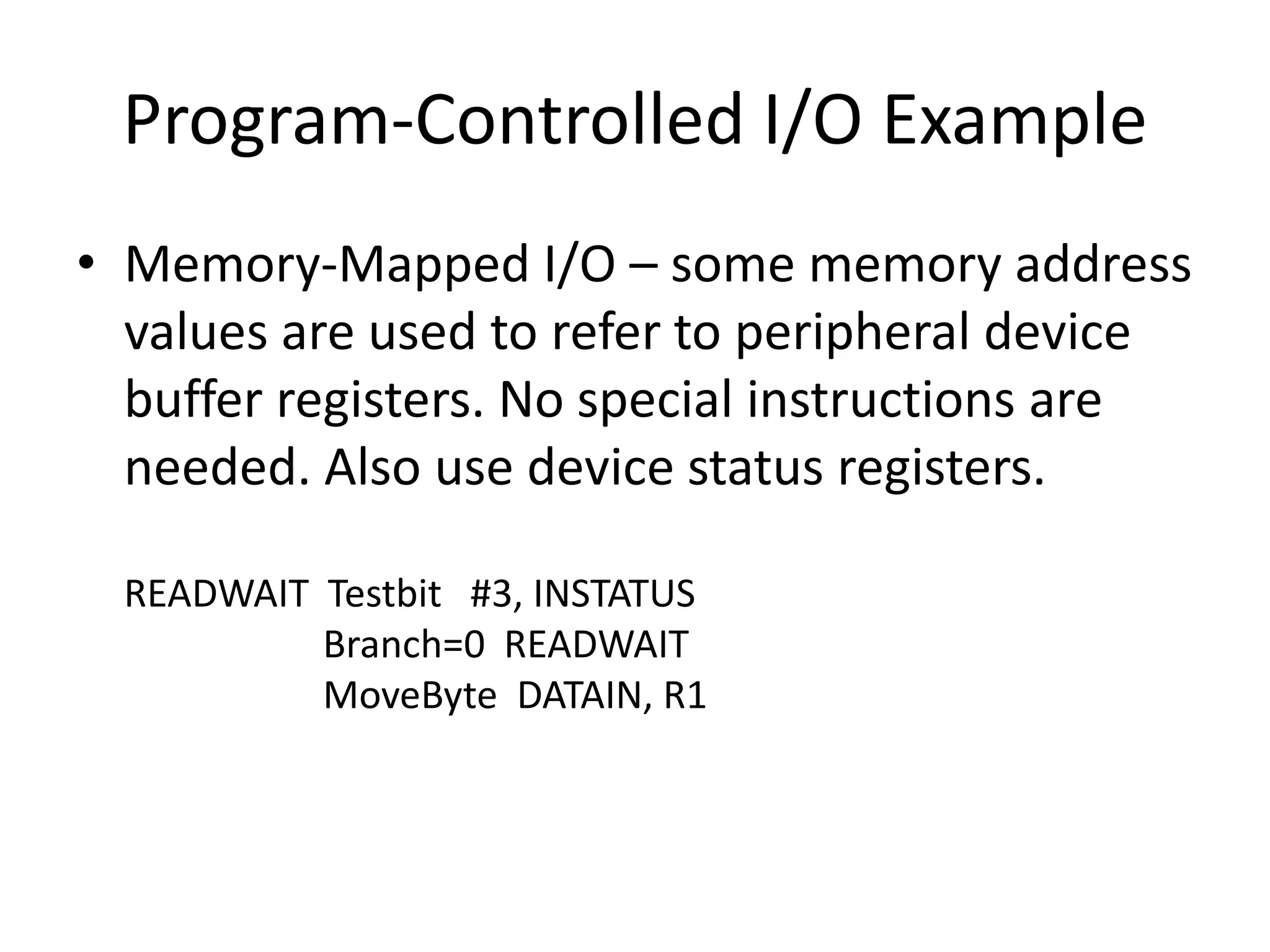
• Memory-Mapped I/O – some memory address
values are used to refer to peripheral device
buffer registers. No special instructions are
needed. Also use device status registers.
READWAIT Testbit #3, INSTATUS
Branch=0 READWAIT
MoveByte DATAIN, R1
Program-Controlled I/O Example
• Assumption – the initial state of SIN is 0 and the
initial state of SOUT is 1.
• Any drawback of this mechanism in terms of
efficiency?
– Two wait loopsprocessor execution time is wasted
• Alternate solution?
– Interrupt
Stacks
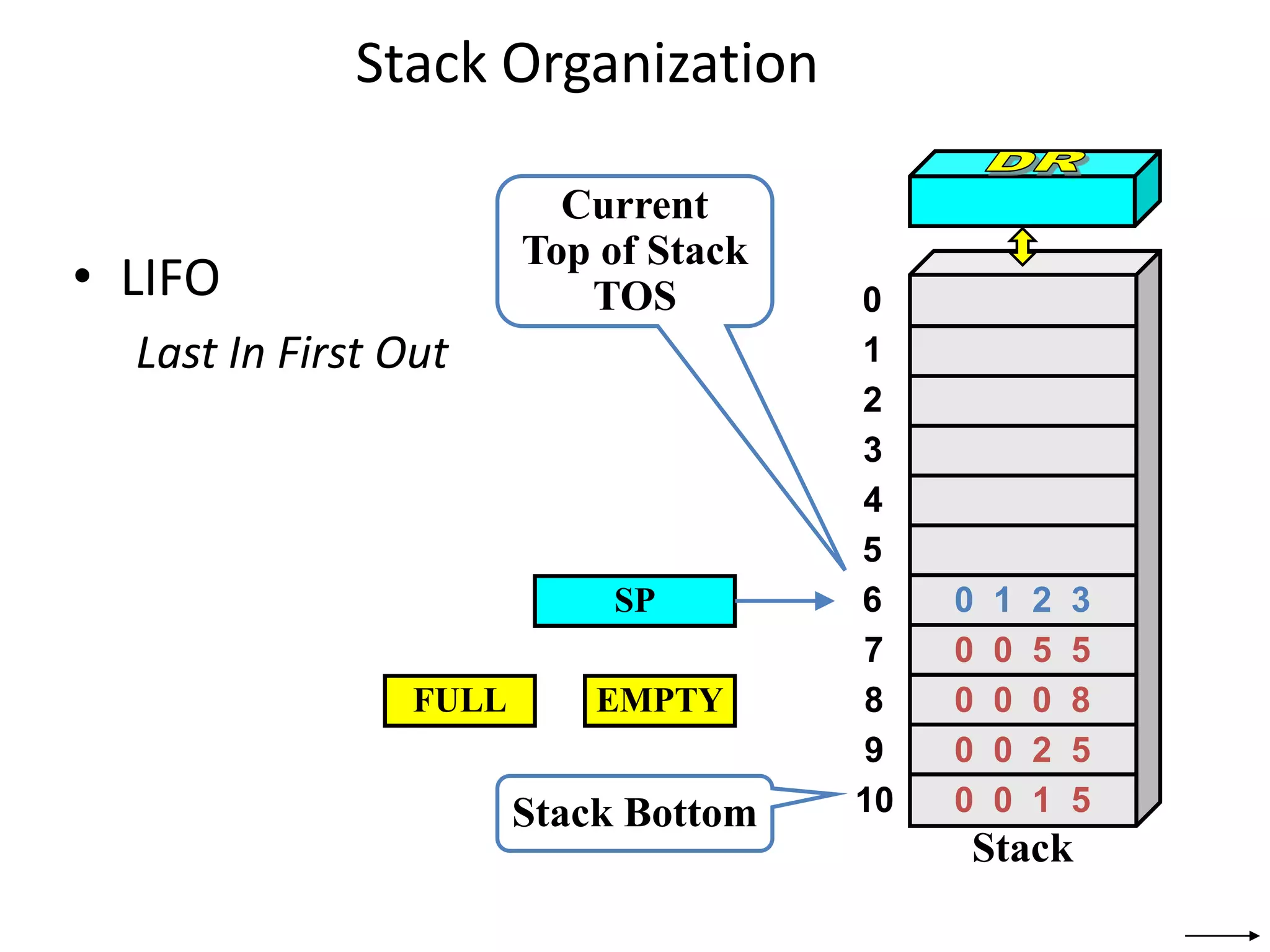
Stack Organization
• LIFO
Last In First Out
SP
Stack Bottom
Current
Top of Stack
TOS 0
1
2
3
4
7
8
9
10
5
6
Stack
0 0 5 5
0 0 0 8
0 0 2 5
0 0 1 5
0 1 2 3
FULL EMPTY
Stack Organization
• PUSH
SP ← SP – 1
M[SP] ← DR
If (SP = 0) then (FULL ← 1)
EMPTY ← 0
SP
Stack Bottom
Current
Top of Stack
TOS 0
1
2
3
4
7
8
9
10
5
6
Stack
0 0 5 5
0 0 0 8
0 0 2 5
0 0 1 5
0 1 2 3
FULL EMPTY
1 6 9 0
1 6 9 0
Current
Top of Stack
TOS
Stack Organization
• POP
DR ← M[SP]
SP ← SP + 1
If (SP = 11) then (EMPTY ← 1)
FULL ← 0
SP
Stack Bottom
Current
Top of Stack
TOS 0
1
2
3
4
7
8
9
10
5
6
Stack
0 0 5 5
0 0 0 8
0 0 2 5
0 0 1 5
0 1 2 3
FULL EMPTY
1 6 9 0
1 6 9 0
Current
Top of Stack
TOS
0
1
2
102
202
201
200
100
101
Stack Organization
• Memory Stack
– PUSH
SP ← SP – 1
M[SP] ← DR
– POP
DR ← M[SP]
SP ← SP + 1
PC
AR
SP
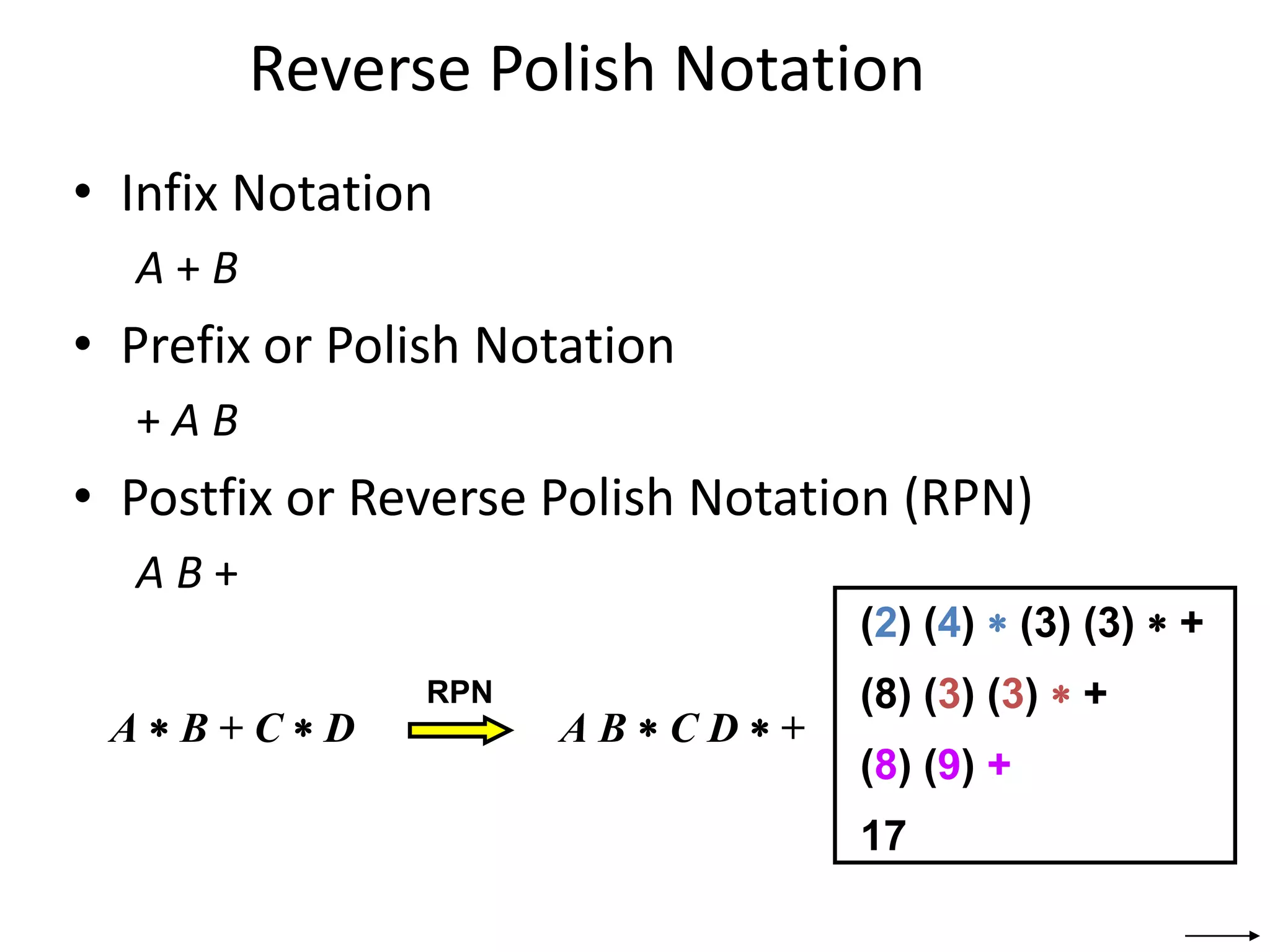
Reverse Polish Notation
• Infix Notation
A + B
• Prefix or Polish Notation
+ A B
• Postfix or Reverse Polish Notation (RPN)
A B +
A ∗ B + C ∗ D A B ∗ C D ∗ +
RPN
(2) (4) ∗ (3) (3) ∗ +
(8) (3) (3) ∗ +
(8) (9) +
17
Reverse Polish Notation
• Example
(A + B) ∗ [C ∗ (D + E) + F]
(A B +) (D E +) C ∗ ∗
F +
Reverse Polish Notation
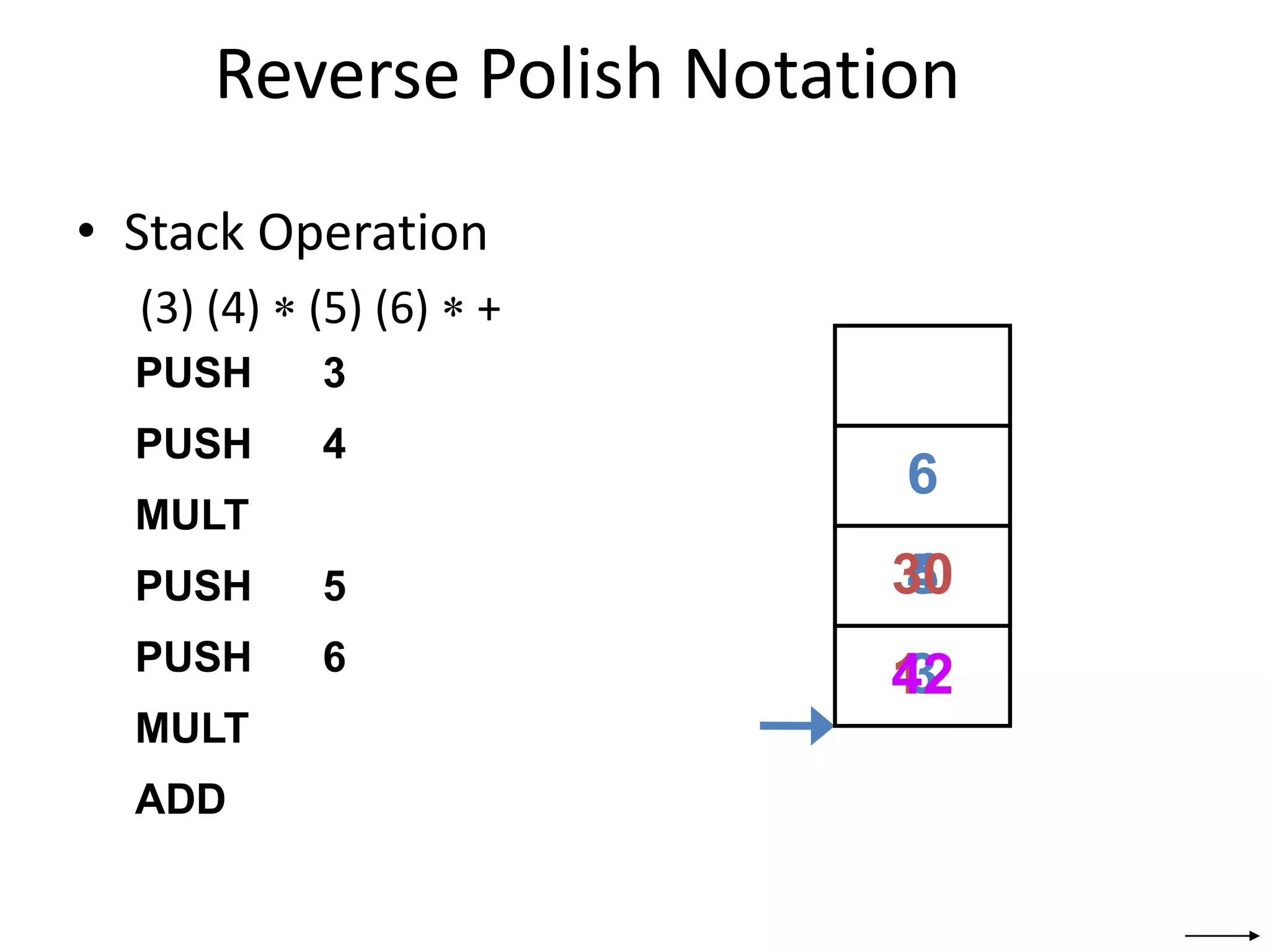
• Stack Operation
(3) (4) ∗ (5) (6) ∗ +
PUSH 3
PUSH 4
MULT
PUSH 5
PUSH 6
MULT
ADD
3
4
12
5
6
30
42
Additional Instructions
Logical Shifts
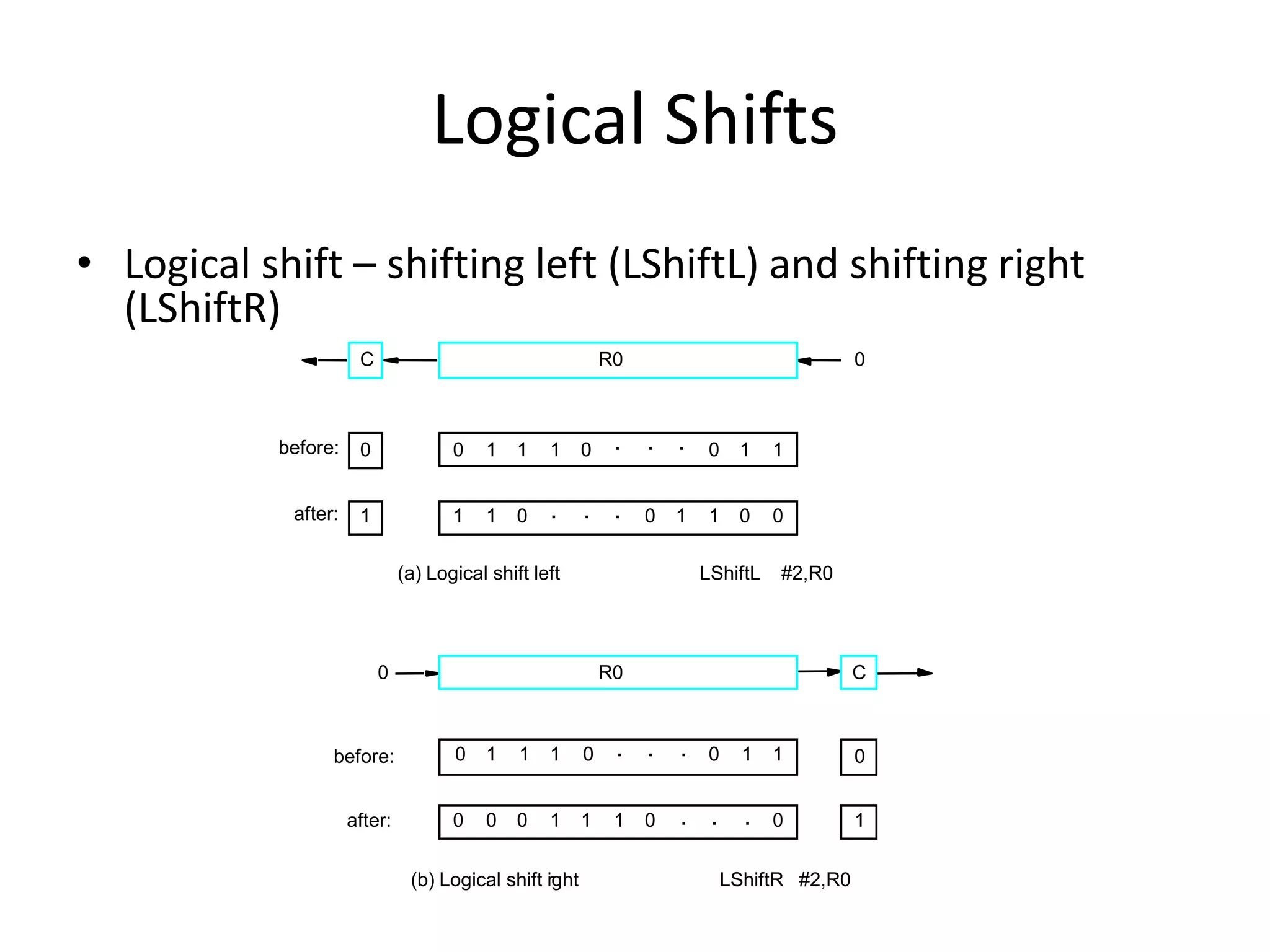
• Logical shift – shifting left (LShiftL) and shifting right
(LShiftR)
C
R0
0
before:
after:
0
1
0 0 0
1 1 1 . . . 1
1
0 0 1 1 1 0
0
0
(b) Logical shift r
ight LShiftR #2,R0
(a) Logical shift left LShiftL #2,R0
C R0 0
before:
after:
0
1
0 0 0
1 1 1 . . . 1
1
1 1
0 . . . 0
0
1
0
1
. . .
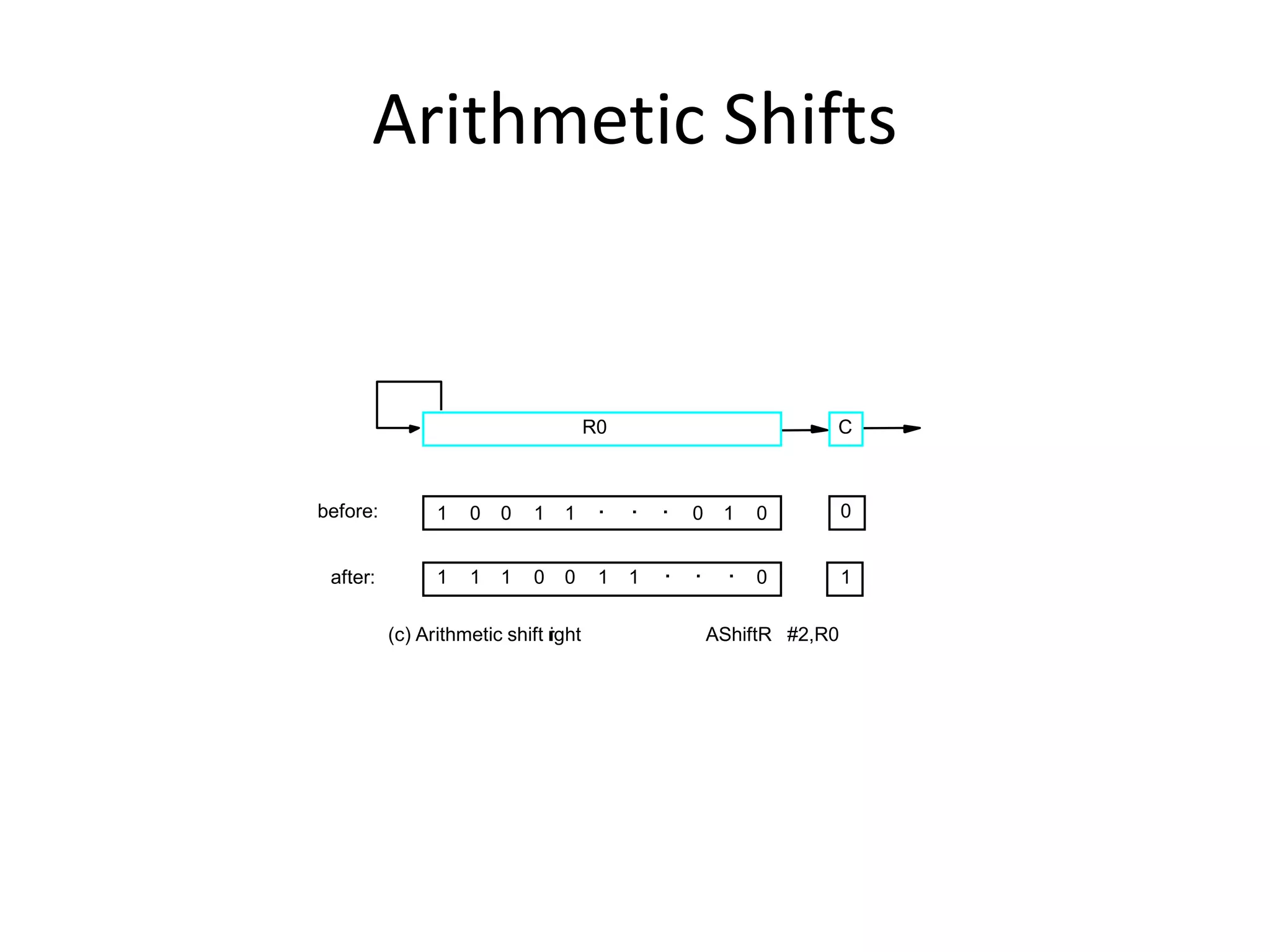
Arithmetic Shifts
C
before:
after:
0
1
1 1 0
0 0 1 . . . 0
1
1 1 0 0 1 0
1
1
(c) Arithmetic shift r
ight AShiftR #2,R0
R0
. . .
Rotate
Figure 2.32. Rotate instructions.
C
R0
before:
after:
0
1
0 0 0
1 1 1 . . . 1
1
1 0 1 1 1 0
0
1
(c) Rotate r
ight without carr
y RotateR #2,R0
(a) Rotate left without carr
y RotateL #2,R0
C R0
before:
after:
0
1
0 0 0
1 1 1 . . . 1
1
1 1
0 . . . 1
0
1
0
1
C
before:
after:
0
1
0 0 0
1 1 1 . . . 1
1
1 0 1 1 1 0
0
0
(d) Rotate r
ight with carr
y RotateRC #2,R0
R0
. . .
. . .
(b) Rotate left with carr
y RotateLC #2,R0
C R0
before:
after:
0
1
0 0 0
1 1 1 . . . 1
1
1 1
0 . . . 0
0
1
0
1
Multiplication and Division
• Not very popular (especially division)
• Multiply Ri, Rj
Rj ← [Ri] х [Rj]
• 2n-bit product case: high-order half in R(j+1)
• Divide Ri, Rj
Rj ← [Ri] / [Rj]
Quotient is in Rj, remainder may be placed in R(j+1)
Encoding of Machine Instructions
• Assembly language program needs to be converted into machine
instructions. (ADD = 0100 in ARM instruction set)
• In the previous section, an assumption was made that all instructions are
one word in length.
• OP code: the type of operation to be performed and the type of operands
used may be specified using an encoded binary pattern
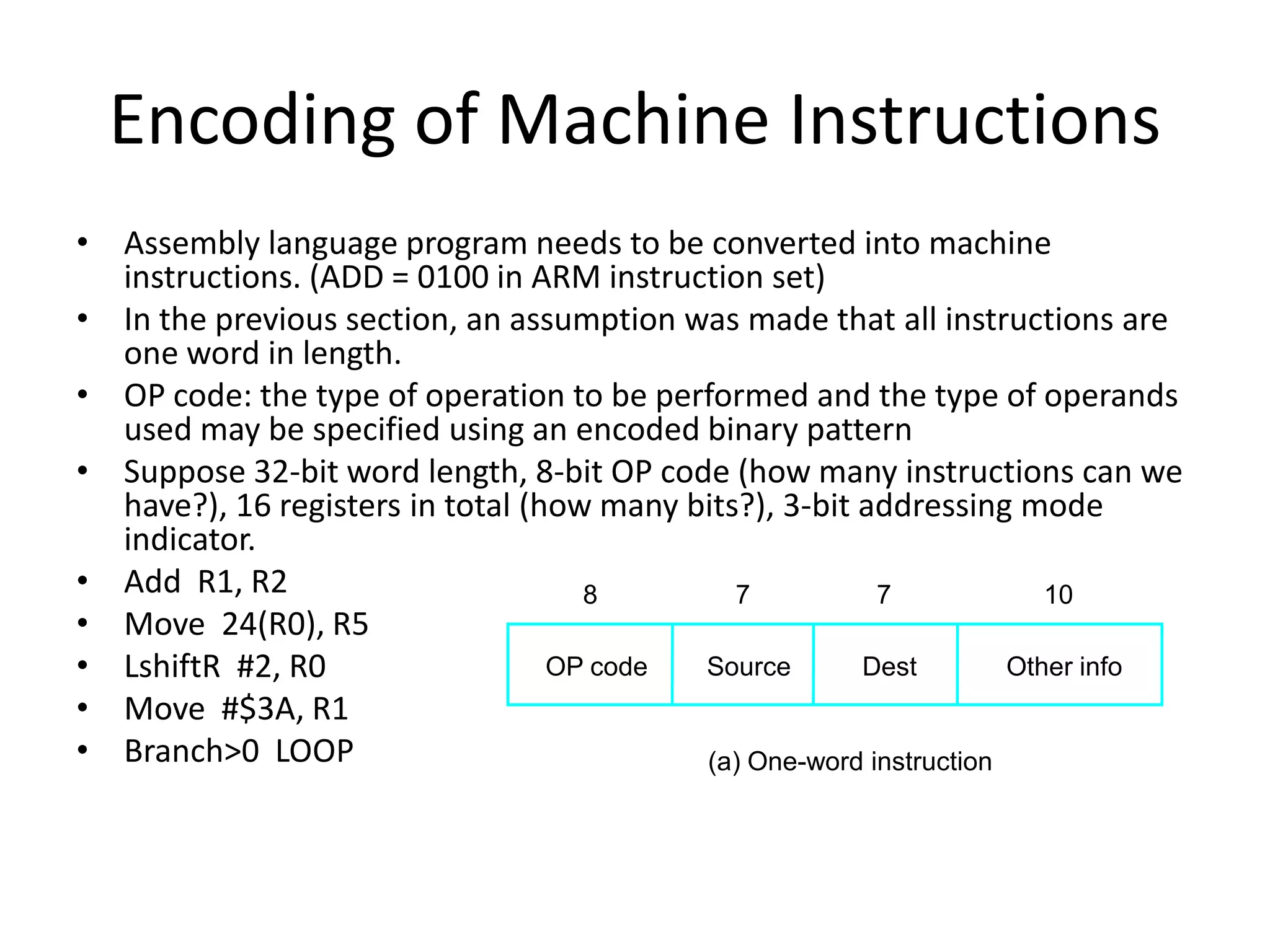
• Suppose 32-bit word length, 8-bit OP code (how many instructions can we
have?), 16 registers in total (how many bits?), 3-bit addressing mode
indicator.
• Add R1, R2
• Move 24(R0), R5
• LshiftR #2, R0
• Move #$3A, R1
• Branch>0 LOOP
OP code Source Dest Other info
8 7 7 10
(a) One-word instruction
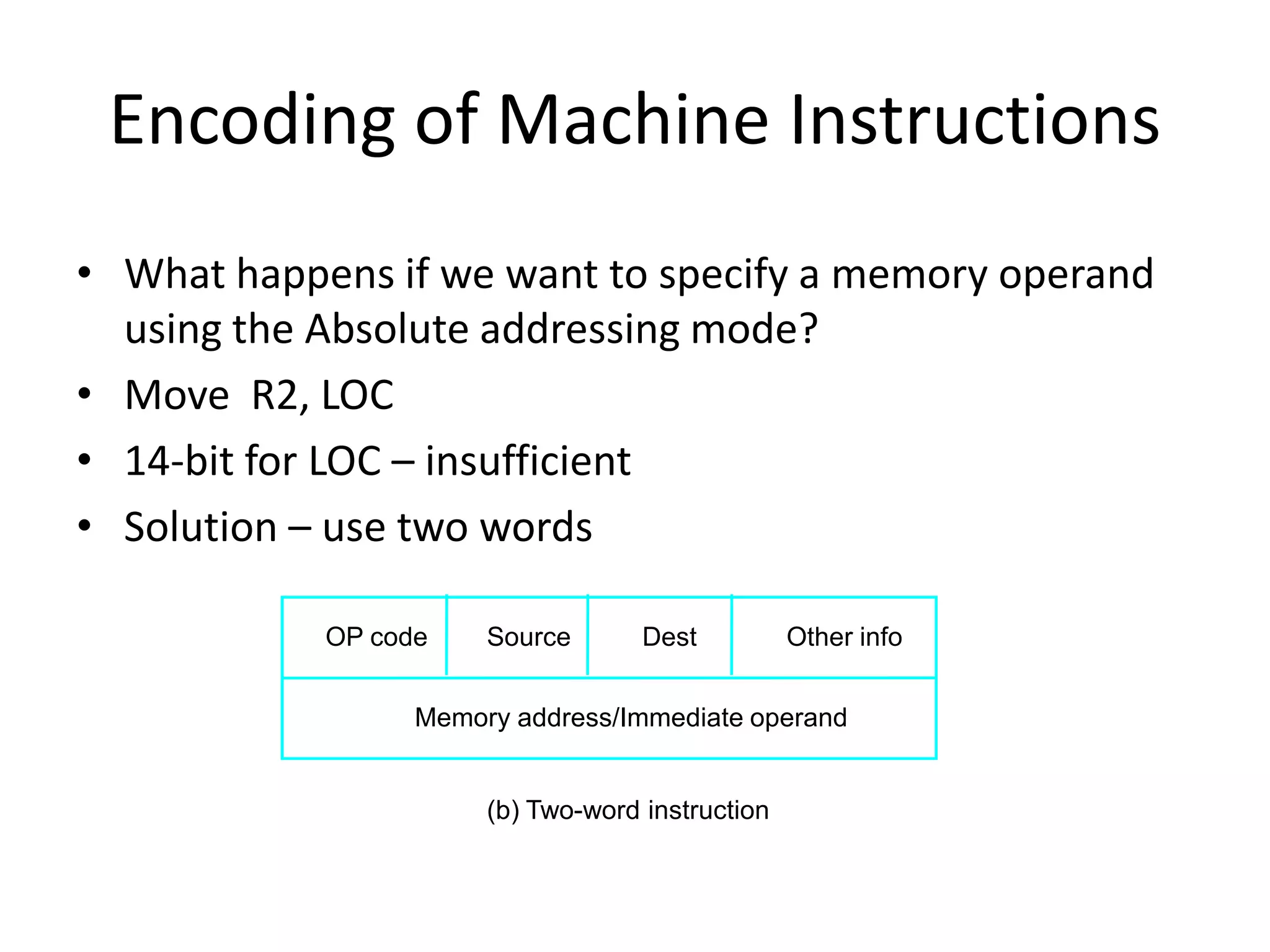
Encoding of Machine Instructions
• What happens if we want to specify a memory operand
using the Absolute addressing mode?
• Move R2, LOC
• 14-bit for LOC – insufficient
• Solution – use two words
(b) Two-word instruction
Memory address/Immediate operand
OP code Source Dest Other info
Encoding of Machine Instructions
• Then what if an instruction in which two operands can be
specified using the Absolute addressing mode?
• Move LOC1, LOC2
• Solution – use two additional words
• This approach results in instructions of variable length.
Complex instructions can be implemented, closely
resembling operations in high-level programming
languages – Complex Instruction Set Computer (CISC)
Encoding of Machine Instructions
• If we insist that all instructions must fit into a single 32-
bit word, it is not possible to provide a 32-bit address or
a 32-bit immediate operand within the instruction.
• It is still possible to define a highly functional instruction
set, which makes extensive use of the processor registers.
• Add R1, R2 ----- yes
• Add LOC, R2 ----- no
• Add (R3), R2 ----- yes

Instruction types

  • 1.
  • 2.
    Types of Instructions •Data Transfer Instructions Name Mnemonic Load LD Store ST Move MOV Exchange XCH Input IN Output OUT Push PUSH Pop POP Data value is not modified
  • 3.
    Data Transfer Instructions ModeAssembly Register Transfer Direct address LD ADR AC ← M[ADR] Indirect address LD @ADR AC ← M[M[ADR]] Relative address LD $ADR AC ← M[PC+ADR] Immediate operand LD #NBR AC ← NBR Index addressing LD ADR(X) AC ← M[ADR+XR] Register LD R1 AC ← R1 Register indirect LD (R1) AC ← M[R1] Autoincrement LD (R1)+ AC ← M[R1], R1 ← R1+1
  • 4.
    Data Manipulation Instructions •Arithmetic • Logical & Bit Manipulation • Shift Name Mnemonic Increment INC Decrement DEC Add ADD Subtract SUB Multiply MUL Divide DIV Add with carry ADDC Subtract with borrow SUBB Negate NEG Name Mnemonic Clear CLR Complement COM AND AND OR OR Exclusive-OR XOR Clear carry CLRC Set carry SETC Complement carry COMC Enable interrupt EI Disable interrupt DI Name Mnemonic Logical shift right SHR Logical shift left SHL Arithmetic shift right SHRA Arithmetic shift left SHLA Rotate right ROR Rotate left ROL Rotate right through carry RORC Rotate left through carry ROLC
  • 5.
    Program Control Instructions NameMnemonic Branch BR Jump JMP Skip SKP Call CALL Return RET Compare (Subtract) CMP Test (AND) TST Subtract A – B but don’t store the result 1 0 1 1 0 0 0 1 0 0 0 0 1 0 0 0 0 0 0 0 0 0 0 0 Mask
  • 6.
    Conditional Branch Instructions MnemonicBranch Condition Tested Condition BZ Branch if zero Z = 1 BNZ Branch if not zero Z = 0 BC Branch if carry C = 1 BNC Branch if no carry C = 0 BP Branch if plus N = 0 BM Branch if minus N = 1 BV Branch if overflow V = 1 BNV Branch if no overflow V = 0
  • 7.
  • 8.
    I/O • The dataon which the instructions operate are not necessarily already stored in memory. • Data need to be transferred between processor and outside world (disk, keyboard, etc.) • I/O operations are essential, the way they are performed can have a significant effect on the performance of the computer.
  • 9.
    Program-Controlled I/O Example •Read in character input from a keyboard and produce character output on a display screen.  Rate of data transfer (keyboard, display, processor)  Difference in speed between processor and I/O device creates the need for mechanisms to synchronize the transfer of data.  A solution: on output, the processor sends the first character and then waits for a signal from the display that the character has been received. It then sends the second character. Input is sent from the keyboard in a similar way.
  • 10.
    Program-Controlled I/O Example -Registers - Flags - Device interface
  • 11.
    Program-Controlled I/O Example •Machine instructions that can check the state of the status flags and transfer data: READWAIT Branch to READWAIT if SIN = 0 Input from DATAIN to R1 WRITEWAIT Branch to WRITEWAIT if SOUT = 0 Output from R1 to DATAOUT
  • 12.
    Program-Controlled I/O Example •Memory-Mapped I/O – some memory address values are used to refer to peripheral device buffer registers. No special instructions are needed. Also use device status registers. READWAIT Testbit #3, INSTATUS Branch=0 READWAIT MoveByte DATAIN, R1
  • 13.
    Program-Controlled I/O Example •Assumption – the initial state of SIN is 0 and the initial state of SOUT is 1. • Any drawback of this mechanism in terms of efficiency? – Two wait loopsprocessor execution time is wasted • Alternate solution? – Interrupt
  • 14.
  • 15.
    Stack Organization • LIFO LastIn First Out SP Stack Bottom Current Top of Stack TOS 0 1 2 3 4 7 8 9 10 5 6 Stack 0 0 5 5 0 0 0 8 0 0 2 5 0 0 1 5 0 1 2 3 FULL EMPTY
  • 16.
    Stack Organization • PUSH SP← SP – 1 M[SP] ← DR If (SP = 0) then (FULL ← 1) EMPTY ← 0 SP Stack Bottom Current Top of Stack TOS 0 1 2 3 4 7 8 9 10 5 6 Stack 0 0 5 5 0 0 0 8 0 0 2 5 0 0 1 5 0 1 2 3 FULL EMPTY 1 6 9 0 1 6 9 0 Current Top of Stack TOS
  • 17.
    Stack Organization • POP DR← M[SP] SP ← SP + 1 If (SP = 11) then (EMPTY ← 1) FULL ← 0 SP Stack Bottom Current Top of Stack TOS 0 1 2 3 4 7 8 9 10 5 6 Stack 0 0 5 5 0 0 0 8 0 0 2 5 0 0 1 5 0 1 2 3 FULL EMPTY 1 6 9 0 1 6 9 0 Current Top of Stack TOS
  • 18.
    0 1 2 102 202 201 200 100 101 Stack Organization • MemoryStack – PUSH SP ← SP – 1 M[SP] ← DR – POP DR ← M[SP] SP ← SP + 1 PC AR SP
  • 19.
    Reverse Polish Notation •Infix Notation A + B • Prefix or Polish Notation + A B • Postfix or Reverse Polish Notation (RPN) A B + A ∗ B + C ∗ D A B ∗ C D ∗ + RPN (2) (4) ∗ (3) (3) ∗ + (8) (3) (3) ∗ + (8) (9) + 17
  • 20.
    Reverse Polish Notation •Example (A + B) ∗ [C ∗ (D + E) + F] (A B +) (D E +) C ∗ ∗ F +
  • 21.
    Reverse Polish Notation •Stack Operation (3) (4) ∗ (5) (6) ∗ + PUSH 3 PUSH 4 MULT PUSH 5 PUSH 6 MULT ADD 3 4 12 5 6 30 42
  • 22.
  • 23.
    Logical Shifts • Logicalshift – shifting left (LShiftL) and shifting right (LShiftR) C R0 0 before: after: 0 1 0 0 0 1 1 1 . . . 1 1 0 0 1 1 1 0 0 0 (b) Logical shift r ight LShiftR #2,R0 (a) Logical shift left LShiftL #2,R0 C R0 0 before: after: 0 1 0 0 0 1 1 1 . . . 1 1 1 1 0 . . . 0 0 1 0 1 . . .
  • 24.
    Arithmetic Shifts C before: after: 0 1 1 10 0 0 1 . . . 0 1 1 1 0 0 1 0 1 1 (c) Arithmetic shift r ight AShiftR #2,R0 R0 . . .
  • 25.
    Rotate Figure 2.32. Rotateinstructions. C R0 before: after: 0 1 0 0 0 1 1 1 . . . 1 1 1 0 1 1 1 0 0 1 (c) Rotate r ight without carr y RotateR #2,R0 (a) Rotate left without carr y RotateL #2,R0 C R0 before: after: 0 1 0 0 0 1 1 1 . . . 1 1 1 1 0 . . . 1 0 1 0 1 C before: after: 0 1 0 0 0 1 1 1 . . . 1 1 1 0 1 1 1 0 0 0 (d) Rotate r ight with carr y RotateRC #2,R0 R0 . . . . . . (b) Rotate left with carr y RotateLC #2,R0 C R0 before: after: 0 1 0 0 0 1 1 1 . . . 1 1 1 1 0 . . . 0 0 1 0 1
  • 26.
    Multiplication and Division •Not very popular (especially division) • Multiply Ri, Rj Rj ← [Ri] х [Rj] • 2n-bit product case: high-order half in R(j+1) • Divide Ri, Rj Rj ← [Ri] / [Rj] Quotient is in Rj, remainder may be placed in R(j+1)
  • 27.
    Encoding of MachineInstructions
  • 28.
    Encoding of MachineInstructions • Assembly language program needs to be converted into machine instructions. (ADD = 0100 in ARM instruction set) • In the previous section, an assumption was made that all instructions are one word in length. • OP code: the type of operation to be performed and the type of operands used may be specified using an encoded binary pattern • Suppose 32-bit word length, 8-bit OP code (how many instructions can we have?), 16 registers in total (how many bits?), 3-bit addressing mode indicator. • Add R1, R2 • Move 24(R0), R5 • LshiftR #2, R0 • Move #$3A, R1 • Branch>0 LOOP OP code Source Dest Other info 8 7 7 10 (a) One-word instruction
  • 29.
    Encoding of MachineInstructions • What happens if we want to specify a memory operand using the Absolute addressing mode? • Move R2, LOC • 14-bit for LOC – insufficient • Solution – use two words (b) Two-word instruction Memory address/Immediate operand OP code Source Dest Other info
  • 30.
    Encoding of MachineInstructions • Then what if an instruction in which two operands can be specified using the Absolute addressing mode? • Move LOC1, LOC2 • Solution – use two additional words • This approach results in instructions of variable length. Complex instructions can be implemented, closely resembling operations in high-level programming languages – Complex Instruction Set Computer (CISC)
  • 31.
    Encoding of MachineInstructions • If we insist that all instructions must fit into a single 32- bit word, it is not possible to provide a 32-bit address or a 32-bit immediate operand within the instruction. • It is still possible to define a highly functional instruction set, which makes extensive use of the processor registers. • Add R1, R2 ----- yes • Add LOC, R2 ----- no • Add (R3), R2 ----- yes