Faculty of Engineering
Computer Engineering Department
Islamic University of Gaza
Eng. Alaa.I.Haniya
Assembly Language Lab # 9
Shift,Rotate,Multiplication and Division
Instruction
1
AssemblyLanguageLab#9Shift,Rotate,MultiplicationandDivisionInstruction
Assembly Language Fundamentals
Objective:
To know more about Assembly language, such Shift, Rotate, Multiplication and Division
Instructions.
Shift and Rotate Instructions
 Shifting means to move bits right and left inside an operand.
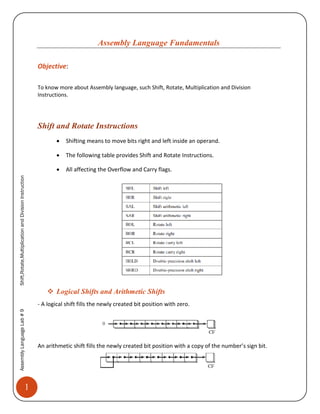
 The following table provides Shift and Rotate Instructions.
 All affecting the Overflow and Carry flags.
 Logical Shifts and Arithmetic Shifts
- A logical shift fills the newly created bit position with zero.
An arithmetic shift fills the newly created bit position with a copy of the number’s sign bit.
2
AssemblyLanguageLab#9Shift,Rotate,MultiplicationandDivisionInstruction|2/20/2013
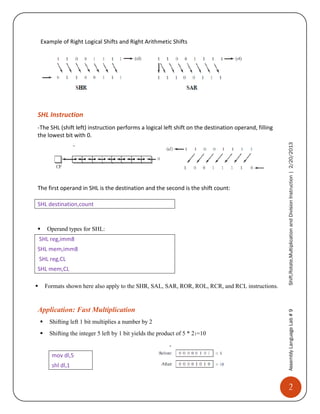
Example of Right Logical Shifts and Right Arithmetic Shifts
SHL Instruction
-The SHL (shift left) instruction performs a logical left shift on the destination operand, filling
the lowest bit with 0.
The first operand in SHL is the destination and the second is the shift count:
SHL destination,count
 Operand types for SHL:
SHL reg,imm8
SHL mem,imm8
SHL reg,CL
SHL mem,CL
 Formats shown here also apply to the SHR, SAL, SAR, ROR, ROL, RCR, and RCL instructions.
Application: Fast Multiplication
 Shifting left 1 bit multiplies a number by 2
 Shifting the integer 5 left by 1 bit yields the product of 5 * 21=10
mov dl,5
shl dl,1
3
AssemblyLanguageLab#9Shift,Rotate,MultiplicationandDivisionInstruction
Shifting left n bits multiplies the operand by2 𝑛
For example, 5 * 22 = 20
mov dl,5
shl dl,2 ;DL = 20, CF = 0
SHR Instruction
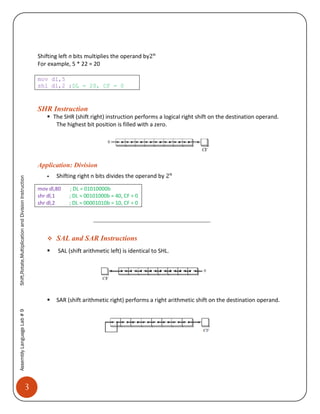
 The SHR (shift right) instruction performs a logical right shift on the destination operand.
The highest bit position is filled with a zero.
Application: Division
 Shifting right n bits divides the operand by 2 𝑛
mov dl,80 ; DL = 01010000b
shr dl,1 ; DL = 00101000b = 40, CF = 0
shr dl,2 ; DL = 00001010b = 10, CF = 0
 SAL and SAR Instructions
 SAL (shift arithmetic left) is identical to SHL.
 SAR (shift arithmetic right) performs a right arithmetic shift on the destination operand.
4
AssemblyLanguageLab#9Shift,Rotate,MultiplicationandDivisionInstruction|2/20/2013
 Applications:
1. Signed Division
An arithmetic shift preserves the number's sign.
mov dl,-80 ; DL = 10110000b
sar dl,1 ; DL = 11011000b = -40, CF = 0
sar dl,2 ; DL = 11110110b = -10, CF = 0
2. Sign-Extend
Suppose AX contains a signed integer and you want to extend its sign into EAX. First shift EAX
16 bits to the left, then shift it arithmetically 16 bits to the right:
mov ax,-128 ; EAX = ????FF80h
shl eax,16 ; EAX = FF800000h
sar eax,16 ; EAX = FFFFFF80h
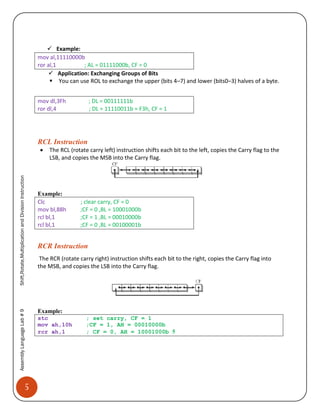
 ROL Instruction
 The ROL (rotate left) instruction shifts each bit to the left. The highest bit is copied into
the Carry flag and the lowest bit position.
 No bits are lost.
Example:
mov al,11110000b
rol al,1 ;AL = 11100001b, CF = 1
Application: Exchanging Groups of Bits
You can use ROL to exchange the upper (bits 4–7) and lower (bits0–3) halves of a byte.
mov dl,3Fh ; DL = 00111111b
rol dl,4 ; DL = 11110011b = F3h, CF = 1
 ROR Instruction
 The ROR (rotate right) instruction shifts each bit to the right and copies the lowest bit
into the Carry flag and the highest bit position.
 No bits are lost.
5
AssemblyLanguageLab#9Shift,Rotate,MultiplicationandDivisionInstruction
 Example:
mov al,11110000b
ror al,1 ; AL = 01111000b, CF = 0
 Application: Exchanging Groups of Bits
 You can use ROL to exchange the upper (bits 4–7) and lower (bits0–3) halves of a byte.
mov dl,3Fh ; DL = 00111111b
ror dl,4 ; DL = 11110011b = F3h, CF = 1
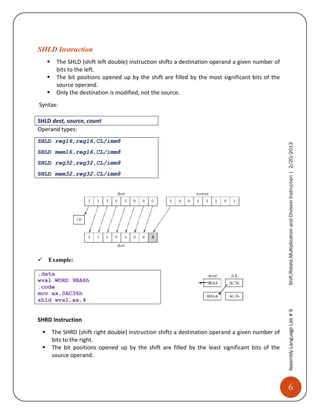
RCL Instruction
 The RCL (rotate carry left) instruction shifts each bit to the left, copies the Carry flag to the
LSB, and copies the MSB into the Carry flag.
Example:
Clc ; clear carry, CF = 0
mov bl,88h ;CF = 0 ,BL = 10001000b
rcl bl,1 ;CF = 1 ,BL = 00010000b
rcl bl,1 ;CF = 0 ,BL = 00100001b
RCR Instruction
The RCR (rotate carry right) instruction shifts each bit to the right, copies the Carry flag into
the MSB, and copies the LSB into the Carry flag.
Example:
stc ; set carry, CF = 1
mov ah,10h ;CF = 1, AH = 00010000b
rcr ah,1 ; CF = 0, AH = 10001000b 5
6
AssemblyLanguageLab#9Shift,Rotate,MultiplicationandDivisionInstruction|2/20/2013
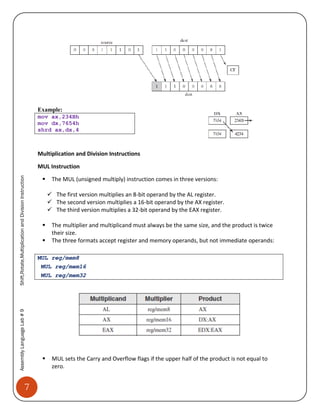
SHLD Instruction
 The SHLD (shift left double) instruction shifts a destination operand a given number of
bits to the left.
 The bit positions opened up by the shift are filled by the most significant bits of the
source operand.
 Only the destination is modified, not the source.
Syntax:
SHLD dest, source, count
Operand types:
SHLD reg16,reg16,CL/imm8
SHLD mem16,reg16,CL/imm8
SHLD reg32,reg32,CL/imm8
SHLD mem32,reg32,CL/imm8

Example:
.data
wval WORD 9BA6h 
.code
mov ax,0AC36h 
shld wval,ax,4 
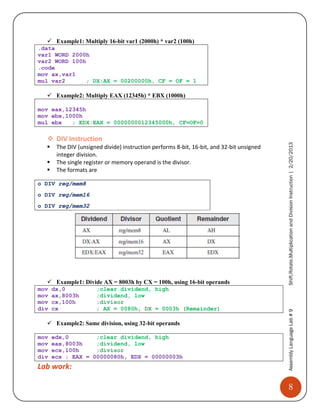
SHRD Instruction
 The SHRD (shift right double) instruction shifts a destination operand a given number of
bits to the right.
 The bit positions opened up by the shift are filled by the least significant bits of the
source operand.
7
AssemblyLanguageLab#9Shift,Rotate,MultiplicationandDivisionInstruction
Example:
mov ax,234Bh
mov dx,7654h
shrd ax,dx,4
Multiplication and Division Instructions
MUL Instruction
 The MUL (unsigned multiply) instruction comes in three versions:
 The first version multiplies an 8-bit operand by the AL register.
 The second version multiplies a 16-bit operand by the AX register.
 The third version multiplies a 32-bit operand by the EAX register.
 The multiplier and multiplicand must always be the same size, and the product is twice
their size.
 The three formats accept register and memory operands, but not immediate operands:
MUL reg/mem8
MUL reg/mem16
MUL reg/mem32
 MUL sets the Carry and Overflow flags if the upper half of the product is not equal to
zero.
8
AssemblyLanguageLab#9Shift,Rotate,MultiplicationandDivisionInstruction|2/20/2013
 Example1: Multiply 16-bit var1 (2000h) * var2 (100h)
.data
var1 WORD 2000h
var2 WORD 100h
.code
mov ax,var1
mul var2 ; DX:AX = 00200000h, CF = OF = 1

 Example2: Multiply EAX (12345h) * EBX (1000h)
mov eax,12345h
mov ebx,1000h
mul ebx ; EDX:EAX = 0000000012345000h, CF=OF=0
 DIV Instruction
 The DIV (unsigned divide) instruction performs 8-bit, 16-bit, and 32-bit unsigned
integer division.
 The single register or memory operand is the divisor.
 The formats are
o DIV reg/mem8
o DIV reg/mem16
o DIV reg/mem32
 Example1: Divide AX = 8003h by CX = 100h, using 16-bit operands
mov dx,0 ;clear dividend, high
mov ax,8003h ;dividend, low
mov cx,100h ;divisor
div cx ; AX = 0080h, DX = 0003h (Remainder)

 Example2: Same division, using 32-bit operands
mov edx,0 ;clear dividend, high
mov eax,8003h ;dividend, low
mov ecx,100h ;divisor
div ecx ; EAX = 00000080h, EDX = 00000003h
Lab work:
9
AssemblyLanguageLab#9Shift,Rotate,MultiplicationandDivisionInstruction
Excercise1:
The greatest common divisor of two integers is the largest integer that will evenly divide
(without a remainder) both integers . The GCD algorithm involves integer division in a loop,
described by the following c++ code:
int GCD(int x , int y)
{
x = abs (x);
y = abs (y);
do {
int n = x % y;
x = y;
y = n;
} while (y > 0) ;
return x ;
}
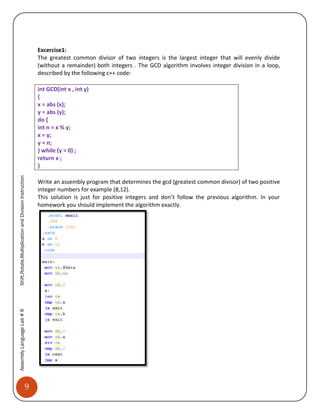
Write an assembly program that determines the gcd (greatest common divisor) of two positive
integer numbers for example (8,12).
This solution is just for positive integers and don’t follow the previous algorithm. In your
homework you should implement the algorithm exactly.
10
AssemblyLanguageLab#9Shift,Rotate,MultiplicationandDivisionInstruction|2/20/2013
11
AssemblyLanguageLab#9Shift,Rotate,MultiplicationandDivisionInstruction
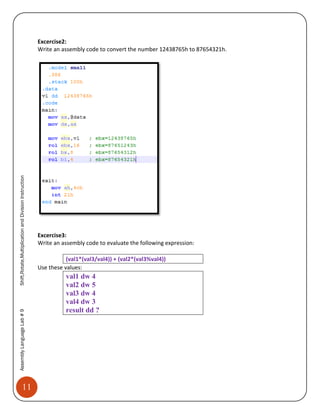
Excercise2:
Write an assembly code to convert the number 12438765h to 87654321h.
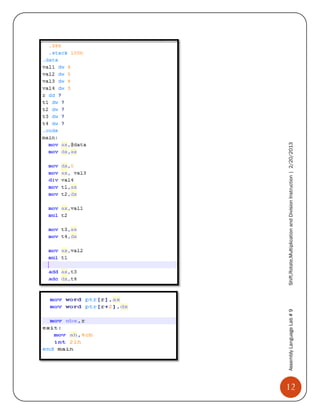
Excercise3:
Write an assembly code to evaluate the following expression:
(val1*(val3/val4)) + (val2*(val3%val4))
Use these values:
val1 dw 4
val2 dw 5
val3 dw 4
val4 dw 3
result dd ?
12
AssemblyLanguageLab#9Shift,Rotate,MultiplicationandDivisionInstruction|2/20/2013
13
AssemblyLanguageLab#9Shift,Rotate,MultiplicationandDivisionInstruction
Homework:
1. Write an assembly code to convert a binary string into hexadecimal value. If the binary
String is greater than 32 digits length a value zero must be returned. Use this value
declaration:
B_Val db '10001111' , '$'
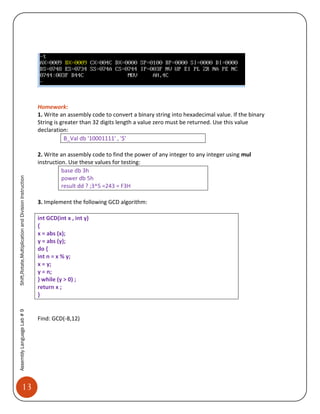
2. Write an assembly code to find the power of any integer to any integer using mul
instruction. Use these values for testing:
base db 3h
power db 5h
result dd ? ;3^5 =243 = F3H
3. Implement the following GCD algorithm:
int GCD(int x , int y)
{
x = abs (x);
y = abs (y);
do {
int n = x % y;
x = y;
y = n;
} while (y > 0) ;
return x ;
}
Find: GCD(-8,12)

Assembly language-lab9

  • 1.
    Faculty of Engineering ComputerEngineering Department Islamic University of Gaza Eng. Alaa.I.Haniya Assembly Language Lab # 9 Shift,Rotate,Multiplication and Division Instruction
  • 2.
    1 AssemblyLanguageLab#9Shift,Rotate,MultiplicationandDivisionInstruction Assembly Language Fundamentals Objective: Toknow more about Assembly language, such Shift, Rotate, Multiplication and Division Instructions. Shift and Rotate Instructions  Shifting means to move bits right and left inside an operand.  The following table provides Shift and Rotate Instructions.  All affecting the Overflow and Carry flags.  Logical Shifts and Arithmetic Shifts - A logical shift fills the newly created bit position with zero. An arithmetic shift fills the newly created bit position with a copy of the number’s sign bit.
  • 3.
    2 AssemblyLanguageLab#9Shift,Rotate,MultiplicationandDivisionInstruction|2/20/2013 Example of RightLogical Shifts and Right Arithmetic Shifts SHL Instruction -The SHL (shift left) instruction performs a logical left shift on the destination operand, filling the lowest bit with 0. The first operand in SHL is the destination and the second is the shift count: SHL destination,count  Operand types for SHL: SHL reg,imm8 SHL mem,imm8 SHL reg,CL SHL mem,CL  Formats shown here also apply to the SHR, SAL, SAR, ROR, ROL, RCR, and RCL instructions. Application: Fast Multiplication  Shifting left 1 bit multiplies a number by 2  Shifting the integer 5 left by 1 bit yields the product of 5 * 21=10 mov dl,5 shl dl,1
  • 4.
    3 AssemblyLanguageLab#9Shift,Rotate,MultiplicationandDivisionInstruction Shifting left nbits multiplies the operand by2 𝑛 For example, 5 * 22 = 20 mov dl,5 shl dl,2 ;DL = 20, CF = 0 SHR Instruction  The SHR (shift right) instruction performs a logical right shift on the destination operand. The highest bit position is filled with a zero. Application: Division  Shifting right n bits divides the operand by 2 𝑛 mov dl,80 ; DL = 01010000b shr dl,1 ; DL = 00101000b = 40, CF = 0 shr dl,2 ; DL = 00001010b = 10, CF = 0  SAL and SAR Instructions  SAL (shift arithmetic left) is identical to SHL.  SAR (shift arithmetic right) performs a right arithmetic shift on the destination operand.
  • 5.
    4 AssemblyLanguageLab#9Shift,Rotate,MultiplicationandDivisionInstruction|2/20/2013  Applications: 1. SignedDivision An arithmetic shift preserves the number's sign. mov dl,-80 ; DL = 10110000b sar dl,1 ; DL = 11011000b = -40, CF = 0 sar dl,2 ; DL = 11110110b = -10, CF = 0 2. Sign-Extend Suppose AX contains a signed integer and you want to extend its sign into EAX. First shift EAX 16 bits to the left, then shift it arithmetically 16 bits to the right: mov ax,-128 ; EAX = ????FF80h shl eax,16 ; EAX = FF800000h sar eax,16 ; EAX = FFFFFF80h  ROL Instruction  The ROL (rotate left) instruction shifts each bit to the left. The highest bit is copied into the Carry flag and the lowest bit position.  No bits are lost. Example: mov al,11110000b rol al,1 ;AL = 11100001b, CF = 1 Application: Exchanging Groups of Bits You can use ROL to exchange the upper (bits 4–7) and lower (bits0–3) halves of a byte. mov dl,3Fh ; DL = 00111111b rol dl,4 ; DL = 11110011b = F3h, CF = 1  ROR Instruction  The ROR (rotate right) instruction shifts each bit to the right and copies the lowest bit into the Carry flag and the highest bit position.  No bits are lost.
  • 6.
    5 AssemblyLanguageLab#9Shift,Rotate,MultiplicationandDivisionInstruction  Example: mov al,11110000b roral,1 ; AL = 01111000b, CF = 0  Application: Exchanging Groups of Bits  You can use ROL to exchange the upper (bits 4–7) and lower (bits0–3) halves of a byte. mov dl,3Fh ; DL = 00111111b ror dl,4 ; DL = 11110011b = F3h, CF = 1 RCL Instruction  The RCL (rotate carry left) instruction shifts each bit to the left, copies the Carry flag to the LSB, and copies the MSB into the Carry flag. Example: Clc ; clear carry, CF = 0 mov bl,88h ;CF = 0 ,BL = 10001000b rcl bl,1 ;CF = 1 ,BL = 00010000b rcl bl,1 ;CF = 0 ,BL = 00100001b RCR Instruction The RCR (rotate carry right) instruction shifts each bit to the right, copies the Carry flag into the MSB, and copies the LSB into the Carry flag. Example: stc ; set carry, CF = 1 mov ah,10h ;CF = 1, AH = 00010000b rcr ah,1 ; CF = 0, AH = 10001000b 5
  • 7.
    6 AssemblyLanguageLab#9Shift,Rotate,MultiplicationandDivisionInstruction|2/20/2013 SHLD Instruction  TheSHLD (shift left double) instruction shifts a destination operand a given number of bits to the left.  The bit positions opened up by the shift are filled by the most significant bits of the source operand.  Only the destination is modified, not the source. Syntax: SHLD dest, source, count Operand types: SHLD reg16,reg16,CL/imm8 SHLD mem16,reg16,CL/imm8 SHLD reg32,reg32,CL/imm8 SHLD mem32,reg32,CL/imm8  Example: .data wval WORD 9BA6h  .code mov ax,0AC36h  shld wval,ax,4  SHRD Instruction  The SHRD (shift right double) instruction shifts a destination operand a given number of bits to the right.  The bit positions opened up by the shift are filled by the least significant bits of the source operand.
  • 8.
    7 AssemblyLanguageLab#9Shift,Rotate,MultiplicationandDivisionInstruction Example: mov ax,234Bh mov dx,7654h shrdax,dx,4 Multiplication and Division Instructions MUL Instruction  The MUL (unsigned multiply) instruction comes in three versions:  The first version multiplies an 8-bit operand by the AL register.  The second version multiplies a 16-bit operand by the AX register.  The third version multiplies a 32-bit operand by the EAX register.  The multiplier and multiplicand must always be the same size, and the product is twice their size.  The three formats accept register and memory operands, but not immediate operands: MUL reg/mem8 MUL reg/mem16 MUL reg/mem32  MUL sets the Carry and Overflow flags if the upper half of the product is not equal to zero.
  • 9.
    8 AssemblyLanguageLab#9Shift,Rotate,MultiplicationandDivisionInstruction|2/20/2013  Example1: Multiply16-bit var1 (2000h) * var2 (100h) .data var1 WORD 2000h var2 WORD 100h .code mov ax,var1 mul var2 ; DX:AX = 00200000h, CF = OF = 1   Example2: Multiply EAX (12345h) * EBX (1000h) mov eax,12345h mov ebx,1000h mul ebx ; EDX:EAX = 0000000012345000h, CF=OF=0  DIV Instruction  The DIV (unsigned divide) instruction performs 8-bit, 16-bit, and 32-bit unsigned integer division.  The single register or memory operand is the divisor.  The formats are o DIV reg/mem8 o DIV reg/mem16 o DIV reg/mem32  Example1: Divide AX = 8003h by CX = 100h, using 16-bit operands mov dx,0 ;clear dividend, high mov ax,8003h ;dividend, low mov cx,100h ;divisor div cx ; AX = 0080h, DX = 0003h (Remainder)   Example2: Same division, using 32-bit operands mov edx,0 ;clear dividend, high mov eax,8003h ;dividend, low mov ecx,100h ;divisor div ecx ; EAX = 00000080h, EDX = 00000003h Lab work:
  • 10.
    9 AssemblyLanguageLab#9Shift,Rotate,MultiplicationandDivisionInstruction Excercise1: The greatest commondivisor of two integers is the largest integer that will evenly divide (without a remainder) both integers . The GCD algorithm involves integer division in a loop, described by the following c++ code: int GCD(int x , int y) { x = abs (x); y = abs (y); do { int n = x % y; x = y; y = n; } while (y > 0) ; return x ; } Write an assembly program that determines the gcd (greatest common divisor) of two positive integer numbers for example (8,12). This solution is just for positive integers and don’t follow the previous algorithm. In your homework you should implement the algorithm exactly.
  • 11.
  • 12.
    11 AssemblyLanguageLab#9Shift,Rotate,MultiplicationandDivisionInstruction Excercise2: Write an assemblycode to convert the number 12438765h to 87654321h. Excercise3: Write an assembly code to evaluate the following expression: (val1*(val3/val4)) + (val2*(val3%val4)) Use these values: val1 dw 4 val2 dw 5 val3 dw 4 val4 dw 3 result dd ?
  • 13.
  • 14.
    13 AssemblyLanguageLab#9Shift,Rotate,MultiplicationandDivisionInstruction Homework: 1. Write anassembly code to convert a binary string into hexadecimal value. If the binary String is greater than 32 digits length a value zero must be returned. Use this value declaration: B_Val db '10001111' , '$' 2. Write an assembly code to find the power of any integer to any integer using mul instruction. Use these values for testing: base db 3h power db 5h result dd ? ;3^5 =243 = F3H 3. Implement the following GCD algorithm: int GCD(int x , int y) { x = abs (x); y = abs (y); do { int n = x % y; x = y; y = n; } while (y > 0) ; return x ; } Find: GCD(-8,12)