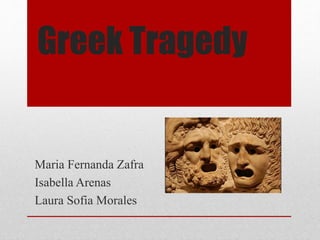
Greek Tragedy
Maria Fernanda Zafra
Isabella Arenas
Laura Sofia Morales
Hypotheses
Aristotelian Hypothesis:
Evolved from the satyr dithyramb, Greek hymn. (Dionysus)
The Poetics.
Attica performance
Tragedy , comes from the Greek word for “goat” and “song”
which makes reference to the satyrs chorus.
Alexandrian Hypothesis: Grammarians understood its roots
as “song for the sacrifice of the goat” or “song for the goat”
Product of the quoting of Horace’s Ars Poetica in which it is
said the word comes from the fact that a goat was the prize of
a poetic contest.
Horace’s Ars Poetica 220
• “The poet, who first tried his skill
in tragic verse for the paltry prize of
a goat, soon after exposed to view
wild satyrs naked, and attempted
raillery with severity, still
preserving the gravity of tragedy”
More Hypotheses
D'Amico: suggest a different meaning for the word tragoidìa ,
more than just the “goat song” it alludes to the characters of the
Dionysian Rites
J. Winkler:
It comes from the word tragizien which translates to “adolescent
voice- change”
The singer representing the social puberty.
Jane E. Harrison:
A tribute to Dionysus God of beer, (before being God of wine).
Beer was distilled from barley tragos.
This particular cereal was known as “the goat”
She suggests it translates to “the harvest song rather than the goat
song”
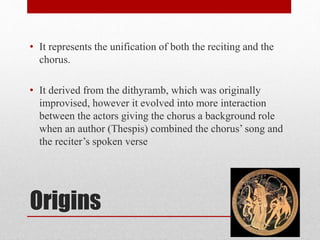
Origins
• It represents the unification of both the reciting and the
chorus.
• It derived from the dithyramb, which was originally
improvised, however it evolved into more interaction
between the actors giving the chorus a background role
when an author (Thespis) combined the chorus’ song and
the reciter’s spoken verse
• Although opinions amongst scholars vary it can be said
the fact that Hypokrites mean “answerer” has an impact
in the understanding of the tragedy’s origins.
It could be taken literally as the actor’s answer to the
chorus' sung question.
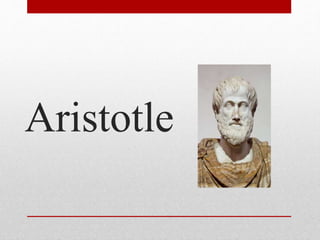
Aristotle
Aristotle on Tragedy
“Tragedy is a process of imitating an action
has serious implications, is complete, and
possesses magnitude; by means of language
sensuously attractive… in the parts”
Concepts
Imitation (mimesis): not exactly a copy but rather a
representation of reality itself and gives meaning to such
reality . He categorizes this within Poetry’s realm and as such
says it relates to the universal rather than the accidental and
allows people to relate to the performance
• “an action with serious implications”: raises and purifies
pity and fear.
• “complete and possesses, magnitude”: Not an disarray of
events but a sequenced chain of events with a beginning, a
middle and an end. This is were the actor performs his
imitation of reality and takes on the responsibility of
selecting only those elements that’ll help convey the
universal truths
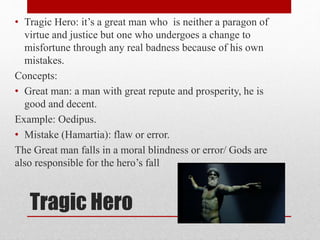
Tragic Hero
• Tragic Hero: it’s a great man who is neither a paragon of
virtue and justice but one who undergoes a change to
misfortune through any real badness because of his own
mistakes.
Concepts:
• Great man: a man with great repute and prosperity, he is
good and decent.
Example: Oedipus.
• Mistake (Hamartia): flaw or error.
The Great man falls in a moral blindness or error/ Gods are
also responsible for the hero’s fall
Plot
• Six Elements of Tragedy:
1. Plot :
Pathos: suffering, calamity.
Simple but complex
Complex:
Have reversal (the situation reverses to something unexpected)
Recognition (A change from ignorance to awareness of a bond of
love or hate)
2. Characters
3.Verbal Expression
4.Thought
5.Visial adornment
6.Song composition
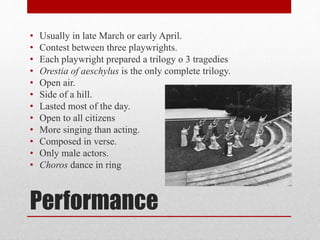
Performance
• Usually in late March or early April.
• Contest between three playwrights.
• Each playwright prepared a trilogy o 3 tragedies
• Orestia of aeschylus is the only complete trilogy.
• Open air.
• Side of a hill.
• Lasted most of the day.
• Open to all citizens
• More singing than acting.
• Composed in verse.
• Only male actors.
• Choros dance in ring
•Concepts
Catharsis
• Means purification of emotions.
• When a character in a tragedy realizes his/her flaws or
downfalls.
• Especially in pity and fear.
• A Catharsis is an emotional discharge through which one
can achieve a state of moral or spiritual renewal or
achieve a state of liberation from anxiety and stress.
Hamartia
• Means to miss the mark.
• First used by Aristotle.
• Protagonist`s flaw that contributes to a change in plot
actions, changing actors his/her good actions to bad.
• Ignorance, judgment, character or sin.
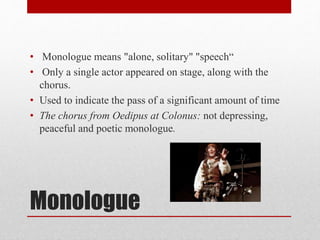
Monologue
• Monologue means "alone, solitary" "speech“
• Only a single actor appeared on stage, along with the
chorus.
• Used to indicate the pass of a significant amount of time
• The chorus from Oedipus at Colonus: not depressing,
peaceful and poetic monologue.
Soliloquy
• Many plays began with expository soliloquy.
• The dominated kind was audience address.
• Meant to be heard by the audience but not by other
characters
• The character thinking out loud.
• For example: Hamlet`s “To be or not to be”
Classical unities
Rules form drama developed by Aristotle
• 1. Unity of action: play should have one action that
follows; not interrupted.
• 2. Unity of time: a play should not last more than 24
hours.
• 3. Unity of place: single physical space in the play.
Aside
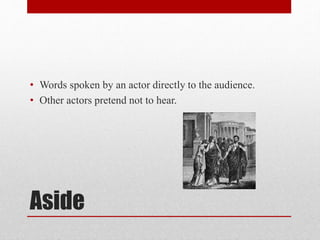
• Words spoken by an actor directly to the audience.
• Other actors pretend not to hear.
Tragic Flaw
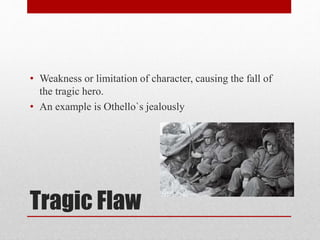
• Weakness or limitation of character, causing the fall of
the tragic hero.
• An example is Othello`s jealously
Spectacle
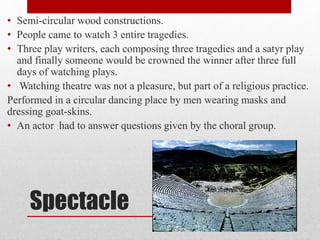
• Semi-circular wood constructions.
• People came to watch 3 entire tragedies.
• Three play writers, each composing three tragedies and a satyr play
and finally someone would be crowned the winner after three full
days of watching plays.
• Watching theatre was not a pleasure, but part of a religious practice.
Performed in a circular dancing place by men wearing masks and
dressing goat-skins.
• An actor had to answer questions given by the choral group.
Video
• https://www.youtube.com/watch?v=v
NAM3PzGcow

Greek tragedy

  • 1.
    Greek Tragedy Maria FernandaZafra Isabella Arenas Laura Sofia Morales
  • 2.
    Hypotheses Aristotelian Hypothesis: Evolved fromthe satyr dithyramb, Greek hymn. (Dionysus) The Poetics. Attica performance Tragedy , comes from the Greek word for “goat” and “song” which makes reference to the satyrs chorus. Alexandrian Hypothesis: Grammarians understood its roots as “song for the sacrifice of the goat” or “song for the goat” Product of the quoting of Horace’s Ars Poetica in which it is said the word comes from the fact that a goat was the prize of a poetic contest.
  • 3.
    Horace’s Ars Poetica220 • “The poet, who first tried his skill in tragic verse for the paltry prize of a goat, soon after exposed to view wild satyrs naked, and attempted raillery with severity, still preserving the gravity of tragedy”
  • 4.
    More Hypotheses D'Amico: suggesta different meaning for the word tragoidìa , more than just the “goat song” it alludes to the characters of the Dionysian Rites J. Winkler: It comes from the word tragizien which translates to “adolescent voice- change” The singer representing the social puberty. Jane E. Harrison: A tribute to Dionysus God of beer, (before being God of wine). Beer was distilled from barley tragos. This particular cereal was known as “the goat” She suggests it translates to “the harvest song rather than the goat song”
  • 5.
    Origins • It representsthe unification of both the reciting and the chorus. • It derived from the dithyramb, which was originally improvised, however it evolved into more interaction between the actors giving the chorus a background role when an author (Thespis) combined the chorus’ song and the reciter’s spoken verse
  • 6.
    • Although opinionsamongst scholars vary it can be said the fact that Hypokrites mean “answerer” has an impact in the understanding of the tragedy’s origins. It could be taken literally as the actor’s answer to the chorus' sung question.
  • 7.
  • 8.
    Aristotle on Tragedy “Tragedyis a process of imitating an action has serious implications, is complete, and possesses magnitude; by means of language sensuously attractive… in the parts”
  • 9.
    Concepts Imitation (mimesis): notexactly a copy but rather a representation of reality itself and gives meaning to such reality . He categorizes this within Poetry’s realm and as such says it relates to the universal rather than the accidental and allows people to relate to the performance • “an action with serious implications”: raises and purifies pity and fear. • “complete and possesses, magnitude”: Not an disarray of events but a sequenced chain of events with a beginning, a middle and an end. This is were the actor performs his imitation of reality and takes on the responsibility of selecting only those elements that’ll help convey the universal truths
  • 10.
    Tragic Hero • TragicHero: it’s a great man who is neither a paragon of virtue and justice but one who undergoes a change to misfortune through any real badness because of his own mistakes. Concepts: • Great man: a man with great repute and prosperity, he is good and decent. Example: Oedipus. • Mistake (Hamartia): flaw or error. The Great man falls in a moral blindness or error/ Gods are also responsible for the hero’s fall
  • 11.
    Plot • Six Elementsof Tragedy: 1. Plot : Pathos: suffering, calamity. Simple but complex Complex: Have reversal (the situation reverses to something unexpected) Recognition (A change from ignorance to awareness of a bond of love or hate) 2. Characters 3.Verbal Expression 4.Thought 5.Visial adornment 6.Song composition
  • 12.
    Performance • Usually inlate March or early April. • Contest between three playwrights. • Each playwright prepared a trilogy o 3 tragedies • Orestia of aeschylus is the only complete trilogy. • Open air. • Side of a hill. • Lasted most of the day. • Open to all citizens • More singing than acting. • Composed in verse. • Only male actors. • Choros dance in ring
  • 13.
  • 14.
    Catharsis • Means purificationof emotions. • When a character in a tragedy realizes his/her flaws or downfalls. • Especially in pity and fear. • A Catharsis is an emotional discharge through which one can achieve a state of moral or spiritual renewal or achieve a state of liberation from anxiety and stress.
  • 15.
    Hamartia • Means tomiss the mark. • First used by Aristotle. • Protagonist`s flaw that contributes to a change in plot actions, changing actors his/her good actions to bad. • Ignorance, judgment, character or sin.
  • 16.
    Monologue • Monologue means"alone, solitary" "speech“ • Only a single actor appeared on stage, along with the chorus. • Used to indicate the pass of a significant amount of time • The chorus from Oedipus at Colonus: not depressing, peaceful and poetic monologue.
  • 17.
    Soliloquy • Many playsbegan with expository soliloquy. • The dominated kind was audience address. • Meant to be heard by the audience but not by other characters • The character thinking out loud. • For example: Hamlet`s “To be or not to be”
  • 18.
    Classical unities Rules formdrama developed by Aristotle • 1. Unity of action: play should have one action that follows; not interrupted. • 2. Unity of time: a play should not last more than 24 hours. • 3. Unity of place: single physical space in the play.
  • 19.
    Aside • Words spokenby an actor directly to the audience. • Other actors pretend not to hear.
  • 20.
    Tragic Flaw • Weaknessor limitation of character, causing the fall of the tragic hero. • An example is Othello`s jealously
  • 21.
    Spectacle • Semi-circular woodconstructions. • People came to watch 3 entire tragedies. • Three play writers, each composing three tragedies and a satyr play and finally someone would be crowned the winner after three full days of watching plays. • Watching theatre was not a pleasure, but part of a religious practice. Performed in a circular dancing place by men wearing masks and dressing goat-skins. • An actor had to answer questions given by the choral group.
  • 22.